Report Overview
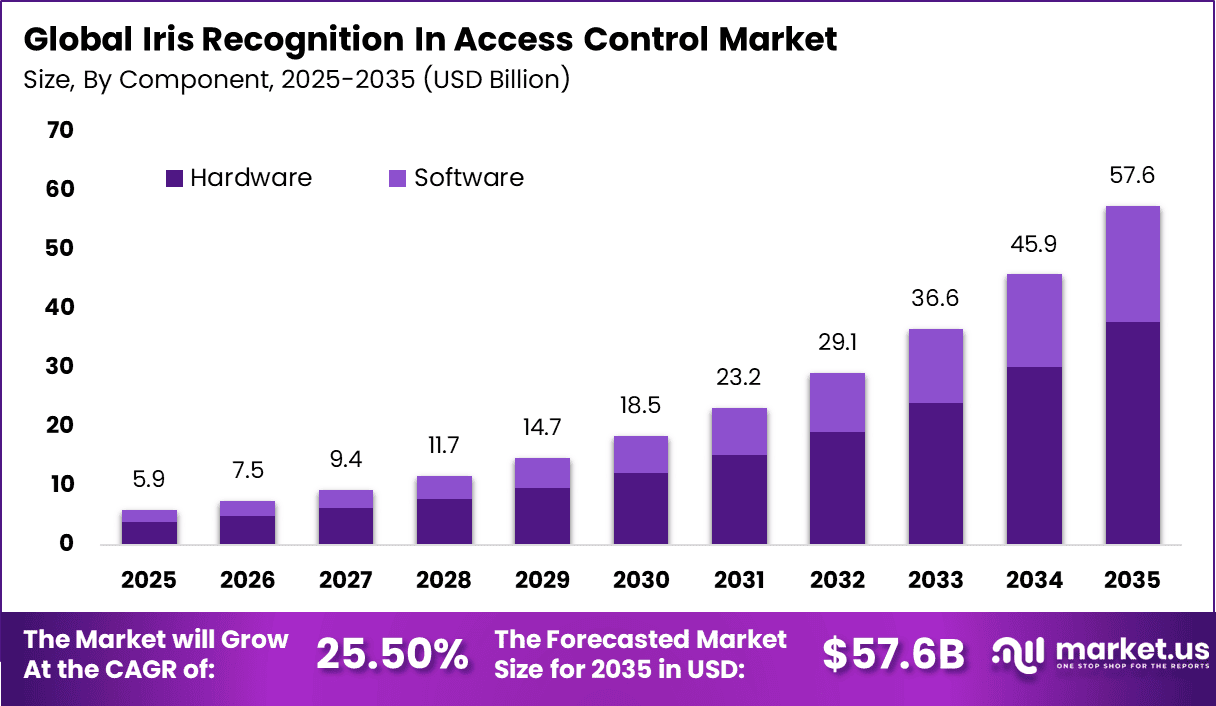
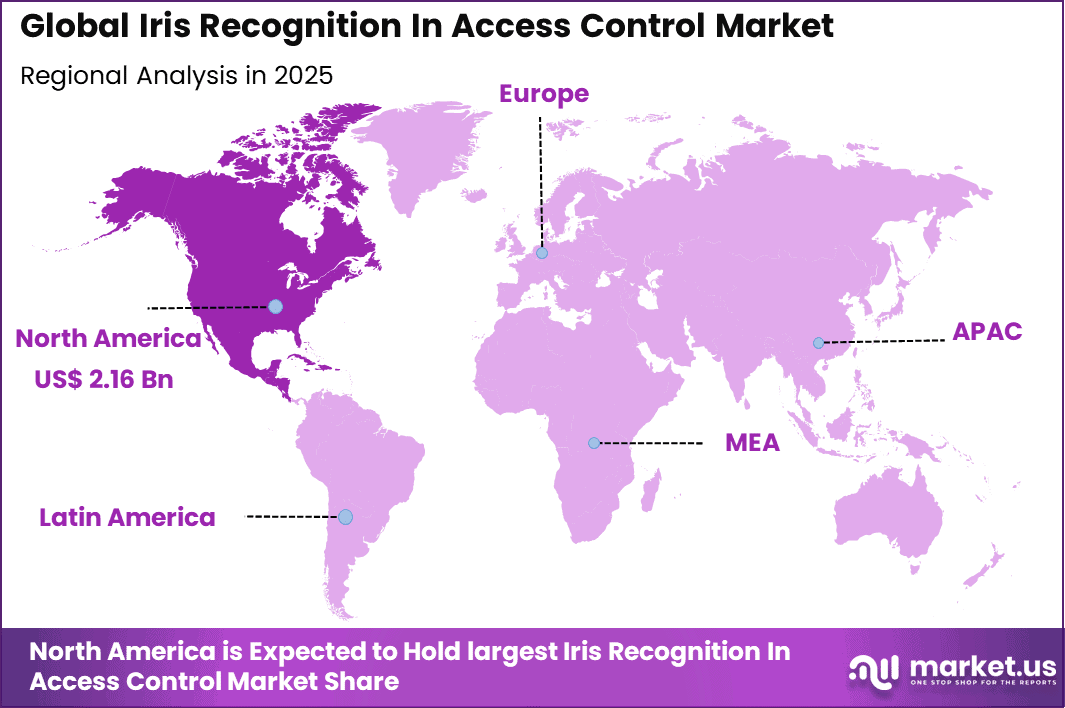
The Global Iris Recognition In Access Control Market generated USD 5.9 billion in 2025 and is predicted to register growth from USD 7.5 billion in 2026 to about USD 57.6 billion by 2035, recording a CAGR of 25.5% throughout the forecast span. In 2025, North America held a dominant market position, capturing more than a 36.4% share, with USD 2.16 billion in revenue.
The iris recognition in access control market refers to systems that use the unique patterns in a person’s eye to verify identity before allowing entry to secure areas. These systems capture an image of the iris and compare it with stored templates to confirm whether a person is authorised. Iris recognition is used in workplaces, secure facilities, government buildings, airports, healthcare settings, and data centres where strong identity verification is needed.
The main driving factors for this market are rising concerns about physical security and the need for reliable identity verification. Many organisations face threats from unauthorised entry that can lead to theft, data loss, or harm to people. Traditional access methods such as key cards or passwords can be lost, stolen, or shared without permission, creating risk.
Iris recognition systems rely on biometric traits that are unique to each person and difficult to forge, which supports stronger security. Improvements in camera technology and image processing have also made iris systems more accurate and easier to operate in real environments.
Top Market Takeaways
- By component, hardware dominated the iris recognition in access control market with a 65.7% share, supplying scanners and readers for high-security entry points.
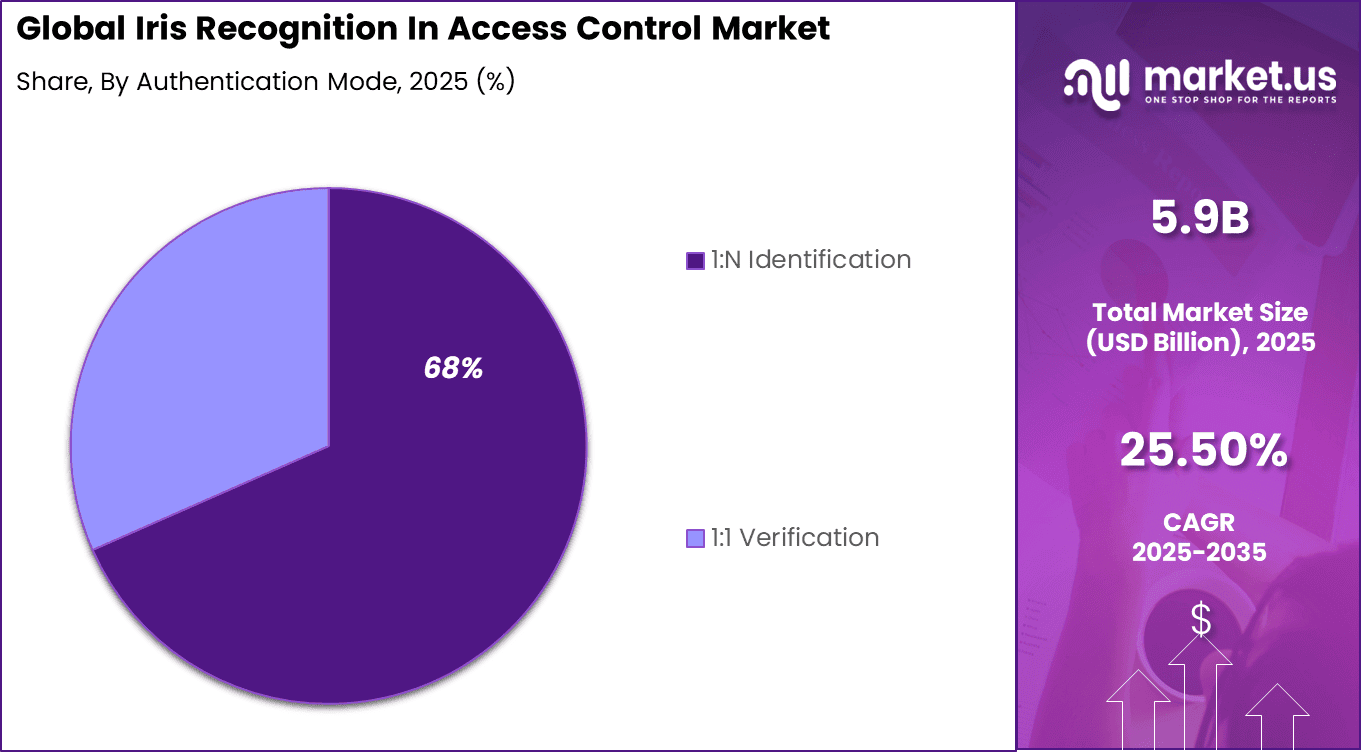
- By authentication mode, 1:N identification led at 68.4%, allowing rapid matching against large databases without PINs or cards.
- By end-user industry, banking, financial services, and insurance (BFSI) captured 35.7%, deploying iris tech for vaults, ATMs, and secure branches.
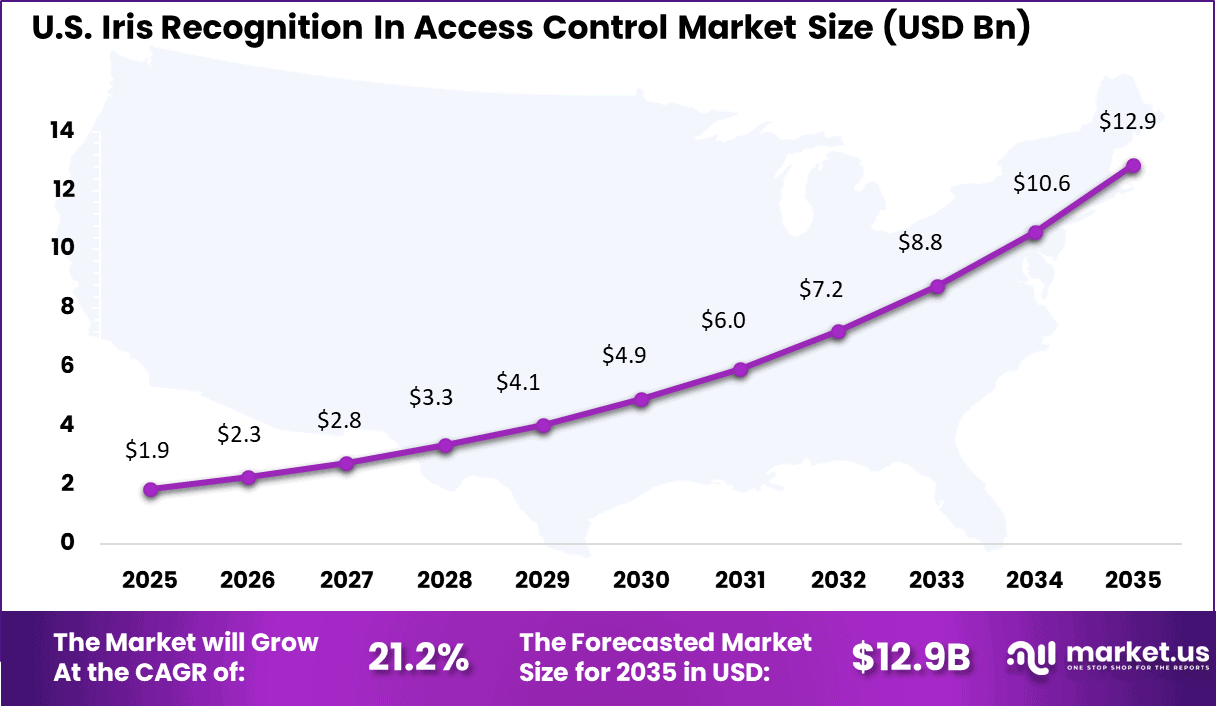
- North America held 36.4% of the global market, with the U.S. valued at USD 1.88 billion and growing at a CAGR of 21.2%.
Key Market Insights
Performance and Accuracy Metrics
- Modern iris recognition systems have very low error rates, with a false match rate below 0.01% and a false accept rate as low as 1 in 1.2 million.
- Iris scanners capture around 240 to 260 biometric data points, which is much higher than the roughly 16 points used in fingerprint scanning.
- Verification is very fast, usually completed within 0.5 to 2 seconds.
- In high-traffic locations such as airports, systems can process more than 500 people per hour, making them suitable for large-scale use.
Adoption in Access Control
- Government and military use: More than 200 U.S. military bases have replaced hand geometry readers with iris scanners for secure access control.
- Border control: In the United Arab Emirates, all 32 air, land, and sea ports use iris recognition to screen travelers, helping identify over 330,000 cases of attempted re-entry using false identities.
- Commercial use: Major technology companies such as Google have used iris scanning to protect access to data centers since 2011.
- Public enrollment: India’s Aadhaar system has enrolled over 1.3 billion people using iris scans for secure identity verification.
Component Analysis
Hardware accounts for 65.7% of the Iris Recognition in Access Control market, showing that physical devices form the core of iris-based security systems. This hardware includes iris scanners, cameras, sensors, and dedicated processing units used to capture and analyze iris patterns.
Organizations invest in high-quality hardware to ensure accurate image capture under different lighting and environmental conditions. Reliable hardware is essential to maintain authentication accuracy and system uptime.
From an operational perspective, hardware-based iris recognition systems offer high durability and long service life. These devices are commonly installed at secure entry points such as bank branches, data centers, and restricted facilities. The strong share of this segment reflects the need for precise and robust physical components to support advanced biometric access control.
Authentication Mode Analysis
1:N identification accounts for 68.4% of the authentication mode segment, making it the most widely used approach in iris recognition systems. In this mode, a captured iris pattern is compared against a large database to identify an individual. This is especially useful in high-security environments where identity needs to be established rather than just verified.
From a usage perspective, 1:N identification supports fast and automated access decisions for large user populations. It is commonly used in banking, government, and enterprise security systems. The strong dominance of this segment reflects growing demand for scalable and accurate identification methods that can handle large databases without compromising security.
End-User Industry Analysis
The BFSI sector accounts for 35.7% of end-user adoption, making it the leading industry segment for iris recognition in access control. Financial institutions handle sensitive data, cash assets, and secure facilities that require strong authentication. Iris recognition provides a high level of security and reduces the risk of unauthorized access and identity fraud.
BFSI organizations also focus on compliance and risk management. Iris-based access control supports strict security policies and audit requirements. The strong presence of this segment reflects the financial sector’s emphasis on advanced biometric technologies to protect critical infrastructure and customer trust.
Key Market Segments
By Component
- Hardware
- Iris Scanners
- Cameras
- Integrated Iris-Recognition Systems
- Other Optical Modules and Illumination
- Software
- Stand-alone Matching Engines
- SDKs and Middleware
- Cloud-based Platforms
By Authentication Mode
- 1:1 Verification
- 1:N Identification
By End-user Industry
- Government and Law-Enforcement
- Banking, Financial Services and Insurance (BFSI)
- Healthcare and Life Sciences
- Consumer Electronics
- Military and Defense
- Travel and Immigration
- Commercial and Enterprise
- Others (Education, Automotive OEMs)
Regional Analysis
North America accounted for a 36.4% share, supported by strong demand for high-accuracy biometric security solutions across government, defense, healthcare, and enterprise facilities. Iris recognition has been widely adopted in access control systems due to its high reliability and low false acceptance rates compared to other biometric methods.
Demand has been driven by rising security concerns, the need for contactless authentication, and stricter access control requirements in sensitive environments. The region’s advanced security infrastructure has enabled steady deployment of iris-based systems.
The U.S. market reached USD 1.88 Bn and is projected to grow at a 21.2% CAGR, reflecting strong investment in advanced biometric technologies. Adoption has been particularly high in government buildings, airports, research facilities, and critical infrastructure sites where secure and fast access is essential. Iris recognition systems have helped U.S. organizations improve identity verification accuracy and reduce unauthorized access.
Key Regions and Countries
- North America
- US
- Canada
- Europe
- Germany
- France
- The UK
- Spain
- Italy
- Russia
- Netherlands
- Rest of Europe
- Asia Pacific
- China
- Japan
- South Korea
- India
- Australia
- Singapore
- Thailand
- Vietnam
- Rest of APAC
- Latin America
- Brazil
- Mexico
- Rest of Latin America
- Middle East & Africa
- South Africa
- Saudi Arabia
- UAE
- Rest of MEA
Key Reasons for Adoption
- Demand is increasing for high-security access control in sensitive environments
- Traditional access methods are vulnerable to theft, loss, and duplication
- Biometric accuracy requirements are rising in regulated and high-risk facilities
- Contactless authentication is preferred for hygiene and convenience
- Organizations need reliable identity verification for controlled access
Benefits
- Access security is strengthened through unique iris-based identification
- Authentication accuracy is improved with low error rates
- Unauthorized access risk is reduced across secure facilities
- User convenience is enhanced through fast and contactless verification
- System reliability is improved with stable biometric performance
Usage
- Used in government buildings for secure entry management
- Applied in defense and military facilities for restricted access
- Deployed in airports and border control checkpoints
- Utilized in data centers to protect critical infrastructure
- Integrated into enterprise security systems for controlled access
Emerging Trends
| Key Trend | Description |
|---|---|
| Multimodal biometric access devices | Iris readers increasingly combine iris with face or card credentials in a single access terminal to support flexible security policies. |
| Edge AI for faster matching | On-device processing accelerates iris template matching, enabling real-time access decisions without constant dependence on cloud servers. |
| Contactless and walk-through systems | Long-range cameras and wide-angle imagers allow users to authenticate while walking, improving throughput at gates and turnstiles. |
| Integration with mobile and cloud PACS | Iris readers are being integrated with mobile credentials and cloud-based physical access control platforms for centralized management. |
| Ruggedized readers for harsh environments | Devices are designed to work reliably in outdoor, dusty, or low-light industrial and critical-infrastructure locations. |
Growth Factors
| Key Factors | Description |
|---|---|
| Rising demand for high-security authentication | Critical infrastructure, data centers, and government sites require stronger identity verification than cards or PINs. |
| Preference for touchless access | Post-pandemic hygiene concerns and convenience are driving a shift from fingerprint readers to non-contact iris systems. |
| Increase in identity fraud and insider threats | Organizations adopt iris recognition to reduce credential sharing and tailgating risks. |
| Regulatory and compliance requirements | Sectors such as finance, defense, and healthcare must meet stricter physical security and auditability standards. |
| Falling hardware costs and better usability | Improvements in camera technology, speed, and user experience make iris access control more affordable and easier to deploy at scale. |
Market Dynamics
Driver Analysis - High Accuracy for High-Security Access Points
Iris recognition is being adopted in access control because it provides strong identity confidence compared with many other biometric options. The iris pattern is stable over time and is difficult to copy, which supports use in sensitive environments such as government facilities, critical infrastructure sites, and controlled enterprise areas.
This driver becomes more important as organisations tighten access policies for restricted zones and auditability. When access events must be linked to a verified individual, iris-based access control can reduce reliance on badges and shared codes, improving accountability and lowering the risk of unauthorised entry.
Restraint Analysis - Higher Hardware Cost and Deployment Practicality
A key restraint is the higher cost of iris capture hardware compared with common alternatives such as fingerprint or basic facial systems. Access control deployments typically require specialised cameras and controlled capture conditions, which raises the total cost of installation and makes adoption slower in cost-sensitive sites.
Deployment practicality can also limit use in busy entry points. Users must align their eyes at an appropriate distance and angle, and performance can be affected by environmental factors and user comfort. These realities can create friction in high-throughput entrances, where speed and convenience are often the main priority.
Opportunity Analysis - Standard-Based Interoperability and Identity Programs
There is a clear opportunity in building iris access control around recognised data standards. Interchange standards for iris image data support more consistent enrolment and integration across devices and vendors, which reduces lock-in risk for buyers and improves long-term scalability for multi-site deployments.
Opportunity also exists where national and enterprise identity programs are expanding and require stronger identity assurance. When identity management becomes a core requirement for digital government or regulated services, iris biometrics can be positioned as a high-assurance option for secure facility access and controlled service points.
Challenge Analysis - Spoof Resistance and Performance in Real Conditions
A central challenge is maintaining strong protection against presentation attacks while keeping the user experience simple. Research indicates that robust presentation attack detection for iris recognition is still an active area, and solutions must keep improving to handle realistic spoof attempts without creating excessive false blocks for genuine users.
Another challenge is consistent performance with non-ideal images, which can occur due to motion, lighting, eyewear, or user positioning. In access control settings, systems must work reliably across varied conditions and user groups, which increases the need for careful device selection, calibration, and ongoing operational testing.
Competitive Analysis
The competitive landscape of the iris recognition in access control market is shaped by a mix of global biometric technology leaders and specialized iris recognition solution providers. NEC Corporation, IDEMIA, Thales through Gemalto, HID Global under ASSA ABLOY, Fujitsu, Samsung Electronics, and Vision-Box hold strong positions due to their advanced biometric algorithms and enterprise security systems.
These companies benefit from strong research capabilities, high accuracy matching, and the ability to deliver end-to-end access control solutions for airports, government facilities, and critical infrastructure.
Iris-focused specialists such as Iris ID, IriTech, EyeLock, Princeton Identity, IrisGuard, CMITech, BioEnable Technologies, Aware, DERMALOG, Cognitec Systems, Smartmatic, CLEAR, and SRI International intensify competition by offering purpose-built iris recognition devices and platforms. Competitive differentiation increasingly depends on recognition accuracy, speed, usability in varied lighting conditions, and compliance with privacy and security regulations.
Top Key Players in the Market
- NEC Corporation
- IDEMIA
- HID Global (ASSA ABLOY)
- Thales Group (Gemalto)
- Iris ID Inc.
- IriTech Inc.
- EyeLock LLC
- Princeton Identity Inc.
- BioEnable Technologies Pvt. Ltd.
- IrisGuard UK Ltd.
- Aware Inc.
- Vision-Box
- DERMALOG Identification Systems
- Cognitec Systems GmbH
- Smartmatic
- Samsung Electronics Co., Ltd.
- Fujitsu Limited
- CLEAR Inc.
- CMITech Company Ltd.
- SRI International
- Others
Future Outlook
Growth in the Iris Recognition in Access Control market is expected to increase as organizations require high security and reliable identity verification. Iris recognition offers strong accuracy and is difficult to duplicate, which makes it suitable for sensitive environments. Adoption is rising in government facilities, data centers, airports, and corporate offices. Over time, better camera technology, faster matching, and improved user experience are likely to support wider use.
Recent Developments
- In December 2025, NEC developed a walk‑through face and iris multimodal biometric authentication system that authenticates moving individuals up to three meters away, combining its NIST‑top‑ranked face and iris recognition for high‑security access‑control environments.
- In October 2025, Thales was named Frost & Sullivan’s Company of the Year 2025 for automated border control, highlighting its multi‑modal biometrics (face, fingerprint, iris) with AI‑driven accuracy and liveness detection for eGates and access‑control systems.
Report Scope
| Report Features | Description |
|---|---|
| Market Value (2025) | USD 5.9 Billion |
| Forecast Revenue (2035) | USD 57.6 Billion |
| CAGR(2025-2035) | 25.5% |
| Base Year for Estimation | 2024 |
| Historic Period | 2020-2024 |
| Forecast Period | 2025-2035 |
| Report Coverage | Revenue forecast, AI impact on Market trends, Share Insights, Company ranking, competitive landscape, Recent Developments, Market Dynamics and Emerging Trends |
| Segments Covered | By Component (Hardware, Software), By Authentication Mode (1:1 Verification, 1:N Identification), By End-user Industry (Government and Law-Enforcement, Banking, Financial Services and Insurance (BFSI), Others (Education, Automotive OEMs)) |
| Regional Analysis | North America – US, Canada; Europe – Germany, France, The UK, Spain, Italy, Russia, Netherlands, Rest of Europe; Asia Pacific – China, Japan, South Korea, India, New Zealand, Singapore, Thailand, Vietnam, Rest of Latin America; Latin America – Brazil, Mexico, Rest of Latin America; Middle East & Africa – South Africa, Saudi Arabia, UAE, Rest of MEA |
| Competitive Landscape | NEC Corporation, IDEMIA, HID Global (ASSA ABLOY), Thales Group (Gemalto), Iris ID Inc., IriTech Inc., EyeLock LLC, Princeton Identity Inc., BioEnable Technologies Pvt. Ltd., IrisGuard UK Ltd., Aware Inc., Vision-Box, DERMALOG Identification Systems, Cognitec Systems GmbH, Smartmatic, Samsung Electronics Co., Ltd., Fujitsu Limited, CLEAR Inc., CMITech Company Ltd., SRI International, Others |
| Customization Scope | Customization for segments, region/country-level will be provided. Moreover, additional customization can be done based on the requirements. |
| Purchase Options | We have three licenses to opt for: Single User License, Multi-User License (Up to 5 Users), Corporate Use License (Unlimited Users and Printable PDF) |