


Report Overview
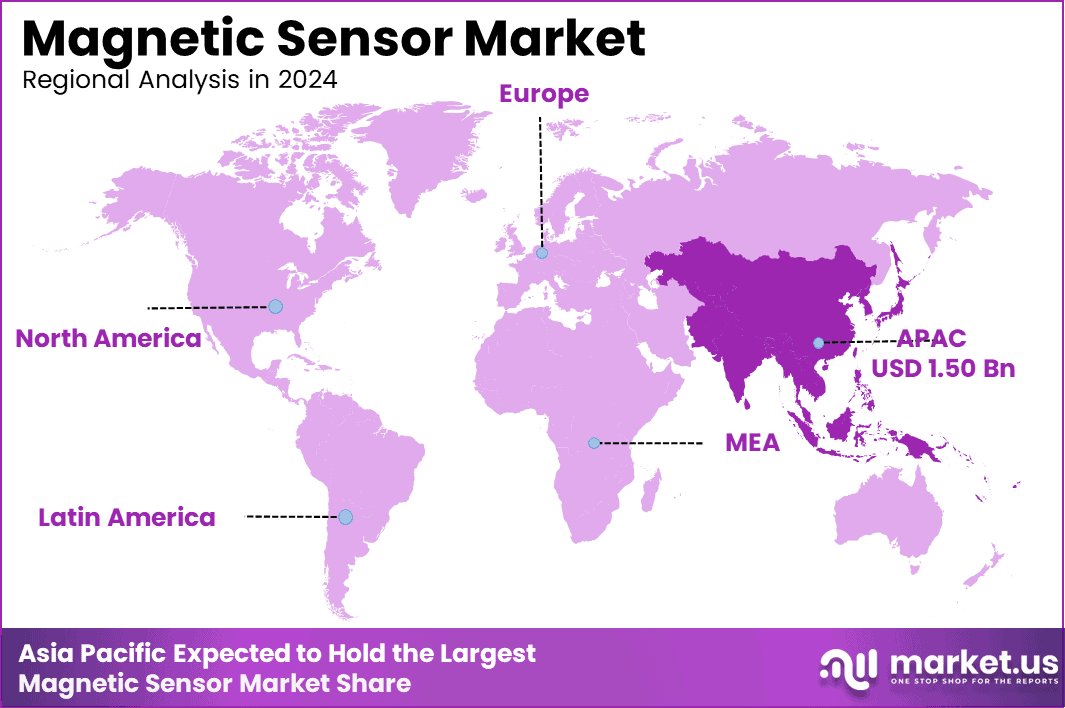
The Global Magnetic Sensor Market reached USD 3.1 billion in 2024 and will climb to USD 6.2 billion by 2034, growing at a CAGR of 7.1% between 2025 and 2034. Asia Pacific holds 48.3% of global revenue and generates USD 1.5 billion.
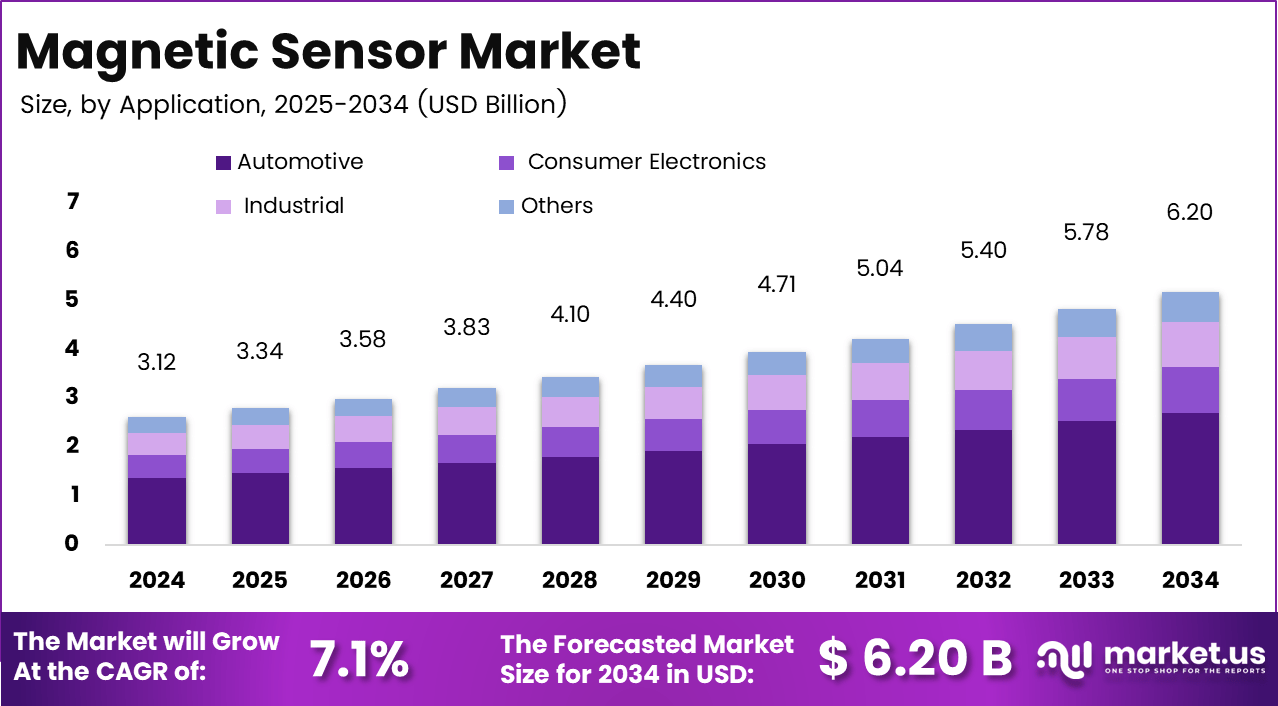
Vehicle output drives most of this demand. OICA data shows global vehicle production rose from 92.7 million units in 2024 to 96.4 million units in 2025, a gain of 3.9%, while global sales moved up to 99.8 million units. Every one of those vehicles carries speed, position, current, and angle sensors across the powertrain, brakes, steering, and seat systems.
Electrification lifts the content per car even faster. The IEA reports that electric car sales grew 20% in 2025 to more than 20 million units, so one in four new cars sold ran on electric power, and the agency expects 23 million sales in 2026. Traction inverters, battery packs and e-axles each need contactless current and angle sensing, which pushes sensor value per vehicle well above conventional models.
Scale explains the lead. CAAM data shows China alone built 34.531 million vehicles in 2025, up 10.4% year on year, with sales of 34.40 million units. New energy vehicle production and sales passed 16 million units and took more than half of all new car sales inside China.
The IEA adds that China produced close to 75% of the world’s electric cars in 2025. India supports the base further, with SIAM recording 2,943,456 vehicles and two-wheelers built in November 2025 alone. This manufacturing density keeps sensor fabs, packaging plants, and module assembly inside the region.
Key Takeaways
- The Global Magnetic Sensor Market stood at USD 3.1 billion in 2025 and will reach USD 6.2 billion by 2035.
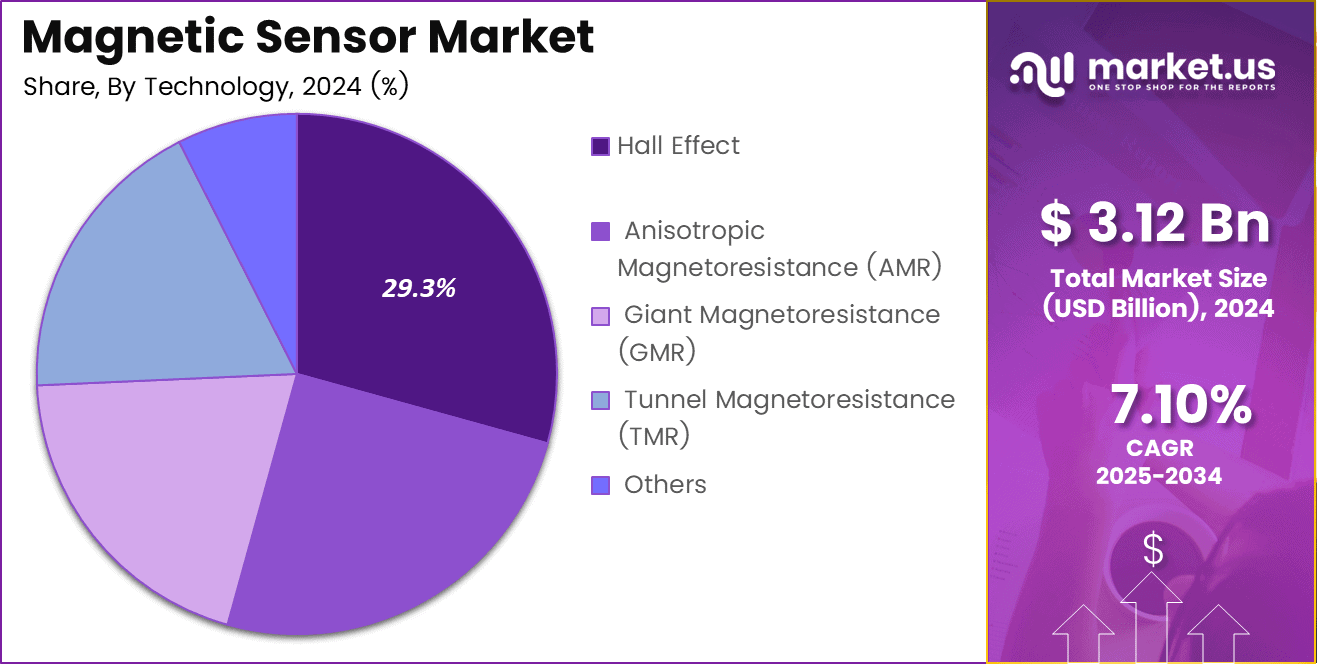
- Hall Effect leads the technology segment with a 29.3% share.
- Automotive leads the application segment with a 43.7% share.
- Asia Pacific leads all regions with a 48.3% share and USD 1.5 billion in revenue.
Role of Generative AI
Generative AI is revolutionizing the magnetic sensor market by enhancing product design, predictive maintenance, and manufacturing efficiency. AI-driven simulations optimize sensor design and material compositions, reducing development costs. In real-time, AI predicts equipment failures and extends sensor life, improving reliability in automotive and industrial applications.
It boosts manufacturing accuracy and yield rates while automating calibration and detecting micro-defects for consistent performance. AI also enables data-driven sensor customization for electric vehicles, robotics, and consumer electronics. Additionally, it aids in the integration of sensors in autonomous systems and offers market insights to forecast demand, regional growth, and technological gaps.
By Technology
Hall Effect dominates with 29.3% due to low-cost, rugged automotive position sensing.
Hall Effect devices lead because carmakers and appliance builders trust a simple, low-cost chip that survives heat, dust, and vibration. Factories have refined this silicon for decades, so a single part often costs cents and drops straight into existing boards without new design work.
Volume users pick it for wheel speed, seat position, motor commutation, and lid detection, where high precision matters less than reliability. Allegro MicroSystems, one of the largest suppliers, reported magnetic sensor sales of $539 million in fiscal 2026, up 13.5%, showing steady pull for these workhorse parts.
Tunnel Magnetoresistance now climbs fastest because engineers need sharper signals at lower power. TMR chips sense weaker fields, cut current draw, and hold accuracy in electric drivetrains, robot joints, and battery current monitors. Spintronic specialist NVE Corporation earned $26.3 million in fiscal 2026 revenue at a 79% gross margin, proving buyers pay more for this accuracy.
By Application
Automotive dominates with 43.7% due to dozens of sensors per vehicle.
Vehicles absorb the most magnetic sensors because every car carries dozens of them, from crankshaft timing to pedal position, door latches, and steering angle. Global output reached 96.4 million vehicles in 2025, a 3.9% rise over the prior year, so even one extra sensor per model multiplies into millions of parts.
Safety rules push further: anti-lock braking, electric power steering, and driver assistance all depend on contactless position feedback that stays accurate for a decade. Electrification adds more sockets still, since roughly 22 million electric cars rolled off assembly lines in 2025, each needing current sensing for batteries, inverters, and charging ports.
Phones, wearables, earbuds, and folding screens use compact magnetometers for compass work, lid and hinge detection, and stylus tracking. With 9.2 billion mobile-cellular subscriptions active worldwide, replacement cycles alone create enormous unit demand, and richer features keep raising sensor count per device.
Key Market Segments
By Technology
- Hall Effect
- Anisotropic Magnetoresistance (AMR)
- Giant Magnetoresistance (GMR)
- Tunnel Magnetoresistance (TMR)
- Others
By Application
- Automotive
- Consumer Electronics
- Industrial
- Others
Geopolitical Impact Analysis
Trade policy now shapes sensor costs as much as silicon supply. The WTO expects world merchandise trade volume growth to slow from 2.8% in 2024 to 2.4% in 2025 and just 0.5% in 2026, which tightens order books for sensor makers that ship across three continents before a part reaches a car plant.
The United States imposed a 25% Section 232 tariff on defined semiconductor articles and opened parallel talks with trading partners, with relief carved out for firms building new US capacity from January 15, 2026. Magnetic sensor suppliers respond by dual sourcing wafers and qualifying second assembly sites, both of which add cost before any price rise reaches the customer.
Raw material controls hit harder. Magnetic sensing systems pair sensor dies with permanent magnets, and the IEA notes that China placed seven heavy rare earth elements, their compounds and magnets under export control in April 2025, after which export volumes fell sharply and left carmakers in the United States and Europe short of magnets.
Wider controls announced in October 2025 covered five more elements and any foreign-made parts holding Chinese-sourced material, and the IEA values downstream production at risk outside China at USD 6.5 trillion a year, with over USD 1.5 trillion exposed in the United States and in Europe each.
Chinese rare earth magnet shipments to the United States in January and February 2026 fell 22% against 2025 levels. Logistics compound the squeeze, since UNCTAD recorded a 42% drop in Suez Canal trade volume during the Red Sea disruption, and Asia-to-Europe routings around Africa still add 10 to 14 days.
Regional Analysis
Asia Pacific dominates the Magnetic Sensor Market, holding a 48.3% share and generating USD 1.5 billion in revenue. The region also grows the fastest through 2035. China anchors that position. CAAM figures show passenger vehicle production reached 30.27 million units in 2025 and commercial vehicle output reached 4.26 million units, both records.
North America holds the second strongest commercial position because design wins and consolidation happen here. onsemi disclosed a proposal in March 2025 to buy Allegro MicroSystems for USD 35.10 per share in cash, an implied enterprise value of 6.9 billion dollars, which shows how buyers price magnetic sensing assets.
Europe ranks third and grows on regulation. The IEA reports that European electric car sales rose more than 30% in 2025 and accounted for 28% of total sales, the strongest growth among major markets, after the European Union tightened its CO2 standards for cars.
China Market Size
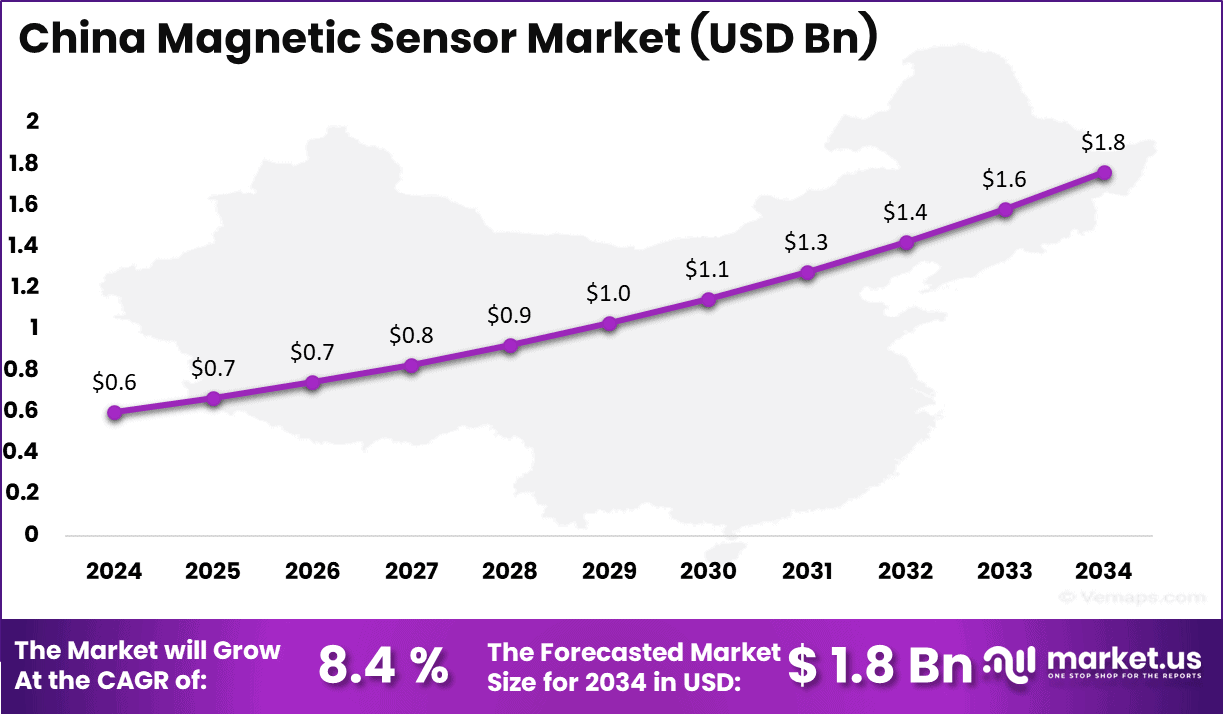
China’s magnetic sensor market was valued at USD 0.6 billion in 2024 and is projected to reach USD 1.8 billion by 2034, growing at a CAGR of 8.4%. This growth is driven by rapid advancements in electric vehicles, industrial automation, and consumer electronics manufacturing across the region.
Key Regions and Countries
North America
- US
- Canada
Europe
- Germany
- France
- The UK
- Spain
- Italy
- Rest of Europe
Asia Pacific
- China
- Japan
- South Korea
- India
- Australia
- Rest of APAC
Latin America
- Brazil
- Mexico
- Rest of Latin America
Middle East and Africa
- GCC
- South Africa
- Rest of MEA
Market Dynamics
Drivers
| Driver | (~) % Impact on CAGR Forecast | Geographic Relevance | Impact Timeline |
|---|---|---|---|
| Traction Motor & Battery Current Sensing Content Growth in Electrified Powertrains | +1.9% | China, Europe, North America | Short term (2 years or less) |
| Mandated ADAS Type-Approval Phase-In (Steering, Braking, Pedal Position Sensing) | +1.1% | Europe, Japan, South Korea | Short term (2 years or less) |
| Isolated Current Sensing for 800 VDC AI Data Center Power Delivery | +1.0% | North America, Taiwan, Middle East | Short term (2 years or less) |
| TMR Migration in Smartphones, Wearables and Foldable Hinge Detection | +0.7% | China, South Korea, Vietnam, India | Medium term (2 to 4 years) |
| BLDC Conversion in HVAC, White Goods and Power Tools | +0.6% | Asia-Pacific, North America | Medium term (2 to 4 years) |
| Magnetic Rotary Encoder Retrofit in Discrete Factory Automation | +0.5% | Germany, Japan, China | Medium term (2 to 4 years) |
Traction Motor & Battery Current Sensing Content Growth in Electrified Powertrains
EV adoption is increasing magnetic sensor content per vehicle, with attach rates rising from around 15 to 25 devices in combustion vehicles to 40 to 70 devices in battery-electric vehicles. ASIL-D coreless current sensors can command 2x to 4x the price of basic Hall switches. Global electric car sales exceeded 17 million units in 2024, representing more than 20% of sales, and surpassed 20 million units in 2025.
Automotive sensing suppliers reported revenue growth of around 28% year over year in the December 2025 quarter, while e-Mobility revenue increased about 46%. Fiscal 2026 automotive growth approached 17%, with content gains of roughly 8 to 10 percentage points. Design cycles now extend 24 to 36 months, while gross margins can reach 49% to 51%, supporting long-term platform opportunities across 2027 to 2030.
Restraints
| Restraint | (~) % Impact on CAGR Forecast | Geographic Relevance | Impact Timeline |
|---|---|---|---|
| Extraterritorial Licensing of Chinese-Origin Rare Earth Magnet Inputs | -1.6% | Global, acute in North America and Europe | Short term (2 years or less) |
| Domestic Hall IC Price Undercutting and Forced Localization Sourcing | -0.8% | China, Southeast Asia | Short term (2 years or less) |
| Section 232 Tariff Stacking on Semiconductors and Derivative Goods | -0.9% | United States, Mexico, Taiwan | Short term (2 years or less) |
| Restrictive Policy Rates Freezing Industrial and Robotics CapEx Approvals | -0.7% | Eurozone, United Kingdom, Latin America | Medium term (2 to 4 years) |
| Foundational ECU Chip Allocation Halts Suspending Tier-1 Module Builds | -0.5% | Europe, Japan, North America | Short term (2 years or less) |
| Contractual Annual Price-Down Clauses in OEM Long-Term Agreements | -0.7% | Global | Long term (4 years or more) |
Extraterritorial Licensing of Chinese-Origin Rare Earth Magnet Inputs
China’s rare-earth export controls have become a structural risk for magnetic sensor modules. MOFCOM Announcement No. 61 of 2025, published on 9 October 2025 and effective from 1 December 2025, applies when controlled Chinese rare earth content reaches 0.1% or more of product value. Licensing lead times have extended from around 4 to 6 weeks to 90 to 150 days, while non-Chinese heavy rare-earth processing still represents only a low double-digit share of global capacity.
Supply restrictions can raise magnetic-module bill-of-materials costs by approximately 3% to 8%, while dual-source qualification may require 1,000 to 2,000 hours of testing across 3 production lots. The pressure can reduce gross margins by around 150 to 300 basis points, require safety stocks covering 6 to 9 months, and delay redesign or capital spending by approximately 12 to 18 months.
Challenges
| Challenge | (~) % CAGR Friction Drag | Geographic Relevance | Mitigation Horizon |
|---|---|---|---|
| Mature-Node Capacity Allocation Squeeze | -0.9% | Taiwan, Japan, Europe, United States | Medium term (2 to 4 years) |
| Inductive Sensing Displacement Risk | -0.8% | Europe, North America, China | Long term (4 years or more) |
| Analog Sensing Talent Deficit | -0.7% | United States, Europe, Japan | Long term (4 years or more) |
| Functional Safety Requalification Cycles | -0.6% | Global | Medium term (2 to 4 years) |
| Stray-Field Immunity Engineering Burden | -0.5% | China, Europe, North America | Medium term (2 to 4 years) |
| Fragmented Industrial Interface Standards | -0.4% | Germany, Japan, India | Long term (4 years or more) |
Mature-Node Capacity Allocation Squeeze
Mature-node foundry capacity is becoming a structural constraint for magnetic sensor suppliers. Most devices rely on 8-inch and 40 to 90 nm processes, where utilization among leading foundries is expected to rise from around 80% in 2025 to nearly 90% in 2026 and remain above 80% through the first half of 2027. Some operators have announced 15% to 20% cuts in mature 12-inch capacity by 2028, removing roughly 50,000 wafers per month.
Wafer prices are rising by mid-to-high single digits, while supply commitments have extended to 9 to 12 months from 4 to 6 months historically. Fab transfers can require 12 to 24 months, with qualification involving 231 devices, 3 lots, and more than 1,000 hours of stress testing. These constraints limit how quickly suppliers can convert demand growth, even as electronics and optical factory orders increased 22.7% month on month in June 2026.
Opportunities
| Opportunity | (~) % Potential CAGR Upside | Geographic Relevance | Execution Window |
|---|---|---|---|
| Humanoid and Dexterous Robot Joint Encoder Sockets | +1.4% | China, United States, Japan, South Korea | Medium term (2 to 4 years) |
| Cryogen-Free Biomagnetic Diagnostics (Magnetocardiography, Wearable Neuroimaging) | +0.9% | United States, Europe, Japan | Long term (4 years or more) |
| Grid-Edge Fault and Feeder Current Sensing Retrofit | +0.8% | India, Middle East, Africa, United States | Medium term (2 to 4 years) |
| Sensor-Derived Predictive Maintenance Subscription Monetization | +0.7% | Europe, North America | Long term (4 years or more) |
| Incentive-Backed Localized Sensor Assembly and Test in India and ASEAN | +0.6% | India, Vietnam, Malaysia, Thailand | Medium term (2 to 4 years) |
| Roll-Up of Regional Encoder and Magnet Module Houses | +0.5% | Europe, Japan, North America | Medium term (2 to 4 years) |
Humanoid and Dexterous Robot Joint Encoder Sockets
Humanoid robotics remains an untapped opportunity, with global shipments still in the low tens of thousands in 2026, versus roughly 4 million industrial and service robots. Humanoids may require 30 to 55 axes, compared with only 6 to 7 axes in conventional robotic arms, increasing demand for compact magnetic encoders.
Qualified multi-axis encoder modules could command a 25% to 40% price uplift. Spreading an AEC-Q100-equivalent qualification across joints could reduce per-axis engineering costs by 50% to 60% and improve gross margins by around 500 to 900 basis points.
Key Players Analysis
Tier 1 leaders maintain their position through scale and strong automotive exposure. NXP Semiconductors reported USD 12.27 billion in revenue in 2025, including USD 7.12 billion from automotive. Automotive revenue reached USD 1.78 billion in the first quarter of 2026, increasing 6% year on year.
Honeywell International increased 2025 sales by 8% to USD 37.4 billion while restructuring its sensing portfolio. A one-time fourth-quarter charge reduced full-year GAAP sales by approximately USD 310 million. Allegro MicroSystems also maintained strong R&D spending, investing USD 179.6 million in fiscal 2025 and USD 52.9 million in the third quarter of fiscal 2026, equal to 23.1% of sales.
Tier 2 challengers compete through specialized technologies and focused product portfolios. Elmos Semiconductor SE achieved record 2025 sales of EUR 582.6 million and invested EUR 33.6 million in capital expenditure, representing 5.8% of sales. Its first-quarter 2026 revenue increased 20.2% to EUR 152.5 million.
Alps Alpine expects fiscal 2026 net sales of JPY 1,045.0 billion and operating income of JPY 45.5 billion, following first-quarter sales of JPY 237.9 billion. Asahi Kasei has shipped more than 50 billion Hall sensor units globally and received IEEE recognition in February 2026. NVE Corporation, MultiDimension Technology, MEMSIC, iC-Haus, and Baumer remain focused on specialist GMR and TMR applications where precision and design performance are key differentiators.
Top Key Players in the Market
- NXP Semiconductors
- Asahi Kasei
- Baumer Ltd.
- iC-Haus
- MEMSIC Semiconductor Co., Ltd.
- MultiDimension Technology Co., Ltd.
- NVE Corporation
- Alps Alpine Co., Ltd.
- Elmos Semiconductor SE
- Honeywell International, Inc.
- Allegro MicroSystems, Inc.
Recent Developments
- In June 2025, NXP Semiconductors completed its acquisition of TTTech Auto in an all-cash transaction valued at 625 million dollars to speed up software-defined vehicle platforms. NXP Semiconductors closed the purchase of Aviva Links for 243 million dollars and Kinara for 307 million dollars, a combined 550 million dollars in cash.
- In April 2026, Everspin Technologies signed a 10-year foundry services agreement with Microchip Technology to build 8-inch MRAM, TMR sensor, and STT MRAM wafers at Fab 4 in Gresham, Oregon, with first shipments expected in the second half of 2027. Everspin Technologies executed a 40 million agreement for military and aerospace MRAM applications and added onshore Toggle MRAM technology capability.
- In August 2025, Asahi Kasei approved an investment of about 16 billion yen to double PIMEL photosensitive polyimide capacity at its Fuji City site in Shizuoka by 2030 for semiconductor manufacturing.
Report Scope
| Report Features | Description |
|---|---|
| Market Value (2024) | USD 3.1 Billion |
| Forecast Revenue (2034) | USD 6.2 Billion |
| CAGR (2025-2034) | 7.1% |
| Base Year for Estimation | 2024 |
| Historic Period | 2020-2023 |
| Forecast Period | 2025-2034 |
| Report Coverage | Revenue Forecast, Market Dynamics, Competitive Landscape, Recent Developments |
| Segments Covered | By Technology (Hall Effect, Anisotropic Magnetoresistance (AMR), Giant Magnetoresistance (GMR), Tunnel Magnetoresistance (TMR), Others); By Application (Automotive, Consumer Electronics, Industrial, Others) |
| Regional Analysis | North America – US, Canada; Europe – Germany, France, The UK, Spain, Italy, Rest of Europe; Asia Pacific – China, Japan, South Korea, India, Australia, Singapore, Rest of APAC; Latin America – Brazil, Mexico, Rest of Latin America; Middle East & Africa – GCC, South Africa, Rest of MEA |
| Competitive Landscape | NXP Semiconductors, Asahi Kasei, Baumer Ltd., iC-Haus, MEMSIC Semiconductor Co., Ltd., MultiDimension Technology Co., Ltd., NVE Corporation, Alps Alpine Co., Ltd., Elmos Semiconductor SE, Honeywell International, Inc., Allegro MicroSystems, Inc. |
| Customization Scope | We will provide customization by segment and region/country. Additional customization can be done based on requirements. |
| Purchase Options | We have three licenses to opt for: Single User License, Multi-User License (Up to 5 Users), Corporate Use License (Unlimited Users and Printable PDF) |





































