


Report Overview
The Global Printed Temperature Sensor Market size is expected to be worth around USD 2,685 million by 2035, from USD 904 million in 2025, growing at a CAGR of 11.5% during the forecast period from 2025 to 2035. North America held a dominant market position, capturing more than a 34.5% share, holding USD 311.8 million in revenue.
Printed Temperature Sensor refers to a thin and flexible sensing device made through printing methods on materials such as plastic, paper, or textile. It is used to measure temperature changes in wearables, medical patches, smart packaging, batteries, and industrial equipment where lightweight, low-cost, and bendable monitoring solutions are required.
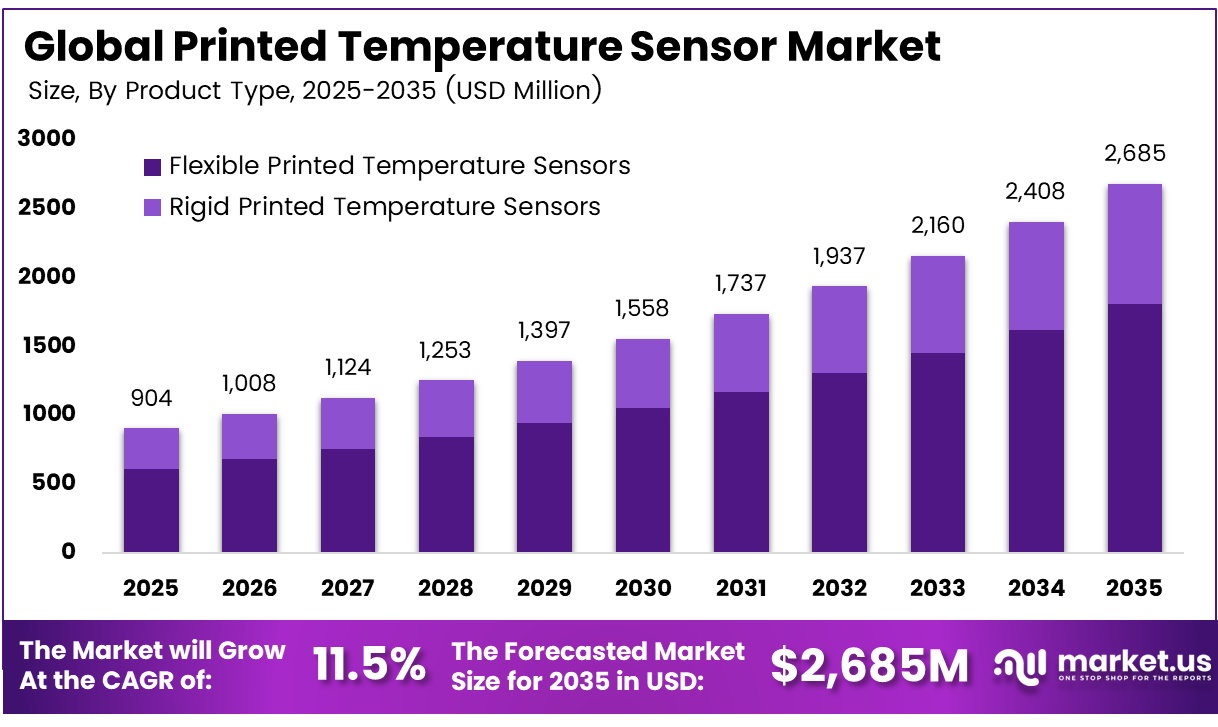
Top driving factors include the shift toward flexible and miniaturized electronics, rising demand for continuous temperature monitoring, and wider use of connected devices in homes, factories, and hospitals. Growth is also supported by printed sensors that can be placed on plastics, paper, or textiles at line speeds above 100 meters per minute through roll-to-roll processes.
The market for Printed Temperature Sensors is driven by the growing use of flexible electronics, wearable health devices, smart packaging, and connected industrial systems. These sensors are gaining demand because they are thin, lightweight, and easy to place on curved or soft surfaces. The rising need for real-time temperature monitoring is further supporting adoption across healthcare, logistics, and manufacturing applications.
Demand is strongest in wearables, medical patches, battery packs, smart packaging, and industrial equipment, where large numbers of sensing points are required. Engineers are using sensor densities above 10 sensing points per square centimeter to monitor hot spots, leakage, battery safety, and patient skin temperature trends in real time with better accuracy.
For instance, in May 2025, Murata announced new miniature NTC‑based temperature sensors that can be embedded onto flexible substrates and, in some cases, co‑fabricated with printed conductive inks. The products target wearables, medical disposables, and compact industrial modules, supporting the gradual shift from rigid boards to printed sensor architectures.
Key Takeaway
- In 2025, the Flexible Printed Temperature Sensors segment held a dominant market position, capturing a 67.4% share of the Global Printed Temperature Sensor Market.
- In 2025, the Resistive segment held a dominant market position, capturing a 83.6% share of the Global Printed Temperature Sensor Market.
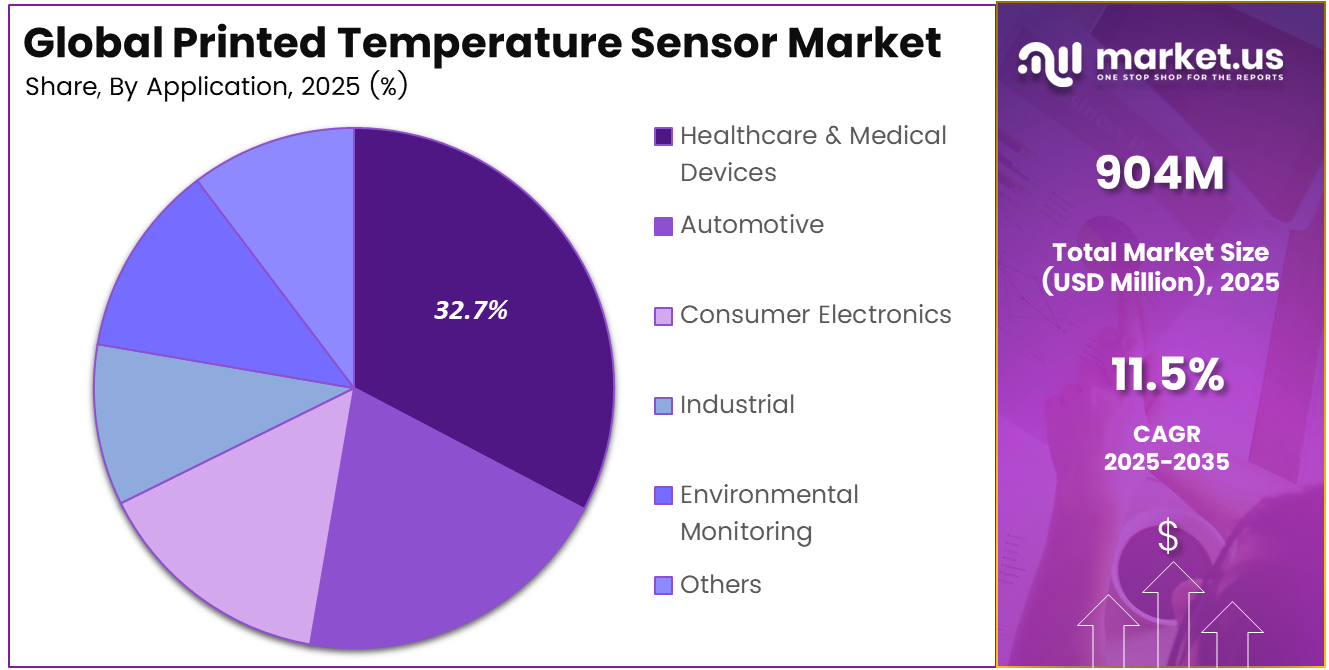
- In 2025, the Healthcare & Medical Devices segment held a dominant market position, capturing a 32.7% share of the Global Printed Temperature Sensor Market.
- The U.S. Printed Temperature Sensor Market was valued at USD 284.4 Million in 2025, with a robust CAGR of 9.6%.
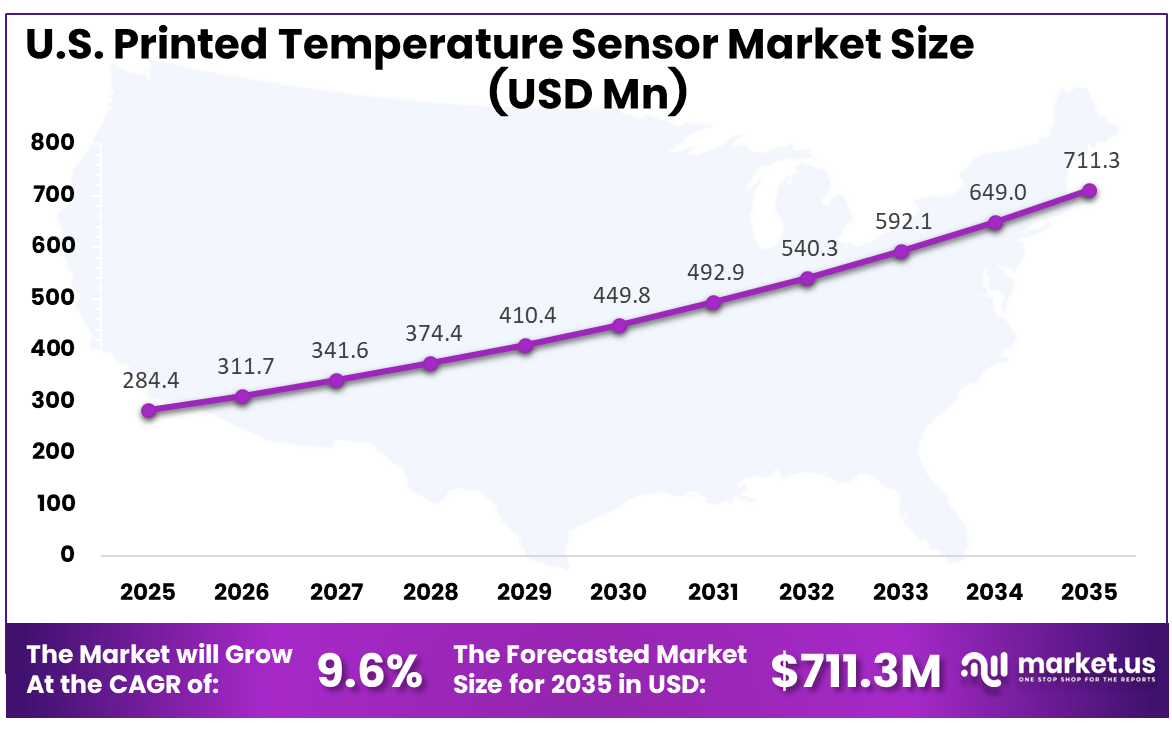
- In 2025, North America held a dominant market position in the Global Printed Temperature Sensor Market, capturing more than a 34.5% share.
Role of Generative AI
Generative AI is becoming useful in printed temperature sensor design, testing, and reporting. In large electronics and materials teams, close to 30–40% of simulation and documentation work is now partly supported by AI models for screening ink formulations, predicting failure modes, and improving performance records.
AI tools are also helping teams manage large volumes of temperature data from wearables, smart labels, and connected packaging. More than 60% of organizations testing advanced IoT analytics are piloting or planning generative AI features for anomaly detection, automated alerts, and sensor-based maintenance recommendations.
Investment and Business Benefits
Investment opportunities are expanding in advanced materials, high-speed printing lines, wireless sensor modules, and data platforms for cold chain, batteries, and clinical care. Startups can benefit by building application-focused designs, such as wound dressings with thousands of sensing pixels or packaging labels that react after 8 hours above a set temperature limit.
Business benefits include lower sensor costs, easier installation, less wiring, and stronger data visibility for maintenance and quality control. In factories, temperature sensors printed directly on equipment surfaces can reduce installation time by more than 50%, while helping teams improve condition-based maintenance and reduce unplanned downtime across production environments.
Regional Analysis
In 2025, North America held a dominant market position in the Global Printed Temperature Sensor Market, capturing more than a 34.5% share, holding USD 311.8 million in revenue. This dominance is due to the strong adoption of wearable medical devices, flexible electronics, smart packaging, and industrial monitoring solutions. The region benefits from advanced healthcare infrastructure, active sensor research, and high investment in connected device technologies. Growing use of real-time temperature tracking in hospitals, cold chain logistics, and manufacturing further supports regional leadership.
For instance, in September 2025, Analog Devices was highlighted as an emerging leader in the North America temperature sensor matrix, with growing adoption of its precision sensor ICs across industrial automation and automotive systems. Its focus on highly accurate, low‑noise temperature front‑ends enables OEMs to pair ADI chips with printed sensor elements in smart, connected hardware.
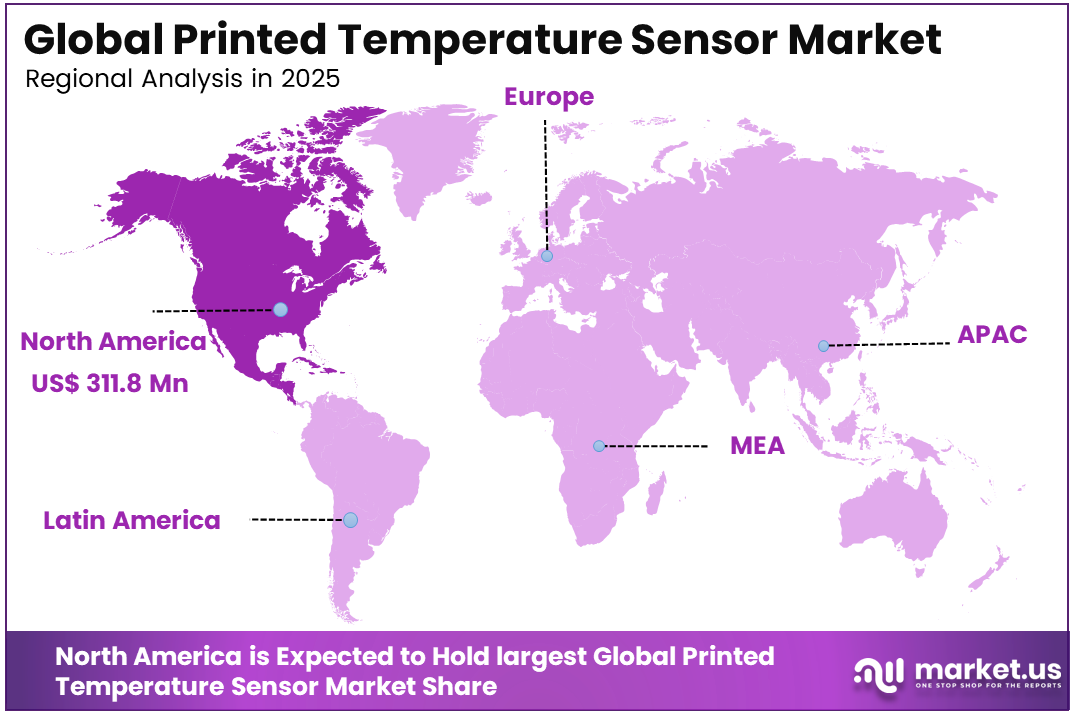
U.S. Printed Temperature Sensor Market Size
The market for Printed Temperature Sensors within the U.S. is growing tremendously and is currently valued at USD 284.4 million; the market has a projected CAGR of 9.6%. The market is growing due to the rising adoption of wearable health devices, smart medical patches, flexible electronics, and connected industrial monitoring systems. Strong demand from healthcare, packaging, battery safety, and manufacturing applications is supporting wider use. The presence of advanced electronics manufacturers, strong research activity, and growing focus on real-time temperature tracking are also encouraging steady market expansion.
For instance, in February 2026, Honeywell introduced new board‑mount NTC temperature sensing assemblies for HVAC and industrial equipment, distributed through North American channels like Mouser. Their small form factor and reflow‑solderable construction make them suitable for integration on printed substrates, reinforcing Honeywell’s role in advanced temperature control platforms in the U.S. market.
Key Regions and Countries
North America
- US
- Canada
Europe
- Germany
- France
- The UK
- Spain
- Italy
- Russia
- Netherlands
- Rest of Europe
Asia Pacific
- China
- Japan
- South Korea
- India
- Australia
- Singapore
- Thailand
- Vietnam
- Rest of APAC
Latin America
- Brazil
- Mexico
- Rest of Latin America
Middle East & Africa
- South Africa
- Saudi Arabia
- UAE
- Rest of MEA
Product Type Analysis
In 2025, the Flexible Printed Temperature Sensors segment held a dominant market position, capturing a 67.4% share of the Global Printed Temperature Sensor Market. This dominance is due to the strong suitability of flexible printed temperature sensors for curved, thin, and lightweight surfaces. Their use is increasing in wearable devices, medical patches, smart packaging, and flexible electronics, where traditional rigid sensors may be difficult to place or may affect user comfort.
Flexible printed temperature sensors also support easier product design because they can be produced on plastic films, textiles, and other bendable materials. Their thin structure helps manufacturers add temperature monitoring without increasing device size, which makes them useful for compact and portable electronic products.
For instance, in March 2025, Sensirion introduced a compact digital temperature sensor platform aimed at wearables and small devices, with a focus on low power use and easy integration into flexible substrates. This type of launch supports wider adoption of thin, bendable temperature-sensing layers in patches and textiles used for everyday and medical monitoring.
Sensing Technology Analysis
In 2025, the Resistive segment held a dominant market position, capturing a 83.6% share of the Global Printed Temperature Sensor Market. This dominance is due to the simple design and reliable performance of resistive sensing technology. These sensors measure temperature through changes in electrical resistance, making them easy to integrate into printed circuits, flexible films, and low-power electronic systems used across medical, industrial, and consumer applications.
Resistive printed temperature sensors are also preferred because they can be manufactured with fewer complex components. This helps reduce production difficulty and supports stable readings in wearable, packaging, and equipment monitoring use cases where continuous and practical temperature tracking is required.
For instance, in March 2026, Sensirion announced a cost-focused digital temperature sensor intended for compact and space-limited systems. While not branded as printed, the resistive sensing core and tiny footprint make it suitable for integration into printed circuit and hybrid printed setups where designers want reliable yet affordable temperature measurement.
Application Analysis
In 2025, the Healthcare & Medical Devices segment held a dominant market position, capturing a 32.7% share of the Global Printed Temperature Sensor Market. This dominance is due to the growing use of printed temperature sensors in healthcare and medical devices. These sensors are suitable for skin patches, wearable monitors, smart wound care, and patient tracking systems, where soft, thin, and comfortable designs are important for long-term use.
Healthcare applications also benefit from printed temperature sensors because they support continuous monitoring without heavy wiring or bulky devices. Their flexibility allows better contact with the body, helping caregivers observe temperature changes more easily in remote care, recovery tracking, and preventive health monitoring.
For instance, in January 2025, Sensirion highlighted a calibrated digital temperature sensor platform tailored for pharmaceutical cold chain and medical uses, emphasizing traceable accuracy and reliability. These capabilities translate well into healthcare devices and patches where printed temperature sensing elements must deliver trustworthy data for patient safety.
Key Market Segments
By Product Type
- Flexible Printed Temperature Sensors
- Rigid Printed Temperature Sensors
By Sensing Technology
- Resistive
- Thermoelectric
- Others
By Application
- Healthcare & Medical Devices
- Automotive
- Consumer Electronics
- Industrial
- Environmental Monitoring
- Others
Emerging Trends
A major trend is the rise of ultra-thin, skin-like sensors for medical and wellness applications. Printed temperature sensors are now being laminated onto skin and textiles, while studies show sub-degree accuracy across body temperature ranges and sensitivity gains of roughly 20–30% over earlier polymer formulations.
Smart labels are also becoming important in logistics, food, and pharmaceutical cold chains. Printed sensor labels can help track package-level temperature exposure, and trials suggest shipment-level temperature compliance can improve by about 10–15% when these labels are combined with cloud analytics and timely alerts.
Growth Factors
Growth is supported by the wider adoption of flexible and wearable electronics, where light and thin sensors are preferred over rigid components. Industry surveys show that more than 50% of device makers exploring flexible form factors are actively evaluating printed temperature sensing to simplify assembly and reduce device weight.
Cost efficiency and scalable production are also supporting adoption once sensor designs are finalized. Printed sensor production can use high-throughput printing lines, and pilot runs have shown material waste reductions close to 20% with line-throughput gains of 15–25% compared with traditional subtractive fabrication.
Market Dynamics
Drivers - Flexible Electronics Adoption
The market for Printed Temperature Sensors is driven by the rising use of flexible electronics in wearables, medical patches, smart packaging, and connected devices. These sensors can be printed on thin and bendable materials, making them suitable for compact products where rigid sensors may limit comfort or design freedom.
Manufacturers are adopting printed temperature sensors because they can be integrated into curved surfaces, textiles, and plastic films with fewer design limits. Their lightweight structure supports real-time monitoring in healthcare, industrial equipment, and consumer electronics, where flexible sensing is becoming an important product requirement.
For instance, in August 2025, NXP introduced the MCX W23 wireless microcontroller for compact, battery-powered sensing nodes in medical and smart sensing devices. The platform is tailored for body-worn and portable sensors and can host thin, flexible temperature elements, helping designers embed thermal monitoring into curved or textile-based devices.
Restraint - Performance Stability Issues
Performance stability remains a restraint because printed temperature sensors must maintain accuracy under bending, heat, moisture, and repeated handling. Changes in printed materials, substrate movement, or environmental exposure can affect readings, especially in healthcare and industrial applications where reliable temperature tracking is highly important.
Long-term use also creates concerns around calibration, durability, and signal consistency. If the printed sensing layer weakens or reacts to external stress, the sensor may deliver less accurate results. This makes material selection, quality testing, and protective coating essential before wider commercial adoption.
For instance, in September 2025, Honeywell introduced a pressure sensor for ultra-clean semiconductor processes that resists drift under harsh thermal and vacuum conditions. The focus on minimizing offset drift and meeting strict material rules highlights why long-term stability is critical and why some users remain cautious about newer printed temperature films.
Opportunities - Wearable Healthcare Expansion
Wearable healthcare expansion creates strong opportunities for printed temperature sensors as medical devices become thinner, softer, and more comfortable. These sensors can be used in skin patches, smart bandages, patient monitors, and remote care devices to support continuous temperature tracking without bulky wires or rigid components.
Demand is also rising as healthcare systems focus on home-based monitoring, recovery tracking, and preventive care. Printed temperature sensors offer a practical fit because they can be placed close to the body, follow natural movement, and provide useful data for clinicians, caregivers, and digital health platforms.
For instance, in August 2025, NXP’s MCX W23 wireless MCU platform was promoted for miniature body-worn and medical sensing devices. It supports multiple sensor types with Bluetooth connectivity, making it a natural hub for printed temperature elements that need low-power radio links for remote patient monitoring scenarios.
Challenges - Scale Up Complexity
Scale-up complexity remains a challenge because printed temperature sensors must be produced with consistent quality across large volumes. Variations in ink thickness, substrate behavior, drying conditions, and printing accuracy can affect sensor output, making production control difficult during commercial manufacturing.
Manufacturers also need to connect printed sensors with circuits, batteries, wireless modules, and data systems without reducing flexibility or reliability. This increases process complexity and testing needs. For medical, logistics, and industrial use, every batch must meet strict performance standards before broad deployment.
For instance, in May 2024, TE described how its printed electronics team uses gravure and other techniques to print functional inks on flexible feedstock for contacts and sensors at a roll scale. The article notes the need for tight process control and material tuning, illustrating the complexity of scaling printed sensor production.
Key Players Analysis
One of the leading players in May 2025, Murata Manufacturing Co., Ltd., announced new miniature NTC‑based temperature sensors that can be embedded onto flexible substrates and, in some cases, co‑fabricated with printed conductive inks. The products target wearables, medical disposables, and compact industrial modules, supporting the gradual shift from rigid boards to printed sensor architectures.
Top Key Players in the Market
- Texas Instruments Inc.
- Honeywell International Inc.
- TE Connectivity Ltd.
- Renesas Electronics Corporation
- STMicroelectronics N.V.
- Analog Devices, Inc.
- NXP Semiconductors N.V.
- Panasonic Corporation
- Murata Manufacturing Co., Ltd.
- Vishay Intertechnology, Inc.
- Omega Engineering Inc.
- Sensirion AG
- Printed Electronics Ltd.
- Others
Recent Developments
- In June 2025, TE Connectivity announced design wins for its thin‑film temperature sensors in flexible electronics and smart packaging applications. By combining film‑based elements with printable interconnects, TE is positioning itself as a key enabler of printed temperature‑sensor arrays for logistics, cold‑chain monitoring, and disposable medical patches.
- In October 2025, Printed Electronics Ltd. unveiled a new generation of fully printed temperature‑sensor labels for logistics and smart packaging. Built using advanced conductive inks and roll‑to‑roll processes, the labels offer disposable, low‑cost monitoring over large areas, directly supporting the broader printed temperature sensor market’s transition into high‑volume commercial use.
Report Scope
| Report Features | Description |
|---|---|
| Market Value (2025) | USD 904 Million |
| Forecast Revenue (2035) | USD 2,685 Million |
| CAGR (2026-2035) | 11.5% |
| Base Year for Estimation | 2025 |
| Historic Period | 2020-2024 |
| Forecast Period | 2026-2035 |
| Report Coverage | Revenue Forecast, Market Dynamics, Competitive Landscape, Recent Developments |
| Segments Covered | By Product Type (Flexible Printed Temperature Sensors, Rigid Printed Temperature Sensors), By Sensing Technology (Resistive, Thermoelectric, Others), By Application (Healthcare & Medical Devices, Automotive, Consumer Electronics, Industrial, Environmental Monitoring, Others) |
| Regional Analysis | North America (US and Canada), Europe (Germany, France, The UK, Spain, Italy, and Rest of Europe), Asia Pacific (China, Japan, South Korea, India, Australia, and Rest of APAC), Latin America (Brazil, Mexico, and Rest of Latin America), Middle East & Africa (GCC, South Africa, and Rest of MEA) |
| Competitive Landscape | Texas Instruments Inc., Honeywell International Inc., TE Connectivity Ltd., Renesas Electronics Corporation, STMicroelectronics N.V., Analog Devices, Inc., NXP Semiconductors N.V., Panasonic Corporation, Murata Manufacturing Co., Ltd., Vishay Intertechnology, Inc., Omega Engineering Inc., Sensirion AG, Printed Electronics Ltd., Others |
| Customization Scope | Customization at the segment and region/country levels will be provided. Moreover, customization can be tailored to the requirements. |
| Purchase Options | We have three licenses to opt for: Single User License, Multi-User License (Up to 5 Users), Corporate Use License (Unlimited Users and Printable PDF) |





























