


Report Overview
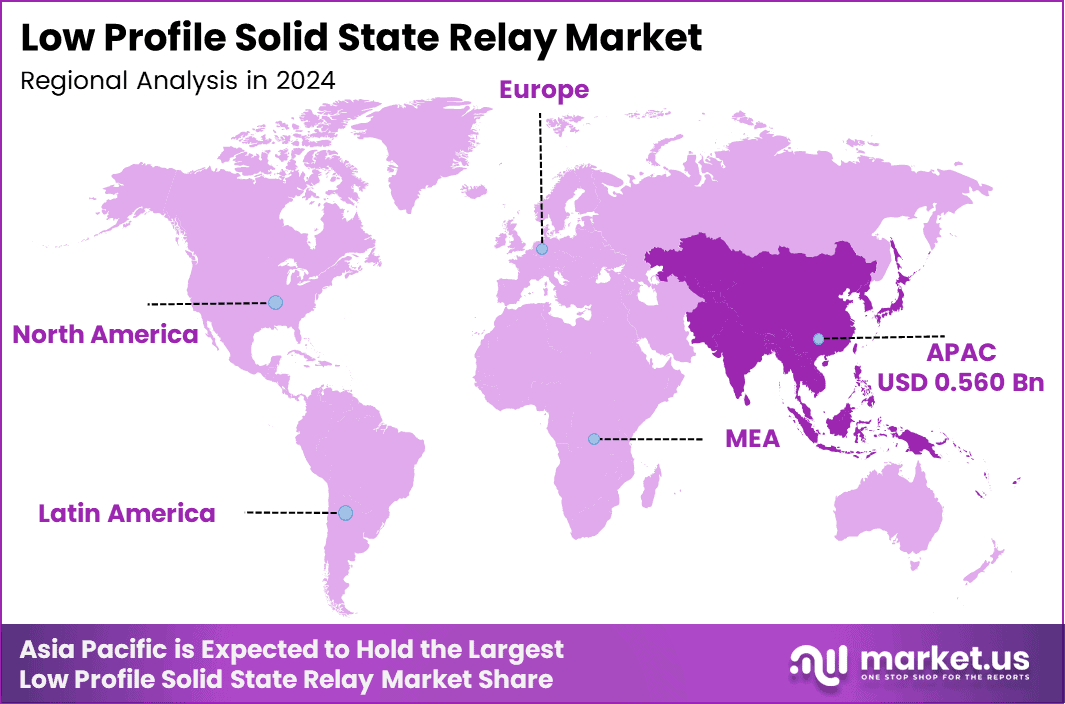
In 2024, the Global Low Profile Solid State Relay Market was valued at USD 1.4 billion. The market is projected to grow at a CAGR of 9.5% during 2024–2034, reaching approximately USD 3.47 billion by 2034. Asia Pacific dominated the global market in 2024, accounting for 40.2% of the total market share and generating approximately USD 0.56 billion in revenue.
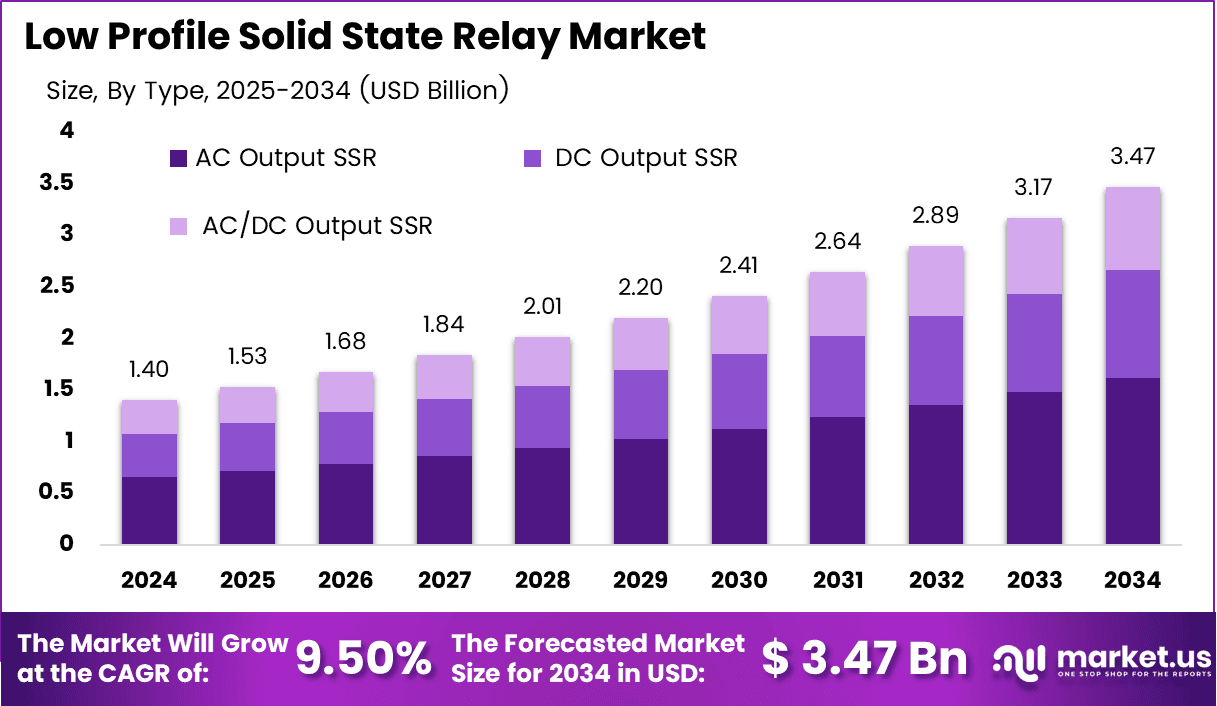
This growth is closely tied to the expansion of three major end-use sectors: automotive, data centers, and industrial automation. Global motor vehicle production rose from 92.7 million units in 2024 to 96.4 million units in 2025, a 3.9% jump, with Asia Pacific alone producing 59.2 million vehicles, or 61% of world output, according to OICA.
As factories in China, Japan, and India build more vehicles, especially electric ones like China’s 16.6 million new-energy vehicles produced in 2025, demand for compact, heat-tolerant relays grows directly with output. At the same time, data centers are consuming far more power. The IEA reports global data center electricity use stood at 415 TWh in 2024 and is set to roughly double to 945 TWh by 2030, growing 15% a year, as AI computing expands.
This surge forces data center operators to add more power distribution and load-switching hardware, where compact solid-state relays are preferred for their reliability and space savings in dense server racks. Industrial automation adds a third pillar of demand: the International Federation of Robotics recorded 542,076 new industrial robot installations in 2024, topping 500,000 units for the fourth year running, with China and other Asian manufacturers leading this build-out.
Key Takeaways
- The global Low Profile Solid State Relay Market was valued at USD 1.4 billion in 2024.
- The global Low Profile Solid State Relay Market is projected to grow at a CAGR of 9.5% and is estimated to reach USD 3.47 billion by 2034.
- On the basis of type, the AC Output SSR segment dominated the market, accounting for 46.7% of the total market share.
- By application, the Industrial Automation segment dominated the market, accounting for 35.3% of the total market share.
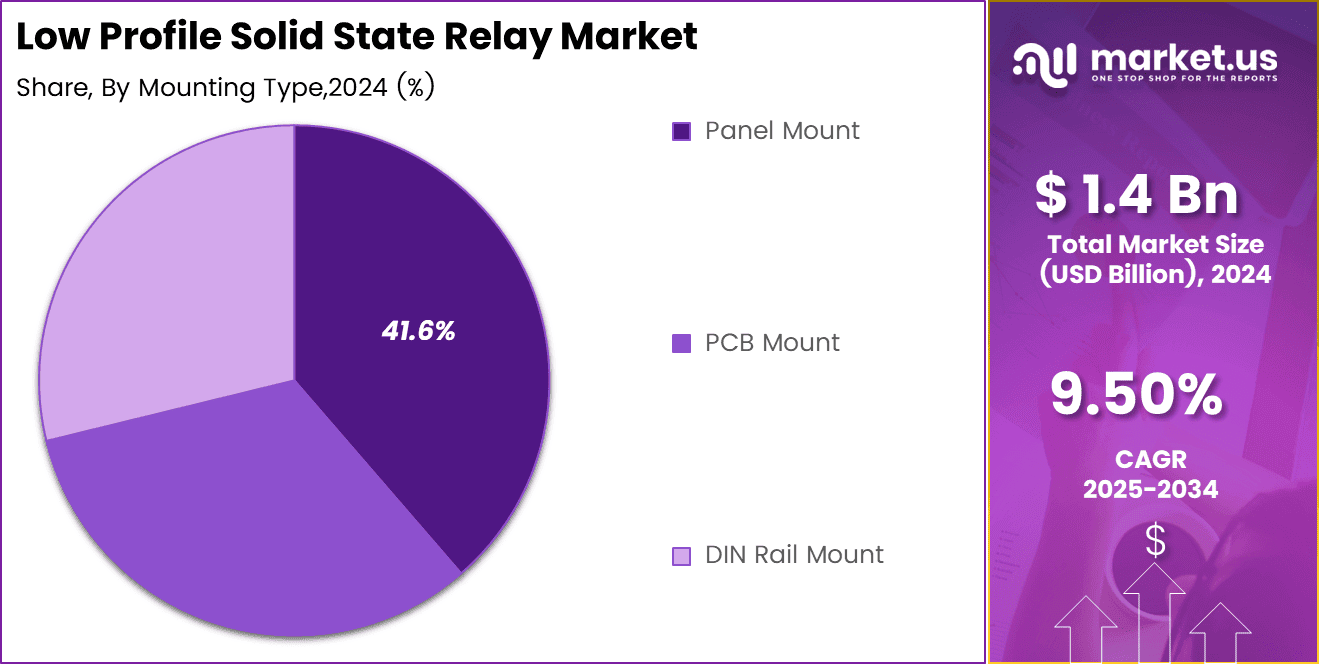
- Based on mounting type, the Panel Mount segment dominated the market, accounting for 41.6% of the total market share.
- By end-user, the Industrial segment dominated the market, accounting for 45.8% of the total market share.
- In 2024, Asia Pacific was the most dominant region in the Low Profile Solid State Relay Market, accounting for 40.2% of the total market share and generating approximately USD 0.56 billion in revenue.
By Type
The AC Output SSR segment holds the largest market share at 46.7%, driven by its widespread application in industrial automation and energy-efficient solutions. These relays are commonly used in controlling AC-powered devices, such as motors, heating elements, and HVAC systems, across various industrial sectors.
The AC Output Low Profile Solid State Relays market is expected to maintain steady growth with a projected CAGR of 5.5%. Technological advancements in thermal management and compact design are expected to support this growth.
By 2034, this segment is anticipated to capture 48.3% of the market share. As industries continue to embrace automation and energy efficiency, demand for AC Output SSRs is likely to increase, especially in manufacturing, energy, and industrial automation sectors.
By Application
Industrial Automation accounts for 35.3% of the market share, reflecting the growing demand for SSRs in automated manufacturing processes. Automation technologies, including robotic arms, conveyors, and material handling systems, rely on SSRs for precise control.
The Industrial Automation segment is projected to grow at a CAGR of 6.2%, reaching 37.5% by 2034. The shift toward automation in industries such as automotive, food processing, and electronics manufacturing is a key driver.
By Mounting Type
Panel Mount dominates the Low Profile Solid State Relays market with a share of 41.6%, primarily due to their robust design and ease of installation in industrial control panels. These relays are widely used in applications requiring stable, reliable performance in environments with high electrical loads.
The Panel Mount segment is expected to grow at a 4.7% CAGR, with its share increasing to 43.2% by 2034. This growth is driven by the rise in modular electrical systems, which are commonly found in industrial automation, HVAC, and building controls. Panel-mount SSRs offer space-saving solutions, making them highly suitable for compact systems.
By End-User
The Industrial end-user segment leads with a 45.8% Low Profile Solid State Relays market share, driven by the demand for SSRs in manufacturing, energy, and transportation industries. SSRs are crucial in controlling motors, heating elements, and lighting systems, ensuring reliable and efficient operations in industrial settings.
The Industrial segment is expected to grow at a CAGR of 5.8%, reaching 47.2% by 2034. This growth is fueled by the increasing automation and need for reliable, low-maintenance components in industrial processes. The rise of smart factories and the global push for energy-efficient and sustainable manufacturing further support the demand for SSRs. Industries seek to enhance productivity and reduce operational downtime.
Key Market Segments
By Type
- AC Output SSR
- DC Output SSR
- AC/DC Output SSR
By Application
- Industrial Automation
- Building Equipment
- Home Appliances
- Automotive
- Others
By Mounting Type
- Panel Mount
- PCB Mount
- DIN Rail Mount
By End-User
- Industrial
- Commercial
- Residential
Regional Analysis
The Asia-Pacific (APAC) region is set to maintain its leadership in the global Low Profile Solid State Relay market. As of 2024, the APAC region, including China, is expected to generate approximately USD 0.56 billion in market revenue.
The increasing demand for industrial automation, energy-efficient solutions, and the expanding manufacturing sector in countries like Japan, South Korea, and India are some of the main drivers behind this growth. The region’s market is benefiting from rising investments in smart technologies and green initiatives, positioning it to continue dominating the global market through the forecasted period.
Globally, the Low Profile Solid State Relay market is expanding as industries increasingly adopt energy-efficient solutions to meet sustainability goals. Low-profile SSRs offer advantages such as compact size, low maintenance, and high reliability, making them highly suitable for industries that prioritize automation and energy efficiency.
China Market Size
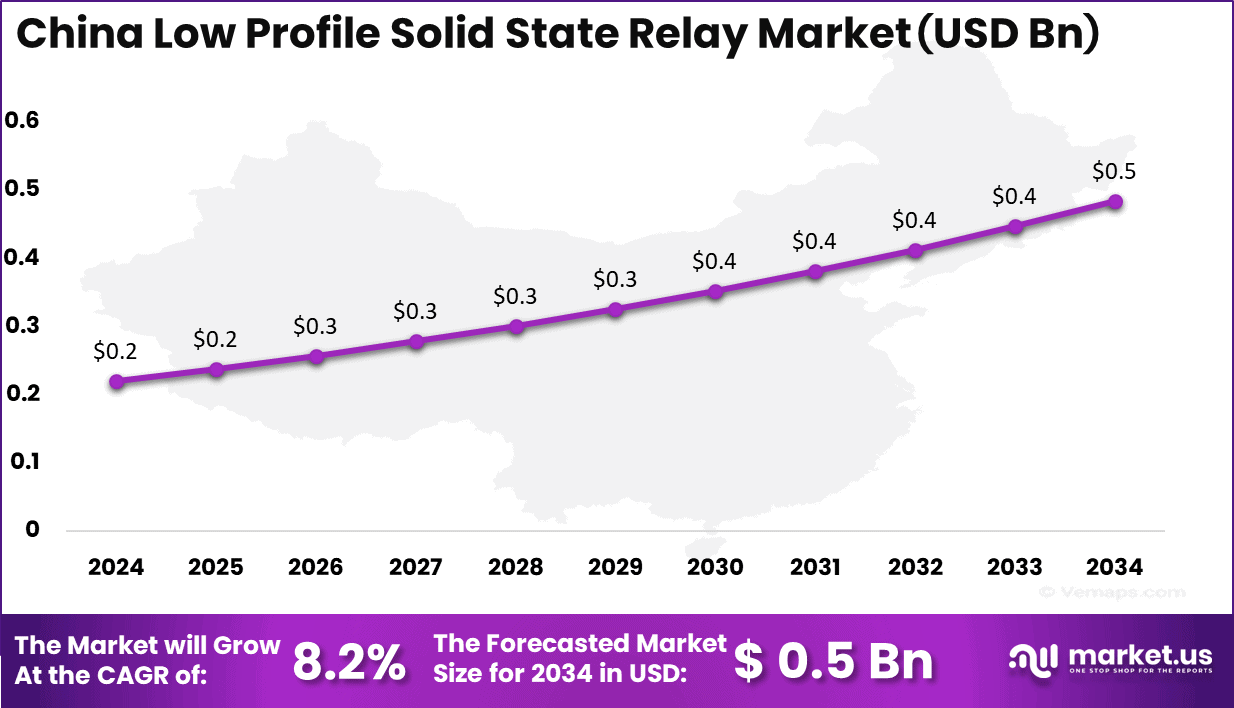
The China Low Profile Solid State Relay market is experiencing steady growth, with a projected increase from USD 0.2 billion in 2024 to USD 0.5 billion by 2034. The market is anticipated to grow at a compound annual growth rate (CAGR) of 8.2%.
This growth is driven by several factors, including the rising demand for automation in various industries such as manufacturing, automotive, and electronics. Furthermore, China’s growing focus on energy efficiency and industrial upgrades plays a crucial role in driving the adoption of low-profile SSRs.
Key Regions and Countries
- North America
- US
- Canada
- Europe
- Germany
- France
- The UK
- Spain
- Italy
- Rest of Europe
- Asia Pacific
- China
- Japan
- South Korea
- India
- Australia
- Singapore
- Rest of Asia Pacific
- Latin America
- Brazil
- Mexico
- Rest of Latin America
- Middle East & Africa
- South Africa
- Saudi Arabia
- UAE
- Rest of MEA
Drivers
| Driver | (~) % Impact on CAGR Forecast | Geographic Relevance | Impact Timeline |
|---|---|---|---|
| Industrial Automation Retrofits | +2.1% | China, Germany, USA | Short term (≤ 2 years) |
| EV Power Electronics Integration | +1.8% | China, South Korea, USA | Short term (≤ 2 years) |
| Panel Space Constraints in Control Cabinets | +1.4% | Global (Asia-Pacific led) | Short term (≤ 2 years) |
| Renewable Inverter and BESS Switching Demand | +1.2% | India, China, EU | Medium term (2–4 years) |
| Semiconductor Fab Automation Expansion | +0.9% | Taiwan, South Korea, USA | Short term (≤ 2 years) |
Industrial Automation Retrofits
The root cause of this driver is the accelerated replacement cycle for programmable logic controller (PLC)-integrated switching gear that began after several national manufacturing modernization schemes launched between 2022 and 2023.
The quantitative mechanism shows low-profile SSR unit shipments into automation OEMs rising at an estimated 11%–13% annual clip through 2024, based on association-level shipment data from electromechanical component trade bodies, versus roughly 6%–7% growth for standard-profile SSRs. This implies a 150–200 basis-point premium contribution to the segment’s baseline growth trajectory.
Strategically, this shift is compressing per-unit board space requirements by approximately 30%–35% compared to legacy panel-mount SSRs. This allows control-panel manufacturers to reduce enclosure bill-of-materials costs by an estimated 4%–6% per cabinet while supporting a gradual gross margin uplift of 150%–250% basis points for component suppliers that transitioned production lines toward the low-profile form factor ahead of the 2024 baseline year.
Restraints
| Restraint | (~) % Impact on CAGR Forecast | Geographic Relevance | Impact Timeline |
|---|---|---|---|
| High Component Cost vs. Electromechanical Relays | -1.9% | Global (price-sensitive markets) | Short term (≤ 2 years) |
| Thermal Density Limits in Compact Housings | -1.3% | Global | Short term (≤ 2 years) |
| Capital Rationing Amid Elevated Interest Rates | -1.1% | USA, EU, India | Short term (≤ 2 years) |
| Semiconductor Substrate Supply Tightness | -0.8% | Taiwan, China, USA | Short term (≤ 2 years) |
High Component Cost vs. Electromechanical Relays
The root cause is the persistent bill-of-materials gap between semiconductor-based switching and electromechanical contacts, with low-profile SSR unit costs running approximately 3–5 times higher per equivalent current rating than comparable mechanical relays, according to manufacturer price sheets and distributor catalogs referenced by electrical component associations.
The quantitative bottleneck is most acute in the sub-10 ampere, price-sensitive OEM segment, where finance teams at panel-builder customers report deferring conversion decisions when incremental per-unit cost exceeds roughly 2 percent of finished panel cost. This threshold low-profile variants often breach due to added heat-sink miniaturization and optical isolation components that raise manufacturing cost per unit by an estimated 8–12 percent versus standard SSRs.
Strategically, this cost differential is freezing near-term conversion in cost-competitive appliance and HVAC controller segments, forcing component suppliers to absorb 150–200 basis points of gross margin compression to hold price parity in competitive tenders, while delaying planned capacity expansion capital expenditure by an estimated 6–9 months at several mid-tier fabrication and assembly facilities through 2024.
Challenges
| Challenge | (~) % CAGR Friction Drag | Geographic Relevance | Mitigation Horizon |
|---|---|---|---|
| Off-State Leakage Current Reliability | -1.2% | Global | Medium term (2–4 years) |
| Skilled Power-Electronics Talent Shortage | -1.0% | USA, EU, India | Long term (≥ 4 years) |
| Fragmented Load-Type Compatibility Standards | -0.7% | Global | Medium term (2–4 years) |
| Multi-Tier Supplier Lead-Time Volatility | -0.6% | China, Taiwan, Southeast Asia | Medium term (2–4 years) |
Off-State Leakage Current Reliability
The structural vulnerability stems from the inherent semiconductor physics of solid-state switching, where residual off-state leakage current typically ranging from 1 to 10 milliamps can trigger nuisance tripping or false signal states in sensitive instrumentation and low-current control loops.
The quantitative friction manifests as elevated field-return rates, with industry association reliability data indicating leakage-related returns accounting for an estimated 15%–20% of total SSR warranty claims in low-profile form factors where miniaturized die packaging leaves less thermal and electrical margin than standard housings.
This requires long-term corporate adjustments, including incremental R&D allocation of roughly 3%–4% of segment revenue toward improved MOSFET and triac gating design, extended qualification testing cycles adding 4–6 weeks to product launch timelines, and closer collaboration with end-use integrators to redesign circuit tolerances.
Opportunities
| Opportunity | (~) % Potential CAGR Upside | Geographic Relevance | Execution Window |
|---|---|---|---|
| Adjacent Medical Device Miniaturization | +1.6% | USA, EU, Japan | Medium term (2–4 years) |
| Behind-the-Meter Energy Storage Retrofits | +1.4% | India, Southeast Asia, Africa | Medium term (2–4 years) |
| Smart Building HVAC Controller Upgrades | +1.1% | Global | Medium term (2–4 years) |
| Regional Fab Roll-Up and M&A Consolidation | +0.8% | China, USA, EU | Long term (≥ 4 years) |
| Aftermarket Retrofit Kits for Legacy Panels | +0.6% | Global | Long term (≥ 4 years) |
Adjacent Medical Device Miniaturization
This is classified as untapped white space rather than a current driver because low-profile SSR penetration into implantable and portable diagnostic equipment remains negligible today, with adoption still concentrated in industrial and automotive segments per manufacturer product-line disclosures and association shipment breakdowns as of 2024.
The future monetization mechanism lies in medical-grade certification pathways, where component suppliers that pursue compliance with relevant device-safety standards could unlock a meaningful share of the addressable market currently served by bulkier electromechanical or hybrid switching solutions, particularly as portable dialysis, infusion pump, and diagnostic imaging manufacturers seek footprint reductions of 25%–40% in switching subassemblies.
The unit-economic shift is substantial, since medical-qualified low-profile SSRs typically command average selling price premiums of 18%–25% over industrial-grade equivalents while carrying gross margins estimated at 8%–12% percentage points above the segment average. This makes this a deliberate strategic play requiring regulatory investment and design-cycle lead times of roughly 18–30 months rather than a capability already being monetized at scale.
Key Players Analysis
The Low Profile Solid State Relay market exhibits a bifurcated structure. Tier-1 leaders, Omron, TE Connectivity, Schneider Electric, Siemens, Broadcom, and Vishay, leverage diversified electronics and automation revenue bases exceeding several billion dollars to fund SSR R&D as a small but strategic line item.
TE Connectivity posted record FY2025 net sales of $17.3 billion, with its Industrial Solutions segment, relay-relevant, surging 23.7% to $7.87 billion, boosted by the $179 million Richards Manufacturing acquisition.
Schneider Electric’s FY2025 R&D cash costs hit €2.38 billion (5.9% of revenue), sustaining component miniaturization pipelines relevant to low-profile SSR packaging. Siemens grew total revenue 4% to €78.9 billion, with Digital Industries contributing €16.72 billion, funding automation-embedded relay integration.
Tier-2 challengers, Littelfuse, Rockwell Automation, Vishay, Carlo Gavazzi, Celduc Relais, WAGO, Phoenix Contact, and Crydom, compete on specialization and cost efficiency rather than scale. Littelfuse’s FY2025 net sales reached $2.386 billion (+8.9%), with R&D spend of $106.9 million (4.5% of sales), reflecting protection and passive component focus.
Rockwell Automation’s FY2025 revenue held flat at $8.34 billion with R&D at $482 million (5.8% of sales), signaling steady automation-relay integration investment rather than aggressive expansion. Vishay posted FY2025 revenue of $3.07 billion, with gross margin compressing to 19.4% amid Newport-related integration costs, indicating tighter margins among discrete and passive specialists.
Top Key Players
- Omron Corporation
- Crydom Inc.
- Panasonic Corporation
- TE Connectivity Ltd.
- Vishay Intertechnology, Inc.
- Fujitsu Limited
- IXYS Integrated Circuits Division, Inc.
- Broadcom Inc.
- Carlo Gavazzi Holding AG
- Celduc Relais
- Omega Engineering Inc.
- Rockwell Automation, Inc.
- Phoenix Contact GmbH & Co. KG
- Schneider Electric SE
- Siemens AG
- Littelfuse, Inc.
- Avago Technologies Limited
- Toshiba Corporation
- WAGO Kontakttechnik GmbH & Co. KG
- Altech Corporation
- Others
Recent Development
- In June 2024, Expansion of Electric Vehicle (EV) charging infrastructure: Several major EV charging companies expanded their networks, increasing the number of charging stations by 30%. This move bolstered the role of fast-charging infrastructure, which accounted for 42.3% of the total network compared to 57.7% for slower, standard chargers, reflecting a 4:6 ratio.
- In August 2025, There Was a Surge in Renewable Energy Adoption: multiple countries announced increased investments in renewable energy projects, particularly solar and wind power. This move significantly increased the share of renewable energy, which reached 48.7%, compared with 51.3% for traditional energy sources.
Report Scope
| Report Features | Description |
|---|---|
| Market Value (2024) | USD 1.4 Bn |
| Forecast Revenue (2034) | USD 3.47 Bn |
| CAGR(2025-2034) | 9.5% |
| Base Year for Estimation | 2024 |
| Historic Period | 2020-2023 |
| Forecast Period | 2025-2034 |
| Report Coverage | Revenue forecast, AI impact on Market trends, Share Insights, Company ranking, competitive landscape, Recent Developments, Market Dynamics, and Emerging Trends |
| Segments Covered | By Type (AC Output SSR, DC Output SSR, AC/DC Output SSR), By Application (Industrial Automation, Building Equipment, Home Appliances, Automotive, Others), By Mounting Type (Panel Mount, PCB Mount, DIN Rail Mount), By End-User (Industrial, Commercial, Residential) |
| Regional Analysis | North America – US, Canada; Europe – Germany, France, The UK, Spain, Italy, Russia, Netherlands, Rest of Europe; Asia Pacific – China, Japan, South Korea, India, New Zealand, Singapore, Thailand, Vietnam, Rest of Latin America; Latin America – Brazil, Mexico, Rest of Latin America; Middle East & Africa – South Africa, Saudi Arabia, UAE, Rest of MEA |
| Competitive Landscape | Omron Corporation, Crydom Inc., Panasonic Corporation, TE Connectivity Ltd., Vishay Intertechnology, Inc., Fujitsu Limited, IXYS Integrated Circuits Division, Inc., Broadcom Inc., Carlo Gavazzi Holding AG, Celduc Relais, Omega Engineering Inc., Rockwell Automation, Inc., Phoenix Contact GmbH & Co. KG, Schneider Electric SE, Siemens AG, Littelfuse, Inc., Avago Technologies Limited, Toshiba Corporation, WAGO Kontakttechnik GmbH & Co. KG, Altech Corporation, Others |
| Customization Scope | Customization for segments, region/country-level will be provided. Moreover, additional customization can be done based on the requirements. |
| Purchase Options | We have three licenses to opt for: Single User License, Multi-User License (Up to 5 Users), Corporate Use License (Unlimited Users and Printable PDF) |





































