


Report Overview
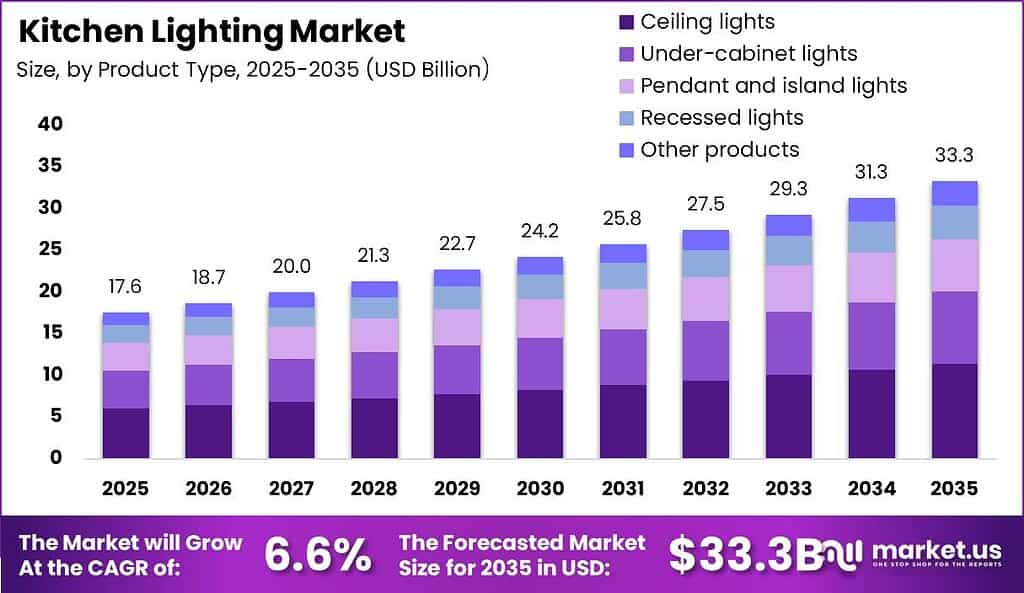
Global Kitchen Lighting Market size is expected to be worth around USD 33.30 Billion by 2035 from USD 17.60 Billion in 2025, growing at a CAGR of 6.6% during the forecast period 2026 to 2035. This expansion reflects steady renovation spending and the shift of kitchen fixtures from single replacements to multi-layer packages. Investors who track units per project rather than fixture price alone will better capture margin expansion across the decade.
Therefore, the kitchen lighting market covers ceiling, under-cabinet, pendant, recessed and specialty fixtures sold into homes, commercial kitchens, hospitality venues and institutions. Buyers layer ambient, task and accent sources to support cooking, dining and open-plan living. Suppliers that bundle controls with luminaires raise average project value and lock in installer loyalty before competitors standardize the same packages.
Key Takeaways
- The market reaches USD 17.60 Billion in 2025 and is projected to hit USD 33.30 Billion by 2035 at a CAGR of 6.6%.
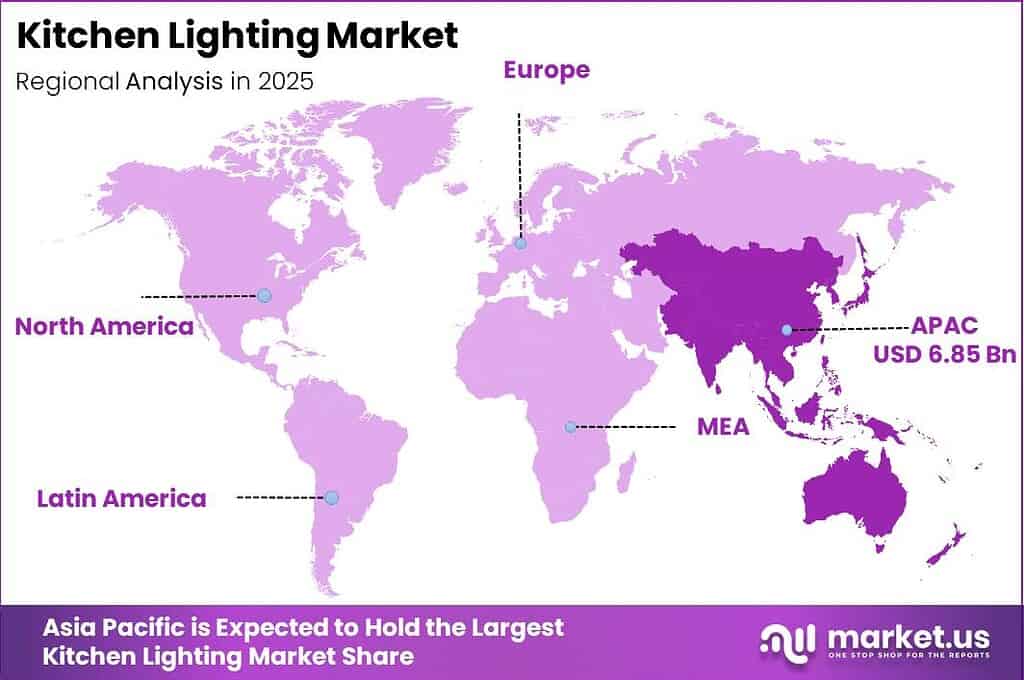
- Asia Pacific leads with a 39.00% share valued at USD 6.85 Billion.
- Ceiling lights lead product type with a 34.20% share.
- LED leads light source with an 81.00% share.
- Renovation and retrofit leads installation type with a 56.00% share.
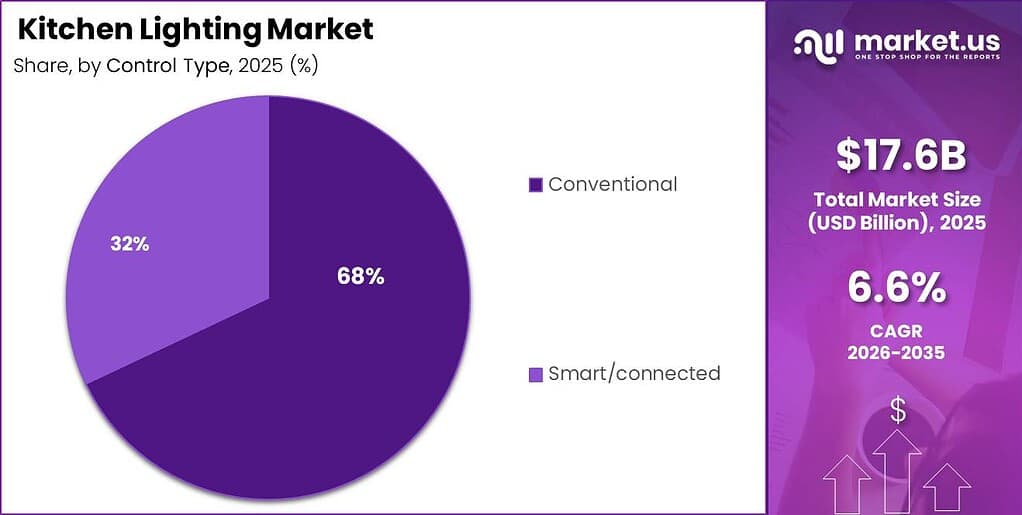
- Conventional controls lead control type with a 68.00% share.
- Residential leads end user with a 68.00% share.
As per our research, 72% of U.S. homeowners who upgraded kitchen lighting in 2026 selected recessed lighting and the same share selected undercabinet lighting. This dual selection raises fixture counts per renovation and rewards vendors who sell coordinated kits rather than isolated SKUs. Consequently, channel partners that train installers on layered layouts convert more full-kitchen tickets before price-led rivals enter the same projects.
Figures from the same 2026 U.S. study show 56% of renovating homeowners installed pendant lights while 21% selected chandeliers. This mix elevates decorative spend above pure task lighting and supports premium island and dining packages. In October 2025, Lutron Electronics began shipping its Rania A20, S30 and S38 lamps, expanding natural-white residential options that fit these design choices and help suppliers defend average selling prices.
Product Type Analysis
Ceiling lights dominates with 34.20% due to broad ambient coverage needs.
In 2025, Ceiling lights held a dominant market position in the By Product Type segment of Kitchen Lighting Market, with a 34.20% share. Ambient ceiling fixtures remain the first specification in most kitchen layouts because they set base illumination before task layers are added. Houzz’s 2026 UK kitchen-renovation study reported that 80% of homeowners upgraded kitchen lighting fixtures, confirming high replacement intensity. Suppliers who pair ceiling bases with matching under-cabinet runs raise attach rates and protect margin against commodity spot fixtures.
Under-cabinet lights deliver task illumination on counters where shadows from overhead sources reduce safety and speed. Among UK homeowners updating kitchen lighting in 2025, 43% chose fixtures combining metal and glass while 39% selected all-metal fixtures, showing material preference that shapes under-cabinet styling. Vendors who stock high-CRI linear strips with simple clip mounts win installer preference on retrofit jobs. This creates sticky distributor demand for complete counter packages rather than one-off bulbs.
Pendant and island lights anchor visual focus over islands and dining zones where homeowners want statement design. Recessed lights provide clean ceiling planes popular in modern open kitchens. Other products cover specialty and niche fixtures that fill remaining share collectively. Brands that offer coordinated families across ceiling, under-cabinet, pendant and recessed lines reduce specification friction and capture multi-fixture tickets before single-category specialists respond.
Light Source Analysis
LED dominates with 81.00% due to efficiency and long lifetime.
In 2025, LED held a dominant market position in the By Light Source segment of Kitchen Lighting Market, with a 81.00% share. High efficacy and long life make LEDs the default choice for both new builds and retrofits. In the 2026 UK study, 71% of renovating homeowners selected LED lightbulbs, making LEDs the most frequently reported energy-efficient kitchen feature. Manufacturers who lock in LED platforms early protect volume against fluorescent and halogen exit paths.
Fluorescent sources still appear in some older commercial kitchens where ballast systems remain installed. Incandescent and halogen options serve limited aesthetic or specialty niches where color rendering or dimming feel is prioritized over efficiency. Other sources hold residual share as codes and utility programs push conversion. Distributors who phase inventory toward LED families reduce dead stock risk and free shelf space for higher-turn connected accessories.
The IEA notes China and India lead global LED adoption with market shares exceeding 85% and 75% respectively, reinforcing volume scale that lowers component costs worldwide. This cost curve supports aggressive kitchen LED pricing without destroying brand tiers. Investors should favor firms that own driver and optical IP rather than pure assembly models exposed to commodity price swings.
Installation Type Analysis
Renovation and retrofit dominates with 56.00% due to existing housing stock upgrades.
In 2025, Renovation and retrofit held a dominant market position in the By Installation Type segment of Kitchen Lighting Market, with a 56.00% share. Most kitchens already exist, so upgrade cycles drive more unit demand than pure new construction. Houzz’s 2025 UK kitchen findings showed that 85% of renovating homeowners updated lighting fixtures and 65% added undercabinet lighting. Contractors who standardize quick-fit kits shorten labor hours and win more bid packages in this channel.
New construction installs full layered systems during shell and finish stages when electrical rough-in is open. Specifiers can place recessed cans, ceiling fixtures and control wiring before drywall closes, raising design freedom versus retrofit constraints. Builders who pre-select modular LED families cut change-order risk and stabilize procurement costs across multi-unit projects. This signals durable volume for manufacturers with builder-direct programs and certified product lists.
Retrofit jobs often face older wiring and limited ceiling access, which favors surface and under-cabinet solutions over deep recessed work. Suppliers that publish clear load and dimmer compatibility charts reduce callbacks and protect installer margins. As a result, channel education becomes a competitive moat equal to product performance in the renovation majority of demand.
Control Type Analysis
Conventional dominates with 68.00% due to simple switch and dimmer familiarity.
In 2025, Conventional held a dominant market position in the By Control Type segment of Kitchen Lighting Market, with a 68.00% share. Wall switches and basic dimmers remain the default for cost-sensitive renovations and mass-market housing. In 2026 NKBA research, 87% of respondents said kitchens had become spaces for showcasing decorative or statement lighting, yet many of those projects still use conventional controls. Vendors who pair premium fixtures with simple dimming keep average order value high without forcing full smart upgrades.
Smart and connected controls enable scenes, schedules and voice or app operation across layered kitchen zones. Homeowners who already run multi-room automation adopt kitchen nodes faster because kitchen use spans morning prep through late-night navigation. Manufacturers that ship Matter-ready modules cut integration friction and reduce return rates. This creates an upsell path for distributors once conventional base fixtures are secured.
Conventional dominance means smart share still has room to expand without displacing the bulk of unit volume overnight. Companies that design dual-path SKUs accepting both standard dimmers and wireless hubs protect channel breadth. Consequently, portfolio balance between conventional reliability and connected features becomes a core portfolio design choice for the forecast period.
End User Analysis
Residential dominates with 68.00% due to high home renovation frequency.
In 2025, Residential held a dominant market position in the By End User segment of Kitchen Lighting Market, with a 68.00% share. Home kitchens generate the largest unit volume through renovation and new housing activity. The NKBA’s 2026 Kitchen Trends Report found that 95% of surveyed industry professionals identified natural lighting as an important homeowner consideration, 93% cited overall lighting quality and 92% cited task lighting for kitchen work zones. Brands that message task quality and natural-light balance win specification influence with designers and remodelers.
Commercial kitchens prioritize durability, cleanability and high lumen output under long operating hours. Hospitality and foodservice venues add decorative layers that support guest experience in open kitchens and dining-adjacent spaces. Institutional facilities such as schools and healthcare sites emphasize code compliance and maintenance simplicity. Other commercial and institutional buyers hold remaining share collectively and reward vendors with long-life LED warranties and standardized spare parts.
Residential scale gives suppliers volume leverage that funds R&D for commercial-grade variants of the same LED platforms. Firms that segment catalogs clearly by residential aesthetics versus commercial ruggedization avoid channel conflict. This reflects a structure where home demand sets volume while non-residential demand sets specification rigor.
Key Market Segments
By Product Type
- Ceiling lights
- Under-cabinet lights
- Pendant and island lights
- Recessed lights
- Other products
By Light Source
- LED
- Fluorescent
- Incandescent
- Halogen
- Other
By Installation Type
- New construction
- Renovation and retrofit
By Control Type
- Conventional
- Smart/connected
By End User
- Residential
- Commercial
- Hospitality and foodservice
- Institutional facilities
Regional Analysis
Asia Pacific Dominates the Kitchen Lighting Market with a Market Share of 39.00%, Valued at USD 6.85 Billion
Asia Pacific leads global kitchen lighting demand through dense urban housing growth and rapid LED conversion in China, India, Japan, South Korea and Australia. Large residential construction pipelines and expanding hospitality kitchens sustain fixture volumes across ceiling and under-cabinet categories. Local manufacturing scale also lowers landed cost for exporters serving other regions. Investors should prioritize partners with regional assembly and distributor depth to capture this leading share through 2035.
North America and Europe form the next major demand pools, driven by renovation cycles and energy-code pressure on inefficient sources. Homeowners in these markets layer task and decorative fixtures during kitchen remodels, supporting higher average project values than pure replacement bulbs. Strong designer and builder channels favor brands with certified LED performance data. This means premium and smart-capable lines can grow faster than unit volume alone suggests.
Latin America and Middle East and Africa contribute smaller but rising shares as modular kitchens and tourism-led foodservice expand. Import-dependent markets remain sensitive to freight and duty swings that affect fixture pricing. Suppliers who offer modular, easy-install kits reduce labor barriers in these regions. As a result, go-to-market models that pair logistics resilience with simple installation win share ahead of complex specification systems.
Key Regions and Countries
North America
- US
- Canada
Europe
- Germany
- France
- The UK
- Spain
- Italy
- Rest of Europe
Asia Pacific
- China
- Japan
- South Korea
- India
- Australia
- Rest of APAC
Latin America
- Brazil
- Mexico
- Rest of Latin America
Middle East and Africa
- GCC
- South Africa
- Rest of MEA
Market Dynamics
Market Opportunity Analysis - Smart controls, retrofit kits and emerging modular kitchens open white space beyond ceiling LED volume.
Smart and connected controls still trail conventional systems at 68.00% conventional share, leaving clear room in residential kitchens that already layer multiple fixtures. Homeowners who buy statement pendants and under-cabinet runs often stop short of full scene control. Entrants that ship dual-path dimmers and simple app onboarding can attach software margin without displacing fixture sales. This creates a lower-friction path than forcing a full smart overhaul on every project.
Renovation and retrofit already holds 56.00% of installation demand, yet many older kitchens still lack under-cabinet task light. Sensor-ready linear kits that clip into existing cabinets reduce electrician time and landlord objections. New players who design for 15-minute installs can win mass retail and e-commerce shelves before premium brands respond. Therefore, speed of install becomes as important as lumen output in this pocket of demand.
Hospitality and foodservice plus institutional facilities sit outside the 68.00% residential core and remain under-served by pure décor brands. These buyers need cleanable housings, long warranties and standardized spares more than fashion finishes. Specialists who certify products for commercial kitchens can secure multi-site contracts with steadier reorder cycles. This reflects a route to scale that is less dependent on housing finance swings.
Emerging modular kitchen growth in India, Southeast Asia, Latin America and Africa remains below Asia Pacific’s overall 39.00% leadership concentration in mature coastal markets. Value-engineered LED ceiling and under-cabinet bundles priced for first-time kitchen buyers can open volume without premium branding. Early movers who localize assembly and packing cut duty and freight drag. As a result, regional SKUs become a practical entry wedge rather than a global catalog dump.
Technology and Innovation Landscape - High-efficacy LEDs, tunable whites and connected strips redefine kitchen layer performance.
High-efficacy LED platforms now reach up to 210 lumens per watt with lifetimes up to 50,000 hours on professional catalogue products applicable to kitchens. This performance cuts energy and maintenance arguments that once favored cheaper legacy lamps. Manufacturers who publish verified lumen maintenance data win specification trust with builders and designers. Investors should track who owns driver and phosphor IP rather than housing design alone.
Undercabinet LED fixtures such as Signify Day-Brite units deliver 175 to 594 lumens at 2.5 to 7.3 watts with 90 CRI and 70% lumen maintenance at 50,000 hours. Compact thermal design enables continuous runs under cabinets without hot spots. Brands that standardize color temperatures at 3,000 K or 3,500 K simplify multi-fixture matching. This creates fewer callbacks and stronger installer preference on retrofit jobs.
Tunable white tape lights and natural-white lamp families expand kitchen scenes from fixed task light to time-of-day comfort. Homeowners can shift cooler tones for prep and warmer tones for dining without changing fixtures. Suppliers who integrate these sources with established control systems reduce commissioning risk. Consequently, electronics content per kitchen rises even when fixture count stays flat.
Connected strip-light portfolios and bridge upgrades extend kitchen lighting into whole-home automation meshes. Strip form factors fit toe-kicks, shelves and glass cabinets that hard luminaires cannot reach. Firms that redesign strips for easier cutting and power injection lower DIY failure rates. This signals a shift from one-time fixture sales toward ecosystem lock-in through apps and hubs.
Drivers
Declining LED operating costs move kitchen lighting purchases from décor toward lifecycle investment. The U.S. Department of Energy indicated in 2024 that replacing fluorescent systems with LEDs can cut lighting electricity use by 20% to 60%. Controlled-lighting projects delivered more than 50% energy reduction, with annual savings from 1.3 million kWh to more than 3.5 million kWh. This payback logic adds roughly 1.3% to the 6.6% baseline CAGR as buyers adopt bundled task, ambient and control packages.
The revised Energy Performance of Buildings Directive entered into force on 28 May 2024 and requires national transposition by 29 May 2026. Residential renovation activity and layered kitchen design add further pull in North America, Europe and developed Asia-Pacific. Energy-code compliance and hospitality kitchen expansion extend demand into commercial channels. Suppliers who sell multi-zone kits rather than single luminaires raise units per project and installer conversion.
| Driver | (~) % Impact on CAGR Forecast | Geographic Relevance | Impact Timeline |
|---|---|---|---|
| LED Retrofit Economics | +1.3% | Global; strongest in North America and Europe | Short term (2 years or less) |
| Residential Renovation Activity | +0.9% | North America, Europe and developed Asia-Pacific | Medium term (2 to 4 years) |
| Layered Kitchen Design | +0.7% | Global urban and premium residential markets | Short term (2 years or less) |
| Energy-Code Compliance | +0.6% | European Union, North America and East Asia | Medium term (2 to 4 years) |
| Hospitality Kitchen Expansion | +0.4% | Asia-Pacific, Middle East and tourism-led economies | Medium term (2 to 4 years) |
Restraints
High borrowing costs restrain kitchen renovation starts because lighting is purchased late in cabinetry and appliance budgets. According to the OECD, rising interest rates combine with higher material and labour costs to lift renovation expense. The IMF reported in 2024 that real home prices across predominantly high-income OECD economies had risen approximately 37% over the preceding decade. This financing pressure deducts about 1.1% from the 6.6% baseline CAGR by delaying whole-kitchen projects.
Low-cost fixture saturation in mass retail compresses brand pricing power globally. Import-duty exposure hits the United States and other import-dependent markets in the short term. Electrical retrofit expense slows upgrades in older European and North American housing stocks. Landlord reluctance limits upgrades in urban rental markets over longer horizons. Participants must defend mix with energy-payback messaging and installer-ready kits rather than competing only on shelf price.
| Restraint | (~) % Impact on CAGR Forecast | Geographic Relevance | Impact Timeline |
|---|---|---|---|
| Housing-Finance Affordability | -1.1% | North America, Europe and mortgage-sensitive Asia-Pacific | Short term (2 years or less) |
| Low-Cost Fixture Saturation | -0.7% | Global mass-market retail channels | Medium term (2 to 4 years) |
| Import-Duty Exposure | -0.6% | United States and import-dependent markets | Short term (2 years or less) |
| Electrical Retrofit Expense | -0.5% | Older housing stocks in Europe and North America | Medium term (2 to 4 years) |
| Landlord Upgrade Reluctance | -0.3% | Urban rental markets globally | Long term (4 years or more) |
Challenges
Smart kitchen lighting must work across multiple wireless stacks, voice ecosystems, hubs and legacy dimmers. The Connectivity Standards Alliance positions Matter as a single IP-based protocol to simplify development, yet Wi-Fi, Thread and Bluetooth Low Energy still coexist. Peer-reviewed 2024 research characterized Matter as an open-source, royalty-free standard still transitioning toward common architecture. Qualification burden creates about 0.8% friction against maximum CAGR through extra engineering and higher return rates.
Electronic component volatility concentrates risk in Asian supply chains and can delay smart fixture launches. Installer skills gaps slow commissioning of connected kitchens in North America, Europe and emerging smart-home markets. Thermal management constraints limit compact under-cabinet designs. Specification return complexity raises cost in e-commerce and project channels. Manufacturers need modular radios, over-the-air updates and cross-platform test matrices rather than ecosystem-only product lines.
| Challenge | (~) % CAGR Friction Drag | Geographic Relevance | Mitigation Horizon |
|---|---|---|---|
| Protocol Fragmentation Complexity | -0.8% | Global smart-home markets | Medium term (2 to 4 years) |
| Electronic Component Volatility | -0.7% | Global; concentrated in Asian supply chains | Short term (2 years or less) |
| Installer Skills Gap | -0.5% | North America, Europe and emerging smart-home markets | Long term (4 years or more) |
| Thermal Management Constraints | -0.4% | Global compact-kitchen applications | Medium term (2 to 4 years) |
| Specification Return Complexity | -0.3% | Global e-commerce and project channels | Short term (2 years or less) |
Opportunities
Adaptive wellness lighting remains an opportunity because most kitchens still use fixed-output task and ambient fixtures. Peer-reviewed research available by 2026 indicated circadian-effective indoor lighting may benefit sleep and cognition among older adults. The World Health Organization healthy-ageing framework raises the value of supportive home environments. Suppliers that package tunable output with high-contrast task light could add about 0.9% above the 6.6% baseline CAGR and lift gross margin by an estimated 5 to 9 percentage points.
Lighting-as-a-Service models target commercial kitchens and multifamily properties that prefer opex over capex. Modular repairable fixtures align with European Union sustainability rules and longer asset life. Retrofit sensor kits unlock the large installed residential base in the short term. Emerging-market modular kitchens in India, Southeast Asia, Latin America and Africa open long-term volume. Early movers who build kit, service and subscription layers capture upside before the category commoditizes.
| Opportunity | (~) % Potential CAGR Upside | Geographic Relevance | Execution Window |
|---|---|---|---|
| Adaptive Wellness Lighting | +0.9% | North America, Europe, Japan and South Korea | Medium term (2 to 4 years) |
| Lighting-as-a-Service | +0.7% | Commercial kitchens and multifamily properties globally | Medium term (2 to 4 years) |
| Modular Repairable Fixtures | +0.6% | European Union and sustainability-led markets | Long term (4 years or more) |
| Retrofit Sensor Kits | +0.5% | Global installed residential base | Short term (2 years or less) |
| Emerging-Market Modular Kitchens | +0.4% | India, Southeast Asia, Latin America and Africa | Long term (4 years or more) |
Key Company Insights
Signify N.V. positions kitchen-relevant LED platforms on high efficacy and long life. Signify’s 2025 Philips professional LED catalogue lists lamp efficacy of up to 210 lumens per watt and product lifetime of up to 50,000 hours. This performance supports both residential and professional kitchen installs and lowers total cost of ownership arguments. Scale in LED manufacturing gives the firm pricing and channel reach that smaller fixture brands struggle to match.
Acuity Inc. holds strength in specification-grade luminaires and controls suited to commercial and multi-dwelling kitchens. Broad portfolio depth lets the company serve builders and facility managers who need consistent families across rooms. However, residential decorative kitchen share remains more contested by design-led specialists. Focused kitchen under-cabinet and island packages would reduce that exposure and defend project attach rates.
In September 2025, Lutron Electronics launched its Intelligent Lighting portfolio comprising Ketra, Rania and Lumaris families compatible with HomeWorks and RadioRA 3 control systems, reinforcing controls-led competition around kitchen scenes.
Key Players
- Signify N.V.
- Acuity Inc.
- ams OSRAM AG
- GE Lighting — Savant Systems, Inc.
- Panasonic Holdings Corporation
- Kichler Lighting LLC
- Lutron Electronics Co., Inc.
- Hubbell Incorporated
- EGLO Leuchten GmbH
- Inter IKEA Systems B.V.
- Zumtobel Group AG
- Fagerhult Group
- Havells India Limited
- Legrand S.A.
- Cree Lighting
Recent Developments
- August 2025: Lutron Electronics introduced Rania Natural White Tape Light, Lumaris Downlights and Lumaris Tunable White Tape Light for residential spaces, including kitchen and under-cabinet applications.
- September 2025: Signify launched the Philips Hue Bridge Pro, Hue Essential range and redesigned LED strip-light portfolio for connected residential lighting applications.
Geopolitical Impact Analysis
According to UNCTAD, maritime trade growth is set to slow to 0.5% in 2025 after 2.2% growth in 2024, before averaging about 2% annually over 2026 to 2030. Kitchen lighting fixtures and LED components move heavily in container trades from Asian manufacturing hubs. Freight volatility and route disruption raise landed cost for importers in North America and Europe. This means distributors must widen safety stock or dual-source drivers and housings to protect project lead times.
Data from UNCTAD shows new tariffs are disrupting established trade flows while freight rates stay high and volatile. LED drivers, aluminum housings and electronic controls face duty and delay risk on lanes serving kitchen fixture assembly. World Bank and IMF monitoring of trade policy uncertainty reinforces the need for regional inventory buffers. As a result, manufacturers with multi-country final assembly can stabilize pricing for renovation contractors better than single-origin pure importers.
Report Scope
| Report Features | Description |
|---|---|
| Market Value (2025) | USD 17.60 Billion |
| Forecast Revenue (2035) | USD 33.30 Billion |
| CAGR (2026-2035) | 6.6% |
| Base Year for Estimation | 2025 |
| Historic Period | 2020-2024 |
| Forecast Period | 2026-2035 |
| Report Coverage | Revenue Forecast, Market Dynamics, Market Opportunity Analysis, Technology and Innovation Landscape, Competitive Landscape, Recent Developments |
| Segments Covered | By Product Type (Ceiling lights, Under-cabinet lights, Pendant and island lights, Recessed lights, Other products), By Light Source (LED, Fluorescent, Incandescent, Halogen, Other), By Installation Type (New construction, Renovation and retrofit), By Control Type (Conventional, Smart/connected), By End User (Residential, Commercial, Hospitality and foodservice, Institutional facilities) |
| Regional Analysis | North America (US and Canada), Europe (Germany, France, The UK, Spain, Italy, and Rest of Europe), Asia Pacific (China, Japan, South Korea, India, Australia, and Rest of APAC), Latin America (Brazil, Mexico, and Rest of Latin America), Middle East and Africa (GCC, South Africa, and Rest of MEA) |
| Competitive Landscape | Signify N.V., Acuity Inc., ams OSRAM AG, GE Lighting — Savant Systems, Inc., Panasonic Holdings Corporation, Kichler Lighting LLC, Lutron Electronics Co., Inc., Hubbell Incorporated, EGLO Leuchten GmbH, Inter IKEA Systems B.V., Zumtobel Group AG, Fagerhult Group, Havells India Limited, Legrand S.A., Cree Lighting |
| Customization Scope | Customization for segments, region / country-level will be provided. Additional customization can be done based on requirements. |
| Purchase Options | We have three licenses to opt for: Single User License | Multi-User License (Up to 5 Users) | Corporate Use License (Unlimited User and Printable PDF) |





































