


Report Overview
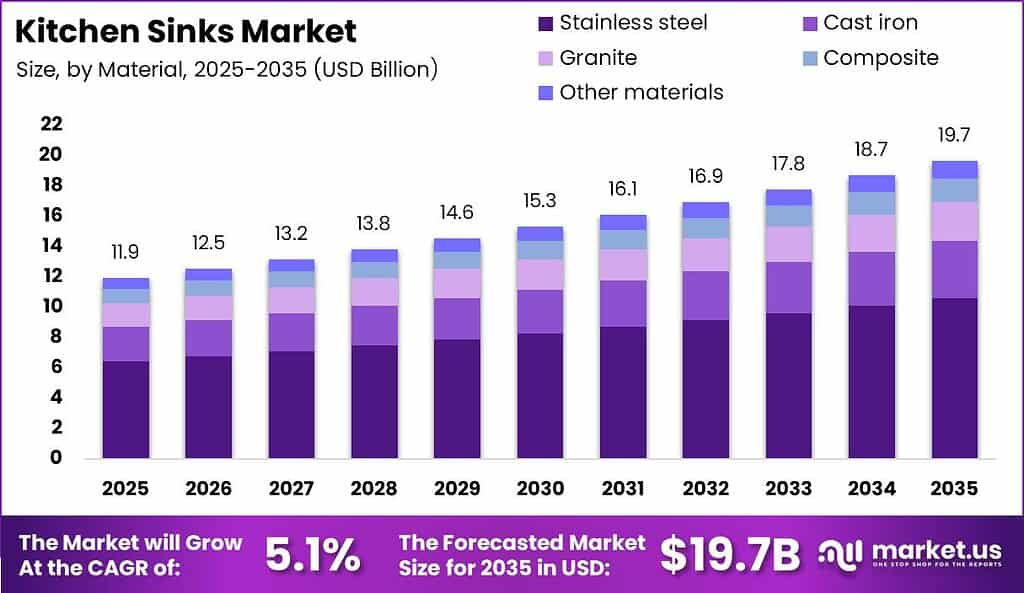
Global Kitchen Sinks Market size is expected to be worth around USD 19.70 Billion by 2035 from USD 11.90 Billion in 2025, growing at a CAGR of 5.1% during the forecast period 2026 to 2035. This expansion reflects steady unit offtake tied to housing completions and kitchen remodeling cycles. Investors who track fixture-level spend per new dwelling can map volume growth more accurately than headline construction totals alone.
Therefore, the Kitchen Sinks Market covers fixed basins used for food preparation, washing, and drainage in residential and commercial kitchens. Product structure spans material, installation type, shape, price range, and end user. Buyers select configurations that match cabinet size, countertop material, and hygiene rules. Sellers who align SKUs to these constraints protect margin against pure price competition.
Key Takeaways
- The market reaches USD 11.90 Billion in 2025 and USD 19.70 Billion by 2035 at a 5.1% CAGR.
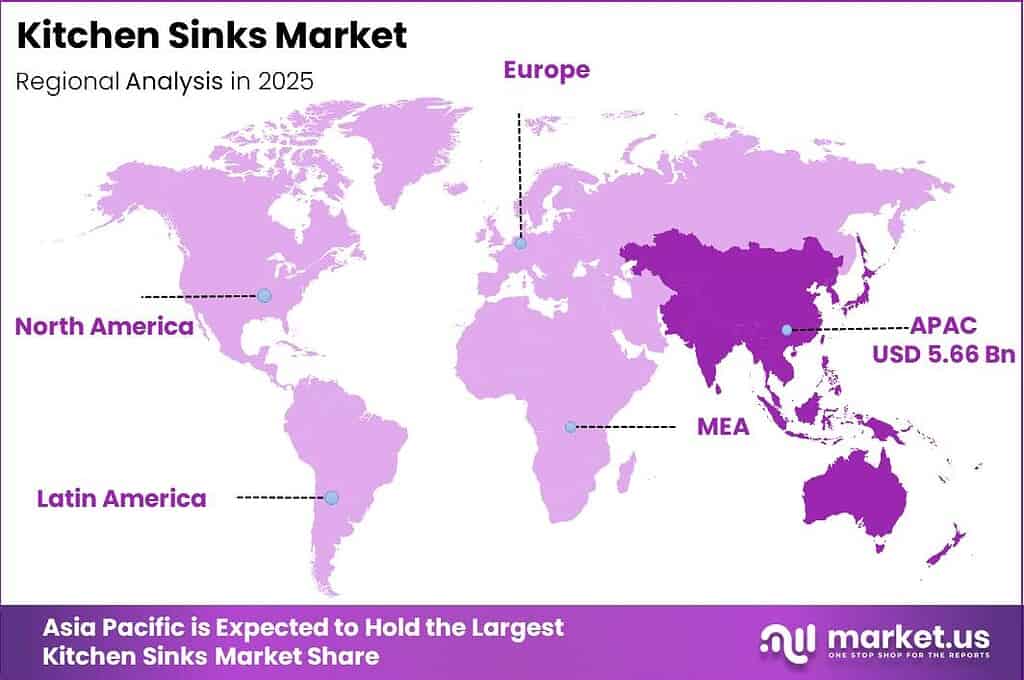
- Asia Pacific leads with a 47.50% share, valued at USD 5.66 Billion.
- Stainless steel leads materials with a 54.00% share.
- Drop-in/top-mount leads installation types with a 46.50% share.
- Rectangular leads shapes with a 58.00% share.
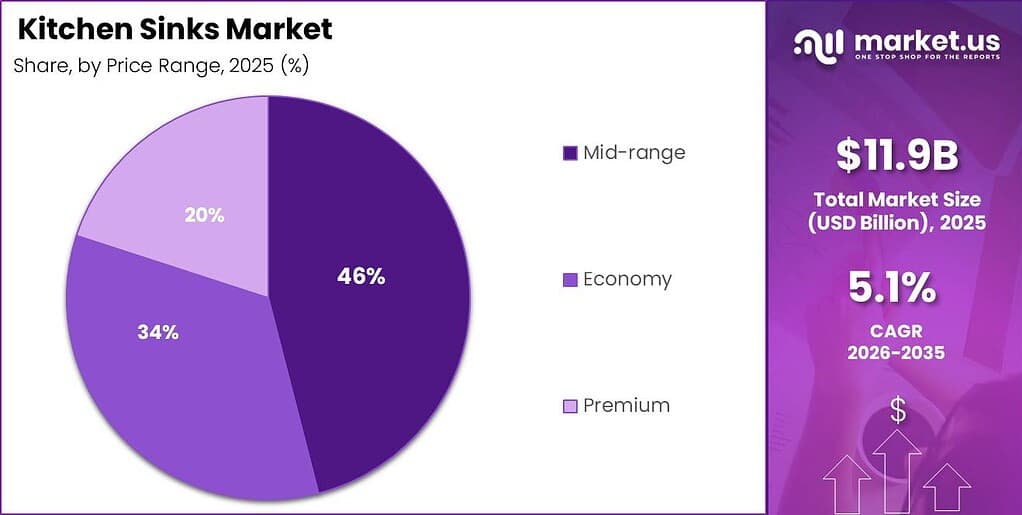
- Mid-range leads price tiers with a 46.00% share.
- Residential leads end users with a 72.00% share.
As per our research, Kohler’s September 2025 Vault Smart Divide specification lists an 18-gauge stainless-steel body, two 9-inch-deep bowls, and a 36-inch minimum base cabinet. These dimensions set a clear fit standard for remodelers. Brands that publish cabinet-ready specs reduce installer rejection rates and win specification slots faster. Consequently, channel partners favor lines that cut on-site modification time.
In April 2025, Kohler entered India’s stainless-steel kitchen sink category with its Strive range, customized with deeper and thicker bowls for Indian homes. This move links rising urban housing completions to local product demand. Manufacturers that adapt bowl depth and gauge to regional cooking habits capture first-cycle replacements in new apartments. This creates a durable foothold before local private labels scale.
However, end-use growth in residential kitchens still depends on remodel budgets and new-unit handovers. Each completed dwelling typically needs at least one sink install. Vendors who tie production plans to housing completion data avoid excess finished-goods inventory when permit cycles slow.
Material Analysis
Stainless steel dominates with 54.00% due to durability and supply chain depth.
In 2025, Stainless steel held a dominant market position in the By Material segment of Kitchen Sinks Market, with a 54.00% share. Kraus’s 2025 Kitchen Project Guide specifies a 33-inch Standart PRO double-bowl sink in 16-gauge stainless steel with a 10-inch depth. Gauge and depth choices drive commercial and premium residential preference. Fabricators who hold deep-draw capacity for 16-gauge coils lock in higher average selling prices.
Cast iron sinks serve buyers who want thermal mass and classic enamel finishes in heritage remodels. These units command longer install times and higher freight cost than stamped steel. Dealers who stock limited SKUs of cast iron protect specialty margin without bloating warehouse turns. This reflects a niche role rather than volume leadership.
Granite and composite sinks attract design-led residential projects that need color match to quartz tops. Carysil-type recipes combine natural mineral content with resin binders for scratch resistance. Installers who train on composite cutouts reduce warranty claims from edge chipping. Square and custom colors in this group support premium kitchen packages.
Other materials cover ceramic, fireclay, and specialty alloys used in hospitality and outdoor kitchens. These lines hold the remaining share collectively with cast iron, granite, and composite behind stainless steel. Buyers in foodservice often specify non-steel options for chemical resistance. Suppliers who certify food-contact compliance win multi-unit restaurant contracts.
Installation Type Analysis
Drop-in/top-mount dominates with 46.50% due to simple retrofit installation speed.
In 2025, Drop-in/top-mount held a dominant market position in the By Installation Type segment of Kitchen Sinks Market, with a 46.50% share. The 2025 Kraus Kore workstation sink combines 16-gauge stainless steel with a 33-by-22-inch footprint and a 9-inch bowl depth. Top-mount formats fit existing cutouts during quick remodels. Distributors who push drop-in kits raise sell-through in DIY and contractor channels.
Undermount sinks deliver a seamless countertop look preferred in mid-range and premium new builds. They require precise cutouts and stronger adhesive or clip systems. Fabricators who partner with countertop shops capture bundled bids. This signals higher labor content and sticky specifier relationships.
Wall-mounted sinks serve compact urban flats and commercial prep zones where floor cabinets are limited. Structural wall support and trap design raise engineering cost versus cabinet-mounted bowls. Specifiers in hospitality use wall-mount lines to free floor space for cleaning. This creates a stable commercial sub-niche.
Others include dual-mount and specialty farmhouse apron styles that hold remaining share with wall-mounted units. Dual-mount flexibility reduces SKU risk for retailers. Brands that offer one bowl with both mount options cut inventory complexity while covering more job types.
Shape Analysis
Rectangular dominates with 58.00% due to cabinet width standardization.
In 2025, Rectangular held a dominant market position in the By Shape segment of Kitchen Sinks Market, with a 58.00% share. Abey’s May 2026 Lucia double-bowl kitchen sink holds 25.5 litres in each bowl for a combined nominal capacity of 51 litres. Rectangular bowls maximize usable area inside standard base cabinets. OEMs who tool common rectangle dies lower per-unit stamping cost.
Square sinks fit narrow galley kitchens and secondary prep stations where width is constrained. They trade total capacity for footprint efficiency. Retailers who merchandise square SKUs beside modular kitchen packages lift attachment rates. This reflects space-led rather than volume-led demand.
Round sinks appear mainly in bar, island, and secondary wet zones. Lower capacity limits primary-kitchen use but supports design differentiation. Designers who specify round bowls in islands create visual contrast against linear counters. Margin stays healthy on lower unit volume.
Other shapes, including D-bowl and custom asymmetric forms, hold remaining share with square and round. Custom tooling raises MOQ risk. Manufacturers who reserve custom shapes for project bids protect plant utilization on core rectangle runs.
Price Range Analysis
Mid-range dominates with 46.00% due to balanced feature and price mix.
In 2025, Mid-range held a dominant market position in the By Price Range segment of Kitchen Sinks Market, with a 46.00% share. Oliveri’s catalogue specifies a 78-litre capacity for the PR1290U mega-bowl sink versus 39 litres per bowl on the PR1263U double-bowl model. Capacity steps help buyers self-select within mid-tier budgets. Brands that ladder capacity clearly reduce discounting at the shelf.
Economy sinks target high-volume housing and rental turnover projects. Thin gauge and limited accessories keep landed cost low. Contractors who standardize one economy SKU across multi-unit builds compress procurement time. This keeps volume high while limiting brand premium capture.
Premium sinks bundle workstation ledges, thicker gauge, composite minerals, or designer finishes. Higher ASP expands dealer margin per ticket. Showrooms that demo accessories convert upgrade intent into attach sales. Premium and economy together hold the balance of share behind mid-range.
End User Analysis
Residential dominates with 72.00% due to housing and remodel unit density.
In 2025, Residential held a dominant market position in the By End User segment of Kitchen Sinks Market, with a 72.00% share. Abey’s Alfresco 540 outdoor kitchen sink, listed in April 2026, has a 47.39-litre water capacity and ships with a 5-star mixer at 5 litres per minute. Outdoor and indoor residential SKUs extend household attach rates. Builders who offer outdoor kitchen options lift fixture revenue per home.
Commercial end users include restaurants, hotels, healthcare, and institutional kitchens with stricter hygiene and durability rules. Deeper bowls, heavier gauge, and service parts programs matter more than finish variety. Manufacturers who hold NSF-ready lines and rapid spare-parts logistics win multi-site operators. Commercial holds the remaining share and stabilizes demand when housing cycles soften.
Key Market Segments
By Material
- Stainless steel
- Cast iron
- Granite
- Composite
- Other materials
By Installation Type
- Drop-in/top-mount
- Undermount
- Wall-mounted
- Others
By Shape
- Rectangular
- Square
- Round
- Other shapes
By Price Range
- Economy
- Mid-range
- Premium
By End User
- Residential
- Commercial
Regional Analysis
Asia Pacific Dominates the Kitchen Sinks Market with a Market Share of 47.50%, Valued at USD 5.66 Billion
Asia Pacific leads on the back of urban housing completions across China, India, and Southeast Asia. High new-unit handovers translate into fixture installs at scale. Regional stainless steel production lines support competitive landed cost for both domestic and export channels. Investors who fund capacity near tier-2 cities capture volume before logistics costs rise.
North America and Europe grow mainly through remodeling and aging housing stock replacement. Higher average selling prices offset slower unit growth versus Asia Pacific. In March 2026, BLANCO launched the OOVALON sink from its new VELGRANIT composite material as part of the OOVALON/LUNEOO UNIT. Composite launches refresh European showroom traffic and defend premium mix. This signals value growth even when housing starts soften.
Latin America and Middle East and Africa add incremental volume through hospitality builds and selective residential upgrades. Import dependence raises sensitivity to steel coil and freight swings. Distributors who hold safety stock of core stainless SKUs protect fill rates during port delays.
Key Regions and Countries
North America
- US
- Canada
Europe
- Germany
- France
- The UK
- Spain
- Italy
- Rest of Europe
Asia Pacific
- China
- Japan
- South Korea
- India
- Australia
- Rest of APAC
Latin America
- Brazil
- Mexico
- Rest of Latin America
Middle East and Africa
- GCC
- South Africa
- Rest of MEA
Market Dynamics
Market Opportunity Analysis - Commercial, premium composite, and tier-2 residential gaps reward focused entrants.
Commercial end users hold the minority share behind residential at 72.00%, yet foodservice and institutional kitchens demand heavier gauge and service programs. Many regional fabricators still under-serve multi-site operators with spare-parts SLAs. New entrants who bundle NSF-ready bowls with 48-hour parts logistics can win chain contracts. This creates sticky recurring revenue beyond one-time fixture sales.
Composite and granite materials trail stainless steel’s 54.00% lead and remain underexploited in color-matched kitchen packages. Countertop fabricators already control the cutout decision. Sink brands that co-brand with quartz partners capture specification at the slab stage. Investors gain a route into higher ASP without fighting pure steel price wars.
Therefore, mid-range price leadership at 46.00% leaves economy and premium pockets open in Asia Pacific’s 47.50% region. Tier-2 cities need durable stainless at accessible tickets while coastal metros absorb workstation premiums. Localizers who split SKUs by city tier avoid over-engineering rural stock. This improves turns and reduces discounting.
Undermount and wall-mounted formats trail drop-in’s 46.50% share and stay under-penetrated in retrofit-heavy markets. Training installers on clip systems and waterproofing lowers callback risk. Distributors who certify installer networks unlock undermount mix shift. Early movers lock dealer mindshare before national brands flood training content.
Technology and Innovation Landscape - Workstation ledges, quieter bowls, and recycled content redefine product edges.
Kohler reported in September 2025 that its Smart Divide kitchen-sink divider is approximately 50% as high as a conventional double-bowl divider, improving clearance for larger cookware. Lower dividers cut the need for single-bowl only SKUs. Brands that redesign dividers win cooks who wash sheet pans daily. This lifts double-bowl relevance in modern kitchens.
Kohler’s March 2026 Task Smart Divide workstation is a 33-inch double-equal-bowl sink supplied with 2 fitted accessories, a colander and a cutting board, that slide along the rim. Accessories raise basket size and attach margin. Retailers who demo sliding tools convert upgrades at the point of sale. Manufacturers without rim tracks lose the workstation conversation.
Teka’s July 2026 Be Linea RS15 kitchen sink uses SilentSmart technology to deliver 50% less operating noise, with a 200 mm bowl depth and 15 mm-radius corners. Noise reduction matters in open-plan homes. Specifiers who list decibel claims differentiate stainless from commodity imports. Quiet bowls support premium pricing in dense urban housing.
Carysil’s July 2025 Big Bowl composite kitchen sink contains 80% natural quartz and 20% acrylic resin, with a 544-by-394-by-205 mm bowl and a 600 mm cabinet requirement. Mineral-rich composites open color and heat-resistance claims stainless cannot match. Plants that master resin curing secure design-led projects. Material innovation here defends share against steel price pressure.
Drivers
Asia-Pacific urban housing construction fuels volume growth as national housing ministries and construction associations recorded elevated new-unit handovers through 2025. India added several million new urban dwelling units in 2025, each needing at least one kitchen sink. China residential completions stabilized after the prior downturn and supported steady fixture offtake. Unit volume growth of roughly 6 to 8 percent annually in the region keeps stainless steel lines above 75 percent utilization.
This driver shortens payback on new cold-forming and deep-drawing capacity for manufacturers serving the corridor. Gross margins in the 18 to 22 percent range for regional producers support channel expansion into tier-2 and tier-3 cities. Buyers gain wider SKU availability. Investors see faster capital recovery on press-line upgrades tied to housing completion data.
| Driver | (~) % Impact on CAGR Forecast | Geographic Relevance | Impact Timeline |
|---|---|---|---|
| Residential remodeling surge | +1.2% | North America, Europe | Short term (2 years or less) |
| Asia-Pacific urban housing construction | +1.4% | Asia-Pacific | Short term (2 years or less) |
| Stainless steel material preference | +0.7% | Global | Medium term (2 to 4 years) |
| Modular kitchen adoption | +0.5% | Asia-Pacific, Middle East | Short term (2 years or less) |
| Foodservice and QSR expansion | +0.4% | Global | Medium term (2 to 4 years) |
| Retrofit demand in aging housing stock | +0.3% | North America, Europe | Medium term (2 to 4 years) |
Restraints
Raw material tariffs on stainless steel imports raise landed coil cost for North American fabricators. Section 232-linked duties on imported flat-rolled stainless steel stayed near the 25 percent threshold into 2026 per U.S. Department of Commerce notices. Input cost per finished sink unit rose an estimated 9 to 12 percent for import-dependent plants. Domestic mill lead times stretched by 3 to 5 weeks and slowed large commercial order fulfillment.
Fabricator gross margins compressed by an estimated 200 to 350 basis points under tariff pass-through limits. Several mid-sized producers delayed capacity expansion capital expenditure through 2026. Buyers face higher quote prices or longer waits. Sellers without domestic coil contracts lose bid competitiveness on multi-site kitchen projects.
| Restraint | (~) % Impact on CAGR Forecast | Geographic Relevance | Impact Timeline |
|---|---|---|---|
| Elevated interest rates delaying home purchases | -0.9% | North America, Europe | Short term (2 years or less) |
| Raw material tariffs on stainless steel imports | -0.8% | North America | Short term (2 years or less) |
| Volatile nickel and steel input pricing | -0.5% | Global | Short term (2 years or less) |
| Restrictive building permit backlogs | -0.4% | Europe | Short term (2 years or less) |
| Regional ceramic and quartz composite import bans | -0.3% | Select Middle East markets | Short term (2 years or less) |
Challenges
Skilled fabrication labor shortage stems from an aging metal-fabrication workforce. The U.S. Bureau of Labor Statistics reported sustained openings in sheet-metal and fabricated-metal-product occupations exceeding 30,000 unfilled positions monthly through late 2025. Production line throughput losses reach roughly 6 to 10 percent at deep-drawing and welding stations. Average order-to-delivery cycles for customized or undermount lines extend by 2 to 3 weeks.
This challenge opens a revenue path for automation suppliers and training partnerships. Robotic welding and automated press-forming cells show capital payback periods of roughly 3 to 4 years. Employers who fund apprenticeship pipelines reduce overtime cost and scrap. Early movers convert labor risk into a cost and delivery advantage over manual-heavy rivals.
| Challenge | (~) % CAGR Friction Drag | Geographic Relevance | Mitigation Horizon |
|---|---|---|---|
| Skilled fabrication labor shortage | -0.5% | North America, Europe | Medium term (2 to 4 years) |
| Fragmented unorganized manufacturing base | -0.4% | Asia-Pacific, India | Long term (4 years or more) |
| Logistics and port congestion delays | -0.3% | Global | Medium term (2 to 4 years) |
| Water conservation compliance complexity | -0.3% | North America, Europe | Medium term (2 to 4 years) |
| Design standardization gaps across regions | -0.2% | Global | Long term (4 years or more) |
Opportunities
Smart and touchless sink integration remains untapped white space. Sensor-enabled faucet and touchless basin adoption stays below 5 percent of the installed base per building-products association surveys. Co-development with sensor and IoT suppliers can lift blended average selling prices by an estimated 15 to 20 percent per smart-enabled unit. Gross margin expansion of 300 to 500 basis points is plausible as commercial kitchens specify touchless fixtures.
Capturing this space requires electronics integration and software diagnostics beyond commodity metal forming. The capability gap stays open through at least 2026. Early movers who lock sensor partnerships and train service networks set the specification standard. Late entrants risk competing only on steel price in a smarter product mix.
| Opportunity | (~) % Potential CAGR Upside | Geographic Relevance | Execution Window |
|---|---|---|---|
| Smart and touchless sink integration | +0.9% | North America, Europe, East Asia | Medium term (2 to 4 years) |
| Sustainable recycled-material sink lines | +0.6% | Europe, North America | Medium term (2 to 4 years) |
| Tier-2/3 city premiumization in emerging markets | +0.7% | India, Southeast Asia | Long term (4 years or more) |
| Direct-to-consumer online channel expansion | +0.4% | Global | Short term (2 years or less) |
| M&A roll-up of fragmented regional fabricators | +0.5% | Asia-Pacific, Latin America | Long term (4 years or more) |
Key Company Insights
Franke Holding AG positions on workstation systems that turn the sink into a prep hub. In June 2026, Franke launched the Box Pro stainless-steel sink range with a three-level workstation system and integrated ledges for food preparation, rinsing and draining. This approach raises accessory attach rates and defends ASP. Rivals without multi-level ledges compete mainly on bowl price.
Kohler Co. builds depth through broad stainless collections and sustainability labeling. Kohler’s 2025 Strive collection contained 31 stainless-steel sink models, with 11 of 31 models, about 35.5%, as workstation sinks. All 31 models contained recycled content, and 29 of 31, about 93.5%, carried a Declare label. Specifiers who need green documentation favor this lineup in commercial bids.
Key Players
- Franke Holding AG
- Kohler Co.
- BLANCO GmbH + Co. KG
- Elkay Manufacturing Company — Zurn Elkay
- Moen Incorporated
- Teka Group
- LIXIL Corporation — American Standard
- Roca Sanitario, S.A.
- Villeroy & Boch AG
- Ruvati USA, Inc.
- Duravit AG
- Reginox B.V.
- Schock GmbH
- Hafele SE & Co KG
- Alveus — Kovinoplastika Lož d.o.o.
Recent Developments
- February 2025: BLANCO launched the INTEOS workstation sink with integrated accessories and organizing solutions at KBIS 2025.
- February 2025: Ruvati launched its Dual-Tier Pro workstation sink collection featuring two accessory tracks, rounded corners and an offset drain.
- September 2025: Schock expanded its Cristadur Green Line with four new colors and launched the three-model Kiruna sink family.
Geopolitical Impact Analysis
According to U.S. trade remedy practice, Section 232 steel measures have kept stainless flat-rolled duties near or above a 25% ad valorem threshold into 2026, with later restructuring moving some articles toward higher full-value rates up to 50% on core metals. Kitchen sink fabricators depend on cold-rolled stainless coil as the primary input. Higher duties raise unit metal cost and stretch domestic mill lead times. North American producers without locked coil contracts face margin compression on fixed-price commercial bids.
As a result, Data from World Shipping Council and UNCTAD-linked logistics trackers show that port congestion and rerouting around conflict zones have added multi-week transit variance on Asia-to-Europe and Asia-to-North America fixture lanes. Sink exporters in China and India ship finished stainless units in containers sensitive to freight spikes of double-digit percentages during peak disruption. Importers who dual-source regionally cut stockout risk. This signals a shift from pure lowest-cost Asian sourcing toward hybrid inventory strategies.
Report Scope
| Report Features | Description |
|---|---|
| Market Value (2025) | USD 11.90 Billion |
| Forecast Revenue (2035) | USD 19.70 Billion |
| CAGR (2026-2035) | 5.1% |
| Base Year for Estimation | 2025 |
| Historic Period | 2020-2024 |
| Forecast Period | 2026-2035 |
| Report Coverage | Revenue Forecast, Market Dynamics, Market Opportunity Analysis, Technology and Innovation Landscape, Competitive Landscape, Recent Developments |
| Segments Covered | By Material (Stainless steel, Cast iron, Granite, Composite, Other materials), By Installation Type (Drop-in/top-mount, Undermount, Wall-mounted, Others), By Shape (Rectangular, Square, Round, Other shapes), By Price Range (Economy, Mid-range, Premium), By End User (Residential, Commercial) |
| Regional Analysis | North America (US and Canada), Europe (Germany, France, The UK, Spain, Italy, and Rest of Europe), Asia Pacific (China, Japan, South Korea, India, Australia, and Rest of APAC), Latin America (Brazil, Mexico, and Rest of Latin America), Middle East and Africa (GCC, South Africa, and Rest of MEA) |
| Competitive Landscape | Franke Holding AG, Kohler Co., BLANCO GmbH + Co. KG, Elkay Manufacturing Company — Zurn Elkay, Moen Incorporated, Teka Group, LIXIL Corporation — American Standard, Roca Sanitario, S.A., Villeroy & Boch AG, Ruvati USA, Inc., Duravit AG, Reginox B.V., Schock GmbH, Hafele SE & Co KG, Alveus — Kovinoplastika Lož d.o.o. |
| Customization Scope | Customization for segments, region / country-level will be provided. Additional customization can be done based on requirements. |
| Purchase Options | We have three licenses to opt for: Single User License | Multi-User License (Up to 5 Users) | Corporate Use License (Unlimited User and Printable PDF) |





































