


Report Overview
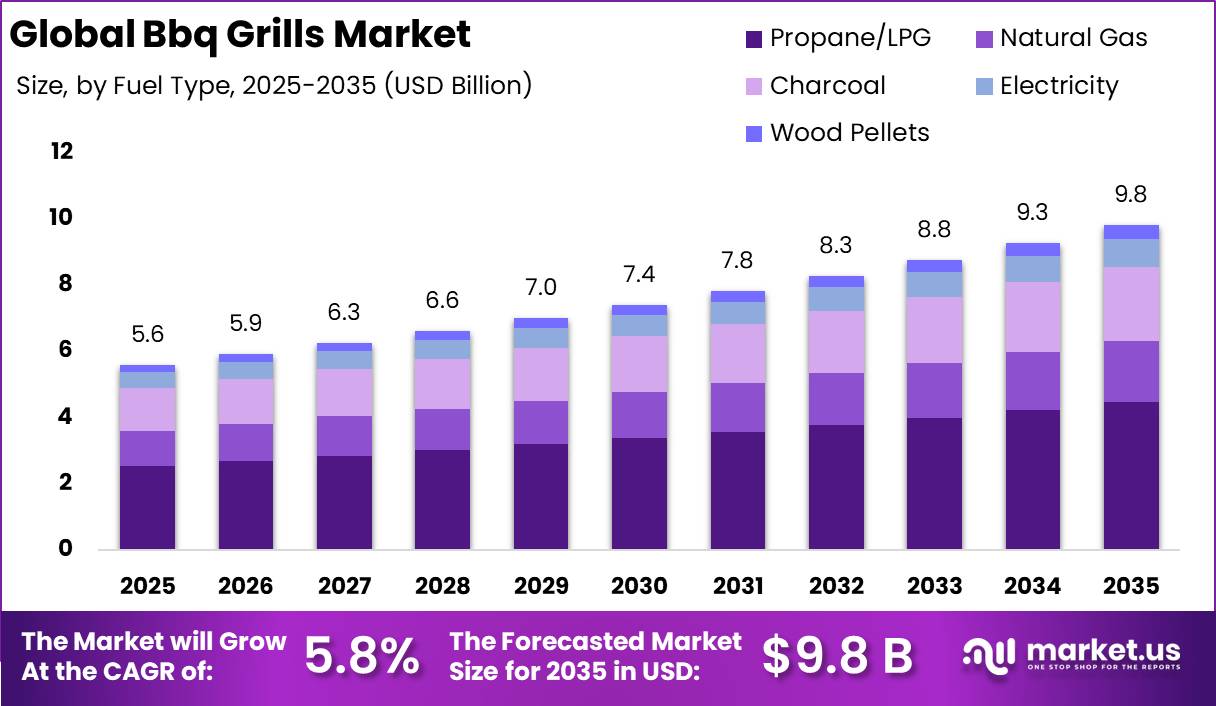
Global BBQ Grills Market size is expected to be worth around USD 9.8 Billion by 2035 from USD 5.6 Billion in 2025, growing at a CAGR of 5.8% during the forecast period 2026 to 2035. North America leads all regions with a 48.5% share, reflecting deeply embedded outdoor cooking culture and high residential investment in backyard infrastructure.
The BBQ grills market covers gas, charcoal, electric, pellet, portable, kamado, and built-in grilling systems sold to residential and commercial end users across offline and online retail channels. Products are differentiated by fuel type, burner count, construction material, and price tier. This structure creates distinct competitive lanes for mass-market volume players and premium outdoor living specialists.
Key Takeaways
- The global BBQ Grills Market is valued at USD 5.6 Billion in 2025 and is forecast to reach USD 9.8 Billion by 2035.
- The market grows at a CAGR of 5.8% during the forecast period 2026 to 2035.
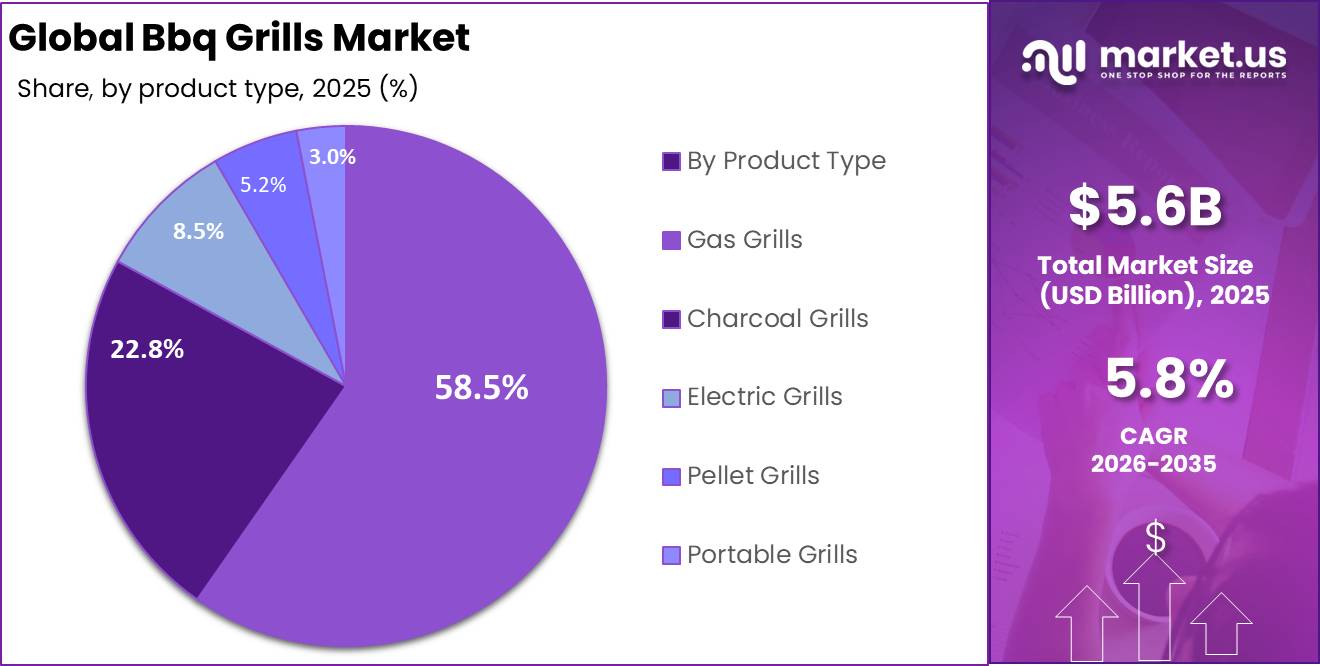
- By Product Type, Gas Grills dominate with a 58.5% share, driven by widespread consumer preference for convenience and precise heat control.
- By Fuel Type, Propane/LPG holds the leading position with a 45.6% share.
- By Number of Burners, the 3-Burner segment leads with a 38.5% share.
- By Material, Stainless Steel commands a 52.8% share across all product categories.
- By Price Range, the Mid-Range ($200 to $800) tier dominates with a 48.5% share.
- By Sales Channel, Offline retail leads with a 72.5% share.
- By End User, Residential users account for 88.5% of total market demand.
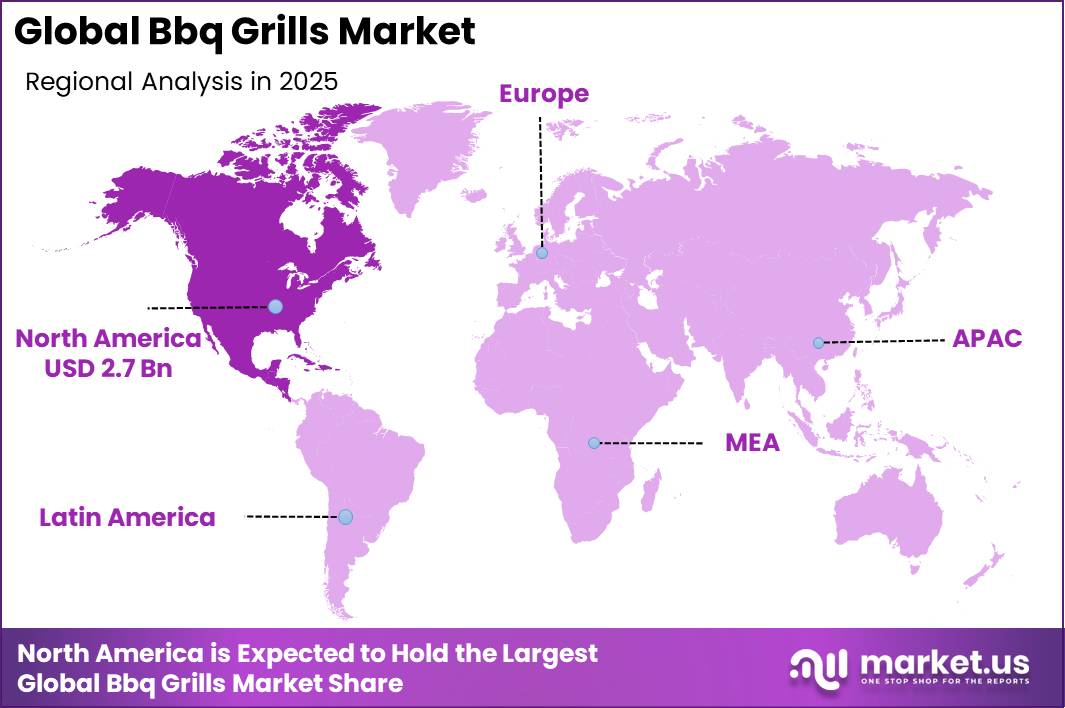
- North America is the dominant region with a 48.5% share, valued at USD 2.72 Billion in 2025.
Government investment in outdoor recreation infrastructure directly supports BBQ grill demand at the consumer level. According to the Bureau of Economic Analysis, the outdoor recreation economy contributed USD 696.7 Billion to U.S. GDP in 2024. This scale confirms that outdoor living is a structural economic category, not a seasonal trend, and that grill manufacturers operating in this space address a durable, government-tracked consumer segment.
Data from the Bureau of Economic Analysis shows outdoor recreation represented 2.4% of total U.S. GDP in 2024. This positions the BBQ grill industry within a broadly supported national economic activity. Brands that align product development and retail strategy with this macroeconomic backdrop gain credibility with institutional retail buyers and outdoor lifestyle distributors.
In January 2026, Weber LLC launched its 2026 product collection featuring an integrated smart grilling ecosystem connecting grills, accessories, probes, and the WEBER CONNECT® application across multiple fuel types. This move signals a shift from hardware sales toward platform monetization. Manufacturers that build connected product ecosystems early will generate recurring consumer engagement and defensible revenue streams beyond the initial purchase.
Product Type Analysis
Gas Grills dominate with 58.5% due to convenience, precise heat control, and fast ignition.
In 2025, Gas Grills held a dominant market position in the By Product Type segment of the BBQ Grills Market, with a 58.5% share. Consumers choose gas grills for their reliability and ease of use across both routine weeknight cooking and weekend entertaining. As reported by NY Post, 74% of consumers described grilling as an art form rather than simply a cooking method, which supports continued investment in higher-performing gas grill models rather than basic entry-level units.
Charcoal Grills hold a 22.8% share, sustained by a dedicated consumer base that prioritizes authentic smoky flavor over convenience. This segment commands strong loyalty among food-focused buyers willing to invest time in the cooking process. As a result, charcoal grill manufacturers benefit from a retention-driven purchase cycle that limits price sensitivity in the core enthusiast segment.
Pellet Grills account for a 52% share within the multi-fuel and smoker-adjacent subsegment, reflecting strong adoption of precision temperature-controlled outdoor cooking. According to t3.com, flat-top griddles and planchas emerged as one of the fastest-growing outdoor cooking categories in 2026, signaling consumer appetite for format diversification beyond traditional grill types. In 2026, Weber LLC introduced Stealth Edition Genesis® and Spirit® grills featuring premium aesthetics and smart-grilling integration, reinforcing how product innovation is actively reshaping the segment mix.
Electric Grills hold an 8.5% fuel-type share and serve apartment dwellers and urban consumers restricted by open-flame regulations. Portable Grills represent 30% of portable format demand, while Kamado Grills hold 15% and Built-in Grills hold 0.5%, together capturing the remaining share in their respective format niches.
Fuel Type Analysis
Propane/LPG dominates with 45.6% due to wide retail availability and established consumer infrastructure.
In 2025, Propane/LPG held a dominant market position in the By Fuel Type segment of the BBQ Grills Market, with a 45.6% share. Propane supply chains are deeply embedded in North American and European retail, giving this fuel type a structural distribution advantage over alternatives. This creates high switching costs for consumers and reinforces repeat accessory purchases such as tanks, regulators, and hose fittings.
Charcoal fuel accounts for 22.8% of the fuel type segment, closely tied to the charcoal grill install base and the smoking culture consumer cluster. Demand in this subsegment responds to flavor trends and specialty hardwood blend availability rather than price signals alone. This means charcoal fuel suppliers who offer premium wood varieties can extract meaningfully higher margins per unit than commodity bag sellers.
Natural Gas holds an 18.9% share, primarily serving homeowners with permanent outdoor kitchen installations connected to residential gas lines. This subsegment aligns with built-in grill adoption and home improvement capital expenditure rather than portable purchase cycles. Wood Pellets capture 4.2% of fuel demand, while Electricity accounts for 8.5%, with both serving distinct regulatory and lifestyle-driven consumer segments.
Number of Burners Analysis
3 Burners dominates with 38.5% due to optimal balance between cooking capacity and price value.
In 2025, the 3-Burner configuration held a dominant market position in the By Number of Burners segment of the BBQ Grills Market, with a 38.5% share. This configuration addresses the needs of the average household grilling group without moving into the premium price tier associated with four or more burners. Retailers that stock deep assortments in the 3-burner format capture the broadest base of mainstream residential buyers. The 4 to 6 Burner, Up to 2 Burner, and 6 or More Burner subsegments hold the remaining share across family, compact, and professional-scale cooking use cases respectively.
Material Analysis
Stainless Steel dominates with 52.8% due to corrosion resistance, premium aesthetics, and long service life.
In 2025, Stainless Steel held a dominant market position in the By Material segment of the BBQ Grills Market, with a 52.8% share. Consumers and commercial buyers both view stainless steel as the preferred material for outdoor cooking equipment exposed to weather. This preference supports premiumization because stainless construction allows manufacturers to justify higher price points with a tangible durability narrative. Porcelain-Coated Steel, Cast Iron, and Others capture the remaining material share across budget, specialty, and hybrid construction formats.
Price Range Analysis
Mid-Range ($200 to $800) dominates with 48.5% due to accessible price points and broad feature availability.
In 2025, the Mid-Range ($200 to $800) tier held a dominant market position in the By Price Range segment of the BBQ Grills Market, with a 48.5% share. This tier balances consumer value expectations with sufficient product quality to sustain repeat purchases and brand loyalty. As reported by The Guardian, retailers recorded strong growth in sales of premium barbecue models priced above £1,000, signaling that the Premium ($800 to $2,000) tier is the most active growth lane above mid-range. Economy (Under $200) and Luxury (Above $2,000) tiers capture the remaining share at opposite ends of the purchasing spectrum.
Sales Channel Analysis
Offline dominates with 72.5% due to consumer preference for in-store product evaluation before purchase.
In 2025, Offline retail held a dominant market position in the By Sales Channel segment of the BBQ Grills Market, with a 72.5% share. Consumers shopping for BBQ grills consistently prefer to assess size, build quality, and feature sets in person before committing to purchase. Based on NY Post data, 48% of women surveyed planned to grill more actively during the summer season, expanding the active shopper base and increasing foot traffic to outdoor cooking retail floors. This signals near-term volume growth for brick-and-mortar grill retailers. The Online channel holds the remaining share and serves as the primary platform for accessories, consumables, and repeat purchases.
End User Analysis
Residential dominates with 88.5% due to widespread household ownership of outdoor cooking equipment.
In 2025, Residential users held a dominant market position in the By End User segment of the BBQ Grills Market, with an 88.5% share. NY Post found that 80% of grill owners consider outdoor cooking one of their favorite summer activities, establishing grilling as a culturally embedded behavior rather than an occasional choice. This depth of engagement supports high repurchase rates and strong accessory attachment across the residential base. Consequently, brands that invest in post-sale engagement, including recipe content, grill maintenance tools, and loyalty programs, can extend customer lifetime value well beyond the initial hardware transaction.
The Outdoor Commercial Grills segment, while accounting for the minority share, represents a structurally different revenue model built on higher unit values and volume replenishment cycles. NY Post data shows 67% of surveyed grill owners planned to save money by cooking at home more frequently. This behavioral shift concentrates near-term unit volume in the residential segment while creating medium-term opportunity for commercial operators as outdoor dining and food-truck expansion absorbs the social dining demand. In May 2026, Weber LLC unveiled its first Santa Maria-style live-fire grill platform at the Open Fire World Championship during Memphis in May, signaling a deliberate push by major brands into live-fire and commercial-adjacent format categories.
Key Market Segments
By Product Type
- Gas Grills
- Charcoal Grills
- Electric Grills
- Pellet Grills
- Portable Grills
- Kamado Grills
- Built-in Grills
By Fuel Type
- Propane/LPG
- Natural Gas
- Charcoal
- Electricity
- Wood Pellets
By Number of Burners
- Up to 2 Burners
- 3 Burners
- 4 to 6 Burners
- 6 or More Burners
By Material
- Stainless Steel
- Porcelain-Coated Steel
- Cast Iron
- Others
By Price Range
- Economy (Under $200)
- Mid-Range ($200 to $800)
- Premium ($800 to $2,000)
- Luxury (Above $2,000)
By Sales Channel
- Offline
- Online
By End User
- Residential
- Commercial
Regional Analysis
North America Dominates the BBQ Grills Market with a Market Share of 48.5%, Valued at USD 2.72 Billion
North America commands 48.5% of the global BBQ grills market, valued at USD 2.72 Billion in 2025. The region benefits from deeply established grilling culture, high rates of single-family home ownership, and large-format retail infrastructure that prioritizes outdoor cooking categories. In January 2025, Traeger launched the Woodridge series of wood pellet grills, which contributed to grill revenue growth in the first quarter of 2025, confirming that product innovation directly translates to near-term North American sales momentum.
Europe holds a structurally significant secondary position in the global BBQ grills market. Regulatory pressure on open-flame and gas combustion products in urban zones is reshaping product mix toward electric and pellet alternatives. This regulatory context creates a durable entry point for manufacturers offering low-emission formats, particularly in dense metropolitan markets across Germany, France, and the UK where outdoor space and compliance requirements differ sharply from North American norms.
Asia Pacific is an emerging volume market for the Barbeque Grill category, driven by urbanization, a growing middle class with rising disposable income, and expanding organized retail in China, South Korea, and Australia. The region’s product preferences skew toward compact and portable formats suited to smaller outdoor spaces. Manufacturers that localize product sizing and fuel compatibility to APAC market norms will capture share ahead of global competitors relying on North American product configurations.
Key Regions and Countries
North America
- US
- Canada
Europe
- Germany
- France
- The UK
- Spain
- Italy
- Rest of Europe
Asia Pacific
- China
- Japan
- South Korea
- India
- Australia
- Rest of APAC
Latin America
- Brazil
- Mexico
- Rest of Latin America
Middle East and Africa
- GCC
- South Africa
- Rest of MEA
Market Dynmaics
Market Opportunity Analysis - Underserved segments and regions offer structural entry points for focused BBQ grill market players
The Commercial end user segment captures only 11.5% of current market demand, yet commercial outdoor cooking operations represent a fundamentally different revenue profile from residential accounts. Food trucks, outdoor catering operators, and hospitality venues require higher unit values, volume replacement cycles, and service contracts. Brands that develop commercial-grade grill lines with dedicated distribution agreements can access this segment without competing directly on the residential retail price ladder.
The Electric Grill format holds an 8.5% fuel-type share today, but urban density policies and open-flame bans across European and dense APAC markets create a structural ceiling on gas and charcoal adoption in these zones. This means the Electric Grill segment is not limited by consumer preference but by product range and retail availability. Manufacturers that invest in higher-wattage, feature-rich electric formats can capture urban residential demand that gas-focused competitors cannot legally address in these regulated environments.
The Online sales channel currently holds the minority share against offline’s 72.5% dominance. However, accessories, consumables such as Grilling Tools And Accessories, wood pellets, and covers represent low-friction, high-frequency repeat purchase categories that suit digital commerce far better than large appliance hardware. Brands that build strong online SKU assortments around consumables and accessories can generate recurring e-commerce revenue without displacing their core offline hardware sales.
The Built-in Grills subsegment holds only a 0.5% product type share today, but aligns directly with the premium outdoor kitchen investment trend that HPBA research identifies as a structural driver. This gap between current share and identified driver strength signals that the built-in format is earlier in its adoption cycle than other product types. New entrants and mid-tier manufacturers that establish built-in grill product lines now can capture first-mover positioning before the segment matures into a contested category.
Technology and Innovation Landscape - Connected grilling platforms and AI-powered cooking systems redefine competitive positioning in the BBQ grills market
Smart connected grilling is the most consequential technology shift in the BBQ grills market today. Weber identified smart connected barbecues with app-based monitoring as one of the fastest-growing outdoor cooking trends for 2026. The WEBER CONNECT® application connects grills, probes, and accessories across multiple fuel types within a single ecosystem. Brands that build proprietary connected platforms early create switching costs that commodity hardware competitors cannot easily replicate.
Artificial intelligence is entering the outdoor cooking category through products like the Brisk It Zelos 450, which combines generative AI cooking assistance with Wi-Fi connectivity and automated cooking controls. In 2026, Brisk It extended this approach with the AI Hybrid Gas Grill, pairing digital flame control with wood-pellet flavor technology. These AI-enabled products target a consumer base that expects software-grade experiences from hardware appliances. Manufacturers that ignore this shift risk ceding the premium technology segment to AI-native challengers.
Multi-fuel and hybrid grill formats represent a direct response to consumer demand for format flexibility without owning multiple appliances. The Hybrid Grill concept, combining gas, charcoal, and pellet fuel modes, addresses a clear consumer pain point around fuel preference and flavor variety. This means manufacturers investing in multi-fuel engineering can capture buyers across traditionally separate product categories, expanding the addressable household per product unit and improving retail sell-through rates.
Stainless steel construction commands a 52.8% material share, making material durability a baseline performance expectation rather than a premium differentiator. The next material innovation frontier is corrosion-resistant non-stainless alternatives that can reduce landed cost while maintaining consumer-perceived quality. Weber’s 2025 introduction of the SLATE® Rust-Resistant Griddle demonstrates that material engineering in corrosion resistance is an active product development priority, not a future aspiration, and signals a new battleground in manufacturing cost competitiveness.
Drivers
The conversion of standalone grills into nodes within full Outdoor Kitchen systems is the strongest mix-upgrade driver in the BBQ grills market today. HPBA’s 2025 consumer research confirms that grilling investment is increasingly tied to backyard capital expenditure rather than seasonal food preparation alone. This behavior raises average selling prices and expands attach rates for side burners, prep counters, pizza ovens, refrigeration, and modular installation services.
This structural shift improves manufacturer economics by moving value creation from a one-time hardware sale toward a broader ecosystem transaction. The effect is most pronounced in the U.S. and Canada but extends into Western Europe and affluent Gulf and APAC households where outdoor entertaining and home improvement spending are rising. Brands positioned across the full outdoor kitchen system, not just the grill unit, capture a meaningfully larger share of the total backyard spend per household.
| Driver | (~) % Impact on CAGR Forecast | Geographic Relevance | Impact Timeline |
|---|---|---|---|
| Replacement-led demand renewal | +1.2% | North America core, Western Europe spill-over | Short term (≤ 2 years) |
| Premium outdoor living and built-in kitchens | +1.0% | North America core, EU premium clusters, GCC, affluent APAC corridors | Medium term (2-4 years) |
| Value-tier resilience and retail price ladder expansion | +0.9% | North America core, Latin America spill-over, selected APAC corridors | Short term (≤ 2 years) |
| Pellet, multi-fuel and smart grilling innovation | +0.8% | North America core, Western Europe, Australia | Medium term (2-4 years) |
| Fuel-cost moderation and operating-cost visibility | +0.6% | North America propane-heavy markets, EU gas-sensitive markets | Short term (≤ 2 years) |
| Safety compliance and component upgrade cycle | +0.5% | North America core, EU regulated markets | Medium term (2-4 years) |
Restraints
Renewed inflation in fabricated metal input costs is the most immediate restraint on BBQ grill market growth in 2026. U.S. steel and aluminum tariff rates reached 50% in 2025, and Section 232 duties continue to apply across metals and derivative products in 2026. Import-dependent manufacturers and private-label brands face realistic landed cost increases of 8% to 15% on affected SKUs, with absolute cost increases of roughly $45 to $180 per unit depending on stainless content and origin mix.
Grill retail elasticity steepens sharply once ticket prices cross mid-range thresholds. Suppliers typically recover only 60% to 75% of the input cost shock through retail price adjustments, forcing gross margin compression of 150 to 350 basis points. This compression delays promotional calendars and reduces assortment breadth at big-box retailers. The drag is most acute in North America where tariff pass-through is immediate and in EU import programs where stainless-intensive outdoor kitchen systems remain margin-sensitive.
| Restraint | (~) % Impact on CAGR Forecast | Geographic Relevance | Impact Timeline |
|---|---|---|---|
| Steel & aluminum inflation | -1.2% | North America core, EU importers | Short term (≤ 2 years) |
| Freight and lead-time volatility | -0.8% | EU, North America import channels, APAC export hubs | Short term (≤ 2 years) |
| Weak housing-linked discretionary demand | -1.0% | North America core, UK, Western Europe | Medium term (2-4 years) |
| Regulatory compliance cost creep | -0.7% | EU, UK, North America premium tiers | Medium term (2-4 years) |
| Fuel-cost and operating-value pressure | -0.5% | North America, selected EU markets | Short term (≤ 2 years) |
| Safety-recall and liability drag | -0.4% | North America core, EU branded market | Medium term (2-4 years) |
Challenges
Import dependence, tariff uncertainty, and compliance surveillance combine to create an ongoing cost and planning burden across major BBQ grill markets. The U.S. International Trade Commission’s DataWeb platform provides official import and export statistics, highlighting the classification accuracy risk that grill manufacturers face across internationally sourced metal components and finished appliances. Traeger’s full-year 2025 revenue fell 7.4% to $559.5 million, with grill revenue declining 8.0% to $298.9 million, and its 2026 guidance explicitly excluded the impact of recently implemented or proposed tariffs.
The European Commission’s Safety Gate issues daily alerts on dangerous non-food products, requiring grill manufacturers to maintain active post-market monitoring programs across all markets where their products are distributed. This ongoing compliance burden extends well beyond initial product certification and adds recurring operational cost to every product refresh cycle. Brands that build compliance infrastructure early gain a structural cost advantage over competitors managing regulatory exposure reactively.
| Challenge | (~) % CAGR Friction Drag | Geographic Relevance | Mitigation Horizon |
|---|---|---|---|
| Import exposure volatility | -1.1% | North America core, EU import markets | Medium term (2–4 years) |
| Product safety compliance load | -0.9% | EU regulatory hubs, North America | Long term (≥ 4 years) |
| Tariff and classification risk | -0.8% | US import channels, APAC export bases | Medium term (2–4 years) |
| Channel inventory imbalance | -0.7% | US mass retail, Europe specialty retail | Short term (≤ 2 years) |
| Seasonal production inflexibility | -0.6% | North America, Western Europe | Medium term (2–4 years) |
| Profit pool compression | -0.5% | Global branded grill vendors | Medium term (2–4 years) |
Opportunities
The clearest near-term opportunity in the BBQ grills market is the consolidation of fragmented subsegments, including griddles, pellet specialists, portable camping grills, and modular outdoor accessories, into broader platform businesses with shared retail and direct-to-consumer channels. A disciplined acquisition strategy targeting two to four niche assets by 2030 can generate 5% to 9% revenue synergies through channel cross-placement and 200 to 500 basis points of gross-margin improvement through sourcing leverage.
Scaled players that execute this roll-up approach can also achieve 8% to 12% SG&A savings by centralizing logistics, digital marketing, and product development across acquired brands. As per our research, this strategy could add approximately +1.9 percentage points to sector growth in North America and Europe by accelerating category formalization. Early movers that acquire and integrate niche brands before category consolidation matures will define the competitive structure of the market through 2030 and beyond.
| Opportunity | (~) % Potential CAGR Upside | Geographic Relevance | Execution Window |
|---|---|---|---|
| Outdoor kitchen systems | +1.8% | North America core, GCC, ANZ, affluent EU | Medium term (2-4 years) |
| Recurring consumables stack | +1.4% | North America core, EU, developed APAC | Short term (≤ 2 years) |
| Urban electric/balcony grills | +1.6% | EU, Japan, South Korea, dense tier-1 APAC | Medium term (2-4 years) |
| Prosumer foodservice crossover | +1.2% | U.S., Canada, Western Europe, tourism markets | Short term (≤ 2 years) |
| Roll-up of niche brands | +1.9% | North America, EU | Medium term (2-4 years) |
| Smart cooking data monetization | +1.1% | U.S., Canada, Western Europe, premium APAC | Long term (≥ 4 years) |
Key Company Insights
Weber-Stephen Products LLC holds the strongest brand equity position in the North American residential grill market. A trust study based on 4,517 consumer opinions ranked Weber as the most trusted outdoor cooking grill brand in America. In January 2025, Weber expanded its pellet grilling category with the launch of the WEBER SMOQUE™ Pellet Smoker, targeting consumers seeking dedicated smoking capabilities. Weber identified smart connected barbecues with app-based monitoring as one of the fastest-growing outdoor cooking trends for 2026, positioning the brand at the center of the connected grilling shift.
In January 2025, Brisk It unveiled the Zelos 450 at CES 2025, launching an AI-powered pellet grill with generative AI cooking assistance, Wi-Fi connectivity, and automated cooking controls. Brisk It targets the technology-first consumer segment that larger incumbents have historically underserved. This positions Brisk It as a genuine challenger in the premium smart grill lane. However, its narrow product portfolio and limited retail distribution create scaling risk as connected grilling moves from early adopter to mainstream consumer segment.
Key Players
- Weber-Stephen Products LLC
- The Middleby Corporation (Char-Broil, Masterbuilt)
- Napoleon (Wolf Steel Ltd)
- Traeger Pellet Grills, LLC
- RH Peterson Co (Broilmaster)
- Spectrum Brands (Brinkmann)
- Nexgrill Industries, Inc
- Dyna-Glo (GHP Group)
- Bull Outdoor Products, Inc
- Landmann USA
- Kenmore (Transform Holdco LLC)
- Blackstone Products
- Pit Boss Grills (Dansons)
- Camp Chef
- KitchenAid (Whirlpool Corporation)
- Others
Recent Developments
- January 2025 – Weber LLC launched its 2025 outdoor cooking collection, introducing the redesigned Spirit® Gas Grill, WEBER SMOQUE™ Pellet Smoker, 28-inch SLATE® Rust-Resistant Griddle, and WEBER WORKS™ accessory system to expand its BBQ grill portfolio.
- January 2025 – Weber LLC unveiled a fully reengineered Spirit® Gas Grill lineup to mark the product family’s 30th anniversary, adding Snap-Jet ignition, integrated thermometers, and accessory compatibility features.
- January 2025 – Weber LLC introduced the 28-inch SLATE® Rust-Resistant Griddle, strengthening its presence in the outdoor griddle segment.
- August 2025 – Traeger, Inc. announced Project Gravity, a company-wide operational transformation initiative designed to streamline operations and support future investment in outdoor cooking innovation.
- Spring 2026 – Weber LLC introduced the Performer Smart Charcoal Grill, its first Wi-Fi-enabled charcoal grill, bringing connected monitoring and app-based controls to the charcoal grilling category.
- Spring 2026 – Weber LLC launched the Kettle Smart Ring, Smart Hub Display, and new wireless temperature probes to expand its connected outdoor cooking ecosystem.
- 2026 – Brisk It announced the AI Hybrid Gas Grill, combining digital flame control with wood-pellet flavor technology, extending the company’s AI-enabled outdoor cooking portfolio.
- 2026 – Traeger, Inc. continued investing in product innovation and brand development while leveraging the successful Woodridge platform to strengthen its position in the pellet grill segment.
Report Scope
| Report Features | Description |
|---|---|
| Market Value (2025) | USD 5.6 Billion |
| Forecast Revenue (2035) | USD 9.8 Billion |
| CAGR (2026-2035) | 5.8% |
| Base Year for Estimation | 2025 |
| Historic Period | 2020-2024 |
| Forecast Period | 2026-2035 |
| Report Coverage | Revenue Forecast, Market Dynamics, Market Opportunity Analysis, Technology and Innovation Landscape, Competitive Landscape, Recent Developments |
| Segments Covered | By Product Type (Gas Grills, Charcoal Grills, Electric Grills, Pellet Grills, Portable Grills, Kamado Grills, Built-in Grills); By Fuel Type (Propane/LPG, Natural Gas, Charcoal, Electricity, Wood Pellets); By Number of Burners (Up to 2 Burners, 3 Burners, 4 to 6 Burners, 6 or More Burners); By Material (Stainless Steel, Porcelain-Coated Steel, Cast Iron, Others); By Price Range (Economy Under $200, Mid-Range $200 to $800, Premium $800 to $2,000, Luxury Above $2,000); By Sales Channel (Offline, Online); By End User (Residential, Commercial) |
| Regional Analysis | North America (US and Canada), Europe (Germany, France, The UK, Spain, Italy, and Rest of Europe), Asia Pacific (China, Japan, South Korea, India, Australia, and Rest of APAC), Latin America (Brazil, Mexico, and Rest of Latin America), Middle East and Africa (GCC, South Africa, and Rest of MEA) |
| Competitive Landscape | Weber-Stephen Products LLC, The Middleby Corporation (Char-Broil, Masterbuilt), Napoleon (Wolf Steel Ltd), Traeger Pellet Grills LLC, RH Peterson Co (Broilmaster), Spectrum Brands (Brinkmann), Nexgrill Industries Inc, Dyna-Glo (GHP Group), Bull Outdoor Products Inc, Landmann USA, Kenmore (Transform Holdco LLC), Blackstone Products, Pit Boss Grills (Dansons), Camp Chef, KitchenAid (Whirlpool Corporation), Others |
| Customization Scope | Customization for segments, region/country-level will be provided. Additional customization can be done based on requirements. |
| Purchase Options | We have three licenses to opt for: Single User License, Multi-User License (Up to 5 Users), Corporate Use License (Unlimited User and Printable PDF) |





































