


Report Overview
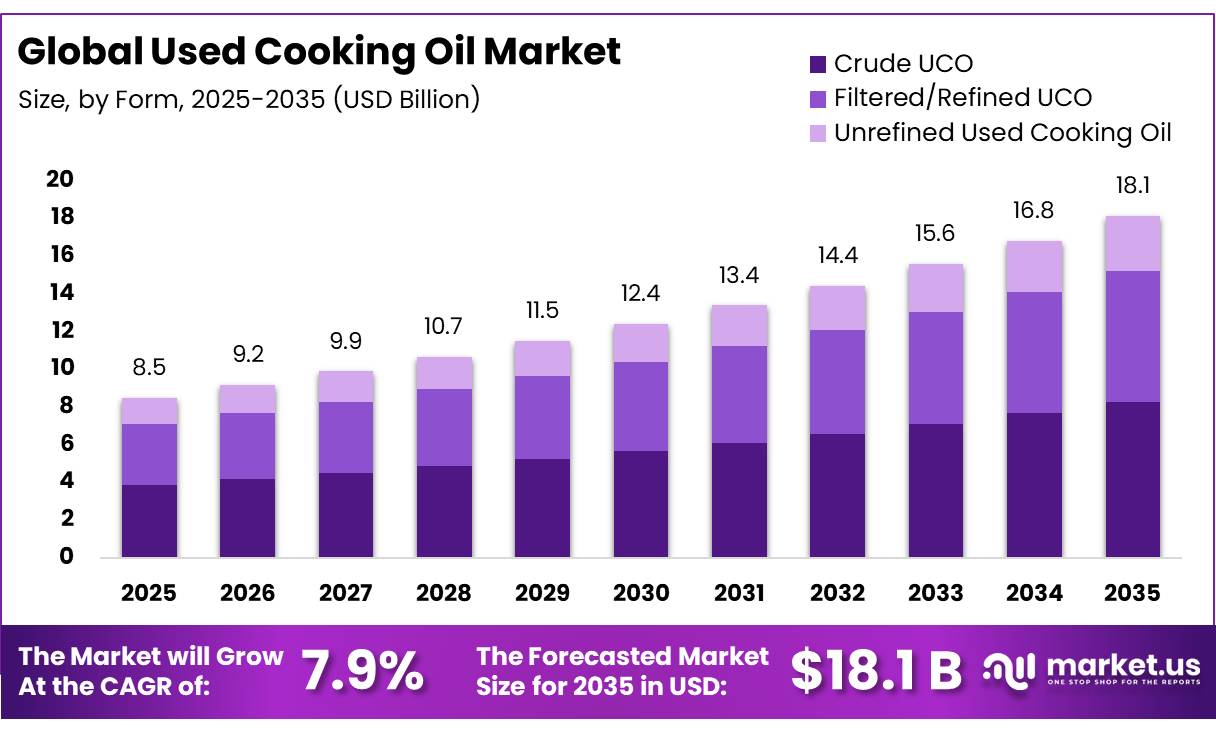
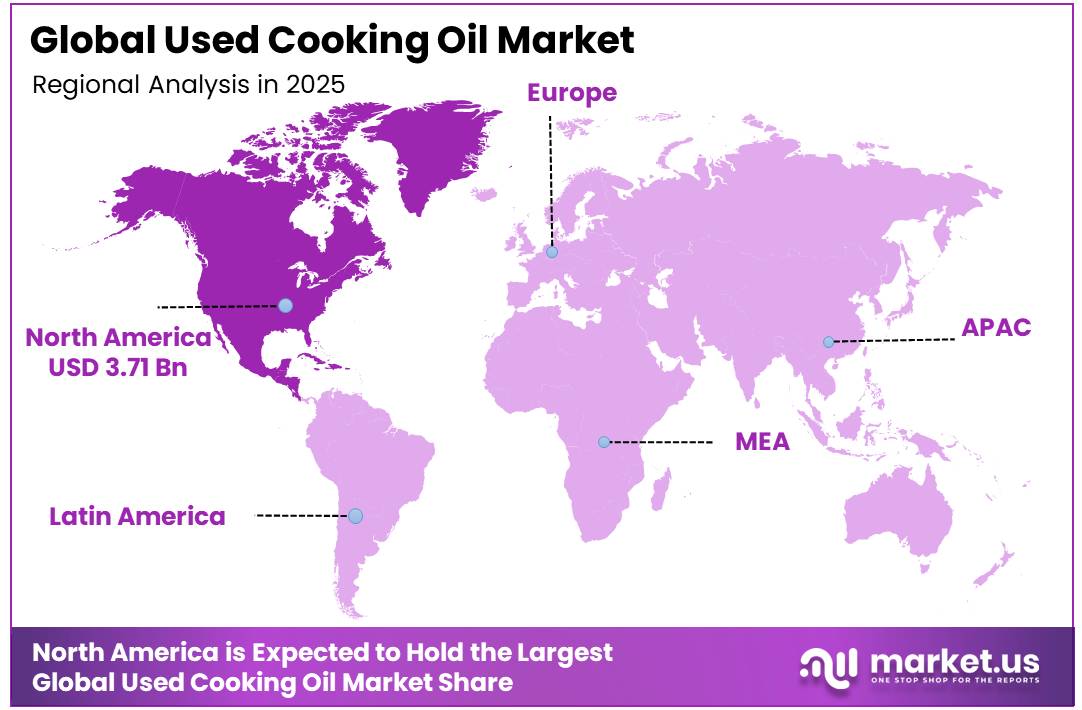
In 2025, the Global Used Cooking Oil Market was valued at USD 8.5 billion, and between 2026 and 2035, this market is estimated to register a CAGR of 7.9%, reaching about USD 18.1 billion by 2035. In 2025, North America led the market, achieving over 43.69% share with a revenue of USD 3.7 Billion.
Used Cooking Oil (UCO) has become an increasingly important feedstock within the global circular economy due to its growing utilization in renewable fuels, biodiesel production, sustainable aviation fuel (SAF), animal feed applications, and industrial oleochemicals. The industry is transforming waste generated by restaurants, foodservice operators, food manufacturers, and households into valuable raw materials, helping reduce environmental impacts associated with improper oil disposal.
- According to the International Energy Agency (IEA), global biofuel demand is expected to increase by nearly 38 billion liters between 2023 and 2028, representing a nearly 30% rise from current levels.
Key Takeaways
- The global used cooking oil market was valued at USD 8.5 billion in 2025.
- The market is projected to grow at a CAGR of 7.9% and is estimated to reach USD 18.1 billion by 2035.
- Crude UCO is the dominant segment by form, accounting for 45.6% of the market in 2025, driven by its role as the primary collection-grade material entering the value chain before further refining or filtration.
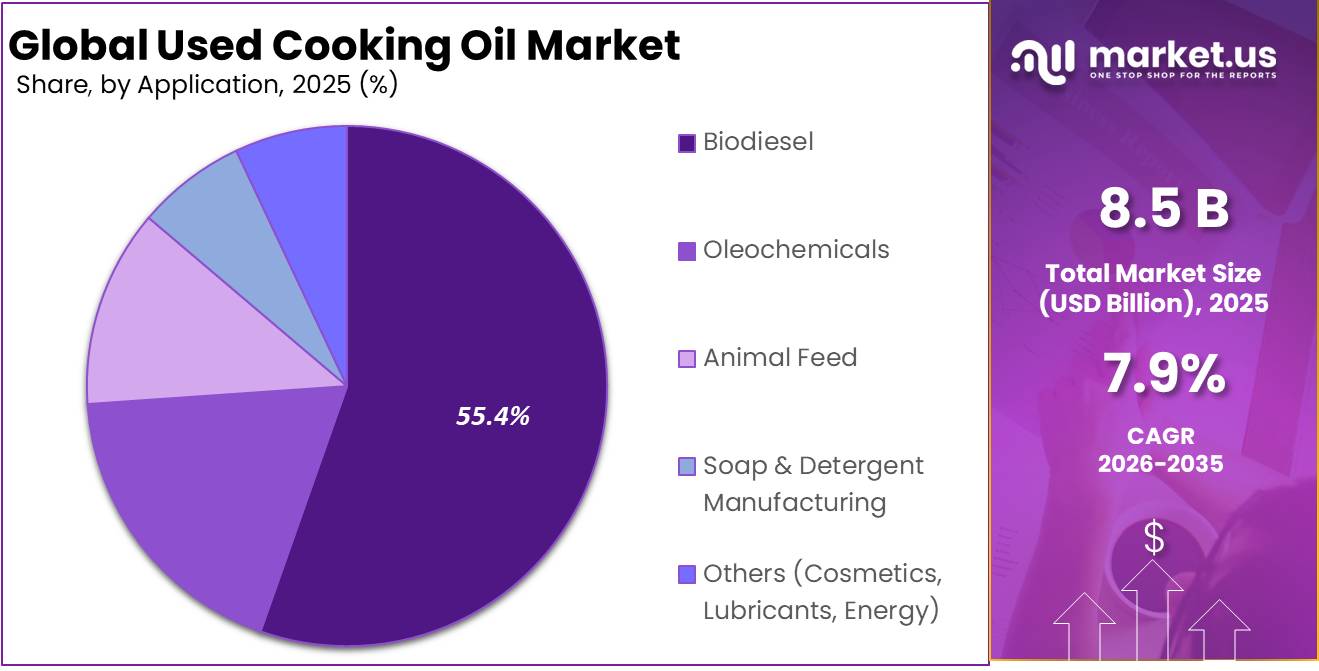
- Biodiesel is the dominant application, accounting for 55.4% of the market in 2025, driven by sustained demand for waste-derived feedstocks in renewable fuel and low-carbon fuel blending programs.
- North America holds the largest regional share at 43.69%, driven by established used cooking oil collection and rendering infrastructure alongside growing biodiesel and renewable diesel production capacity.
This expansion is creating stronger demand for waste-based feedstocks such as used cooking oil because they offer significantly lower lifecycle greenhouse gas emissions compared to conventional fossil fuels. The industrial landscape is being shaped by expanding renewable diesel and sustainable aviation fuel production capacities, particularly across North America and Europe.
- The International Air Transport Association (IATA) reported that global SAF production reached 1 million tonnes in 2024, double the volume produced in 2023.
Since UCO is one of the most widely accepted feedstocks for SAF manufacturing, rising airline decarbonization efforts are increasing collection and processing investments across the supply chain. In addition, the U.S. Environmental Protection Agency’s Renewable Fuel Standard (RFS) continues to support advanced biofuel production through renewable volume obligations, encouraging greater utilization of waste-derived oils.
Government policies remain a major growth driver. The European Union’s Renewable Energy Directive (RED III) requires member states to accelerate renewable energy adoption in transportation, with advanced biofuels produced from waste feedstocks receiving favorable treatment under sustainability frameworks.
- According to the European Commission, renewable energy accounted for 24.5% of the EU’s gross final energy consumption in 2023, highlighting the region’s ongoing transition toward cleaner energy sources and creating long-term demand for sustainable feedstocks including UCO.
The U.S. Department of Energy estimates that sustainable aviation fuel could contribute up to a 100% reduction in lifecycle greenhouse gas emissions compared with conventional jet fuel when produced from sustainable feedstocks. Rising investments in advanced refining technologies and waste-to-fuel infrastructure are expected to strengthen supply chains and improve feedstock availability. As governments, airlines, fuel producers, and foodservice operators intensify sustainability commitments, the UCO industry is positioned to play a critical role in supporting low-carbon transportation and circular resource utilization worldwide.
Used Cooking Oil Market Segmentation
Form Analysis
Crude UCO dominates the market due to strong biodiesel feedstock demand.
In 2025, Crude UCO held a dominant market position, capturing more than a 45.6% share. The segment remained the largest within the used cooking oil market due to its extensive use in biodiesel and renewable diesel production. Crude UCO is widely collected from restaurants, foodservice operators, and food processing facilities and is directly supplied to refining units for further processing. Its broad availability and lower procurement cost compared with refined alternatives supported its strong market presence. The segment also benefited from the rapid expansion of renewable fuel infrastructure.
- According to the U.S. Energy Information Administration (EIA), U.S. renewable diesel production capacity is more than 4.3 billion gallons per year in 2024, creating significant demand for waste-based feedstocks such as crude used cooking oil.
Filtered/Refined UCO is the fastest-growing segment. In 2026, the segment gained momentum as end users increasingly sought higher-quality feedstocks with improved consistency and lower impurity levels. Refined UCO offers advantages in advanced biofuel production, oleochemical manufacturing, and specialized industrial applications where stricter quality standards are required. Growing investments in upgrading and purification technologies further enhanced the commercial value of refined products. The segment also benefited from rising regulatory focus on traceability, sustainability certification, and fuel quality compliance.
Application Analysis
Biodiesel leads the market with over 55.4% share driven by renewable fuel demand.
In 2025, Biodiesel held a dominant market position, capturing more than a 55.4% share. The segment remained the largest application area for used cooking oil due to its extensive use as a sustainable feedstock in biodiesel production. Fuel manufacturers continued to increase the use of waste-derived oils to meet renewable energy targets and reduce greenhouse gas emissions. The ability of used cooking oil-based biodiesel to serve as a lower-carbon alternative to conventional diesel supported strong demand across transportation and industrial sectors.
In 2025, growing investments in renewable fuel infrastructure and expanding blending requirements further strengthened the consumption of used cooking oil in biodiesel manufacturing. The segment also benefited from established collection networks and processing facilities that ensured a steady supply of feedstock. As governments and industries continued to focus on cleaner fuel solutions, biodiesel maintained its leading position within the used cooking oil market.
- The International Energy Agency (IEA) stated that global biofuel demand is expected to increase by nearly 38 billion liters between 2023 and 2028, further strengthening the requirement for readily available feedstocks. These industry developments continued to support the dominance of crude UCO throughout 2025.
Oleochemicals is the fastest-growing segment. In 2026, the segment witnessed increasing adoption of used cooking oil as a sustainable raw material for producing fatty acids, glycerin, surfactants, lubricants, and other bio-based chemical products. Manufacturers increasingly explored renewable feedstocks to reduce dependence on fossil-based materials and support sustainability goals. The growing demand for environmentally responsible ingredients across personal care, household cleaning, and industrial applications contributed to the segment’s expansion.
Key Market Segments
By Form
- Crude UCO
- Filtered/Refined UCO
- Unrefined Used Cooking Oil
By Application
- Biodiesel
- Oleochemicals
- Animal Feed
- Soap & Detergent Manufacturing
- Others (Cosmetics, Lubricants, Energy)
Driver Analysis
SAF policies widening UCO demand pool
The UCO market is also being pulled upward by aviation decarbonization, because sustainable aviation fuel creates a second high-value outlet for the same waste-lipid pool already contested by biodiesel and renewable diesel. Under ReFuelEU Aviation, aviation biofuels produced from Annex IX feedstocks can count toward minimum SAF shares, and the European Commission has clarified that fuels from Annex IX Part B feedstocks can count without a cap under the aviation framework.
Drivers Impact Analysis
| Driver | (~) % Impact on CAGR Forecast | Geographic Relevance | Impact Timeline |
|---|---|---|---|
| Biofuel mandate expansion lifting UCO offtake | +2.4% | North America core, EU core, UK, APAC spill-over | Short term (≤ 2 years) |
| Traceability and compliance formalizing UCO collection | +1.9% | India core, EU core, Southeast Asia corridors | Short term (≤ 2 years) |
| SAF policies widening UCO demand pool | +1.6% | EU core, UK, North America spill-over, Gulf hubs | Medium term (2-4 years) |
| Crop-based fuel caps shifting demand to waste oils | +1.5% | EU core, UK, select OECD markets | Medium term (2-4 years) |
| Anti-fraud and trade actions repricing certified supply | +1.2% | EU, UK, North America import channels | Short term (≤ 2 years) |
| Foodservice throughput expanding recoverable feedstock base | +1.0% | India, Southeast Asia, Middle East, urban Africa | Long term (≥ 4 years) |
Restraint Analysis
RFS policy volatility
In North America, a meaningful restraint comes from policy uncertainty inside the Renewable Fuel Standard framework, because compliance economics for waste-based biofuels can change materially when exemptions or program recalibrations alter obligated demand. EPA’s final 2023–2025 rule set advanced biofuel at 7.33 billion RINs and biomass-based diesel at 3.35 billion gallons in 2025, but the agency also continued acting on small refinery exemption petitions in 2025, including decisions granting full exemptions to some petitions and partial exemptions to many others across 2021–2024 compliance years.
Restraint Impact Analysis
| Restraint | (~) % Impact on CAGR Forecast | Geographic Relevance | Impact Timeline |
|---|---|---|---|
| Traceability cost burden | -2.1% | EU core, UK core, India core, APAC export corridors | Short term (≤ 2 years) |
| Fraud-risk audit tightening | -1.8% | EU core, China-EU lanes, Southeast Asia-EU lanes | Short term (≤ 2 years) |
| RFS policy volatility | -1.5% | North America core | Short term (≤ 2 years) |
| SAF feedstock pull | -1.4% | EU core, UK core, Gulf hubs, North America spill-over | Medium term (2-4 years) |
| Fragmented collection base | -1.3% | India, Southeast Asia, urban Africa, LATAM | Long term (≥ 4 years) |
| Trade duty distortion | -1.0% | UK, EU import channels, North America spill-over | Medium term (2-4 years) |
Opportunity Analysis
Informal-to-formal collection roll-up
The clearest white-space opportunity is formalizing UCO volumes that are generated today but not yet captured by organized channels, especially in India where FSSAI’s RUCO system already provides a regulatory spine but collection remains uneven outside major cities. FSSAI-linked public references indicate India uses about 2,700 crore litres of cooking oil annually and could collect around 140 crore litres of UCO, while the regulator also targets food businesses consuming more than 50 litres of frying oil per day and has already enabled enrollment of non-food production units to collect from FBOs.
That means the opportunity is not baseline demand creation, but building route-density platforms, digital supplier onboarding, and city-by-city roll-ups that convert theoretical waste generation into contracted volume; even lifting formal capture by 15%–20% across the addressable bulk-consumer base could materially expand feedstock throughput without waiting for end-market demand to rise. The commercial upside comes from lower procurement cost per litre through denser pickup networks, higher asset utilization at biodiesel pretreatment sites, and better negotiating power with downstream offtakers once supply is aggregated into regionally dominant pools.
Opportunity Impact Analysis
| Opportunity | (~) % Potential CAGR Upside | Geographic Relevance | Execution Window |
|---|---|---|---|
| Informal-to-formal collection roll-up | +2.6% | India core, Southeast Asia, urban Africa | Short term (≤ 2 years) |
| SAF-grade UCO upgrading | +2.1% | EU core, UK core, Gulf hubs, North America spill-over | Medium term (2-4 years) |
| Traceability SaaS monetization | +1.7% | EU, India, APAC export corridors, LATAM | Short term (≤ 2 years) |
| Adjacent non-fuel offtake expansion | +1.4% | India, APAC manufacturing belts, EU specialty chemicals | Medium term (2-4 years) |
| Port-based pretreatment hubs | +1.3% | Southeast Asia-EU lanes, Middle East, Mediterranean | Medium term (2-4 years) |
| Aggregator M&A platform build | +1.1% | India, EU local clusters, North America metros | Long term (≥ 4 years) |
Challenges Analysis
Verification-heavy compliance burden
Closely related but distinct is the specific challenge of verification-heavy compliance processes for waste-based biofuels, which demand continuous third-party checks, document sampling, and origin evidence that are complicated and resource-intensive to maintain at scale.
The UK RTFO impact assessment already documented concerns that not all UCO supplied in an earlier compliance year was genuine and responded by tightening compliance policies, while current RTFO and SAF technical guidance requires independently verified carbon and sustainability reports, evidence from the origin of UCO, and detailed proof that biofuels comply with voluntary schemes and statutory criteria at each supply-chain stage.
Challenges Impact Analysis
| Challenge | (~) % CAGR Friction Drag | Geographic Relevance | Mitigation Horizon |
|---|---|---|---|
| Informal-sector collection gaps | -1.7% | India, Southeast Asia, urban Africa | Long term (≥ 4 years) |
| Multi-layer traceability complexity | -1.5% | EU regulatory hubs, UK, APAC export corridors | Medium term (2-4 years) |
| Verification-heavy compliance burden | -1.3% | EU, UK, India organized sector | Medium term (2-4 years) |
| Policy and certification ambiguity | -1.2% | EU, UK, North America core | Medium term (2-4 years) |
| Cross-border logistics and fraud risk | -1.1% | China–EU lanes, Asia–EU/UK corridors | Long term (≥ 4 years) |
| Data and digital talent constraints | -0.9% | EU, India, APAC logistics corridors | Long term (≥ 4 years) |
Geopolitical Impact Analysis
Ongoing Geopolitical Conflicts Disrupt Used Cooking Oil Supply Chains.
The current geopolitical environment, including the ongoing Russia–Ukraine conflict and heightened tensions in the Middle East, has created significant challenges for the global used cooking oil (UCO) market. These conflicts have affected energy markets, transportation routes, and international trade flows, all of which influence the movement and pricing of waste-based feedstocks.
Higher fuel and logistics costs have increased the expense of collecting, transporting, and processing used cooking oil across major regions. Shipping disruptions in key maritime corridors have also resulted in longer delivery times for UCO shipments destined for biodiesel and renewable diesel producers. As a result, market participants have experienced fluctuations in feedstock availability and procurement costs.
At the same time, concerns over energy security have encouraged many countries to accelerate investments in renewable fuels. This has increased demand for alternative feedstocks such as used cooking oil, particularly from biodiesel and sustainable aviation fuel producers seeking reliable low-carbon raw materials. The growing focus on reducing dependence on conventional fossil fuels has further strengthened interest in waste-derived energy sources.
The market has also witnessed tighter competition for certified UCO supplies as governments and fuel manufacturers pursue sustainability targets. While geopolitical uncertainties continue to create short-term supply chain pressures, they are simultaneously reinforcing the long-term strategic importance of used cooking oil within global renewable fuel and circular economy initiatives.
Regional Analysis
North America leads the Used Cooking Oil Market, supported by strong biofuel policies and established collection networks
North America dominated the global used cooking oil market in 2025, accounting for 43.69% of the market and generating approximately USD 3.71 billion in revenue. The region’s leadership is supported by a well-developed used cooking oil collection infrastructure, growing renewable fuel production, and favorable government regulations promoting waste-based biofuels. The United States remains the largest contributor within the region, driven by strong demand from renewable diesel and biodiesel producers.
The U.S. Environmental Protection Agency’s Renewable Fuel Standard (RFS) continues to encourage the use of waste-derived fuels through renewable volume obligations. Canada has also strengthened its clean fuel initiatives, supporting the utilization of low-carbon feedstocks. The presence of large-scale collection companies, advanced recycling facilities, and growing investments in sustainable fuel production has enabled North America to maintain its dominant position in 2025 and continue its strong market performance into 2026.
Europe remains a major UCO market because renewable-energy and transport-decarbonisation policies support the use of waste-based biofuels. However, UCO use in the European Union is subject to sustainability rules, traceability controls, and limits under the renewable-fuels framework. The EU Union Database is increasing supply-chain transparency by tracking renewable-fuel feedstocks and transactions from collection through fuel placement on the market.
Key Regions and Countries
- North America
- The US
- Canada
- Europe
- Germany
- France
- The UK
- Spain
- Italy
- Russia & CIS
- Rest of Europe
- APAC
- China
- Japan
- South Korea
- India
- ASEAN
- Rest of APAC
- Latin America
- Brazil
- Mexico
- Rest of Latin America
- Middle East & Africa
- GCC
- South Africa
- Rest of MEA
Key Players Analysis
The Used Cooking Oil (UCO) market is moderately fragmented, with a mix of global leaders and regional suppliers competing across collection, processing, refining, and distribution activities. While the market does not exhibit monopolistic characteristics, a handful of established companies hold a notable position due to their extensive collection networks, processing facilities, and long-term partnerships with biodiesel and renewable fuel producers.
Market competition is largely influenced by feedstock availability, regulatory compliance, traceability standards, and the ability to deliver consistent-quality UCO. Companies with integrated operations and strong sourcing capabilities are better positioned to secure contracts with renewable fuel manufacturers, giving them a competitive advantage in key markets.
Major participants operating in the global Used Cooking Oil market include Darling Ingredients Inc., Baker Commodities Incorporated, Muenzer Bharat Pvt. Ltd., Abra Food Group, Greasecycle Inc., Mahoney Environmental etc. These companies focus on expanding collection networks, improving processing efficiency, and strengthening supply chain traceability to meet growing demand from biodiesel and renewable diesel industries.
The Major Players In The Industry
- Darling Ingredients Inc.
- Baker Commodities Incorporated
- Muenzer Bharat Pvt. Ltd.
- Abra Food Group
- Brocklesby Limited
- Arrow Oils Limited
- Greasecycle Inc.
- Mahoney Environmental
- Renewable Energy Group, Inc.
- Veolia Environment
- Eco Green Fuels
- Northern Biofuels Private Limited
- Biod Energy (India) Private Limited
- Gogreen Bioenergy India Pvt Ltd
- K Nandini Refineries
- Others
Key Development
- In November 2024, Darling Ingredients Inc. introduced DarLinQ, a real-time used cooking oil management technology that uses sonar and Bluetooth monitoring to track oil levels in collection containers. The system was designed to improve collection-route efficiency, increase UCO recovery, and provide theft alerts, helping strengthen traceability and supply reliability across the UCO recycling value chain.
- In March 2026, Eco Green Fuels showed authorized and paid-up capital of ₹0.10 million each, an open financial charge of ₹25 million, and an operational plant address in Tumakuru, Karnataka.
Report Scope
| Report Features | Description |
|---|---|
| Market Value (2025) | USD 8.5 Bn |
| Forecast Revenue (2035) | USD 18.1 Bn |
| CAGR (2026-2035) | 7.9% |
| Base Year for Estimation | 2025 |
| Historic Period | 2020-2024 |
| Forecast Period | 2026-2035 |
| Report Coverage | Revenue Forecast, Market Dynamics, Competitive Landscape, Recent Developments |
| Segments Covered | By Form (Crude UCO, Filtered/Refined UCO, and Unrefined Used Cooking Oil), By Application (Biodiesel, Oleochemicals, Animal Feed, Soap & Detergent Manufacturing, and Others (Cosmetics, Lubricants, Energy)) |
| Regional Analysis | North America – The US & Canada; Europe – Germany, France, The UK, Spain, Italy, Russia & CIS, Rest of Europe; APAC– China, Japan, South Korea, India, ASEAN & Rest of APAC; Latin America– Brazil, Mexico & Rest of Latin America; Middle East & Africa– GCC, South Africa, & Rest of MEA |
| Competitive Landscape | Darling Ingredients Inc., Baker Commodities Incorporated, Muenzer Bharat Pvt. Ltd., Abra Food Group, Brocklesby Limited, Arrow Oils Limited, Greasecycle Inc., Mahoney Environmental, Renewable Energy Group, Inc., Veolia Environment, Eco Green Fuels, Northern Biofuels Private Limited, Biod Energy (India) Private Limited, Gogreen Bioenergy India Pvt Ltd, K Nandini Refineries, Others |
| Customization Scope | Customization for segments, region/country-level will be provided. Moreover, additional customization can be done based on the requirements. |
| Purchase Options | We have three licenses to opt for: Single User License, Multi-User License (Up to 5 Users), Corporate Use License (Unlimited Users and Printable PDF) |





































