


Global Hydroponics Nutrients Market Size, Share, And Industry Analysis Report By Nutrient (Nitrogenous, Phosphatic, Potassic, Micronutrients), By Type (Synthetic, Organic), By Crop (Tomato, Cucumber, Leafy Greens, Pepper, Strawberries, Others), By Region and Companies - Industry Segment Outlook, Market Assessment, Competition Scenario, Statistics, Trends and Forecast 2026-2035
- Published date: March 2026
- Report ID: 181323
- Number of Pages: 379
- Format:
-
keyboard_arrow_up
Quick Navigation
Report Overview
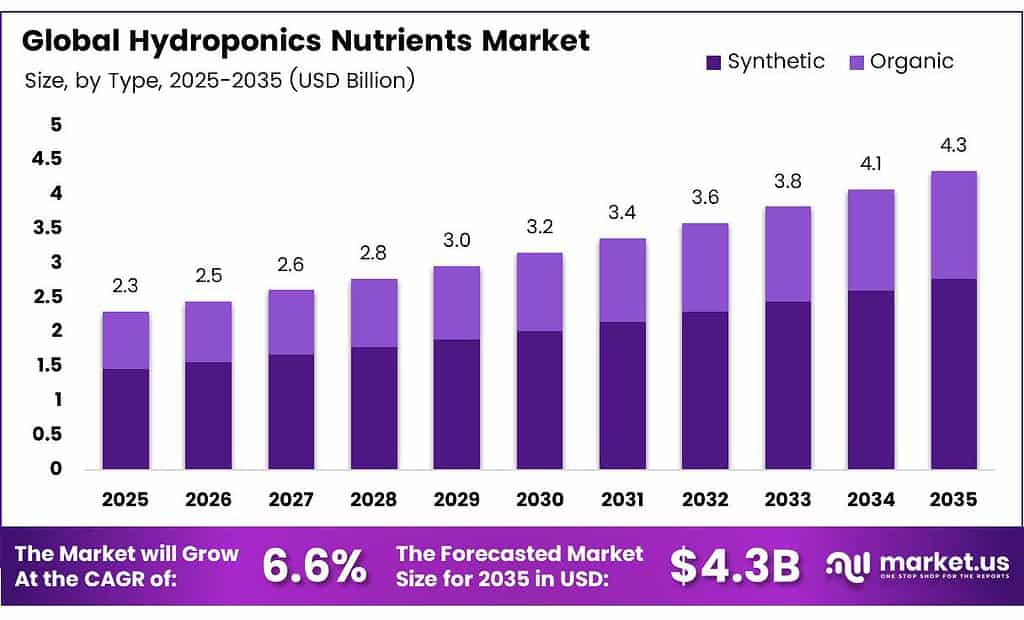
The Global Hydroponics Nutrients Market size is expected to be worth around USD 4.3 billion by 2035 from USD 2.3 billion in 2025, growing at a CAGR of 6.6% during the forecast period 2026 to 2035.
The hydroponics nutrients market covers specialized nutrient solutions and formulations used in soil-free crop production systems. These products supply plants with essential macronutrients and micronutrients directly through water-based growing media. Farmers and commercial growers rely on these solutions to produce consistent, high-quality crops in controlled settings.
Controlled environment agriculture drives widespread adoption of hydroponic nutrient systems. Vertical farms, greenhouses, and indoor growing facilities depend on precise nutrient delivery to maximize yield per square foot. This shift away from conventional field farming accelerates demand for advanced, crop-specific nutrient formulations globally.
- Global fertilizer consumption was expected to reach 205 million tonnes of nutrients in FY2025, surpassing the previous record of 201.5 million tonnes in FY2020. This record-breaking consumption signals robust agricultural demand globally, creating a strong downstream foundation for the hydroponics nutrients segment.
- Global potash production was expected to recover to 73.5 million tonnes in 2024, up 5%, led by recovering Russian production and a new supply ramp-up in Laos. This recovery improves raw material availability for potassic nutrient producers serving the hydroponics sector, supporting stable supply chains and competitive pricing.
Rising consumer preference for pesticide-free and organically grown produce further boosts hydroponic nutrient adoption. Retailers and food brands increasingly source from certified hydroponic farms to meet clean-label product demands. This trend encourages growers to invest in premium nutrient solutions that support organic and veganic certifications.
Key Takeaways
- The Global Hydroponics Nutrients Market is valued at USD 2.3 billion in 2025 and is projected to reach USD 4.3 billion by 2035 at a CAGR of 6.6% during the forecast period 2026 to 2035.
- Nitrogenous leads with a 39.4% market share in 2025.
- Synthetic nutrients dominate with a 69.1% share in 2025.
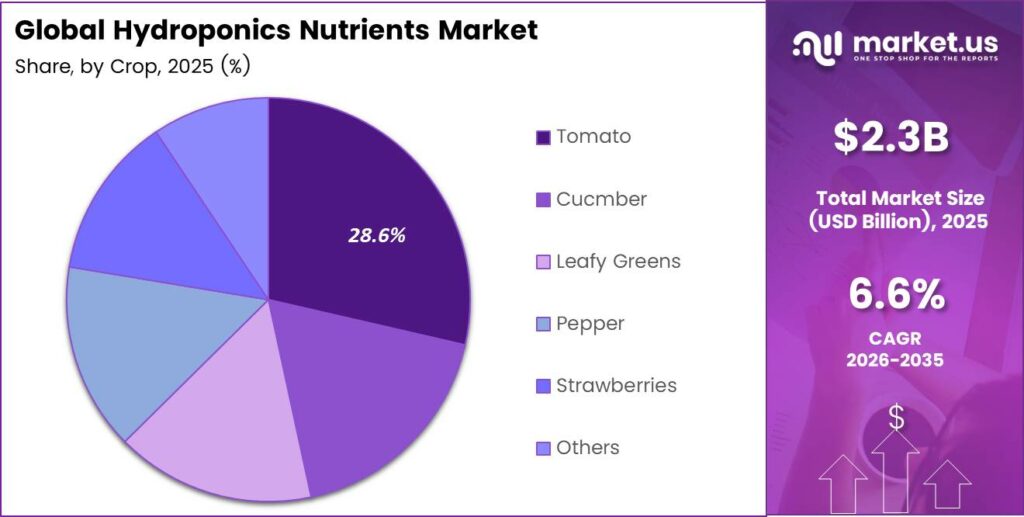
- Tomato holds the highest share at 28.6% in 2025.
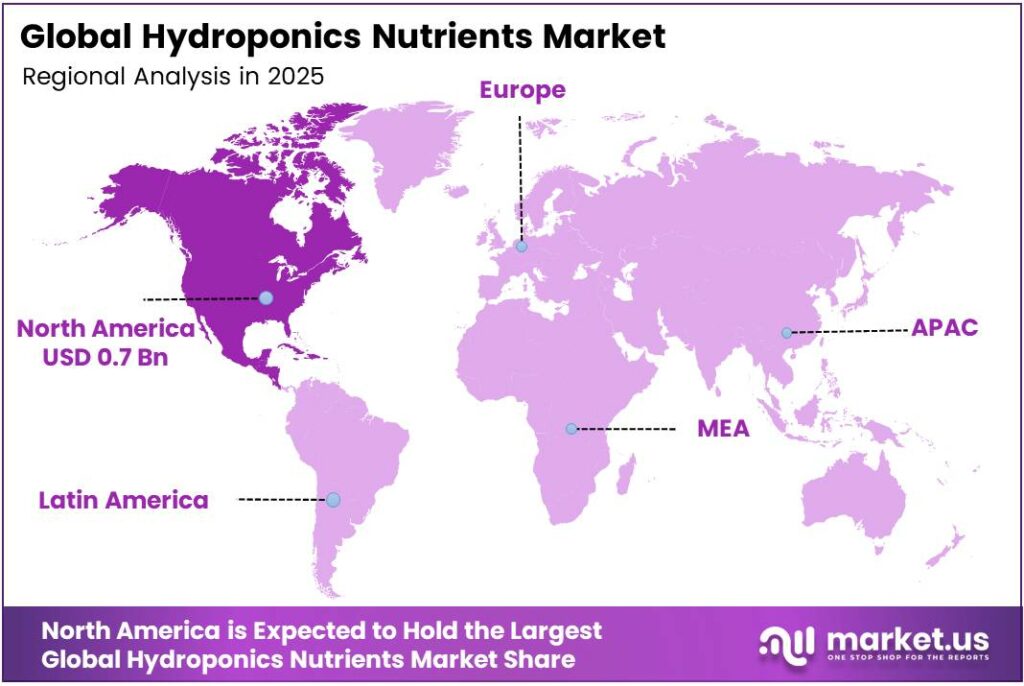
- North America leads regional markets with a 31.2% share, valued at approximately USD 0.7 billion in 2025.
By Nutrient Analysis
Nitrogenous nutrients dominate with 39.4% due to their essential role in plant protein synthesis and vegetative growth.
In 2025, Nitrogenous nutrients held a dominant market position in the by-nutrient segment of the Hydroponics Nutrients Market, with a 39.4% share. Nitrogen drives chlorophyll production and supports rapid vegetative development across most hydroponic crops. Moreover, its broad compatibility with diverse growing systems makes it the most widely used nutrient category in commercial operations.
Phosphatic nutrients play a critical role in root development and energy transfer within hydroponic plants. Growers apply these nutrients during early growth and flowering stages to improve yield and crop quality. Additionally, soluble phosphate formulations integrate easily into automated nutrient delivery systems used in modern vertical farms.
Potassium nutrients support cell regulation, water uptake, and fruit quality in hydroponic crops. Commercial growers rely on potassium-rich solutions to improve shelf life and post-harvest performance. Consequently, potassic nutrient demand grows alongside premium produce markets that prioritize appearance and nutritional value.
Micronutrients address trace element deficiencies that limit crop performance even when macronutrients are sufficient. Chelated forms of iron, manganese, zinc, and boron are widely used in precision feeding programs. Therefore, micronutrient products increasingly form part of complete nutrient packages offered by specialty hydroponic solution providers.
By Type Analysis
Synthetic nutrients dominate with 69.1% due to their precise formulation, cost efficiency, and consistent performance in controlled systems.
In 2025, Synthetic nutrients held a dominant market position in the By Type segment of the Hydroponics Nutrients Market, with a 69.1% share. These chemically formulated solutions offer exact elemental ratios that growers can replicate batch after batch. Moreover, synthetic nutrients dissolve rapidly and integrate seamlessly with automated dosing equipment in large-scale commercial facilities.
Organic nutrients represent the faster-growing segment, supported by rising consumer demand for chemical-free produce. These bio-derived solutions use plant, animal, and microbial sources to deliver nutrients in a natural form. However, their slower release rates and higher cost require growers to invest in specialized growing media and monitoring systems.
By Crop Analysis
Tomato dominates with 28.6% due to high commercial demand and well-established hydroponic production protocols.
In 2025, Tomato held a dominant market position in the By Crop segment of the Hydroponics Nutrients Market, with a 28.6% share. Tomatoes remain the most commercially cultivated hydroponic crop globally due to their high retail value and year-round demand. Additionally, well-documented nutrient protocols make tomato cultivation accessible for both small and large-scale hydroponic producers.
Cucumber ranks among the top hydroponic crops due to its fast growth cycle and strong retail market presence. Commercial greenhouse operators favor cucumber for its high yield potential and consistent nutritional requirements. Therefore, cucumber-specific nutrient blends represent an important product category for hydroponic nutrient manufacturers.
Leafy Greens drive significant nutrient demand owing to their rapid turnover and high volume production in vertical farms. Crops such as lettuce, spinach, and basil require lightweight, fast-acting nutrient solutions. Consequently, leafy green cultivation supports high purchase frequency among urban farm operators and retail-focused hydroponic producers.
Pepper cultivation in hydroponic systems benefits from specialized nutrient regimens that support fruit development and flavour intensity. Growers apply targeted solutions at different growth stages to optimize yield. Moreover, rising foodservice demand for specialty peppers encourages more operators to adopt controlled hydroponic production.
Strawberries represent a premium hydroponic crop with growing adoption in vertical farming environments. Nutrient formulations for strawberries require careful calcium and potassium management to prevent deficiencies. Additionally, the high retail price of hydroponic strawberries justifies greater investment in precision nutrient management programs.
Key Market Segments
By Nutrient
- Nitrogenous
- Phosphatic
- Potassic
- Micronutrients
By Type
- Synthetic
- Organic
By Crop
- Tomato
- Cucumber
- Leafy Greens
- Pepper
- Strawberries
- Others
Emerging Trends
Nano-Chelation, Organic Certification, and Smart Technology Reshape Hydroponics Nutrient Solutions
Nano-chelated mineral technology gains strong traction among commercial hydroponic producers seeking higher nutrient absorption efficiency. Potassium nitrate and sodium potassium nitrate sales volumes rose 30% to 412.4 thousand metric tons in the first nine months of 2024, reflecting growing grower confidence in advanced mineral-based solutions.
- Organic and veganic certified nutrient solutions attract growing interest from growers targeting premium retail markets. Certification-backed products command higher prices and align with clean-label food production standards. Crop-nutrition deliveries of 22,940 thousand tonnes in 2024, up from 22,273 thousand tonnes in 2023, demonstrate that certified and specialty nutrient demand continues to expand globally.
Smartphone-integrated hydroponic systems with pre-loaded nutrient schedules simplify farm management for small and mid-scale operators. These platforms automate dosing, reduce human error, and improve consistency across growing cycles. Furthermore, circular economy approaches that recover nutrients from recycled and waste-derived sources are emerging as a sustainable production strategy that reduces input costs and environmental impact.
Drivers
Controlled Environment Agriculture Expansion and Water-Efficient Farming Demand Drive Hydroponics Nutrient Market Growth
Controlled environment agriculture adoption accelerates globally as food producers seek year-round crop output independent of climate and season. Greenhouse complexes and vertical farming startups expand their footprints across urban centers, creating sustained demand for specialized hydroponic nutrient solutions.
- Specialty Plant Nutrition revenue totaled US$717.3 million for the nine months ended September 30, 2024, up from US$690.2 million in the same period of 2023. This revenue growth confirms that commercial growers actively increase their investment in specialty nutrient products, underlining strong market demand across multiple crop categories and geographies.
Water scarcity in arid and urban regions pushes farmers toward hydroponics as a resource-efficient alternative to conventional soil cultivation. Hydroponic systems use significantly less water per kilogram of crop produced, making them attractive where water costs are high. Consequently, governments in water-stressed regions promote hydroponic adoption through subsidies and agri-tech investment programs that directly stimulate nutrient product demand.
Restraints
High Setup Costs and Nutrient Management Complexity Limit Broader Hydroponics Market Adoption
Automated nutrient dosing systems require significant upfront capital investment that many small and mid-scale growers struggle to justify. Pumps, sensors, controllers, and monitoring equipment add substantially to total farm setup costs. Moreover, maintenance and calibration requirements increase operational expenses over time, reducing the financial appeal for entry-level hydroponic operators.
Maintaining a precise nutrient solution balance across different crop phenotypes remains a technically demanding challenge. Each crop variety responds differently to changes in pH, electrical conductivity, and elemental ratios. Consequently, growers without agronomy expertise face frequent yield losses and crop deficiencies that reduce profitability and discourage broader investment in hydroponic nutrient systems.
Supply chain volatility for key nutrient inputs such as potassium, phosphorus, and nitrogen compounds introduces price uncertainty for producers. Global raw material disruptions can raise production costs and compress margins for nutrient manufacturers and end-users alike. Therefore, unpredictable input pricing continues to restrain expansion among cost-sensitive commercial and smallholder hydroponic growers worldwide.
Growth Factors
Agri-Tech Subsidies, AI Integration, and Crop-Specific Formulations Unlock New Hydroponics Nutrient Market Opportunities
Developing nations introduce government-backed agri-tech subsidy programs that lower barriers to hydroponic farm establishment. Additionally, according to the International Fertilizer Association, global urea output reached a record 199.7 million tonnes in 2024, reflecting expanded production capacity that improves supply availability for hydroponic nutrient manufacturers.
- This shift demonstrates that growers increasingly choose dedicated nutrient brands over generic inputs, signaling the growing commercial value of crop-specific formulations and branded product strategies. Furthermore, global phosphoric acid production reached 88.4 million tonnes in 2024, up 4%, improving raw material supply for phosphatic nutrient production.
AI and IoT integration enables real-time nutrient monitoring and automated dosing with precision that manual systems cannot match. Smart sensors detect deficiencies and adjust solution composition before crop damage occurs, improving yield consistency. The aquaponics and integrated agri-aquaculture sector presents an untapped demand channel, as these hybrid systems require carefully balanced nutrient inputs compatible with both fish and plant cultivation.
Regional Analysis
North America Dominates the Hydroponics Nutrients Market with a Market Share of 31.2%, Valued at USD 0.7 Billion
North America leads the global hydroponics nutrients market, holding a 31.2% share valued at USD 0.7 billion in 2025. The United States drives this dominance through widespread adoption of commercial vertical farms, cannabis cultivation facilities, and large-scale greenhouse operations. Moreover, strong retail demand for locally grown, pesticide-free produce supports sustained investment in premium nutrient solutions across the region.
Europe maintains a strong position in the hydroponics nutrients market, supported by advanced greenhouse infrastructure in the Netherlands, Spain, and Germany. Stringent food safety regulations encourage growers to adopt certified and precisely formulated nutrient products. Additionally, the European Union’s farm-to-fork strategy promotes sustainable cultivation methods, accelerating controlled environment agriculture adoption across the continent.
Asia Pacific records the fastest growth rate in the hydroponics nutrients market, driven by rapid urbanization and food security priorities in China, Japan, India, and Southeast Asia. Governments across the region invest in vertical farming and greenhouse programs to reduce reliance on imported produce. Consequently, demand for both synthetic and organic hydroponic nutrients expands sharply alongside new commercial farm developments.
The Middle East and Africa region adopts hydroponics at an accelerating pace due to severe water scarcity and limited arable land availability. Countries such as the UAE, Saudi Arabia, and Israel develop large indoor farming complexes to achieve food self-sufficiency. Therefore, demand for efficient nutrient solutions tailored to desert-climate growing conditions presents a significant emerging opportunity for market participants.
Key Regions and Countries
North America
- US
- Canada
Europe
- Germany
- France
- The UK
- Spain
- Italy
- Rest of Europe
Asia Pacific
- China
- Japan
- South Korea
- India
- Australia
- Rest of APAC
Latin America
- Brazil
- Mexico
- Rest of Latin America
Middle East & Africa
- GCC
- South Africa
- Rest of MEA
Key Players Analysis
Scotts Miracle-Gro holds a leading position in the hydroponics nutrients market through its dedicated Hawthorne Gardening division. The company supplies a broad portfolio of nutrient solutions, growing media, and lighting products to commercial and home growers. Its integrated distribution network and brand recognition give it significant reach across North American and European retail and professional channels.
Haifa Group specializes in advanced plant nutrition solutions with a strong focus on controlled-release and soluble fertilizers suited to hydroponic applications. The company serves greenhouse and vertical farm operators across multiple continents with crop-specific nutrient programs. Its technical support services and agronomic expertise reinforce customer loyalty among large-scale commercial growers who require consistent and precise formulations.
Advanced Nutrients Ltd targets the premium hydroponics segment with science-driven nutrient formulations designed for maximum plant performance. The company invests heavily in proprietary research to develop products that optimize pH stability, bioavailability, and yield outcomes. Its strong brand identity among professional cultivators positions it as a preferred supplier in high-value crop segments, including cannabis and specialty produce.
ICL Group operates across the full spectrum of specialty plant nutrition, offering products relevant to both conventional agriculture and controlled environment growing. The company leverages its global production infrastructure and raw material access to deliver competitive pricing and supply reliability. Its specialty nutrition division continues to develop formulations that address the evolving needs of hydroponic producers worldwide.
Top Key Players in the Market
- Scotts Miracle-Gro
- Haifa Group
- Advanced Nutrients Ltd
- ICL Group
- Nouryon
- SQM
- Am Hydro
- Nutrifield
- Emerald Harvest
- WE Hydroponics
Recent Developments
- In 2025, Scotts Miracle-Gro (via its Hawthorne Gardening Supply hydroponics/horticulture division, which supplies nutrients, media, and equipment for soilless cultivation, including cannabis) closed its in-house distribution center in central Ohio and outsourced some logistics operations as part of efforts to improve profitability in its cannabis supply division. Hawthorne focuses on premium hydroponic brands for lighting, growth media, and fertilizers.
- In 2025, Haifa North West Europe launched Haifa Soluble DUO, a new water-soluble fertilizer for fertigation (direct nutrient delivery via irrigation, ideal for hydroponics). Available in formulas 10-0-35+10 CaO and 3-0-9+34 CaO, it allows growers to boost calcium without extra nitrogen, chlorides, or sulphates—or reduce nitrogen while maintaining potassium and calcium levels.
Report Scope
Report Features Description Market Value (2025) USD 2.3 Billion Forecast Revenue (2035) USD 4.3 Billion CAGR (2026-2035) 6.6% Base Year for Estimation 2025 Historic Period 2020-2024 Forecast Period 2026-2035 Report Coverage Revenue Forecast, Market Dynamics, Competitive Landscape, Recent Developments Segments Covered By Nutrient (Nitrogenous, Phosphatic, Potassic, Micronutrients), By Type (Synthetic, Organic), By Crop (Tomato, Cucumber, Leafy Greens, Pepper, Strawberries, Others) Regional Analysis North America (US and Canada), Europe (Germany, France, The UK, Spain, Italy, and Rest of Europe), Asia Pacific (China, Japan, South Korea, India, Australia, and Rest of APAC), Latin America (Brazil, Mexico, and Rest of Latin America), Middle East & Africa (GCC, South Africa, and Rest of MEA) Competitive Landscape Scotts Miracle-Gro, Haifa Group, Advanced Nutrients Ltd, ICL Group, Nouryon, SQM, Am Hydro, Nutrifield, Emerald Harvest, WE Hydroponics Customization Scope Customization for segments, region/country-level will be provided. Moreover, additional customization can be done based on the requirements. Purchase Options We have three licenses to opt for: Single User License, Multi-User License (Up to 5 Users), Corporate Use License (Unlimited Users and Printable PDF)  Hydroponics Nutrients MarketPublished date: March 2026add_shopping_cartBuy Now get_appDownload Sample
 -
-
- Scotts Miracle-Gro
- Haifa Group
- Advanced Nutrients Ltd
- ICL Group
- Nouryon
- SQM
- Am Hydro
- Nutrifield
- Emerald Harvest
- WE Hydroponics
Our Clients

- 181323
- March 2026






