Report Overview
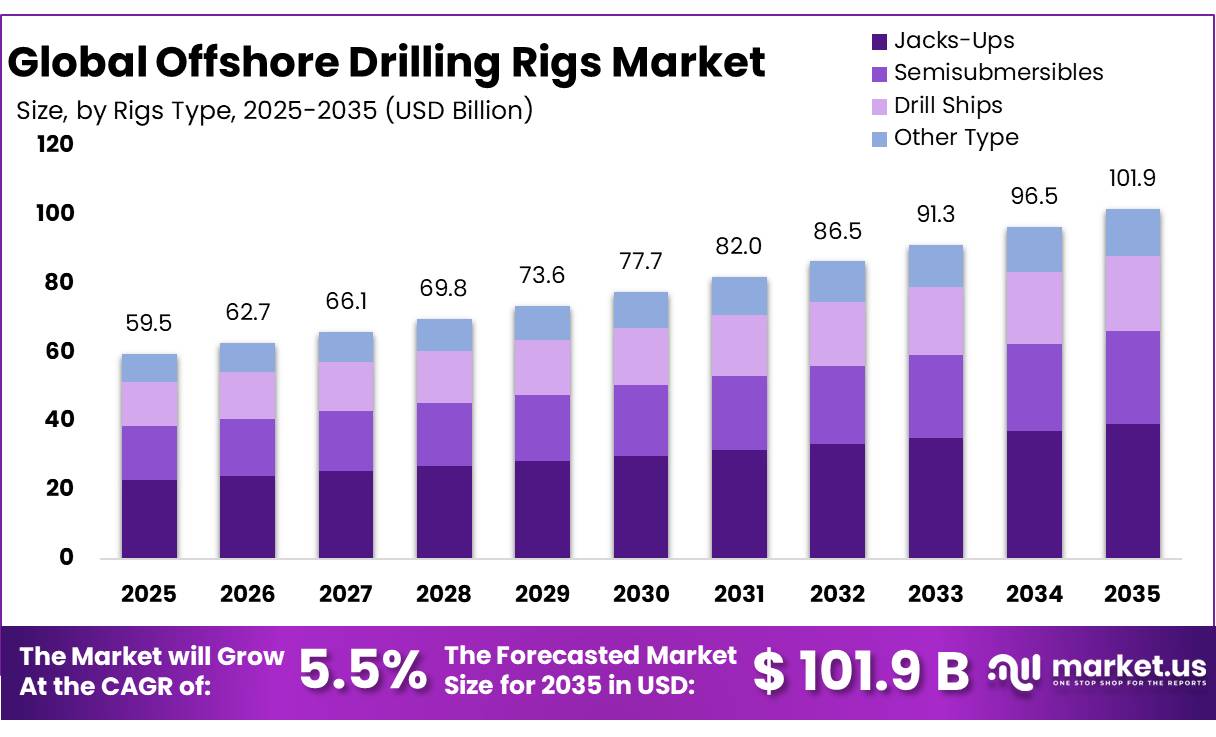
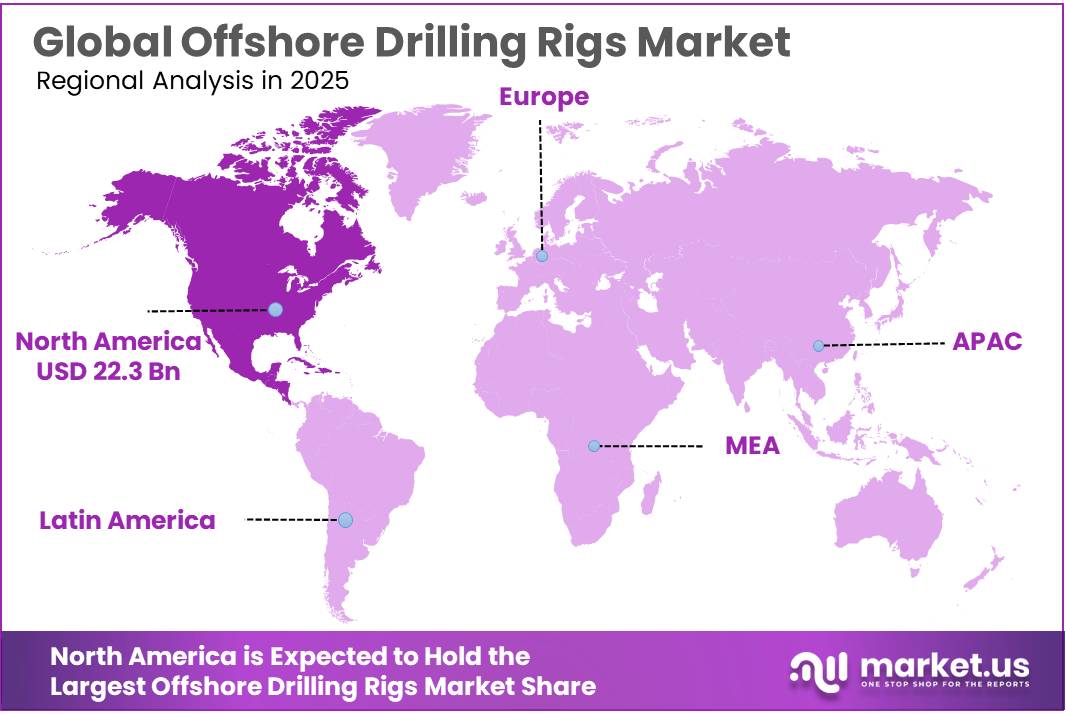
The Global Offshore Drilling Rigs Market size is expected to be worth around USD 101.9 Billion by 2035, from USD 59.5 Billion in 2025, growing at a CAGR of 5.5% during the forecast period from 2026 to 2035. In 2025, North America held a dominant market position, capturing more than a 37.67% share, holding USD 22.3 Billion revenue.
Offshore drilling rigs are specialized structures and vessels used to drill wells beneath the seabed to explore for and produce crude oil and natural gas. The main types include jack-up rigs for relatively shallow waters, semisubmersible rigs for deepwater operations, and drillships designed for deep and ultra-deepwater locations. These rigs use drilling equipment, well-control systems, pumps, sensors, and marine support systems to operate in challenging offshore conditions.
The industry remains important in established offshore regions such as the Gulf of Mexico, the North Sea, Brazil, and West Africa. The United States Bureau of Safety and Environmental Enforcement provides annual production data and tracks deepwater activity in the Gulf of Mexico, reflecting the continuing role of deepwater assets in offshore energy production.
- In Norway, total petroleum production reached approximately 239.2 million standard cubic metres of oil equivalent in 2025, while 97 fields were operating at year-end. These figures show the scale of offshore production infrastructure that requires drilling, maintenance, and further development.
Demand is driven by the need to replace declining output from mature fields, develop new offshore discoveries, and improve recovery from existing wells. The Norwegian Offshore Directorate reported 49 exploration wells completed in 2025, including 40 wildcat wells and 9 appraisal wells, which resulted in 21 discoveries. These activities create demand for drilling rigs, well services, maintenance, and specialist equipment.
Future growth opportunities include deepwater exploration, extended drilling campaigns, additional wells at existing fields, and subsea projects connected to established infrastructure. The Norwegian authorities estimated NOK 256 billion in petroleum-sector investment on the continental shelf for 2026, although investment levels are expected to decline gradually toward 2030 as current development projects are completed.
Key Takeaways
- Offshore Drilling Rigs Market size is expected to be worth around USD 101.9 Billion by 2035, from USD 59.5 Billion in 2025, growing at a CAGR of 5.5%.
- Jacks-Ups held a dominant market position, capturing more than a 38.67% share.
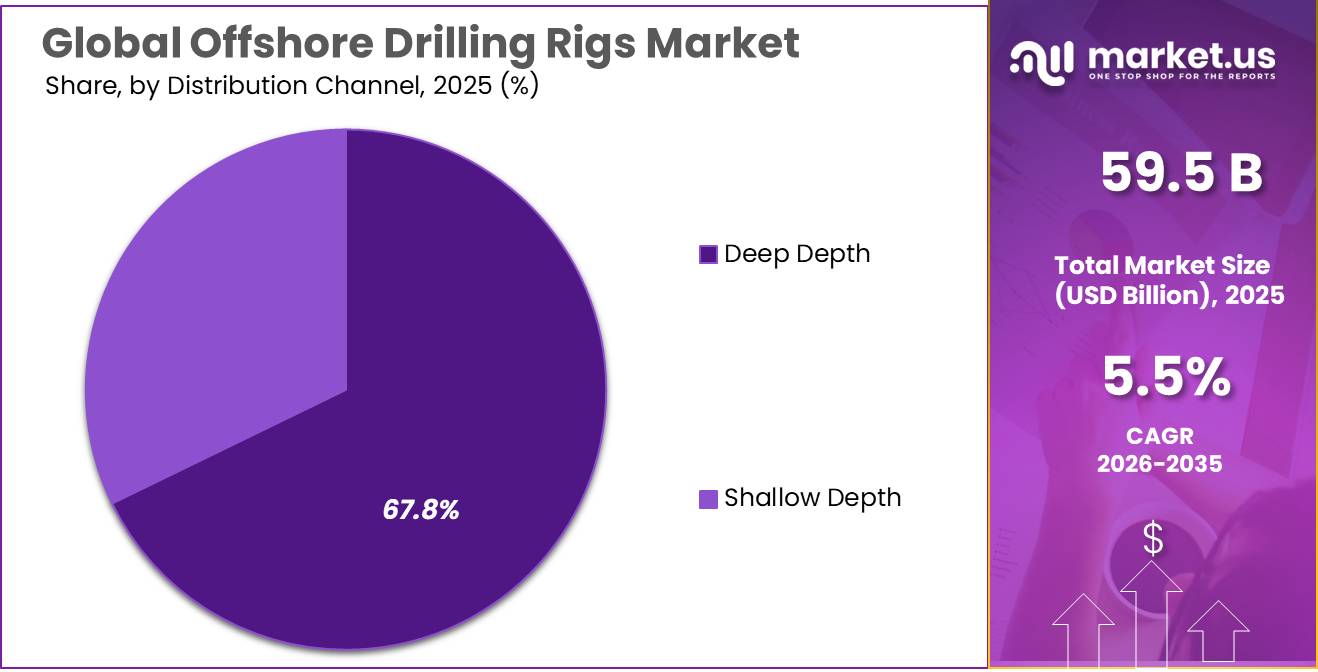
- Deep Depth held a dominant market position, capturing more than a 67.89% share.
- North America held a dominant position in the Offshore Drilling Rigs Market in 2025, accounting for 37.67% of the market, with a reported value of USD 22.3 billion.
By Rigs Type Analysis
Jack-up rigs lead due to their suitability for shallow-water drilling and stable operating design.
In 2025, “Jacks-Ups” held a dominant market position, capturing more than a 38.67% share of the Offshore Drilling Rigs Market. Jack-up rigs are mobile offshore drilling units that use extendable legs to rest on the seabed and raise the drilling platform above the water. Their design makes them suitable for shallow-water exploration, development wells, and maintenance work.
In 2025, the Norwegian Continental Shelf recorded 49 completed exploration wells, including 40 wildcat wells and 9 appraisal wells, supporting continued demand for offshore drilling services. However, this government statistic covers all exploration-well activity and does not separately identify jack-up rigs. The segment’s market share of 38.67% is the supplied figure, not a government-reported statistic.
Semisubmersibles are floating offshore drilling units supported by submerged pontoons and columns, which help reduce the effects of waves and vessel movement. They are used for deepwater exploration and drilling in demanding sea conditions. In 2025, the Norwegian Continental Shelf recorded 49 completed exploration wells, with 21 discoveries reported from exploration activity, supporting the need for continued offshore appraisal and development work. These figures indicate activity across the offshore sector but do not represent semisubmersible-specific rig counts.
By Application Depth Analysis
Deep-depth drilling leads due to its role in developing offshore oil and gas resources in deeper waters.
In 2025, “Deep Depth” held a dominant market position, capturing more than a 67.89% share of the Offshore Drilling Rigs Market. Deepwater drilling requires high-capability rigs, advanced positioning systems, and reliable well-control equipment to operate safely in challenging marine conditions. These rigs support exploration, appraisal, and production drilling in offshore fields where conventional shallow-water equipment is unsuitable.
Government data from the U.S. Bureau of Safety and Environmental Enforcement provides offshore production and operational information for the Gulf of Mexico, where deepwater projects contribute to oil and gas output. However, the 67.89% market share is the supplied figure, not a government-reported estimate.
Shallow Depth drilling involves offshore operations in comparatively low water depths, where jack-up rigs are commonly used because their legs can rest on the seabed and provide a stable drilling platform. According to the U.S. Bureau of Safety and Environmental Enforcement, shallow water is classified as less than 500 feet for its offshore well-permit reporting.
In 2025, the agency recorded 2 new-well permits, 3 revised new-well permits, and 19 sidetrack permits in the shallow-water category. These figures demonstrate continuing shallow-water drilling activity, although permits do not directly measure completed wells or rig demand. Shallow-water projects can benefit from established infrastructure and lower technical complexity than many deepwater developments.
Key Market Segments
Rigs Type
- Jacks-Ups
- Semisubmersibles
- Drill Ships
- Other Type
Application Depth
- Shallow Depth
- Deep Depth
Driver Analysis
Deepwater Americas Buildout
Brazil, Guyana and the wider Atlantic Margin form the strongest unit-demand driver because each FPSO-led development requires multi-year exploration, appraisal, development and injection-well campaigns, turning isolated discoveries into repeat drillship demand: the U.S. EIA estimates Guyana averaged about 750,000 b/d in 2025 after a tenfold increase from 2020 and expects Uaru to add 250,000 b/d, taking national output above 1 million b/d by 2027, while Brazil surpassed 4 million b/d of monthly crude production in October 2025 and its 2025 average was forecast near 3.8 million b/d.
ExxonMobil’s published Stabroek development architecture illustrates drilling intensity—Liza Phase 1 contains 17 wells, Liza Phase 2 has 30, Payara 41 and Yellowtail 51, or 139 producer and injector wells across four projects—while the block has recorded more than 30 significant discoveries since 2015.
Petrobras’ 2026–2030 plan separately indicates around 100 complementary offshore wells in Brazil, and its Equatorial Margin allocation includes 15 exploration wells backed by approximately $2.5 billion. At a conservative 55–80 days per deepwater well, the disclosed 139-well Guyana set alone represents roughly 21–30 rig-years before sidetracks and non-productive time; this converts regional production growth into backlog, mobilization fees and premium dual-activity drillship demand.
The business model therefore shifts from short exploration fixtures toward campaign contracting, performance incentives and integrated well-delivery partnerships, justifying an estimated +2.2 percentage-point contribution over 2026–2031.
Drivers Impact Analysis
| Driver | (~) % Impact on CAGR Forecast | Geographic Relevance | Impact Timeline |
|---|---|---|---|
| Deepwater Americas Buildout | +2.2 pp | Brazil, Guyana, Suriname, U.S. Gulf | Medium term (2–4 years) |
| Offshore Reserve Replacement | +1.6 pp | Global; NOCs and majors | Long term (≥ 4 years) |
| Premium Rig Tightening | +1.4 pp | Atlantic, North Sea, West Africa | Short term (≤ 2 years) |
| HPHT and 20K Wells | +1.1 pp | U.S. Gulf core, Brazil spill-over | Medium term (2–4 years) |
| Middle East Jackup Programs | +0.9 pp | Saudi Arabia, Qatar, UAE | Medium term (2–4 years) |
| Digital Low-Emission Retrofits | +0.7 pp | North Sea, Guyana, Brazil, Gulf | Short term (≤ 2 years) |
Restraint Analysis
Newbuild Capital Barrier
New offshore rig construction is restrained by an unfavorable capital-recovery equation: Borr Drilling estimates a modern ready-to-drill jackup now requires roughly $300 million, more than 3 years of yard lead time, a 7–10-year underpinning contract, and sustainable dayrates above $200,000 across a 25-year asset life, while only around 10 jackups—about 2% of the global fleet—were in the orderbook entering 2025.
Limited yard slots compound the hurdle because Chinese, Korean, Singaporean and Middle Eastern facilities are also committed to LNG carriers, FPSOs, FSRUs and naval construction; the available rig orderbook included only 28 units in September 2025, comprising six drillships, 13 jackups, seven semisubmersibles and two tenders.
A simplified financing case shows that a $300 million unit funded at 60% debt and 7% interest requires approximately $12.6 million of annual interest before principal repayment, while a rig earning $200,000 per day at 85% utilization generates $62.1 million of gross annual revenue, leaving limited room after crew, maintenance, insurance, mobilization, tax, shipyard reserve and depreciation.
Consequently, contractors favor acquisitions, selective reactivations and contract-backed upgrades over speculative newbuilds; this suppresses fleet renewal, limits incremental supply for expanding demand centers, and creates an estimated -1.7 percentage-point long-term CAGR restraint.
Restraint Impact Analysis
| Restraint | (~) % Impact on CAGR Forecast | Geographic Relevance | Impact Timeline |
|---|---|---|---|
| Newbuild Capital Barrier | -1.7 pp | Global; Asia shipyards | Long term (≥ 4 years) |
| FID Deferral Risk | -1.4 pp | Brazil, West Africa, North Sea, Gulf | Medium term (2–4 years) |
| Reactivation Cost Burden | -1.2 pp | Global floater fleet | Medium term (2–4 years) |
| Regulatory Liability Costs | -1.0 pp | U.S. Gulf, North Sea, Australia | Medium term (2–4 years) |
| Equipment Lead-Time Bottlenecks | -0.9 pp | Asia yards, Atlantic basins | Medium term (2–4 years) |
| Aging Fleet Recertification | -0.8 pp | North Sea, SE Asia, West Africa | Short term (≤ 2 years) |
Opportunity Analysis
CCS Injection Drilling
Offshore carbon capture and storage is an adjacent well-construction market rather than a present core driver of rig utilization, creating upside for contractors that qualify rigs, risers, BOPs, completions and crews for CO2 injection, monitoring, legacy-well remediation and abandonment before storage hubs reach full build-out. Northern Endurance Partnership—the UK’s first offshore project to receive a carbon-storage permit—has contracted services for six new subsea CO2 injection wells plus re-abandonment of two legacy wells, targets first injection as early as 2028, and holds a 4 million-tonne-per-year permitted injection rate against a UK 2030 national storage objective of 20–30 million tonnes annually.
Northern Lights Phase II is separately progressing toward more than 5 million tonnes per year of transport-and-storage capacity by 2028, while earlier Northern Lights work required a semisubmersible to drill a carbon-injection well and sidetrack another, demonstrating that conventional offshore drilling assets can be redeployed rather than replaced. In an analyst scenario, a six-well campaign at 50–75 rig-days per well and a $250,000–350,000 daily jackup or semisubmersible rate creates $75–158 million of gross rig demand before completion and intervention services; capturing 20% of a 10-project North Sea pipeline would therefore add $150–300 million of contracted value.
This is a genuine upside—not a baseline driver—because most projects remain in permitting, FEED or early award stages, and contractors must invest now in corrosion-tolerant CO2 procedures, injection-well integrity expertise, CCS-specific risk insurance and partnerships with storage-license holders to convert emerging policy support into bankable backlog.
Opportunity Impact Analysis
| Opportunity | (~) % Potential CAGR Upside | Geographic Relevance | Execution Window |
|---|---|---|---|
| CCS Injection Drilling | +1.7 pp | North Sea, UK, U.S. Gulf, Asia | Medium term (2–4 years) |
| P&A Lifecycle Platforms | +1.5 pp | North Sea, Gulf of Mexico, SE Asia | Short term (≤ 2 years) |
| Rig-as-a-Service Contracts | +1.2 pp | Brazil, Guyana, Middle East, Africa | Short term (≤ 2 years) |
| Fleet M&A Roll-Ups | +1.0 pp | Global; North Sea, Middle East | Medium term (2–4 years) |
| Offshore Geothermal Conversion | +0.7 pp | North Sea, Indonesia, U.S. Gulf | Long term (≥ 4 years) |
| Remote Operations Hubs | +0.6 pp | North Sea, Gulf, Brazil, Australia | Medium term (2–4 years) |
Challenges Analysis
Critical Equipment Lead Times
Modern offshore rigs depend on a narrow supplier base for 15K/20K BOPs, control pods, marine risers, top drives, draw works, thrusters, mud pumps, high-pressure manifolds and power-management hardware, making a single failed component capable of turning an otherwise contracted rig into an idle asset while replacement material moves through OEM manufacturing, certification, freight and installation. Industry sources identify 20,000-psi BOP stacks as requiring capital investment and lead times comparable with newbuild programs, while new-rig delivery periods exceed 3 years and shipyards are expected to struggle with major order volumes.
For an ultra-deepwater rig earning $450,000 per day, a 21-day delay awaiting a BOP control component removes $9.45 million of revenue before operator penalties, personnel standby, vessel costs and repair labor; an additional 5% spare-parts holding on a $50 million critical-equipment inventory ties up another $2.5 million of working capital per rig. The market is not frozen because contractors can cannibalize stacked units, pool spares and negotiate OEM support, but sustainable growth requires dual-sourcing, regional repair hubs, condition-based inventory planning, long-lead framework orders and interoperable component standards; without these measures, lead-time friction warrants a -1.3-percentage-point CAGR drag across Asian yards, Brazil, the Gulf of Mexico and West African deepwater fleets.
Challenges Impact Analysis
| Challenge | (~) % CAGR Friction Drag | Geographic Relevance | Mitigation Horizon |
|---|---|---|---|
| Critical Equipment Lead Times | -1.3 pp | Asia yards, Brazil, Gulf, West Africa | Medium term (2–4 years) |
| Aging Rig Integrity | -1.1 pp | North Sea, SE Asia, West Africa | Long term (≥ 4 years) |
| Offshore Skills Scarcity | -1.0 pp | Global; Gulf, Brazil, Middle East | Long term (≥ 4 years) |
| Digital OT Cybersecurity | -0.8 pp | North Sea, Gulf, Brazil, Australia | Medium term (2–4 years) |
| Cross-Basin Rig Logistics | -0.7 pp | Atlantic, Middle East, APAC corridors | Medium term (2–4 years) |
| Project Timing Volatility | -0.6 pp | Global; North Sea, Asia, Africa | Short term (≤ 2 years) |
Geopolitical Impact Analysis
Geopolitical Impact of the Iran War on the Offshore Drilling Rigs Market
The ongoing Iran war and rising tensions around the Strait of Hormuz are creating uncertainty for the Offshore Drilling Rigs Market in 2026. Attacks on energy infrastructure and commercial vessels have disrupted oil shipments, raised shipping costs, and increased concerns about offshore project safety. According to the International Energy Agency (IEA), global oil demand is forecast to decline by 2.6 million barrels per day in 2026, reflecting restricted fuel availability, higher prices, and weaker economic conditions. The agency also reported that oil flows through the Strait of Hormuz recovered to 10.9 million barrels per day in September 2026, remaining below pre-war levels.
For offshore drilling contractors, the conflict can increase insurance premiums, rig mobilization costs, equipment delivery delays, and crew-safety expenses, particularly for operations near affected waters. Higher oil prices may encourage producers to invest in new exploration and drilling, but uncertainty can also delay project approvals and capital spending. Operators may prioritize safer locations and long-term contracts to control risk. Over time, demand will depend on the duration of the conflict, the stability of shipping routes, and energy companies’ investment decisions.
Regional Insights
North America: Dominant Region
North America held a dominant position in the Offshore Drilling Rigs Market in 2025, accounting for 37.67% of the market, with a reported value of USD 22.3 billion. The region benefits from established offshore oil and gas infrastructure, deepwater projects in the Gulf of Mexico, experienced drilling contractors, and continued investment in field development.
According to the U.S. Bureau of Safety and Environmental Enforcement, oil production from the U.S. Outer Continental Shelf reached a record 714 million barrels in 2025, reflecting the scale of offshore operations and the importance of drilling and production infrastructure. This activity supports demand for deepwater rigs, well services, equipment maintenance, and advanced safety systems. North America’s position is further supported by established supply chains and access to specialist offshore engineering services.
The North Sea, particularly Norway, represents an important offshore drilling opportunity because operators continue exploring for resources and developing discoveries near existing infrastructure. In 2025, Norway completed 49 exploration wells and recorded 21 discoveries, with estimated recoverable resources of 67 million standard cubic metres of oil equivalent. The Norwegian Offshore Directorate expects approximately 40 exploration wells in 2026, indicating continued exploration activity, although at a lower level than in 2025.
These projects can support demand for semisubmersible rigs, jack-up rigs, drilling services, and equipment upgrades. Existing platforms and subsea infrastructure may help make smaller discoveries commercially attractive. However, the available official data does not establish that Norway or Europe is the fastest-growing region by market revenue. This activity instead highlights a meaningful growth opportunity for offshore drilling contractors.
Key Regions and Countries Insights
- North America
- US
- Canada
- Europe
- Germany
- France
- The UK
- Spain
- Italy
- Rest of Europe
- Asia Pacific
- China
- Japan
- South Korea
- India
- Australia
- Rest of APAC
- Latin America
- Brazil
- Mexico
- Rest of Latin America
- Middle East & Africa
- GCC
- South Africa
- Rest of MEA
Key Players Analysis
Transocean Ltd. specializes in offshore drilling services, with a strong focus on ultra-deepwater and harsh-environment operations. In February 2026, the company reported full-year 2025 operating revenue of approximately USD 3.965 billion, up 13% from 2024. Its fleet included 27 mobile offshore drilling units, comprising 20 ultra-deepwater drillships and 7 harsh-environment semisubmersibles. The company reported a contract backlog of approximately USD 6.064 billion as of February 19, 2026, supporting its future revenue opportunities.
Valaris plc provides offshore drilling services through drillships, semisubmersibles, and jack-up rigs. In February 2026, the company reported revenue efficiency of 96% for full-year 2025 and 98% in the fourth quarter. It also secured nearly USD 900 million in additional contract backlog since its previous quarterly report. As of February 2026, its reported backlog included approximately USD 3.03 billion for drillships and USD 1.13 billion across its jack-up categories. Valaris expected all 10 active drillships to be working as 2027 began, supporting fleet utilization and revenue visibility.
Noble Corporation provides offshore drilling services for deepwater exploration and high-specification jack-up operations. In February 2026, the company reported approximately USD 1.106 billion in adjusted earnings before interest, taxes, depreciation, and amortization for full-year 2025, alongside a contract backlog of USD 7.5 billion. It secured approximately USD 1.3 billion in new contract awards since its October 2025 fleet report. Noble also completed the sale of 5 jack-up rigs for USD 360 million, allowing it to focus on its core offshore drilling operations.
Top Key Players Outlook
- Transocean Ltd.
- Valaris plc
- Noble Corporation
- Seadrill Limited
- Diamond Offshore Drilling, Inc.
- Shelf Drilling Ltd.
- COSL Drilling Europe AS
- Borr Drilling Limited
- Odfjell Drilling Ltd.
- Saipem S.p.A.
- Other Key Players
Recent Developments
- In March 2026, Diamond Offshore Drilling, Inc redeemed USD 55 million of Diamond-related second-lien notes for USD 56.7 million, as part of its debt management activities. In June 2026, Noble announced an USD 800 million senior-notes offering due in 2034, supporting its wider financing strategy.
- In August 2026, Seadrill Limited reported second-quarter net income of USD 29 million and adjusted EBITDA of USD 144 million, and increased its full-year revenue guidance to USD 1.50 billion to USD 1.55 billion.
Report Scope
| Report Features | Description |
|---|---|
| Market Value (2025) | USD 59.5 Bn |
| Forecast Revenue (2035) | USD 101.9 Bn |
| CAGR (2026-2035) | 5.5% |
| Base Year for Estimation | 2025 |
| Historic Period | 2020-2024 |
| Forecast Period | 2026-2035 |
| Report Coverage | Revenue Forecast, Market Dynamics, Competitive Landscape, Recent Developments |
| Segments Covered | Rigs Type (Jacks-Ups, Semisubmersibles, Drill Ships, Other Type), Application Depth (Shallow Depth, Deep Depth) |
| Regional Analysis | North America – US, Canada; Europe – Germany, France, The UK, Spain, Italy, Rest of Europe; Asia Pacific – China, Japan, South Korea, India, Australia, Singapore, Rest of APAC; Latin America – Brazil, Mexico, Rest of Latin America; Middle East & Africa – GCC, South Africa, Rest of MEA |
| Competitive Landscape | Transocean Ltd., Valaris plc, Noble Corporation, Seadrill Limited, Diamond Offshore Drilling, Inc., Shelf Drilling Ltd., COSL Drilling Europe AS, Borr Drilling Limited, Odfjell Drilling Ltd., Saipem S.p.A., Other Key Players |
| Customization Scope | Customization for segments, region/country-level will be provided. Moreover, additional customization can be done based on the requirements. |
| Purchase Options | We have three licenses to opt for: Single User License, Multi-User License (Up to 5 Users), Corporate Use License (Unlimited User and Printable PDF) |