


Report Overview
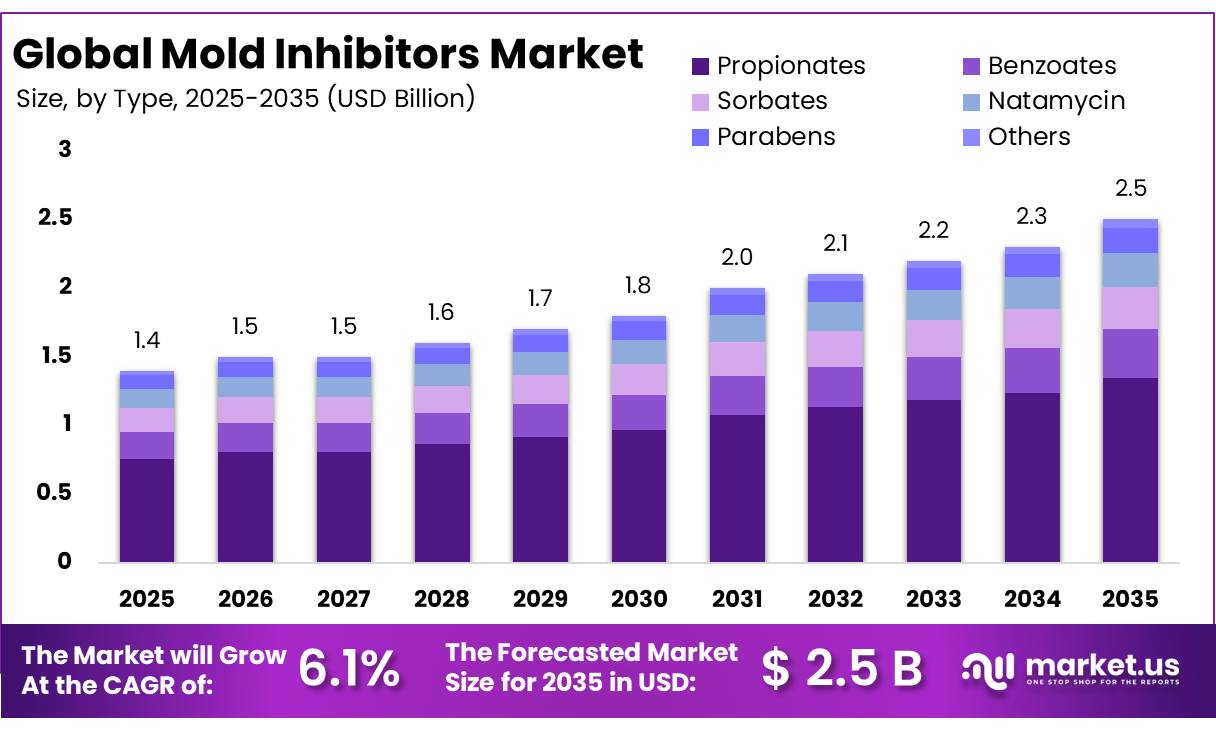
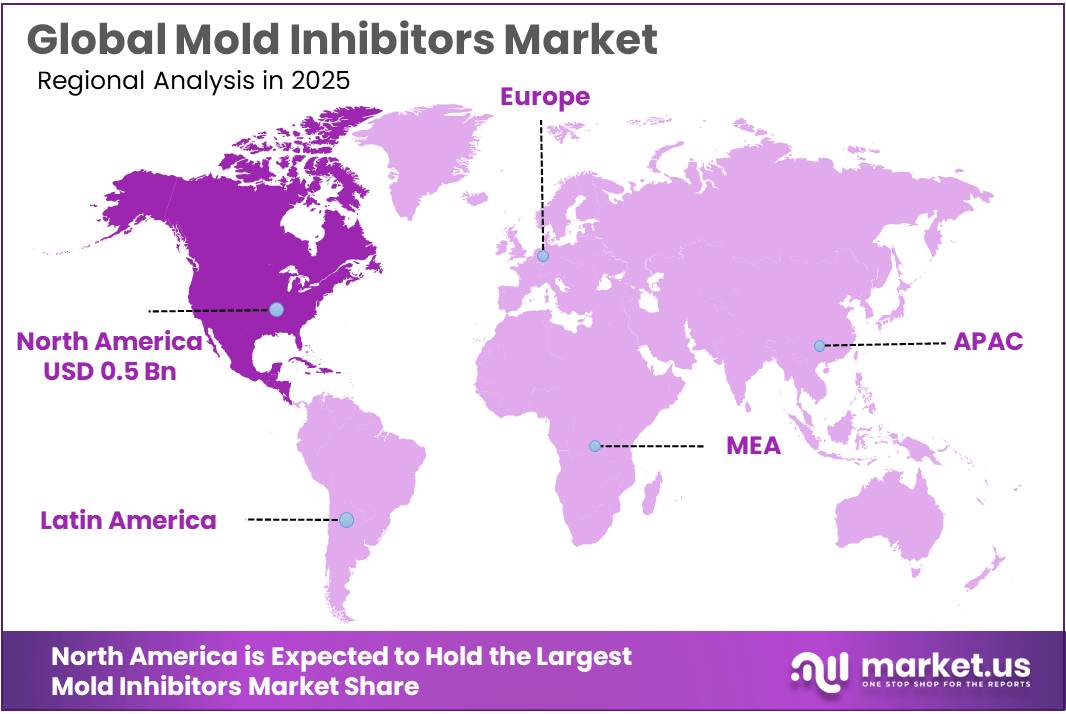
The Global Mold Inhibitors Market size is expected to be worth around USD 2.5 Billion by 2035, from USD 1.4 Billion in 2025, growing at a CAGR of 6.1% during the forecast period from 2026 to 2035. In 2025, North America held a dominant market position, capturing more than a 36.50% share, holding USD 0.5 Billion revenue.
Mold inhibitors are preservative compounds used to slow fungal growth and protect food, animal feed, grain, bakery products, silage, and other moisture-sensitive materials during storage. Important commercial chemistries include propionic acid, propionates, sorbic acid, sorbates, and benzoates. In the United States, the 2025 edition of 21 CFR Part 582 lists propionic acid, sorbic acid, calcium propionate, potassium sorbate, sodium benzoate, and related substances among chemical preservatives permitted for animal-feed applications under specified conditions.
- Cefic reported that the European chemical industry generated EUR 635 billion in turnover in 2025 and employed around 1.2 million people, while approximately 31,000 companies operated across the sector. Europe represented about 13% of global chemical sales, while specialty chemicals remained an important value-added category. Mold inhibitors benefit from this manufacturing base because organic acids and preservative blends require reliable chemical production, formulation, quality control, and distribution infrastructure.
Animal-feed preservation is one of the strongest demand areas. In February 2026, USDA reported U.S. production of 1.63 million tons of distillers dried grains with solubles, 1.19 million tons of high-moisture distillers wet grains, and 242,146 tons of corn gluten feed. Large volumes of moisture-sensitive grain co-products create a practical need for storage management and microbial control. Mold inhibitors can help processors extend usable storage time, protect nutrient quality, and reduce economic losses associated with fungal deterioration.
Food and feed safety regulations provide another important demand driver. FDA maintains an aflatoxin action level of 20 ppb for foods and for several animal-feed situations involving dairy animals, immature animals, and unspecified uses. Higher permitted levels apply to certain livestock categories, reaching 300 ppb for corn and peanut products intended for finishing beef cattle. These limits encourage grain handlers and feed manufacturers to strengthen prevention, testing, moisture management, and preservation practices before contamination reaches unacceptable levels.
The technical value of acid-based preservation is also supported by regulatory science. EFSA evaluated a preservative combination containing 370 g/kg propionic acid, 140 g/kg sodium benzoate, and 110 g/kg sodium propionate. The assessment found the formulation effective for high-moisture cereals at minimum application levels starting at 3,000 mg/kg, while complete feed containing more than 12% moisture required at least 5,000 mg/kg under the evaluated conditions. Such findings support continued formulation development around organic-acid systems.
Key Takeaways
- Mold Inhibitors Market size is expected to be worth around USD 2.5 Billion by 2035, from USD 1.4 Billion in 2025, growing at a CAGR of 6.1%.
- Propionates held a dominant market position, capturing more than a 53.90% share of the Mold Inhibitors Market.
- Synthetic held a dominant market position, capturing more than a 68.00% share of the Mold Inhibitors Market.
- Microorganism-based held a dominant market position, capturing more than a 43.20% share.
- Liquid held a dominant market position, capturing more than a 59.00% share of the Mold Inhibitors Market.
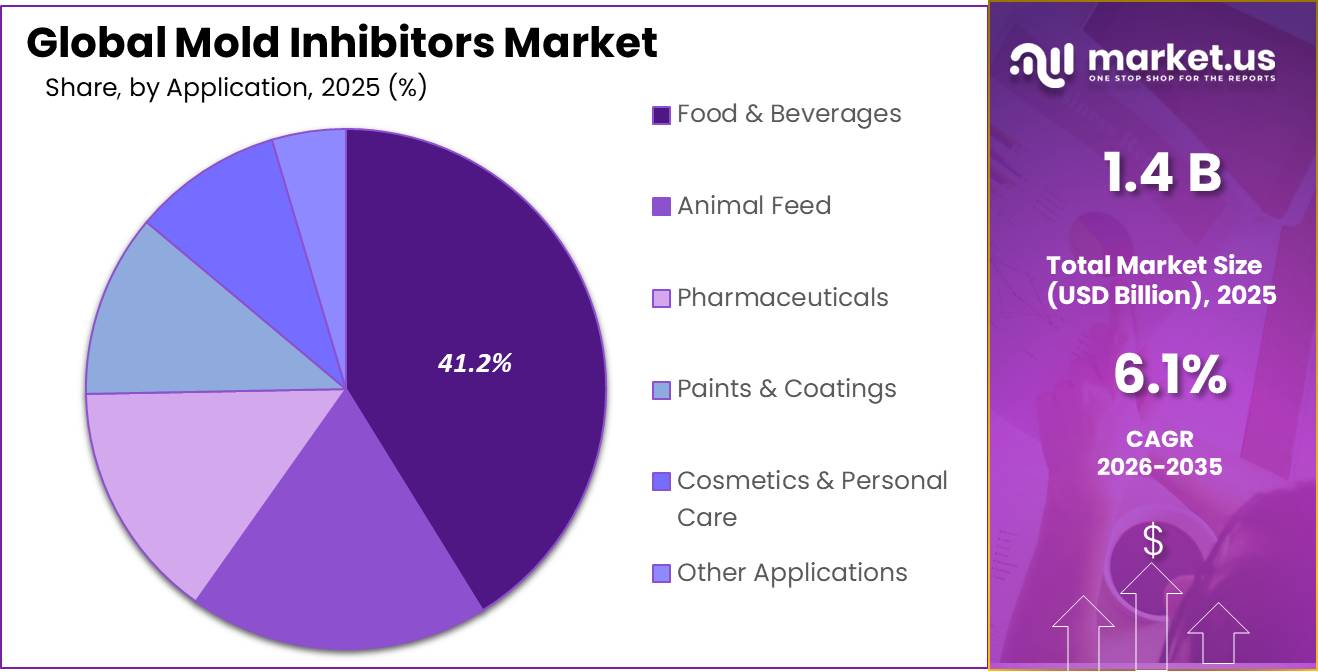
- Food & Beverages held a dominant market position, capturing more than a 41.20% share of the Mold Inhibitors Market.
- North America held a dominant position in 2025, capturing more than a 36.50% share and reaching USD 0.50 billion.
By Type Analysis
Propionates Lead with 53.90% Share Due to Strong Use in Food and Feed Preservation
In 2025, “Propionates” held a dominant market position, capturing more than a 53.90% share of the Mold Inhibitors Market. Propionates remain widely used because calcium and sodium propionate can control mold growth in bakery products, animal feed, and other moisture-sensitive products without significantly changing product quality. As of 2026, the U.S. FDA continued to recognize calcium propionate as an antimicrobial agent and antioxidant.
- European feed regulations require sodium propionate to contain at least 98.5% active material and calcium propionate at least 98%. Permitted propionic-acid-equivalent levels reach 30,000 mg/kg in complete pig feed and 10,000 mg/kg in poultry feed.
Benzoates represent an important type of mold inhibitor, particularly in acidic foods, beverages, feed materials, and preservation blends where fungal and yeast control is required. In 2026, the U.S. FDA continued to classify sodium benzoate as an antimicrobial agent and states that its current food usage results in a maximum level of 0.1%. European feed regulations also authorize sodium benzoate as a preservative, with a recommended minimum application rate of 4,000 mg/kg in complete feed containing 12% moisture.
EFSA has additionally evaluated preservative combinations containing 140 g/kg sodium benzoate, supporting its role in high-moisture cereal protection. These regulatory applications help maintain benzoates as a practical alternative where processors require controlled microbial protection and longer product stability.
By Nature Analysis
Synthetic Mold Inhibitors Lead with 68.00% Share Due to Consistent Performance and Established Regulatory Use
In 2025, “Synthetic” held a dominant market position, capturing more than a 68.00% share of the Mold Inhibitors Market. Synthetic inhibitors remain widely used because manufacturers can achieve consistent purity, controlled dosage, reliable antifungal activity, and easier integration into large food and feed production systems. Calcium propionate is a major example.
- Under the European Union’s 2025 feed-additive rules, calcium propionate produced through chemical synthesis must contain at least 98% active material on a dry-matter basis, while its loss on drying is limited to 6%.
Natural mold inhibitors are gaining importance as food and feed manufacturers explore fermentation-derived ingredients, organic acids, cultured ingredients, and plant-based preservation systems. Natamycin provides a clear commercial example because it is produced from microorganisms and functions as an antimycotic against molds and yeasts.
FDA identifies natamycin as being derived from Streptomyces natalensis and Streptomyces chattanoogensis. Under the 2025 U.S. Code of Federal Regulations, food-grade natamycin must have a purity of 97% ±2%, with arsenic limited to 1 ppm and heavy metals to 20 ppm. Its permitted application on cheese is capped at 20 mg/kg, demonstrating the controlled regulatory use of naturally derived mold inhibitors in commercial food preservation.
By Source Analysis
Microorganism-based Mold Inhibitors Lead with 43.20% Share as Fermentation-Derived Preservatives Gain Wider Use
In 2025, “Microorganism-based” held a dominant market position, capturing more than a 43.20% share of the Mold Inhibitors Market. Microorganism-based inhibitors are gaining wider use because fermentation-derived compounds can provide targeted control against molds and yeasts while supporting cleaner preservation systems.
- Natamycin is a key example and is produced from Streptomyces natalensis and Streptomyces chattanoogensis, according to the U.S. FDA. Under the 2025 U.S. Code of Federal Regulations, natamycin can be used in broiler feed at 11 ppm to retard Aspergillus parasiticus growth for up to 14 days, while treated feed must be used within 4 weeks. For cheese applications, permitted natamycin use is limited to 20 mg/kg, supporting its established role as a commercial antimycotic preservative.
Plant-based mold inhibitors are becoming increasingly relevant as food and feed manufacturers look for botanical alternatives based on essential oils and naturally occurring antifungal compounds. Oregano, thyme, clove, and similar plant extracts contain compounds such as carvacrol and thymol that can help suppress fungal activity. In July 2025, the European Commission authorized Spanish-type oregano essential oil from Thymbra capitata as a feed additive for all animal species.
The regulated oil must contain 60–75% carvacrol, up to 5% thymol, 5.5–9% p-cymene, and 3.5–10% γ-terpinene. A 2025 scientific review indexed by the U.S. National Library of Medicine also identified Origanum essential oils as having antifungal potential against several fungal groups. These developments support further commercial interest in plant-derived preservation systems, particularly where manufacturers seek natural-label solutions and lower dependence on conventional synthetic preservatives.
By Form Analysis
Liquid Mold Inhibitors Lead with 59.00% Share Due to Easy Mixing and Uniform Application
In 2025, “Liquid” held a dominant market position, capturing more than a 59.00% share of the Mold Inhibitors Market. Liquid formulations remain widely preferred because they can be sprayed, pumped, or metered directly into feed, silage, grains, and food-processing lines. Their fluid form supports more even distribution across large production batches and works well with automated dosing systems.
- In October 2025, the European Commission renewed its feed authorization and specified propionic acid at a minimum purity of 99.5%, with non-volatile residue limited to 0.01% and aldehydes to 0.1%. The permitted maximum level reaches 30,000 mg/kg in complete pig feed and 10,000 mg/kg in poultry feed. U.S. government PubChem data updated in 2026 also identifies propionic acid as a colorless liquid with a molecular weight of 74.08 g/mol, while FDA classifies it as an antimicrobial agent.
Dry/Powder mold inhibitors remain an important form, particularly in bakery premixes, compound feed, dry grain treatments, and powdered ingredient systems. Their solid format makes them easier to store, transport, weigh, and blend into dry formulations without adding additional moisture. Calcium propionate is a widely used example because it combines mold-control properties with good handling characteristics in industrial food and feed production.
By Application Analysis
Food & Beverages Leads with 41.20% Share as Manufacturers Focus on Shelf Life and Mold Control
In 2025, “Food & Beverages” held a dominant market position, capturing more than a 41.20% share of the Mold Inhibitors Market. Food and beverage manufacturers widely use preservatives such as calcium propionate, sodium benzoate, potassium sorbate, and natamycin to protect bakery goods, beverages, cheese, sauces, and other moisture-sensitive products from mold and yeast.
- The U.S. FDA specifically identifies preservatives as ingredients used to prevent spoilage caused by bacteria, molds, fungi, and yeast in beverages, baked goods, cereals, dressings, and snack foods. Under the 2025 U.S. Code of Federal Regulations, natamycin used for cheese preservation can be applied at up to 20 mg/kg, while the additive must have 97% ±2% purity, arsenic below 1 ppm, and heavy metals below 20 ppm.
Animal Feed represents another important application for mold inhibitors because grains, silage, compound feed, and wet processing co-products can deteriorate when moisture and storage conditions encourage fungal growth. Propionic acid and its salts are widely used to improve feed stability and reduce spoilage risk. In October 2025, the European Commission renewed authorization of propionic acid, sodium propionate, and ammonium propionate for all terrestrial animal species.
Maximum propionic-acid-equivalent levels reach 30,000 mg/kg in complete pig feed and 10,000 mg/kg in poultry feed. The need for preservation is also supported by large volumes of moist feed materials. USDA reported production of 1.19 million tons of distillers wet grains and 170,163 tons of wet corn gluten feed in February 2026. Such moisture-rich products require careful storage and microbial control, supporting continued use of mold inhibitors in commercial animal nutrition.
Key Market Segments
By Type
- Propionates
- Benzoates
- Sorbates
- Natamycin
- Parabens
- Others
By Nature
- Natural
- Synthetic
By Source
- Plant-based
- Animal-based
- Microorganism-based
- Others
By Form
- Dry/Powder
- Liquid
By Application
- Food & Beverages
- Animal Feed
- Pharmaceuticals
- Paints & Coatings
- Cosmetics & Personal Care
- Other Applications
Driver Analysis
Climate-Linked Mold Control
Climate-linked fungal pressure is the largest modeled driver because warmer temperatures, erratic rainfall and higher humidity enlarge the number of crop lots requiring preventive treatment before visible spoilage or toxin formation occurs: EFSA notes that temperature, humidity, rainfall and atmospheric carbon dioxide alter fungal behavior and mycotoxin production, while the European Environment Agency expects a +2°C scenario to raise aflatoxin risk in maize particularly across Spain, Italy and the Balkans and indicates that DON and ZEN could show moderate near-term effects during 2021–2050.
The commercial mechanism is broader than emergency remediation—feed mills, grain elevators and food processors shift from seasonal spot purchases to risk-zoned, moisture-adjusted inhibitor programs covering harvest intake, storage, transport and finished product; because mold inhibitors suppress fungal growth but do not reliably remove toxin already present, earlier dosing increases treated tonnes and favors bundled sales combining organic-acid blends, surfactants, application equipment, moisture sensing and verification services. Grain-storage science places fungal-growth onset around 65–70% equilibrium relative humidity, with tropical and subtropical temperatures creating favorable conditions for pests and fungi, so a modest increase in days above these thresholds can materially lift preventive-treatment frequency.
The resulting value capture comes from fewer downgraded lots, lower dry-matter and nutrient losses, and reduced mycotoxin-testing failures; a 2025 review estimated U.S. crop losses from mycotoxin contamination at $932 million annually, plus $466 million for enforcement, testing and quality control, indicating a large avoidable-cost pool even before animal-performance losses are included. On that evidence, the driver is assigned +1.4 percentage points to attainable CAGR, concentrated first in southern Europe, the U.S. Corn Belt, Brazil, India and Southeast Asia, with persistence beyond four years as suppliers move from commodity preservatives to climate-risk subscriptions priced per protected tonne.
Drivers Impact Analysis
| Driver | (~) % Impact on CAGR Forecast | Geographic Relevance | Impact Timeline |
|---|---|---|---|
| Climate-linked mold control | +1.4% | EU south, Americas, APAC | Long term (≥ 4 years) |
| Feed-volume expansion | +1.2% | APAC core, Americas | Medium term (2–4 years) |
| Shelf-life loss reduction | +1.1% | Global food chains | Short term (≤ 2 years) |
| Clean-label preservation | +0.9% | North America, EU | Medium term (2–4 years) |
| Storage modernization | +0.8% | Africa, South Asia, LATAM | Medium term (2–4 years) |
| Regulatory validation | +0.5% | EU, U.S., UK | Short term (≤ 2 years) |
Restraint Analysis
Synthetic-Label Rejection
Consumer scrutiny of ingredient panels places a direct ceiling on conventional propionate-, sorbate- and benzoate-led growth in packaged food, particularly where brands market “no artificial preservatives”: 2025 consumer evidence indicates 67% of shoppers were extremely or very likely to inspect ingredient lists, 63% checked them to avoid specific ingredients and one-third reported avoiding artificial ingredients such as dyes, while a separate U.S. survey found 51% actively sought clean-label packaged foods.
Substitution is not unit-cost neutral: calcium propionate is normally used around 0.1–0.3% of flour weight, whereas clean-label fermentates in a 2025 bread study commonly required 1–4% for moderate performance and at least 6% to approach the mold-free duration of 0.3% calcium propionate, making an equal-price-per-kilogram natural replacement potentially 20–60 times more expensive on inclusion alone before recipe adjustments.
This mismatch can delay reformulation, but where brand equity outweighs additive economics it destroys volume for traditional actives and shifts value to lower-concentration claims, shorter shelf life or chilled distribution. The modeled -1.1-percentage-point drag is therefore concentrated in North America, Western Europe, Japan, South Korea and premium urban APAC over two to four years, with conventional suppliers needing dual portfolios, consumer-friendly declarations and efficacy-per-dose proof to prevent commoditized acid volumes from decoupling from packaged-food output.
Restraint Impact Analysis
| Restraint | (~) % Impact on CAGR Forecast | Geographic Relevance | Impact Timeline |
|---|---|---|---|
| Synthetic-label rejection | -1.1% | North America, EU, affluent APAC | Medium term (2–4 years) |
| Preservation substitution | -0.9% | Global packaged foods | Long term (≥ 4 years) |
| Dose-efficacy ceiling | -0.8% | Global bakery, feed | Short term (≤ 2 years) |
| Acid-cost volatility | -0.7% | EU, import-led APAC/LATAM | Short term (≤ 2 years) |
| Regulatory compliance load | -0.6% | EU core, exporters | Medium term (2–4 years) |
| Handling-capex burden | -0.4% | SMEs, emerging markets | Medium term (2–4 years) |
Opportunity Analysis
Preservation-as-a-Service
The most executable white space is to stop selling inhibitor kilograms and monetize verified protected tonnes through a recurring preservation-as-a-service contract combining leased dosing hardware, inline moisture sensors, cloud analytics, consumable replenishment and spoilage-performance reporting; this is an opportunity rather than a baseline driver because most current transactions remain product-volume based even though commercial systems can already measure whole incoming loads, auto-route grain, adjust liquid preservative dosing to real-time moisture and reconcile additive inventory.
The addressable conversion pool is substantial: global feed output reached about 1.44 billion tonnes in 2025, up 40.1 million tonnes, so capturing only 1% of that throughput under service contracts would place roughly 14.4 million tonnes under management; at an analyst-modeled service fee of $0.75–1.50 per treated tonne, this equates to $10.8–21.6 million of recurring annual platform revenue before chemical sales, and penetration of 5% would scale the pool fivefold.
The go-to-market should prioritize feed groups operating at least 100,000 tonnes annually, where a 1 kg/tonne dosing error equals 100 tonnes of annual chemical variance, then extend through mill-equipment OEMs and distributors; a two-year execution window is realistic because the underlying sensors and SCADA links exist, but scaling requires cybersecurity, calibration libraries, standardized savings baselines and contractual allocation of loss risk. Successful conversion could add approximately 1.0 percentage point above baseline CAGR by raising revenue per customer, recurring share and equipment-linked switching costs without depending on underlying feed growth.
Opportunity Impact Analysis
| Opportunity | (~) % Potential CAGR Upside | Geographic Relevance | Execution Window |
|---|---|---|---|
| Preservation-as-a-service | +1.0% | North America, EU, APAC mills | Short term (≤ 2 years) |
| Fermentate platform expansion | +0.9% | North America, EU, Japan | Medium term (2–4 years) |
| Antifungal active packaging | +0.8% | EU, North America, East Asia | Medium term (2–4 years) |
| Emerging-market microdosing | +0.7% | Africa, South Asia, LATAM | Medium term (2–4 years) |
| Bio-based acid localization | +0.6% | EU, China, India, Americas | Long term (≥ 4 years) |
| Integrated mold-risk platform | +0.5% | Global industrial processors | Short term (≤ 2 years) |
Challenges Analysis
Climate-Efficacy Variability
This does not halt inhibitor sales, but it raises the frequency of forecast errors because a fixed dose validated at one crop moisture, water activity, pH and storage temperature may underperform in a hotter, wetter or more stressed harvest; operational concern increases materially once grain moisture exceeds roughly 14%, storage relative humidity exceeds 85%, and temperature exceeds 55°F, conditions under which mold and mycotoxin risk becomes more difficult to control.
On an analyst-modeled 100,000-tonne seasonal treatment program, moving from a standard 1 kg/tonne application to a risk-adjusted 1.5–2.0 kg/tonne consumes an extra 50–100 tonnes of formulation, while a single 2% underprotected lot exposes 2,000 tonnes to downgrade, rejection or remediation; the asymmetry pushes suppliers toward conservative dosing, raises customer cost per protected tonne and makes efficacy claims harder to standardize across years.
The required adjustment is a regional strain library, climate-linked risk zoning, harvest-specific protocols, multi-acid formulations and performance warranties bounded by moisture and storage conditions, supported by continuous temperature and humidity sensing rather than annual label guidance. Because climate distributions and fungal ecology will keep changing after individual products are reformulated, full normalization is unlikely before four years, and the residual uncertainty is assessed to remove approximately 1.1 percentage points from maximum attainable CAGR through slower trials, higher technical-service intensity and periodic loss of customer confidence.
Challenges Impact Analysis
| Challenge | (~) % CAGR Friction Drag | Geographic Relevance | Mitigation Horizon |
|---|---|---|---|
| Climate-Efficacy Variability | -1.1% | EU, Americas, South Asia | Long term (≥ 4 years) |
| Sampling Data Uncertainty | -0.9% | Global grain/feed chains | Medium term (2–4 years) |
| Matrix-Specific Performance | -0.8% | Global food/feed plants | Long term (≥ 4 years) |
| Dosing Integration Gaps | -0.7% | APAC, Africa, LATAM | Medium term (2–4 years) |
| Corrosion-Safety Burden | -0.6% | Global processing hubs | Medium term (2–4 years) |
| Regulatory Skills Fragmentation | -0.4% | EU, North America, APAC | Long term (≥ 4 years) |
Geopolitical Impact Analysis
War-Driven Energy and Grain Disruptions Reshape Mold Inhibitor Demand
The continuing Russia–Ukraine war and armed conflict in the Middle East are creating a mixed impact on the Mold Inhibitors Market. Mold inhibitors depend heavily on organic acids, petrochemical feedstocks, energy, packaging, and freight. UNCTAD reported in 2026 that Middle East conflict pushed oil prices up by more than 60%, while gas prices more than doubled. Higher energy and transport costs can raise production expenses for propionic acid, benzoates, sorbates, and formulated preservation systems.
At the same time, war-related disruption is increasing the need for grain and feed protection. FAO reported in August 2026 that damaged infrastructure and restricted Black Sea exports were putting additional pressure on Ukraine’s grain storage capacity. A new support programme was launched across nine oblasts to provide temporary storage for the 2026 harvest. Longer storage periods and delayed exports increase the importance of moisture management, fungal control, and preservation products.
Black Sea disruption is also influencing feedstock prices. FAO reported that U.S. maize export prices in August 2026 were 20.7% above the previous year. For mold-inhibitor suppliers, these conditions create higher input and logistics costs but also stronger demand from grain handlers, feed manufacturers, and food processors seeking to reduce spoilage during extended storage periods.
Regional Insights
North America Leads the Mold Inhibitors Market, While Asia Pacific Shows Strong Growth Potential
North America held a dominant position in 2025, capturing more than a 36.50% share and reaching USD 0.50 billion. The United States provides the region with a large addressable feed base. USDA projected 2025/26 feed and residual use of the four principal feed grains at 159.176 million metric tons, with corn representing more than 97% of that volume. USDA also reported 86.2 million cattle and calves at the start of 2026.
Regional demand for mold inhibitors is closely tied to food processing, compound feed output, grain storage, humidity exposure, and regulatory controls on fungal contamination. North America benefits from mature preservative use, large feed-grain volumes, and established food manufacturing systems. Asia Pacific is gaining importance as livestock production becomes more intensive and compound-feed use expands. OECD-FAO expects global feed-protein consumption to rise 13.5% through 2035, increasing the need for better storage stability and microbial control across feed chains.
Asia Pacific is expected to be the fastest-growing regional segment, supported by expanding livestock and poultry production, warmer storage environments, and greater adoption of commercial feed. OECD-FAO projects Asian countries to account for 56% of the increase in global feed consumption through 2034 as livestock and poultry operations expand and intensify. The 2026 Outlook also expects lower-middle-income economies to record annual feed-demand growth of 2.8% over the next decade.
Key Regions and Countries Insights
- North America
- US
- Canada
- Europe
- Germany
- France
- The UK
- Spain
- Italy
- Rest of Europe
- Asia Pacific
- China
- Japan
- South Korea
- India
- Australia
- Rest of APAC
- Latin America
- Brazil
- Mexico
- Rest of Latin America
- Middle East & Africa
- GCC
- South Africa
- Rest of MEA
Key Players Analysis
Kemin Industries holds a strong position in mold inhibition through its feed-preservation portfolio, including Ammo CURB®, Myco CURB®, Ultra CURB® and KALLSIL®. Myco CURB Liquid contains about 65% propionic acid, supported by sorbic and benzoic acids for controlling mold in feed and stored grains. Kemin operates in more than 90 countries, serves customers across 120+ countries, and employs more than 3,000 people. Its liquid and dry formulations give feed producers flexible options for controlling spoilage and maintaining nutrient quality.
BASF SE is an important supplier of organic-acid-based mold-control solutions, including Luprosil®, Lupro-Cid® and Lupro-Grain® for feed, grain and silage preservation. BASF has nearly 5 decades of experience in feed preservation and markets Amasil products in 75%, 85%, 94% and 99% concentrations. In 2025, BASF generated EUR 59.657 billion in sales, employed 108,251 people, and operated 234 production sites in 93 countries. This large chemical network supports reliable production and global distribution of preservative ingredients.
Cargill strengthens its mold- and mycotoxin-management position through animal nutrition, organic-acid solutions and the Notox™ portfolio. In 2025, its global research drew on more than 400,000 feed analyses from over 150 farms, feed plants and storage locations. Its 2025 mycotoxin report later covered 389,926 analyses across 41 countries, with 71% of samples testing positive for at least one mycotoxin. Cargill recorded USD 154 billion in fiscal 2025 revenue and employed more than 155,000 people worldwide.
Top Key Players Outlook
- Kemin Industries, Inc.
- BASF SE
- Cargill, Incorporated
- Archer Daniels Midland Company (ADM)
- Corbion N.V.
- Eastman Chemical Company
- Perstorp Holding AB
- dsm-firmenich AG
- Tate & Lyle PLC
- Kerry Group plc
- Nutreco N.V.
- Novus International, Inc.
- Impextraco N.V.
- BIOMIN GmbH
- ADDCON GmbH
Recent Developments
- ADM generated USD 80.27 billion in 2025 revenue, while Animal Nutrition operating profit reached USD 98 million, up 66% year over year.
- Corbion generated EUR 1,267.4 million in 2025 sales and EUR 204.3 million in adjusted EBITDA, while its Functional Ingredients & Solutions segment produced EUR 970.4 million in sales.
Report Scope
| Report Features | Description |
|---|---|
| Market Value (2025) | USD 1.4 Bn |
| Forecast Revenue (2035) | USD 2.5 Bn |
| CAGR (2026-2035) | 6.1% |
| Base Year for Estimation | 2025 |
| Historic Period | 2020-2024 |
| Forecast Period | 2026-2035 |
| Report Coverage | Revenue Forecast, Market Dynamics, Competitive Landscape, Recent Developments |
| Segments Covered | By Type (Propionates, Benzoates, Sorbates, Natamycin, Parabens, Others), By Nature (Natural, Synthetic), By Source (Plant-based, Animal-based, Microorganism-based, Others), By Form (Dry/Powder, Liquid), By Application (Food & Beverages, Animal Feed, Pharmaceuticals, Paints & Coatings, Cosmetics & Personal Care, Other Applications) |
| Regional Analysis | North America – US, Canada; Europe – Germany, France, The UK, Spain, Italy, Rest of Europe; Asia Pacific – China, Japan, South Korea, India, Australia, Singapore, Rest of APAC; Latin America – Brazil, Mexico, Rest of Latin America; Middle East & Africa – GCC, South Africa, Rest of MEA |
| Competitive Landscape | Kemin Industries, Inc., BASF SE, Cargill, Incorporated, Archer Daniels Midland Company (ADM), Corbion N.V., Eastman Chemical Company, Perstorp Holding AB, dsm-firmenich AG, Tate & Lyle PLC, Kerry Group plc, Nutreco N.V., Novus International, Inc., Impextraco N.V., BIOMIN GmbH, ADDCON GmbH |
| Customization Scope | Customization for segments, region/country-level will be provided. Moreover, additional customization can be done based on the requirements. |
| Purchase Options | We have three licenses to opt for: Single User License, Multi-User License (Up to 5 Users), Corporate Use License (Unlimited User and Printable PDF) |





































