Report Overview
The Global Enterprise Metadata Management Market reached USD 10.6 billion in 2024 and is forecast to reach USD 84.2 billion by 2034, expanding at a 23.0% CAGR from 2025 to 2034. North America leads the market with a 40.7% share and USD 4.3 billion in 2024 revenue.
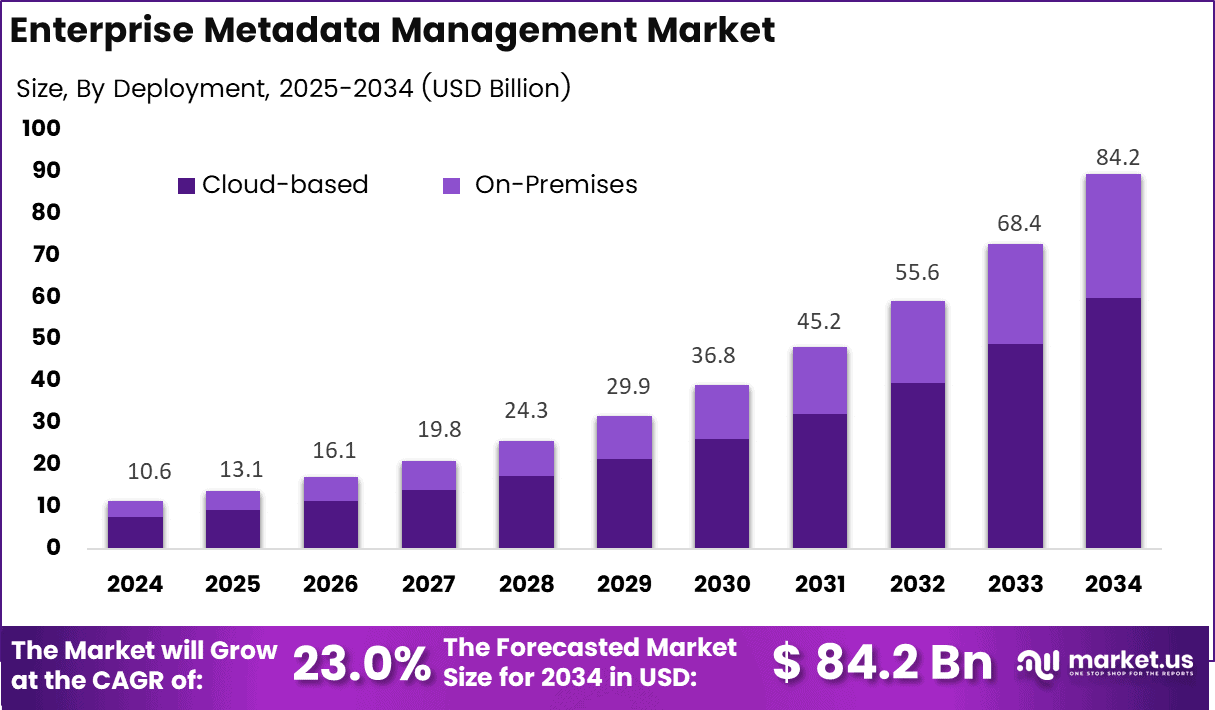
Rising cloud use, artificial intelligence, digital services, and regulatory controls increase the volume and complexity of enterprise data. Metadata platforms help companies locate data, document ownership, track lineage, apply quality rules, and prove compliance.
The International Telecommunication Union estimated that 6 billion people used the internet in 2025, an increase of more than 240 million during the year. This expansion creates more customer, transaction, device, and operational records that enterprises must classify and govern.
UNCTAD also reported that data centers consumed about 460 terawatt-hours of electricity in 2022 and could consume 1,000 terawatt-hours in 2026, showing the rapid growth of digital processing capacity. These trends support demand for automated catalogs, lineage tools, governance software, and managed metadata services.
The region combines mature cloud infrastructure, large technology suppliers, strict data controls, and heavy enterprise spending on artificial intelligence. The World Bank reported that high-income economies held 77% of global colocation data-center capacity in June 2025.
It also estimated that the United States supplied 84% of global cloud-computing exports on a per-capita basis. Microsoft planned about USD 80 billion of fiscal 2025 investment in AI-enabled data centers, with more than half allocated to the United States. This infrastructure supports large pools of distributed data across cloud and on-premises systems.
Key Takeaways
- The Enterprise Metadata Management Market was valued at USD 10.6 billion in 2024 and is forecast to reach USD 84.2 billion by 2034. The market is projected to expand at a 23.0% CAGR from 2025 to 2034.
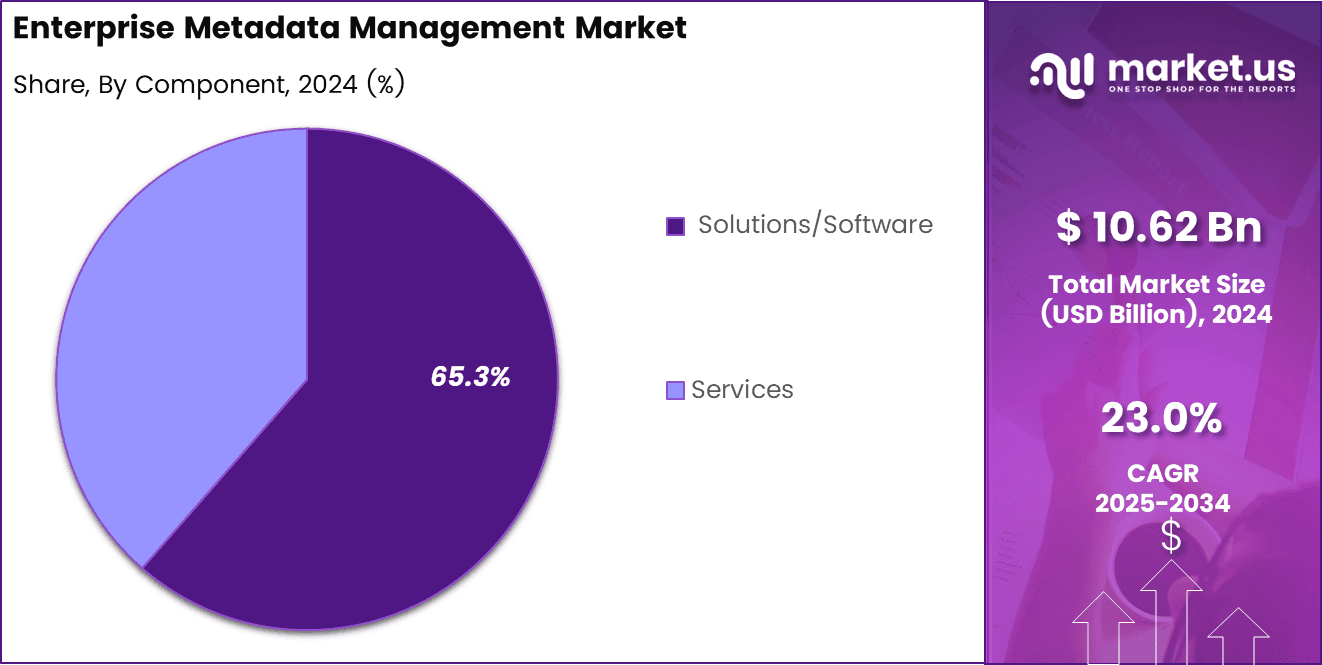
- Solutions/Software led the component segment with a 65.3% share.
- Cloud-based deployment led the deployment segment with a 60.1% share.
- Technical Metadata led the metadata type segment with a 45.6% share.
- Large Enterprises led the organization size segment with a 71.4% share.
- Data Governance and Compliance led the application segment with a 30.8% share.
- IT and Telecommunications led the industry vertical segment with a 25.2% share.
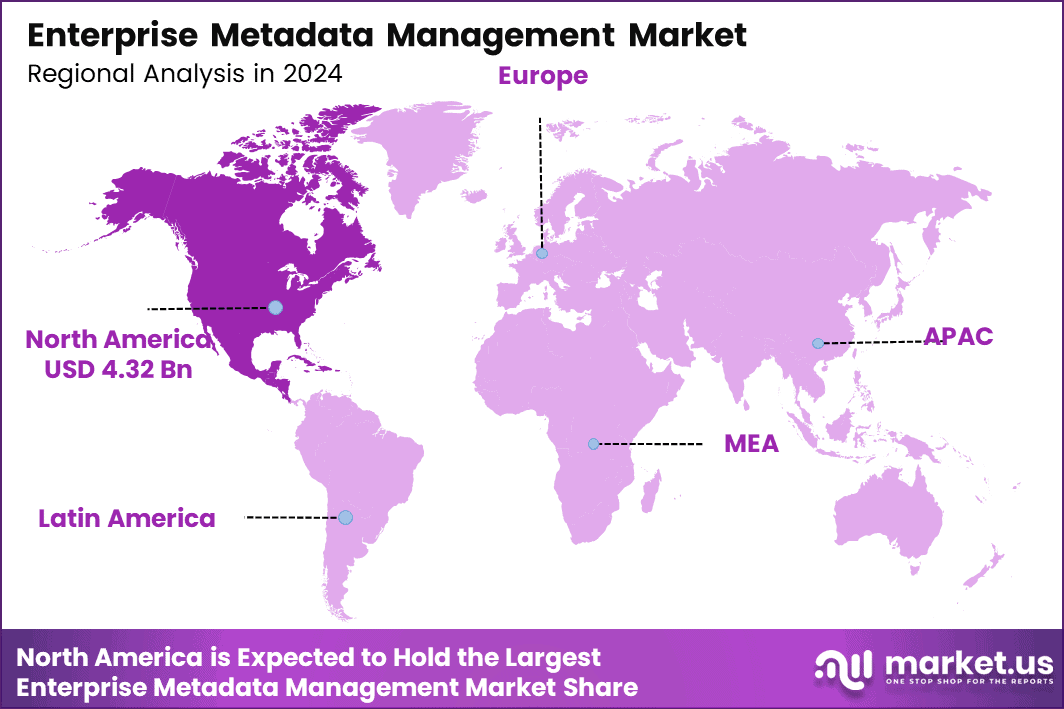
- North America led the market with a 40.7% share and USD 4.3 billion in revenue.
By Component
Solutions/Software dominates with 65.3% due to integrated tools covering core metadata tasks.
Solutions and software hold the 65.3% lead because enterprises need one control layer for catalogs, lineage, policy, quality, and access. A software platform can scan many systems, store links between data assets, and give business and technical teams one shared view.
Subscription pricing, regular updates, and links to cloud data platforms also make software easier to scale than separate manual projects. Informatica reported cloud subscription annual recurring revenue of $827.3 million at the end of 2024, up from $616.8 million one year earlier. That 34% rise shows strong spending on cloud data tools that depend on active metadata.
By Deployment
Cloud-based dominates with 60.1% due to scalable access fitting distributed data estates.
Cloud-based deployment accounts for the largest share at 60.1% because it enables organizations to connect distributed data sources without maintaining separate infrastructure. It also supports flexible scaling, centralized upgrades, remote access, and easier integration with cloud warehouses and software platforms.
Eurostat reported that 52.7% of EU enterprises purchased cloud services in 2025, up from 45.2% in 2023, representing a 7.4 percentage-point increase. Cloud deployment is also expected to grow fastest as enterprises increasingly operate across multiple public clouds and internal systems. Usage-based pricing, faster implementation, AI-powered search, automated tagging, and policy controls are supporting adoption, particularly among smaller organizations.
By Metadata Type
Technical Metadata dominates with 45.6% due to automated scans mapping complex system structures.
Technical metadata accounts for the largest share at 45.6% because enterprise data systems continuously generate schemas, tables, fields, file formats, job logs, and system relationships. Automated scanners can capture this information across databases, cloud environments, and applications, helping engineers trace errors, manage dependencies, and maintain data pipelines.
NielsenIQ reported processing about 4 trillion data records per week in 2025 and approximately 173 trillion records during the full year, highlighting the need for scalable metadata management. Business metadata is expected to grow faster as analytics and AI tools are increasingly used by nontechnical employees.
By Organization Size
Large Enterprises dominate with 71.4% due to complex data estates requiring centralized control.
Large enterprises account for the largest share at 71.4% because they manage complex data environments across multiple business units, countries, legacy systems, cloud platforms, and partner networks. Their larger security teams, data offices, and software budgets support broader adoption of metadata catalogs, lineage tools, ownership records, and policy controls.
Small and medium-sized enterprises are expected to grow faster as cloud-based delivery lowers cost and technical barriers. SMEs represent about 90% of businesses and more than 50% of employment worldwide. Subscription pricing, automated scanning, guided setup, and managed services are making metadata platforms more accessible, supporting faster adoption among smaller organizations.
By Application
Data Governance and Compliance dominates with 30.8% due to regulatory duties demanding clear audit evidence.
Data governance and compliance account for the largest share at 30.8%, as organizations must demonstrate data ownership, usage rights, movement, retention, and access controls. Metadata platforms support these requirements through searchable records, policy mapping, access labels, and audit trails.
Regulatory pressure remains a major factor, with European data protection authorities issuing approximately €1.255 billion in fines during 2024, including €652.0 million imposed by Ireland alone. Data lineage and impact analysis are expected to grow fastest as cloud migration and AI create more complex data flows.
By Industry Vertical
IT and Telecommunications dominate with 25.2% due to massive data flows requiring continuous control.
IT and telecommunications account for the largest share at 25.2%, supported by the high volume and complexity of data generated across networks, billing systems, digital platforms, and customer applications. Metadata platforms are used to improve data discovery, dependency mapping, access control, and change management.
According to the ITU, mobile broadband carried around 1.5 zettabytes of end-user traffic in 2025, while fixed broadband carried approximately 7.3 zettabytes, strengthening demand for automated data catalogs, lineage, and operational metadata.
Healthcare and life sciences are expected to record the fastest growth as clinical, insurance, laboratory, and research data become increasingly digital and interconnected. By 2024, approximately 91% of U.S. office-based physicians had adopted certified electronic health records, while more than 99% of non-federal acute care hospitals had adopted electronic health records.
Key Market Segments
By Component
- Solutions/Software
- Meta Repositories
- Data Lineage and Provenance
- Data Cataloging
- Data Governance and Compliance
- Metadata Management Suites
- Services
- Professional Services
- Managed Services
By Deployment
- On-Premises
- Cloud-based
By Metadata Type
- Technical Metadata
- Business Metadata
- Operational Metadata
By Organization Size
- Large Enterprises
- Small and Medium-sized Enterprises (SMEs)
By Application
- Data Governance and Compliance
- Data Lineage and Impact Analysis
- Data Quality Management
- Risk Management
- Asset and Discovery Management
- Others
By Industry Vertical
- IT and Telecommunications
- BFSI
- Healthcare and Life Sciences
- Retail and E-commerce
- Government and Public Sector
- Manufacturing
- Energy and Utilities
- Others
Geopolitical Impact Analysis
Geopolitical tensions affect enterprise metadata management through the servers, storage systems, network equipment, semiconductors, and cloud facilities that run metadata platforms. Trade restrictions can raise the cost of deploying private-cloud and on-premises systems.
In 2025, the United States introduced a baseline tariff of 10% on many trading partners, while announced reciprocal rates reached 34% for China, 20% for the European Union, 32% for Taiwan, and 25% for South Korea. Some computers, solid-state drives, displays, and semiconductor products later received exemptions, but frequent policy changes increased procurement risk.
The WTO estimated that reciprocal tariffs and wider trade-policy uncertainty could reduce world merchandise trade volume by 1.5% in 2025. Metadata vendors rely on globally distributed hardware and cloud partners, so higher equipment costs can increase hosting charges, implementation fees, and contract prices.
Shipping disruptions also affect data-center construction and hardware replacement. IMF PortWatch data showed that Suez Canal trade fell 50% year over year during the first two months of 2024. Rerouted deliveries from Türkiye to Somalia added 14 days, while shipments from Egypt added 5 days and shipments from Oman and Saudi Arabia added 3 days.
UNCTAD later reported that Suez Canal tonnage remained 70% below 2023 levels in May 2025 and forecast maritime trade growth of only 0.5% for 2025, down from 2.2% in 2024. These disruptions delay servers, cooling systems, fiber equipment, and backup power components. Material prices create another cost variable.
The World Bank forecasts a 10% decline in copper prices and a 21% fall in Brent crude prices during 2025. Lower copper and energy prices can reduce data-center construction and operating costs, but tariffs and longer routes may offset part of that benefit.
Regional Analysis
North America dominates the Enterprise Metadata Management Market, holding a 40.7% share and generating USD 4.3 billion in revenue. The United States and Canada support a mature market through high internet use, large cloud ecosystems, advanced financial institutions, and strict controls over personal and regulated data. ITU data placed internet use across the Americas between 88% and 93% in 2024.
Asia Pacific offers strong expansion potential, although the data input block does not formally identify it as the fastest-growing region. ITU reported that 77% of the region’s population used the internet in 2024. The WTO also recorded 10% growth in Asian computer-services exports during the first quarter of 2024, supported by a 31% increase in China.
The region had more than 450 million mobile internet users in 2024, compared with 220 million in 2014, while internet adoption approached 78%. This expansion creates more digital records and increases the need for data catalogs, quality controls, consent tracking, and compliance workflows. Limited cloud capacity and uneven technical skills may slow adoption outside large enterprises.
US Market Size
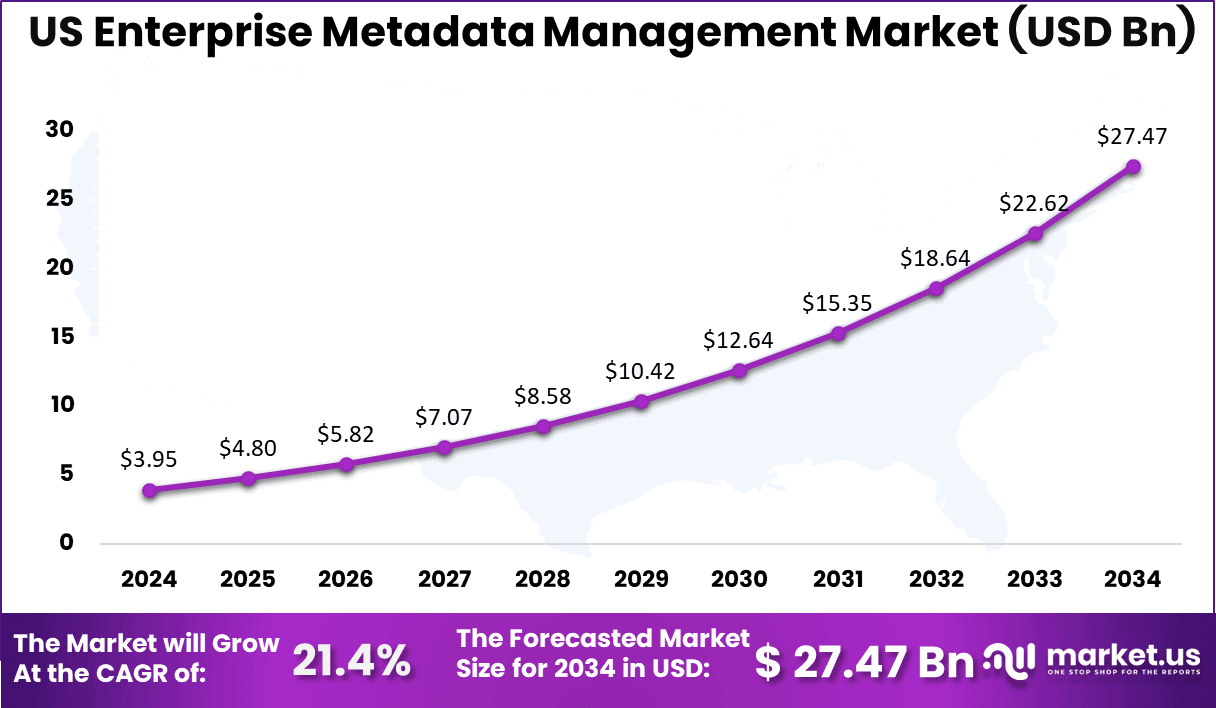
The US enterprise metadata management market was valued at USD 3.95 billion in 2024 and is projected to reach USD 27.47 billion by 2034, growing at a CAGR of 21.4%. Stringent data privacy regulations, rapid digital transformation across enterprises, and large-scale cloud migration initiatives primarily drive growth.
Key Regions and Countries
North America
- US
- Canada
Europe
- Germany
- France
- The UK
- Spain
- Italy
- Rest of Europe
Asia Pacific
- China
- Japan
- South Korea
- India
- Australia
- Rest of APAC
Latin America
- Brazil
- Mexico
- Rest of Latin America
Middle East and Africa
- GCC
- South Africa
- Rest of MEA
Market Dynamics
Drivers
| Driver | (~) % Impact on CAGR Forecast | Geographic Relevance | Impact Timeline |
|---|---|---|---|
| AI/LLM Data Readiness Mandates | +4.2% | North America, Western Europe | Short term (2 years or less) |
| EU AI Act Data Lineage Compliance | +3.1% | European Union | Short term (2 years or less) |
| Cloud Data Platform Migration | +2.8% | Global | Medium term (2 to 4 years) |
| Active Metadata Automation Adoption | +2.3% | North America, APAC | Short term (2 years or less) |
| Enterprise Data Catalog Consolidation | +1.6% | Global | Medium term (2 to 4 years) |
AI/LLM Data Readiness Mandates Reshaping Enterprise Data Architecture
The rapid expansion of enterprise AI is driving demand for machine-readable metadata that supports large language model fine-tuning and retrieval-augmented generation. Enterprise AI budgets increased by roughly 30% to 40% year-over-year through 2025 and into 2026, with spending increasingly directed toward metadata tagging, data lineage, and semantic-layer technologies.
Without automated metadata classification, data preparation can consume approximately 60% to 80% of total AI project time, making active metadata platforms increasingly essential for AI deployment. Vendors are responding by shifting from traditional perpetual licenses toward consumption-based SaaS models linked to metadata volumes and API usage.
These consumption-based offerings can generate gross margins approximately 8 to 12 percentage points higher than legacy license-and-maintenance models. Strong AI-related demand, combined with improved SaaS economics, is therefore supporting the sector’s underlying 23.0% CAGR growth trajectory.
Restraints
| Restraint | (~) % Impact on CAGR Forecast | Geographic Relevance | Impact Timeline |
|---|---|---|---|
| Elevated Enterprise IT Borrowing Costs | -2.4% | North America, Europe | Short term (2 years or less) |
| Cross-Border Data Localization Bans | -1.8% | China, India, Middle East | Short term (2 years or less) |
| Legacy System Contractual Lock-In | -1.3% | Global, concentrated in BFSI | Short term (2 years or less) |
| Frozen Public Sector IT Budgets | -0.9% | North America, Europe | Short term (2 years or less) |
Elevated Borrowing Costs Freezing Discretionary Metadata CapEx
Restrictive monetary policy has increased financing costs for enterprise technology investments. U.S. Federal Reserve and European Central Bank policy rates remained elevated compared with the pre-2022 decade average through 2026, increasing the discount rate applied to multi-year data infrastructure projects.
Mid-market enterprises with annual revenue below USD 500 million may defer non-essential data tooling purchases by approximately 9 to 14 months when their weighted average cost of capital exceeds 8%. The impact is creating a clear divide between large and smaller enterprise buyers.
Large companies with stronger balance sheets can continue metadata platform investments, while smaller firms increasingly delay purchases into later budget cycles. This financing pressure can reduce vendor new-bookings growth by an estimated 2 to 3 percentage points and extend average sales cycles from approximately 4 months to 6 months.
Challenges
| Challenge | (~) % CAGR Friction Drag | Geographic Relevance | Mitigation Horizon |
|---|---|---|---|
| Metadata Skills Talent Deficit | -1.9% | Global, acute in North America | Medium term (2 to 4 years) |
| Fragmented Multi-Cloud Data Silos | -1.5% | Global | Medium term (2 to 4 years) |
| Interoperability Standard Gaps | -1.1% | Global | Long term (4 years or more) |
| Legacy Schema Migration Complexity | -0.8% | North America, Europe | Medium term (2 to 4 years) |
| Vendor Consolidation Integration Risk | -0.6% | Global | Long term (4 years or more) |
Metadata Talent Deficit Constraining Implementation Velocity
A persistent shortage of professionals with combined data engineering, semantic modeling, and governance-policy expertise is creating structural pressure on metadata platform adoption. Demand for AI and big-data skills is increasing faster than the supply of qualified workers.
Roles requiring data-cataloging and governance expertise can take 35% to 45% longer to fill than general software engineering positions, extending enterprise metadata platform deployments by approximately 3 to 5 months.
Enterprises are responding through low-code and AI-assisted metadata tagging, managed data-governance services, and internal workforce upskilling. However, the talent shortage is expected to remain a long-term constraint, creating an estimated 1.9 percentage point friction on the market’s addressable growth potential rather than being resolved within a single budget cycle.
Opportunities
| Opportunity | (~) % Potential CAGR Upside | Geographic Relevance | Execution Window |
|---|---|---|---|
| Mid-Market and SMB Metadata-as-a-Service | +2.6% | North America, APAC | Medium term (2 to 4 years) |
| Vertical-Specific Governance Modules | +1.9% | BFSI, Healthcare, Global | Medium term (2 to 4 years) |
| Emerging Market Digitalization Roll-Up | +1.7% | Southeast Asia, Latin America, India | Long term (4 years or more) |
| Metadata-Driven Data Monetization Layers | +1.4% | Global | Long term (4 years or more) |
| Cross-Vendor M&A Consolidation | +1.1% | Global | Long-term (4 years or more) |
Untapped Mid-Market Metadata-as-a-Service White Space
This opportunity exists because most enterprise metadata management vendors primarily target large enterprises, leaving mid-market and SMB customers relatively underserved. Cloud-based, self-service metadata platforms can reduce complex onboarding requirements and expand adoption among smaller organizations. Simplified deployment models may also reduce customer acquisition costs by approximately 40% to 55%.
Vendors can capture this opportunity through prebuilt connectors, industry-specific templates, automated metadata discovery, and subscription-based services. Multi-tenant cloud software can support gross margins of around 75% to 82%, making the segment commercially attractive while expanding the addressable customer base beyond large enterprises.
Key Players Analysis
Tier 1 market leaders include Microsoft, IBM, Oracle, SAP, Informatica, and Snowflake. Their scale supports global sales, cloud infrastructure, product integration, and long research cycles. Microsoft reported USD 168.9 billion in Microsoft Cloud revenue and USD 106.3 billion in Intelligent Cloud revenue for fiscal 2025.
Oracle generated USD 44.0 billion from cloud services and license support and invested USD 9.9 billion in research and development during fiscal 2025. These companies can combine metadata governance with databases, analytics, identity tools, security products, and AI services.
IBM reported USD 27.1 billion in 2024 software revenue and spent USD 7.5 billion on research, development, and engineering. Salesforce also agreed to acquire Informatica for approximately USD 8.0 billion. The transaction combines Informatica’s catalog, lineage, governance, quality, privacy, and master-data functions with Salesforce Data Cloud and Agentforce.
Tier 2 challengers include Collibra, Alation, Atlan, Data. world, Precisely, Quest, MANTA, Solidatus, Global IDs, Smartlogic Semaphore, Alex Solutions, Denodo, Octopai, Cloudera, and Cambridge Semantics. These companies compete through specialized catalogs, knowledge graphs, automated lineage, semantic layers, and flexible deployment.
Snowflake bridges both tiers through its platform scale and specialist data focus. It generated USD 986.8 million in fourth-quarter fiscal 2025 revenue, with 27% annual growth. Challengers can gain share by offering faster implementation, open integrations, and focused governance tools, while large vendors can bundle metadata functions into wider cloud and database contracts.
Top Key Players in the Market
- Informatica LLC
- Collibra NV
- Alation Inc.
- IBM Corporation
- Oracle Corporation
- SAP SE
- Microsoft Corporation
- Talend S.A.
- Snowflake Inc.
- Data. World, Inc.
- Atlan Pte. Ltd.
- Quest Software Inc.
- Precisely Software Incorporated
- Erwin Inc. (Quest)
- MANTA Software, Inc.
- Solidatus Ltd.
- Global IDs Inc.
- Smartlogic Semaphore Ltd.
- ASG Technologies Group, Inc.
- Alex Solutions Pty Ltd.
- Denodo Technologies Inc.
- Syniti (Capgemini SE)
- Octopai Ltd.
- Cloudera, Inc.
- Cambridge Semantics Inc.
Recent Developments
- In May 2025, Salesforce signed an agreement to acquire Informatica for approximately USD 8.0 billion in equity value and USD 25 per share, strengthening its data catalog, lineage, governance, quality, privacy, and master-data capabilities.
- In July 2025, Capgemini agreed to acquire WNS for USD 3.3 billion in cash, excluding net financial debt, and secured a EUR 4.0 billion bridge facility to support the transaction and related obligations.
- In March 2026, IBM completed its acquisition of Confluent for USD 31 per share and an enterprise value of approximately USD 11.0 billion, adding governed real-time data streaming to its hybrid-cloud and AI portfolio.
- In April 2026, Microsoft announced a USD 10.0 billion investment in Japan from 2026 through 2029 to expand AI infrastructure, cybersecurity programs, domestic data-residency support, and training for one million workers by 2030.
Report Scope
| Report Features | Description |
|---|---|
| Market Value (2024) | USD 10.6 billion |
| Forecast Revenue (2034) | USD 84.2 billion |
| CAGR (2025-2034) | 23.0% |
| Base Year for Estimation | 2024 |
| Historic Period | 2020-2023 |
| Forecast Period | 2025-2034 |
| Report Coverage | Revenue Forecast, Market Dynamics, Competitive Landscape, Recent Developments |
| Segments Covered | By Component (Solutions/Software, Meta Repositories, Data Lineage and Provenance, Data Cataloging, Data Governance and Compliance, Metadata Management Suites, Services, Professional Services, Managed Services); By Deployment (On-Premises, Cloud-based); By Metadata Type (Technical Metadata, Business Metadata, Operational Metadata); By Organization Size (Large Enterprises, Small and Medium-sized Enterprises (SMEs)); By Application (Data Governance and Compliance, Data Lineage and Impact Analysis, Data Quality Management, Risk Management, Asset and Discovery Management, Others); By Industry Vertical (IT and Telecommunications, BFSI, Healthcare and Life Sciences, Retail and E-commerce, Government and Public Sector, Manufacturing, Energy and Utilities, Others) |
| Regional Analysis | North America – US, Canada; Europe – Germany, France, The UK, Spain, Italy, Rest of Europe; Asia Pacific – China, Japan, South Korea, India, Australia, Singapore, Rest of APAC; Latin America – Brazil, Mexico, Rest of Latin America; Middle East & Africa – GCC, South Africa, Rest of MEA |
| Competitive Landscape | Informatica LLC, Collibra NV, Alation Inc., IBM Corporation, Oracle Corporation, SAP SE, Microsoft Corporation, Talend S.A., Snowflake Inc., Data World, Inc., Atlan Pte. Ltd., Quest Software Inc., Precisely Software Incorporated, Erwin Inc. (Quest), MANTA Software, Inc., Solidatus Ltd., Global IDs Inc., Smartlogic Semaphore Ltd., ASG Technologies Group, Inc., Alex Solutions Pty Ltd., Denodo Technologies Inc., Syniti (Capgemini SE), Octopai Ltd., Cloudera, Inc., Cambridge Semantics Inc. |
| Customization Scope | Customization for segments, region/country-level will be provided. Moreover, additional customization can be done based on the requirements. |
| Purchase Options | We have three licenses to opt for: Single User License, Multi-User License (Up to 5 Users), Corporate Use License (Unlimited Users and Printable PDF) |