


Report Overview
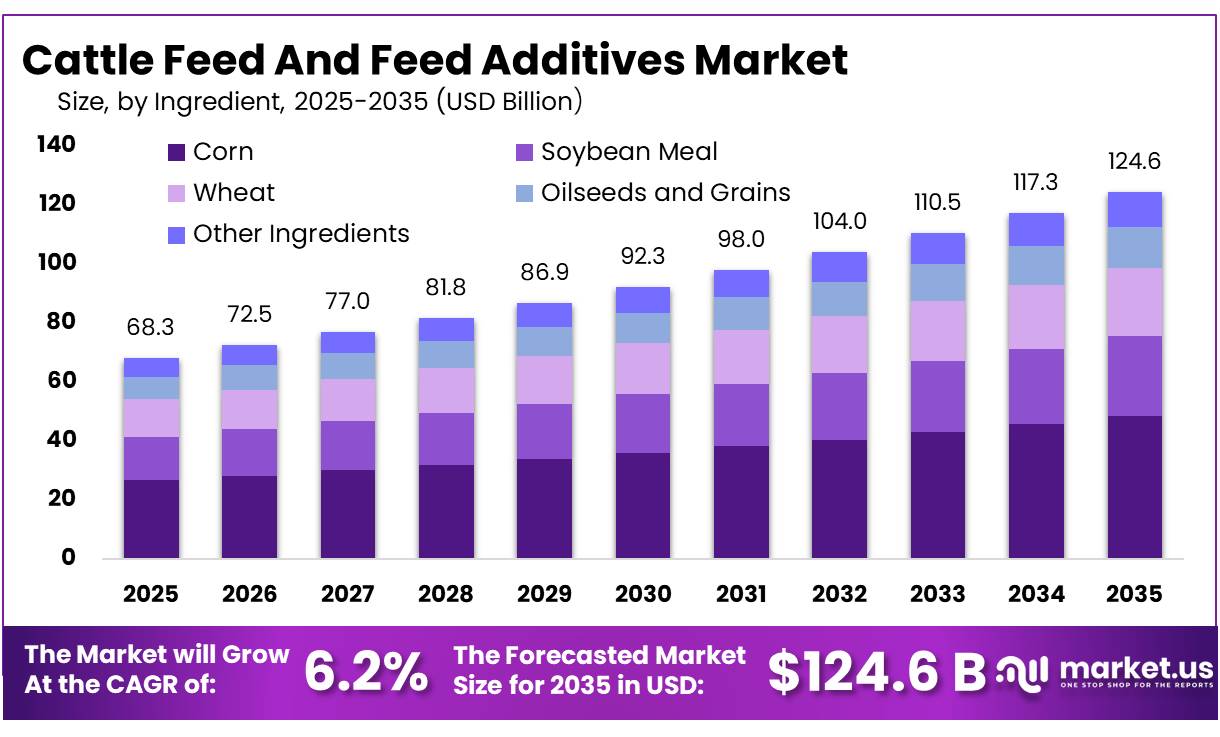
The Global Cattle Feed And Feed Additives Market size is expected to be worth around USD 124.6 Billion by 2035, from USD 68.3 Billion in 2025, growing at a CAGR of 6.2% during the forecast period from 2026 to 2035. In 2025, Asia Pacific held a dominant market position, capturing more than a 36.85% share, holding USD 25.1 Billion revenue.
The cattle feed and feed additives industry forms a critical link between crop production, livestock farming, dairy processing, and beef supply chains. Commercial feed combines energy sources, proteins, minerals, vitamins, amino acids, enzymes, probiotics, and other functional ingredients to improve nutrient intake, feed conversion, and animal performance.
- The International Feed Industry Federation estimates that global compound feed production could reach about 1.4 billion tonnes in 2025, while commercial feed manufacturing generates annual turnover exceeding USD 500 billion.
Cattle feed remains a major component of this system, particularly in intensive dairy and beef production. In the European Union, industrial compound feed output is forecast at 147.5 million tonnes in 2025, including 41.585 million tonnes of cattle feed. In the United States, USDA reported 86.2 million cattle and calves on farms at the start of 2026, including 27.6 million beef cows, 9.57 million milk cows, and 13.8 million cattle on feed.
- The OECD-FAO Agricultural Outlook projects the gross value of global agricultural production to rise 14% by 2034, with livestock production increasing 16%. Global meat output is projected to reach 406 million tonnes by 2034, while beef production is expected to reach 84 million tonnes. This supports demand for balanced rations, specialty premixes, and additives that improve digestion, nutrient utilization, and production efficiency.
Feed-cost management is another major industry driver. USDA states that corn represents more than 95% of U.S. feed-grain production and use, making grain availability and pricing important to cattle-feed economics. For 2026/27, U.S. feed-grain ending stocks are projected at 44.4 million metric tonnes, around 7.9 million tonnes below the revised 2025/26 level. This strengthens interest in alternative ingredients, enzymes, and precision formulation technologies that extract more value from feed.
Regulation is also shaping product development. The U.S. FDA finalized its Animal Food Ingredient Consultation framework in 2025 to provide an additional pathway for firms developing new animal-food ingredients. In the European Union, feed-additive authorisations are generally valid for 10 years after scientific safety assessment. This structure favours suppliers that can demonstrate safety, efficacy, traceability, and environmental performance.
Key Takeaways
- Cattle Feed And Feed Additives Market size is expected to be worth around USD 124.6 Billion by 2035, from USD 68.3 Billion in 2025, growing at a CAGR of 6.2%.
- Corn held a dominant market position, capturing more than a 38.90% share.
- Amino Acids held a dominant market position, capturing more than a 27.80% share.
- Pellets held a dominant market position, capturing more than a 52.80% share.
- Dairy Cattle held a dominant market position, capturing more than a 58.10% share.
- Direct Sales held a dominant market position, capturing more than a 51.30% share.
- Asia Pacific held a dominant market position, capturing more than a 36.85% share and reaching approximately USD 25.17 billion.
By Ingredient Analysis
Corn dominates the ingredient segment with more than a 38.90% share, supported by its large-scale use as an energy-rich cattle feed ingredient.
In 2025, “Corn” held a dominant market position, capturing more than a 38.90% share of the Cattle Feed and Feed Additives Market by ingredient. Corn remains widely used in cattle diets because it provides concentrated energy, is easy to include in formulated rations, and has a well-established feed supply chain.
- According to the U.S. Department of Agriculture, U.S. corn production for the 2025/26 marketing year was estimated at 17.021 billion bushels, while feed and residual use reached 6.2 billion bushels. The large volume directed toward animal feeding highlights corn’s continuing importance in livestock nutrition. Its dependable availability also allows commercial feed manufacturers to maintain consistent formulations for dairy and beef cattle while managing feed costs at industrial scale.
Soybean Meal holds an important position in cattle feed formulations because of its high protein content, consistent nutritional quality, and compatibility with corn-based diets. It is commonly used to improve the protein balance of rations, particularly where forage and grain alone do not provide enough dietary protein.
In 2026, the U.S. Department of Agriculture raised projected domestic soybean meal use for the 2025/26 marketing year to 43.2 million short tons. USDA also maintained the soybean meal export forecast at 19.4 million short tons, while soybean crushing during September 2025–February 2026 reached 1.33 billion bushels. These volumes show a strong processing and supply base supporting soybean meal availability for livestock-feed manufacturers and commercial cattle operations.
By Additive Type Analysis
Amino Acids dominate the additive type segment with more than a 27.80% share, supported by precision protein nutrition in cattle diets.
In 2025, “Amino Acids” held a dominant market position, capturing more than a 27.80% share of the Cattle Feed and Feed Additives Market by additive type. Amino acids are increasingly used in formulated cattle diets to improve protein balance and make nutrient use more efficient.
- The scale of commercial cattle production supports this requirement. USDA reported 86.2 million cattle and calves, including 9.57 million milk cows and 13.8 million cattle on feed, as of January 1, 2026. In July 2025, the European Commission also amended the authorization terms for liquid L-lysine as a feed additive for all animal species and specifically noted that supplemental lysine for ruminants requires protection against degradation in the rumen to achieve its intended nutritional effect.
Vitamins remain an important additive type in the Cattle Feed and Feed Additives Market because commercial dairy and beef feeding programs require balanced micronutrient intake alongside energy and protein. Their role becomes particularly important in high-producing animals, where carefully formulated feed helps maintain normal metabolism, growth, reproduction, and productivity.
USDA reported that U.S. milk production reached 232 billion pounds in 2025, while the annual average dairy herd included 9.50 million milk cows. Average milk production reached 24,390 pounds per cow, demonstrating the high productivity level supported by modern feeding systems. In October 2025, the European Commission renewed the authorization of calcium D-pantothenate and D-panthenol, both forms of vitamin B5, as feed additives for all animal species.
By Form Analysis
Pellets dominate the cattle feed and feed additives market with more than a 52.80% share
In 2025, “Pellets” held a dominant market position, capturing more than a 52.80% share of the Cattle Feed and Feed Additives Market by form. Pelleted feed is widely preferred in commercial cattle operations because it combines different nutrients into a compact and uniform feed form, reduces ingredient separation, and makes feeding and transportation easier. The scale of compound-feed demand continues to support this format.
- UK government data show that the total volume of animal feed increased by 5.7% in 2025, while compound-feed volumes increased by 2.4%. The European Commission’s Joint Research Centre also documented in 2025 that a bovine feed additive was intended for incorporation into dry mash or pelleted feed at 40 g per cow per day and 12 g per calf per day, showing the practical use of pellets as a delivery format for functional cattle-feed ingredients.
Crumbles remain an important form in the Cattle Feed and Feed Additives Market, particularly for young cattle and feeding programs that require smaller and easier-to-consume particles than full-size pellets. Crumbles are produced by breaking pellets into smaller pieces while retaining the benefits of a processed and blended feed formulation. The underlying cattle population provides a sizeable demand base for these prepared feeds.
USDA reported 86.2 million cattle and calves on U.S. farms as of January 2026, including a 32.9 million-head calf crop for 2025. Around 13.8 million cattle and calves were also on feed for the slaughter market at the beginning of 2026. These large commercial cattle and calf populations support continuing demand for convenient processed feed forms such as crumbles, especially during controlled feeding and early-stage nutrition programs.
By Cattle Type Analysis
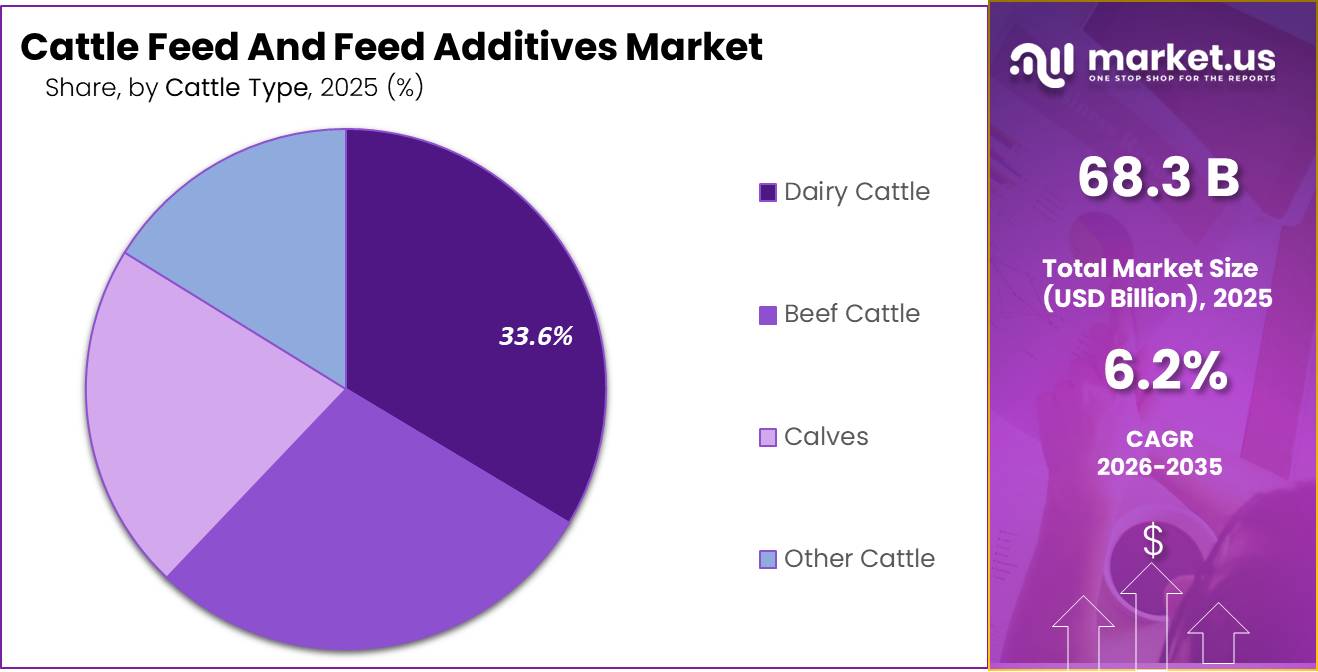
Dairy Cattle dominates with more than a 58.10% share, supported by intensive feeding needs and consistently high milk productivity.
In 2025, “Dairy Cattle” held a dominant market position, capturing more than a 58.10% share of the Cattle Feed and Feed Additives Market by cattle type. Dairy cattle require carefully balanced feed throughout the production cycle, which keeps demand strong for energy ingredients, proteins, minerals, vitamins, amino acids, and other nutritional additives.
- USDA reported that U.S. milk production reached 231.658 billion pounds in 2025, increasing 2.6% from the previous year. The average dairy herd stood at 9.498 million cows, while milk production averaged 24,390 pounds per cow. These high production levels encourage dairy farms to use formulated feeds and nutritional additives that help maintain milk output, reproductive performance, and overall herd efficiency.
Beef Cattle represents an important segment of the Cattle Feed and Feed Additives Market because commercial beef production depends on efficient weight gain, balanced nutrition, and controlled finishing programs. USDA reported 27.6 million beef cows in the United States as of January 2026.
The country also had 13.8 million cattle and calves on feed, while the 2025 calf crop was estimated at 32.9 million head. These figures show the large population moving through breeding, growing, and feedlot systems. Feed manufacturers therefore continue to supply energy-dense feeds, protein ingredients, minerals, vitamins, and performance-focused additives that support daily weight gain and feed efficiency in beef operations.
By Distribution Channel Analysis
Direct Sales dominates with more than a 51.30% share
In 2025, “Direct Sales” held a dominant market position, capturing more than a 51.30% share of the Cattle Feed and Feed Additives Market by distribution channel. Direct purchasing is well suited to large dairy farms, beef producers, and feedlot operators that require regular bulk volumes, customized formulations, consistent product quality, and technical nutrition support.
- USDA reported that the United States had 86.2 million cattle and calves at the beginning of 2026, including 13.8 million cattle on feed. USDA Economic Research Service also forecast U.S. feed expenditure at USD 69.5 billion in 2026, showing the large purchasing requirement created by livestock production. These operating conditions support direct manufacturer-to-farm supply, particularly where buyers need large and repeat feed deliveries.
Distributors and Retailers remain an important distribution channel in the Cattle Feed and Feed Additives Market because smaller and geographically dispersed farms often depend on local agricultural dealers, feed stores, cooperatives, and regional distributors for convenient product access. USDA estimated that the United States had 1.865 million farms in 2025, covering 873.95 million acres, with an average farm size of 469 acres.
Around 78.8% of farms generated less than USD 100,000 in annual sales, indicating a large base of smaller operations that can benefit from regional retail and distributor networks. This broad customer base supports demand for packaged cattle feed, minerals, vitamins, premixes, and specialty additives supplied through local distribution points.
Key Market Segments
By Ingredient
- Corn
- Soybean Meal
- Wheat
- Oilseeds and Grains
- Other Ingredients
By Additive Type
- Vitamins
- Trace Minerals
- Amino Acids
- Feed Enzymes
- Antioxidants
- Probiotics and Prebiotics
- Other Additives
By Form
- Pellets
- Crumbles
- Mash
- Liquid
- Other Forms
By Cattle Type
- Dairy Cattle
- Beef Cattle
- Calves
- Other Cattle
By Distribution Channel
- Direct Sales
- Distributors and Retailers
- Online Sales
Driver Analysis
Dairy Output Expansion
Dairy output expansion is the strongest immediate volume driver because every incremental litre of milk raises requirements for digestible energy, protein, minerals, vitamins, rumen buffers, protected fats, yeast cultures, and mycotoxin management, particularly where production growth comes from larger commercial herds and higher yield rather than subsistence animal numbers; USDA forecasts U.S. milk production of 236.6 billion pounds in 2026, with higher cow inventories offsetting lower expected yield per cow, and projects 238.0 billion pounds in 2027, while its July outlook attributed expansion to low slaughter, adequate margins above feed cost, and longer cow retention.
At a modeled 0.35-0.45 kg of additional concentrate for each incremental litre of daily milk, a 1,000-cow herd lifting output by two litres per cow per day requires approximately 255-329 tonnes of additional formulated feed annually; at USD 300-400 per tonne, that creates USD 76,500-131,600 of feed revenue, while additive programs costing USD 0.08-0.25 per cow per day add another USD 29,200-91,250 annually.
The driver changes the supplier model from commodity tonnage toward lactation-stage rations, milk-component optimization, forage testing, and performance contracts linked to income over feed cost; even a 1% feed-efficiency improvement on a herd consuming 8,000 tonnes annually can avoid 80 tonnes of ration while allowing vendors to capture higher-margin value through formulation software and specialty additives. Because the U.S. is already expanding and South Asian dairy demand remains structurally linked to population and income growth, this driver is modeled to add +1.6 percentage points to attainable CAGR in the next two years, with premium revenue concentrated in large commercial dairies and volume growth concentrated in India, Pakistan, China, the EU, and the United States.
Drivers Impact Analysis
| Driver(~) | % Impact on CAGR Forecast | Geographic Relevance | Impact Timeline |
|---|---|---|---|
| Dairy Output Expansion | +1.6 pp | U.S., India, Pakistan, EU, China | Short term (≤ 2 years) |
| Livestock Feed Intensification | +1.4 pp | South Asia, ASEAN, Brazil, MENA | Long term (≥ 4 years) |
| Precision Nutrition Adoption | +1.3 pp | North America, EU, China, Australia | Medium term (2-4 years) |
| Methane Additive Scaling | +1.2 pp | EU, U.S., Brazil, Canada, Australia | Medium term (2-4 years) |
| Antibiotic-Alternative Feeding | +1.0 pp | EU, North America, China, APAC | Short term (≤ 2 years) |
| Traceable Feed Procurement | +0.8 pp | EU, Brazil, U.S., export corridors | Medium term (2-4 years) |
Restraint Analysis
Input-Cost Volatility
Ingredient inflation remains the largest near-term restraint because cattle-feed formulations are exposed simultaneously to maize, soybean meal, oilseed cakes, brans, molasses, minerals, energy and freight, while raw materials can represent roughly 80% of a compound-feed producer’s operating cost and feed itself can account for 60–70% of cattle-production cost. The price signal was already adverse in 2026: the World Bank soybean-meal series reached USD 403 per metric tonne in August 2026, 13.8% above August 2025, while FAO’s August cereal index rose 2.2% month on month and international maize prices increased 2.5% amid crop concerns, feed demand and trade-flow disruption.
The model therefore applies a -1.6 percentage-point CAGR deduction under a stress band in which protein-meal and energy-component costs remain 8–15% above the prior-year average for two procurement cycles; because commercial mills cannot immediately reformulate without changing protein, fibre, energy density or palatability, a 10% blended ingredient shock can absorb most of the gross contribution on price-locked contracts, force 30–90-day repricing, and shift customers toward lower-cost farm-mixed rations.
Strategic effects include working-capital expansion, smaller forward-purchase coverage, lower utilization at independent mills, slower commissioning of extrusion and pelleting lines, and delayed adoption of premium enzymes, probiotics, buffers and precision mineral packs as buyers defend the cost per litre of milk or kilogram of weight gain rather than the nominal nutritional specification.
Restraint Impact Analysis
| Restraint(~) | % Impact on CAGR Forecast | Geographic Relevance | Impact Timeline |
|---|---|---|---|
| Input-cost volatility | -1.6% | Global; APAC, LATAM, MENA | Short term (≤ 2 years) |
| Farmer affordability pressure | -1.1% | South Asia, Africa, LATAM | Medium term (2-4 years) |
| Cattle-herd contraction | -0.8% | North America core, EU | Medium term (2-4 years) |
| Regulatory compliance drag | -0.7% | EU, UK, North America | Medium term (2-4 years) |
| Additive import concentration | -0.9% | EU core, APAC corridors | Short term (≤ 2 years) |
| Mycotoxin and climate risk | -0.6% | Global maize belts, tropics | Long term (≥ 4 years) |
Opportunity Analysis
Precision Nutrition-as-a-Service
Precision nutrition-as-a-service is an opportunity rather than a current driver because most feed revenue is still generated by selling tonnes or premix kilograms, while animal-level data, automated ration adjustment and outcome-based recurring fees remain weakly monetized outside advanced farms; the strategic pivot is to combine feed, sensors, ration software, laboratory testing and nutritionist intervention in one per-cow subscription priced against verified feed savings or milk-component uplift. The technical base already exists: precision livestock systems can integrate RFID, feed weighing, activity, rumination and milk data to improve feeding decisions, yet published reviews emphasize that commercial return still depends on connecting those technologies to management actions rather than merely installing hardware.
India’s large-scale ration-balancing experience demonstrates monetizable economics at a lower technology level: coverage of 2.865 million animals produced an average INR 16.33 reduction in daily feed cost, INR 25.52 increase in net income per animal per day, 11.8% lower feed cost per kilogram of milk and 13.7% lower enteric methane per kilogram of milk.
The upside model assumes suppliers enroll only 1–2% of commercially fed dairy cattle annually, charge a service fee equivalent to 10–20% of independently verified farmer savings, and lift premium additive attachment by 8–15 percentage points; this produces a modeled +1.5 percentage-point CAGR uplift, shifts 5–10% of participating-account revenue from volatile commodity feed toward recurring software, testing and advisory income, and can add 200–500 basis points to account-level gross margin.
Opportunity Impact Analysis
| Opportunity(~) | % Potential CAGR Upside | Geographic Relevance | Execution Window |
|---|---|---|---|
| Precision nutrition-as-a-service | +1.5% | North America, EU, India, China | Short term (≤ 2 years) |
| Methane-linked outcome contracts | +1.3% | EU, North America, ANZ, Brazil | Short term (≤ 2 years) |
| Smallholder route-to-market | +1.2% | South Asia, Africa, Southeast Asia | Medium term (2-4 years) |
| Circular feedstock hubs | +0.9% | APAC, EU, LATAM, Africa | Medium term (2-4 years) |
| Traceable low-carbon feed | +0.7% | EU core, Brazil–EU corridors | Short term (≤ 2 years) |
| Regional nutrition roll-ups | +0.8% | India, Africa, Southeast Asia, LATAM | Medium term (2-4 years) |
Challenges Analysis
Nutrient Variability Management
Cattle-feed manufacturers must continuously reformulate around biological and climatic variability rather than a stable industrial bill of materials: maize, silage, hay, oilseed meals, brans and agro-industrial co-products can vary by crop, origin, storage condition, moisture, fibre digestibility and toxin burden, while climate change is increasing the frequency of drought, floods, heat and pest pressure across agrifood systems.
This is ongoing friction rather than a restraint because material remains available and sales continue, but each quality deviation forces ingredient substitution, laboratory release, least-cost reformulation and customer-performance monitoring; the model assigns a -1.2 percentage-point drag where quarterly nutrient dispersion of 5–12% around book values requires 1–3% safety over-formulation for protein, energy or minerals, raises formulation cost by USD 3–10 per tonne, and adds 12–48 hours to lot release.
The operational penalty extends to livestock demand: cattle experience heat stress above roughly 25°C, while each 1°C increase above 30°C can reduce feed intake by 3–5%, disrupting expected feed conversion and making a technically correct ration appear commercially ineffective. Beef-feed tonnage still rose 1.8% to 134.1 million tonnes in 2024, but scarce forage in North America, Latin America and Australia increased reliance on commercial feed, illustrating how weather can expand volume while simultaneously intensifying formulation risk.
Long-term mitigation requires multi-origin procurement, dynamic safety stocks, portable near-infrared spectroscopy at intake, climate-adjusted nutrient matrices, tighter supplier standard deviations, real-time ration reformulation and contracts that price digestible nutrient units rather than nominal tonnes; normalization takes more than four years because climate variance, forage biology and farm-level storage practices cannot be engineered out of the system.
Challenges Impact Analysis
| Challenge(~) | % CAGR Friction Drag | Geographic Relevance | Mitigation Horizon |
|---|---|---|---|
| Nutrient Variability Management | -1.2% | Global; APAC, LATAM, Africa | Long term (≥ 4 years) |
| Quality Assurance Gaps | -1.0% | South Asia, Africa, LATAM | Medium term (2-4 years) |
| Field-Efficacy Variability | -0.9% | Global cattle systems | Long term (≥ 4 years) |
| Digital Integration Fragmentation | -0.7% | North America, EU, APAC | Medium term (2-4 years) |
| Technical Talent Scarcity | -0.6% | Global; emerging markets core | Long term (≥ 4 years) |
| Last-Mile Formulation Complexity | -0.8% | South Asia, Africa, SEA | Medium term (2-4 years) |
Geopolitical Impact Analysis
War Disruptions Raise Feed Grain, Freight and Additive Supply Risks
The ongoing Russia–Ukraine war continues to influence the Cattle Feed and Feed Additives Market through grain availability, freight costs, energy prices, and supply-chain uncertainty. Ukraine remains an important supplier of corn, barley, and other feed grains. USDA reported that Ukrainian grain exports during July–December 2025 were around 30% slower than the same period a year earlier, as Russian attacks affected energy infrastructure, railways, ports, and vessels operating around the Black Sea.
Earlier USDA data also showed Ukraine’s corn exports at about 20.0 million metric tons in the 2024/25 marketing year, representing a 32% decline from the previous year. Lower Black Sea availability can encourage livestock producers and feed manufacturers to source corn and other energy ingredients from alternative suppliers, increasing procurement and logistics pressure.
Middle East military tensions have added another layer of risk. UNCTAD reported in 2026 that disruption around the Strait of Hormuz reduced vessel transits by about 95% at its peak. The Strait normally handles around one-quarter of global seaborne oil trade and about 16 million tonnes of fertilizer trade. Higher fuel, fertilizer, insurance, and shipping costs can therefore raise grain-production and feed-delivery expenses, while encouraging feed companies to diversify suppliers and strengthen regional inventories.
Regional Insights
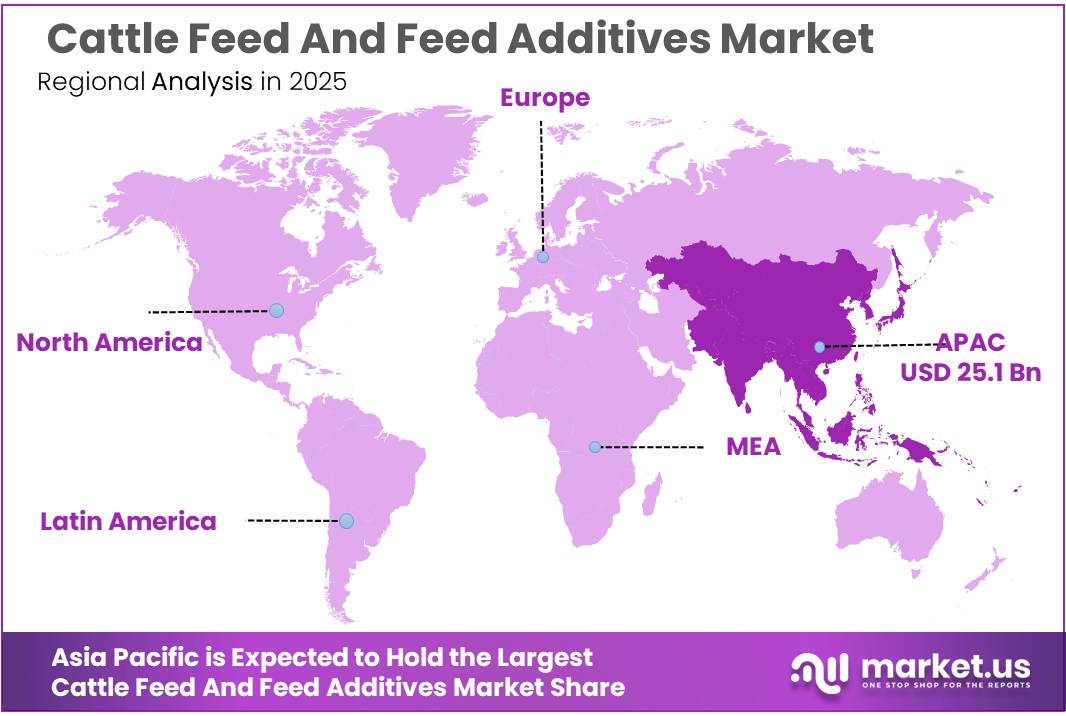
Asia Pacific Dominates with 36.85% Share and USD 25.17 Billion
In 2025, Asia Pacific held a dominant market position, capturing more than a 36.85% share and reaching approximately USD 25.17 billion. China provides a major regional demand base. Government statistics show that China produced 8.01 million tonnes of beef in 2025, increasing 2.8%, while milk production reached 40.91 million tonnes. Corn production also reached 301.24 million tonnes, up 2.1%, providing a large domestic feed-grain base.
Australia further supports regional feed demand, with 2.4 million cattle slaughtered and 727,921 tonnes of beef produced during the December 2025 quarter. These livestock and grain volumes support strong consumption of compound cattle feed and nutritional additives.
Key Regions and Countries Insights
- North America
- US
- Canada
- Europe
- Germany
- France
- The UK
- Spain
- Italy
- Rest of Europe
- Asia Pacific
- China
- Japan
- South Korea
- India
- Australia
- Rest of APAC
- Latin America
- Brazil
- Mexico
- Rest of Latin America
- Middle East & Africa
- GCC
- South Africa
- Rest of MEA
Key Players Analysis
Cargill holds a strong position in cattle feed and feed additives through compound feed, premixes, micronutrition, digestive-health solutions, and precision feeding technologies. In fiscal 2026, Cargill generated USD 164 billion in revenue. Its animal nutrition business expanded the Engerwitzdorf micronutrition facility in 2025, raising capacity by 50% to 30,000 metric tons annually. Cargill also agreed to acquire 100% of Mig-Plus, which operates 2 facilities and employs around 450 people, strengthening its ruminant nutrition capabilities.
ADM participates in the cattle feed and additives sector through feed ingredients, amino acids, premixes, nutritional solutions, and specialty animal nutrition products. In 2025, ADM’s Nutrition segment generated approximately USD 7.5 billion in revenue, increasing 2% from the previous year. Animal Nutrition operating profit reached USD 98 million, compared with USD 59 million in 2024. ADM also processed 36.324 million metric tons of oilseeds and 18.525 million metric tons of corn, supporting its large feed-ingredient supply platform.
Land O’Lakes operates Purina Animal Nutrition as a major feed and nutritional solutions platform for cattle and other livestock. The cooperative reported USD 16.41 billion in net sales during 2025 and supplies feed for around 100 million animals each day. Its Purina Animal Nutrition Center covers approximately 1,263 acres, includes a 300-cow dairy operation, and employs more than 150 nutritionists, veterinarians, and animal-care specialists. The research center evaluates more than 3,000 animals annually across multiple livestock categories.
De Heus Animal Nutrition maintains a broad cattle-feed presence through compound feeds, concentrates, premixes, minerals, and farm nutrition services. The company operates more than 80 production locations across over 20 countries, sells products in approximately 75 countries, and employs more than 8,000 people. In 2025, De Heus acquired Voeders Huys, adding around 250,000 tons of annual production capacity. In 2026, it completed the acquisition of CJ Feed & Care operations, adding 17 feed mills across several Asian markets.
Top Key Players Outlook
- Cargill, Incorporated
- ADM
- Nutreco/Trouw Nutrition
- Land O’Lakes/Purina Animal Nutrition
- De Heus Animal Nutrition
- ForFarmers N.V.
- Alltech, Inc.
- dsm-firmenich
- BASF SE
- Evonik Industries
- Adisseo
- Kemin Industries
- Novus International
- Zinpro Corporation
- IFF/Danisco Animal Nutrition
Recent Developments
- In February 2026, dsm-firmenich agreed to divest its remaining Animal Nutrition & Health business to CVC Capital Partners for about EUR 2.2 billion, including an earnout of up to EUR 0.5 billion, while retaining a 20% stake. The ANH business generated around EUR 3.5 billion in annualized sales and employed about 8,000 people in 2025.
- In February 2026, Alltech, Inc the combined business officially launched as Akralos Animal Nutrition, operating more than 40 feed mills and employing over 1,400 people across North America, with feeds, minerals, and supplements serving livestock producers.
Report Scope
| Report Features | Description |
|---|---|
| Market Value (2025) | USD 68.3 Bn |
| Forecast Revenue (2035) | USD 124.6 Bn |
| CAGR (2026-2035) | 6.2% |
| Base Year for Estimation | 2025 |
| Historic Period | 2020-2024 |
| Forecast Period | 2026-2035 |
| Report Coverage | Revenue Forecast, Market Dynamics, Competitive Landscape, Recent Developments |
| Segments Covered | By Ingredient (Corn, Soybean Meal, Wheat, Oilseeds and Grains, Other Ingredients), By Additive Type (Vitamins, Trace Minerals, Amino Acids, Feed Enzymes, Antioxidants, Probiotics and Prebiotics, Other Additives), By Form (Pellets, Crumbles, Mash, Liquid, Other Forms), By Cattle Type (Dairy Cattle, Beef Cattle, Calves, Other Cattle, By Distribution Channel (Direct Sales, Distributors and Retailers, Online Sales) |
| Regional Analysis | North America – US, Canada; Europe – Germany, France, The UK, Spain, Italy, Rest of Europe; Asia Pacific – China, Japan, South Korea, India, Australia, Singapore, Rest of APAC; Latin America – Brazil, Mexico, Rest of Latin America; Middle East & Africa – GCC, South Africa, Rest of MEA |
| Competitive Landscape | Cargill, Incorporated, ADM, Nutreco/Trouw Nutrition, Land O’Lakes/Purina Animal Nutrition, De Heus Animal Nutrition, ForFarmers N.V., Alltech, Inc., dsm-firmenich, BASF SE, Evonik Industries, Adisseo, Kemin Industries, Novus International, Zinpro Corporation, IFF/Danisco Animal Nutrition |
| Customization Scope | Customization for segments, region/country-level will be provided. Moreover, additional customization can be done based on the requirements. |
| Purchase Options | We have three licenses to opt for: Single User License, Multi-User License (Up to 5 Users), Corporate Use License (Unlimited User and Printable PDF) |





































