


Report Overview
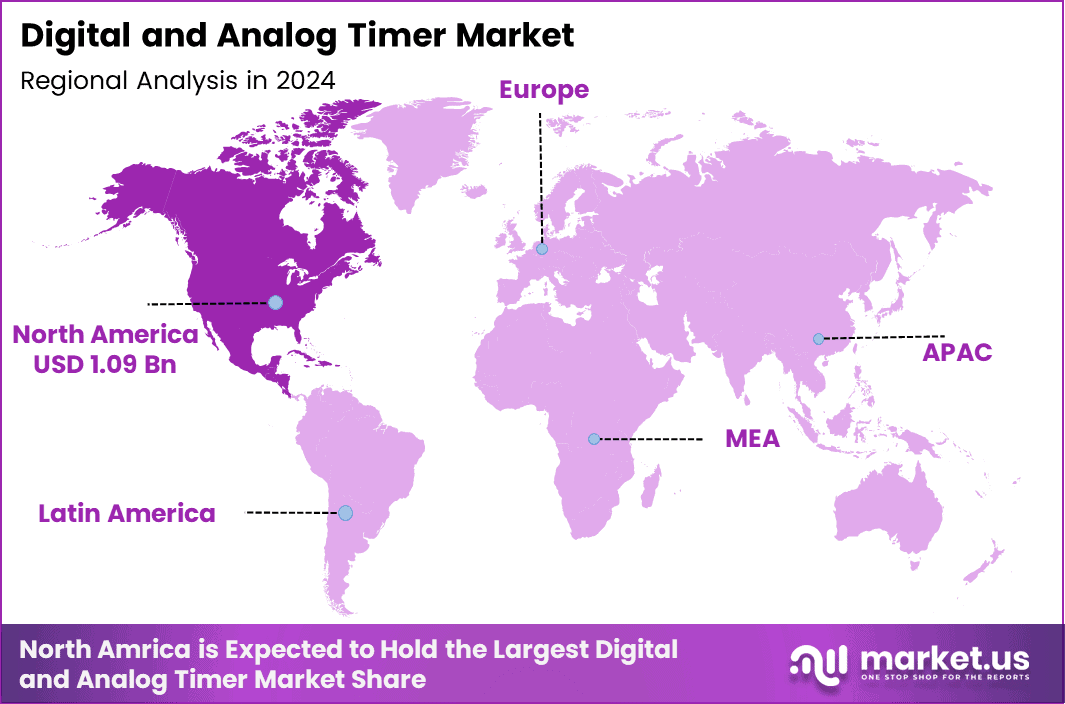
In 2024, the Global Digital and Analog Timer Market was valued at USD 3.0 billion. The market is projected to grow at a CAGR of 10.2% during 2025–2034, reaching approximately USD 7.9 billion by 2034. North America dominated the global market in 2024, accounting for the total market share and generating approximately USD 1.09 billion in revenue.
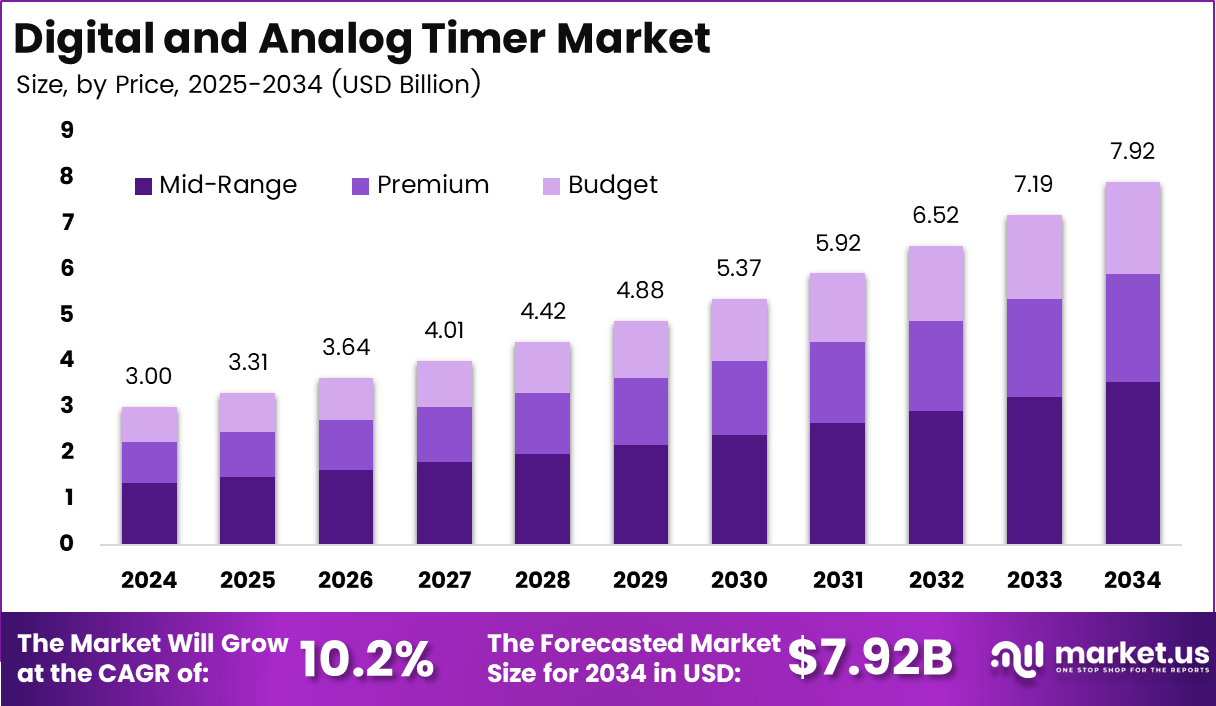
Growth is supported by rising spending on buildings, factory equipment, transport, and energy-control systems where timers are widely installed. U.S. construction spending reached $2.154 trillion in 2024, up 6.5% from $2.024 trillion in 2023, increasing demand for panel timers, DIN-rail timers, lighting controls, pumps, motors, and HVAC scheduling products.
Energy efficiency is also strengthening demand for automated timing controls. ENERGY STAR states that qualified smart thermostats can reduce heating-and-cooling bills by about 8%, saving roughly $50 annually, which supports wider use of programmable and connected control systems in buildings.
North American region also produced about 18.7 million vehicles in 2025, including 10.24 million in the United States, supporting timer demand across welding, coating, conveyors, testing, and assembly. These trends support the projected 10.2% annual growth rate, with digital timers expected to outpace analog products.
Key Takeaways
- The Global Digital and Analog Timer Market was valued at USD 3.0 billion in 2024 and is projected to reach USD 7.9 billion by 2034, growing at a 10.2% CAGR.
- Digital Timers led the product type segment with a 65.7% share due to programmable control for connected and automated equipment.
- Industrial applications dominated with a 38.8% share, supported by continuous operations that require reliable cycle control.
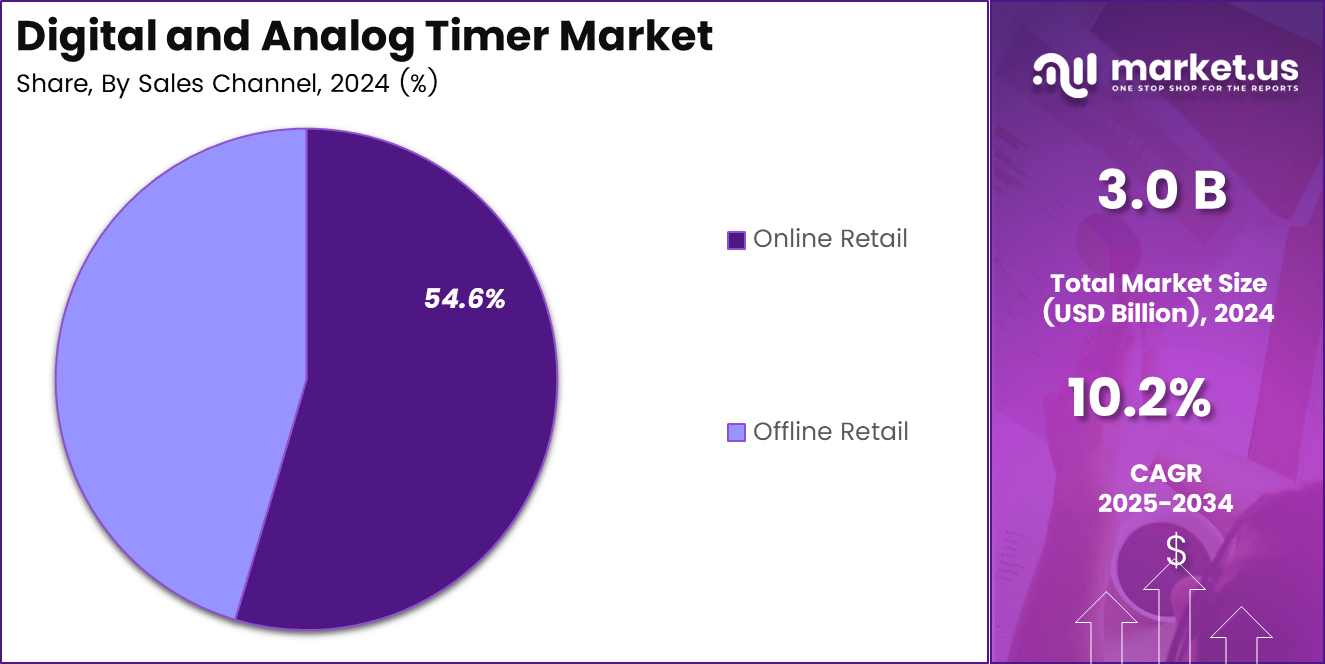
- Online Retail accounted for 54.6% of the market due to wider product choice and easier price comparison.
- Advanced Timers held a 60.3% share because multi-function control supports complex automated processes.
- Mid-Range timers dominated the price segment with a 44.7% share due to balanced features, reliability, and cost.
- North America dominated the market in 2024, generating approximately USD 1.09 billion in revenue.
By Product Type
Digital Timers dominate with 65.7% due to programmable control suited to connected automated equipment.
Digital timers lead because users need precise, repeatable control across factories, buildings, and homes. They let users set several on and off periods, countdowns, delays, and weekly schedules from one device. This flexibility helps buyers replace separate switches and manual checks. Digital timers also fit modern cooling equipment, where scheduled operation can cut wasted power use.
The International Energy Agency reports that air conditioners and electric fans use almost 20% of all electricity consumed in buildings worldwide. That power burden gives building owners a clear reason to use programmable timer controls. Digital timers should also grow fastest because the global stock of air conditioners could rise from 1.6 billion units to 5.6 billion units by 2050.
By End-User Application
Industrial dominates with 38.8% due to continuous operations that need reliable cycle control.
Industrial users lead because timer controls sit inside many daily factory tasks, including motor starts, conveyor movement, welding cycles, packaging lines, drying, and safety delays. Plants value timer products because a small control part can keep a process running at the right speed and in the right order. The International Federation of Robotics counted 4,281,585 industrial robots working in factories worldwide in 2023, after a 10% rise from the prior year.
It also recorded 541,302 new robot installations during that year. Every robot cell needs coordinated timing for movement, loading, testing, and machine safety, which supports strong industrial demand. Healthcare should grow fastest among the listed end users. Hospitals and clinics need timed lighting, ventilation, sterilization, laboratory testing, medicine storage, and patient-care equipment.
The World Health Organization reports that global health spending reached $9.8 trillion in 2021, equal to 10.3% of world GDP. This spending base supports new facilities and equipment upgrades, which raise the need for reliable digital timing controls. Household and education buyers add volume, but factories and healthcare sites place greater value on accuracy, long service life, and dependable operation.
By Sales Channel
Online Retail dominates with 54.6% due to broad choice, which supports easy price comparison.
Online retail leads because timer buyers can compare specifications, prices, wiring formats, voltage ratings, and delivery dates before they buy. This matters in a market with many small products that look alike but serve different jobs. Online stores also help industrial buyers find DIN-rail, panel-mount, plug-in, and programmable products without visiting several local sellers.
The International Telecommunication Union estimated that 5.5 billion people used the internet in 2024, equal to 68% of the world’s population. It added that 227 million more people came online during the year. This growing digital base supports product search, direct orders, and repeat purchases through online channels.
By Functionality
Advanced Timers dominate with 60.3% because multi-function control meets automated process needs.
Advanced timers lead because users increasingly need more than a single delay or countdown. These products offer repeat cycles, multi-step programs, weekly schedules, memory settings, displays, alarms, and links to wider control systems. The United Nations expects urban populations to rise by 2.5 billion people by 2050, with close to 90% of this increase occurring in Asia and Africa.
The World Bank reports global manufacturing value added of about $16.82 trillion in 2024. Manufacturing therefore creates a very large base for controls that improve repeatability and cut manual work. Advanced timers should also grow fastest because automation keeps spreading into both large and small facilities.
By Price Range
Mid-Range dominates with 44.7% due to balanced features, reliability, and purchase cost.
Mid-range timers lead because they give most users the right balance of price, durability, and useful functions. Industrial workshops, small commercial sites, schools, and households often need dependable schedules and displays, but they do not always need premium connectivity or specialist software.
Price remains important because OECD consumer prices stood about 30% higher in September 2024 than in December 2019 across the OECD area. Buyers therefore compare total cost closely and often choose products that offer practical features without premium prices. Premium timers should grow fastest because energy use and automation needs justify higher-value controls in selected sites.
The International Energy Agency estimates that space cooling used around 2,100 terawatt-hours of electricity in 2022. Building owners can support premium timers when they need linked schedules, remote control, and better energy management for this large power load. Budget products will continue to serve basic replacement and simple appliance needs, especially where buyers focus only on first cost.
Key Market Segments
By Product Type
- Digital Timers
- Analog Timers
By End-User Application
- Industrial
- Household
- Healthcare
- Educational
By Sales Channel
- Online Retail
- Offline Retail
By Functionality
- Advanced Timers
- Basic Timers
By Price Range
- Mid-Range
- Budget
- Premium
Comparative Market Landscape
Digital Timers
- Dominating segment, expected to account for around 65-70% of the total market by 2028.
- Projected to grow at a CAGR of 8-10% during the forecast period, driven by the increasing adoption in industrial automation, IoT, and smart home applications.
- Expected to capture the bulk of future market expansion due to programmability, precision, and energy efficiency.
Analog Timers
- Expected to retain a market share of approximately 30-35% by 2028.
- Growth is expected to slow, with a CAGR of 3-5%, as demand remains stable in cost-sensitive and basic applications, such as household appliances and simple industrial setups.
- Analog timers will maintain a niche market presence, driven by their low cost, simplicity, and reliability.
| Trend | What it means | Why it matters |
|---|---|---|
| IoT & Smart Integration | Increasingly connected with IoT platforms, smart homes, and mobile apps for remote scheduling and monitoring. | Minimal connectivity; used mainly in standalone, manual settings. |
| Industrial Automation | Widely adopted in factories and machinery for precise scheduling, process control, and safety compliance. | Limited use in basic machinery and small-scale industrial setups. |
| Miniaturization & Compact Design | Strong focus on smaller, embedded modules for electronics, appliances, and automotive systems. | Less scope for miniaturization; designs remain basic and mechanical. |
| Energy Efficiency & Sustainability | Central role in smart grids, lighting, and HVAC systems to optimize energy consumption. | Used in simple cost-saving applications like basic lighting timers. |
| Cost-Sensitive Applications | Higher upfront cost but long-term savings through automation and programmability. | Preferred in low-cost residential and commercial uses due to affordability. |
| Renewable Energy Integration | Increasing use of solar power systems and EV charging stations for optimized scheduling. | Rarely integrated with renewable energy systems, it remains traditional. |
Regional Analysis
In 2024, North America held a 36.4% share of the global market, valued at approximately USD 1.1 billion. North America, led by the United States, represents one of the most advanced markets for digital and analog timers. The region benefits from a highly developed industrial base, strong adoption of automation technologies, and a growing emphasis on energy efficiency across residential, commercial, and industrial sectors.
The presence of major technology providers, coupled with ongoing investments in industrial digitization and smart infrastructure, ensures that North America remains a key contributor to global market expansion throughout the forecast period, with a projected sales growth of 3-5% CAGR for analog timers.
US Market Size
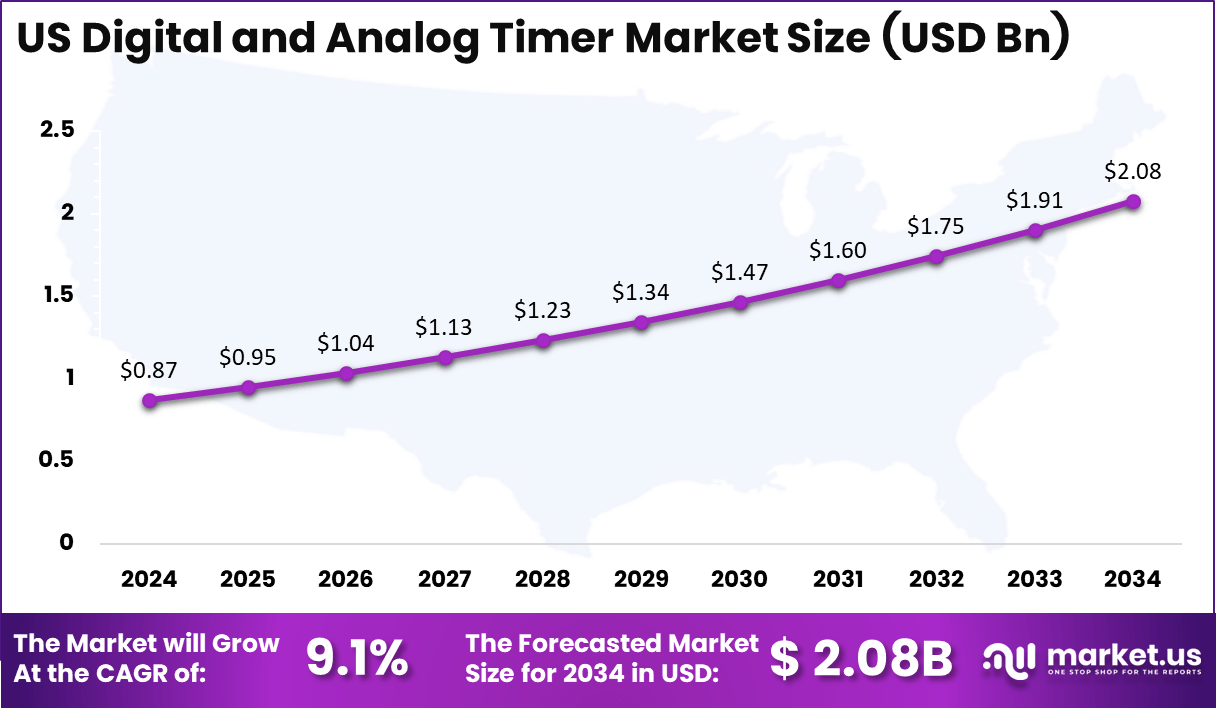
The U.S. Digital and Analog Timer Market was valued at USD 0.87 billion, reflecting its strong role in industrial automation, consumer electronics, and energy efficiency solutions. The market is projected to expand at a CAGR of 9.1% from 2025 to 2034, driven by the rapid adoption of smart timers, IoT-enabled devices, and renewable energy applications. By 2034, the U.S. market is expected to surpass USD 2.1 billion, positioning it as a critical contributor to North America’s dominance in the global landscape.
Key Regions and Countries
- North America
- US
- Canada
- Europe
- Germany
- France
- The UK
- Spain
- Italy
- Rest of Europe
- Asia Pacific
- China
- Japan
- South Korea
- India
- Australia
- Singapore
- Rest of Asia Pacific
- Latin America
- Brazil
- Mexico
- Rest of Latin America
- Middle East & Africa
- South Africa
- Saudi Arabia
- UAE
- Rest of MEA
Market Dynamics
Drivers
| Driver | (~) % Impact on CAGR Forecast | Geographic Relevance | Impact Timeline |
|---|---|---|---|
| Building energy scheduling | +2.0% | Global | Short term (2 years or less) |
| Factory automation expansion | +1.7% | Asia Pacific, Europe, North America | Medium term (2 to 4 years) |
| Appliance control upgrades | +1.2% | Global | Medium term (2 to 4 years) |
| Water system automation | +0.9% | Middle East, Asia Pacific, Latin America | Medium term (2 to 4 years) |
| Laboratory equipment demand | +0.8% | North America, Europe, Asia Pacific | Short term (2 years or less) |
Building energy scheduling
Building energy scheduling provides the largest active lift because timers turn energy-saving goals into a low-cost hardware purchase for lighting, cooling, pumps, and ventilation. The International Energy Agency states that air conditioners and fans account for nearly 20% of electricity used in buildings, so facility managers can gain immediate value by limiting equipment run hours.
The U.S. Census Bureau recorded construction spending at a $2.1922 trillion annual rate in December 2024, creating a broad installation base for new control panels and building systems. The European Commission also made Regulation (EU) 2023/826 applicable from May 2025.
Manufacturers can sell higher-value programmable units through electrical contractors, while distributors can bundle timers with HVAC and lighting-control stock. The effect supports an estimated +2.0% incremental contribution to the baseline growth path without assuming an unrealistic step-change in total market demand.
Restraints
| Restraint | (~) % Impact on CAGR Forecast | Geographic Relevance | Impact Timeline |
|---|---|---|---|
| Imported chip cost exposure | -1.6% | North America | Short term (2 years or less) |
| Low-cost product substitution | -1.2% | Global | Medium term (2 to 4 years) |
| Customer CapEx deferrals | -1.0% | Europe, North America | Short term (2 years or less) |
| Analog product replacement limits | -0.8% | Global | Medium term (2 to 4 years) |
| Compliance testing expense | -0.7% | Europe | Medium term (2 to 4 years) |
Imported chip cost exposure
Imported chip cost exposure creates the strongest immediate restraint because a digital timer contains low-value but essential electronic parts that suppliers cannot readily remove or redesign. The White House imposed an immediate 25% ad valorem duty on a narrow group of advanced computing chips and derivative products.
OECD economic outlook data projected global output growth to slow from 3.3% in 2024 to 2.9% in 2026, which can make industrial buyers more sensitive to a price increase. The U.S. Census Bureau’s retail and construction indicators show that control-equipment demand depends heavily on project timing, so procurement teams can defer non-essential upgrades when component costs rise.
Producers must either absorb higher input costs, reduce distributor margin, or pass through price increases that risk lower unit sales. This creates an estimated -1.6% drag on forecast CAGR, especially for import-dependent designs and lower-priced digital timer ranges.
Challenges
| Challenge | (~) % CAGR Friction Drag | Geographic Relevance | Mitigation Horizon |
|---|---|---|---|
| Volatile freight routes | -1.3% | Global | Medium term (2 to 4 years) |
| Control system cybersecurity | -1.1% | North America, Europe, Asia Pacific | Long term (4 years or more) |
| Regional standards divergence | -0.9% | Global | Long term (4 years or more) |
| Firmware maintenance burden | -0.8% | Global | Medium term (2 to 4 years) |
| Legacy system integration | -0.7% | Global | Medium term (2 to 4 years) |
Volatile freight routes
Volatile freight routes limit the market’s growth ceiling because timer makers depend on regular flows of chips, relays, enclosures, displays, and finished goods across several production countries. UN Trade and Development reported that the Shanghai Containerized Freight Index had more than doubled by mid-2024 from late 2023, driven by rerouting, congestion, fuel use, and insurance costs.
Its data also showed that the Shanghai–West Africa route rose 137% to $5,563 per twenty-foot equivalent unit between January and July 2024. The U.S. National Institute of Standards and Technology identifies operational technology as vulnerable to cyberattacks.
The International Federation of Robotics recorded 4,281,585 industrial robots operating worldwide, meaning factories increasingly expect predictable component supply and cannot easily accept missed delivery windows.
Suppliers need dual sourcing, regional buffer stock, longer purchase commitments, and shipment visibility tools. Those actions protect sales but increase working capital and operating costs, producing an estimated -1.3% friction drag on the market’s maximum expansion rate.
Opportunities
| Opportunity | (~) % Potential CAGR Upside | Geographic Relevance | Execution Window |
|---|---|---|---|
| Legacy equipment retrofit kits | +1.8% | Global | Medium term (2 to 4 years) |
| Timer monitoring subscriptions | +1.4% | North America, Europe, Asia Pacific | Long term (4 years or more) |
| Water pumping packages | +1.2% | Middle East, Asia Pacific, Latin America | Medium term (2 to 4 years) |
| Healthcare compliance controls | +1.0% | Global | Long term (4 years or more) |
| Distributor service bundles | +0.8% | Global | Medium term (2 to 4 years) |
Legacy equipment retrofit kits
Legacy equipment retrofit kits represent the largest unexploited opportunity because many users can add programmed control without replacing motors, pumps, panels, or whole machines. This remains future white space rather than a current driver because suppliers must create simple retrofit packages, installer training, and compatible wiring designs before they can capture it at scale.
The World Bank reported global manufacturing value added of about $16.82 trillion in 2024, indicating a large installed industrial base where incremental control upgrades can compete with full equipment replacement. OECD tax data show that machinery investment receives an average cost-recovery rate of 85.3% across its covered economies, supporting customer interest in practical equipment upgrades.
The United Nations projects that urbanization could add another 2.5 billion people to urban areas by 2050, which will expand the need to modernize local building and utility systems. A successful retrofit offer can target a 15% to 25% higher revenue per installed timer through enclosures, sensors, commissioning, and maintenance contracts, while reducing installer time per upgrade through standard kits. This supports potential upside of +1.8% above the baseline forecast if manufacturers build channel capability and prove payback to operators.
Key Trending Analysis
Tier-1 leaders include Schneider Electric, Eaton, Legrand, Honeywell, Omron, and Panasonic. Together, they are estimated to account for 45–55% of branded global digital and analog timer sales, based on their strong positions across industrial automation, building electrical systems, and energy management.
Schneider Electric generated €40.152 billion in FY2025 revenue, with €2.380 billion in R&D cash costs, equal to 5.9% of sales, and €1.496 billion in net capex, or 3.7%. Eaton reported $27.4 billion in 2025 sales, supported by $797 million in R&D and $919 million in capex.
Legrand recorded €9.481 billion in 2025 sales, with 7.7% organic growth and 5.1% acquisition-led growth. Honeywell operated from a $38 billion adjusted-sales base in 2025, while its Access Solutions acquisition contributed $179 million in Q1 2025 sales. Omron invested ¥21.6 billion in R&D and ¥6.1 billion in capex within its Industrial Automation business in FY2024.
Tier-2 specialists are estimated to hold 25–35% collectively, competing mainly through product range, pricing, and regional distribution. Havells reported ₹21,745.81 crore in FY2025 revenue and ₹257.95 crore in R&D spending, with 46.61% directed toward environmental and social product-process improvement. L&T reported ₹255,734 crore in FY2025 group revenue.
Top Key Players
- Alion
- ANLY Electronics Co., Ltd
- Ascon Tecnologic
- Autonics Corporation
- Carlo Gavazzi
- Crouzet
- Dwyer Instruments
- Eaton
- Enerlites
- Hager
- Havells India Ltd India
- Honeywell
- IDEC
- IMO Precision Controls
- Intermatic
- KACON
- Koyo Electronics
- Larsen & Toubro Limited
- Legrand
- Leviton
- Marsh Bellofram
- Omron
- Oribis
- Panasonic
- Pujing
- Schneider Electric
- SELEC Controls Pvt. Ltd.
- Sisel Engineering Inc.
- Others
Recent Development
- In May 2025, A leading smart device manufacturer introduced a next-generation digital timer series with IoT integration and voice assistant compatibility. The IoT-enabled timers are projected to capture 40-45% of the market share by 2028, contributing significantly to the shift towards connected, intelligent solutions.
- In March 2025, A major appliance company launched energy-efficient analog timers, designed for household and commercial use. Analog timers are expected to retain 25-30% of the market share, providing steady growth in emerging economies where cost-effective solutions are prioritized.
- In January 2025, Several global brands unveiled AI-powered programmable timers offering predictive scheduling, real-time monitoring, and energy optimization. AI-driven timers are anticipated to grow at a CAGR of 10-12%, with strong adoption in sectors requiring high precision and smart functionality.
Report Scope
| Report Features | Description |
|---|---|
| Market Value (2024) | USD 3.0 Bn |
| Forecast Revenue (2034) | USD 7.92 Bn |
| CAGR(2025-2034) | 10.2% |
| Base Year for Estimation | 2024 |
| Historic Period | 2020-2023 |
| Forecast Period | 2025-2034 |
| Report Coverage | Revenue forecast, AI impact on Market trends, Share Insights, Company ranking, competitive landscape, Recent Developments, Market Dynamics and Emerging Trends |
| Segments Covered | By Product Type (Digital Timers, Analog Timers) By End-User Application (Household, Industrial, Healthcare, Educational) By Sales Channel (Online Retail, Offline Retail) By Functionality (Basic Timers, Advanced Timers) By Price Range (Budget, Mid-Range, Premium) |
| Regional Analysis | North America – US, Canada; Europe – Germany, France, The UK, Spain, Italy, Russia, Netherlands, Rest of Europe; Asia Pacific – China, Japan, South Korea, India, New Zealand, Singapore, Thailand, Vietnam, Rest of Latin America; Latin America – Brazil, Mexico, Rest of Latin America; Middle East & Africa – South Africa, Saudi Arabia, UAE, Rest of MEA |
| Competitive Landscape | Alion, ANLY Electronics Co., Ltd, Ascon Tecnologic, Autonics Corporation, Carlo Gavazzi, Crouzet, Dwyer Instruments, Eaton, Enerlites, Hager, Havells India Ltd India, Honeywell, IDEC, IMO Precision Controls, Intermatic, KACON, Koyo Electronics, Larsen & Toubro Limited, Legrand, Leviton, Marsh Bellofram, Omron, Oribis, Panasonic, Pujing, Schneider Electric, SELEC Controls Pvt. Ltd., Sisel Engineering Inc., Others |
| Customization Scope | Customization for segments, region/country-level will be provided. Moreover, additional customization can be done based on the requirements. |
| Purchase Options | We have three license to opt for: Single User License, Multi-User License (Up to 5 Users), Corporate Use License (Unlimited User and Printable PDF) |





































