Report Overview
In 2024, the Global Data Marketplace Platform Market was valued at USD 1,586.9 million and is projected to expand at a 24.6% CAGR through 2034, reaching approximately USD 14,313.0 million. North America accounted for more than 41.6% of global revenue in 2024, or about USD 660.1 million.
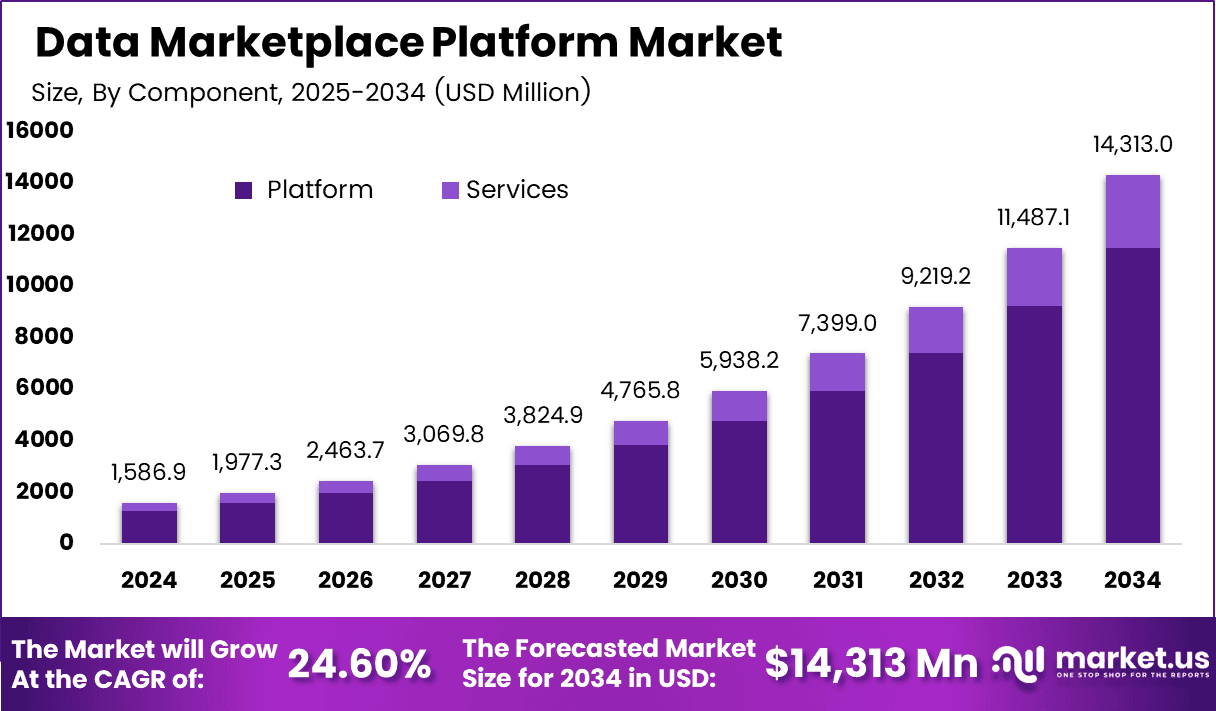
This growth is supported by the fast rise of digital business activity, where firms need trusted external data for pricing, risk checks, customer analysis, supply planning, fraud control, and AI model development. According to UN Trade and Development (UNCTAD), business e-commerce sales across 43 economies rose by nearly 60% between 2016 and 2022, reaching USD 27 trillion.
The North America region combines a large online population, strong digital business adoption, and rapid growth in technology-based services. The International Telecommunication Union reported that 66% of Asia-Pacific’s population used the internet in 2024, providing a major base for digital commerce, mobile services, online payments, and platform-based business models.
The World Bank also found that the share of East Asian firms investing in digital solutions increased from 13% in 2020 to 54% in 2022, while the share remained below 30% in other developing regions. This matters for data marketplace platforms because each new digital workflow creates demand for outside data on customers, locations, demand patterns, credit, supply chains, and business risk.
Key Takeaways
- The Data Marketplace Platform Market was valued at USD 1,586.9 million in 2024 and is projected to reach USD 14,313 million by 2034, expanding at a CAGR of 24.6%.
- By Component: Platform 80.4% emerged as the dominant category, driven by increasing adoption of integrated data exchange and monetization solutions across enterprises.
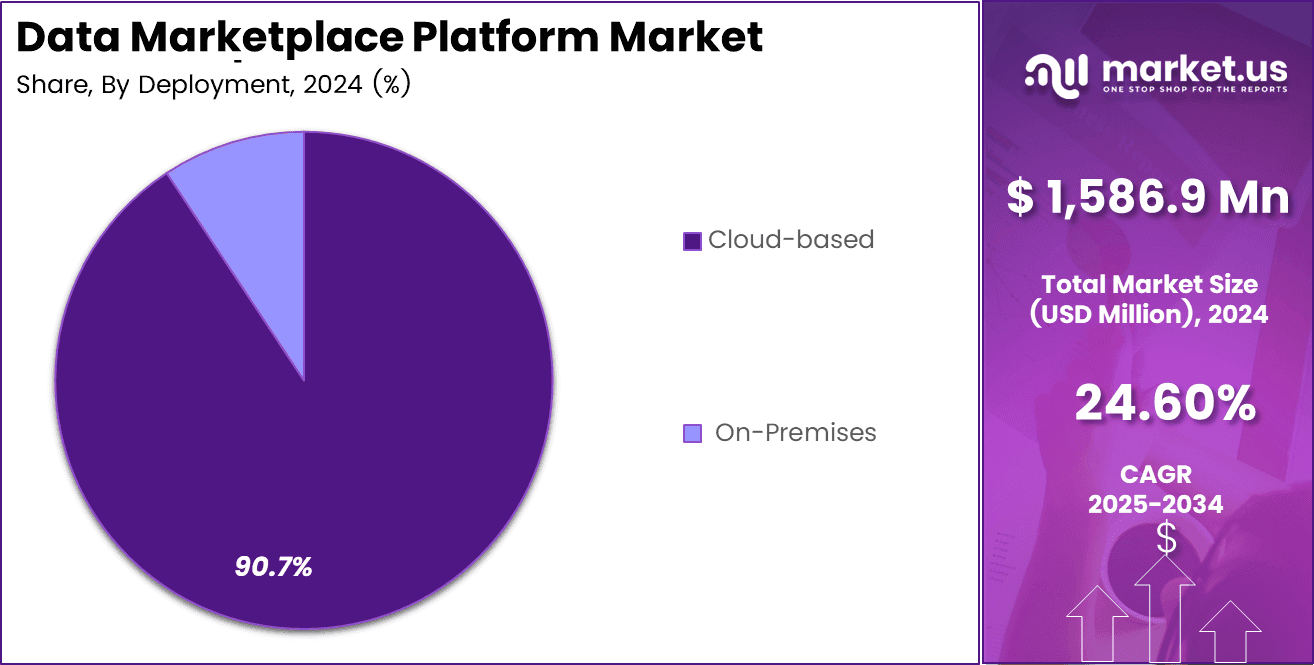
- By Deployment: Cloud-based 90.7% continues to lead due to its scalability, flexibility, and lower infrastructure costs, supporting real-time data transactions and analytics.
- By Revenue Model: Commission 45.2% holds the largest share as platforms increasingly monetize through transaction-based revenue streams, promoting data-driven collaboration.
- By Enterprise Size: Large Enterprises 74.5% dominate the market, owing to their strong digital infrastructure and higher investment capacity in data marketplace ecosystems.
- By End-User: Financial Services 30.1%remains the leading sector, supported by the rising demand for predictive insights, regulatory data compliance, and risk analytics.
- North America leads the market with a valuation of USD 660.1 million in 2024, followed by Europe and Asia-Pacific, reflecting strong adoption in advanced economies.
Role of Generative AI
Generative AI plays a transformative role in the Data Marketplace Platform Market by automating data curation, enhancing data quality, and generating synthetic datasets to overcome data scarcity challenges. It enables intelligent data matching, contextual enrichment, and privacy-preserving data synthesis.
Through natural language interfaces and predictive modeling, Gen AI simplifies complex data discovery, improves personalization, and accelerates decision-making. It also supports automated metadata tagging, anomaly detection, and smart pricing for data assets. As enterprises increasingly adopt AI-driven data ecosystems, generative AI is expected to become central to improving data marketplace efficiency, transparency, and scalability across diverse industry applications.
By Component
Platform dominates with 80.4% due to centralized access, governance, and transaction tools.
Platform leads the market because buyers prefer a single place to discover, test, license, pay for, and govern external data. This model also benefits from network effects as more sellers improve data choice, and more buyers increase revenue opportunities. The platform accounted for 80.4% of the market. Snowflake reported 13,296 customers as of January 31, 2026, while full-year product revenue reached $4.47 billion, growing by 29%.
Services are expected to grow faster as companies require support for data integration, cleansing, governance, access management, and employee training. Snowflake’s professional services and other revenue increased from $164.0 million to $211.6 million in fiscal 2026, representing growth of nearly 29%. This indicates that wider platform adoption is also increasing demand for implementation, migration, governance, and technical support services.
By Deployment
Cloud-based dominates with 90.7% due to rapid scaling and lower infrastructure costs.
Cloud-based deployment leads the market because companies can publish, purchase, and manage data without installing dedicated infrastructure at each location. Its flexibility in storage, computing, security, and data integration supports the segment’s 90.7% share. Eurostat reported that 52.7% of EU enterprises purchased cloud services in 2025, up 7.4 percentage points from 2023, compared with only 17.8% in 2014.
Database hosting was used by 45.5% of enterprise cloud users, supporting demand for cloud-based data marketplace workloads. Cloud-based deployment is also expected to grow fastest as AI and analytics projects require scalable computing and rapid access to diverse datasets. Buyers can increase or reduce usage without major hardware investment, while sellers can update centralized cloud datasets more efficiently.
By Revenue Model
Commission dominates with 45.2% due to low-risk pricing tied to transaction value.
Commission-based revenue leads because sellers pay only when a transaction is completed, reducing entry barriers and encouraging more data listings. This model aligns platform revenue with transaction value and supports flexible pricing based on data volume, freshness, and usage rights. These advantages support Commission’s 45.2% market share.
Subscription-Based revenue is expected to grow fastest as enterprises prefer predictable costs and continuous access to external data. Salesforce reported that subscription and support generated about 94% of fiscal 2025 revenue, while total revenue reached $37.9 billion, increasing 9%. Informatica also reported quarterly cloud subscription revenue of $186.8 million, up 33% year over year, highlighting growing demand for recurring cloud-based data services.
By Enterprise Size
Large Enterprises dominate with 74.5% due to high data demand and compliance budgets.
Large Enterprises lead the market because they purchase multiple datasets, manage complex analytics, and face strict compliance requirements across business units and regions. Their larger IT teams can manage licensing, integration, access control, and data quality at scale, supporting the segment’s 74.5% share. OECD data show that 76% of large European enterprises employed ICT specialists in 2020, compared with only 14% of SMEs.
SMEs are expected to grow fastest as cloud platforms, subscriptions, and managed services reduce upfront costs and technical requirements. An OECD review of the United Kingdom in 2026 found that more than 60% of surveyed companies invested in cloud computing, over 40% in data analytics, and around 25% in AI. Easier purchasing, packaged datasets, and flexible pricing are expected to accelerate marketplace adoption among smaller enterprises.
By End-User
Financial Services dominates with 30.1% due to constant risk, pricing, and compliance needs.
Financial Services leads the market because banks, insurers, asset managers, and payment companies rely on external data for credit assessment, fraud detection, pricing, trading, and regulatory reporting. These activities require accurate and timely data, supporting the segment’s 30.1% share.
The World Bank’s Global Findex 2025, based on about 145,000 adults across 141 economies, found that 79% of adults had a financial account and 86% owned a mobile phone, highlighting the scale of digital financial activity.
Healthcare and Life Sciences is expected to grow fastest as organizations increasingly use clinical, claims, genomic, and public health data. WHO Europe reported that 44 countries had a national digital health strategy and all 53 member states had personal-data protection laws, while only 19 had guidance for evaluating digital health tools.
Key Market Segments
By Component
- Platform
- Services
By Deployment
- Cloud-based
- On-Premises
By Revenue Model
- Subscription-Based
- Commission
- Paid Features
- Others
By Enterprise Size
- Large Enterprises
- Small and Medium Enterprises (SMEs)
By End-User
- Financial Services
- Advertising, Media and Entertainment
- Retail and CPG
- Healthcare and Life Sciences
- Technology
- Public Sector
- Manufacturing
- Other (Education, Automotive, Energy, Oil and Gas)
Regional Analysis
North America dominates the global Data Marketplace Platform Market, holding an estimated 41.5% share in 2024 with a market value of USD 660.1 million. The region’s leadership is driven by robust technological infrastructure, high cloud adoption rates, and increasing investment in data monetization frameworks.
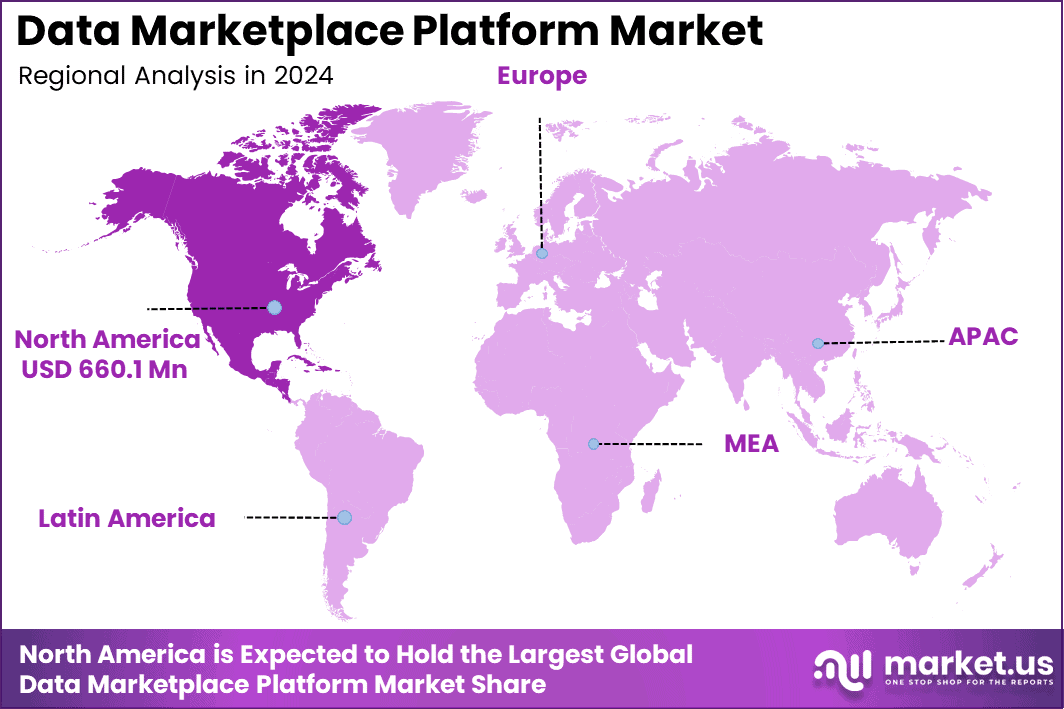
The United States accounts for nearly 78.4% of North America’s total market share, supported by the presence of major tech players and advanced AI integration in enterprise analytics. Europe follows with approximately 27.6% of the global market, propelled by GDPR-led data transparency initiatives and rapid digitalization across industries.
The Asia-Pacific (APAC) region is expected to witness the fastest growth, expanding at a projected CAGR of 25.8%, fueled by government-backed data-sharing ecosystems and expanding enterprise digitization in China, Japan, and India. The Middle East & Africa (MEA) and Latin America collectively account for around 10.9% of the market, with increasing adoption in smart city and financial technology projects.
US Market Size
The US Data Marketplace Platform Market is experiencing rapid expansion, valued at USD 589.53 million in 2024 and projected to reach USD 4,597.16 million by 2034, registering a strong CAGR of 22.8% during the forecast period. This growth reflects the country’s accelerating adoption of AI-driven data exchange systems, open-data policies, and cloud-based analytics infrastructure.
The US currently accounts for approximately 41.5% of the global data marketplace platform market share, indicating its leadership in data monetization and enterprise digitization. The market’s growth trajectory is further supported by high data utilization rates among large enterprises, representing nearly 68.2% of platform adoption in 2024.
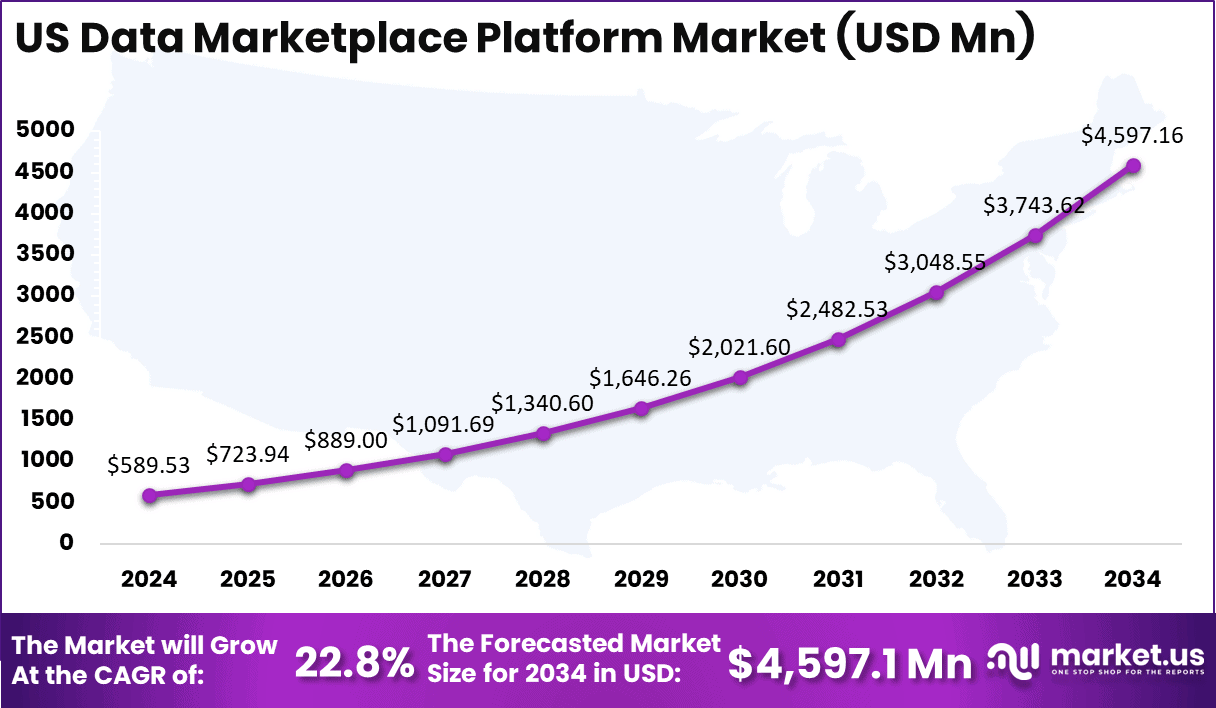
The increasing integration of blockchain and generative AI technologies in US data platforms enhances transparency and interoperability, attracting investment from both private and institutional sectors. As data becomes a critical business asset, the US market continues to lead innovation in intelligent data sharing, offering scalable, secure, and regulatory-compliant marketplace solutions that empower enterprises across sectors such as financial services, healthcare, retail, and technology.
Key Regions and Countries
- North America
- US
- Canada
- Europe
- Germany
- France
- The UK
- Spain
- Italy
- Rest of Europe
- Asia Pacific
- China
- Japan
- South Korea
- India
- Australia
- Singapore
- Rest of Asia Pacific
- Latin America
- Brazil
- Mexico
- Rest of Latin America
- Middle East & Africa
- South Africa
- Saudi Arabia
- UAE
- Rest of MEA
Market Dynamics
Drivers
| Driver | (~) % Impact on CAGR Forecast | Geographic Relevance | Impact Timeline |
|---|---|---|---|
| EU connected-product data access | +3.4% | European Union | Short term (2 years or less) |
| Enterprise AI training-data demand | +3.0% | North America, Europe, Asia-Pacific | Short term (2 years or less) |
| Cloud-native data procurement | +2.6% | Global | Short term (2 years or less) |
| Open-data commercialization | +1.8% | North America, Europe, selected Asia-Pacific markets | Medium term (2 to 4 years) |
| Embedded analytics distribution | +1.5% | Global | Medium term (2 to 4 years) |
EU connected-product data access
The European Union’s Data Act moved from legal entry into force on 11 January 2024 to broad application on 12 September 2025, creating a current commercial catalyst for marketplaces that can operationalize governed access to data generated by connected products, according to the European Commission.
Platforms able to price by query, subscription tier, permitted use case, or downstream value capture can increase recurring revenue density, although compensation and trade-secret safeguards still constrain monetizable availability, as reflected in European Commission implementation materials. The resulting shift from one-off transfers to governed recurring access plausibly contributes +3.4% to the stated baseline growth trajectory.
Restraints
| Restraint | (~) % Impact on CAGR Forecast | Geographic Relevance | Impact Timeline |
|---|---|---|---|
| Privacy compliance liability | -3.2% | Europe, North America, Asia-Pacific | Short term (2 years or less) |
| Data localization mandates | -2.5% | Asia-Pacific, Middle East, Europe | Medium term (2 to 4 years) |
| Restricted sensitive-data trading | -2.1% | Global | Short term (2 years or less) |
| Unclear data ownership | -1.8% | Global | Medium term (2 to 4 years) |
| Public-sector licensing constraints | -1.3% | North America, Europe | Medium term (2 to 4 years) |
Privacy compliance liability
Privacy exposure is an immediate sales restraint because a marketplace may facilitate discovery and contracting, but cannot neutralize the legal risk attached to unlawful collection, re-identification, onward transfer, or incompatible reuse of personal and sensitive data. OECD data-governance analysis notes that data governance spans the full value cycle from creation through deletion and includes technical, policy, and regulatory controls.
Suppliers therefore may withhold high-value datasets, while buyers lengthen approval cycles and demand indemnities that compress platform take rates; a plausible -3.2% deduction reflects the resulting constraint on immediately tradable supply rather than a contraction of the underlying need for data.
Challenges
| Challenge | (~) % CAGR Friction Drag | Geographic Relevance | Mitigation Horizon |
|---|---|---|---|
| Data Quality Standardization Gap | -2.8% | Global | Medium term (2 to 4 years) |
| Semantic Interoperability Fragmentation | -2.4% | Global | Long term (4 years or more) |
| Provenance Verification Burden | -2.0% | Global | Medium term (2 to 4 years) |
| Metadata Maintenance Backlog | -1.7% | Global | Medium term (2 to 4 years) |
| Specialist Governance Talent Scarcity | -1.5% | North America, Europe, Asia-Pacific | Long term (4 years or more) |
Data Quality Standardization Gap
Data-quality standardization is a persistent growth-ceiling challenge because heterogeneous schemas, incomplete documentation, inconsistent refresh intervals, duplicate entities, and unmeasured bias do not necessarily stop a transaction, but they materially weaken reuse, renewals, and automated procurement.
For platform operators, the friction becomes recurring investment in profiling, metadata curation, lineage capture, quality scoring, schema mapping, and buyer-facing validation; without these controls, purchasers discount assets, restrict use to pilots, and avoid automatic renewal. A sustained -2.8% drag is plausible because platform scale requires quality comparability across suppliers, not merely a larger count of listings.
Opportunities
| Opportunity | (~) % Potential CAGR Upside | Geographic Relevance | Execution Window |
|---|---|---|---|
| Usage-governed AI data products | +3.6% | North America, Europe, Asia-Pacific | Medium term (2 to 4 years) |
| Federated confidential-data exchanges | +2.9% | Global | Long term (4 years or more) |
| Industrial digital-twin data bundles | +2.5% | Europe, North America, Asia-Pacific | Medium term (2 to 4 years) |
| Outcome-linked data monetization | +2.1% | Global | Medium term (2 to 4 years) |
| Vertical catalog acquisition roll-ups | +1.7% | North America, Europe | Long term (4 years or more) |
Usage-governed AI data products
Usage-governed AI data products are future upside rather than a current baseline driver because most marketplace inventory is still sold as raw files, API calls, or broad subscriptions rather than as versioned, task-specific, rights-controlled training and evaluation packages with enforceable downstream-use terms.
A platform that packages curated datasets with lineage, permitted-model scopes, refresh guarantees, bias documentation, monitoring rights, and usage metering can shift economics from low-value bulk delivery toward recurring governance-enabled services: a 15% to 30% improvement in realized take rate and a 20% to 40% reduction in buyer-side data-preparation effort are plausible operating targets where standardization and automation are executed effectively.
This remains white space because it requires investment in rights intelligence, policy enforcement, model-evaluation workflows, and vertical validation before it can scale; successful execution could add approximately +3.6% above the baseline CAGR while expanding margins through reusable compliance and curation layers rather than proportional growth in manual transaction operations.
Key Player Analysis
The Data Marketplace Platform Market has a two-tier competitive structure. Tier-1 companies include Microsoft, Oracle, IBM, SAP, Google, Amazon Web Services, and Adobe. Microsoft’s Intelligent Cloud segment generated $34.7 billion in Q3 FY2026, growing 30% year over year, while Azure revenue increased 40%.
Oracle also maintains a strong position through its cloud and data infrastructure portfolio. The company reported FY2026 revenue of $67.4 billion, up 17%, while cloud revenue reached $34 billion, increasing 39%. R&D expenditure stood at approximately $10.27 billion, up 4.18%, while capital expenditure reached $55.7 billion as Oracle expanded infrastructure for data and AI workloads.
Snowflake represents a major specialist data-cloud provider. In fiscal 2026, product revenue reached $4.47 billion, increasing 29% year over year, while remaining performance obligations reached $9.77 billion, up 42%. Its net revenue retention rate of 125% also indicates strong expansion in customer data consumption. Cloudera, Informatica, and Talend compete as Tier-2 data management and integration specialists.
Niche players such as Acxiom, Dawex, Quandl, BattleFin, Narrative.io, and Datatrade focus on specialized areas including identity data, financial datasets, and industry-specific data exchange. These companies compete through data specialization and vertical expertise, while larger providers retain advantages in infrastructure scale, customer reach, and integration with major cloud data marketplaces.
Top Key Players
- Acxiom LLC
- Amazon Web Services
- Dawex
- Snowflake
- Quandl
- BattleFin
- Narrative.io
- Datatrade
- Oracle Corporation
- Microsoft Corporation
- Adobe
- SAP SE
- Cloudera, Inc.
- IBM Corporation
- Google LLC
- Informatica LLC
- Talend S.A.
- Others
Recent Developments
- In June 2025, the world introduced Data Marketplace, a new e-commerce-style discovery interface for business users to find, purchase, and manage data products internally. The platform aims to bring enterprise data access closer to the business user by simplifying discovery and procurement.
- In December 2024, Hong Kong Exchanges and Clearing (HKEX) rolled out its Data Marketplace platform, offering shareholding, derivatives, and non-trading reference data via multiple delivery channels (including cloud transfer). The launch signals broader adoption of marketplace models in regulated markets
| Report Features | Description |
|---|---|
| Market Value (2024) | USD 1,586.9 Million |
| Forecast Revenue (2034) | USD 14,313.0 Million |
| CAGR(2025-2034) | 24.6% |
| Base Year for Estimation | 2024 |
| Historic Period | 2020-2023 |
| Forecast Period | 2025-2034 |
| Report Coverage | Revenue forecast, AI impact on Market trends, Share Insights, Company ranking, competitive landscape, Recent Developments, Market Dynamics, nd Emerging Trends |
| Segments Covered | By Component (Platform, Services), By Deployment (Cloud-based, On-Premises), By Revenue Model (Subscription-Based, Commission, Paid Features, Others), By Enterprise Size (Large Enterprises, Small & Medium Enterprises (SMEs)), By End-User (Financial Services, Advertising, Media & Entertainment, Retail & CPG, Healthcare & Life Sciences, Technology, Public Sector, Manufacturing, Other (Education, Automotive, Energy, Oil & Gas)) |
| Regional Analysis | North America – US, Canada; Europe – Germany, France, The UK, Spain, Italy, Russia, Netherlands, Rest of Europe; Asia Pacific – China, Japan, South Korea, India, New Zealand, Singapore, Thailand, Vietnam, Rest of Latin America; Latin America – Brazil, Mexico, Rest of Latin America; Middle East & Africa – South Africa, Saudi Arabia, UAE, Rest of MEA |
| Competitive Landscape | Acxiom LLC, Amazon Web Services, Dawex, Snowflake, Quandl, BattleFin, Narrative.io, Datatrade, Oracle Corporation, Microsoft Corporation, Adobe, SAP SE, Cloudera, Inc., IBM Corporation, Google LLC, Informatica LLC, Talend S.A., Others |
| Customization Scope | Customization for segments, region/country-level will be provided. Moreover, additional customization can be done based on the requirements. |
| Purchase Options | We have three licenses to choose from: Single User License, Multi-User License (Up to 5 Users), Corporate Use License (Unlimited Users, Printable PDF) |