Report Overview
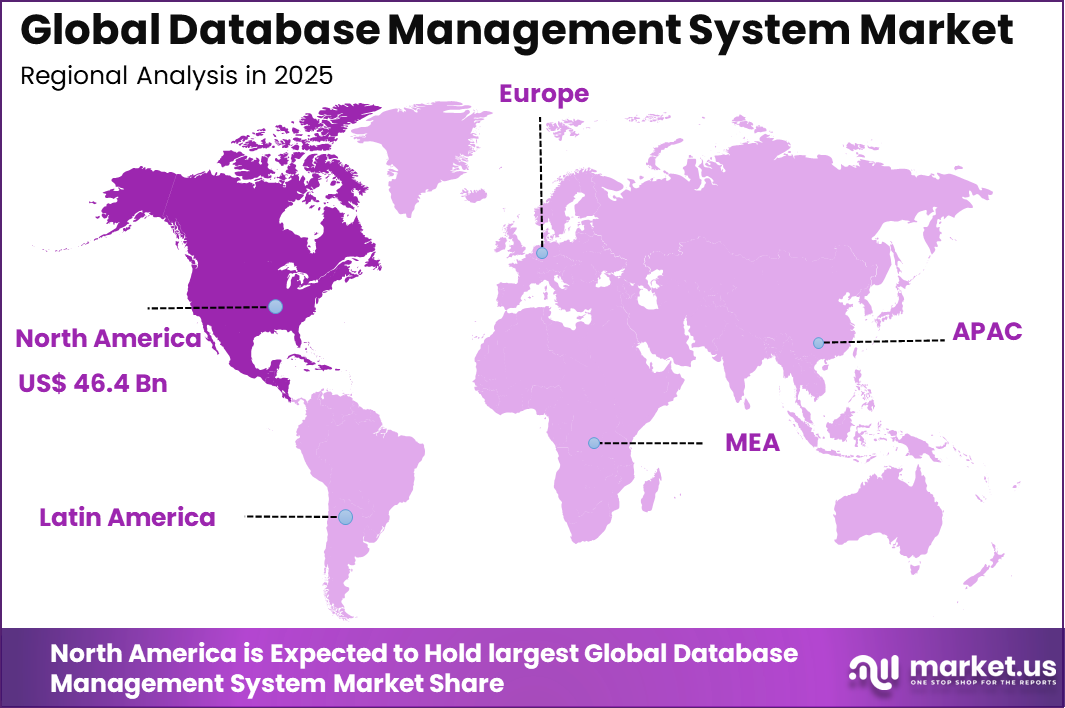
The Global Database Management System Market size is expected to be worth around USD 337.4 billion by 2035, from USD 111.6 billion in 2025, growing at a CAGR of 11.7% during the forecast period from 2025 to 2035. North America held a dominant market position, capturing more than a 41.6% share, holding USD 46.4 billion in revenue.
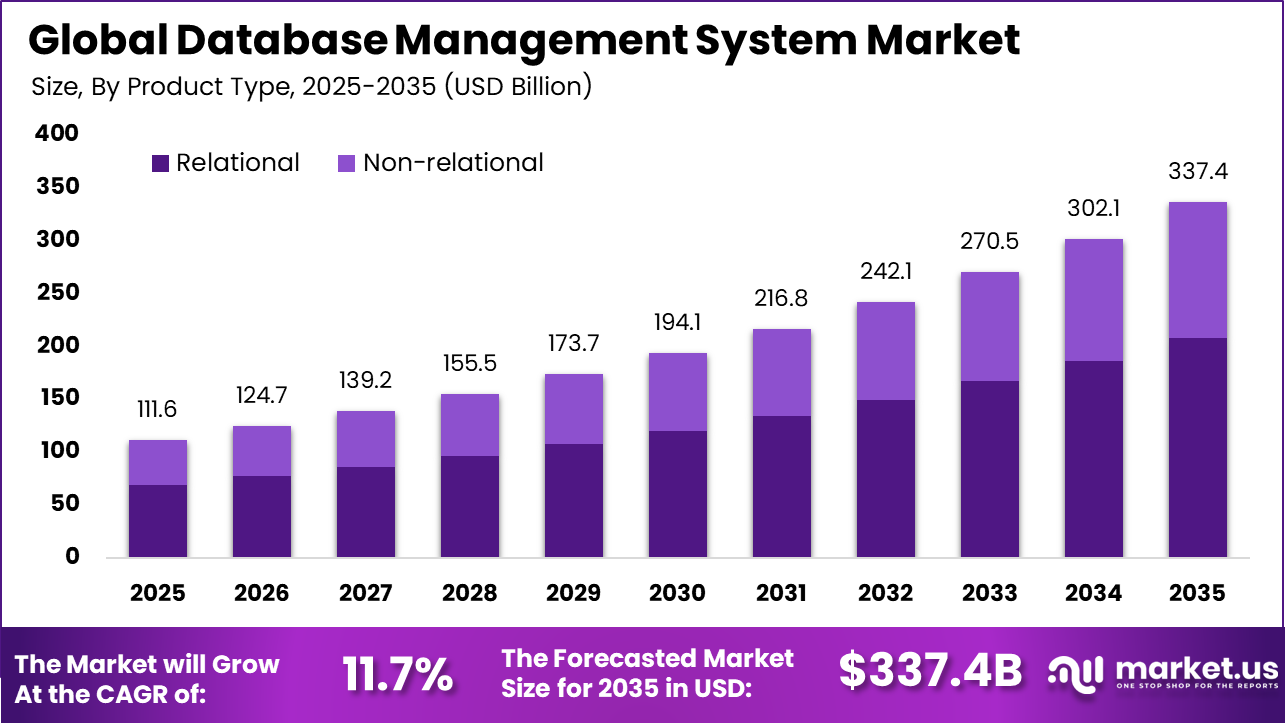
The Database Management System Market encompasses software platforms for storing, organizing, retrieving, securing, and managing structured and unstructured data. These systems support applications, websites, analytics platforms, and enterprise DBMS. The market covers relational, document, graph, vector, and other database models used for transactions, analytics, cloud workloads, and AI applications.
The growth of cloud-native development is strengthening demand for modern database platforms. CNCF reported 19.9 million cloud-native developers globally in Q1 2026, up from 15.6 million in Q3 2025, representing a 28% increase over six months. Database systems are increasingly used across finance, retail, healthcare, telecom, manufacturing, government, and digital services.
Enterprises are increasingly adopting database platforms capable of supporting mixed workloads, real-time analytics, large-scale applications, and AI-ready data pipelines. According to the 2025 Stack Overflow Developer Survey, 58.6% of respondents reported working with SQL, highlighting the continued importance of database technologies in global software and application development.
Key Takeaway
- The relational segment led the global database management system market in 2025, accounting for a 61.8% share, supported by its reliability and widespread use in structured data management.
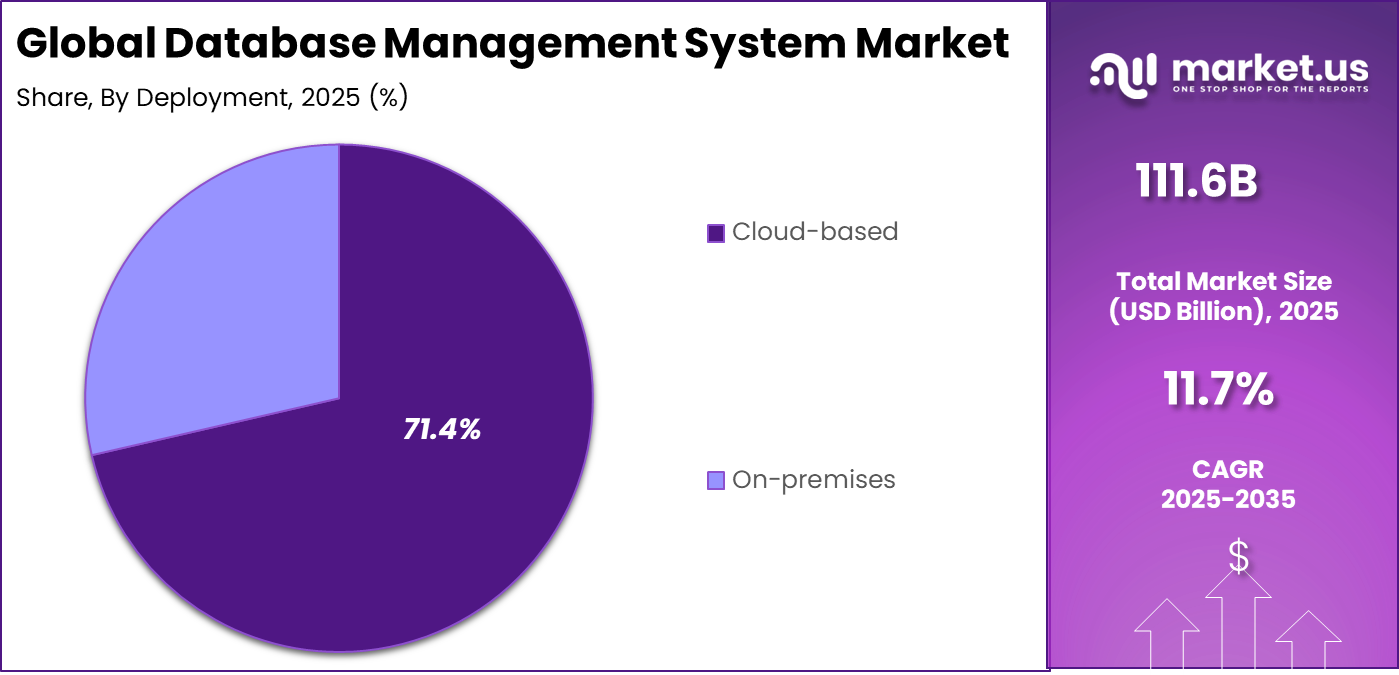
- Cloud-based deployment dominated with a 71.4% share, driven by growing demand for scalable, flexible, and cost-efficient data infrastructure solutions.
- Large enterprises held a leading position with a 67.7% share, reflecting higher data volumes and increased investment in advanced database technologies.
- The BFSI sector accounted for a 24.3% share, supported by the need for secure, high-performance data management systems.
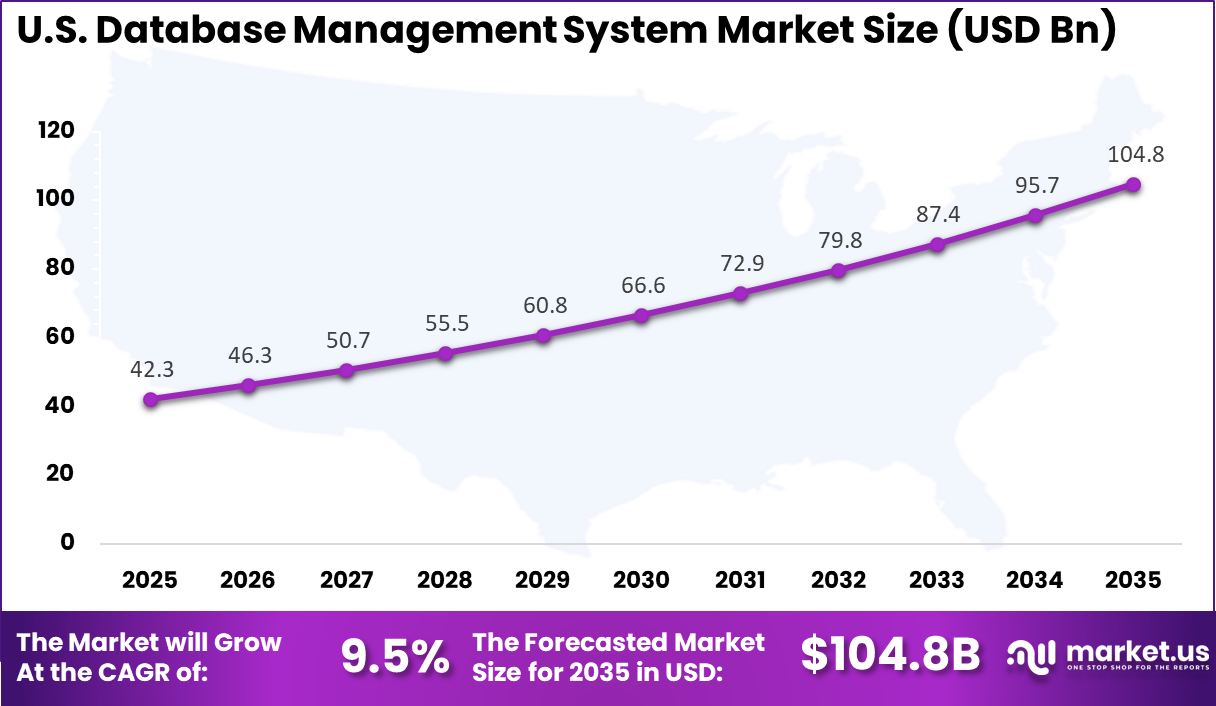
- The U.S. database management system market reached USD 42.3 billion in 2025, expanding at a CAGR of 9.5%, driven by strong digital transformation initiatives.
- North America maintained its leading position globally, capturing over 41.6% share, supported by advanced IT infrastructure and early adoption of data technologies.
Type Analysis
In 2025, the Relational segment held a dominant market position, capturing a 61.8% share of the Global Database Management System Market. This dominance is due to the strong reliability and structured approach offered by relational databases. They organize data into tables with defined relationships, making it easier to manage large datasets.
Relational databases are widely trusted for handling critical workloads where consistency is essential. Their ability to support complex queries and maintain stable performance makes them suitable for long-term use. Organizations continue to rely on them as they provide a proven framework for managing structured data efficiently across multiple departments.
Deployment Analysis
In 2025, the Cloud-Based segment held a dominant market position, capturing a 71.4% share of the Global Database Management System Market. This dominance is due to the flexibility and scalability provided by cloud-based database systems. Organizations can quickly adjust storage and processing capacity based on demand without heavy infrastructure investments.
Cloud-based systems also reduce the burden of maintenance and upgrades, which helps organizations focus on core activities. They enable remote access, improve collaboration, and support digital transformation efforts. As more businesses shift toward online operations, cloud deployment continues to gain strong acceptance across industries.
Organization Size Analysis
In 2025, the Large Enterprises segment held a dominant market position, capturing a 67.7% share of the Global Database Management System Market. This dominance is due to the extensive data requirements and complex operations within large enterprises. These organizations manage vast amounts of information across multiple functions, which requires strong database systems to ensure consistency, security, and performance. DBMS platforms help maintain centralized control over data usage and access.
Large enterprises also prioritize data governance and compliance, which increases their reliance on advanced database solutions. These systems support strategic decision-making by providing accurate and timely insights. Their ability to integrate with multiple business systems further strengthens their importance in large-scale operations.
Vertical Analysis
In 2025, the BFSI segment held a dominant market position, capturing a 24.3% share of the Global Database Management System Market. This dominance is due to the high need for secure and accurate data handling in financial services. The BFSI sector deals with sensitive transactions and customer information, which requires reliable database systems.
Database systems also support fraud detection, compliance monitoring, and risk management within the sector. Financial institutions depend on them to maintain transparency and accountability. As digital banking and online transactions increase, the importance of strong database systems continues to grow in this industry.
Key Market Segments
By Type
- Relational
- Non-relational
By Deployment
- Cloud
- On-premises
By Organization Size
- Large Enterprises
- SMEs
By Vertical
- BFSI
- IT & Telecom
- Retail & E-commerce
- Healthcare & Life Sciences
- Government
- Manufacturing
- Media & Entertainment
- Others
Regional Analysis
In 2025, North America held a dominant market position, capturing more than a 41.6% share, holding USD 46.4 billion in revenue. The region benefits from advanced IT infrastructure and high adoption of data-driven technologies. Organizations across industries are investing in database systems to support digital transformation initiatives.
For instance, in February 2026, IBM advanced North American Database Management System leadership with watsonx. Data 2.0 integrates hybrid cloud and AI governance across Db2 and NoSQL systems. The platform’s open-table format supports and accelerates enterprise AI adoption while maintaining strict compliance. U.S. firms gain unmatched data federation capabilities.
U.S. Market Size
The U.S. market reached USD 42.2 billion and is growing at a CAGR of 9.5%. Growth is driven by increasing demand for cloud computing, data analytics, and enterprise applications. Businesses are focusing on improving data management capabilities to gain competitive advantages. As data continues to play a critical role in decision-making, North America remains a key market for database systems.
For instance, in January 2026, AWS reinforced U.S. dominance in Database Management Systems by launching enhanced Aurora AI features, enabling real-time analytics on petabyte-scale data. This innovation helps enterprises process massive workloads faster, solidifying North America’s lead in cloud database infrastructure with unmatched scalability. Fortune 500 adoption continues to grow rapidly.
Key Regions and Countries
North America
- US
- Canada
Europe
- Germany
- France
- The UK
- Spain
- Italy
- Russia
- Netherlands
- Rest of Europe
Asia Pacific
- China
- Japan
- South Korea
- India
- Australia
- Singapore
- Thailand
- Vietnam
- Rest of APAC
Latin America
- Brazil
- Mexico
- Rest of Latin America
Middle East & Africa
- South Africa
- Saudi Arabia
- UAE
- Rest of MEA
Market Analysis
Drivers
| Driver | (~) % Impact on CAGR Forecast | Geographic Relevance | Impact Timeline |
|---|---|---|---|
| Cloud-native and DBaaS migration | +2.8% | North America, Western Europe | Short term (2 years or less) |
| Enterprise generative AI workload integration | +2.1% | Global, led by North America | Short term (2 years or less) |
| Real-time analytics and IoT data ingestion demand | +1.4% | Asia Pacific, North America | Medium term (2 to 4 years) |
| Enterprise legacy-to-cloud modernization spend | +1.2% | North America, Europe | Short term (2 years or less) |
| Open-source database commercialization | +0.9% | Global | Medium term (2 to 4 years) |
| Data residency-driven regional cloud buildout | +0.7% | Asia Pacific, Middle East | Medium term (2 to 4 years) |
Cloud-Native and DBaaS Migration Redefining Vendor Revenue Models
The dominant force behind current DBMS expansion is the accelerating shift of enterprise workloads from perpetually licensed on-premises engines to managed Database-as-a-Service consumption, a transition that is restructuring vendor unit economics from upfront license fees toward recurring, usage-metered revenue streams.
Per hyperscaler capital expenditure disclosures in 2025 annual filings, combined cloud infrastructure investment exceeded $200 billion for the three largest providers, with database and data-platform services cited as a top-three reinvestment priority.
This licensing-to-consumption shift compresses gross margins on legacy license renewals by an estimated 3 to 5 percentage points annually as customers renegotiate toward pay-as-you-go tiers, according to enterprise IT spending trackers referenced in OECD digital economy reporting, while simultaneously lifting net revenue retention for cloud-native vendors above 120%, a pattern corroborated by investor-relations commentary from major cloud database operators during their 2025 and early 2026 earnings calls.
Restraints
| Restraint | (~) % Impact on CAGR Forecast | Geographic Relevance | Impact Timeline |
|---|---|---|---|
| Elevated interest rates delaying enterprise IT CapEx | -1.6% | North America, Europe | Short term (2 years or less) |
| Cross-border data residency and sovereignty bans | -1.1% | European Union, China, India | Short term (2 years or less) |
| Capital scarcity among mid-market database startups | -0.8% | Global, acute in emerging markets | Short term (2 years or less) |
| Government procurement freezes on foreign cloud vendors | -0.6% | China, Russia, select Middle East states | Medium term (2 to 4 years) |
| Antitrust-driven cloud bundling restrictions | -0.4% | European Union | Short term (2 years or less) |
Interest Rate Environment Freezing Enterprise Database Modernization Budgets
The most immediate structural hard stop constraining current DBMS sales is the persistently elevated cost of capital, which has directly frozen discretionary enterprise IT modernization budgets that would otherwise fund large-scale database platform replacements.
Per central bank policy rate data referenced in IMF World Economic Outlook updates, benchmark rates in major economies remained anchored near 4.25% to 4.50% through mid-2026, roughly double the average observed in the 2019 to 2021 period. This financing cost increase raises the weighted average cost of capital used in enterprise CapEx approval models by an estimated 150 to 200 basis points.
Pushing multi-year database migration projects below internal hurdle-rate thresholds and causing an estimated 20% to 25% deferral rate on planned large-scale platform replacement initiatives, a pattern consistent with corporate CapEx guidance commentary disclosed in 2025 and 2026 earnings calls across enterprise software buyers.
Challenges
| Challenge | (~) % CAGR Friction Drag | Geographic Relevance | Mitigation Horizon |
|---|---|---|---|
| Database administrator talent shortage | -0.9% | Global, acute in North America | Medium term (2 to 4 years) |
| Multi-cloud vendor lock-in friction | -0.7% | Global | Long term (4 years or more) |
| Legacy system migration complexity | -0.6% | North America, Europe, Japan | Medium term (2 to 4 years) |
| Fragmented data governance standards | -0.5% | European Union, Asia Pacific | Long term (4 years or more) |
| Escalating cybersecurity threat surface | -0.4% | Global | Medium term (2 to 4 years) |
Skilled Database Administrator Shortage Constraining Deployment Velocity
The most persistent operational friction across the sector is a structural shortfall of qualified database administration and platform engineering talent, which does not halt current sales but systematically slows the ceiling on deployment velocity and expansion revenue.
Per National Labor Bureau occupational outlook statistics, unfilled database administrator and architect roles in major markets exceeded 60,000 positions through 2025, against university and certification program graduation rates covering less than 40% of that annual demand according to industry association workforce reporting.
This talent deficit extends average implementation timelines for complex multi-database enterprise deployments by an estimated 25% to 30%, per enterprise IT services delivery benchmarks cited in national statistical agency productivity surveys, as vendors and system integrators compete for a constrained labor pool and pass elevated staffing costs through to services pricing.
Wage inflation for specialized database engineering talent has run at approximately 7% to 9% annually since 2023, according to labor bureau wage indices, compressing services-attach margins for vendors bundling implementation support by an estimated 1.5 percentage points.
Opportunities
| Opportunity | (~) % Potential CAGR Upside | Geographic Relevance | Execution Window |
|---|---|---|---|
| Vector and AI-native database monetization | +2.3% | Global, led by North America | Medium term (2 to 4 years) |
| Sovereign cloud and regional data-center roll-ups | +1.5% | Asia Pacific, Middle East, EU | Medium term (2 to 4 years) |
| SME digitalization in underpenetrated emerging markets | +1.1% | Africa, Southeast Asia, Latin America | Long term (4 years or more) |
| Database-embedded edge computing monetization | +0.9% | North America, East Asia | Long term (4 years or more) |
| Automated self-managing database tooling M&A | +0.7% | Global | Medium term (2 to 4 years) |
Vector and AI-Native Database Monetization as Untapped White Space
The largest unexploited upside lies in monetizing vector-search and AI-native database capabilities as a distinct product tier rather than a bundled feature, a white space that remains untapped today because most vendors still treat vector indexing as a free add-on to existing relational or NoSQL offerings rather than a premium-priced standalone workload.
Per enterprise software investor-relations disclosures from specialized database vendors in 2025 and 2026, early vector-tier pricing experiments have achieved gross margins of 75% to 80%, materially above the 55% to 60% typical of legacy licensed relational engines, according to company-level financial statement comparisons.
Cost-per-query economics for embedding-based retrieval are falling roughly 30% year-over-year per semiconductor and cloud infrastructure cost benchmarking referenced in industry association compute-efficiency reports, meaning vendors that build dedicated commercial packaging now can capture disproportionate unit-economic upside before the segment matures and pricing compresses.
Key Players Analysis
The Database Management System market follows a clear tiered structure led by hyperscale cloud providers and established enterprise software companies. Tier-1 leaders, including Microsoft, Oracle, AWS, Google Cloud, and IBM, account for an estimated 55-60% of platform-level database revenue, supported by large cloud ecosystems, enterprise customer bases, and infrastructure scale.
Microsoft strengthened its position as Azure and other cloud services revenue crossed $100 billion annually in fiscal 2026, growing 41% year-over-year. Total fiscal 2026 revenue reached $331.8 billion, while Microsoft Cloud revenue exceeded $214 billion, up 27%. Oracle reported fiscal 2026 cloud revenue of $33.99 billion, up 51%, on total revenue of $67.36 billion. Its MultiCloud database revenue grew 115% sequentially, supported by 23 live MultiCloud data centers and another 47 under construction.
AWS generated $128.7 billion in full-year 2025 net sales and $45.6 billion in operating income, with margins of nearly 35%. Its disclosed capital expenditure plan of about $200 billion annually supports continued AI and database infrastructure expansion. IBM also reinforced its hybrid-cloud position by allocating $8.316 billion to R&D in 2025, representing an 11.2% year-over-year increase.
Tier-2 challengers, including MongoDB, Snowflake, SAP, Teradata, Couchbase, Redis, and MariaDB, compete through specialized architectures, developer-focused platforms, and consumption-based pricing. MongoDB ended fiscal 2026 with $2.5 billion in revenue, up 22.8%, and $716.3 million in R&D spending, up 20%, while Atlas represented 72% of Q4 revenue. Snowflake generated $4.47 billion in fiscal 2026 product revenue, up 29%, with net revenue retention of 125% and remaining performance obligations of $9.77 billion, up 42% year-over-year.
Top Key Players in the Market
- Amazon Web Services (AWS)
- Google Cloud
- IBM Corporation
- Microsoft
- MongoDB, Inc.
- Oracle
- Redis
- SAP SE
- Snowflake Inc.
- Teradata
- PostgreSQL
- Couchbase
- SQLite
- Redis Labs
- MariaDB Corporation
- Other Key Players
Recent Developments
- In March 2026, MongoDB announced Atlas Vector Search 2.0 and upgraded its workload autoscaling, targeting AI and real‑time search use cases across enterprise apps. The enhancements are already driving higher adoption among U.S. SaaS and fintech firms, reinforcing North America’s lead in developer‑centric NoSQL.
- In January 2026, Oracle rolled out Autonomous Database 26Ai, adding built‑in vector search, AI‑driven performance tuning, and Apache Iceberg integration. The suite targets hybrid deployments and complex analytics‑heavy workloads, continuing Oracle’s strong footprint in enterprise DBMS in North America.
Report Scope
| Report Features | Description |
|---|---|
| Market Value (2025) | USD 111.6 Bn |
| Forecast Revenue (2035) | USD 337.4 Bn |
| CAGR (2026-2035) | 11.7% |
| Base Year for Estimation | 2025 |
| Historic Period | 2020-2024 |
| Forecast Period | 2026-2035 |
| Report Coverage | Revenue forecast, AI impact on Market trends, Share Insights, Company ranking, competitive landscape, Recent Developments, Market Dynamics and Emerging Trends |
| Segments Covered | By Type (Relational, Non-relational), By Deployment (Cloud, On-premises), By Organization Size (Large Enterprises, SMEs), By Vertical (BFSI, IT & Telecom, Retail & E-commerce, Healthcare & Life Sciences, Government, Manufacturing, Media & Entertainment, Others) |
| Regional Analysis | North America – US, Canada; Europe – Germany, France, The UK, Spain, Italy, Russia, Netherlands, Rest of Europe; Asia Pacific – China, Japan, South Korea, India, New Zealand, Singapore, Thailand, Vietnam, Rest of Latin America; Latin America – Brazil, Mexico, Rest of Latin America; Middle East & Africa – South Africa, Saudi Arabia, UAE, Rest of MEA |
| Competitive Landscape | Amazon Web Services (AWS), Google Cloud, IBM Corporation, Microsoft, MongoDB, Inc., Oracle, Redis, SAP SE, Snowflake Inc., Teradata, PostgreSQL, Couchbase, SQLite, Redis Labs, MariaDB Corporation, Other Key Players |
| Customization Scope | Customization for segments and region/country-level will be provided. Moreover, additional customization can be done based on the requirements. |
| Purchase Options | We have three licenses to opt for: Single User License, Multi-User License (Up to 5 Users), Corporate Use License (Unlimited Users and Printable PDF) |