Report Overview
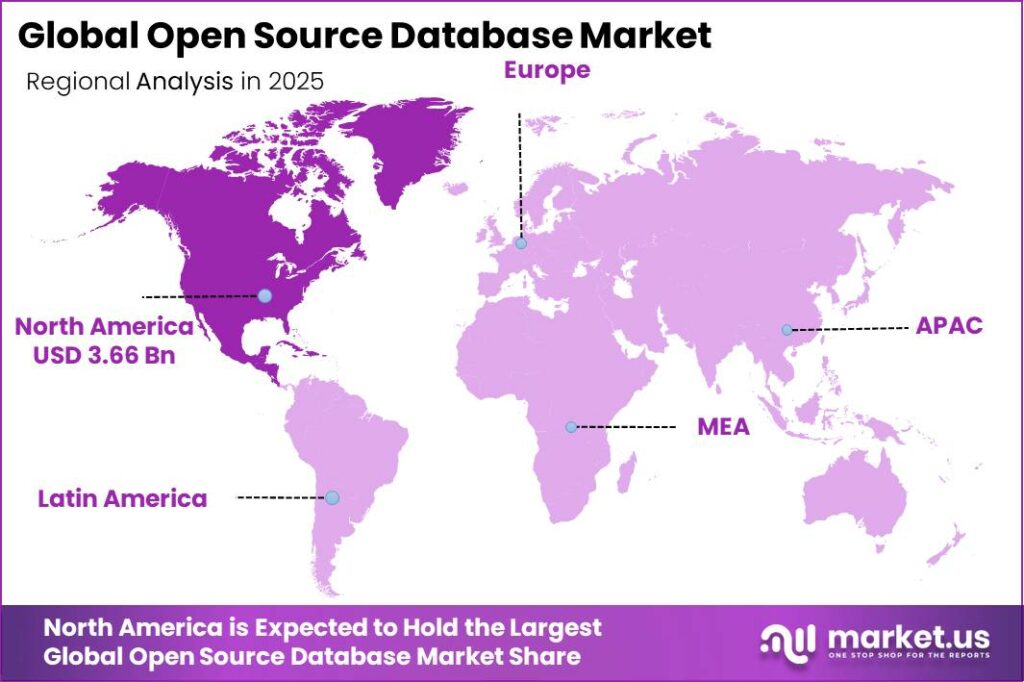
In 2025, the Global Open Source Database Market was valued at USD 8.9 billion. The market is projected to grow at a CAGR of 18.1% during 2026–2035, reaching approximately USD 45.7 billion by 2035. North America dominated the global market in 2025, accounting for more than 41.2% of the total market share and generating approximately USD 3.7 billion in revenue.
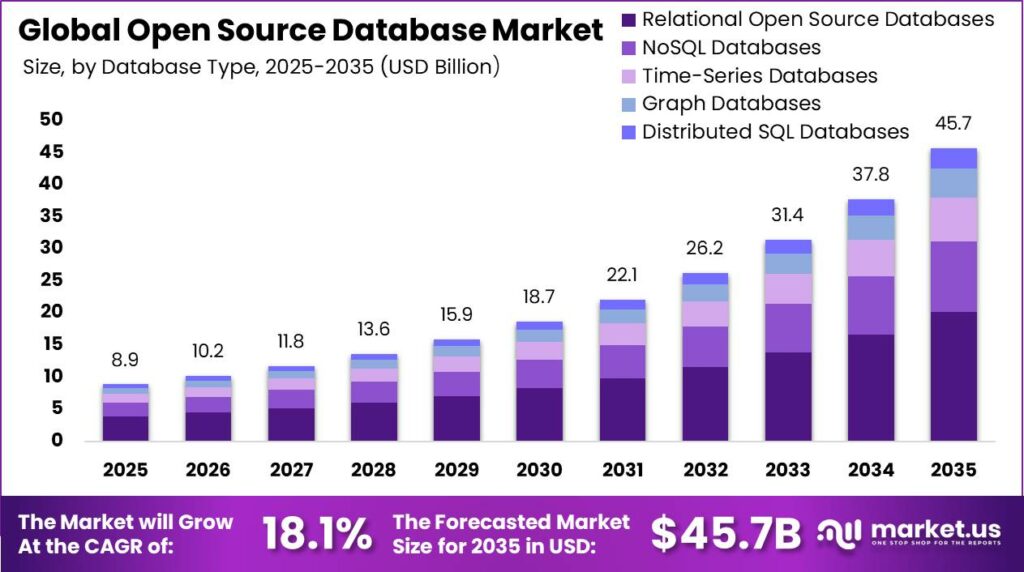
The growth of the open source database market is strongly linked to the rapid expansion of digital data, cloud adoption, and the digital economy. Global data creation is expected to increase significantly, reaching nearly 394 zettabytes by 2028 compared with 129 zettabytes in 2023, creating a need for scalable and cost-efficient database solutions. As businesses manage larger volumes of information, open source databases are gaining preference due to their lower licensing costs, flexible deployment options, and ability to support cloud, analytics, and artificial intelligence workloads.
The increasing contribution of the digital economy, which represents around 15% of global GDP, is further encouraging enterprises to invest in modern data infrastructure. Organizations are shifting toward open source solutions to improve operational efficiency and reduce overall technology costs.
North America’s leading position is supported by strong cloud infrastructure, advanced technology adoption, and the presence of major digital service providers. Rising cloud computing investments and the migration of enterprise workloads to cloud and edge environments are creating continuous demand for open source database platforms. These factors are expected to support steady market expansion globally through 2035.
Key Takeaway
- The Global Open Source Database Market reached USD 8.9 billion in 2025 and is projected to grow to USD 45.7 billion by 2035 at an 18.1% CAGR.
- Relational open source databases dominated the market by type with a 44.2% share, supported by strong enterprise adoption of SQL-based platforms.
- Cloud-based deployment accounted for the largest share at 68.9%, driven by increasing cloud migration and scalable data infrastructure needs.
- MySQL and PostgreSQL ecosystem solutions led the technology segment with a 51.3% share due to broad developer support and enterprise usage.
- Web and mobile applications held the leading application share of 39.7%, reflecting rising demand for digital platforms and services.
- IT and Telecom emerged as the top end-user segment with a 33.6% share, driven by large-scale data management requirements.
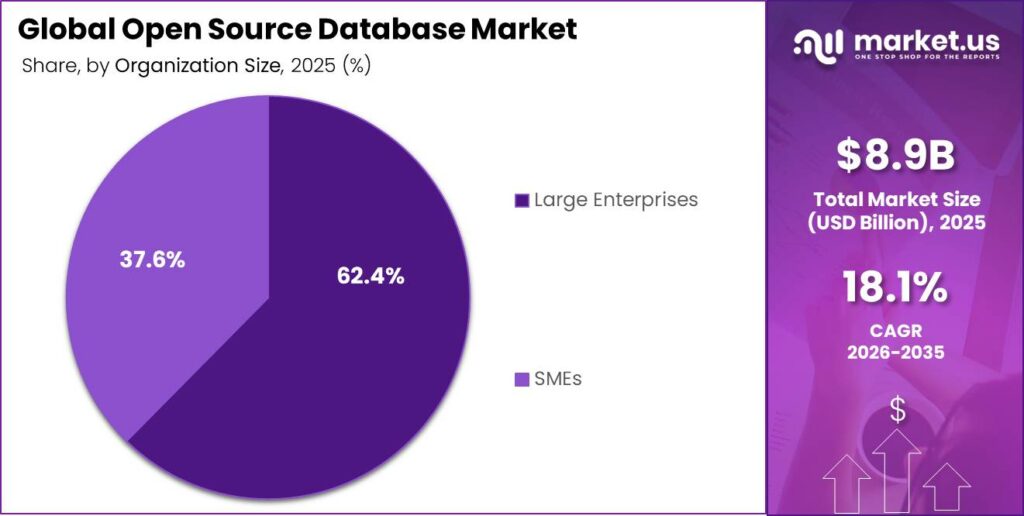
- Large enterprises captured 62.4% of the market, leveraging open source databases for cost efficiency and flexible deployment.
- Transactional workloads represented the largest workload segment with a 46.1% share due to demand for reliable business applications.
- Community-driven usage accounted for a 57.8% share, highlighting the importance of open source developer ecosystems.
- North America dominated the regional market with a 41.2% share, supported by advanced cloud infrastructure and digital technology adoption.
By Database Type
The Relational Open Source Databases segment accounted for 44.2% of the Open Source Database Market in 2025. The segment continues to lead because MySQL and PostgreSQL are the most widely deployed open-source relational database systems worldwide. Their long-standing enterprise adoption, ACID compliance, mature ecosystems, and seamless integration with transactional applications make them the preferred choice for business-critical workloads.
According to the DB-Engines Ranking (July 2026), MySQL ranked first among open-source databases with a score of 846, followed by PostgreSQL with 688, while MongoDB ranked third with 387. The 2025 Stack Overflow Developer Survey further highlights the strength of relational databases, reporting PostgreSQL usage by 55.6% of professional developers and MySQL usage by 40.5%, compared with lower adoption levels for most NoSQL databases.
NoSQL Databases are the fastest-growing database type segment, driven by the increasing volume of unstructured and semi-structured data and the growing need for real-time data processing. The expansion of cloud computing, artificial intelligence (AI), machine learning (ML), Internet of Things (IoT), and digital applications has increased demand for flexible database models that can efficiently manage diverse data formats.
By Deployment Mode
The Cloud-Based Deployment segment accounted for 68.9% of the Open Source Database Market in 2025. The segment leads the market as organizations increasingly deploy open-source databases via managed cloud services rather than maintaining their own infrastructure. Cloud deployment helps reduce operational costs, simplifies database management, enables faster scalability, and improves resource utilization.
According to Eurostat, 52.7% of European Union enterprises used paid cloud computing services in 2025, an increase of 7.4 percentage points from 2023. Among enterprises using paid cloud services, 45.5% used them specifically for database hosting, highlighting the growing preference for cloud-based database platforms.
Cloud adoption also rises with enterprise size. European Commission data show that 77.6% of large enterprises use cloud services, compared with 59.0% of medium-sized enterprises and 41.7% of small enterprises, demonstrating that large organizations are driving cloud-based database deployments.
In addition, the U.S. Census Bureau’s Annual Business Survey found that 59.0% of businesses reporting technology adoption impacts considered cloud-based technology to be “very important,” reinforcing the strong role of cloud infrastructure in modern database operations.
By Technology
The MySQL & PostgreSQL Ecosystem segment held 51.3% of the Open Source Database Market in 2025. The segment leads the market because MySQL and PostgreSQL are the two most widely adopted open-source database technologies, supported by mature development tools, large open-source communities, and extensive managed cloud services such as Amazon RDS, Azure Database, and Google Cloud SQL.
According to the DB-Engines Ranking (July 2026), MySQL recorded a popularity score of 846, ranking 2nd overall among all database management systems, while PostgreSQL scored 688, ranking 4th overall. Both databases ranked significantly higher than other open-source technologies such as MongoDB (387) and Redis (154). The 2025 Stack Overflow Developer Survey also reported PostgreSQL usage by 55.6% of professional developers and MySQL usage by 40.5%, the two highest adoption rates among all database technologies.
By Application
The Web & Mobile Applications segment held 39.7% of the Open Source Database Market in 2025. The segment leads because web and mobile applications represent the largest software category using open-source databases to manage user sessions, content, and commerce data.
Data Analytics & BI is the fastest-growing application segment, driven by increasing enterprise investment in AI-powered decision-making and data analytics. Although no government-sourced CAGR is available for this segment, global corporate AI investment reached approximately USD 581 billion in 2025, up 129.9% from around USD 253 billion in 2024, supporting greater demand for analytics platforms and data pipelines.
Gartner forecasts worldwide software spending to increase from approximately USD 1.11 trillion in 2025 to more than USD 1.23 trillion in 2026, further driving the adoption of analytics and business intelligence solutions built on open-source databases.
By End User
The IT & Telecom segment accounted for 33.60% of the Open Source Database Market in 2025. The sector leads the market because it develops and operates large-scale digital infrastructure that relies heavily on open-source databases.
According to Gartner’s 2026 IT Spending Forecast, worldwide data center systems spending is projected to increase from approximately USD 333 billion in 2025 to nearly USD 475 billion in 2026, reflecting continued investment in server infrastructure, cloud platforms, and database systems by IT and telecom companies.
In addition, RBI and SEBI require Software Bill of Materials (SBOM) tracking for critical applications, with SEBI’s Cybersecurity and Cyber Resilience Framework mandating SBOM inventories for core business applications by August 31, 2025, encouraging modernization of database infrastructure.
By Organization Size
The Large Enterprises segment held 62.4% of the Open Source Database Market in 2025. Large organizations dominate because they manage the highest volume of production workloads and have larger IT budgets for database infrastructure and administration.
According to the European Commission’s Digital Decade monitoring, 77.6% of large enterprises use cloud services, compared with 41.7% of small enterprises, highlighting the greater technology adoption among large organizations. Gartner also forecasts worldwide IT services spending to reach approximately USD 1.69 trillion in 2026, reflecting continued enterprise investment in managed database and infrastructure services.
SMEs are the fastest-growing organization-size segment as technology adoption continues to accelerate among smaller businesses. Although no verified CAGR is available, the U.S. Census Bureau’s Business Trends and Outlook Survey reported that AI adoption among businesses with fewer than 250 employees increased from 6.3% to 8.8% within six months in 2025. In addition, the SBE Council’s October 2025 survey found that 60% of small businesses adopted new technologies to improve efficiency, while 37% cited competitive pressure as the main reason for technology investment.
By Workload Type
The Transactional Workloads segment accounted for 46.10% of the Open Source Database Market in 2025. The segment leads because transactional databases support core business operations such as payment processing, customer records, and order management. MySQL and PostgreSQL continue to dominate these workloads due to their ACID compliance and reliability.
Analytical Workloads are the fastest-growing workload segment, driven by increasing enterprise investments in AI and business intelligence. Although no primary-source CAGR is available, the 2025 CNCF Annual Survey reported that 82% of container users run Kubernetes in production, reflecting the growing use of cloud-native infrastructure for analytics and AI workloads.
By Developer Adoption Model
The Community-Driven Usage segment held 57.80% of the Open Source Database Market in 2025. The segment dominates because most developers use free community editions of open-source databases instead of paid enterprise subscriptions. According to the 2025 Stack Overflow Developer Survey, SQLite was used by approximately 37.5% of developers, while Microsoft SQL Server was used by approximately 30.1%, highlighting the widespread adoption of community-supported database technologies.
Enterprise Subscription Support is the fastest-growing developer adoption model, driven by the need for vendor-backed support, security updates, and regulatory compliance. Although no primary-source CAGR is available, Confluent’s survey of Apache Kafka users found that organizations using enterprise support reported 92% satisfaction, indicating the growing preference for paid subscription services among enterprise customers seeking higher reliability and operational support.
Key Market Segments
Database Type
- Relational Open Source Databases
- NoSQL Databases
- Time-Series Databases
- Graph Databases
- Distributed SQL Databases
Deployment Mode
- Cloud-Based Deployment
- On-Premises Deployment
- Hybrid Deployment
Technology
- MySQL & PostgreSQL Ecosystem
- Apache Ecosystem Databases
- Kubernetes-Native Databases
- AI-Optimized Databases
Application
- Web & Mobile Applications
- Data Analytics & BI
- Cloud-Native Applications
- IoT Data Management
- Enterprise Applications
End User
- IT & Telecom
- BFSI
- Healthcare
- Retail & E-commerce
- Government & Public Sector
- Manufacturing
Organization Size
- Large Enterprises
- SMEs
Workload Type
- Transactional Workloads
- Analytical Workloads
- Mixed Workloads (HTAP)
Developer Adoption Model
- Community-Driven Usage
- Enterprise Subscription Support
Market Dynamics
Drivers
| Driver | (~) % Impact on CAGR Forecast | Geographic Relevance | Impact Timeline |
|---|---|---|---|
| Enterprise cloud migration momentum | +4.0% | North America, Europe, Asia-Pacific | Short term (≤ 2 years) |
| Maturing open source database ecosystems | +2.0% | Global | Medium term (2–4 years) |
| Cost optimization vs. proprietary licenses | +3.0% | Global | Short term (≤ 2 years) |
| Rise of multi-database application architectures | +1.5% | Global | Medium term (2–4 years) |
| Community-driven innovation in features & performance | +1.0% | Global | Long term (≥ 4 years) |
| Cloud-native open source data platforms | +1.0% | North America, Europe | Medium term (2–4 years) |
Enterprise cloud migration momentum
Accelerating enterprise adoption of cloud computing is a primary driver for open source databases, as a steadily rising share of firms now procure cloud services that explicitly include database hosting, development platforms, or computing power for their own software workloads, with recent European statistics showing that around 45.2% of enterprises purchased some form of cloud computing and roughly three-quarters of those buyers consumed sophisticated services such as hosted databases and high-performance computing platforms.
This migration shifts database procurement from perpetual licenses and appliance-based models to consumption-based, managed, or self-managed open source deployments, enabling organizations to reallocate up to mid-teens percentages of their database-related OpEx away from license fees toward cloud infrastructure and engineering capacity, which supports an incremental uplift of about +4.0% on the baseline open source database CAGR by leveraging lower entry costs and elastic scaling.
Restraints
| Restraint | (~) % Impact on CAGR Forecast | Geographic Relevance | Impact Timeline |
|---|---|---|---|
| Enterprise skills and support gaps | -3.0% | Global | Short term (≤ 2 years) |
| Perceived compliance and liability risk | -2.0% | Highly regulated markets | Medium term (2–4 years) |
| Legacy proprietary database lock-in | -2.5% | North America, Europe | Long term (≥ 4 years) |
| Fragmented tooling and integration overhead | -1.5% | Global | Short term (≤ 2 years) |
| Budget competition from proprietary cloud data warehouses | -1.0% | Global | Medium term (2–4 years) |
| Security operations maturity gaps | -1.0% | Global | Short term (≤ 2 years) |
Enterprise skills and support gaps
A significant restraint on open source database adoption is the shortage of in-house expertise and formal support structures, since many enterprises lack enough administrators and developers trained on specific engines such as relational, document, or in-memory systems to operate them with production-grade reliability and security across dozens to hundreds of business-critical applications.
In practical terms, this skills gap can force organizations to overprovision infrastructure by high single-digit percentages to compensate for suboptimal schema design and indexing, increase incident resolution times from hours to days, and drive unplanned downtime events that jeopardize service-level objectives, collectively reducing the achievable market CAGR by an estimated -3.0% relative to the baseline as projects stall or revert to familiar proprietary stacks.
Challenges
| Challenge | (~) % CAGR Friction Drag | Geographic Relevance | Mitigation Horizon |
|---|---|---|---|
| Managing multi-database complexity | -2.5% | Global | Medium term (2–4 years) |
| Ensuring consistent performance at scale | -2.0% | Global | Long term (≥ 4 years) |
| Hybrid and multi-cloud data governance | -1.5% | North America, Europe, Asia-Pacific | Long term (≥ 4 years) |
| Complex migrations from monolithic architectures | -1.0% | Global | Medium term (2–4 years) |
| Keeping up with rapid feature evolution | -1.0% | Global | Short term (≤ 2 years) |
| Balancing community and enterprise priorities | -0.8% | Global | Long term (≥ 4 years) |
Managing multi-database complexity
As organizations increasingly deploy multiple open source databases side by side for different workloads—such as combining relational engines, document stores, and in-memory caches within a single application environment the operational complexity of orchestrating upgrades, monitoring, backups, and schema evolution across several platforms introduces a sustained friction drag on the market’s maximum growth potential.
This manifests quantitatively in duplicated tooling subscriptions, parallel observability stacks, and larger platform engineering teams, pushing unit operating costs per database node up by mid-single-digit percentages and extending project delivery timelines by several weeks to accommodate cross-database integration testing, thereby reducing the realizable upside CAGR by roughly -2.5% relative to what would be achievable under more standardized stacks.
Opportunities
| Opportunity | (~) % Potential CAGR Upside | Geographic Relevance | Execution Window |
|---|---|---|---|
| Monetizing managed open source database services | +3.5% | Global | Short to medium term (≤ 4 years) |
| Verticalized database solutions for regulated sectors | +2.5% | North America, Europe | Medium term (2–4 years) |
| Edge and IoT-optimized open source databases | +2.0% | Global | Long term (≥ 4 years) |
| Data platform consolidation and ecosystem integration | +1.8% | Global | Medium term (2–4 years) |
| Open source alternatives to cloud data warehouses | +1.5% | North America, Europe | Long term (≥ 4 years) |
| New licensing and value-add enterprise features | +1.2% | Global | Short term (≤ 2 years) |
Monetizing managed open source database services
The most material upside opportunity lies in expanding managed services that run popular open source databases as fully operated offerings, capturing value from enterprises that already rely heavily on cloud but prefer to offload operational complexity rather than self-manage clusters. T
This is structurally distinct from today’s driver effect of generic cloud adoption because the untapped white space is in premium service layers automated scaling, performance tuning, security hardening, and high-availability configurations that can command margins several hundred basis points higher than commodity infrastructure, potentially adding around +3.5% to the baseline CAGR where providers can convert even a modest fraction of the installed base into managed offerings.
Geopolitical Impact Analysis
Geopolitical tensions are increasingly affecting cost structures and deployment timelines in the open source database market by increasing the cost of supporting infrastructure such as servers, storage, and networking equipment. Trade fragmentation has raised average applied MFN tariffs on ICT equipment and electronic components to around 3.5%–5.0% across major economies, while WTO data indicates that bound tariff rates on computer and related equipment in some G20 markets have increased by 1–2 percentage points since 2019.
In addition, supply chain disruptions and rerouting of shipping routes have pushed container shipping rates on key Asia–Europe lanes up by more than 200% at peak and extended transit times by 7–10 days, increasing infrastructure costs for cloud providers and enterprise database integrators.
Energy market volatility is further increasing operational expenses for large-scale database deployments. According to the IEA Global Energy Review 2025, global energy demand increased by 2.2% in 2024, compared with the previous decade average of 1.3%, while wholesale power prices in several European markets remained 30–40% above pre-2021 levels.
Economic uncertainty is also influencing enterprise IT spending decisions. The IMF projects global GDP growth could slow to around 3.1% in 2026, with downside scenarios reaching 2.5%, potentially delaying database modernization and migration projects. As a result, vendors and cloud providers are focusing on premium support services, optimized pricing models, and regional strategies to manage rising infrastructure, energy, and supply chain costs while maintaining long-term market growth.
Regional Analysis
North America currently dominates the global open source database market, accounting for a 41.2% share and an estimated USD 3.7 billion in market value in 2025, while Asia Pacific is projected to be the fastest-growing regional market during the forecast period. North America’s leadership is supported by a mature IT ecosystem, widespread cloud adoption, and the strong presence of leading technology vendors and open source communities.
Asia Pacific is expected to register the highest growth rate in the open source database market, driven by rapid digital transformation, expanding cloud deployments, and rising adoption of e-commerce, fintech, and startup ecosystems. Major economies including China, India, and Southeast Asian countries are increasingly standardizing on open source databases to support high-volume, low-latency applications, improve deployment flexibility, and reduce software licensing costs, positioning APAC as the fastest-growing regional market through 2035.
Key Regions and Countries
North America
- US
- Canada
Europe
- Germany
- France
- The UK
- Spain
- Italy
- Rest of Europe
Asia Pacific
- China
- Japan
- South Korea
- India
- Australia
- Rest of APAC
Latin America
- Brazil
- Mexico
- Rest of Latin America
Middle East & Africa
- GCC
- South Africa
- Rest of MEA
Key Players Analysis
The open source database market is characterized by a competitive landscape led by a limited number of major vendors, with MongoDB positioned as the leading commercial open source database provider. MongoDB reported USD 2.01 billion in fiscal 2025 revenue, including USD 1.94 billion from subscription revenue (96% of total) and USD 62.6 million from services. Its cloud database platform, Atlas, contributed approximately 71% of Q4 FY25 revenue and grew 24% year over year, representing an estimated USD 1.4 billion annualized contribution from cloud-native database services.
MongoDB serves around 47,500–59,000 customers and held an estimated 18–22% share of monetized open source database and DBaaS spending in 2025. Despite reporting a net loss of approximately USD 129 million in 2025, the company continues to invest heavily in product innovation, artificial intelligence capabilities, and ecosystem expansion, including the acquisition of Voyage AI in February 2025.
Tier-2 players such as MariaDB and Percona compete through specialized solutions, enterprise support, and lower total cost of ownership. MariaDB reported approximately USD 54.6 million in trailing-twelve-month revenue before its August 2024 take-private and delisting, with quarterly revenue of around USD 13.6 million and an accumulated deficit of approximately USD 249 million as of September 2023.
The broader open source database software market is expected to expand from approximately USD 10–14 billion in 2024 to USD 63–75 billion by 2034, representing a 15–20% CAGR. MongoDB is expected to maintain its leadership due to strong R&D investments, Atlas growth, and a workforce of over 5,500–7,600 employees by 2025–2026, while smaller vendors compete through specialization, open tooling, and enterprise support services.
Top Key Players in the Market
- MongoDB
- Redis
- Couchbase
- Cassandra (Apache)
- PostgreSQL Global Development Group
- MySQL (Oracle)
- MariaDB Foundation
- ClickHouse
- Elastic
- InfluxData
- Neo4j
- Snowflake
- Databricks
- Oracle
- AWS
Recent Developments
- In March 2026, MariaDB plc completed the acquisition of GridGain Systems, Inc., the in-memory computing company behind Apache Ignite, in a cash-and-stock deal valued at approximately $150 million, adding GridGain’s more than 200 enterprise customers and a distributed in-memory data grid capable of processing over 1 billion transactions per second on clusters exceeding 1,000 nodes into the MariaDB open source database portfolio.
- In June 2026, Elastic NV agreed to acquire Deductive AI Inc., an AI-driven site reliability engineering platform built on Elasticsearch, in a transaction reported at up to $85 million, integrating Deductive’s observability engine that ingests more than 5 billion events per day from open source databases and microservices into Elastic’s open source search and observability stack.
- In February 2025, MongoDB, Inc. announced the acquisition of Voyage AI, a provider of advanced embedding and reranking models, for approximately $220 million in total consideration (cash and stock), expanding MongoDB’s AI-native database capabilities to support vector search workloads exceeding 10 million embeddings per deployment while maintaining millisecond-latency queries on its open source-based engine.
- In May 2025, Databricks, Inc. agreed to acquire Neon, a serverless Postgres company built on open source PostgreSQL, in a deal valued at about $1 billion, adding Neon’s multi-tenant serverless Postgres platform capable of automatically scaling to tens of thousands of databases and handling millions of short-lived connections per minute to Databricks’ Lakehouse and AI data infrastructure.
Report Scope
| Report Features | Description |
|---|---|
| Market Value (2025) | USD 8.9 Billion |
| Forecast Revenue (2035) | USD 45.7 Billion |
| CAGR (2026-2035) | 18.1% |
| Base Year for Estimation | 2025 |
| Historic Period | 2020-2024 |
| Forecast Period | 2026-2035 |
| Report Coverage | Revenue Forecast, Market Dynamics, Competitive Landscape, Recent Developments |
| Segments Covered | By Database Type (Relational Open Source Databases, NoSQL Databases, Time-Series Databases, Graph Databases, Distributed SQL Databases), By Deployment Mode (Cloud-Based Deployment, On-Premises Deployment, Hybrid Deployment), By Technology (MySQL & PostgreSQL Ecosystem, Apache Ecosystem Databases, Kubernetes-Native Databases, AI-Optimized Databases), By Application (Web & Mobile Applications, Data Analytics & BI, Cloud-Native Applications, IoT Data Management, Enterprise Applications), By End User (IT & Telecom, BFSI, Healthcare, Retail & E-commerce, Government & Public Sector, Manufacturing), By Organization Size (Large Enterprises, SMEs), By Workload Type (Transactional Workloads, Analytical Workloads, Mixed Workloads (HTAP)), By Developer Adoption Model (Community-Driven Usage, Enterprise Subscription Support) |
| Regional Analysis | North America – US, Canada; Europe – Germany, France, The UK, Spain, Italy, Rest of Europe; Asia Pacific – China, Japan, South Korea, India, Australia, Singapore, Rest of APAC; Latin America – Brazil, Mexico, Rest of Latin America; Middle East & Africa – GCC, South Africa, Rest of MEA |
| Competitive Landscape | MongoDB, Redis, Couchbase, Apache Cassandra, PostgreSQL Global Development Group, MySQL (Oracle), MariaDB Foundation, ClickHouse, Elastic, InfluxData, Neo4j, Snowflake, Databricks, Oracle, AWS |
| Customization Scope | Customization for segments, region/country-level will be provided. Moreover, additional customization can be done based on the requirements. |
| Purchase Options | We have three licenses to opt for: Single User License, Multi-User License (Up to 5 Users), Corporate Use License (Unlimited Users and Printable PDF) |