Report Overview
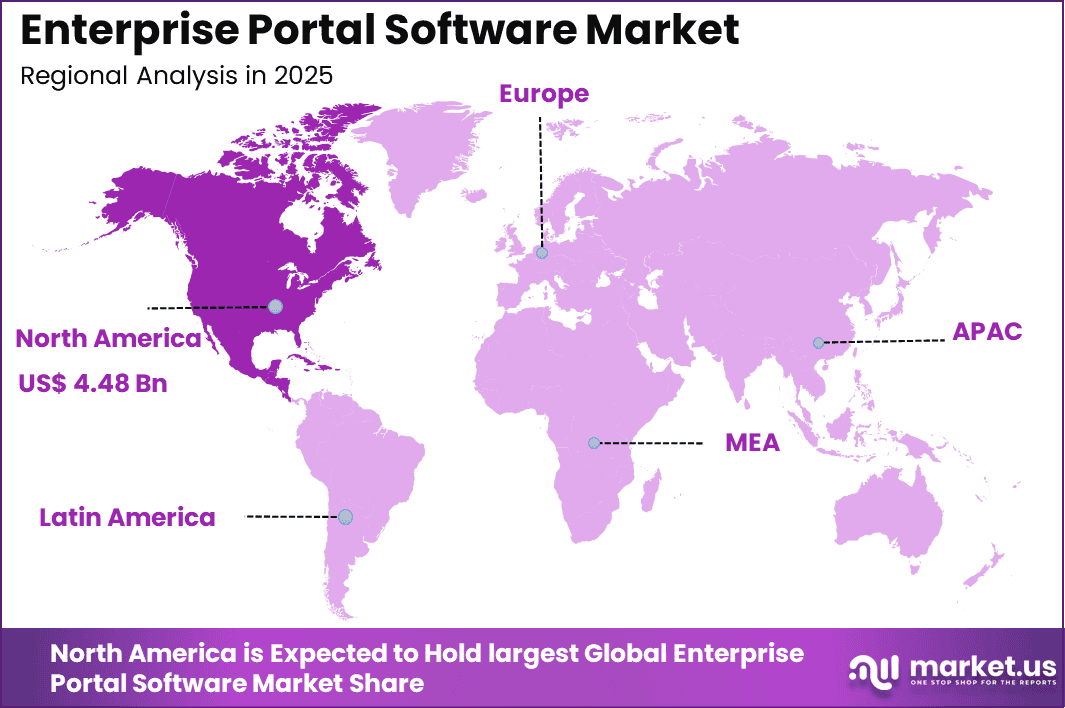
The Global Enterprise Portal Software Market size is expected to be worth around USD 30.09 billion by 2035, from USD 12.03 billion in 2025, growing at a CAGR of 9.6% during the forecast period from 2025 to 2035. North America held a dominant market position, capturing more than a 37.3% share, holding USD 4.48 billion in revenue.
The Enterprise Portal Software market refers to digital platforms that give employees, partners, or business users a single point of access to company applications, documents, workflows, and internal communication tools. In practice, enterprise portals are used to bring together information that would otherwise remain scattered across systems, making daily work more connected and easier to manage.
Top driving factors for this market are closely tied to the growth of digital workplaces and the need for a unified employee experience. As organisations use more cloud applications and distributed work models, the need for a central digital environment has become stronger. Modern platforms like SharePoint now extend beyond document access to enable collaboration, automation, and AI-driven productivity within the broader workplace ecosystem.
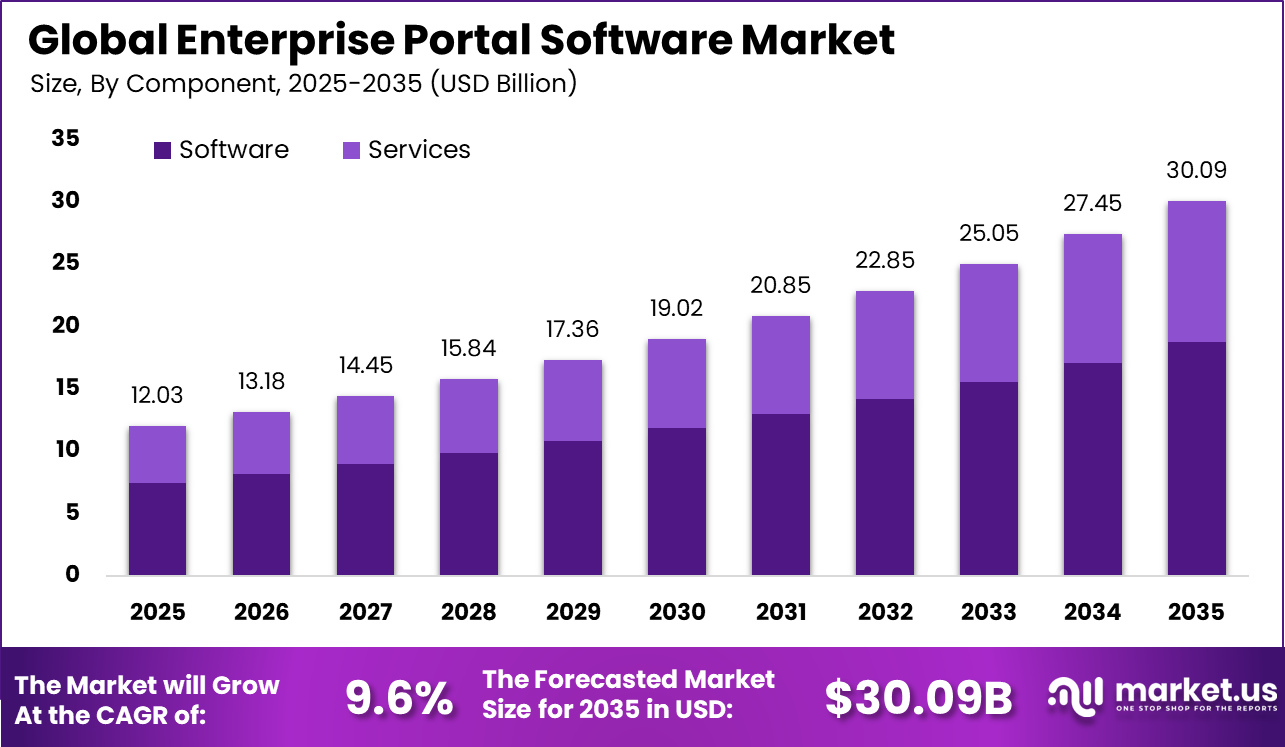
Demand for enterprise portals continues to rise as organizations seek a unified view of information and reduced dependence on disconnected applications. More than 65% of organizations face challenges from using too many apps, which increases inefficiencies. This demand is especially strong in finance and healthcare, where fast, secure, and reliable access to information is essential.
The increasing adoption of technologies such as cloud deployment, workflow automation, AI assistance, mobile access, and identity based access control is reshaping this market. Portal platforms are increasingly expected to do more than host information. They are being designed to surface relevant knowledge, automate repetitive requests, and improve discoverability across enterprise systems.
For instance, in March 2026, Amazon Web Services Inc. expanded its portal offerings with Amazon WorkSpaces Portal, featuring zero-trust security updates. 1,800 U.S. enterprises migrated, enjoying 28% cost savings on virtual desktop access. AWS keeps proving why cloud-native portals dominate enterprise workflows.
Key Takeaway
- The software segment led the global enterprise portal software market in 2025, accounting for 62.3% share, supported by growing demand for integrated digital workplace solutions.
- Large enterprises dominated adoption with a 68.4% share, reflecting higher investments in centralized communication and workflow management platforms.
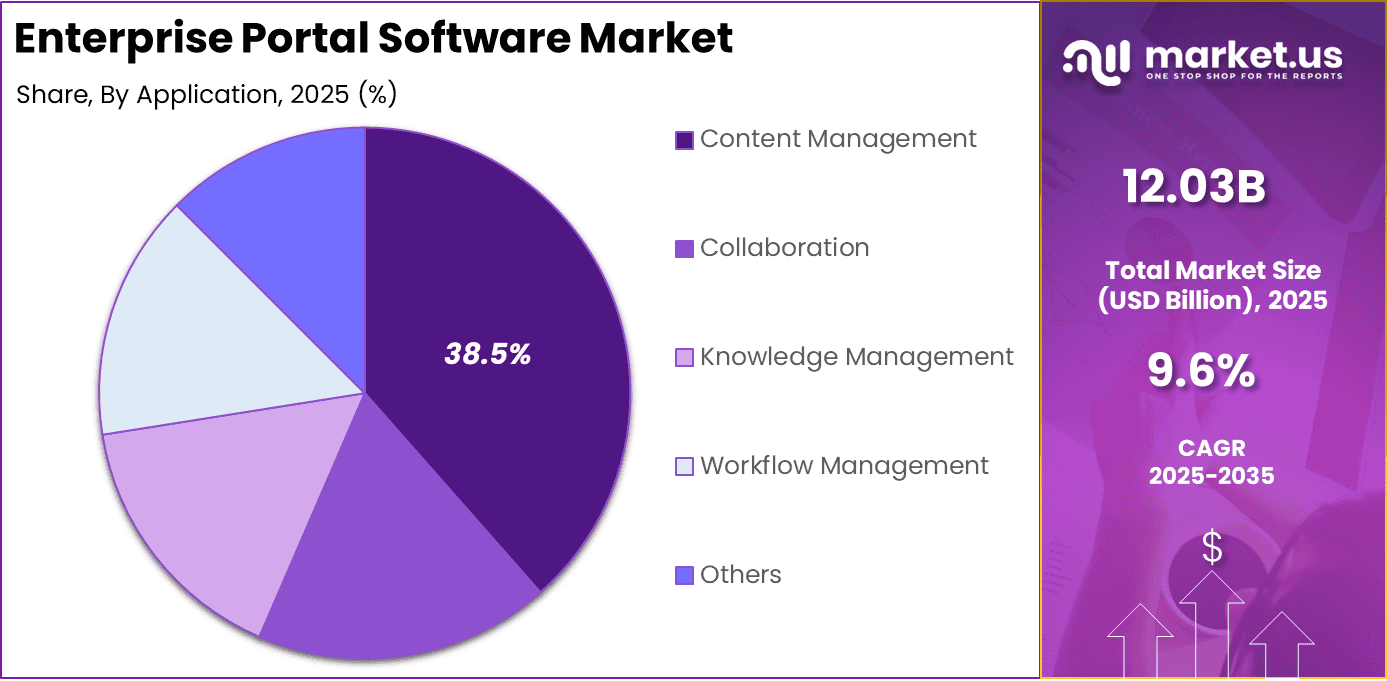
- Content management emerged as the leading application segment, capturing 38.5% share, driven by the need to organize and deliver enterprise information efficiently.
- The BFSI sector held a 27.1% share, supported by increasing use of secure portals for customer engagement and internal operations.
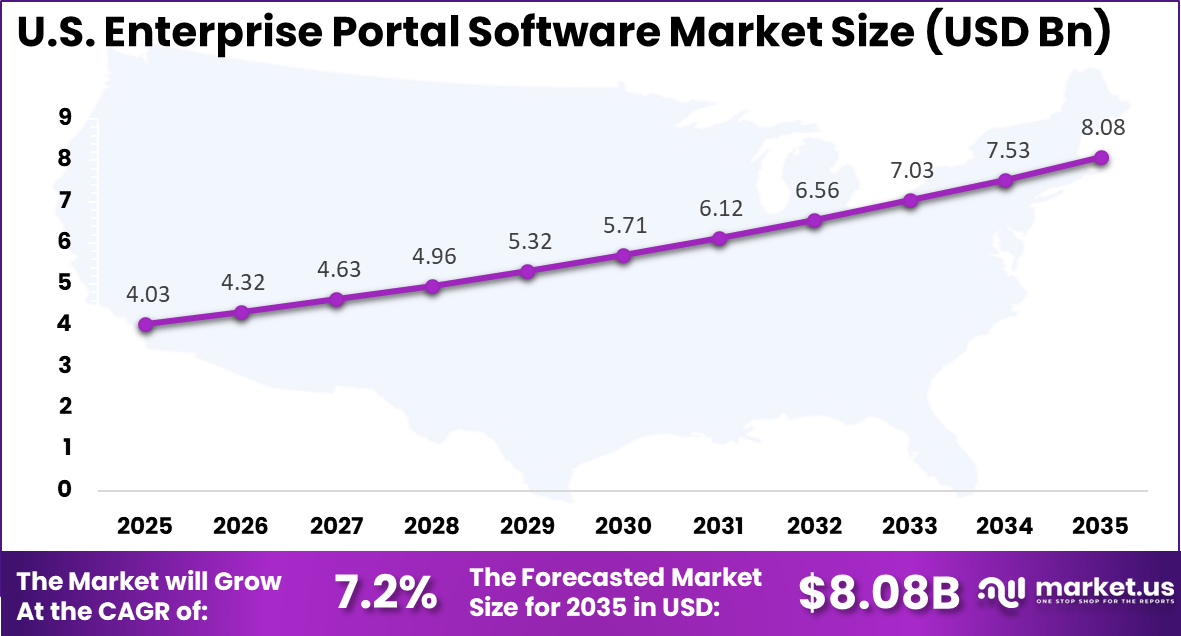
- The U.S. enterprise portal software market reached USD 4.03 billion in 2025, expanding at a CAGR of 7.2%, driven by steady digital transformation initiatives.
- North America maintained its leading position globally, capturing over 37.3% share, supported by advanced IT infrastructure and early technology adoption.
U.S. Market Size
The market for Enterprise Portal Software within the U.S. is growing tremendously and is currently valued at USD 4.03 billion; the market has a projected CAGR of 7.2%. The market is growing due to rising demand for connected digital workplaces, a stronger focus on employee productivity, and the need to unify data across departments.
Businesses are investing in portal platforms to improve internal communication, support remote and hybrid work, and simplify access to applications and documents. Growth is also supported by increasing use of cloud services, automation tools, and secure content management systems across large enterprises and regulated industries.
For instance, in March 2026, Red Hat reinforced U.S. leadership in enterprise portal software by expanding OpenShift Virtualization across major clouds like Azure and IBM Cloud. This move targets VMware migrants, showcasing North America’s innovation edge in hybrid cloud portals that streamline enterprise operations and AI integration.
In 2025, North America held a dominant market position in the Global Enterprise Portal Software Market, capturing more than a 37.3% share, holding USD 4.48 billion in revenue. This dominance is due to the region’s strong digital infrastructure, high enterprise software adoption, and early shift toward cloud-based workplace tools.
Organizations across North America continue to invest in portal platforms to improve employee access, streamline workflows, and support hybrid work models. The presence of large enterprises, strict focus on data management, and growing demand for secure collaboration systems have also strengthened the region’s leadership in this market.
For instance, in February 2026, Verizon strengthened its North American dominance through its enterprise portal enhancements integrated with 5G edge computing. The platform delivers secure, low-latency access for businesses, solidifying U.S. firms’ control in telecom-driven enterprise software ecosystems vital for real-time data portals.
Component Analysis
In 2025, The Software segment held a dominant market position, capturing a 62.3% share of the Global Enterprise Portal Software Market. This dominance is due to the growing need for centralized platforms that connect different enterprise systems and simplify daily operations. Software solutions help organizations manage workflows, content, and communication in one place, which improves efficiency and reduces dependency on multiple disconnected tools across departments and business functions.
Organizations prefer software-driven portals because they offer flexibility, regular updates, and easy integration with existing systems. These solutions support digital transformation by enabling automation and better data visibility. As businesses continue to modernize operations, software remains the core element that drives adoption and long term value in enterprise portal environments.
For Instance, in March 2026, Red Hat moved its Confirmed Stateside Support team to a Salesforce Experience Cloud portal for handling customer support cases, replacing the older Zendesk‑based interface. This shift underlines how enterprises are treating portal software as a core service layer, not just a front‑end wrapper, and highlights the trend toward integrated, cloud‑native portals that can scale with global support needs.
Organization Size Analysis
In 2025, the Large Enterprises segment held a dominant market position, capturing a 68.4% share of the Global Enterprise Portal Software Market. This dominance is due to the complex structure of large enterprises that require strong systems to manage operations across multiple teams and locations. Enterprise portals help these organizations bring together communication, data access, and workflows into a single platform, making it easier to maintain coordination and consistency across the business.
Large enterprises also have the resources to invest in advanced digital tools that improve performance and decision making. They focus on scalable solutions that support global operations and high data volumes. This makes enterprise portals an essential part of their strategy to enhance productivity and maintain operational control across diverse business units.
For instance, in March 2026, Microsoft is enhancing its portal and intranet experiences on Microsoft 365, tailoring them to large‑enterprise customers with complex governance and data‑loss‑prevention requirements. The focus is on simplifying access to HR, IT, and collaboration tools through a single interface, which helps large firms standardise digital experiences across tens of thousands of users.
Application Analysis
In 2025, The Content Management segment held a dominant market position, capturing a 38.5% share of the Global Enterprise Portal Software Market. This dominance is due to the increasing need to manage large volumes of digital content across organizations. Enterprise portals provide a structured way to store, access, and share documents and information, helping employees find relevant data quickly and improving overall workflow efficiency within teams and departments.
Content management remains critical as businesses generate and rely on more data for daily operations. Portals support better collaboration by ensuring that information is updated and accessible in real time. This reduces duplication and confusion, allowing organizations to maintain consistency and improve knowledge sharing across the entire enterprise.
For Instance, in March 2026, Liferay has been updating its portal stack to deepen integration between content management and customer‑experience channels, enabling firms to publish and maintain web content directly from the same environment used for internal collaboration. This convergence helps enterprises reduce content silos and align portal‑based content with marketing, support, and service journeys.
End-User Analysis
In 2025, The BFSI segment held a dominant market position, capturing a 27.1% share of the Global Enterprise Portal Software Market. This dominance is due to the high demand for secure and reliable systems in the financial sector. Enterprise portals help institutions manage sensitive data, support customer interactions, and ensure smooth internal communication, which is essential for maintaining trust and operational accuracy in financial services.
The sector continues to adopt digital platforms to improve service delivery and meet strict regulatory requirements. Enterprise portals enable faster access to information while maintaining strong data protection standards. This supports better decision making and enhances the overall efficiency of banking and financial operations in a highly competitive environment.
For Instance, in March 2026, AWS continues to strengthen backend support for BFSI‑oriented portals, delivering secure identity, data‑protection, and compliance‑ready services that banks and insurers can embed into their customer‑facing and internal portals. This underpins a growing trend of BFSI firms building regulated portals on cloud platforms that can scale and meet stringent regulatory expectations.
Emerging Trend Analysis
A major trend in the enterprise portal software market is the move from static intranet pages to AI-enabled knowledge hubs. Microsoft describes modern SharePoint as a platform for collaboration, communication, automation, and AI experiences, while Microsoft 365 Copilot adds agent-assisted knowledge discovery and content support across workplace tools. This shows that enterprise portals are now being positioned as active work environments rather than simple document repositories.
Another part of this trend is the closer link between portals, enterprise search, and knowledge retrieval. Microsoft’s Azure AI Search and SharePoint indexing guidance show how portal content is increasingly being connected to enterprise search and retrieval systems for faster access to internal knowledge. This is strengthening the role of portals as central points for finding trusted content, navigating workflows, and supporting daily decisions.
Growth Factors
The growth of the enterprise portal software market is being supported by several clear factors. Hybrid work continues to increase the need for centralized digital access, while AI is improving how employees discover knowledge, create content, and complete tasks inside workplace systems. At the same time, organizations want better employee experience and smoother communication across distributed teams, which strengthens demand for modern portal platforms.
Another growth factor is the shift from isolated collaboration tools toward connected digital workplace ecosystems. Microsoft’s product positioning around SharePoint, Copilot, and Viva shows that portal capabilities are increasingly tied to communication, search, automation, and employee engagement in one environment. As enterprises continue to modernize internal operations, portal software is gaining importance as a core layer in the digital workplace stack.
Key Market Segments
By Component
- Software
- On-Premises
- Cloud-Based
- Services
By Organization Size
- Large Enterprises
- Small and Medium Enterprises
By Application
- Content Management
- Collaboration
- Knowledge Management
- Workflow Management
- Others
By End-User
- BFSI
- Healthcare
- IT and Telecom
- Retail
- Manufacturing
- Government
- Others
Key Regions and Countries
North America
- US
- Canada
Europe
- Germany
- France
- The UK
- Spain
- Italy
- Russia
- Netherlands
- Rest of Europe
Asia Pacific
- China
- Japan
- South Korea
- India
- Australia
- Singapore
- Thailand
- Vietnam
- Rest of APAC
Latin America
- Brazil
- Mexico
- Rest of Latin America
Middle East & Africa
- South Africa
- Saudi Arabia
- UAE
- Rest of MEA
Driver Analysis
Need for a Unified Digital Workplace
One of the strongest drivers of this market is the need to unify communication, content, and collaboration in hybrid work environments. Microsoft defines hybrid work as a mix of office and remote work, and its workplace products increasingly position digital platforms as essential for keeping employees connected across locations. Enterprise portals support this need by giving staff one place to access information, updates, policies, and shared resources.
This driver is also linked to employee experience and productivity. Microsoft Viva presents employee experience platforms as tools that improve connection, insight, purpose, and growth, which aligns closely with the role of modern enterprise portals. As organizations try to reduce friction across scattered tools, portal software is being adopted to create a more consistent and easier digital work environment.
Restraint Analysis
Privacy, Governance, and Control Requirements
A key restraint in the enterprise portal software market is the growing need for privacy, governance, and secure content control. Enterprise portals often contain internal communications, employee records, workflow data, and shared documents, which means privacy compliance and access control are critical. Microsoft emphasizes trusted knowledge governance in SharePoint, and broader workspace privacy guidance also shows that modern collaboration environments face increasing compliance pressure.
These requirements can slow deployment and expansion, especially in regulated industries. Organizations must define permissions, retention rules, data handling practices, and governance standards before they can fully scale a portal across teams and geographies. This adds planning and administrative complexity, which can delay adoption even when the business case is clear.
Opportunity Analysis
AI, Automation, and Better Employee Experience
A major opportunity in this market lies in combining portal software with AI, automation, and employee experience tools. Microsoft highlights AI-powered automation, Copilot support, and agent-assisted knowledge features within SharePoint and Microsoft 365, which creates room for portals to become more useful in content creation, task support, and knowledge access. This opens a wider opportunity for portal platforms to move deeper into daily workflow execution.
There is also strong opportunity in portals that improve employee experience, not just content management. Microsoft Viva’s positioning around connection, growth, and insight suggests that organizations increasingly want workplace platforms that support engagement as well as information access. Portals that deliver personalization, easier navigation, and relevant knowledge at the right time are well placed to gain traction.
Challenge Analysis
Integration Complexity Across Enterprise Systems
A major challenge in the enterprise portal software market is integration across many business systems. Large organizations often work with multiple applications, legacy systems, and separate data environments, which makes it difficult to create one portal experience that feels unified and reliable. Sources on enterprise integration challenges consistently point to fragmented systems as a core obstacle, and this directly affects portal performance and usability.
This challenge becomes more serious when organizations want real-time data, workflow automation, and personalized content inside the portal. If systems do not connect well, users may face outdated information, duplicated work, or broken processes. That means the long-term value of portal software depends not only on design, but also on how well it can connect with the wider enterprise application landscape.
Key Players Analysis
In the Enterprise Portal Software market, IBM Corporation, SAP SE, and Oracle Corporation remain major participants due to their strong enterprise software portfolios. These companies provide portal solutions that support content access, workflow management, and business process integration across large organizations. Microsoft Corporation and Amazon Web Services Inc. also hold a strong position by enabling cloud-based portal environments with broad scalability and security support.
Red Hat Inc., VMware Inc., and Broadcom Inc. contribute to the market through infrastructure, virtualization, and enterprise platform capabilities. Their technologies help businesses build flexible portal environments that connect applications, users, and internal data systems more efficiently. HCL Technologies, Ramco Systems Ltd., and Liferay Inc. also strengthen the market by offering customization, integration services, and digital experience platforms for enterprise users.
Verizon Communications Inc., DigitalOcean Inc., and Pivotal Software Inc. add value through cloud connectivity, developer-focused infrastructure, and modern application support. YesAsia Holdings Ltd. and other emerging participants represent a broader competitive layer that supports specialized portal use cases in different industries. Other key players continue to shape the market by improving user experience, deployment flexibility, and enterprise-wide access to digital resources.
Top Key Players in the Market
- Red Hat Inc.
- Verizon Communications Inc.
- IBM Corporation
- SAP SE
- Pivotal Software Inc.
- DigitalOcean Inc.
- Ramco Systems Ltd.
- Oracle Corporation
- VMware Inc.
- Amazon Web Services Inc.
- YesAsia Holdings Ltd.
- Microsoft Corporation
- Liferay Inc.
- Broadcom Inc.
- HCL Technologies
- Others
Recent Developments
- In January 2026, IBM Corporation enhanced its enterprise portal capabilities by launching a new AI-powered integration layer for WebSphere Portal. This update allows seamless data flow across hybrid cloud environments, cutting deployment times by 30% for over 500 North American enterprises.
- In January 2026, Red Hat Inc. introduced OpenShift Portal Builder, an open-source toolkit for containerized enterprise portals. 400+ North American dev teams deployed it within weeks, achieving 50% faster customization than proprietary solutions. Developers are raving about the flexibility without vendor lock-in.
Report Scope
| Report Features | Description |
|---|---|
| Market Value (2025) | USD 12.0 Bn |
| Forecast Revenue (2035) | USD 30.0 Bn |
| CAGR (2026-2035) | 9.6% |
| Base Year for Estimation | 2025 |
| Historic Period | 2020-2024 |
| Forecast Period | 2026-2035 |
| Report Coverage | Revenue forecast, AI impact on Market trends, Share Insights, Company ranking, competitive landscape, Recent Developments, Market Dynamics and Emerging Trends |
| Segments Covered | By Component (Software, Services), By Organization Size (Large Enterprises, Small and Medium Enterprises), By Application (Content Management, Collaboration, Knowledge Management, Workflow Management, Others), By End-User (BFSI, Healthcare, IT and Telecom, Retail, Manufacturing, Government, Others) |
| Regional Analysis | North America – US, Canada; Europe – Germany, France, The UK, Spain, Italy, Russia, Netherlands, Rest of Europe; Asia Pacific – China, Japan, South Korea, India, New Zealand, Singapore, Thailand, Vietnam, Rest of Latin America; Latin America – Brazil, Mexico, Rest of Latin America; Middle East & Africa – South Africa, Saudi Arabia, UAE, Rest of MEA |
| Competitive Landscape | Red Hat Inc., Verizon Communications Inc., IBM Corporation, SAP SE, Pivotal Software Inc., DigitalOcean Inc., Ramco Systems Ltd., Oracle Corporation, VMware Inc., Amazon Web Services Inc., YesAsia Holdings Ltd., Microsoft Corporation, Liferay Inc., Broadcom Inc., HCL Technologies, Others |
| Customization Scope | Customization for segments, region/country-level will be provided. Moreover, additional customization can be done based on the requirements. |
| Purchase Options | We have three license to opt for: Single User License, Multi-User License (Up to 5 Users), Corporate Use License (Unlimited User and Printable PDF) |