Report Overview
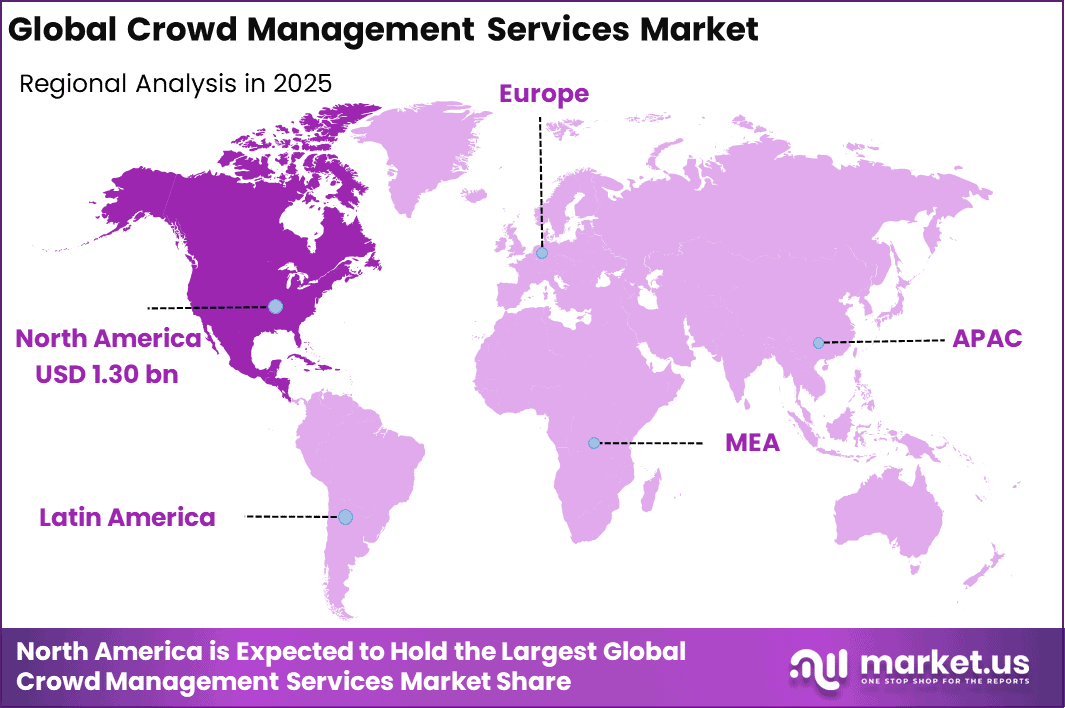
The Global Crowd Management Services Market generated USD 3.2 billion in 2025 and is projected to grow from USD 3.8 billion in 2026 to about USD 16.7 billion by 2035, recording a CAGR of 17.8% over the forecast period. In 2025, North America held a dominant market position, capturing more than 40.2% share and generating USD 1.3 billion in revenue.
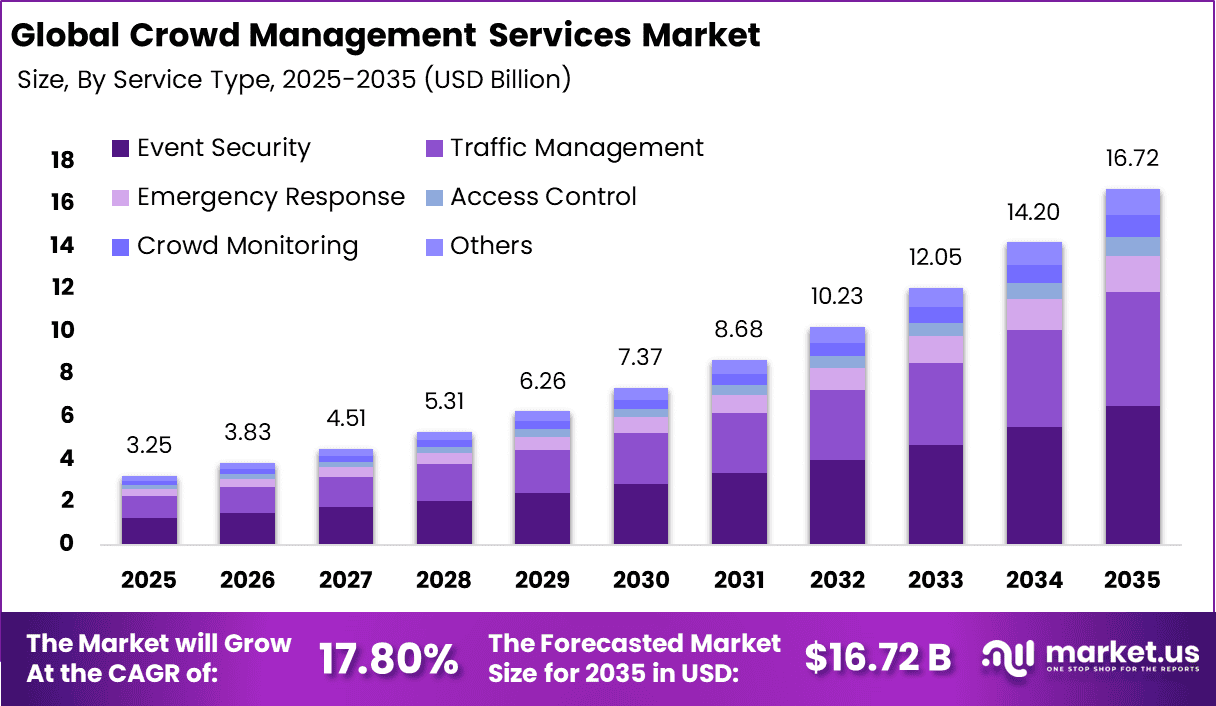
The crowd management services market focuses on planning, coordinating, and controlling the movement of people during events, in public spaces, and within large facilities. These services include risk assessment, entry and exit planning, barrier placement, surveillance coordination, and on-ground personnel deployment.
Effective crowd management reduces the likelihood of congestion, panic, and safety incidents. The market is shaped by event organizers, venue operators, transport authorities, and public agencies seeking structured approaches to manage high footfall environments.
Growth in the crowd management services market is supported by urbanization and expansion of large infrastructure projects such as stadiums, airports, and transit hubs. As cities grow denser, managing pedestrian movement becomes more critical to public safety. Adoption of technology-supported planning and monitoring tools is further strengthening service efficiency.
Top Market Takeaways
- By Service Type, event security dominates with a 38.9% share, delivering access control, threat monitoring, and rapid response teams for high-risk gatherings.
- By Deployment Mode, on-premises captures 64.3%, enabling real-time surveillance integration, dedicated command centers, and customized protocols at fixed venues.
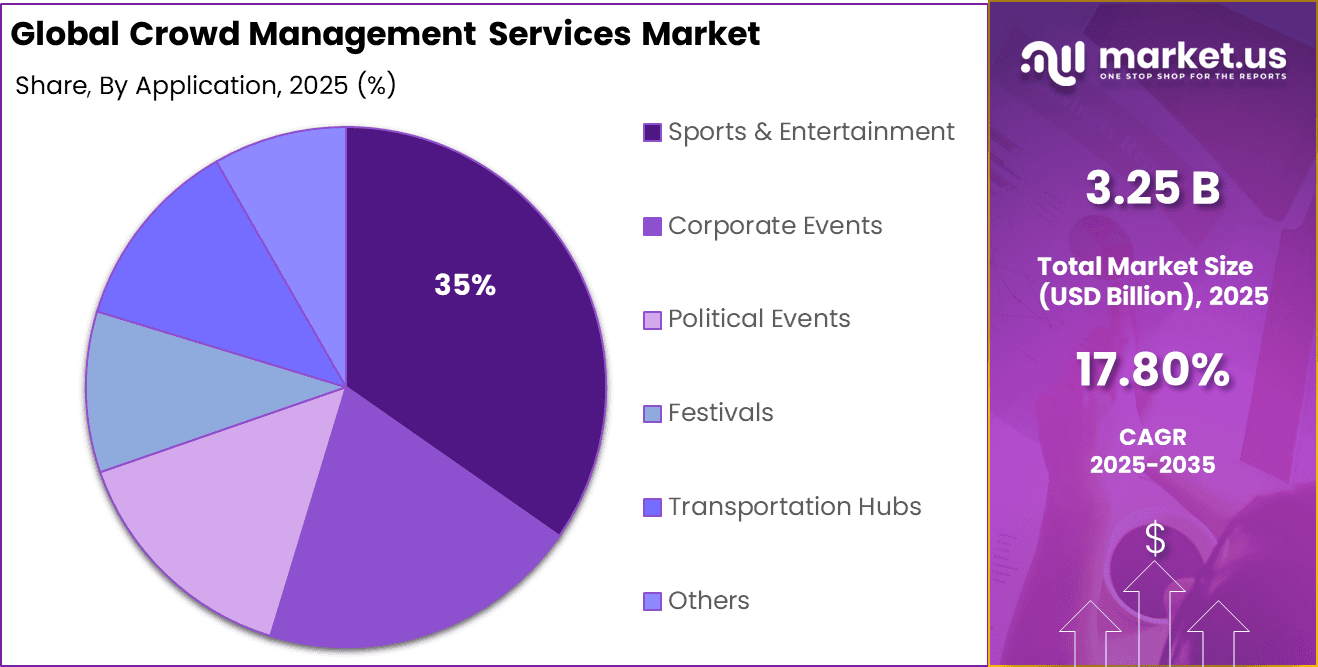
- By Application, sports & entertainment claim 34.7%, managing peak crowd flows, VIP protection, and emergency evacuations during live events.
- By End-User, commercial sectors hold 44.8%, outsourcing comprehensive stewarding for concerts, festivals, and retail activations to mitigate liabilities.
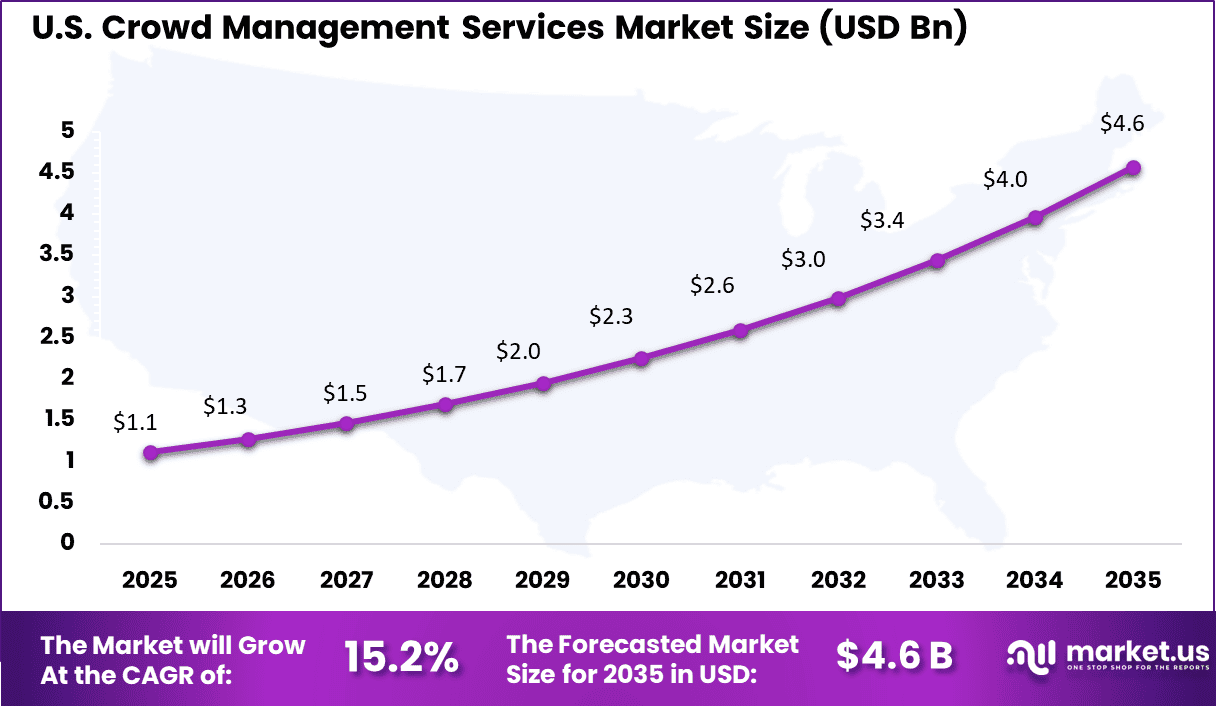
- North America accounts for 40.2% global share, with the U.S. market at USD 1.11 billion and a CAGR of 15.2%, fueled by mega-venue expansions and regulatory compliance.
By Service Type
Event security accounts for 38.9% of adoption in the crowd management services market, as organizers prioritize structured safety protocols during large gatherings. Security personnel manage access control, bag checks, perimeter monitoring, and incident response coordination. These measures help prevent unauthorized entry and reduce the risk of disruptions.
Rising attendance at public events has increased focus on preventive security planning. Professional event security services ensure compliance with safety regulations and insurance requirements. This continues to position event security as the leading service type.
By Deployment Mode
On-premises deployment holds 64.3%, reflecting the need for direct physical presence at venues. Crowd management relies heavily on trained staff stationed at entry points, seating areas, and control rooms. On-site coordination ensures immediate response during emergencies.
Physical deployment also supports real-time communication between stewards, security teams, and event coordinators. Close supervision improves operational efficiency and public safety. This sustains strong preference for on-premises service delivery.
By Application
Sports and entertainment account for 35% of application demand, driven by high spectator turnout and dynamic event environments. Stadiums, concerts, and festivals require structured crowd flow management and risk mitigation strategies. Professional services help maintain orderly movement and prevent overcrowding.
These events often involve high-profile participants and large media coverage. Effective crowd management protects reputation and enhances attendee confidence. This positions sports and entertainment as a key application area.
By End User
Commercial entities represent 44.8% of end user adoption, including venue operators, event promoters, and corporate hosts. These organizations require professional crowd management to meet safety standards and contractual obligations. Outsourced services reduce internal operational burden.
Commercial users also prioritize liability mitigation and brand protection. Structured crowd control enhances event quality and minimizes risk exposure. This continues to drive adoption within commercial segments.
Key Market Segments
By Service Type
- Event Security
- Traffic Management
- Emergency Response
- Access Control
- Crowd Monitoring
- Others
By Deployment Mode
- On-Premises
- Cloud-Based
By Application
- Sports & Entertainment
- Corporate Events
- Political Events
- Festivals
- Transportation Hubs
- Others
By End-User
- Government
- Commercial
- Industrial
- Others
Regional Analysis
North America holds a 40.2% share of the crowd management services market, supported by a high concentration of large public gatherings, sports leagues, music festivals, and corporate events. Service providers in the region are increasingly deploying structured crowd planning, access control systems, and risk assessment frameworks to ensure safety and regulatory compliance. Demand is driven by stricter safety standards, higher insurance requirements, and growing emphasis on proactive risk mitigation across high-capacity venues.
The U.S. market is valued at USD 1.11 Bn and is expanding at a CAGR of 15.2%, reflecting rising investments in professional event safety infrastructure. Adoption is influenced by increasing awareness of crowd-related risks, complex event logistics, and the need for trained personnel supported by digital monitoring tools. Growth is further supported by integration of real-time surveillance systems, predictive analytics, and coordinated emergency response planning across public and private events.
Key Regions and Countries
- North America
- US
- Canada
- Europe
- Germany
- France
- The UK
- Spain
- Italy
- Russia
- Netherlands
- Rest of Europe
- Asia Pacific
- China
- Japan
- South Korea
- India
- Australia
- Singapore
- Thailand
- Vietnam
- Rest of APAC
- Latin America
- Brazil
- Mexico
- Rest of Latin America
- Middle East & Africa
- South Africa
- Saudi Arabia
- UAE
- Rest of MEA
Drivers Impact Analysis
| Key Drivers | Impact on CAGR Forecast (~%) | Geographic Relevance | Impact Timeline | Strategic Importance |
|---|---|---|---|---|
| Rising Frequency of Mass Public Events | +3.6% | North America, Europe | Short to Long Term | Sustains recurring service demand |
| Increasing Safety and Compliance Regulations | +3.1% | North America, Europe | Medium Term | Mandates structured crowd control frameworks |
| Growth in Smart City and Urban Infrastructure Projects | +2.8% | APAC, Middle East | Long Term | Expands monitoring and coordination requirements |
| Expansion of Transportation Hubs and Airports | +2.4% | APAC, North America | Medium to Long Term | Requires continuous passenger flow management |
| Rising Security Concerns and Threat Awareness | +2.0% | Global | Immediate to Medium Term | Drives proactive risk mitigation services |
Restraints Impact Analysis
| Key Restraints | Impact on CAGR Forecast (~%) | Geographic Relevance | Impact Timeline | Market Constraint Level |
|---|---|---|---|---|
| High Operational and Staffing Costs | -2.3% | North America, Europe | Short to Medium Term | Margin pressure for service providers |
| Seasonal and Event-dependent Revenue Cycles | -1.9% | Global | Short Term | Revenue variability challenges |
| Workforce Skill Gaps and Training Requirements | -1.5% | Europe, APAC | Medium Term | Slows service scalability |
| Liability and Insurance Cost Burden | -1.2% | Global | Medium Term | Increases contract expenses |
Investor Type Impact Matrix
| Investor Type | Growth Sensitivity | Risk Exposure | Geographic Focus | Investment Outlook |
|---|---|---|---|---|
| Private Equity | High | Medium | North America, Europe | Attractive due to scalable contract models |
| Strategic Security Firms | Medium to High | Low to Medium | Global | Portfolio diversification into public safety services |
| Institutional Investors | Medium | Medium | Developed Markets | Stable long-term service industry allocation |
| Infrastructure-focused Funds | Medium | Low | Middle East, APAC | Linked to smart city and transport expansion |
| Local Service Providers | Medium | Medium | Regional Markets | Venue-based and municipal contracts |
Technology Enablement Analysis
| Technology Enabler | Impact on CAGR Forecast (~%) | Geographic Relevance | Impact Timeline | Adoption Momentum |
|---|---|---|---|---|
| AI-based Crowd Density Analytics | +3.4% | North America, Europe | Medium to Long Term | Enhances predictive safety planning |
| Real-time Surveillance and Monitoring Systems | +2.9% | Global | Short to Medium Term | Improves incident response speed |
| Mobile Workforce Coordination Platforms | +2.2% | Global | Short Term | Optimizes on-ground staff deployment |
| Integrated Access Control and Ticketing Systems | +1.8% | Europe, APAC | Medium Term | Streamlines entry and exit management |
| Data-driven Event Risk Modeling Tools | +1.5% | North America | Long Term | Supports strategic planning decisions |
Key Challenges
- High responsibility for public safety during large gatherings
- Difficulty in predicting crowd behavior in emergencies
- Rising cost of trained security and event staff
- Strict local regulations and permit requirements
- Risk of reputational damage in case of crowd control failure
Emerging Trends
In the Crowd Management Services market, a clear trend is the adoption of proactive planning that focuses on understanding movement patterns and potential pressure points before events begin. Service providers are placing greater emphasis on mapping entry and exit routes, staging areas, and congregation zones so staff can anticipate pinch points and guide people smoothly through spaces.
This shift helps reduce confusion and supports a safer, more enjoyable experience for attendees. Another pattern emerging is the use of simple communication protocols that ensure all staff receive consistent guidance and can relay clear, calm directions to the crowd when needed, improving overall situational awareness.
Growth Factors
A key growth driver in this market is the rising expectation for safe and comfortable mass gatherings. Attendees increasingly value environments where they can navigate freely without uncertainty or stress about crowding. Effective crowd management supports positive experiences by helping people find their way and feel supported during peak moments of movement.
Another important factor is the increasing scale and diversity of events, where larger audiences and complex layouts elevate the challenge of maintaining controlled movement. As organisers recognise the value of structured crowd support, investment in trained services that prioritise clear guidance and responsiveness is becoming more common. These factors are strengthening the role of crowd management in delivering events that feel orderly, respectful, and attentive to human needs.
Competitive Analysis
The Event Stewarding Services market is led by large security and facility management companies such as G4S, Securitas AB, Allied Universal, Mitie Group, Prosegur, ICTS Europe, Bidvest Noonan, and Wilson James. These companies compete on scale, trained workforce availability, and experience in managing high attendance events such as sports matches, concerts, and public gatherings.
Specialized and regional providers including Showsec, Staffline Group, Odeon Security Services, The SES Group, Constant Security Services, AP Security APS, Sword Security, TSS Total Security Services, Securiguard Services, Reliance Security Services, First Security Guards, Axis Security Services, and others compete through flexible staffing and localized expertise.
Competition in this segment is driven by service quality, crowd management capability, and cost efficiency. These providers are often selected by event organizers seeking reliable on-site supervision and strong coordination with venue authorities.
Top Key Players in the Market
- Showsec
- Securitas AB
- G4S plc
- Allied Universal
- StaffPro Inc.
- Aventguard Security
- Securiguard Services Ltd.
- ACTA Security
- CSC (Contemporary Services Corporation)
- TSE (The Security Experience)
- AP Security (APS) Ltd.
- Wis International
- Staffing 360 Solutions
- SOS Security LLC
- Axis Security Ltd.
- Guardforce Security
- Prosegur
- ICTS Europe
- Odeon Security
- Dynamic Crowd Management (DCM)
- Others
Future Outlook
The future outlook for the Crowd Management Services Market is positive as demand for safe and organised public events continues to increase. More event planners and venue operators are expected to use professional crowd management services because these teams help control large groups, prevent accidents, and improve overall safety.
Adoption of trained staff, technology for monitoring crowd movement, and coordinated planning will enhance effectiveness and responsiveness. Growth can be attributed to rising attendance at concerts, sports events, festivals, and public gatherings, along with a stronger focus on public safety standards. Overall, the market is expected to expand as organisations prioritise safe and efficient crowd control.
Recent Developments
- In February 2026, Showsec deployed advanced drone surveillance networks combined with AI crowd density mapping across major UK music festivals and sporting venues, reducing response times by 35%.
- In January 2026, Showsec established strategic partnerships with Olympic-level event organizers to implement dynamic flow optimization algorithms for multi-venue operations, ensuring zero capacity violations.
- In December 2025, Securitas rolled out enterprise-grade AI analytics platforms enabling real-time steward coordination and behavioral anomaly detection throughout European football stadiums and exhibition centers.
Report Scope
| Report Features | Description |
|---|---|
| Market Value (2025) | USD 3.2 Billion |
| Forecast Revenue (2035) | USD 16.7 Billion |
| CAGR(2025-2035) | 17.8% |
| Base Year for Estimation | 2024 |
| Historic Period | 2020-2024 |
| Forecast Period | 2025-2035 |
| Report Coverage | Revenue forecast, AI impact on Market trends, Share Insights, Company ranking, competitive landscape, Recent Developments, Market Dynamics and Emerging Trends |
| Segments Covered | By Service Type (Event Security, Traffic Management, Emergency Response, Access Control, Crowd Monitoring, Others), By Deployment Mode (On-Premises, Cloud-Based), By Application (Sports & Entertainment, Corporate Events, Political Events, Festivals, Transportation Hubs, Others), By End-User (Government, Commercial, Industrial, Others) |
| Regional Analysis | North America – US, Canada; Europe – Germany, France, The UK, Spain, Italy, Russia, Netherlands, Rest of Europe; Asia Pacific – China, Japan, South Korea, India, New Zealand, Singapore, Thailand, Vietnam, Rest of Latin America; Latin America – Brazil, Mexico, Rest of Latin America; Middle East & Africa – South Africa, Saudi Arabia, UAE, Rest of MEA |
| Competitive Landscape | Showsec, Securitas AB, G4S plc, Allied Universal, StaffPro Inc., Aventguard Security, Securiguard Services Ltd., ACTA Security, CSC (Contemporary Services Corporation), TSE (The Security Experience), AP Security (APS) Ltd., Wis International, Staffing 360 Solutions, SOS Security LLC, Axis Security Ltd., Guardforce Security, Prosegur, ICTS Europe, Odeon Security, Dynamic Crowd Management (DCM), Others |
| Customization Scope | Customization for segments, region/country-level will be provided. Moreover, additional customization can be done based on the requirements. |
| Purchase Options | We have three licenses to opt for: Single User License, Multi-User License (Up to 5 Users), Corporate Use License (Unlimited Users and Printable PDF) |