


Report Overview
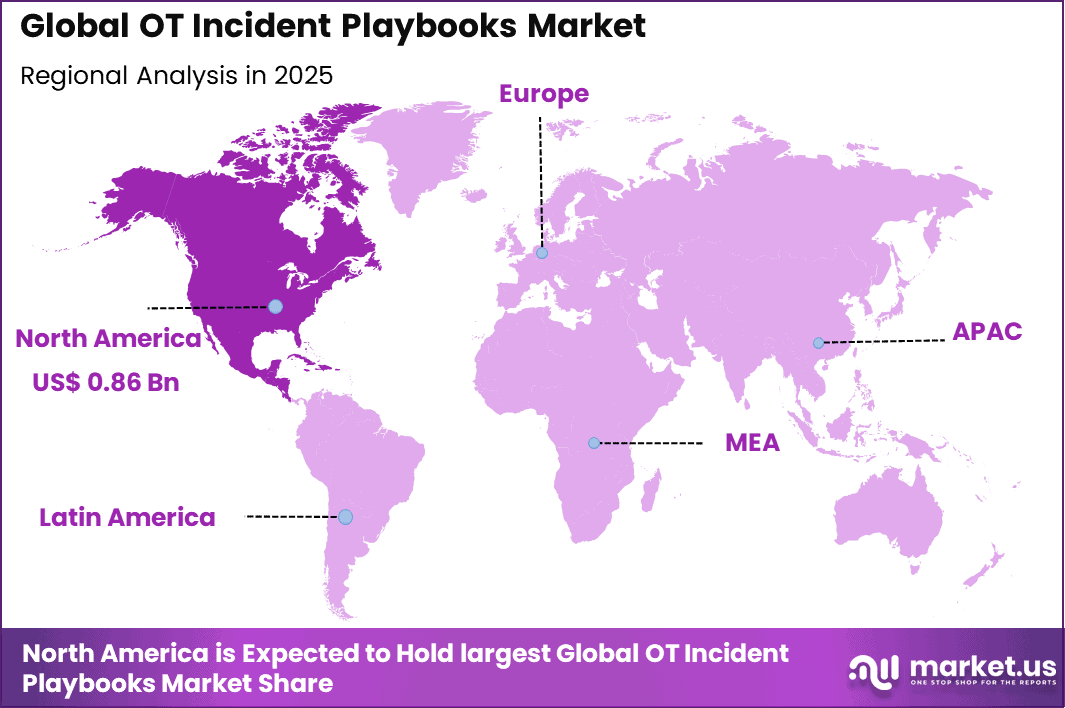
The Global OT Incident Playbooks Market generated USD 2.3 billion in 2025 and is predicted to register growth from USD 2.6 billion in 2026 to about USD 9.1 billion by 2035, recording a CAGR of 15.0% throughout the forecast span. In 2025, North America held a dominant market position, capturing more than a 38.4% share, with USD 0.86 billion in revenue.
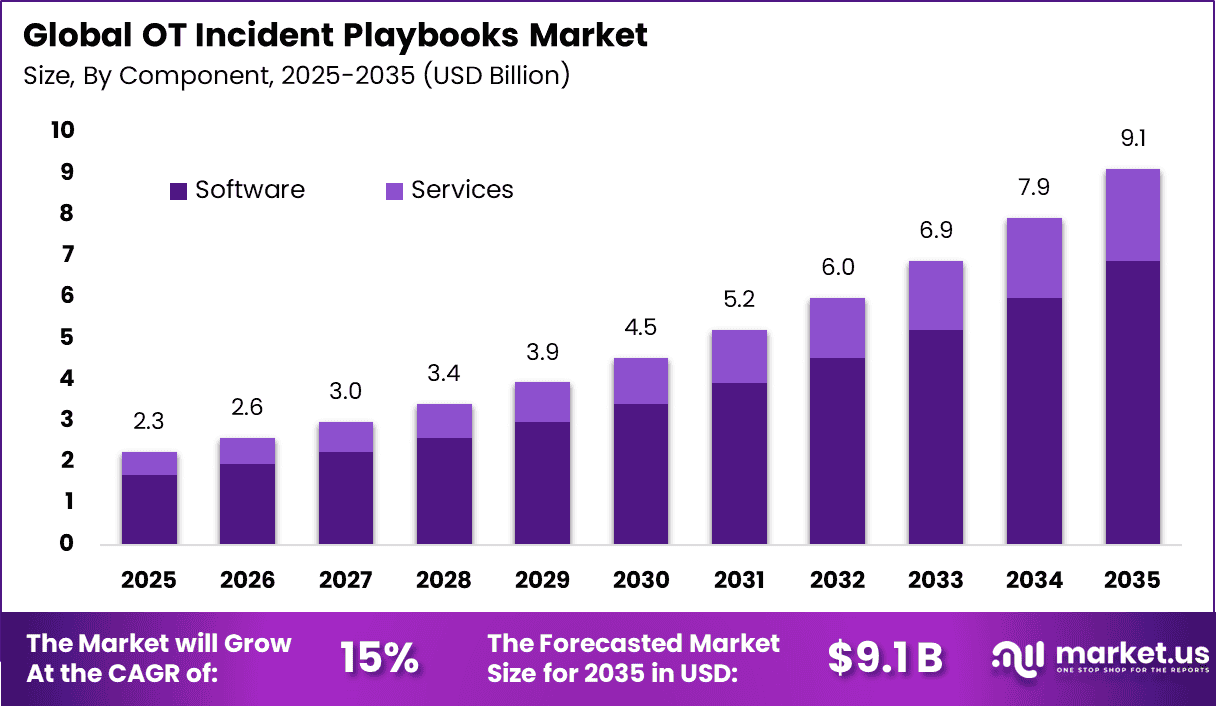
The OT incident playbooks market focuses on structured response frameworks designed for operational technology environments such as manufacturing plants, energy facilities, and industrial control systems. These playbooks define step-by-step actions to be taken when a cyber or operational incident occurs, helping teams respond quickly and consistently.
Unlike IT incidents, disruptions in OT systems can affect physical processes and safety, which makes clear response guidance essential. The market is shaped by industrial organizations seeking controlled and coordinated incident management practices.
A key driving factor is the rising frequency of cyber threats targeting critical infrastructure and industrial networks. Many OT environments were not originally built with strong security controls, which increases vulnerability. When incidents occur, delayed or unstructured responses can lead to extended downtime and safety risks.
Top Market Takeaways
- By component, software accounts for 75.5% of the market, delivering pre-configured workflows, decision trees, and runbooks tailored to OT-specific threats like PLC compromise and HMI ransomware.
- By deployment mode, on-premises represents 70.3%, ensuring air-gapped execution, protocol-specific containment, and compliance with NERC CIP and IEC 62443 standards.
- By organization size, large enterprises hold a 77.9% share, managing mission-critical ICS/SCADA environments with coordinated IT/OT response orchestration.
- By application, energy & utilities capture 39.8%, prioritizing playbooks for grid stability, SCADA restoration, and physical safety during cyber-physical attacks.
- By end-user, industrial sectors command 45.6%, requiring sector-specific playbooks for manufacturing downtime minimization and supply chain continuity.
By Component
Software accounts for 75.5% of adoption in the OT incident playbooks market, as organizations require structured digital frameworks to manage operational technology incidents. These platforms document response procedures, escalation paths, and communication protocols within a centralized system. Standardized playbooks improve consistency in handling cyber and operational disruptions.
Digital playbook software also integrates with monitoring and security systems to trigger automated workflows. This reduces response time and human error during critical events. The need for coordinated and repeatable incident handling continues to position software as the dominant component.
By Deployment Mode
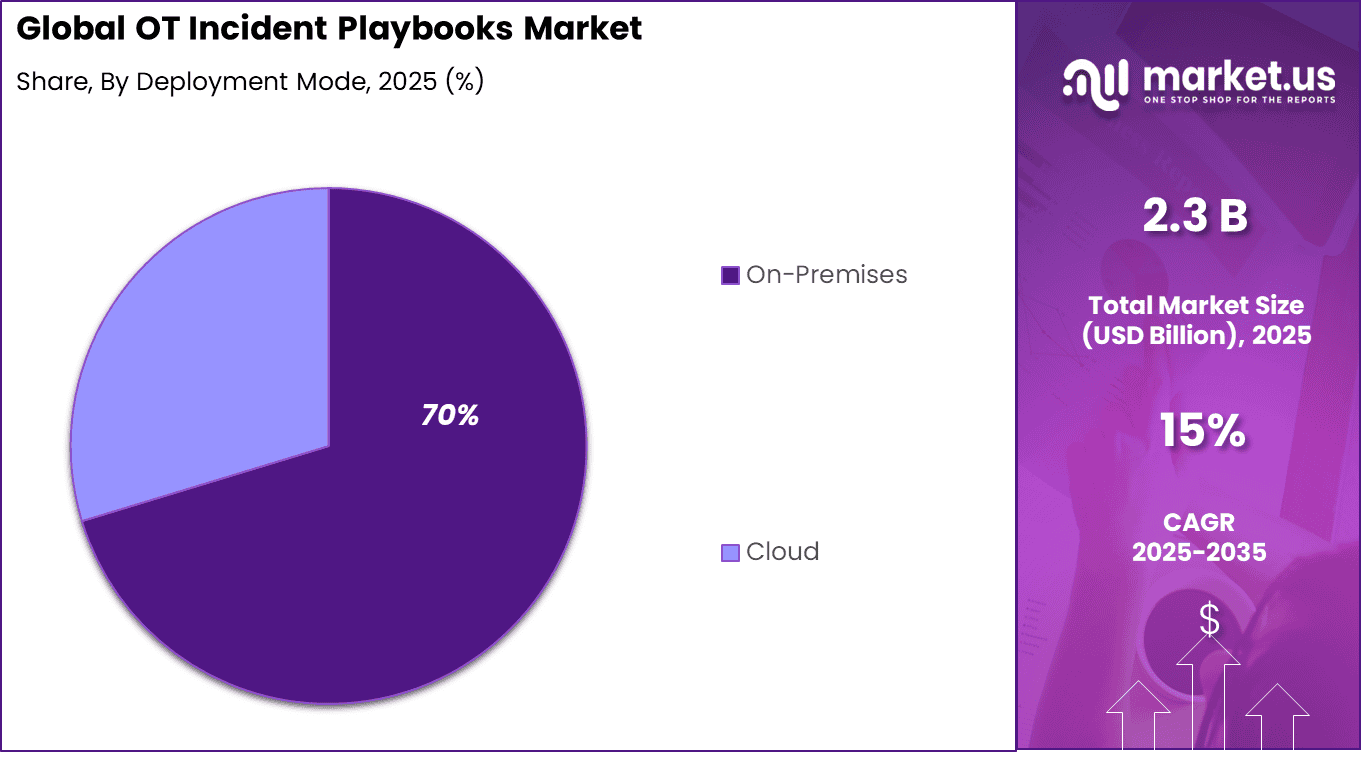
On-premises deployment holds 70%, reflecting the sensitivity of industrial control environments. Many organizations prefer to host incident response systems within their own secure networks. This approach reduces external connectivity risks and supports compliance with sector-specific regulations.
Operational environments such as power plants and manufacturing facilities often require low-latency access to response systems. On-premises deployment ensures availability even during network disruptions. This sustains strong preference for localized implementation.
By Organization Size
Large enterprises represent 77.9% of adoption due to their extensive industrial assets and complex risk exposure. These organizations operate multiple facilities and critical infrastructure systems. Structured incident playbooks help maintain consistent response across locations.
Large firms also face higher regulatory oversight and reputational risk. Comprehensive playbook management supports audit readiness and governance. This drives sustained uptake among enterprise-scale operators.
By Application
Energy and utilities account for 39.8% of application focus, as these sectors manage critical national infrastructure. Operational disruptions can have significant economic and safety impacts. Incident playbooks provide predefined steps to contain and mitigate threats quickly.
Utilities also face increasing cybersecurity risks targeting control systems. Structured response planning strengthens resilience and recovery capability. This continues to anchor energy and utilities as a leading application area.
By End User
Industrial end users hold 45.6% of adoption, driven by the need to protect manufacturing and production systems. Industrial environments rely on continuous operations and minimal downtime. Incident playbook platforms support coordinated action during cyber or operational incidents.
Improved preparedness reduces financial losses and operational disruption. Industrial organizations also benefit from clearer communication channels during emergencies. This sustains steady adoption across industrial sectors.
Key Market Segments
By Component
- Software
- Services
By Deployment Mode
- On-Premises
- Cloud
By Organization Size
- Small and Medium Enterprises (SMEs)
- Large Enterprises
By Application
- Energy & Utilities
- Manufacturing
- Transportation
- Oil & Gas
- Healthcare
- Others
By End-User
- Industrial
- Critical Infrastructure
- Commercial
- Others
Regional Analysis
North America holds a 38.4% share of the OT incident playbooks market, supported by strong industrial cybersecurity frameworks and a high concentration of critical infrastructure assets. Manufacturing plants, energy utilities, and transportation networks in the region are increasingly adopting structured incident response playbooks to manage operational technology threats.
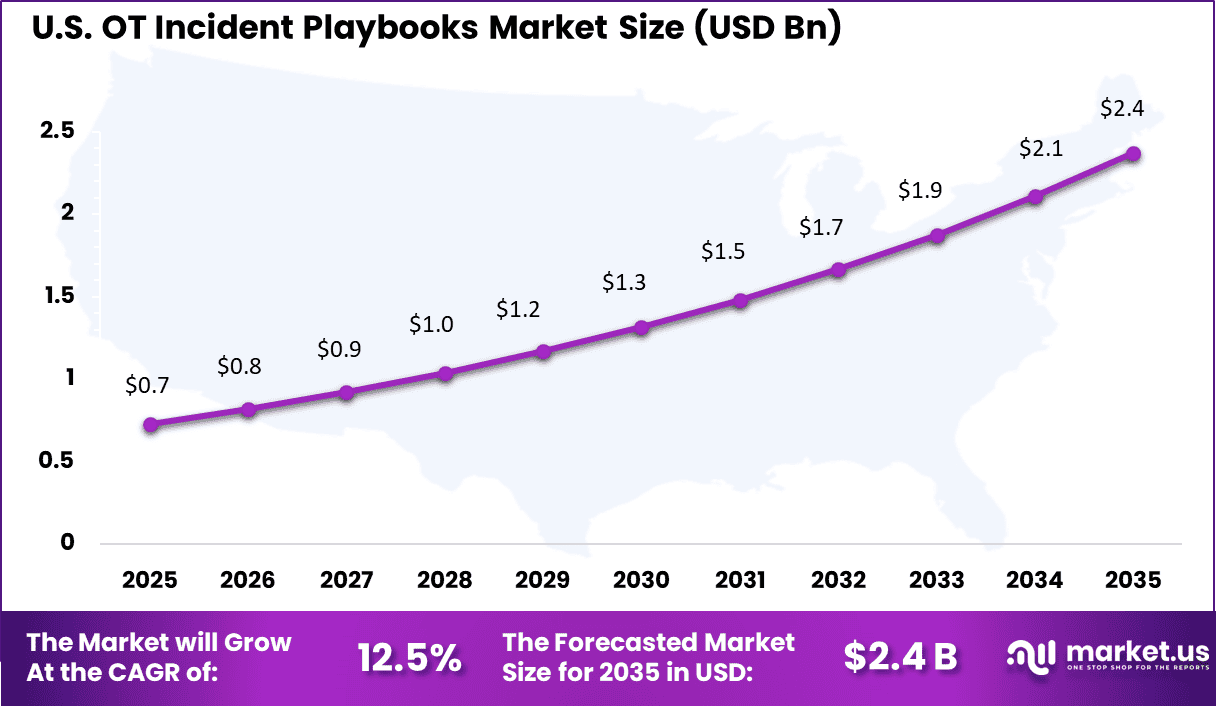
The United States market is valued at USD 0.73 Bn and is expanding at a CAGR of 12.5%, reflecting growing investment in industrial cybersecurity resilience. Adoption is influenced by regulatory oversight, integration of IT and OT systems, and increasing frequency of ransomware and infrastructure-targeted attacks. Growth is further supported by the use of automated response workflows, real-time threat intelligence integration, and cross-functional coordination between security and operational teams.
Key Regions and Countries
- North America
- US
- Canada
- Europe
- Germany
- France
- The UK
- Spain
- Italy
- Russia
- Netherlands
- Rest of Europe
- Asia Pacific
- China
- Japan
- South Korea
- India
- Australia
- Singapore
- Thailand
- Vietnam
- Rest of APAC
- Latin America
- Brazil
- Mexico
- Rest of Latin America
- Middle East & Africa
- South Africa
- Saudi Arabia
- UAE
- Rest of MEA
Drivers Impact Analysis
| Key Drivers | Impact on CAGR Forecast (~%) | Geographic Relevance | Impact Timeline | Strategic Significance |
|---|---|---|---|---|
| Rising OT Cybersecurity Threat Landscape | +3.5% | North America, Europe | Short to Long Term | High priority for critical infrastructure protection |
| Regulatory Compliance Mandates (Energy, Utilities, Manufacturing) | +2.8% | North America, Europe, APAC | Medium to Long Term | Strong enforcement driving structured response frameworks |
| Expansion of Industrial Automation & IIoT | +2.4% | APAC, North America | Long Term | Increased digital assets requiring formalized playbooks |
| Integration with SIEM and SOAR Platforms | +1.9% | Global | Medium Term | Enhances operational efficiency and automated response |
| Growing Investment in Critical Infrastructure Protection | +1.6% | North America, Middle East | Long Term | Government-backed modernization initiatives |
Restraints Impact Analysis
| Key Restraints | Impact on CAGR Forecast (~%) | Geographic Relevance | Impact Timeline | Market Limitation Severity |
|---|---|---|---|---|
| High Deployment and Integration Costs | -2.1% | Emerging Markets | Short to Medium Term | Budget constraints for SMEs |
| Shortage of Skilled OT Security Professionals | -1.8% | Global | Medium Term | Slows effective implementation |
| Legacy Infrastructure Compatibility Issues | -1.5% | Europe, APAC | Medium to Long Term | Integration complexity |
| Limited Awareness in Developing Economies | -1.2% | Latin America, Africa | Short Term | Slower adoption rate |
Investor Type Impact Analysis
| Investor Type | Growth Sensitivity | Risk Exposure | Geographic Focus | Investment Outlook |
|---|---|---|---|---|
| Venture Capital | High | High | North America, Israel | Attractive due to innovation in AI-driven playbooks |
| Private Equity | Medium to High | Medium | North America, Europe | Stable recurring revenue models |
| Strategic Corporate Investors | Medium | Low to Medium | Global | Focused on portfolio cybersecurity expansion |
| Government & Sovereign Funds | Medium | Low | North America, Middle East | Infrastructure resilience priority |
| Institutional Investors | Medium | Medium | Developed Markets | Long-term infrastructure security allocation |
Technology Enablement Analysis
| Technology Enabler | Impact on CAGR Forecast (~%) | Geographic Relevance | Impact Timeline | Adoption Intensity |
|---|---|---|---|---|
| AI-driven Threat Detection | +3.2% | North America, Europe | Short to Long Term | Rapid adoption |
| SOAR Integration | +2.5% | Global | Medium Term | High operational efficiency gains |
| Cloud-based Deployment Models | +1.9% | APAC, North America | Medium to Long Term | Scalable deployment support |
| Digital Twin & Simulation Platforms | +1.4% | Europe, North America | Long Term | Advanced incident preparedness |
| Automated Compliance Mapping Tools | +1.1% | Global | Medium Term | Supports audit readiness |
Key Challenges
- Difficulty in standardizing response procedures across different industrial environments
- Integration challenges with legacy operational technology systems
- Limited real-time visibility into industrial assets and network activity
- Shortage of skilled cybersecurity professionals with OT expertise
- Risk of operational downtime during incident response activities
Emerging Trends
In the OT Incident Playbooks market, a noticeable trend is the development of scenario-based response guides that are tuned to specific industrial environments. Organisations are creating playbooks that map out clear steps for responding to equipment malfunctions, network interruptions, and safety alerts in operational settings such as manufacturing floors, utilities, or transport systems.
These playbooks focus on practical actions that front-line engineers and supervisors can follow with confidence, improving clarity when stress levels are high. Another pattern emerging is the inclusion of simple decision checkpoints that help teams assess whether an issue needs escalation, which supports consistent outcomes and reduces uncertainty during incident response.
Growth Factors
A key growth factor in this market is the increasing reliance on connected operational technology systems, where failures can disrupt production, safety, or service continuity. As these systems become more integral to daily operations, organisations seek structured response plans that help staff act quickly and safely when deviations occur.
Well-crafted playbooks reduce confusion and support reliable incident resolution, which builds trust among operators and managers. Another important factor is the emphasis on cross-team readiness, where operations, safety, and IT groups need a shared understanding of response steps.
Standardised playbooks help bridge communication gaps, ensure smoother handovers, and make sure that everyone follows a common set of actions when an incident unfolds. These needs are encouraging the creation and use of clear, human-centred incident playbooks in operational environments.
Competitive Analysis
The OT Incident Playbooks market is led by industrial cybersecurity and automation providers such as IBM, Honeywell, Siemens, Dragos, Nozomi Networks, Claroty, Schneider Electric, Rockwell Automation, and Radiflow. These companies compete on predefined response frameworks tailored for industrial control systems and critical infrastructure environments.
Their solutions focus on structured incident response, threat containment procedures, and alignment with sector-specific security standards. Large industrial operators often select these vendors for their deep understanding of plant operations and safety requirements.
Global cybersecurity firms including Fortinet, Palo Alto Networks, Kaspersky, Tenable, Check Point Software Technologies, FireEye now Trellix, CyberX under Microsoft, Forescout Technologies, Waterfall Security Solutions, Applied Risk, BAE Systems, and others compete through integrated security orchestration and automated response capabilities.
Competition in this segment is driven by real-time threat intelligence, coordinated IT and OT response workflows, and strong compliance reporting. These providers are often chosen by organizations seeking centralized control over complex industrial security incidents with clear escalation procedures.
Top Key Players in the Market
- IBM
- Honeywell
- Siemens
- Dragos
- Nozomi Networks
- Claroty
- Fortinet
- Palo Alto Networks
- Kaspersky
- Tenable
- Check Point Software Technologies
- FireEye (Trellix)
- CyberX (Microsoft)
- Schneider Electric
- Rockwell Automation
- Forescout Technologies
- Radiflow
- Waterfall Security Solutions
- Applied Risk
- BAE Systems
- Others
Future Outlook
The future outlook for the OT Incident Playbooks Market is positive as industrial and infrastructure organizations increase focus on responding to operational technology incidents quickly and effectively. Demand for incident playbook solutions is expected to grow because these tools help standardize response actions, reduce downtime, and improve coordination during security or operational events.
Adoption of digital workflows, automation, and integration with monitoring systems will support faster and more consistent incident handling. Growth can be attributed to rising cyber threats targeting OT environments, stronger safety and compliance requirements, and the need for reliable operational continuity.
Recent Developments
- In September 2025, Mitsubishi Electric agreed to acquire Nozomi Networks, a leader in OT, IoT, and CPS security and incident response, for roughly $883 million–$1 billion, aiming to build one-stop industrial cyber-defense capabilities.
- In December 2025, ServiceNow agreed to acquire Armis for $7.75 billion in its largest-ever deal, aiming to unify cyber exposure and security operations across IT, OT and medical devices; the deal is expected to close in the second half of 2026.
- In June 2026, Accenture announced plans to acquire a majority stake in Dragos along with full ownership of runZero and NetRise in a combined deal worth approximately $4.175 billion, aiming to unify monitoring, exposure assessment, device visibility, and supply-chain analysis under the Dragos brand; the transaction is expected to close in August–September 2026.
Report Scope
| Report Features | Description |
|---|---|
| Market Value (2025) | USD 2.3 Billion |
| Forecast Revenue (2035) | USD 9.1 Billion |
| CAGR(2025-2035) | 15.0% |
| Base Year for Estimation | 2024 |
| Historic Period | 2020-2024 |
| Forecast Period | 2025-2035 |
| Report Coverage | Revenue forecast, AI impact on Market trends, Share Insights, Company ranking, competitive landscape, Recent Developments, Market Dynamics and Emerging Trends |
| Segments Covered | By Component (Software, Services), By Deployment Mode (On-Premises, Cloud), By Organization Size (Small and Medium Enterprises, Large Enterprises), By Application (Energy & Utilities, Manufacturing, Transportation, Oil & Gas, Healthcare, Others), By End-User (Industrial, Critical Infrastructure, Commercial, Others) |
| Regional Analysis | North America – US, Canada; Europe – Germany, France, The UK, Spain, Italy, Russia, Netherlands, Rest of Europe; Asia Pacific – China, Japan, South Korea, India, New Zealand, Singapore, Thailand, Vietnam, Rest of Latin America; Latin America – Brazil, Mexico, Rest of Latin America; Middle East & Africa – South Africa, Saudi Arabia, UAE, Rest of MEA |
| Competitive Landscape | IBM, Honeywell, Siemens, Dragos, Nozomi Networks, Claroty, Fortinet, Palo Alto Networks, Kaspersky, Tenable, Check Point Software Technologies, FireEye (Trellix), CyberX (Microsoft), Schneider Electric, Rockwell Automation, Forescout Technologies, Radiflow, Waterfall Security Solutions, Applied Risk, BAE Systems, Others |
| Customization Scope | Customization for segments, region/country-level will be provided. Moreover, additional customization can be done based on the requirements. |
| Purchase Options | We have three licenses to opt for: Single User License, Multi-User License (Up to 5 Users), Corporate Use License (Unlimited Users and Printable PDF) |





























