Report Overview
The Global OT Deception Networks Market generated USD 2.6 billion in 2025 and is predicted to register growth from USD 3.2 billion in 2026 to about USD 20.8 billion by 2035, recording a CAGR of 23.3% throughout the forecast span. In 2025, North America held a dominant market position, capturing more than a 33.1% share, with USD 0.84 billion in revenue.
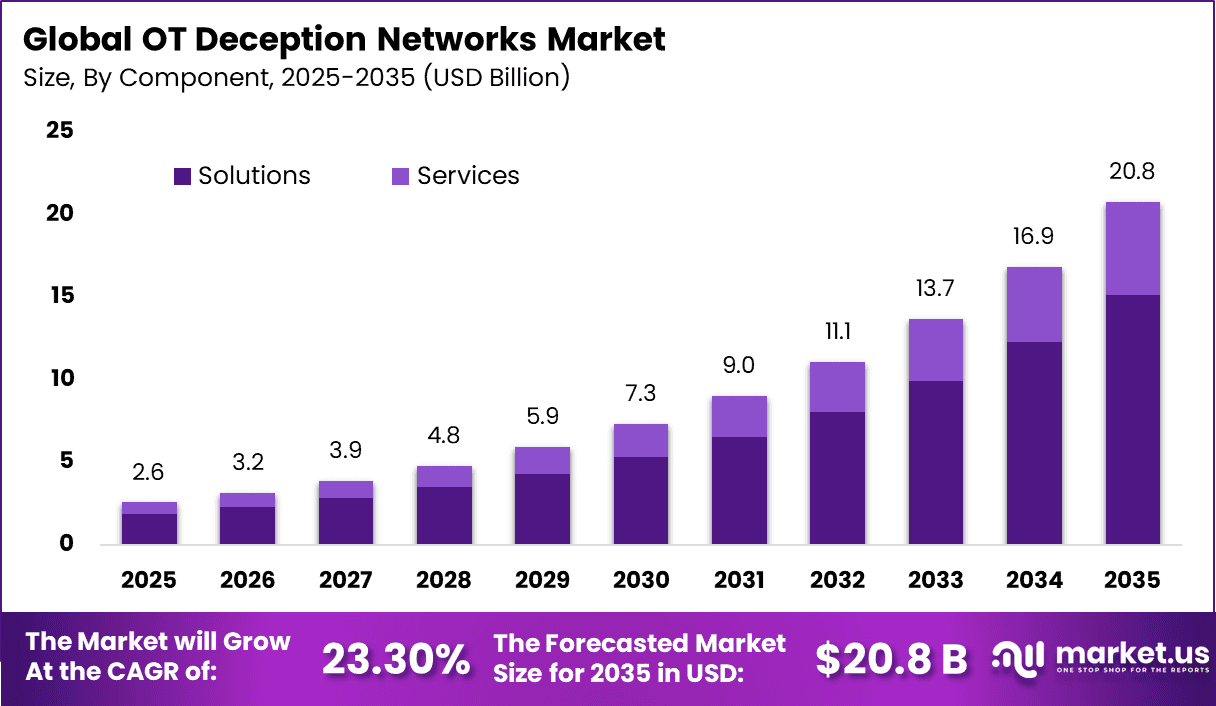
The OT deception networks market focuses on security solutions that create realistic decoy systems within operational technology environments. These decoys imitate industrial devices, control systems, and network assets to attract and detect malicious activity without affecting real operations. The market is shaped by industrial operators seeking advanced protection for critical infrastructure and production facilities.
A key driving factor is the increasing sophistication of cyber threats targeting industrial systems. Traditional perimeter defenses may not detect attackers who bypass initial security layers. Deception networks add an internal detection layer by exposing fake assets that should never be accessed during normal operations. Any interaction with these decoys immediately signals suspicious behavior, allowing security teams to respond quickly and reduce potential damage.
Growth in the OT deception networks market is supported by the expansion of connected industrial environments and remote access capabilities. As operational systems integrate with digital platforms, the attack surface continues to expand. Organizations are therefore adopting layered security strategies that include deception-based detection.
Top Market Takeaways
- By Component, solutions dominate with a 72.8% share, featuring decoy PLCs, fake HMIs, and honeytoken networks that mimic OT protocols like Modbus and EtherNet/IP to detect lateral movement.
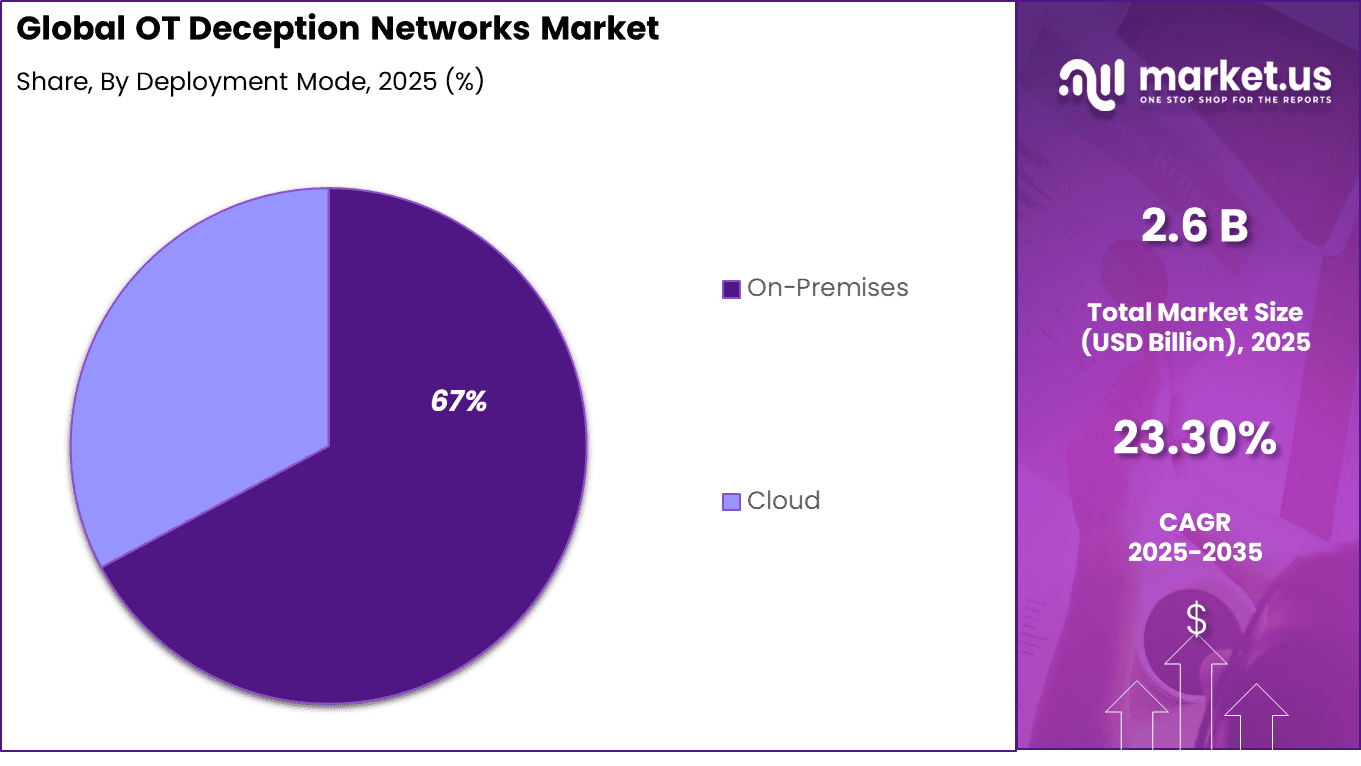
- By Deployment Mode, on-premises deployment claims 67.2%, favored for air-gapped ICS isolation, zero-trust architecture, and real-time threat diversion without cloud latency risks.
- By Organization Size, large enterprises represent 70.5%, implementing enterprise-grade deception grids across distributed SCADA/OT fabrics for unified threat intelligence.
- By End-User, manufacturing leads at 44.6%, using OT decoys to safeguard production lines from ransomware and nation-state intrusions targeting automation assets.
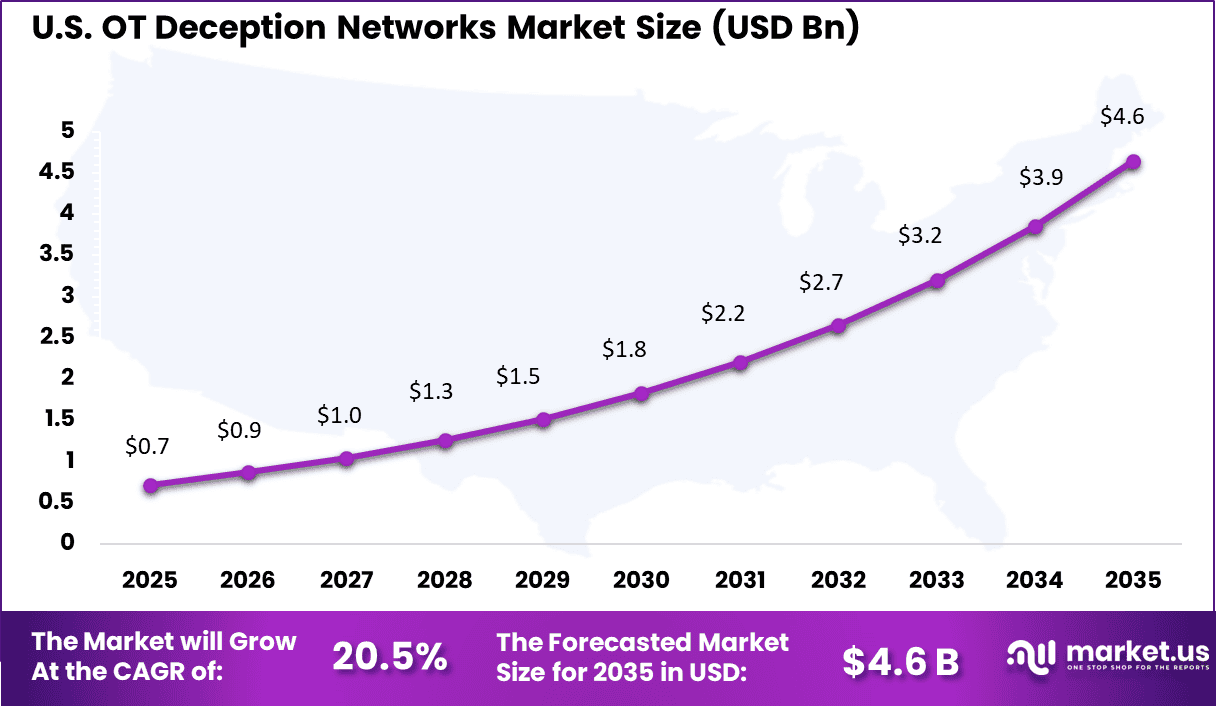
- Regionally, North America holds 33.1% global share, with the U.S. market at USD 0.72 billion and a robust CAGR of 20.5%, propelled by CISA mandates and IIoT expansion.
By Component
Solution-based offerings account for 72.8% of adoption in the OT deception networks market, as organizations deploy specialized platforms to create decoy assets within operational environments. These solutions simulate industrial control systems, programmable logic controllers, and network endpoints to attract malicious activity. By diverting attackers toward controlled environments, organizations gain early threat visibility.
Integrated deception platforms also provide real-time alerting and forensic insights. This improves incident detection speed without disrupting production systems. The growing need for proactive OT security continues to position solutions as the dominant component.
By Deployment Mode
On-premises deployment holds 67%, reflecting the sensitivity of operational technology networks. Industrial facilities prioritize keeping security systems within isolated environments to reduce external exposure. On-premises deployment supports strict access control and low-latency monitoring.
Many OT environments operate under regulatory and safety constraints that limit external connectivity. Localized deployment ensures continuous monitoring even during network disruptions. This sustains strong preference for on-premises deception systems.
By Organization Size
Large enterprises represent 70.5% of adoption due to the scale and complexity of their industrial infrastructure. These organizations manage multiple plants, distributed assets, and interconnected control systems. Deception networks help monitor large attack surfaces more effectively.
Large firms also face higher financial and reputational risk from operational disruption. Advanced deception strategies enhance resilience and detection capabilities. This continues to drive adoption among enterprise-scale operators.
By End User
Manufacturing holds 44.6% of end user adoption, as production facilities are increasingly targeted by cyber threats. Deception networks provide early warning mechanisms without interfering with industrial processes. This helps maintain operational continuity.
Manufacturers also operate legacy equipment that may lack built-in security controls. Deception layers compensate by identifying unauthorized access attempts. This continues to support strong demand within manufacturing environments.
Key Market Segments
By Component
- Solutions
- Services
By Deployment Mode
- On-Premises
- Cloud
By Organization Size
- Large Enterprises
- Small and Medium Enterprises
By End-User
- Manufacturing
- Energy & Utilities
- Oil & Gas
- Transportation
- Healthcare
- Others
Regional Analysis
North America accounts for 33.1% of the OT deception networks market, supported by a strong focus on protecting critical infrastructure and industrial control systems. Organizations across energy, manufacturing, and utilities sectors are deploying deception technologies to create decoy assets that detect lateral movement and unauthorized access within operational technology environments.
Demand is driven by increasing sophistication of cyber attacks targeting industrial networks and the need to enhance early threat detection without disrupting production systems.
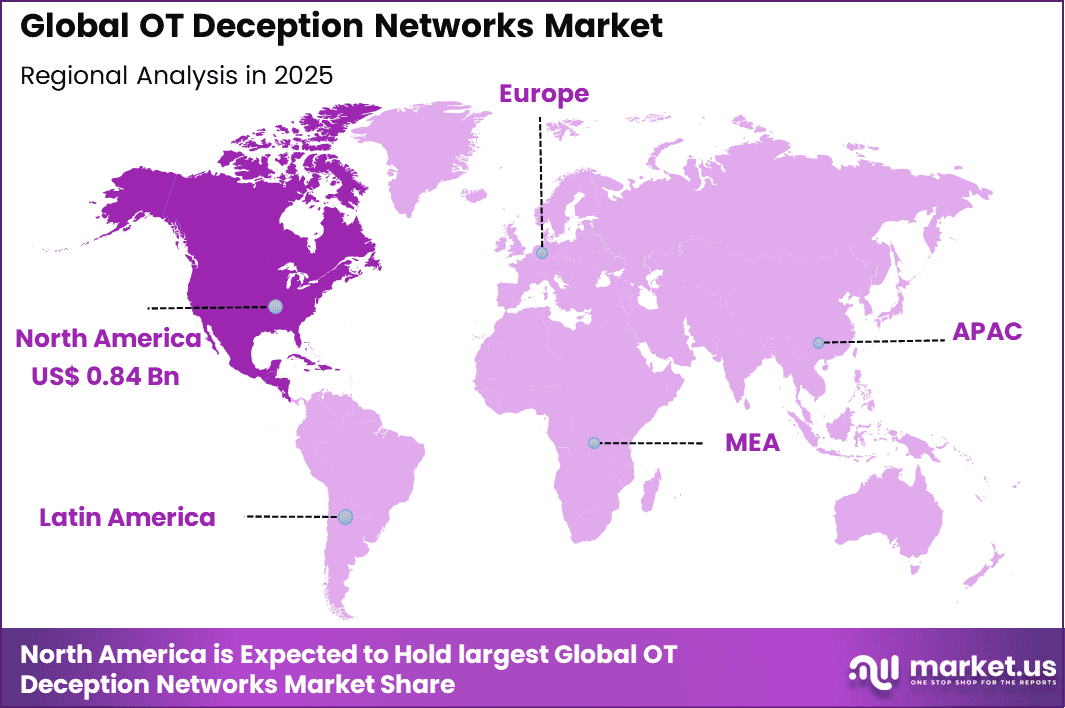
The United States market is valued at USD 0.72 Bn and is expanding at a CAGR of 20.5%, reflecting accelerated investment in proactive OT security strategies. Adoption is influenced by rising ransomware incidents, convergence of IT and OT systems, and regulatory emphasis on infrastructure protection. Growth is further supported by integration of deception platforms with security operations centers, enabling faster threat identification, improved incident response, and stronger resilience across industrial environments.
Key Regions and Countries
- North America
- US
- Canada
- Europe
- Germany
- France
- The UK
- Spain
- Italy
- Russia
- Netherlands
- Rest of Europe
- Asia Pacific
- China
- Japan
- South Korea
- India
- Australia
- Singapore
- Thailand
- Vietnam
- Rest of APAC
- Latin America
- Brazil
- Mexico
- Rest of Latin America
- Middle East & Africa
- South Africa
- Saudi Arabia
- UAE
- Rest of MEA
Drivers Impact Analysis
| Key Drivers | Impact on CAGR Forecast (~%) | Geographic Relevance | Impact Timeline | Strategic Influence |
|---|---|---|---|---|
| Rising Targeted Attacks on OT Infrastructure | +4.8% | North America, Europe | Immediate to Long Term | Primary catalyst for deception deployment |
| Convergence of IT and OT Security Frameworks | +3.9% | Global | Medium to Long Term | Expands enterprise-wide adoption |
| Increasing Adoption of Zero Trust Architectures | +3.2% | North America, APAC | Medium Term | Strengthens proactive threat detection |
| Growth in Critical Infrastructure Digitalization | +2.7% | APAC, Middle East | Long Term | Expands attack surface, increasing need |
| Regulatory Compliance and Reporting Mandates | +2.1% | North America, Europe | Medium Term | Drives formal security validation practices |
Restraints Impact Analysis
| Key Restraints | Impact on CAGR Forecast (~%) | Geographic Relevance | Impact Timeline | Operational Limitation |
|---|---|---|---|---|
| High Initial Implementation Costs | -2.6% | Emerging Markets | Short to Medium Term | Budget constraints for mid-sized operators |
| Complexity in OT Environment Integration | -2.3% | Global | Medium Term | Technical deployment challenges |
| Limited Skilled OT Cybersecurity Workforce | -1.9% | Global | Medium Term | Slower optimization of deception frameworks |
| Resistance to Architectural Change in Legacy Systems | -1.5% | Europe, APAC | Medium to Long Term | Delays modernization cycles |
Investor Type Impact Matrix
| Investor Type | Growth Sensitivity | Risk Exposure | Geographic Focus | Investment Outlook |
|---|---|---|---|---|
| Venture Capital | Very High | High | North America, Israel | Strong interest in AI-powered deception startups |
| Private Equity | High | Medium | North America, Europe | Attractive recurring revenue cybersecurity models |
| Strategic Cybersecurity Vendors | Medium to High | Low to Medium | Global | Portfolio expansion through acquisition |
| Government & Sovereign Funds | Medium | Low | North America, Middle East | Infrastructure security priority |
| Institutional Investors | Medium | Medium | Developed Economies | Long-term digital infrastructure allocation |
Technology Enablement Analysis
| Technology Enabler | Impact on CAGR Forecast (~%) | Geographic Relevance | Impact Timeline | Adoption Momentum |
|---|---|---|---|---|
| AI-driven Behavioral Analytics | +4.1% | North America, Europe | Immediate to Long Term | Accelerates autonomous threat detection |
| Cloud-native Deception Platforms | +3.0% | APAC, North America | Medium Term | Scalable and flexible deployment |
| Integration with SIEM and SOAR Systems | +2.8% | Global | Medium Term | Enhances automated response workflows |
| Digital Twin Simulation for OT Assets | +1.9% | Europe, North America | Long Term | Improves predictive attack modeling |
| Edge-based Deception Deployment | +1.6% | APAC | Long Term | Supports distributed industrial networks |
Key Challenges
- Complexity in deploying deception systems within sensitive industrial environments
- Risk of disruption to critical operations if configurations are not properly managed
- Integration challenges with existing OT security and monitoring tools
- Limited awareness among industrial operators about deception-based security strategies
- High requirement for skilled personnel to design and maintain realistic decoy environments
Emerging Trends
In the OT Deception Networks market, a growing trend is the adoption of layered deceptive elements that mirror real operational technology environments. Organisations are placing decoy assets, false signals, and simulated control points within their network environments so that unauthorised activity triggers early feedback rather than reaching real equipment.
This approach helps defenders observe threat behaviour in a safe context and learn how actors move through systems without exposing critical infrastructure. Another pattern emerging is the creation of simple notification frameworks that alert both security teams and operational staff in clear terms when deception triggers are hit, helping teams respond with confidence and clarity.
Growth Factors
A key growth driver in this market is the increasing complexity and connectivity of operational systems, where traditional perimeter-based protections may not detect subtle intrusions in time. As OT environments become more integrated with enterprise networks, organisations seek ways to surface threats before they impact safety or continuity.
Deception networks provide a means to detect suspicious activity early by encouraging incorrect actions that stand out from normal operations. Another important factor is the emphasis on reducing response uncertainty and stress for front-line engineers and security personnel.
By observing deceptive triggers and clear alert signals, teams can identify genuine threats more quickly and act with assurance, which supports safer and more predictable operations. These needs are strengthening interest in deception approaches that enhance visibility and defence without adding complexity to daily workflows.
Competitive Analysis
The OT Deception Networks market is driven by specialized deception technology providers such as Attivo Networks, TrapX Security, Illusive Networks, Cymmetria, Smokescreen Technologies, Acalvio Technologies, Guardicore now part of Akamai, Fidelis Cybersecurity, CounterCraft, CyberTrap, Minerva Labs, TopSpin Security, SpecterOps, ShadowPlex, DecoyNet, Thinkst Canary, Lupovis, and Deceptive Bytes.
These companies compete on advanced decoy deployment, lateral movement detection, and early threat identification within industrial and hybrid environments. Their strength lies in creating realistic deception layers that mislead attackers and provide high-confidence alerts with low false positives.
Broader cybersecurity vendors such as Rapid7 and Allure Security also participate by integrating deception techniques into wider security platforms. Competition in this segment is driven by ease of deployment, integration with existing security operations tools, and the ability to protect both IT and OT assets. Vendors are often selected based on detection accuracy, minimal impact on industrial systems, and support for critical infrastructure security requirements.
Top Key Players in the Market
- Attivo Networks
- TrapX Security
- Illusive Networks
- Cymmetria
- Smokescreen Technologies
- Acalvio Technologies
- Guardicore (now part of Akamai)
- Fidelis Cybersecurity
- Rapid7
- Allure Security
- CounterCraft
- CyberTrap
- Minerva Labs
- TopSpin Security
- SpecterOps
- ShadowPlex
- DecoyNet
- Thinkst Canary
- Lupovis
- Deceptive Bytes
- Others
Future Outlook
The future outlook for the OT Deception Networks Market is positive as industrial and infrastructure organizations increase efforts to strengthen cybersecurity defenses. Demand for deception network solutions is expected to grow because these tools help detect threats early by misleading attackers and revealing malicious activity before real assets are affected.
Adoption of automated threat response, real-time monitoring, and integration with security operations will improve protection and reduce risk. Growth can be attributed to rising cyber attacks on operational technology environments, stronger compliance requirements, and the need to safeguard critical systems. Overall, the market is expected to expand as businesses prioritize proactive and adaptive security strategies.
Recent Developments
- In October 2025, Acalvio Technologies announced its deception platform operating in AWS GovCloud with FedRAMP Ready status, enabling federal agencies to deploy AI-driven decoys and honeytokens across regulated cloud and cyber‑physical systems.
- In February 2026, Acalvio Technologies was named a “Leader and Outperformer” in the 2026 GigaOm Radar for Deception Technology, highlighting rapid advances in autonomous orchestration, predictive attack path analysis and early generative‑AI deception features.
- In February 2026, Acalvio Technologies was also recognized as the “Company to Beat” in Gartner’s 2025 AI vendor race for AI‑powered advanced cyber deception, citing coverage across legacy OT, modern cloud and cyber‑physical systems
Report Scope
| Report Features | Description |
|---|---|
| Market Value (2025) | USD 2.6 Billion |
| Forecast Revenue (2035) | USD 20.8 Billion |
| CAGR(2025-2035) | 23.3% |
| Base Year for Estimation | 2024 |
| Historic Period | 2020-2024 |
| Forecast Period | 2025-2035 |
| Report Coverage | Revenue forecast, AI impact on Market trends, Share Insights, Company ranking, competitive landscape, Recent Developments, Market Dynamics and Emerging Trends |
| Segments Covered | By Component (Solutions, Services), By Deployment Mode (On-Premises, Cloud), By Organization Size (Large Enterprises, Small and Medium Enterprises), By End-User (Manufacturing, Energy & Utilities, Oil & Gas, Transportation, Healthcare, Others) |
| Regional Analysis | North America – US, Canada; Europe – Germany, France, The UK, Spain, Italy, Russia, Netherlands, Rest of Europe; Asia Pacific – China, Japan, South Korea, India, New Zealand, Singapore, Thailand, Vietnam, Rest of Latin America; Latin America – Brazil, Mexico, Rest of Latin America; Middle East & Africa – South Africa, Saudi Arabia, UAE, Rest of MEA |
| Competitive Landscape | Attivo Networks, TrapX Security, Illusive Networks, Cymmetria, Smokescreen Technologies, Acalvio Technologies, Guardicore (now part of Akamai), Fidelis Cybersecurity, Rapid7, Allure Security, CounterCraft, CyberTrap, Minerva Labs, TopSpin Security, SpecterOps, ShadowPlex, DecoyNet, Thinkst Canary, Lupovis, Deceptive Bytes, Others |
| Customization Scope | Customization for segments, region/country-level will be provided. Moreover, additional customization can be done based on the requirements. |
| Purchase Options | We have three licenses to opt for: Single User License, Multi-User License (Up to 5 Users), Corporate Use License (Unlimited Users and Printable PDF) |