Report Overview
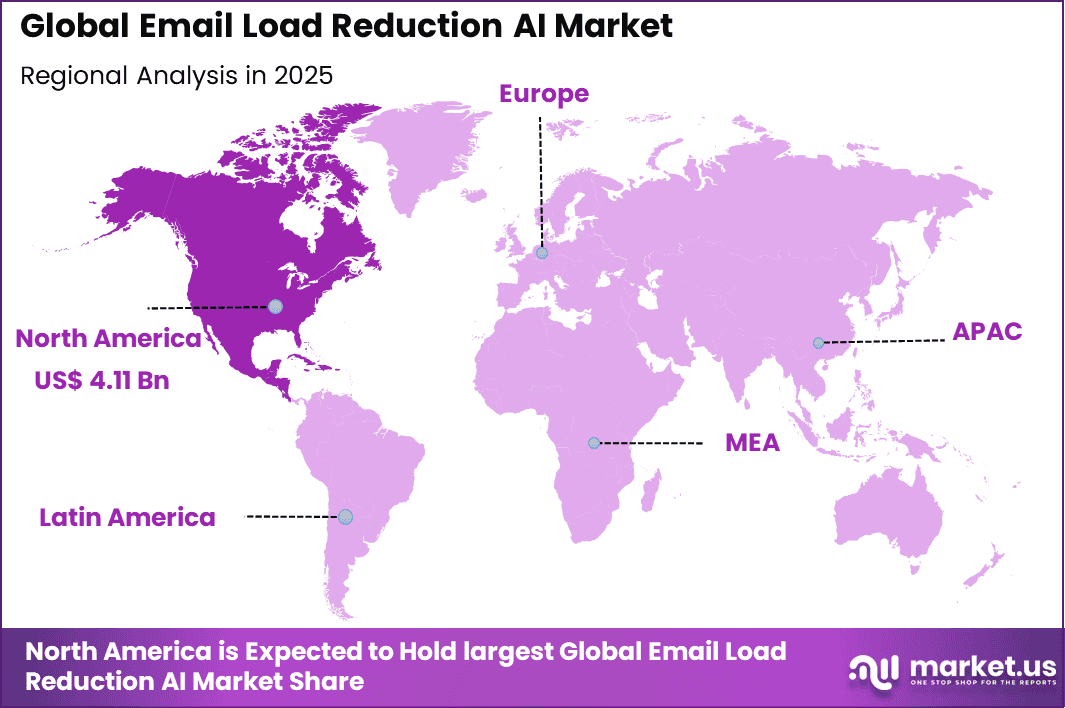
The Global Email Load Reduction AI Market generated USD 12.6 billion in 2025 and is predicted to register growth from USD 14.8 billion in 2026 to about USD 61.8 billion by 2035, recording a CAGR of 17.2% throughout the forecast span. In 2025, North America held a dominant market position, capturing more than a 32.6% share, with USD 4.11 billion in revenue.
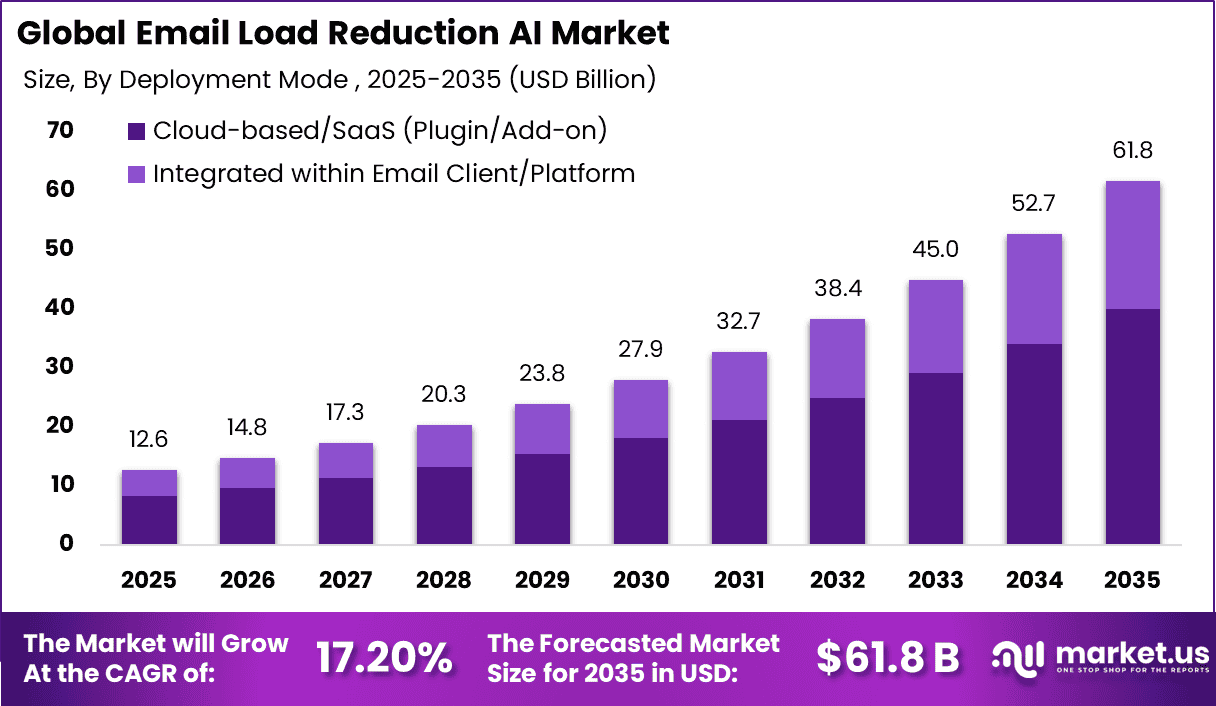
The email load reduction AI market focuses on intelligent systems designed to manage, filter, summarize, and prioritize large volumes of email communication. These solutions use contextual analysis to identify critical messages, automate responses, and reduce inbox congestion.
A key driving factor is the steady increase in daily email traffic across corporate environments. Employees frequently spend significant time sorting, reading, and responding to repetitive or low-priority messages. Manual inbox management creates delays and limits focus on high-value tasks. AI-driven tools help categorize communications, flag urgent items, and automate routine replies, improving overall time management.
Growth in the email load reduction AI market is supported by broader adoption of intelligent workplace automation. As hybrid and remote work models expand, digital communication volumes continue to rise. Organizations are prioritizing productivity enhancement and employee well-being, recognizing the impact of communication overload.
Top Market Takeaways
- By component, software/solutions account for 89.2% of the market, deploying AI agents for auto-summarization, prioritization, response drafting, and inbox triage.
- By deployment mode, cloud-based/SaaS (plugin/add-on) represents 64.8%, integrating seamlessly with Gmail, Outlook, and Teams via lightweight extensions.
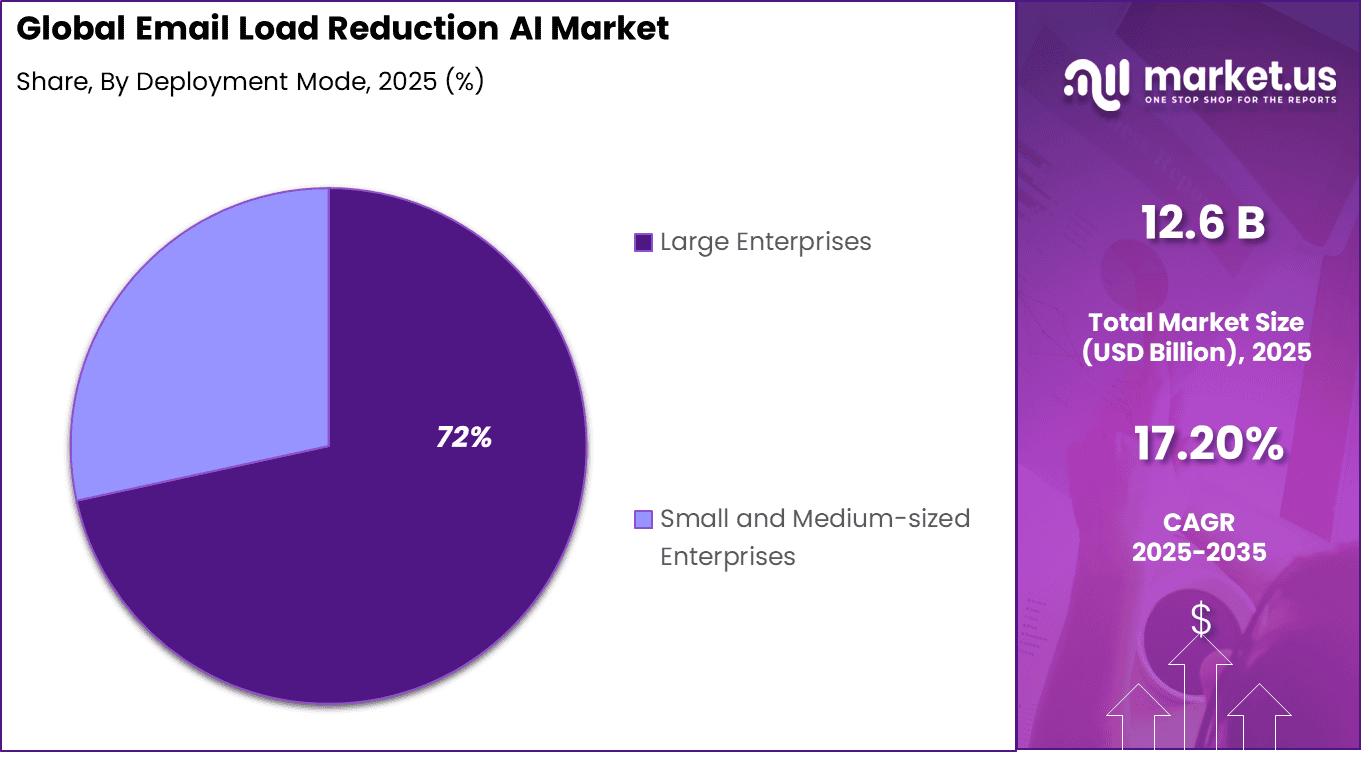
- By organization size, large enterprises hold a 71.6% share, scaling AI across thousands of mailboxes to reclaim executive and team productivity hours.
- By end-user, individual knowledge workers capture 58.3%, using personal AI assistants for context-aware filtering and natural language email automation.
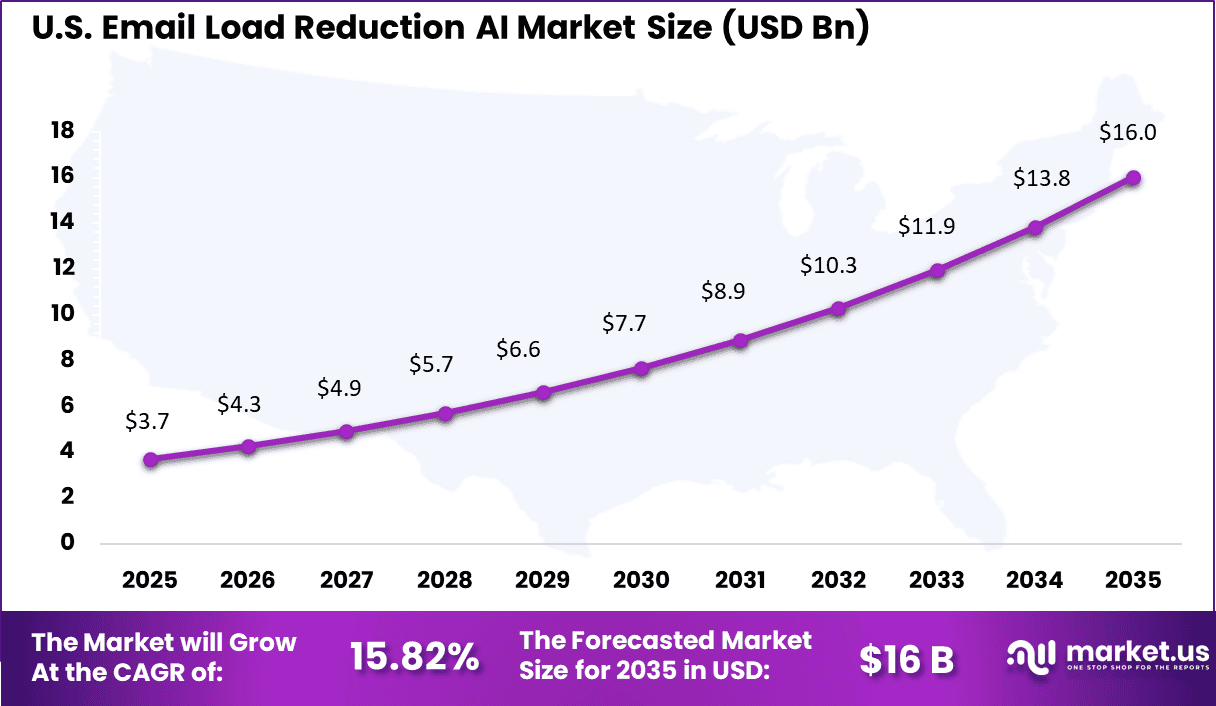
- By region, North America leads with 32.6% of the global market, where the U.S. is valued at USD 3.69 billion with a projected CAGR of 15.82%, driven by remote work persistence and productivity tool adoption.
By Component
Software and solution-based offerings account for 89.2% of adoption in the email load reduction AI market, as users require intelligent tools to manage high volumes of incoming messages. These platforms use natural language processing and behavioral analytics to prioritize, categorize, and summarize emails automatically. This reduces manual sorting and improves response efficiency.
Integrated software tools also provide automated drafting suggestions and meeting extraction features. By learning user communication patterns, these systems improve accuracy over time. This strong functional value continues to position software solutions as the dominant component.
By Deployment Mode
Cloud-based and SaaS deployment holds 64.8%, particularly through plugins and add-ons integrated into existing email platforms. This model enables rapid implementation without infrastructure changes. Users can activate AI capabilities directly within their email interface.
Cloud deployment also supports continuous model updates and cross-device synchronization. Organizations benefit from centralized management and scalable access. These operational advantages reinforce steady SaaS adoption.
By Organization Size
Large enterprises represent 72% of adoption due to high internal communication volumes. Employees in large organizations often manage hundreds of messages daily across teams and departments. AI-driven tools help reduce overload and improve productivity.
Large firms also prioritize workflow optimization and collaboration efficiency. Centralized deployment ensures consistent communication standards. This sustains strong uptake among enterprise-scale organizations.
By End User
Individual knowledge workers account for 58.3% of end user adoption, as professionals seek tools to manage time more effectively. Email overload often affects managers, consultants, and remote workers handling multiple projects. AI-powered assistance helps filter non-essential messages.
Automated summarization and smart reply features support faster decision-making. By reducing cognitive load, these tools improve focus on high-value tasks. This continues to anchor individual professionals as key adopters in the market.
Key Market Segments
By Component
- Software/Solutions
- Smart Email Prioritization & Triage
- Automated Categorization & Folder Management
- Email Summarization & Key Point Extraction
- Draft & Response Suggestion
- Meeting Scheduling & Follow-up Automation
- Unsubscribe & Newsletter Management
- Others
- Services
- Professional Services
- Managed Services
- Others
By Deployment Mode
- Cloud-based/SaaS (Plugin/Add-on)
- Integrated within Email Client/Platform
By Organization Size
- Large Enterprises
- Small and Medium-sized Enterprises (SMEs)
By End-User
- Individual Knowledge Workers
- Customer Support & Sales Teams
- Executive & Management
- Others
Regional Analysis
North America accounts for 32.6% of the email load reduction AI market, supported by high enterprise email usage and widespread adoption of digital collaboration tools. Organizations in the region are deploying AI systems to filter non-essential messages, automate responses, prioritize critical communications, and reduce inbox congestion.
The United States market is valued at USD 3.69 Bn and is expanding at a CAGR of 15.82%, reflecting growing reliance on AI-driven workplace productivity solutions. Adoption is influenced by increasing email volumes, remote work expansion, and the need for intelligent triaging of communications.
Growth is further supported by integration of natural language processing, automated categorization, and contextual prioritization tools that help enterprises improve efficiency and reduce time spent on low-value email interactions.
Key Regions and Countries
- North America
- US
- Canada
- Europe
- Germany
- France
- The UK
- Spain
- Italy
- Russia
- Netherlands
- Rest of Europe
- Asia Pacific
- China
- Japan
- South Korea
- India
- Australia
- Singapore
- Thailand
- Vietnam
- Rest of APAC
- Latin America
- Brazil
- Mexico
- Rest of Latin America
- Middle East & Africa
- South Africa
- Saudi Arabia
- UAE
- Rest of MEA
Drivers Impact Analysis
| Key Driver | Impact on CAGR Forecast (~%) | Geographic Relevance | Impact Timeline |
|---|---|---|---|
| Rising email volume across enterprises and customer support channels | +4.3% | North America, Europe | Short to medium term |
| Increasing adoption of AI-driven productivity tools | +3.8% | Global | Medium term |
| Growth in hybrid and remote workforce communication needs | +3.3% | North America, Asia Pacific | Medium term |
| Expansion of AI-powered summarization and auto-response technologies | +3.0% | Global | Medium term |
| Focus on operational efficiency and employee time optimization | +2.6% | Global | Medium to long term |
Restraints Impact Analysis
| Key Restraint | Impact on CAGR Forecast (~%) | Geographic Relevance | Impact Timeline |
|---|---|---|---|
| Data privacy and sensitive email content concerns | −3.1% | Europe, North America | Short to medium term |
| Accuracy limitations in AI-generated summaries and responses | −2.7% | Global | Medium term |
| Integration complexity with legacy email systems | −2.4% | North America, Europe | Medium term |
| User resistance to automated communication tools | −2.0% | Global | Medium term |
| Dependence on continuous AI model training and updates | −1.8% | Global | Medium to long term |
Investor Type Impact Matrix
| Investor Type | Growth Sensitivity | Risk Exposure | Geographic Focus | Investment Outlook |
|---|---|---|---|---|
| AI productivity software providers | Very High | Medium | North America, Europe | Strong subscription scalability |
| Enterprise SaaS vendors | High | Medium | Global | Integrated productivity expansion |
| Private equity firms | Medium | Medium | North America, Europe | Consolidation of AI productivity tools |
| Venture capital investors | High | High | North America | Innovation in generative AI assistants |
| Strategic enterprise IT investors | Medium | Low to Medium | Global | Operational efficiency enhancement |
Technology Enablement Analysis
| Technology Enabler | Impact on CAGR Forecast (~%) | Primary Function | Geographic Relevance | Adoption Timeline |
|---|---|---|---|---|
| Natural language processing and large language models | +4.9% | Intelligent email summarization and drafting | Global | Short to medium term |
| Context-aware AI workflow automation engines | +4.2% | Priority classification and routing | North America, Europe | Medium term |
| Secure cloud-based AI integration frameworks | +3.6% | Scalable deployment | Global | Medium term |
| Real-time sentiment and intent analysis tools | +3.0% | Enhanced response accuracy | Global | Medium to long term |
| Compliance and data governance integration modules | +2.5% | Regulatory alignment | Europe, North America | Long term |
Key Challenges
- Difficulty in accurately identifying priority emails without missing important messages
- High risk of false filtering affecting critical business communication
- Integration challenges with existing email platforms and enterprise systems
- Data privacy concerns when AI models analyze sensitive email content
- User resistance due to lack of trust in automated email management systems
Emerging Trends
In the Email Load Reduction AI market, a key trend is the shift toward intelligent sorting that helps people focus on the most meaningful messages. Systems are being designed to analyse incoming emails for patterns in sender behaviour, subjects, and user responses so that routine or low-value messages can be filtered or grouped automatically.
This change helps recipients spend less time scanning through high volumes of email and more time on messages that require thoughtful attention. Another emerging pattern is the offering of personalised prioritisation settings that learn from individual habits, enabling the system to align more closely with how each person works and communicates.
Growth Factors
A central growth driver in this market is the ongoing challenge of managing email overload in both professional and personal settings. Many people experience stress and inefficiency when their inbox grows faster than they can process it, and solutions that reduce this burden directly improve daily productivity and satisfaction.
Another important driver is the increasing integration of email with other communication platforms, where context and relevance can be distilled more clearly when data is analysed across systems. This interconnected view helps reduce redundant or unnecessary messages and supports smoother information flow, making communication feel more humane and manageable for recipients.
Competitive Analysis
The Email Load Reduction AI market is led by large technology and productivity platform providers such as Microsoft Corporation, Google LLC, and Salesforce. These companies compete on built-in AI features within enterprise email and collaboration suites, including automated sorting, priority inbox management, and smart reply suggestions.
Their strength lies in deep integration with workplace ecosystems, strong security controls, and large user bases across corporate environments. Specialized email productivity vendors such as Superhuman Labs, SaneBox, Shortwave, Front App, Edison Software, Mailbird, Spike, Clean Email, Mailstrom, Motional, and others compete through focused inbox management tools and faster user experience.
Competition in this segment is driven by intelligent filtering, automated follow-up reminders, and clutter reduction features that help professionals manage high email volumes. These providers are often selected by individuals and small teams seeking improved email efficiency without complex setup.
Top Key Players in the Market
- Microsoft Corporation
- Google LLC
- Salesforce, Inc.
- Superhuman Labs, Inc.
- SaneBox
- Shortwave
- Front App, Inc.
- Edison Software Inc.
- Mailbird
- Spike
- Motional
- Clean Email LLC
- Mailstrom
- Others
Future Outlook
The future outlook for the Email Load Reduction AI Market is positive as businesses seek smarter ways to manage high volumes of email. Demand for AI email load reduction solutions is expected to grow because these tools help filter, prioritize, and automate responses, saving time for employees.
Adoption of natural language processing, machine learning, and smart categorization will improve accuracy and efficiency. Growth can be attributed to rising digital communication, focus on productivity, and the need to reduce manual email handling. Overall, the market is expected to expand as organizations prioritize tools that simplify email management.
Recent Developments
- In January 2026, Google LLC launched AI Inbox, prioritizing tasks and summarizing threads for all users. Gemini answers questions like job recruiter details and proactively suggests actions. Pilots conversational search across messages.
- In October 2025, Microsoft Corporation Rebuilt Outlook team for an AI-first email experience with natural language inbox control. Copilot summarizes attachments, search results, and pre-meeting briefs. Prototypes test weekly, shifting to quarterly releases.
Report Scope
| Report Features | Description |
|---|---|
| Market Value (2025) | USD 12.6 Billion |
| Forecast Revenue (2035) | USD 61.8 Billion |
| CAGR(2025-2035) | 17.2% |
| Base Year for Estimation | 2024 |
| Historic Period | 2020-2024 |
| Forecast Period | 2025-2035 |
| Report Coverage | Revenue forecast, AI impact on Market trends, Share Insights, Company ranking, competitive landscape, Recent Developments, Market Dynamics and Emerging Trends |
| Segments Covered | By Component (Software/Solutions (Smart Email Prioritization & Triage, Automated Categorization & Folder Management, Others), Services (Professional Services, Managed Services, Others)), By Deployment Mode (Cloud-based/SaaS (Plugin/Add-on), Integrated within Email Client/Platform), By Organization Size (Large Enterprises, Small and Medium-sized Enterprises), By End-User (Individual Knowledge Workers, Customer Support & Sales Teams, Others) |
| Regional Analysis | North America – US, Canada; Europe – Germany, France, The UK, Spain, Italy, Russia, Netherlands, Rest of Europe; Asia Pacific – China, Japan, South Korea, India, New Zealand, Singapore, Thailand, Vietnam, Rest of Latin America; Latin America – Brazil, Mexico, Rest of Latin America; Middle East & Africa – South Africa, Saudi Arabia, UAE, Rest of MEA |
| Competitive Landscape | Microsoft Corporation, Google LLC, Salesforce, Inc., Superhuman Labs, Inc., SaneBox, Shortwave, Front App, Inc., Edison Software Inc., Mailbird, Spike, Motional, Clean Email LLC, Mailstrom, Others |
| Customization Scope | Customization for segments, region/country-level will be provided. Moreover, additional customization can be done based on the requirements. |
| Purchase Options | We have three licenses to opt for: Single User License, Multi-User License (Up to 5 Users), Corporate Use License (Unlimited Users and Printable PDF) |