Report Overview
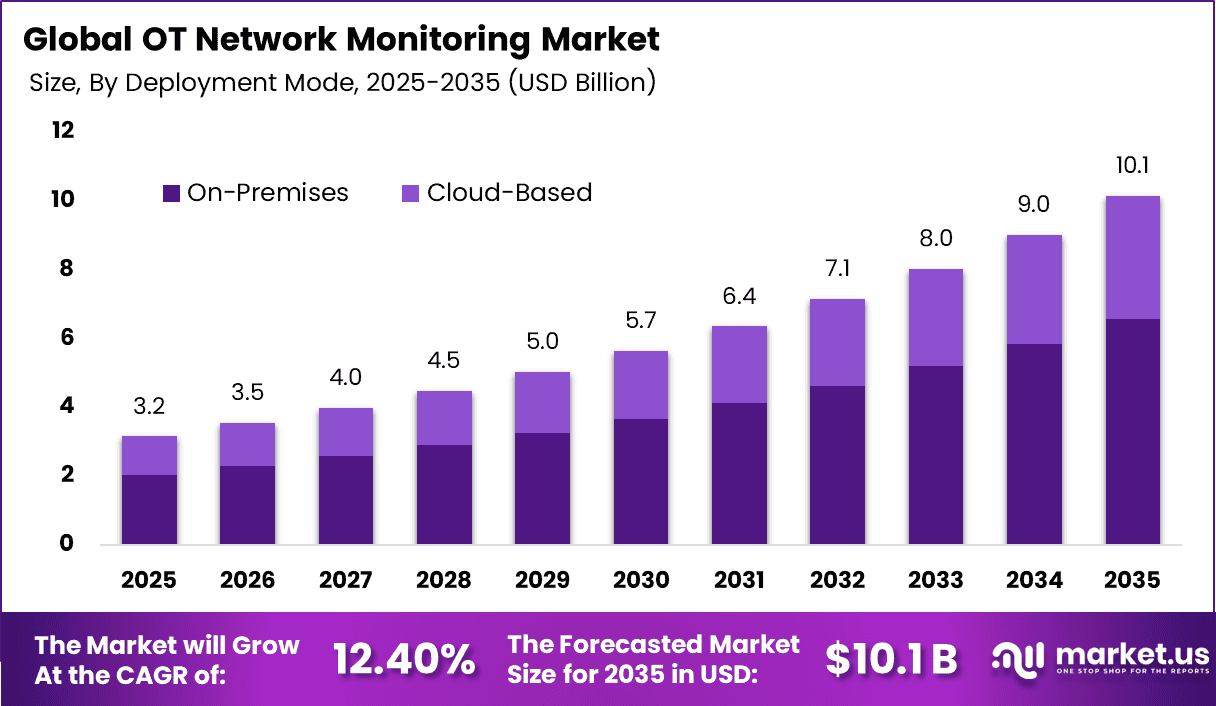
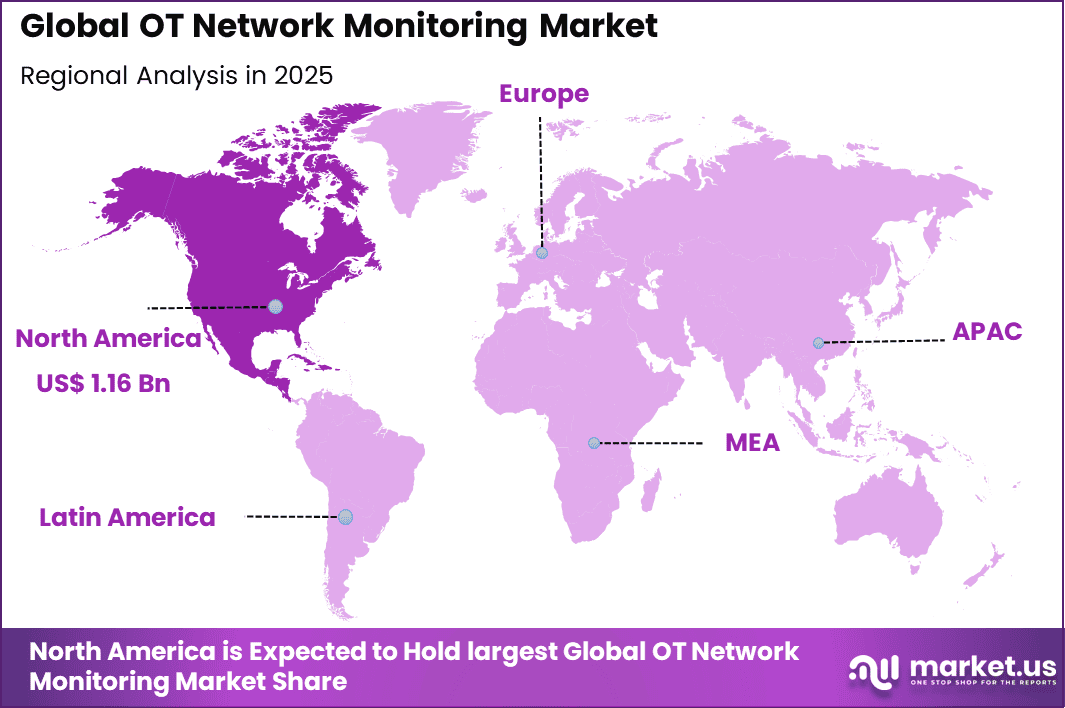
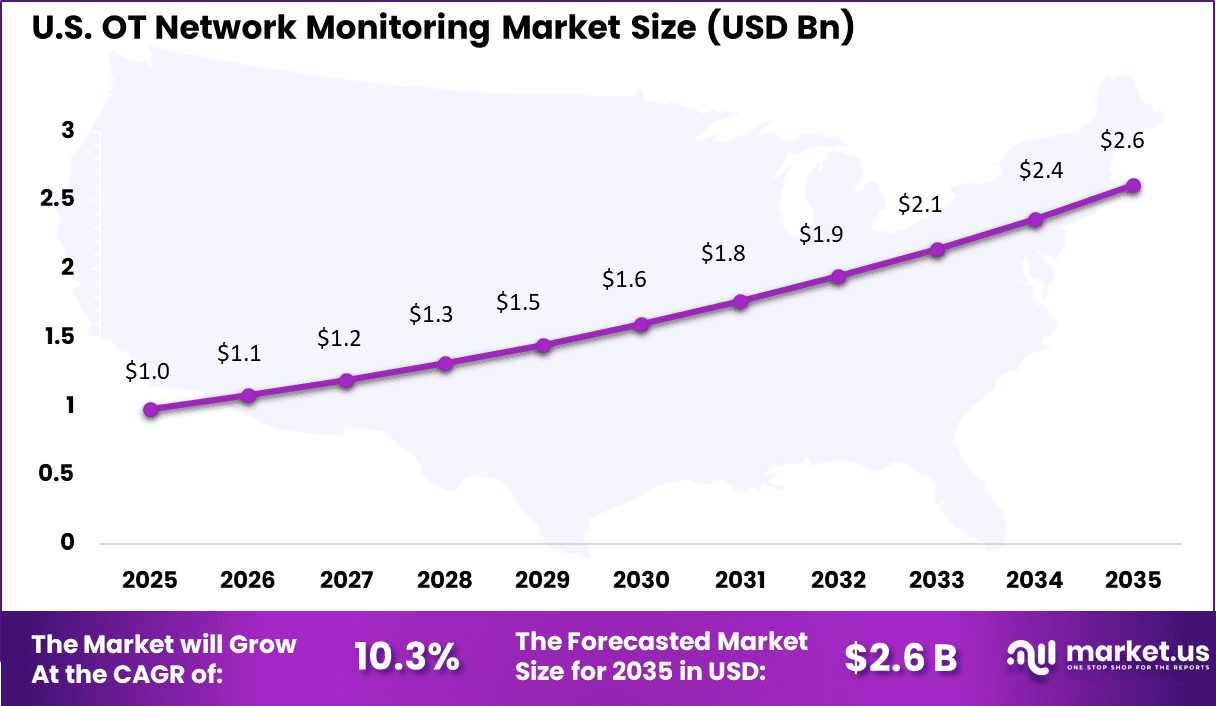
The Global OT Network Monitoring Market generated USD 3.2 billion in 2025 and is predicted to register growth from USD 3.5 billion in 2026 to about USD 10.1 billion by 2035, recording a CAGR of 12.4% throughout the forecast span. In 2025, North America held a dominant market position, capturing more than a 36.9% share, with USD 1.16 billion in revenue.
The OT network monitoring market focuses on tools that provide visibility into operational technology environments such as industrial control systems, manufacturing equipment, and critical infrastructure networks. These systems monitor communication between machines, sensors, controllers, and supervisory platforms to ensure safe and reliable operations.
Unlike traditional IT networks, OT environments manage physical processes, which makes monitoring essential for preventing disruption and safety incidents. The market is shaped by industrial organizations seeking stable operations and stronger control over connected assets. A key driving factor is the growing integration of digital technologies within industrial settings.
Growth in the OT network monitoring market is supported by the broader shift toward industrial automation and connected infrastructure. Organizations are prioritizing proactive risk management to reduce downtime and protect critical assets. Improved regulatory attention on infrastructure resilience is also encouraging adoption.
Top Market Takeaways
- By component, hardware accounts for 54.6% of the market, delivering specialized sensors, probes, and appliances for passive OT protocol analysis without disrupting production networks.
- By deployment mode, on-premises represents 64.7%, preferred for air-gapped environments, zero-latency visibility, and compliance with legacy industrial standards.
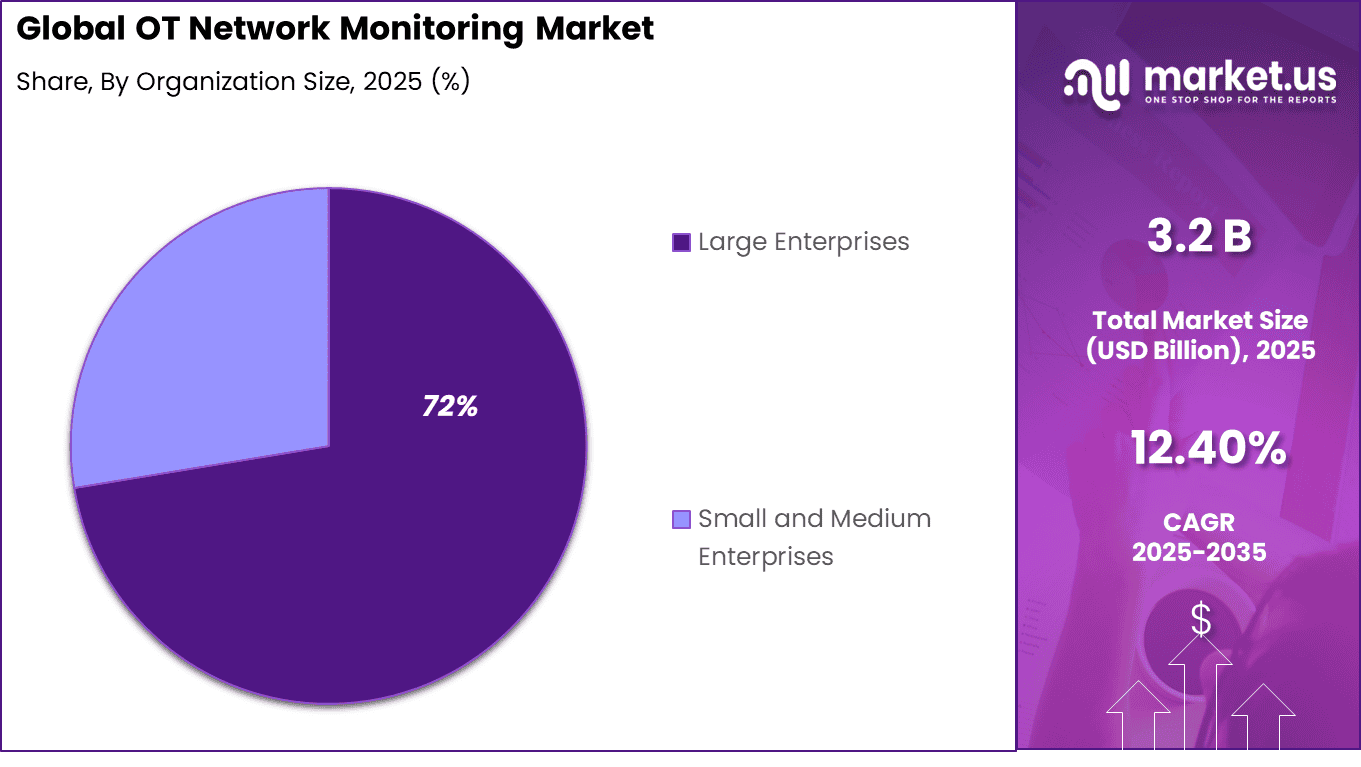
- By organization size, large enterprises hold a 72.4% share, managing complex OT/IT convergence across manufacturing plants and critical infrastructure.
- By application, industrial control systems capture 39.3%, monitoring Modbus, Profibus, and DNP3 traffic for anomaly detection and performance baselining.
- By end-user, IT & telecom commands 42.5%, securing SCADA systems, remote terminal units, and field devices against targeted cyber threats.
By Component
Hardware accounts for 54.6% of adoption in the OT network monitoring market, as industrial environments rely on physical sensors, gateways, and network appliances to capture operational data. These devices monitor traffic across programmable logic controllers, supervisory systems, and field equipment. Reliable hardware infrastructure is essential for continuous visibility in critical environments.
Industrial sites often operate in harsh conditions where durability and stability are required. Dedicated monitoring hardware ensures secure data collection without interrupting production processes. This continues to support strong demand for hardware components.
By Deployment Mode
On-premises deployment holds 64.7%, reflecting the need for direct control over operational technology networks. Industrial facilities prioritize low-latency monitoring and isolation from external networks. On-premises systems reduce exposure to external cyber risks.
Regulatory and safety considerations also favor localized monitoring solutions. Many industrial operators require data to remain within facility boundaries. This sustains the relevance of on-premises deployment in OT monitoring.
By Organization Size
Large enterprises represent 72% of adoption due to the scale and complexity of their industrial operations. These organizations manage multiple facilities and diverse OT assets. Centralized monitoring platforms help standardize oversight across sites.
Large firms also face higher exposure to operational disruption. Comprehensive monitoring improves incident detection and response. This drives sustained adoption among enterprise-scale operators.
By Application
Industrial control systems account for 39.3% of application focus, as these systems form the backbone of manufacturing and infrastructure operations. Monitoring tools analyze communication patterns between controllers and field devices. Early detection of anomalies helps prevent operational downtime.
Continuous visibility into control systems enhances reliability and safety. Monitoring solutions also support compliance with industrial cybersecurity standards. This positions industrial control systems as a primary application area.
By End User
The IT and telecom sector holds 42.5% of end user adoption, driven by the integration of operational and information technology networks. Telecom operators manage distributed infrastructure that requires continuous monitoring. OT monitoring platforms help ensure network availability and performance.
As telecom networks support critical communication services, security and uptime are priorities. Integrated monitoring improves detection of abnormal traffic and potential threats. This continues to anchor IT and telecom as key adopters in the OT network monitoring market.
Key Market Segments
By Solutions
- Automated Record Retrieval & Parsing
- Risk Scoring & Adverse Media Analysis
- Identity Verification & Validation
- Continuous Monitoring Platforms
- Compliance & Audit Trail Management
- Others
By Deployment Mode
- Cloud-based/SaaS
- On-premises
- By Screening Type
- Pre-employment Screening
- Criminal Records
- Employment & Education Verification
- Reference Checks
- Ongoing/Post-hire Screening
- Continuous Criminal Monitoring
- Others
By End-User Industry
- Banking, Financial Services, and Insurance (BFSI)
- Healthcare
- Retail & Gig Economy
- IT & Technology
- Others
By Organization Size
- Large Enterprises
- Small and Medium-sized Enterprises (SMEs)
Regional Analysis
North America accounts for 36.2% of the brand logo detection AI market, supported by strong digital advertising ecosystems and advanced computer vision adoption. Media agencies, retail brands, and sponsorship analysts in the region are increasingly deploying AI-based logo recognition tools to track brand visibility across social media, live broadcasts, and digital content platforms.
Demand is driven by the need for accurate sponsorship valuation, real-time campaign monitoring, and protection against unauthorized brand usage.
A key growth driver in this market is the increasing demand for speed and consistency in hiring and vendor onboarding. Organisations face pressure to complete background checks quickly without compromising quality, and AI-enabled screening helps streamline the process while maintaining thorough evaluation. This supports a more humane experience for applicants who otherwise face long waiting periods.
Another important factor is the growing variety of data sources that need to be reviewed during a background check, from public records to professional affiliations. As these sources grow in number and complexity, AI systems help teams manage the workload without sacrificing accuracy, ensuring that decisions are based on a clear and organised view of relevant information.
Key Regions and Countries
- North America
- US
- Canada
- Europe
- Germany
- France
- The UK
- Spain
- Italy
- Russia
- Netherlands
- Rest of Europe
- Asia Pacific
- China
- Japan
- South Korea
- India
- Australia
- Singapore
- Thailand
- Vietnam
- Rest of APAC
- Latin America
- Brazil
- Mexico
- Rest of Latin America
- Middle East & Africa
- South Africa
- Saudi Arabia
- UAE
- Rest of MEA
Drivers Impact Analysis
| Key Driver | Impact on CAGR Forecast (~%) | Geographic Relevance | Impact Timeline |
|---|---|---|---|
| Increasing cyber threats targeting industrial control systems | +3.6% | North America, Europe | Short to medium term |
| Expansion of Industry 4.0 and smart manufacturing initiatives | +3.1% | Europe, Asia Pacific | Medium term |
| Rising regulatory compliance requirements for critical infrastructure | +2.7% | North America, Europe | Medium term |
| Growing convergence of IT and OT networks | +2.4% | Global | Medium term |
| Increasing deployment of IoT devices in industrial environments | +2.1% | Asia Pacific, North America | Medium to long term |
Restraints Impact Analysis
| Key Restraint | Impact on CAGR Forecast (~%) | Geographic Relevance | Impact Timeline |
|---|---|---|---|
| Complexity of integrating monitoring tools with legacy OT systems | −2.9% | Global | Short to medium term |
| High deployment and maintenance costs | −2.5% | Emerging Markets | Medium term |
| Limited cybersecurity awareness in traditional industrial sectors | −2.2% | Asia Pacific, Latin America | Medium term |
| Interoperability challenges across multi-vendor environments | −1.9% | Global | Medium term |
| Skills shortage in OT cybersecurity expertise | −1.6% | Global | Medium to long term |
Investor Type Impact Matrix
| Investor Type | Growth Sensitivity | Risk Exposure | Geographic Focus | Investment Outlook |
|---|---|---|---|---|
| Industrial cybersecurity vendors | Very High | Medium | North America, Europe | Strong subscription and licensing growth |
| Industrial automation companies | High | Medium | Asia Pacific, Europe | Integrated monitoring expansion |
| Private equity firms | Medium | Medium | North America, Europe | Consolidation of OT security vendors |
| Venture capital investors | Medium | High | North America | Innovation in AI-driven anomaly detection |
| Strategic infrastructure investors | Medium | Low to Medium | Global | Critical asset protection enhancement |
Technology Enablement Analysis
| Technology Enabler | Impact on CAGR Forecast (~%) | Primary Function | Geographic Relevance | Adoption Timeline |
|---|---|---|---|---|
| AI-based anomaly detection for industrial protocols | +3.9% | Threat identification and risk mitigation | Global | Short to medium term |
| Deep packet inspection for OT-specific traffic | +3.4% | Protocol-level monitoring | North America, Europe | Medium term |
| Integration with SIEM and SOC platforms | +2.8% | Centralized threat response | Global | Medium term |
| Edge-based monitoring appliances | +2.4% | On-site network visibility | Asia Pacific, North America | Medium to long term |
| Zero-trust frameworks for industrial networks | +2.0% | Secure access control | Europe, North America | Long term |
Key Challenges
- Data privacy concerns when handling sensitive personal and employment records
- Risk of bias in AI models affecting fair candidate evaluation
- Regulatory differences across regions complicating compliance processes
- Integration challenges with HR and recruitment management systems
- Limited transparency in automated decision-making creating trust issues
Emerging Trends
In the Background Screening AI market, a clear trend is the shift toward more context-aware evaluation of individuals during screening checks. Rather than relying only on basic record matching, systems are being designed to consider patterns of behaviour, relationships between data points, and relevance to the roles being assessed.
This helps reduce false flags and makes the screening process feel fairer to candidates while still identifying areas that need attention. Another pattern emerging is the introduction of transparent feedback features that explain why certain findings were highlighted, helping both employer and applicant understand the screening outcomes in plain language.
Growth Factors
A key growth driver in this market is the increasing demand for speed and consistency in hiring and vendor onboarding. Organisations face pressure to complete background checks quickly without compromising quality, and AI-enabled screening helps streamline the process while maintaining thorough evaluation. This supports a more humane experience for applicants who otherwise face long waiting periods.
Another important factor is the growing variety of data sources that need to be reviewed during a background check, from public records to professional affiliations. As these sources grow in number and complexity, AI systems help teams manage the workload without sacrificing accuracy, ensuring that decisions are based on a clear and organised view of relevant information.
Competitive Analysis
The OT Network Monitoring market is led by specialized industrial cybersecurity providers such as Nozomi Networks, Dragos, Radiflow, Indegy (under Tenable), and CyberX (under Microsoft). These companies compete on deep visibility into industrial control systems, asset discovery accuracy, and threat detection tailored for operational technology environments.
Large cybersecurity and industrial automation companies, including Cisco Systems, Honeywell, Siemens, Fortinet, Kaspersky, Tenable, Check Point Software Technologies, Forescout Technologies, Palo Alto Networks, Schneider Electric, ABB, Darktrace, Waterfall Security Solutions, Applied Risk under Eviden, and others, compete through integrated security platforms and global service capabilities.
Competition in this segment is driven by network segmentation, anomaly detection, and compliance support for critical infrastructure standards. These providers are often selected by organizations seeking unified IT and OT security oversight with strong vendor backing and long-term support.
Top Key Players in the Market
- Claroty
- Nozomi Networks
- Dragos
- Cisco Systems
- Honeywell
- Siemens
- Fortinet
- Radiflow
- Kaspersky
- Tenable
- Check Point Software Technologies
- Forescout Technologies
- Palo Alto Networks
- Schneider Electric
- ABB
- CyberX (now part of Microsoft)
- Indegy (now part of Tenable)
- Darktrace
- Waterfall Security Solutions
- Applied Risk (an Eviden business)
- Others
Future Outlook
The future outlook for the OT Network Monitoring Market is positive as more industrial and critical infrastructure organizations focus on securing their operational technology environments. Demand for OT network monitoring solutions is expected to grow because these tools help detect system issues, identify threats, and ensure reliable operations.
Adoption of real-time analytics, automation, and integration with broader cybersecurity systems will improve visibility and response times. Growth can be attributed to rising cyber risks, stricter safety standards, and the need to maintain uninterrupted industrial processes. Overall, the market is expected to expand as businesses prioritize resilient and proactive network monitoring.
Recent Developments
- In January 2026, Mitsubishi Electric completed its acquisition of Nozomi Networks; Nozomi stated it would continue to offer vendor-agnostic OT, IoT, and cyber-physical-system security solutions to its global customers and partners.
- In September 2025, Mitsubishi Electric announced a definitive agreement to acquire Nozomi Networks, an OT, IoT, and CPS security vendor, for close to $1 billion; the company was expected to operate independently after closing.
- In August 2025, Nozomi Networks and Schneider Electric announced a security sensor embedded in Schneider Electric remote terminal units, extending OT monitoring and detection closer to field devices in industrial environments.
Report Scope
| Report Features | Description |
|---|---|
| Market Value (2025) | USD 3.2 Billion |
| Forecast Revenue (2035) | USD 10.1 Billion |
| CAGR(2025-2035) | 12.4% |
| Base Year for Estimation | 2024 |
| Historic Period | 2020-2024 |
| Forecast Period | 2025-2035 |
| Report Coverage | Revenue forecast, AI impact on Market trends, Share Insights, Company ranking, competitive landscape, Recent Developments, Market Dynamics and Emerging Trends |
| Segments Covered | By Component (Software, Hardware, Services), By Deployment Mode (On-Premises, Cloud-Based), By Organization Size (Small and Medium Enterprises, Large Enterprises), By Application (Industrial Control Systems, Critical Infrastructure, Manufacturing, Energy & Utilities, Transportation, Others), By End-User (IT & Telecom, Oil & Gas, Energy & Power, Manufacturing, Transportation, Government, Others) |
| Regional Analysis | North America – US, Canada; Europe – Germany, France, The UK, Spain, Italy, Russia, Netherlands, Rest of Europe; Asia Pacific – China, Japan, South Korea, India, New Zealand, Singapore, Thailand, Vietnam, Rest of Latin America; Latin America – Brazil, Mexico, Rest of Latin America; Middle East & Africa – South Africa, Saudi Arabia, UAE, Rest of MEA |
| Competitive Landscape | Claroty, Nozomi Networks, Dragos, Cisco Systems, Honeywell, Siemens, Fortinet, Radiflow, Kaspersky, Tenable, Check Point Software Technologies, Forescout Technologies, Palo Alto Networks, Schneider Electric, ABB, CyberX (now part of Microsoft), Indegy (now part of Tenable), Darktrace, Waterfall Security Solutions, Applied Risk (an Eviden business), Others |
| Customization Scope | Customization for segments, region/country-level will be provided. Moreover, additional customization can be done based on the requirements. |
| Purchase Options | We have three licenses to opt for: Single User License, Multi-User License (Up to 5 Users), Corporate Use License (Unlimited Users and Printable PDF) |