


Report Overview
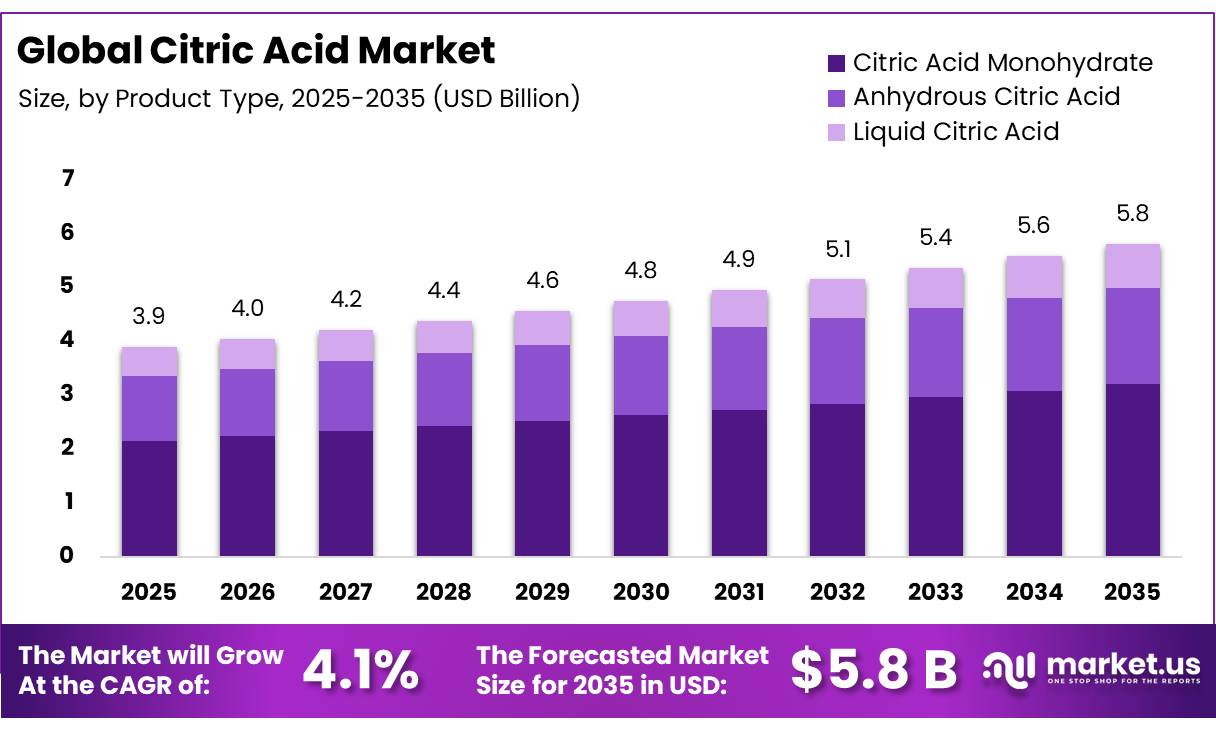
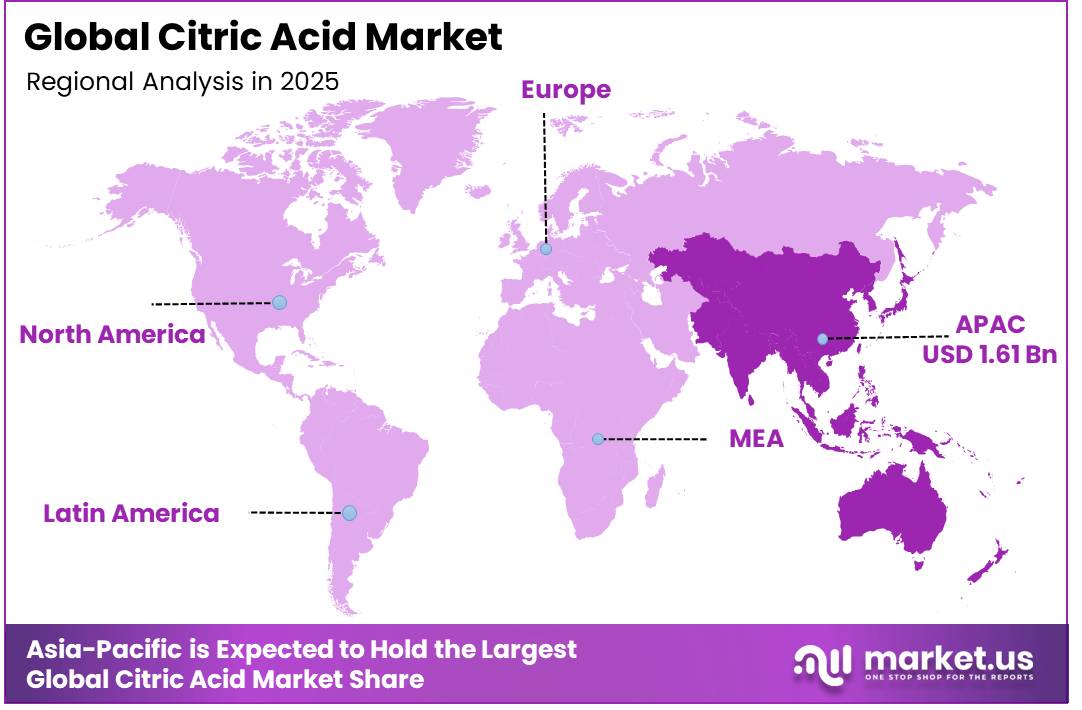
In 2025, the Global Citric Acid Market was valued at USD 3.9 billion, and between 2026 and 2035, this market is estimated to register a CAGR of 4.1%, reaching about USD 5.8 billion by 2035. In 2025, Asia-Pacific led the market, achieving over 41.3% share with a revenue of USD 1.61 Billion.
Citric acid is an important organic acid used across food, beverages, pharmaceuticals, detergents, cosmetics, and technical chemical applications. Industrially, it is mainly produced through microbial fermentation of carbohydrate substances, which keeps it closely linked with sugar and starch supply chains. The U.S. Department of Agriculture identifies citric acid and citrate salts as acids produced by microbial fermentation of carbohydrate substances, while the U.S. FDA lists citric acid as a direct food substance used as a flavoring substance and adjuvant, with purity requirements of not less than 98.0% assay and not more than 0.1% residue on ignition.
- According to FoodDrinkEurope’s Data and Trends Report 2024, the EU food and drink industry generated €1,523 billion in turnover and €296 billion in value added in 2023, with €52 billion invested and nearly 309,000 companies operating in the sector. This large manufacturing base supports steady demand for citric acid as an acidulant, preservative, pH regulator, and flavor balancer.
- According to Cefic’s Facts and Figures 2024 report, Europe’s chemical industry generated €635 billion in turnover and employed approximately 2 million people, while China accounted for 46% of global chemical sales. This strong chemical manufacturing base supports sustained demand for citric acid and its derivatives in organic acids, citrate salts, cleaning formulations, and specialty chemical applications.
Key Takeaways
- The Global Citric Acid Market was valued at USD 3.9 billion in 2025.
- The market is projected to grow at a CAGR of 4.1% and is estimated to reach USD 5.8 billion by 2035.
- Citric Acid Monohydrate is the dominant product type, accounting for 55.2% of the market in 2025, driven by its high use as preservative across food and beverage formulations.
- Fermentation-Based Production is the dominant manufacturing process at 92.8%, driven by the cost-effectiveness, scalability.
- Food and Beverages is the dominant application at 60.4%, driven by the widespread use of citric acid as a natural acidulant, flavor enhancer.
- Food Processing Industry is the dominant end user at 48.9%, driven by the extensive incorporation of citric acid into processed foods, beverages, and packaged goods.
- Food Grade Citric Acid is the dominant grade type at 62.5%, driven by strict food safety compliance requirements and the broad footprint of food and beverage applications.
- Powdered Citric Acid is the most widely used form at 71.4%, driven by its ease of storage, handling, and transport relative to granular and liquid forms.
- Direct B2B Industrial Sales is the dominant distribution channel at 64.8%, driven by bulk procurement patterns among food, pharmaceutical, and industrial manufacturers.
- Asia-Pacific holds the largest regional share at 41.3%, driven by the concentration of citric acid manufacturing capacity and large food and beverage processing bases across China and India.
Future growth opportunities are expected in bio-based chemicals, organic foods, pharmaceutical excipients, effervescent tablets, mineral citrate supplements, household cleaners, and industrial chelation, especially where brands target recyclable packaging and safer ingredient profiles. Feedstock availability also supports expansion: OECD-FAO projected sugarcane to remain above 85% of sugar crops and global sugarcane output to reach 2,100 million tonnes by 2034, growing 1.2% per year. As manufacturers shift toward fermentation-based and lower-toxicity ingredients, citric acid is positioned as a practical, scalable, and regulation-backed chemical for both food-grade and industrial-grade applications.
Product Type Analysis
Citric Acid Monohydrate held a dominant position with more than 55.2% market share in 2025 due to its broad use across food and beverage applications
In 2025, Citric Acid Monohydrate held a dominant market position, capturing more than a 55.2% share. The segment maintained its leading position because it is the preferred form of citric acid in food and beverage manufacturing owing to its excellent solubility, stability, and ease of handling. In October 2024, the USDA National Organic Standards Board (NOSB) recommended that citric acid remain on the National List of allowed substances for organic food processing under 7 CFR 205.605(a), reinforcing its importance in organic food manufacturing.
- In the European Union, Commission Regulation (EU) 2020 permits citric acid (E330) in numerous food applications, including usage levels of up to 10,000 mg/kg in milk chocolate, supporting continued demand for monohydrate grades used in confectionery production. These regulatory developments, together with growing production of processed and packaged foods during 2025, helped sustain the segment’s leadership.
Anhydrous Citric Acid is the fastest-growing segment. Growth is being supported by increasing demand from pharmaceutical manufacturers, powdered beverage producers, and dry food formulation companies, where moisture-sensitive ingredients are preferred. Compared with the monohydrate form, anhydrous citric acid offers better storage stability in low-moisture applications and is widely used in effervescent tablets, powdered drink mixes, seasoning blends, and industrial formulations.
Manufacturing Process Analysis
Fermentation-Based Production dominated the market with more than 92.8% share in 2025, supported by its established use in food-grade citric acid manufacturing
In 2025, Fermentation-Based Production held a dominant market position, capturing more than a 92.8% share. The segment remained the preferred manufacturing process because it is widely accepted for producing food-grade and pharmaceutical-grade citric acid using microbial fermentation, primarily with Aspergillus niger. The process offers high product purity, reliable yields, and compliance with global food safety standards, making it suitable for large-scale commercial production.
Chemical Synthesis is the fastest-growing segment. Although it represents a much smaller share of the overall market than fermentation-based production, the segment is expected to grow steadily due to increasing demand from selected industrial applications where specialized purity requirements and non-food uses are important. Chemical synthesis is primarily utilized in niche industrial processes, laboratory applications, and certain chemical formulations rather than mainstream food production.
Application Analysis
Food and Beverages dominates the market due to its extensive use in processed foods, beverages, and preservative applications.
In 2025, Food and Beverages held a dominant market position, capturing more than a 60.4% share of the global citric acid market. The segment remained the largest because citric acid is widely used as an acidulant, flavor enhancer, preservative, and pH regulator across soft drinks, fruit juices, confectionery, dairy products, sauces, bakery items, and processed foods. Rising demand for packaged and convenience foods, along with stricter food safety standards, continued to support consumption during 2025.
- According to the United States Department of Agriculture (USDA), Economic Research Service (ERS), the value of U.S. food and beverage manufacturing shipments exceeded US$1.09 trillion in 2023, highlighting the scale of food processing industries that extensively utilize ingredients such as citric acid.
The Pharmaceuticals and Nutraceuticals segment is the fastest growing application in the citric acid market due to increasing production of medicines, dietary supplements, effervescent tablets, and mineral formulations. Citric acid is widely used as a buffering agent, stabilizer, chelating agent, and flavor enhancer in pharmaceutical formulations, while nutraceutical manufacturers increasingly use it to improve product stability and consumer acceptance.
End User Analysis
Food Processing Industry dominates the Citric Acid Market with a 48.9% share due to its broad use in processed foods and beverages
In 2025, Food Processing Industry held a dominant market position, capturing more than a 48.9% share of the global citric acid market. The segment remained the largest end user because citric acid is widely used as an acidulant, preservative, flavor enhancer, and pH regulator in processed foods, beverages, dairy products, confectionery, bakery items, sauces, and ready-to-eat meals.
- According to the Ministry of Food Processing Industries (Government of India), the food processing sector contributes around 13% of India’s manufacturing Gross Value Added (GVA) and nearly 12% of manufacturing employment, according to the Annual Report 2024–25, highlighting the large scale of food processing operations that drive demand for ingredients such as citric acid.
Household Consumers is the fastest growing segment in the citric acid market as more people are using citric acid for everyday cleaning, home food preservation, cooking, and DIY applications. During 2025, demand increased as consumers looked for environmentally friendly and non-toxic alternatives to chemical-based cleaners.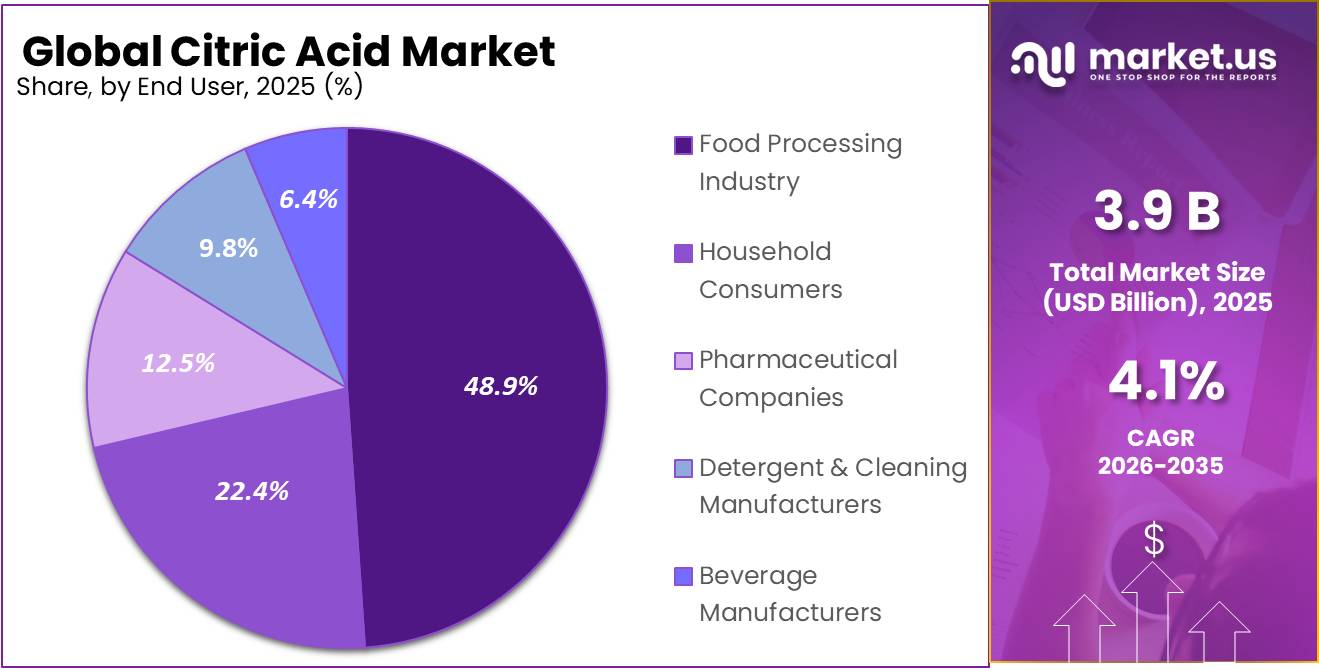
Grade Type Analysis
Food Grade Citric Acid dominates the market with 62.5% share due to its extensive use across food and beverage manufacturing
In 2025, Food Grade Citric Acid held a dominant market position, capturing more than a 62.5% share of the global citric acid market by grade type. The strong position of this segment is mainly supported by its wide application as an acidity regulator, preservative, flavor enhancer, and pH control agent in processed foods, beverages, dairy products, confectionery, bakery items, and ready-to-eat meals. Food manufacturers continue to prefer food grade citric acid because it is approved for use in a broad range of food products and helps improve shelf life while maintaining product quality.
- U.S. Food and Drug Administration (FDA) Citric acid is listed as Generally Recognized as Safe (GRAS) for use in food under 21 CFR §184.1033, supporting its extensive use in food manufacturing.
Pharmaceutical Grade is the fastest growing segment in the citric acid market by grade type. The segment is expanding because citric acid is widely used in tablets, effervescent formulations, syrups, oral solutions, injectable products, and dietary supplements as a buffering agent, stabilizer, chelating agent, and pH adjuster. Growth accelerated through 2025 as pharmaceutical production increased to meet rising demand for chronic disease medicines, nutritional supplements, and over-the-counter healthcare products.
Form Analysis
In 2025, Powdered Citric Acid held a dominant market position, capturing more than a 71.4% share of the global citric acid market by form. Its leading position was supported by its long shelf life, easy storage, simple transportation, and excellent compatibility with dry formulations. Food and beverage manufacturers continued to prefer powdered citric acid because it blends easily with powdered drink mixes, bakery ingredients, confectionery products, seasonings, and processed foods.
- S. Department of Agriculture (USDA), Economic Research Service (2025) Consumer spending on food accounted for about 9.7% of disposable personal income in 2025, reflecting continued demand for processed and packaged foods that widely use powdered food ingredients such as citric acid.
Granular Citric Acid is the fastest-growing segment in the citric acid market by form. The segment is gaining momentum because granular particles generate less dust during handling and provide better flow characteristics in automated manufacturing systems. Food processors, beverage ingredient manufacturers, and industrial users are increasingly adopting granular citric acid for applications that require consistent mixing and easier packaging.
Distribution Channel Analysis
Direct B2B Industrial Sales dominates the Citric Acid Market with a 64.8% share due to long-term supply contracts and high-volume industrial procurement.
In 2025, Direct B2B Industrial Sales held a dominant market position, capturing more than a 64.8% share of the global citric acid market. Large food and beverage manufacturers, pharmaceutical companies, detergent producers, and industrial processors continued to purchase citric acid directly from manufacturers to secure stable pricing, consistent product quality, and uninterrupted supply. Direct agreements allowed buyers to customize packaging, delivery schedules, and product specifications.
Distributors and Wholesalers is the fastest growing segment in the citric acid market as more small and medium-sized manufacturers prefer flexible purchasing over direct bulk contracts. In 2025, this distribution channel expanded steadily because regional distributors improved product availability, reduced delivery times, and offered smaller order quantities suitable for local food processors, beverage companies, cosmetic manufacturers, and chemical formulators.
Key Market Segments
Product Type
- Citric Acid Monohydrate
- Anhydrous Citric Acid
- Liquid Citric Acid
Manufacturing Process
- Fermentation-Based Production
- Chemical Synthesis
Application
- Food and Beverages
- Pharmaceuticals and Nutraceuticals
- Household Detergents and Cleaning Agents
- Cosmetics and Personal Care
- Industrial Applications
End User
- Food Processing Industry
- Household Consumers
- Pharmaceutical Companies
- Detergent and Cleaning Manufacturers
- Beverage Manufacturers
Grade Type
- Food Grade Citric Acid
- Pharmaceutical Grade
- Industrial Grade
Form
- Powdered Citric Acid
- Granular Citric Acid
- Liquid Citric Acid
Distribution Channel
- Direct B2B Industrial Sales
- Distributors and Wholesalers
- Online Retail and E-commerce
Driver Analysis
Processed beverage and shelf-life demand expansion
Citric acid demand remains tightly linked to beverages, juices, sauces, and preserved foods because it functions simultaneously as an acidulant, pH-control agent, flavor balancer, and preservative-processing aid within high-throughput food systems recognized by U.S. Eurostat reported EU sold industrial production of food, beverages and tobacco manufacturing within a broader industrial base valued at about €5.99 trillion in 2023, with July 2025-extracted data indicating food and beverage manufacturing remains a major production pillar; this supports steady citric acid offtake through packaged drink, concentrate, and convenience-food channels.
On that basis, beverage and preservation applications plausibly contribute about +1.1 percentage points to forward CAGR because they drive high-volume recurring consumption, especially across North America and Europe, while APAC captures incremental upside through export-oriented beverage and convenience-food processing.
Drivers Impact Analysis
| Driver | (~) % Impact on CAGR Forecast | Geographic Relevance | Impact Timeline |
|---|---|---|---|
| Processed beverage and shelf-life demand expansion | +1.1% | North America core, EU, APAC corridors, LatAm spill-over | Short term (≤ 2 years) |
| Trade protection tightening and import rebalancing | +0.9% | North America core, China-linked flows, EU-adjacent exporters, ASEAN spill-over | Medium term (2-4 years) |
| Broad regulatory continuity for food additive use | +0.8% | North America core, EU, major food-processing APAC markets | Short term (≤ 2 years) |
| Food manufacturing output resilience | +0.7% | EU core, U.S., India and export-oriented Asian processing hubs | Medium term (2-4 years) |
| Pharmaceutical and nutraceutical excipient demand | +0.6% | North America, EU, India, selected APAC formulation hubs | Medium term (2-4 years) |
| Fermentation efficiency and bio-based scale economics | +0.5% | China, India, Southeast Asia, North America retrofit sites | Long term (≥ 4 years) |
Restraint Analysis
Fermentation cost volatility
Citric acid production remains highly exposed to fermentation economics, so volatility in corn, dextrose, and sugar-equivalent inputs is a direct restraint even when absolute agricultural supply looks adequate, because USDA’s 2026/27 grains outlook pegs the U.S. season-average corn price at $4.20 per bushel while also projecting U.S. corn production down about 7% year over year to 15.8 billion bushels, and the June 2026 ERS outlook still shows changing global coarse-grain balances rather than a fully stable cost floor.
Even when spot corn is not at crisis levels, fermentation producers face margin compression from the mismatch between feedstock moves and contract pass-through timing; a 5% to 10% swing in glucose or starch input cost can translate into an estimated 2% to 4% movement in cash conversion cost for citric acid, especially at plants already running below optimal utilization or facing export-related discounting. The restraint is therefore modeled as the largest single drag, about 1.1 percentage points on baseline CAGR, with greatest sensitivity in APAC fermentation hubs but real spillover into North American and European pricing through trade-linked benchmarks.
Restraint Impact Analysis
| Restraint | (~) % Impact on CAGR Forecast | Geographic Relevance | Impact Timeline |
|---|---|---|---|
| Trade-case disruption | -0.9% | North America core, India export lanes, Canada corridors | Short term (≤ 2 years) |
| Legacy China duties | -0.6% | US import market, China-origin supply chains | Medium term (2-4 years) |
| Fermentation cost volatility | -1.1% | APAC production hubs, North America, EU | Short term (≤ 2 years) |
| Energy cost inflation | -0.7% | North America, EU, selected APAC plants | Medium term (2-4 years) |
| Regulatory data burden | -0.4% | North America core, multinational suppliers | Short term (≤ 2 years) |
| Freight and routing risk | -0.5% | APAC-EU lanes, APAC-North America lanes | Medium term (2-4 years) |
Opportunity Analysis
Organic processing premium grades
This is not a baseline driver because organic-processed food already uses citric acid, but the untapped upside lies in premiumizing supply through traceable fermentation-feedstock declarations, certifier-ready documentation packs, and dedicated low-residue grades designed specifically for organic processors navigating the National List. USDA rules explicitly preserve citric acid produced by microbial fermentation of carbohydrate substances for use in processed organic products, which creates a compliance-backed niche where suppliers can charge an estimated 8% to 15% price premium for lot-level transparency, origin assurance, and shorter documentation cycle times, even though overall commodity demand would have existed without those premium service layers.
The strategic pivot is therefore service-led monetization of certification friction rather than simple volume growth: producers that build “organic-ready” portfolios could shorten customer qualification timelines by 20% to 30%, reduce processor audit-prep costs by 10% to 18%, and convert a currently fragmented account base into sticky annual contracts, adding an estimated 0.9 percentage points to category CAGR in North America, the EU, and Japan where organic labeling economics justify differentiated input sourcing.
Opportunity Impact Analysis
| Opportunity | (~) % Potential CAGR Upside | Geographic Relevance | Execution Window |
|---|---|---|---|
| Antimicrobial formulations | +1.4% | North America core, EU, Gulf | Short term (≤ 2 years) |
| Organic processing premium grades | +0.9% | North America core, EU, Japan | Short term (≤ 2 years) |
| Low-carbon biomanufacturing scale-up | +1.7% | U.S., EU, APAC export hubs | Medium term (2-4 years) |
| Citrates into battery minerals | +1.1% | U.S., LATAM lithium belt, Australia | Medium term (2-4 years) |
| Healthcare excipient specialization | +0.8% | U.S., EU, India | Medium term (2-4 years) |
| Cleaning-system platform bundles | +1.0% | North America, EU urban markets | Long term (≥ 4 years) |
Challenges Analysis
Corn feedstock volatility
Corn-based substrates remain the dominant feedstock for industrial citric acid fermentation, with the U.S. Environmental Protection Agency documenting corn as the primary substrate and U.S. consumption around 96 million kg in 2015, increasingly met via imports. This reliance exposes citric acid producers to multi-layer volatility: annual corn yield variability of 3–6% driven by climate events, biofuel demand swings absorbing up to 20–30% of regional corn output in some markets, and spot corn price oscillations of 15–25% year-on-year, translating into a 6–10% fluctuation in citric acid raw material cost per ton.
At the plant level, fermentation yield sensitivity means a 5% deterioration in substrate cost or quality can compress gross margins by 80–120 basis points, forcing producers to operate with safety stock buffers of 20–40 days and hedging programs covering only 50–60% of forward corn needs, adding working capital drag and increasing cost of capital on inventories by roughly 0.5–0.7 percentage points of sales.
The resulting friction drag on achievable market CAGR, estimated at about -1.2 percentage points, stems from deferred capacity additions, slower price concessions to downstream food and beverage customers, and cautious contract tenors that lengthen the payback period of new fermentation lines from 7–8 years to 9–10 years. Strategically, producers must diversify feedstocks (e.g., sugarcane, molasses) across at least 2–3 substrates per portfolio, extend agribusiness contracts from typical 1-year terms to 3–5-year offtake agreements, and invest 3–5% of annual capex into precision fermentation and process optimization to reduce substrate intensity by 8–12% per ton, gradually normalizing this friction over a 2–4-year horizon.
Challenges Impact Analysis
| Challenge | (~) % CAGR Friction Drag | Geographic Relevance | Mitigation Horizon |
|---|---|---|---|
| Corn feedstock volatility | -1.2% | North America, EU, APAC agro hubs | Medium term (2-4 years) |
| China-centric supply risk | -1.0% | North America core, EU import-reliant, MENA | Medium term (2-4 years) |
| Energy & utilities intensity | -0.8% | EU industrial belts, East Asia, Middle East | Long term (≥ 4 years) |
| Regulatory compliance creep | -0.7% | EU regulatory hubs, US FDA sphere, ASEAN | Long term (≥ 4 years) |
| Skilled bioprocess talent gap | -0.6% | APAC fermentation clusters, EU biotech, US | Long term (≥ 4 years) |
| Logistics & port congestion | -0.9% | Trans-Pacific, EU–Asia lanes, India corridors | Short term (≤ 2 years) |
Geopolitical Impact Analysis
Geopolitical Tensions and Supply Chain Disruptions Influence the Citric Acid Market
The ongoing geopolitical conflicts, particularly the Russia–Ukraine war and the continuing tensions in the Middle East, are affecting the global citric acid market by creating pressure on supply chains, energy costs, and international trade. Citric acid production depends on steady supplies of raw materials such as corn and sugar, along with reliable energy and transportation networks. Higher fuel and electricity costs caused by geopolitical instability have increased manufacturing and logistics expenses for producers in several regions.
Shipping routes have also faced disruptions, especially through the Red Sea, resulting in longer delivery times and higher freight charges. These challenges have increased costs for food, beverage, pharmaceutical, and personal care companies that rely on timely citric acid supplies. In addition, fluctuations in agricultural commodity prices have influenced production costs, as corn remains one of the key feedstocks used in citric acid manufacturing.
Many buyers are responding by diversifying sourcing strategies and increasing inventory levels to reduce supply risks. Manufacturers are also expanding regional production and strengthening relationships with local suppliers to improve supply security. While demand for citric acid remains stable due to its wide use across multiple industries, geopolitical uncertainty continues to influence pricing, trade flows, and procurement decisions. As a result, the market is placing greater emphasis on supply chain resilience and regional manufacturing capabilities.
Regional Analysis
Asia-Pacific Dominates the Global Citric Acid Market
Asia-Pacific dominated the global citric acid market in 2025, accounting for 41.3% of the total market, valued at approximately USD 1.61 billion. The region’s leadership is supported by its large food and beverage manufacturing base, expanding pharmaceutical industry, and strong personal care production. China remains the world’s largest producer and exporter of citric acid, supplying a significant share of global demand through its well-established fermentation industry.
According to the National Bureau of Statistics of China, the country’s food manufacturing industry continued to expand in 2025, supported by rising domestic consumption and export activity. India is also contributing to regional growth, with the Ministry of Food Processing Industries reporting continued investments in food processing infrastructure under government-led initiatives.
Asia-Pacific is also expected to remain the fastest-growing regional market during the forecast period, driven by rapid urbanization, rising disposable incomes, and increasing industrial production across emerging economies. The United Nations projects that Asia will continue to account for nearly 55% of the global urban population, supporting higher consumption of packaged foods and convenience products.
- According to the India Brand Equity Foundation (IBEF) in 2025, India’s food processing industry is projected to reach USD 700 billion by 2030, supporting long-term demand for citric acid across food and beverage applications.
Key Regions and Countries Covered
- North America
- The US
- Canada
- Europe
- Germany
- France
- The UK
- Spain
- Italy
- Russia and CIS
- Rest of Europe
- APAC
- China
- Japan
- South Korea
- India
- ASEAN
- Rest of APAC
- Latin America
- Brazil
- Mexico
- Rest of Latin America
- Middle East and Africa
- GCC
- South Africa
- Rest of MEA
Key Players Analysis
Sucroal S.A. holds a strong Latin American role in cane sugar-based citric acid and citrate salts. The company has 57 years of operating experience and its sustainability summary says it transforms 42,400 tons of sugar per year into citric acid, salts, alcohols, acetic acid, and other products. In North America, ChemPoint lists Sucroal as an authorized food-grade citric acid supply partner. In April 2026, U.S. Commerce finalized a 4.69% weighted-average dumping margin for Sucroal entries from Colombia.
Futaste Co., Ltd. is a China-based fermentation ingredient company with indirect relevance to citric acid through carbohydrate bioprocessing and food-additive channels. Public profiles cite 33+ years of production experience, CNY 291.0 million registered capital, 243,090 m² site area, and 100–500 employees. Its main products include xylitol, maltitol, erythritol, D-xylose, and L-arabinose, with exports to more than 30 countries.
Jiangsu Lemon/Lemon-Flex is better viewed as a citrate-derivative and plasticizer specialist within the citric acid value chain. Founded in 2003 in Jiangsu’s Yixing Economic and Technological Development Zone, the company reports annual capacity of 64,000 tons of citrate ester products, 38,000 tons of triacetin, and 18,000 tons of DOTP.
The Major Players in The Industry
- Cargill Incorporated
- Archer Daniels Midland Company (ADM)
- Jungbunzlauer Suisse AG
- Tate and Lyle PLC
- COFCO Biochemical (Anhui BBCA)
- RZBC Group Co., Ltd.
- Weifang Ensign Industry Co., Ltd.
- Huangshi Xinghua Biochemical Co., Ltd.
- Shandong TTCA Biochemistry Co., Ltd.
- Gadot Biochemical Industries Ltd.
- Citrique Belge (Jungbunzlauer Group)
- Sucroal S.A.
- Shandong Fuyang Biotechnology Co., Ltd.
- Futaste Co., Ltd.
- Jiangsu Lemon Biological Products Co., Ltd.
- Other Players
Key Development
- In February 2026, Archer Daniels Midland Company (ADM) Partnership and Agreement activity came through Akralos, the ADM-Alltech joint venture, which combined ADM’s U.S. feed operations with Alltech’s Hubbard Feeds and Masterfeeds businesses, creating a network of 40+ feed mills and 1,400+ team members.
- In January 2026, Cargill announced an investment of more than RMB 45 million to expand its Beijing plant with 2 new production lines for beverage flavored powders and flavored coatings, strengthening its functional food-systems supply chain in Asia-Pacific.
Report Scope
| Report Features | Description |
|---|---|
| Market Value (2025) | USD 3.9 Bn |
| Forecast Revenue (2035) | USD 5.8 Bn |
| CAGR (2026-2035) | 4.1% |
| Base Year for Estimation | 2025 |
| Historic Period | 2020-2024 |
| Forecast Period | 2026-2035 |
| Report Coverage | Revenue Forecast, Market Dynamics, Competitive Landscape, Recent Developments |
| Segments Covered | By Product Type (Citric Acid Monohydrate, Anhydrous Citric Acid, and Liquid Citric Acid), By Manufacturing Process (Fermentation-Based Production and Chemical Synthesis), By Application (Food and Beverages, Pharmaceuticals and Nutraceuticals, Household Detergents and Cleaning Agents, Cosmetics and Personal Care, and Industrial Applications), By End User (Food Processing Industry, Household Consumers, Pharmaceutical Companies, Detergent and Cleaning Manufacturers, and Beverage Manufacturers), By Grade Type (Food Grade Citric Acid, Pharmaceutical Grade, and Industrial Grade), By Form (Powdered Citric Acid, Granular Citric Acid, and Liquid Citric Acid), By Distribution Channel (Direct B2B Industrial Sales, Distributors and Wholesalers, and Online Retail and E-commerce) |
| Regional Analysis | North America – The US and Canada; Europe – Germany, France, The UK, Spain, Italy, Russia and CIS, Rest of Europe; APAC– China, Japan, South Korea, India, ASEAN and Rest of APAC; Latin America– Brazil, Mexico and Rest of Latin America; Middle East and Africa– GCC, South Africa, and Rest of MEA |
| Competitive Landscape | Cargill Incorporated, Archer Daniels Midland Company (ADM), Jungbunzlauer Suisse AG, Tate & Lyle PLC, COFCO Biochemical (Anhui BBCA), RZBC Group Co., Ltd., Weifang Ensign Industry Co., Ltd., Huangshi Xinghua Biochemical Co., Ltd., Shandong TTCA Biochemistry Co., Ltd., Gadot Biochemical Industries Ltd., Citrique Belge (Jungbunzlauer Group), Sucroal S.A., Shandong Fuyang Biotechnology Co., Ltd., Futaste Co., Ltd., Jiangsu Lemon Biological Products Co., Ltd. and Other Players |
| Customization Scope | Customization for segments, region/country-level will be provided. Moreover, additional customization can be done based on the requirements. |
| Purchase Options | We have three licenses to opt for: Single User License, Multi-User License (Up to 5 Users), Corporate Use License (Unlimited Users and Printable PDF) |





































