


Report Overview
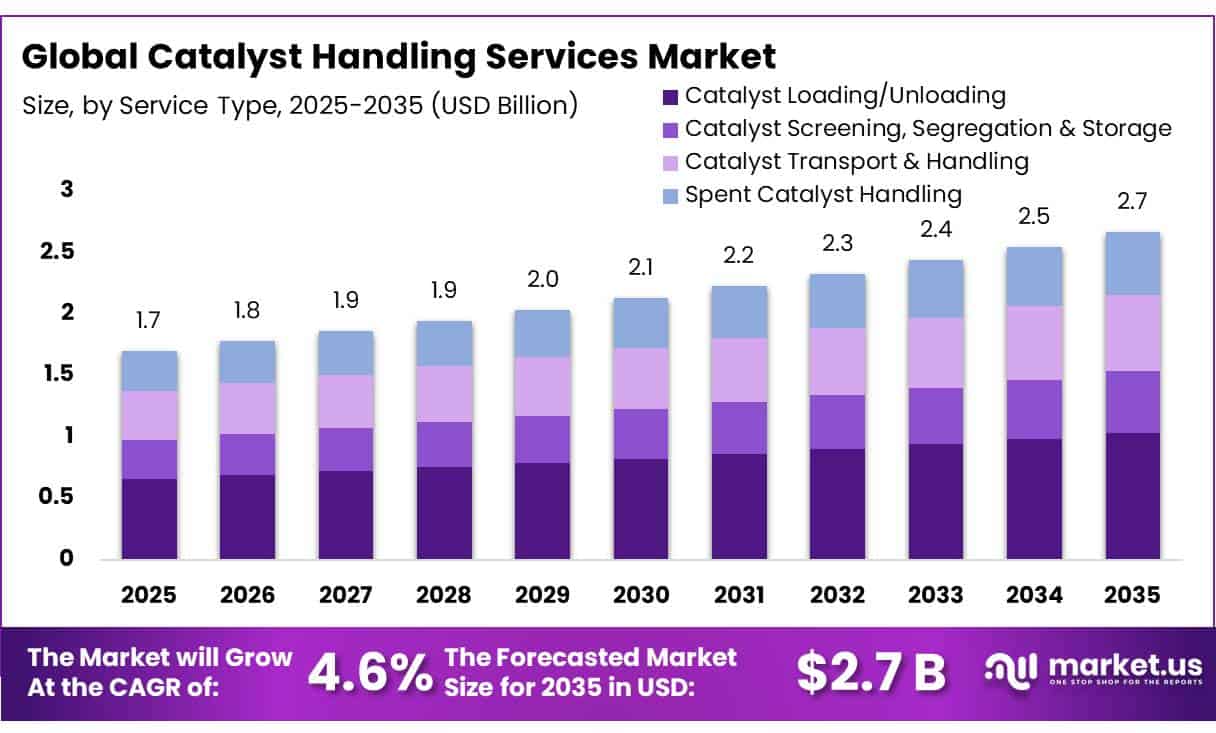
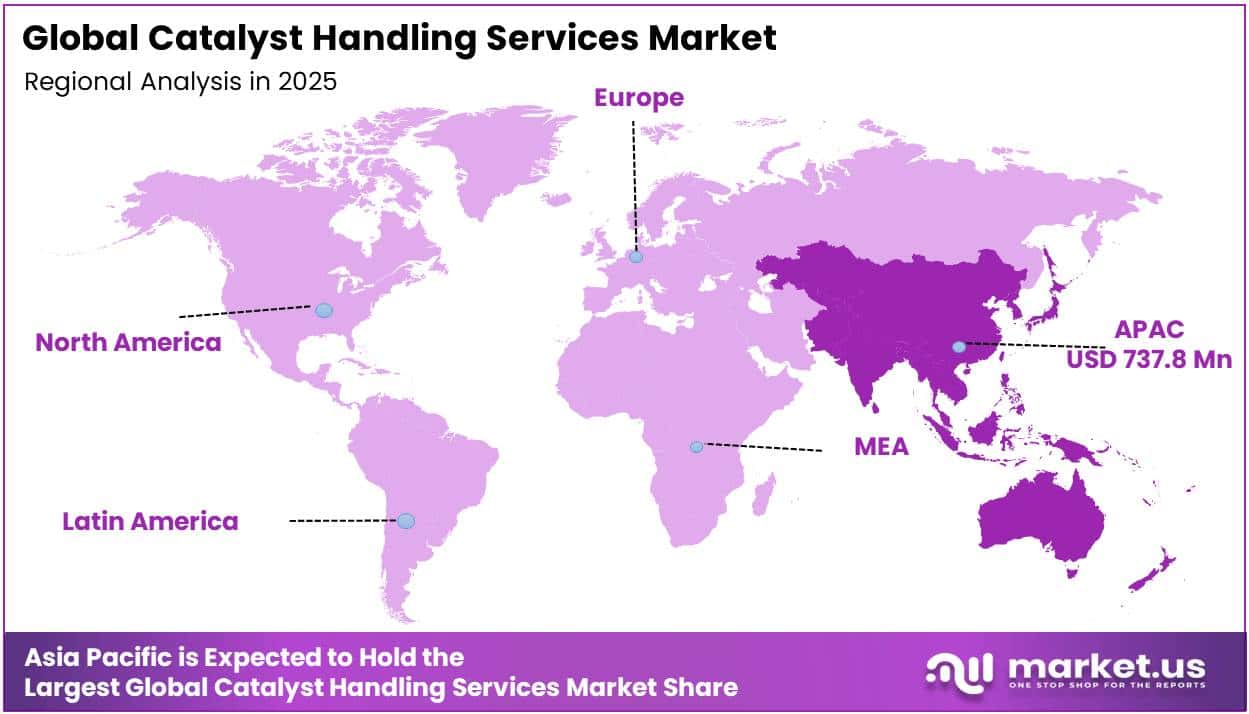
In 2025, the Global Catalyst Handling Services Market was valued at USD 1.7 billion, and between 2026 and 2035, this market is estimated to register a CAGR of 4.6%, reaching about USD 2.7 billion by 2035. In 2025, Asia Pacific held a dominant market position, capturing more than a 43.4% share, holding USD 0.4 Billion revenue.
The catalyst handling services market is driven by the growing complexity of industrial catalysts and the increasing demand for safe, efficient management across petroleum refining, chemicals, and petrochemical sectors. Advanced heterogeneous and homogeneous catalysts require precise loading, transport, storage, and spent catalyst handling to meet stringent regulatory and safety standards, including OSHA and EPA exposure limits.
Asia-Pacific represents a key hub due to expanding refining and chemical capacities in countries such as India, China, and Japan, supported by government initiatives on environmentally compliant recycling of spent catalysts. The integration of digital technologies, including IoT-enabled monitoring, predictive analytics, and automated handling systems, enhances operational efficiency and minimizes occupational hazards.
Geopolitical tensions affecting supply chains and transportation further underscore the need for robust risk management strategies. Service providers increasingly focus on technological integration, regulatory compliance, and strategic partnerships with industrial operators to optimize processes, ensure safety, and strengthen market positioning.
Key Takeaways
- The global catalyst handling services market was valued at USD 1.7 billion in 2025.
- The global market is projected to grow at a CAGR of 4.6% and is estimated to reach USD 2.7 billion by 2035.
- On the basis of service type, catalyst loading/unloading dominated the market, constituting 38.6% of the total market share.
- On the basis of catalyst type, heterogeneous catalysts dominated the market, with 82.4% market share.
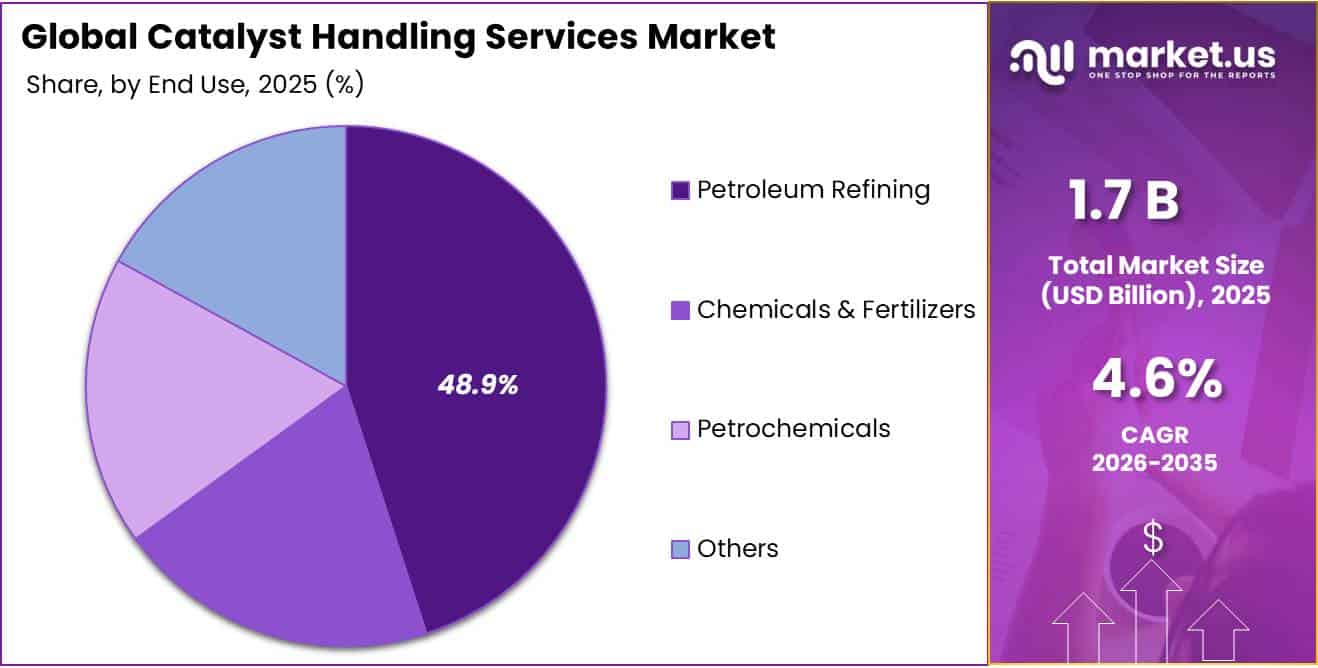
- Among the end uses, petroleum refining held a major share in the catalyst handling services market, 48.9% of the market share.
- In 2025, the Asia Pacific was the most dominant region in the catalyst handling services market, accounting for 43.4% of the total global consumption.
Service Type Analysis
Catalyst Loading/Unloading Dominated the Catalyst Handling Services Market.
Catalyst loading and unloading is the dominant service segment, accounting for 38.6% of the market, reflecting its critical role in industrial operations. Accurate handling of heterogeneous and homogeneous catalysts is essential to maintain reaction efficiency, minimize downtime, and ensure process safety in petroleum refining, petrochemicals, and chemical manufacturing. Automated and mechanized systems are increasingly deployed, often integrated with IoT-enabled monitoring, to regulate temperature, humidity, and particle distribution during transfer.
Compliance with regulatory standards, including OSHA and EPA limits for metals such as nickel and vanadium, necessitates strict operational protocols and trained personnel. Additionally, proper loading and unloading reduce risks associated with catalyst degradation and occupational exposure. With expanding refining and chemical capacities in Asia-Pacific and other industrial hubs, professional catalyst loading and unloading services remain a foundational element for operational reliability and efficiency across the industry.
Catalyst Type Analysis
Heterogeneous Catalysts Led the Market.
Heterogeneous catalysts dominate the market, accounting for 82.4% of the catalyst type segment, due to their extensive application in petroleum refining, petrochemical, and chemical processes. These solid-phase catalysts facilitate reactions in fixed or fluidized beds, enabling high selectivity and conversion efficiency while withstanding harsh temperature and pressure conditions. Their handling requires specialized services for loading, unloading, transport, storage, and spent catalyst management to ensure operational safety and compliance with OSHA and EPA regulations concerning metal content, including nickel, vanadium, and molybdenum.
Automation and IoT-enabled monitoring are increasingly employed to optimize catalyst placement, minimize degradation, and reduce occupational exposure. Given the widespread use of heterogeneous catalysts in large-scale industrial processes, their management represents a significant operational priority, reinforcing the critical role of professional catalyst handling services in maintaining process reliability and regulatory adherence.
End Use Analysis
Petroleum Refining Held a Major Share of the Catalyst Handling Services Market.
Petroleum refining is the dominant end-use segment, representing 48.9% of the market, driven by the extensive reliance on catalysts for processes such as hydrocracking, catalytic reforming, and hydrotreating. These processes require precise catalyst management to maintain high conversion efficiency, product quality, and operational safety. Specialized handling services, including loading, unloading, transport, storage, and spent catalyst management, are critical to prevent degradation, contamination, and exposure to metals such as nickel and vanadium, regulated under OSHA and EPA standards.
Automation and IoT-enabled monitoring systems are increasingly deployed to optimize catalyst performance, track conditions, and ensure regulatory compliance. With refining capacities expanding in Asia-Pacific and other industrial regions, professional catalyst handling remains essential for minimizing downtime, enhancing operational efficiency, and supporting the safe, sustainable operation of refinery facilities.
Key Market Segments
By Service Type
- Catalyst Loading/Unloading
- Catalyst Screening, Segregation & Storage
- Catalyst Transport & Handling
- Spent Catalyst Handling
By Catalyst Type
- Heterogeneous Catalysts
- Homogeneous Catalysts
By End Use
- Petroleum Refining
- Chemicals & Fertilizers
- Petrochemicals
- Others
Driver Analysis
Turnaround outsourcing
Refineries are increasingly treating catalyst loading, unloading, screening, inert-entry support, reactor cleaning, and dust-control work as specialist outsourced scopes rather than relying on internal maintenance teams, because shutdown duration has a direct and disproportionate economic effect on production value: using a practical throughput range of 100,000–300,000 barrels per day and a conservative USD 5–15 per-barrel gross-margin contribution, one additional outage day can put roughly USD 0.5–4.5 million of refinery gross-margin opportunity at risk before considering demurrage, contractor standby, and downstream product-supply penalties.
The commercial model consequently shifts from isolated labor-based work orders toward multi-site master service agreements that bundle reactor preparation, catalyst handling, screening, waste packaging, and post-job reporting; Contract Resources’ specialist, purpose-built equipment approach and recent multi-year Middle East/APAC contract activity illustrate this contractual direction.
Drivers Impact Analysis
| Driver | (~) % Impact on CAGR Forecast | Geographic Relevance | Impact Timeline |
|---|---|---|---|
| Turnaround outsourcing | +1.8% | North America, EU, Middle East | Short term (≤ 2 years) |
| Hydroprocessing renewals | +1.6% | APAC, Middle East, North America | Medium term (2-4 years) |
| Spent-catalyst recovery rules | +1.4% | North America, EU, India | Short term (≤ 2 years) |
| SAF and renewable-diesel conversions | +1.3% | North America, EU, APAC | Medium term (2-4 years) |
| Robotic and digital handling | +1.1% | North America, EU, APAC hubs | Long term (≥ 4 years) |
| Asia–Middle East petrochemical build-out | +0.9% | China, India, GCC, Southeast Asia | Medium term (2-4 years) |
Restraint Analysis
Refinery closures
The most direct structural restraint is permanent refinery closure and conversion activity, because catalyst-handling revenue depends on an installed base of operating FCC, hydrotreating, hydrocracking, reforming, and sulfur-treatment units with recurring change-out schedules; when a refinery closes, its future catalyst-loading, unloading, screening, and waste-packaging spend disappears rather than simply moving to the following quarter.
In the United States, the Energy Information Administration confirmed that LyondellBasell ended refining at its Houston site in March 2025 and Phillips 66 ceased operations at its Los Angeles refinery in October 2025, removing approximately 400,000 barrels per calendar day of operable capacity; the Los Angeles closure alone represented a 5% reduction in West Coast refining capacity. Europe is similarly exposed, with closures or repurposing at Grangemouth, Wesseling, and other legacy sites, while around 20% of global refinery capacity has been assessed as at risk of closure through 2035.
For catalyst-service contractors, this reduces available turnaround events, intensifies competition for the surviving high-complexity sites, and strands specialized vacuum, screening, and pneumatic-conveying assets that were geographically configured around declining refinery clusters; the resulting lower fleet utilization can dilute EBITDA margins by an estimated 200–400 basis points for providers without exposure to renewable fuels, petrochemicals, and metals recovery.
Restraint Impact Analysis
| Restraint | (~) % Impact on CAGR Forecast | Geographic Relevance | Impact Timeline |
|---|---|---|---|
| Refinery closures | -2.2% | North America, EU | Short term (≤ 2 years) |
| Turnaround budget cuts | -1.7% | North America, EU | Short term (≤ 2 years) |
| Skilled labor scarcity | -1.5% | North America, EU, APAC | Medium term (2-4 years) |
| Shutdown schedule volatility | -1.2% | Global | Short term (≤ 2 years) |
| Waste-rule fragmentation | -1.0% | North America, EU, India | Medium term (2-4 years) |
| Legacy fuel-demand erosion | -0.8% | North America, EU | Long term (≥ 4 years) |
Opportunity Analysis
Reactor-to-recycler services
A major white space lies in converting traditional catalyst loading/unloading contracts into an integrated reactor-to-recycler model that manages isolation, inert entry, catalyst vacuum transfer, screening, sampling, hazardous-waste classification, sealed packaging, transport, metals-recovery routing, and recovered-metal value sharing. This is not a current market driver because most handling contractors still invoice primarily for labor, equipment mobilization, and tonnes moved, while the additional value pool resides in preserving chain-of-custody and directing material to recovery rather than disposal.
In the United States, spent hydrotreating and hydrorefining catalysts are regulated hazardous waste streams K171 and K172, yet they may contain commercially relevant vanadium, molybdenum, nickel, cobalt, and other recoverable metals; H.R. 7523, introduced on February 12, 2026, is intended to clarify a regulatory path for legitimate recovery of such critical minerals. For a contractor handling a 100–500 tonne reactor change-out, the addition of certified sampling, packaging, logistics, and recycler coordination can reasonably increase project revenue by 15–30%, while a share of metal-recovery economics can produce a further 5–10% gross-margin uplift where contractual title and recovered-metal pricing are properly structured.
Opportunity Impact Analysis
| Opportunity | (~) % Potential CAGR Upside | Geographic Relevance | Execution Window |
|---|---|---|---|
| Reactor-to-recycler services | +2.4% | North America, EU, India | Short term (≤ 2 years) |
| SAF conversion handling | +2.1% | North America, EU, APAC | Medium term (2-4 years) |
| Digital turnaround SaaS | +1.8% | North America, EU, Middle East | Short term (≤ 2 years) |
| Robotic reactor servicing | +1.6% | Global, North America/EU core | Medium term (2-4 years) |
| Petrochemical hub localization | +1.4% | GCC, China, India, Southeast Asia | Medium term (2-4 years) |
| Distressed contractor M&A | +1.1% | North America, EU | Short term (≤ 2 years) |
Challenges Analysis
Confined-space talent deficit
Catalyst handling relies on a narrow workforce pool combining confined-space certification, respiratory-protection discipline, inert-atmosphere monitoring, vacuum conveying, rigging, hot-work coordination, hazardous-waste packaging, and emergency-rescue competence; this is not a short-cycle labor market because a credible supervisor or specialist equipment operator usually requires 24–60 months of field exposure, site-specific qualification, and safety-record development.
A major refinery turnaround can temporarily expand the number of personnel on site from a few hundred to as many as 2,000 specialist contractors, creating acute competition for the same crews across spring and autumn maintenance peaks. The resulting scarcity increases crew day-rates, overtime, travel, per-diem, and retention costs, with an estimated 10–18% uplift in fully loaded labor expense in high-demand regions relative to normal operating periods; it also exposes fixed-price service contracts to penalty risk when insufficient personnel extend the catalyst-out or catalyst-in critical path. Contractors must mitigate this through 12–18 month workforce planning, formal apprenticeships, multi-skill certification, shared regional labor pools, and an increased proportion of remote-operated equipment, rather than relying on spot hiring shortly before shutdowns.
Challenges Impact Analysis
| Challenge | (~) % CAGR Friction Drag | Geographic Relevance | Mitigation Horizon |
|---|---|---|---|
| Confined-space talent deficit | -1.4% | North America, EU, APAC | Medium term (2-4 years) |
| Turnaround resource clustering | -1.2% | North America, EU, GCC | Medium term (2-4 years) |
| Equipment mobilization volatility | -1.0% | APAC–EU, GCC, global corridors | Short term (≤ 2 years) |
| Hazardous-material traceability | -0.9% | North America, EU, India | Medium term (2-4 years) |
| Digital-OT cyber exposure | -0.8% | North America, EU, Middle East | Long term (≥ 4 years) |
| Multi-site execution inconsistency | -0.7% | Global, APAC/GCC expansion hubs | Medium term (2-4 years) |
Geopolitical Impact Analysis
Operational Challenges in Catalyst Handling Amid Geopolitical Disruptions.
Current geopolitical tensions are affecting the operational landscape for catalyst handling services, particularly in regions critical to petroleum refining and chemical production. The U.S. Department of Energy reported that disruptions in global supply chains for key metals, such as nickel, vanadium, and platinum, commonly used in heterogeneous and homogeneous catalysts, have been observed due to export restrictions and sanctions affecting Russia and Ukraine.
Similarly, the European Commission highlighted that logistical bottlenecks at Black Sea ports and increased inspection protocols have delayed the transportation of hazardous materials, including spent catalysts requiring RCRA-compliant handling under U.S. EPA guidelines. For instance, Shell’s operational disclosure in 2022 noted that international plants have had to adjust catalyst delivery schedules and implement additional storage measures to mitigate delays caused by border restrictions and customs delays.
Moreover, heightened scrutiny over the cross-border movement of reactive and metal-laden catalysts has necessitated enhanced documentation, compliance checks, and safety protocols. These operational adjustments, driven by geopolitical constraints, have increased the complexity, labor requirements, and risk management needs for service providers while emphasizing the importance of strategic planning in catalyst logistics.
Regional Analysis
Asia Pacific Held the Largest Share of the Global Catalyst Handling Services Market.
In 2025, the Asia Pacific dominated the global catalyst handling services market, holding about 43.4% of the total global consumption, driven by extensive refining and petrochemical capacity expansion. According to the Ministry of Petroleum and Natural Gas, in 2023, India’s refining throughput reached 250 million tons per annum, with multiple new hydrocracking and catalytic reforming units under construction in Gujarat and Maharashtra, all requiring advanced heterogeneous catalysts.
In China, the National Development and Reform Commission reported that in 2022, over 60 new chemical and petrochemical plants employing homogeneous and heterogeneous catalysts under high-pressure and high-temperature conditions. Additionally, regional governments, such as Japan’s Ministry of Economy, Trade and Industry, have emphasized environmentally compliant spent catalyst recycling programs, further increasing the demand for professional handling solutions across the Asia-Pacific.
Key Regions and Countries
- North America
- The US
- Canada
- Europe
- Germany
- France
- The UK
- Spain
- Italy
- Russia & CIS
- Rest of Europe
- APAC
- China
- Japan
- South Korea
- India
- ASEAN
- Rest of APAC
- Latin America
- Brazil
- Mexico
- Rest of Latin America
- Middle East & Africa
- GCC
- South Africa
- Rest of MEA
Key Players Analysis
Manufacturers of catalyst handling services focus on operational excellence and technological integration to strengthen their competitive positioning. Key strategic activities include implementing automated loading, unloading, and storage systems to reduce human exposure to toxic metals such as nickel and vanadium, in compliance with OSHA and EPA safety standards. Many companies invest in IoT-enabled monitoring and predictive analytics to optimize catalyst lifecycle management, enabling timely replacement and minimizing process downtime.
Operational protocols for spent catalyst segregation, containment, and recycling are emphasized to meet environmental regulations, such as those outlined under the U.S. RCRA and the European REACH framework. Additionally, partnerships with refinery and chemical plant operators facilitate end-to-end service integration, ensuring regulatory compliance, enhancing safety, and improving overall process efficiency, thereby reinforcing market presence and client trust.
The Major Players in The Industry
- Mourik
- ANABEEB
- Dickinson Group of Companies
- Nico Industrial Services s.r.l.
- CR3
- Catalyst Handling Resources
- Technivac
- REMONDIS SE & Co. KG
- Cat Tech
- Group Peeters
- Contract Resources
- Plant-Tech Services
- Veolia
- Petroneft Non-Entry Engineering Solutions Pvt. Ltd
- Almuzain
- Other Key Players
Key Development
- In June 2025, construction and contracting firm Mourik agreed to acquire GETEC’s industrial cleaning operations, strengthening its presence in northeastern Netherlands and securing a location at the GETEC PARK.EMMEN site, which will be integrated into Mourik’s Industry division.
Report Scope
| Report Features | Description |
|---|---|
| Market Value (2025) | US$37.4 Bn |
| Forecast Revenue (2035) | US$117.2 Bn |
| CAGR (2026-2035) | 12.1% |
| Base Year for Estimation | 2025 |
| Historic Period | 2020-2024 |
| Forecast Period | 2026-2035 |
| Report Coverage | Revenue Forecast, Market Dynamics, Competitive Landscape, Recent Developments |
| Segments Covered | By Product (Aluminum, Zinc, Copper, Stainless Steel, and Others), By Application (Paints & Coatings, Plastics, Printing Inks, Cosmetics, and Others) |
| Regional Analysis | North America – The US & Canada; Europe – Germany, France, The UK, Spain, Italy, Russia & CIS, Rest of Europe; APAC– China, Japan, South Korea, India, ASEAN & Rest of APAC; Latin America– Brazil, Mexico & Rest of Latin America; Middle East & Africa– GCC, South Africa, & Rest of MEA |
| Competitive Landscape | Mourik, ANABEEB, Dickinson Group of Companies, Nico Industrial Services s.r.l., CR3, Catalyst Handling Resources, Technivac, REMONDIS SE & Co. KG, Cat Tech, Group Peeters, Contract Resources, Plant-Tech Services, Veolia, Petroneft Non-Entry Engineering Solutions Pvt. Ltd, Almuzain, and Other Players. |
| Customization Scope | Customization for segments, region/country-level will be provided. Moreover, additional customization can be done based on the requirements. |
| Purchase Options | We have three licenses to opt for: Single User License, Multi-User License (Up to 5 Users), Corporate Use License (Unlimited Users and Printable PDF) |





































