


Report Overview
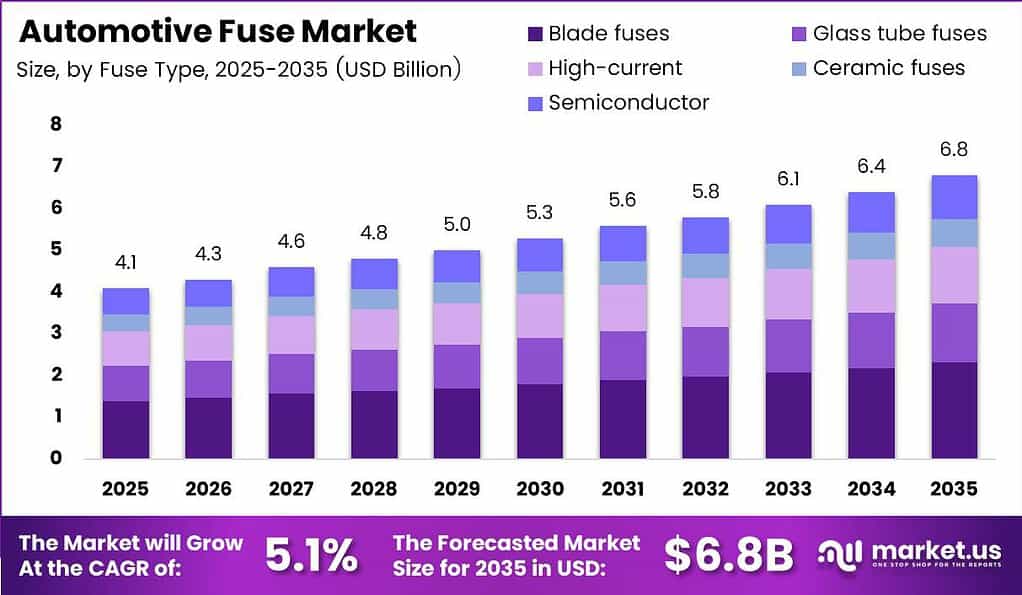
Global Automotive Fuse Market size is expected to be worth around USD 6.8 Billion by 2035 from USD 4.1 Billion in 2025, growing at a CAGR of 5.1% during the forecast period 2026 to 2035. According to OICA, global motor-vehicle production reached 96.4 million units in 2025, up from 92.7 million in 2024, while global vehicle sales reached 99.8 million units. This production volume creates a proportional baseline demand for fuse components across every vehicle assembled worldwide.
The automotive fuse market supplies overcurrent protection components embedded across vehicle electrical architectures. Products range from low-voltage blade fuses protecting cabin electronics to high-voltage ceramic and semiconductor fuses protecting battery packs in electric vehicles. The market serves original-equipment manufacturers, tier-one suppliers, and aftermarket distributors across passenger cars, light commercial vehicles, and heavy-duty platforms globally.
Key Takeaways
- The global Automotive Fuse Market was valued at USD 4.1 Billion in 2025 and is forecast to reach USD 6.8 Billion by 2035, growing at a CAGR of 5.1%.
- By Fuse Type, Blade Fuses dominate with a 33.4% share in 2025.
- By Voltage Class, the 12–24 V class leads with a 41.2% share in 2025.
- By Propulsion, Passenger Cars (ICE + EV) hold the largest share at 62.3% in 2025.
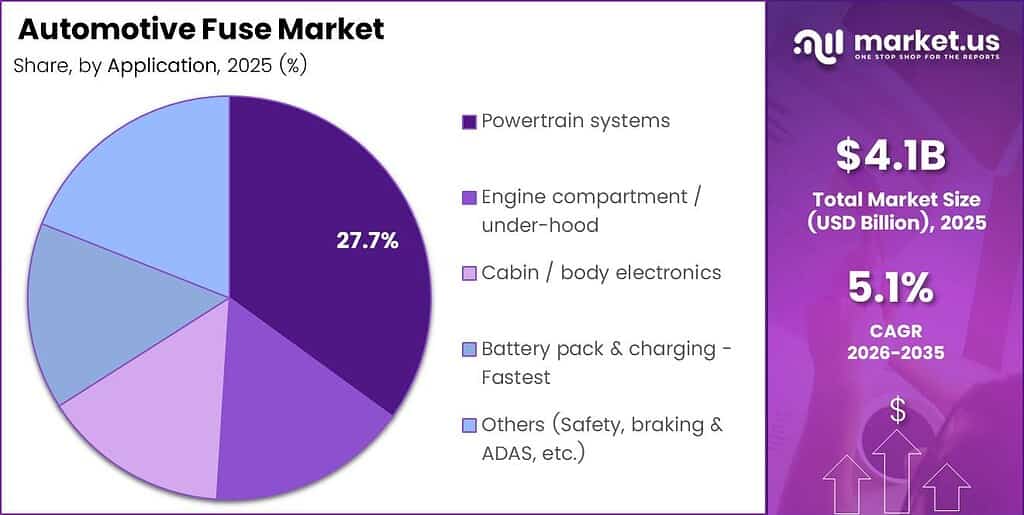
- By Application, Powertrain Systems hold a 27.7% share in 2025.
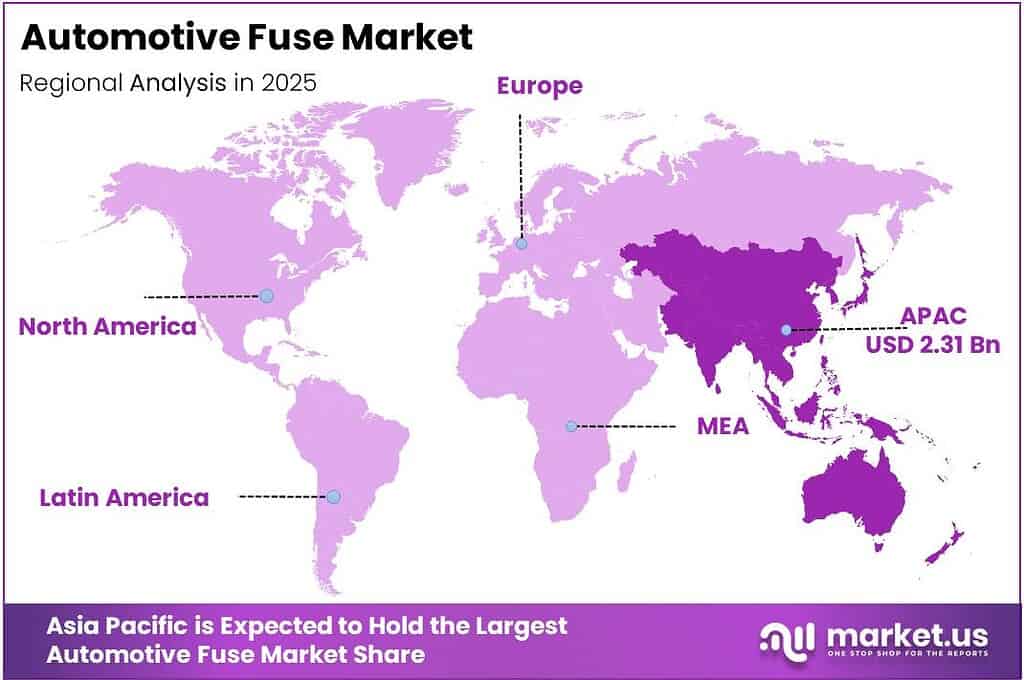
- Asia Pacific dominates the regional landscape with a 55.9% market share, valued at USD 2.31 Billion in 2025.
- Asia Pacific is also the fastest-growing region in the Automotive Fuse Market.
As reported by IEA data, almost 22 million electric cars were produced globally in 2025, more than 25% higher than the prior year. This production surge directly expands the addressable market for high-voltage fuse components. Suppliers positioned in EV-specific protection products gain disproportionate revenue exposure as battery-electric platforms scale. In addition, Littelfuse released its Nano² 415 SMD Fuse series in May 2025, targeting EV charging stations, home chargers, and energy-storage systems, signaling that product roadmaps are actively tracking infrastructure build-out alongside vehicle-side demand.
Data from IEA shows nearly 1.8 million public charging points were added globally in 2025, taking the worldwide public-charger stock to more than 7 million, a growth of more than 33%. Each charging installation requires its own overcurrent protection, extending fuse demand beyond the vehicle itself. This creates a dual revenue channel for fuse suppliers serving both vehicle assembly and stationary charging infrastructure. As per our research, world merchandise-trade volume grew 4.6% in 2025, well above the WTO’s earlier 2.4% forecast, supporting cross-border component flows that automotive fuse suppliers depend on for raw-material sourcing and finished-product distribution.
Type Analysis
Blade Fuses dominate with 33.4% due to universal fitment across ICE and hybrid vehicle platforms.
In 2025, Blade Fuses held a dominant market position in the By Fuse Type segment of the Automotive Fuse Market, with a 33.4% share. Their standardized housing fits legacy and current-generation fuse boxes across virtually every passenger and light commercial vehicle globally. This cross-platform compatibility reduces OEM retooling costs, entrenching blade fuses as the default protection solution in high-volume, cost-sensitive vehicle lines.
Glass Tube Fuses serve a concentrated aftermarket role, protecting older-generation vehicles where blade-format fuse boxes were not yet adopted. Replacement demand in aging fleets across North America, Europe, and South Asia sustains their volume. However, the EU bus fleet reached roughly 700,000 vehicles in 2024, up 1.8% year on year, with electrically chargeable buses at 3.5% of the fleet, pointing to gradual electrification pressure on legacy fuse formats even in commercial segments.
High-current and limiter fuses are the fastest-growing sub-segment within Fuse Type, driven by battery-pack protection requirements in electric and hybrid powertrains. Their higher interrupt ratings and tighter arc-control tolerances command a price premium over standard blade formats. Suppliers investing in high-interrupt-rating product lines early can lock in qualification slots with OEM battery programs before competitors complete their own validation cycles.
Ceramic Fuses serve specific under-hood and high-temperature engine-compartment applications where polymer housings cannot maintain dimensional stability. Semiconductor and chip fuse types address miniaturized circuit-board-level protection in ADAS and cabin electronics modules. Littelfuse reported fiscal 2025 net sales increased by 10%, with organic sales rising 9%, attributing growth partly to energy-storage and data-center end markets that increasingly share protection-component technology with automotive applications.
Voltage Class Analysis
12–24 V Class dominates with 41.2% due to near-universal fitment in ICE and mild-hybrid architectures.
In 2025, the 12–24 V Class held a dominant market position in the By Voltage Class segment of the Automotive Fuse Market, with a 41.2% share. This voltage band covers the primary electrical system of virtually every internal-combustion and mild-hybrid vehicle on the road today. With the EU reporting 256 million cars in use in 2024, a 1.4% year-on-year increase, the sheer installed base of 12–24 V vehicles ensures aftermarket replacement volumes remain structurally large for the full forecast period.
The 24–48 V Class is gaining specification traction in mild-hybrid architectures, where a secondary battery and belt-integrated starter-generator operate alongside the legacy 12 V rail. This dual-voltage configuration requires additional fuse positions and higher interrupt ratings than a pure 12 V system. Suppliers that qualify components for 48 V systems position themselves in a growing OEM content layer without yet competing in the more demanding high-voltage EV segment.
The 49–300 V and above 300 V Classes together serve full-hybrid, plug-in-hybrid, and battery-electric platforms. The above-300 V class is the fastest-growing voltage segment, reflecting architectural migration toward 400 V and 800 V battery systems in premium and performance EVs. As per our research, Mersen was selected by the U.S. Defense Logistics Agency in December 2025 for a three-year graphite-supply contract valued at approximately $10 million, illustrating how advanced material capabilities developed for industrial applications transfer directly into high-voltage automotive fuse qualification.
Propulsion Analysis
Passenger Cars (ICE + EV) dominate with 62.3% due to global volume leadership across both powertrains.
In 2025, Passenger Cars (ICE + EV) held a dominant market position in the By Propulsion segment of the Automotive Fuse Market, with a 62.3% share. This segment encompasses the broadest range of fuse specifications, from standard blade fuses in economy ICE vehicles to high-voltage limiter fuses in premium EVs. IEA data shows the global electric-car fleet reached almost 58 million vehicles at the end of 2024, equivalent to approximately 4% of the total passenger-car fleet, confirming that fuse content per vehicle is rising as EV share grows within this dominant segment.
Commercial Vehicles, spanning light commercial vehicles and medium-to-heavy commercial vehicles, generate a stable volume base from logistics, municipal, and construction fleets. Fleet operators replace fuses more frequently than private owners due to higher utilization cycles, supporting predictable aftermarket revenues. The EU recorded approximately 6.2 million trucks on the road in 2024, up 0.9%, with electrically chargeable trucks at just 0.3% of the fleet, indicating that electrification-driven fuse spec upgrades in this segment remain an early-stage but directionally confirmed opportunity.
Dedicated EVs represent the fastest-growing propulsion sub-segment, driven by battery platforms that require high-voltage fuses across battery pack, DC-DC converter, onboard charger, and thermal-management circuits. Each additional circuit in an EV powertrain adds a protection requirement that an ICE vehicle does not carry. Suppliers with AEC-Q200-qualified high-voltage product lines hold a distinct qualification advantage as OEMs ramp dedicated EV platforms globally.
Application Analysis
Powertrain Systems dominate with 27.7% due to high fuse density and criticality in both ICE and EV drivetrains.
In 2025, Powertrain Systems held a dominant market position in the By Application segment of the Automotive Fuse Market, with a 27.7% share. Powertrain circuits carry the highest sustained current loads in any vehicle, requiring the largest-format fuses with the most stringent interrupt ratings. This criticality makes powertrain fuse content largely resistant to value engineering, giving suppliers stable average selling prices within this application category.
Engine Compartment and under-hood applications protect starter motors, alternators, cooling fans, and auxiliary power distribution from overload conditions. These positions demand thermal durability across a wide operating-temperature range, which limits substitution by lower-spec components. The EU vehicle parc included approximately 31.1 million vans in 2024, with electrically chargeable vans at just 1.3% of the total, confirming that under-hood fuse volumes in this segment will remain ICE-dominated through the near term.
Cabin and body electronics applications have expanded in content per vehicle as passive safety systems, infotainment, and comfort electronics multiply across trim levels. This proliferation increases fuse-position count per vehicle without significantly increasing unit selling price, creating a volume rather than value growth story for suppliers in this application category.
Battery Pack and Charging is the fastest-growing application sub-segment. IEA data shows the stock of private light-duty EV charging points exceeded 43 million globally in 2025, supporting approximately 76 million electric light-duty vehicles. Each charging point and each EV battery system requires dedicated overcurrent protection, expanding addressable units well beyond the vehicle count itself. The remaining Others category, covering safety, braking, and ADAS circuits, rounds out application coverage across all vehicle types.
Key Market Segments
By Fuse Type
- Blade Fuses
- Glass Tube Fuses
- High-Current / Limiter Fuses
- Ceramic Fuses
- Semiconductor / Chip and Other Fuse Types
By Voltage Class
- 12–24 V Class
- 24–48 V Class
- 49–150 V Class
- 151–300 V Class
- Above 300 V Class
By Propulsion
- Passenger Cars (ICE + EV)
- Commercial Vehicles (LCV + M/HCV)
- Dedicated EVs
By Application
- Powertrain Systems
- Engine Compartment / Under-Hood
- Cabin / Body Electronics
- Battery Pack and Charging
- Others (Safety, Braking and ADAS)
Regional Analysis
Asia Pacific Dominates the Automotive Fuse Market with a Market Share of 55.9%, Valued at USD 2.31 Billion
Asia Pacific commands the largest regional share through the concentration of vehicle assembly, component manufacturing, and EV adoption within China, Japan, South Korea, and India. IEA data shows China produced approximately 16 million electric cars in 2025, accounting for around 75% of global EV production. Chinese EV production exceeded domestic demand by 20%, and EV exports surpassed 2.5 million units, directing high-voltage fuse demand from local assembly toward export-grade platforms that require internationally certified protection components. China accounted for more than 70% of global electric-car production in 2024, establishing a structural concentration of fuse sourcing activity within the region.
Europe is a significant growth corridor within the forecast period. IEA data shows electric-car sales in Europe grew by more than 30% in 2025 and reached 28% of total car sales. This pace of EV penetration forces fuse suppliers serving European OEMs to accelerate high-voltage product qualification timelines. China’s public charging infrastructure increased from nearly 3.4 million points at end-2024 to more than 4.7 million at end-2025, accounting for over 75% of global public-charger growth, further anchoring Asia Pacific as the primary infrastructure-driven demand center.
Mersen invested €64.1 million in capital expenditure during the first half of 2025, with more than two-thirds allocated to capacity expansion principally for silicon-carbide semiconductor demand, signaling European supplier investment flows tracking EV protection requirements. TE Connectivity completed its Richards Manufacturing acquisition during fiscal Q2 2025, reporting net sales of $4.1 billion that quarter, a 4% year-on-year increase, reinforcing that leading global suppliers are actively expanding infrastructure coverage through acquisition.
North America maintains a stable demand base supported by large-displacement ICE vehicle production, growing EV assembly programs, and a deep aftermarket channel serving aging vehicles. Latin America, the Middle East, and Africa together represent smaller absolute volumes but carry disproportionate aftermarket intensity as older ICE fleets require ongoing blade-fuse replacement. These regions offer digital aftermarket distribution as an accessible near-term channel for suppliers seeking to capture replacement demand without building local manufacturing infrastructure.
Key Regions and Countries
North America
- US
- Canada
Europe
- Germany
- France
- The UK
- Spain
- Italy
- Rest of Europe
Asia Pacific
- China
- Japan
- South Korea
- India
- Australia
- Rest of APAC
Latin America
- Brazil
- Mexico
- Rest of Latin America
Middle East and Africa
- GCC
- South Africa
- Rest of MEA
Drivers
Vehicle electrification drives the highest incremental fuse content per vehicle across the forecast period. Battery-electric and hybrid platforms require protection across low-voltage, high-voltage, auxiliary, charging, and thermal-management circuits simultaneously. Global electric-car sales exceeded 17 million units in 2024, rising more than 25% year over year, while 2025 sales exceeded 20 million units and represented more than one-quarter of global new-car sales. Battery deployment reached approximately 1.2 TWh in 2025, up nearly 30% from 2024 and more than 7 times the 2020 level, shifting fuse suppliers toward higher-voltage products with tighter arc-control tolerances and faster qualification cycles.
Beyond electrification, rising electronic content per vehicle, fleet aging in North America and Europe, regional production localization in India and East Asia, and expanding advanced driver-assistance systems each contribute independent demand pulls. Suppliers that align product portfolios with multiple simultaneous drivers reduce revenue concentration risk and improve platform win probability across diverse OEM relationships.
| Driver | (~) % Impact on CAGR Forecast | Geographic Relevance | Impact Timeline |
|---|---|---|---|
| Vehicle Electrification | +1.3% | Global; strongest in China, Europe, North America, India | Short term (≤ 2 years) |
| Higher Electronic Content | +0.8% | Global passenger and commercial vehicles | Short term (≤ 2 years) |
| Aging Vehicle Parc | +0.6% | North America, Europe, India, Southeast Asia | Short term (≤ 2 years) |
| Regional Production Localization | +0.5% | India, North America, Europe, East Asia | Medium term (2–4 years) |
| Advanced Driver Systems | +0.4% | China, Europe, North America, Japan, South Korea | Medium term (2–4 years) |
Restraints
Input-cost volatility is the most immediate check on market revenue growth. Fuse production depends on conductive metals, engineered polymers, ceramics, plating chemicals, and packaging inputs that cannot be substituted without triggering requalification cycles. The European Commission classifies copper and nickel as strategic raw materials, while its trade analysis identifies concentrated import dependencies, including 94% of European rare-earth-element imports originating from China, Malaysia, and Russia combined in 2023. A sudden 5%–10% movement in conductive-metal or polymer costs can reduce component gross margin by roughly 1–3 percentage points where customer contracts limit pass-through, and qualification restrictions can delay alternative sourcing by 6–12 months. This combination of margin pressure and sourcing inflexibility imposes an estimated 0.7% deduction from the baseline CAGR.
| Restraint | (~) % Impact on CAGR Forecast | Geographic Relevance | Impact Timeline |
|---|---|---|---|
| Input-Cost Volatility | -0.7% | Global; concentrated in copper, aluminium, polymers and ceramics | Short term (≤ 2 years) |
| OEM Price Compression | -0.5% | Global vehicle-production hubs | Short term (≤ 2 years) |
| Qualification-CapEx Burden | -0.4% | Europe, North America, Japan, South Korea | Short term (≤ 2 years) |
| Counterfeit Replacement Parts | -0.3% | South Asia, Southeast Asia, Africa, Latin America | Short term (≤ 2 years) |
| Vehicle-Output Volatility | -0.2% | Global; most acute in export-oriented economies | Short term (≤ 2 years) |
Challenges
Thermal-derating complexity is the largest structural challenge facing automotive fuse suppliers across the forecast period. Higher current density, smaller packaging envelopes, elevated under-hood temperatures, and mixed-voltage architectures increase the probability that a fuse will either nuisance-trip or fail to interrupt a fault safely. Battery deployment rising to approximately 1.2 TWh in 2025, nearly 30% above 2024, indicates how quickly the installed base of high-energy electrical systems is expanding. A design that loses even 10% of effective current-carrying capability under thermal stress may require larger conductors, additional cooling, or a higher-rated protection device, increasing harness mass and unit cost by roughly 2%–5% and extending validation programs by 3–6 months, creating an estimated 0.8% drag on the market’s maximum growth potential.
| Challenge | (~) % CAGR Friction Drag | Geographic Relevance | Mitigation Horizon |
|---|---|---|---|
| Thermal-Derating Complexity | -0.8% | Global EV and high-load commercial-vehicle platforms | Medium term (2–4 years) |
| Specialist Labor Shortage | -0.6% | Europe, North America, Japan, South Korea, India | Medium term (2–4 years) |
| Multi-Tier Traceability | -0.5% | Global supply chains | Medium term (2–4 years) |
| Platform Fragmentation | -0.4% | Global; strongest across mixed ICE, hybrid and EV portfolios | Medium term (2–4 years) |
| End-of-Life Recovery | -0.3% | Europe, China, North America | Long term (≥ 4 years) |
Opportunities
High-voltage e-fuse platforms represent the largest untapped revenue opportunity in the market. Current demand concentrates in conventional sacrificial protection, while integrated sensing, switching, diagnostics, and coordinated fault isolation for EV battery and charging architectures remain commercially underdeveloped. Battery deployment exceeded 1.2 TWh in 2025, yet the transition to active protection architecture remains uneven across vehicle segments and regions. A successful e-fuse platform could reduce separate protection, sensing, and service components by approximately 10%–20%, lower assembly content by roughly 5%–10%, and expand supplier gross margin by an estimated 3–6 percentage points through software-enabled diagnostics and platform reuse, supporting an additional 0.9% CAGR above the baseline.
| Opportunity | (~) % Potential CAGR Upside | Geographic Relevance | Execution Window |
|---|---|---|---|
| High-Voltage E-Fuse Platforms | +0.9% | China, Europe, North America, Japan, South Korea | Medium term (2–4 years) |
| Smart Resettable Protection | +0.7% | Global connected-vehicle platforms | Medium term (2–4 years) |
| Circular Material Recovery | +0.5% | Europe, China, North America | Long term (≥ 4 years) |
| Digital Aftermarket Distribution | +0.5% | India, Southeast Asia, Latin America, Africa | Short term (≤ 2 years) |
| India-Led Export Platforms | +0.4% | India, Middle East, Africa, Europe | Medium term (2–4 years) |
Key Company Insights
Littelfuse, Inc. generated approximately $2.4 billion in revenue in 2025 and reported approximately $499 million in EBITDA. This margin profile reflects strong pricing power in qualified, application-specific fuse products. TE Connectivity priced $900 million in senior notes and a further €500 million offering in April 2025, both intended partly to finance the Richards Manufacturing acquisition, signaling aggressive balance-sheet deployment to expand electrical-infrastructure coverage.
Eaton Corporation plc reported record sales of $27.4 billion in 2025, a 10% increase from 2024, with organic growth contributing 8 percentage points and acquisitions contributing 2 percentage points. This scale gives Eaton unmatched cross-selling reach across vehicle, industrial, and utility electrical channels. Mersen generated €1.186 billion in sales in 2025 and invested €129.3 million in capital expenditure, signaling capacity-building commitment toward high-specification protection materials that feed directly into automotive fuse applications.
Key Players
- Littelfuse, Inc.
- Eaton Corporation plc
- Mersen S.A.
- Bel Fuse Inc.
- Schurter Holding AG
- Pacific Engineering Corporation (PEC)
- AEM Components, Inc.
- SIBA GmbH
- Conquer Electronics Co., Ltd.
- Vicfuse / Vicfuse Electric
- OptiFuse
- TE Connectivity Ltd.
- Carling Technologies Inc.
- ON Semiconductor Corporation
- Sensata Technologies, Inc.
- Others
Recent Developments
- March 2025 – Littelfuse launched the AEC-Q200-qualified 823A Series high-voltage automotive SMD fuse for EV battery-management systems and high-voltage DC-DC converters, rated at 1,000 VDC in a compact 5 x 20 mm package with a 100 A interrupting rating at 1 kV DC.
- April 2025 – Eaton introduced dual-trigger pyro fuses for enhanced EV circuit protection and safety, expanding its electrified-vehicle protection portfolio.
- September 2025 – Littelfuse introduced the 828 and 827 Series high-voltage cartridge fuses for EV onboard chargers and power-distribution units, rated at 1,000 VDC and 800 VDC respectively, with a 10 kA interrupting rating.
- September 2025 – Eaton launched dozens of new electrified-vehicle fuse families as part of its expanded global fuse portfolio, broadening high-voltage product coverage across commercial and passenger EV platforms.
- February 2025 – TE Connectivity announced its acquisition of Richards Manufacturing in an all-cash transaction valued at approximately $2.3 billion, intended to expand its position in electrical-distribution infrastructure for the energy market.
- June 2026 – Mersen announced its next-generation 1,000 VDC MEV fuse solutions for electric vehicles, targeting battery-pack and charging-circuit protection in high-voltage EV architectures.
Report Scope
| Report Features | Description |
|---|---|
| Market Value (2025) | USD 4.1 Billion |
| Forecast Revenue (2035) | USD 6.8 Billion |
| CAGR (2026-2035) | 5.1% |
| Base Year for Estimation | 2025 |
| Historic Period | 2020-2024 |
| Forecast Period | 2026-2035 |
| Report Coverage | Revenue Forecast, Market Dynamics, Market Opportunity Analysis, Technology and Innovation Landscape, Competitive Landscape, Recent Developments |
| Segments Covered | By Fuse Type (Blade Fuses, Glass Tube Fuses, High-Current / Limiter Fuses, Ceramic Fuses, Semiconductor / Chip and Other Fuse Types), By Voltage Class (12–24 V Class, 24–48 V Class, 49–150 V Class, 151–300 V Class, Above 300 V Class), By Propulsion (Passenger Cars ICE + EV, Commercial Vehicles LCV + M/HCV, Dedicated EVs), By Application (Powertrain Systems, Engine Compartment / Under-Hood, Cabin / Body Electronics, Battery Pack and Charging, Others Safety Braking and ADAS) |
| Regional Analysis | North America (US and Canada), Europe (Germany, France, The UK, Spain, Italy, and Rest of Europe), Asia Pacific (China, Japan, South Korea, India, Australia, and Rest of APAC), Latin America (Brazil, Mexico, and Rest of Latin America), Middle East and Africa (GCC, South Africa, and Rest of MEA) |
| Competitive Landscape | Littelfuse, Inc., Eaton Corporation plc, Mersen S.A., Bel Fuse Inc., Schurter Holding AG, Pacific Engineering Corporation (PEC), AEM Components, Inc., SIBA GmbH, Conquer Electronics Co., Ltd., Vicfuse / Vicfuse Electric, OptiFuse, TE Connectivity Ltd., Carling Technologies Inc., ON Semiconductor Corporation, Sensata Technologies, Inc., Others |
| Customization Scope | Customization for segments, region/country-level will be provided. Additional customization can be done based on requirements. |
| Purchase Options | We have three licenses to opt for: Single User License, Multi-User License (Up to 5 Users), Corporate Use License (Unlimited User and Printable PDF) |





































