


Report Overview
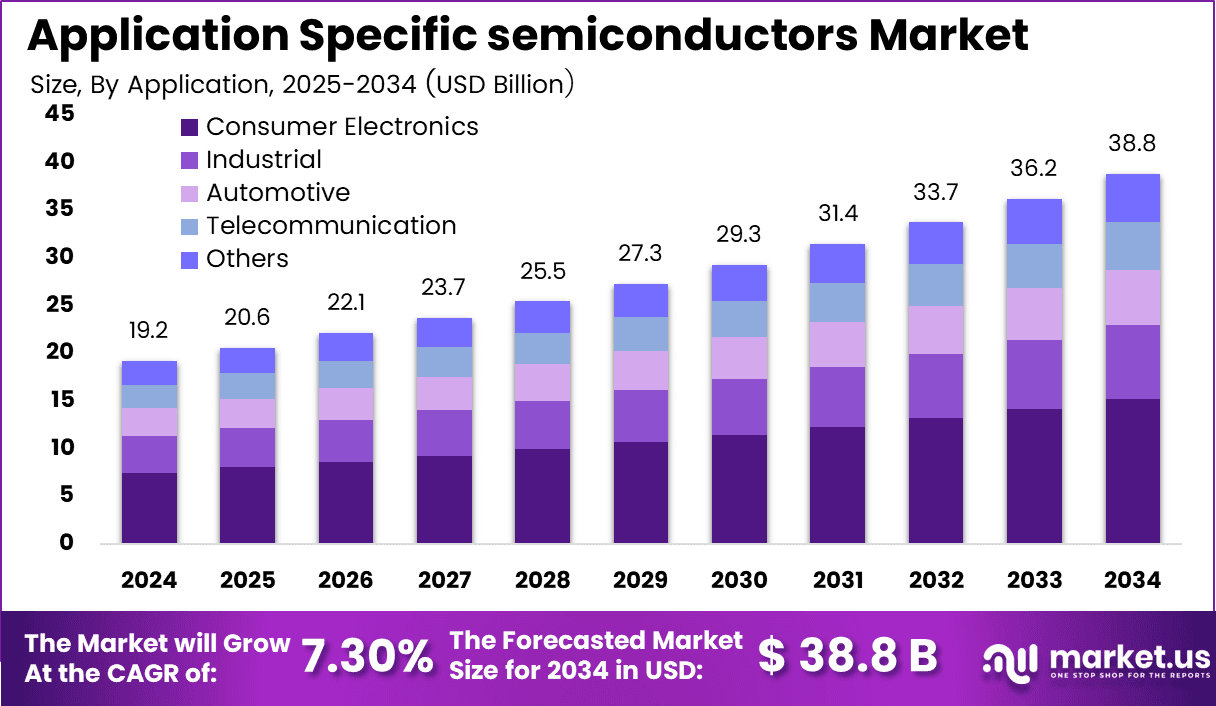
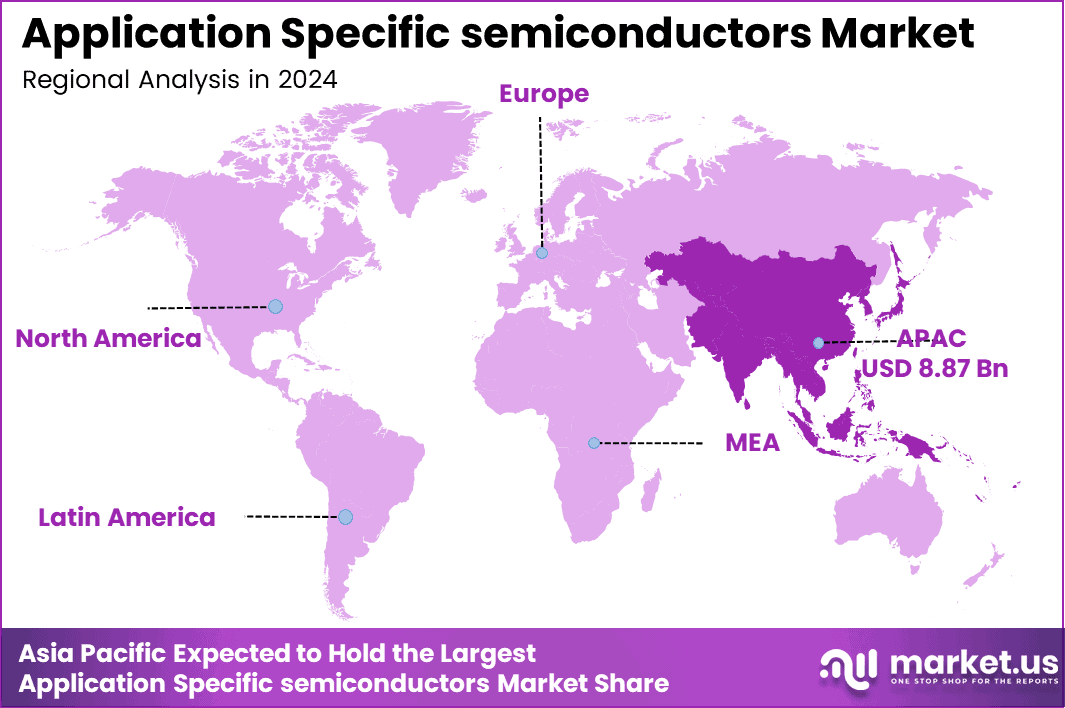
In 2024, the Global Application Specific Semiconductors Market was valued at USD 19.2 billion and is projected to reach around USD 38.8 billion by 2034, growing at a CAGR of 7.3% during 2025–2034. Asia Pacific held more than 46.2% of the market in 2024, generating approximately USD 8.87 billion in revenue.
The broader semiconductor industry also supports this growth. Global semiconductor sales reached a record USD 630.5 billion in 2024, increasing 19.1% from 2023, and are expected to reach around USD 701 billion in 2025. The Americas generated approximately USD 195.1 billion in semiconductor sales during 2024, reflecting strong regional demand for advanced and customized chips.
Automotive applications are another major growth area. Global vehicle production reached approximately 92.7 million units in 2024, increasing demand for application-specific chips used in safety systems, infotainment, electric drivetrains, sensors, and vehicle control systems. Greater electronic content per vehicle continues to support demand for specialized semiconductor solutions.
The Internet of Things is also expanding the addressable market. Around 18.5 billion connected devices were active globally in 2024, representing a 12% increase from the previous year. Rising adoption across vehicles, industrial sensors, smart homes, and medical devices is increasing the need for low-power, application-specific chips and supporting the market’s growth from USD 19.2 billion toward USD 38.8 billion.
Key Takeaways
- The Global Application Specific Semiconductors Market was valued at USD 19.2 billion in 2024 and is projected to reach USD 38.8 billion by 2034, growing at a 7.3% CAGR.
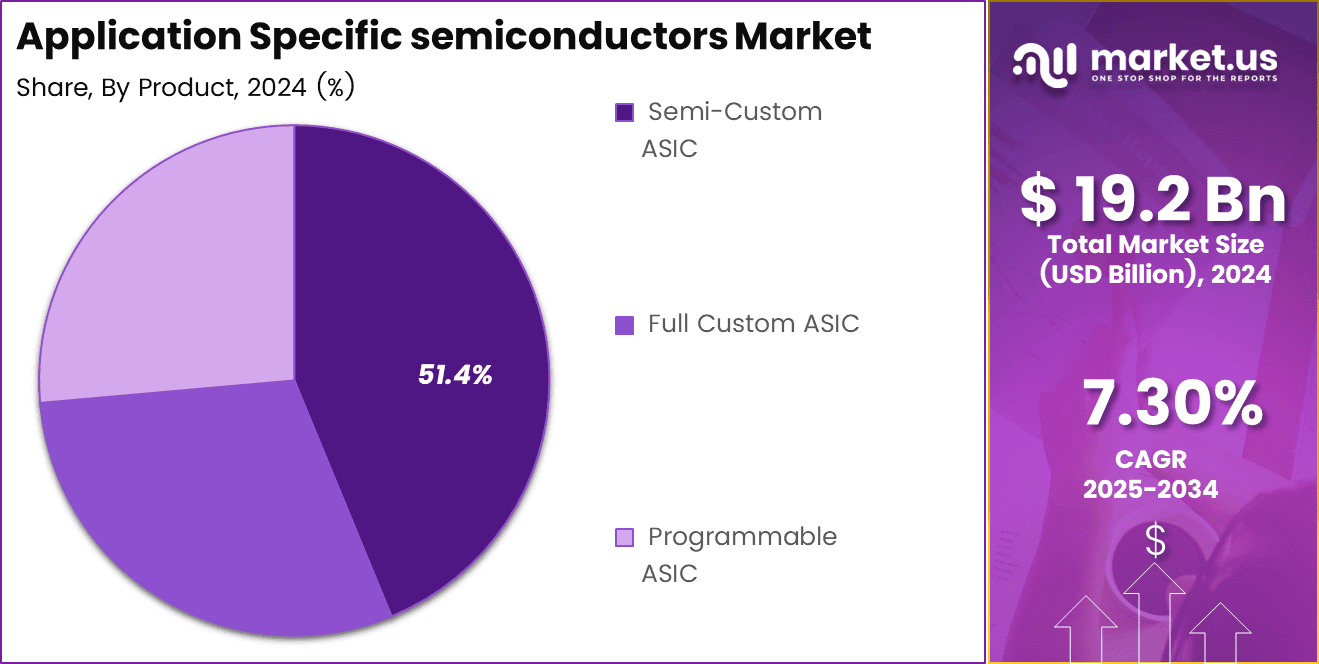
- Semi-Custom ASIC dominated the product segment with a 51.4% share, supported by faster design cycles and lower development risk.
- Consumer Electronics led the application segment with a 39.1% share, driven by high-volume production of smart devices.
- Asia Pacific led the market with more than 46.2% share in 2024, generating approximately USD 8.87 billion in revenue.
Role of Generative AI
Generative AI (GenAI) is transforming the Application-Specific Semiconductors Market by redefining how chips are designed, verified, and optimized. AI-driven design automation tools now use GenAI algorithms to simulate circuit layouts, predict performance bottlenecks, and automatically generate efficient chip architectures—reducing design time by 30–40%.
This has enabled faster prototyping and enhanced yield rates during fabrication. GenAI is also improving EDA (Electronic Design Automation) workflows by enabling intelligent code generation, adaptive testing, and design validation across multiple semiconductor layers.
Moreover, AI-trained models assist in power optimization, transistor placement, and error detection, leading to better chip performance and reliability. In manufacturing, generative AI aids predictive maintenance and wafer defect identification, improving production accuracy. For end-use industries such as automotive, AI computing, and consumer electronics, GenAI-driven ASICs are enabling smarter hardware acceleration, real-time learning capabilities, and low-latency edge analytics.
By Product
Semi-Custom ASIC dominates with 51.4% due to faster design cycles and lower risk.
Semi-Custom ASIC leads the product market because it gives device makers a practical balance of speed, cost control, and product fit. Designers can use proven chip building blocks, such as processor cores, memory links, and input-output functions, then add features for a specific device. This approach reduces design work.
It also fits the large consumer device market, where makers refresh phones, laptops, home devices, and network equipment often. Global semiconductor sales reached $791.7 billion in 2025, while logic product sales reached $301.9 billion, showing the large demand base for chip designs that handle computing and control tasks.
Programmable ASIC represents the fastest-growing product area because customers need more flexibility as product needs change. These chips let teams update functions after production, which helps them test new features, meet changing network rules, and shorten launch plans. Growing 5G use strengthens this need: 5G accounted for 36% of mobile broadband subscriptions in 2025. Equipment makers can use programmable designs to support new network functions without waiting for a full chip redesign.
By Application
Consumer Electronics dominates with 39.1% due to high-volume smart device production.
Consumer Electronics holds the largest application share because phones, tablets, computers, televisions, gaming devices, and connected home products ship in very large volumes and need chips built for clear product tasks. Semi-custom and full custom ASICs help manufacturers combine processing, graphics, camera, wireless, security, and power functions in compact designs.
This lowers power use, protects product features, and helps brands control device performance. The size of the connected user base also supports steady demand: 6 billion people used the internet in 2025, and the global total grew by more than 240 million people during that year. Automotive is the fastest-growing application because car makers now add more electronic controls, driver support tools, displays, safety systems, and electric power functions to every vehicle.
Each new system creates a need for chips that meet strict power, heat, and reliability needs. Electric car sales exceeded 17 million worldwide in 2024, rising by more than 25%, which expands the market for dedicated chips in battery control, power conversion, sensing, and in-car computing. Qualcomm also reported $3.957 billion in automotive revenue in fiscal 2025, up from $2.910 billion a year earlier, showing strong demand for advanced vehicle electronics.
Key Market Segments
By Product
- Semi-Custom ASIC
- Full Custom ASIC
- Programmable ASIC
By Application
- Consumer Electronics
- Telecommunication
- Industrial
- Automotive
- Others
Regional Analysis
The Asia-Pacific (APAC) region is poised for the fastest expansion, with USD 8.87 billion in 2024, driven by rising IoT integration in industrial automation, connected vehicles, and smart city programs in China, Japan, and India.
North America remains a key innovation hub due to its advanced semiconductor design ecosystem, presence of major chipmakers, and significant R&D investments. Growth is supported by increasing integration of ASICs in AI-driven computing, 5G infrastructure, and industrial automation.
US Market Size
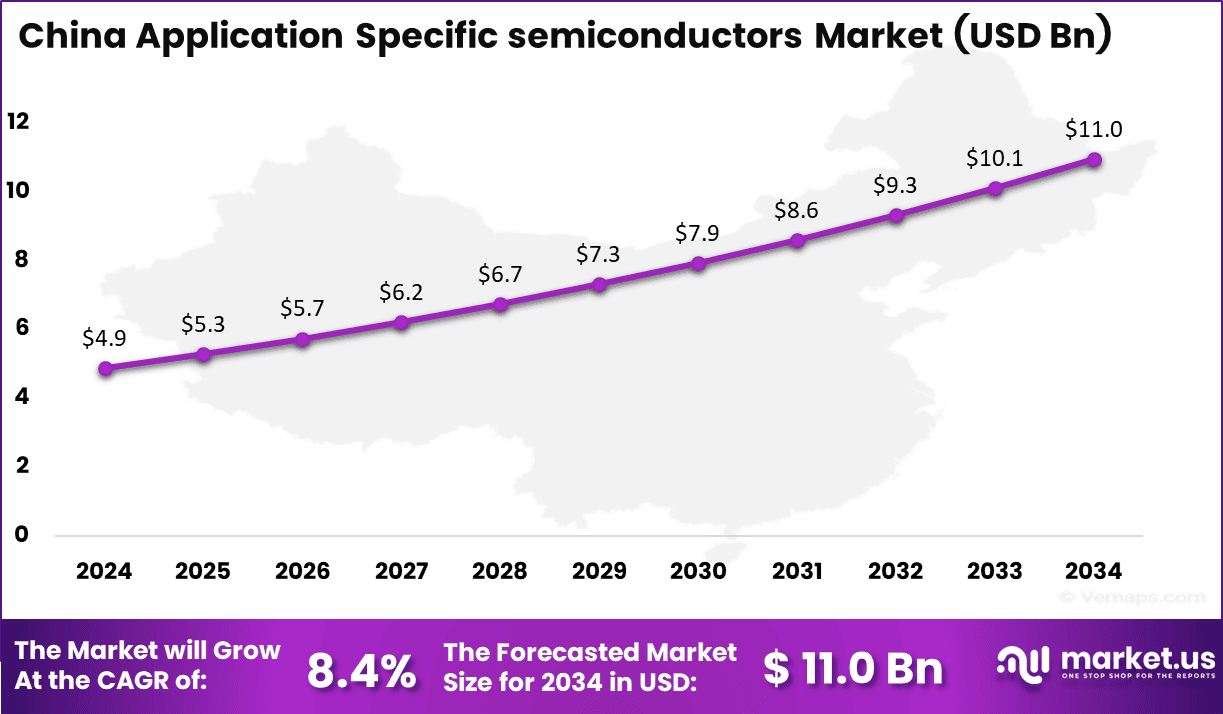
China alone is expected Application-Specific Semiconductors Market grow from USD 4.9 billion in 2024 to USD 11.0 billion by 2034, reflecting a CAGR of 8.4%. North America follows, driven by rapid adoption of AI processors, cloud computing, and defense-grade semiconductors.
Europe maintains a stable share due to growing automotive electronics and industrial automation demand, while Latin America and the Middle East & Africa (MEA) show emerging potential, supported by expanding telecom infrastructure and digital transformation initiatives.
Key Regions and Countries
- North America
- US
- Canada
- Europe
- Germany
- France
- The UK
- Spain
- Italy
- Rest of Europe
- Asia Pacific
- China
- Japan
- South Korea
- India
- Australia
- Rest of APAC
- Latin America
- Brazil
- Mexico
- Rest of Latin America
- Middle East & Africa
- GCC
- South Africa
- Rest of MEA
Market Dynamics
Drivers
| Driver | (~) % Impact on CAGR Forecast | Geographic Relevance | Impact Timeline |
|---|---|---|---|
| AI accelerator and data center ASIC adoption | +2.4% | North America, East Asia | Short term (2 years or less) |
| Electric vehicle and ADAS silicon content growth | +1.3% | East Asia, Europe, North America | Medium term (2 to 4 years) |
| CHIPS Act-linked domestic fab capacity ramp | +1.0% | North America | Medium term (2 to 4 years) |
| IoT and edge sensor unit proliferation | +0.8% | Global | Short term (2 years or less) |
| 5G infrastructure network densification | +0.5% | East Asia, North America, Europe | Short term (2 years or less) |
AI Accelerator and Data Center ASIC Adoption
The main driver is the shift by hyperscalers from general-purpose GPUs toward custom ASICs designed for specific AI training and inference workloads. This transition accelerated during 2024 and 2025, supported by major in-house silicon programs. Global semiconductor sales reached USD 630.5 billion in 2024, up 19.1%, while the Americas accounted for USD 195.1 billion of total sales.
Rising custom-accelerator demand is also reshaping foundry capacity and capital spending. Leading-edge production is increasingly allocated to custom ASIC tape-outs, which could reduce available capacity for merchant ASIC customers by around 8% to 12%. At the same time, advanced fab expansion programs can require more than USD 20 billion in capital investment, with major U.S. manufacturing commitments continuing through 2026.
Restraints
| Restraint | (~) % Impact on CAGR Forecast | Geographic Relevance | Impact Timeline |
|---|---|---|---|
| Section 232 tariffs on advanced chip imports | -1.5% | North America | Short term (2 years or less) |
| High interest rate constraint on fab financing | -0.9% | Global | Short term (2 years or less) |
| Export control restrictions on advanced nodes | -0.6% | East Asia | Short term (2 years or less) |
| Rare earth and specialty gas supply curbs | -0.4% | East Asia, Global | Short term (2 years or less) |
Section 232 Tariffs on Advanced Chip Imports
The main restraint comes from the Section 232 proclamation that took effect in January 2026, imposing a 25% ad valorem duty on covered advanced computing chips and derivative products not linked to U.S.-based supply-chain expansion. For merchant ASIC vendors serving industrial, defense, and other non-data-center customers, this can raise landed costs by 25% on qualifying imports.
Fabless ASIC designers relying on offshore foundries may need to absorb part of this increase, potentially reducing gross margins by around 3 to 5 percentage points, or delay product launches while supply contracts are renegotiated. Uncertainty may continue until exemption reviews are clarified by July 1, 2026, limiting near-term sales visibility for affected products.
Challenges
| Challenge | (~) % CAGR Friction Drag | Geographic Relevance | Mitigation Horizon |
|---|---|---|---|
| Skilled engineering talent deficit | -0.9% | North America, Europe | Long term (4 years or more) |
| Advanced packaging capacity bottleneck | -0.6% | East Asia, North America | Medium term (2 to 4 years) |
| Design cycle and mask set cost inflation | -0.5% | Global | Medium term (2 to 4 years) |
| Fragmented global export compliance regimes | -0.4% | Global | Long term (4 years or more) |
| Workforce retirement and knowledge attrition | -0.3% | Europe, North America | Long term (4 years or more) |
Skilled Engineering Talent Deficit
The semiconductor industry faces a growing workforce shortage as hiring demand outpaces the supply of qualified graduates. The U.S. semiconductor industry is expected to add nearly 115,000 jobs by 2030, with around 58%, or roughly 67,000 roles, potentially remaining unfilled.
Globally, about 1 million additional skilled workers may be needed by 2030, while more than 80% of semiconductor executives rank workforce shortages among their top 3 business risks. Europe faces similar pressure, with nearly 30% of its current semiconductor workforce expected to retire by 2030.
Companies are responding through skills-based hiring, vocational partnerships, community-college programs, and greater automation of design verification. However, these measures could increase near-term training expenditure per engineer by around 15% to 20% before delivering meaningful improvements in design productivity.
Opportunities
| Opportunity | (~) % Potential CAGR Upside | Geographic Relevance | Execution Window |
|---|---|---|---|
| Chiplet-based heterogeneous integration licensing | +1.6% | North America, East Asia | Medium term (2 to 4 years) |
| Sovereign AI infrastructure build-out contracts | +1.2% | Middle East, Europe, Asia-Pacific | Medium term (2 to 4 years) |
| Automotive zonal architecture ASIC redesign wins | +0.9% | Europe, East Asia | Medium term (2 to 4 years) |
| Industrial automation custom silicon roll-up M&A | +0.6% | Global | Long term (4 years or more) |
| Domestic packaging-as-a-service monetization | +0.5% | North America | Long term (4 years or more) |
Chiplet-Based Heterogeneous Integration Licensing
Chiplet interconnect standards and cross-vendor die-to-die licensing remain an emerging opportunity rather than a current growth driver. Industry standardization is still progressing through 2025 and 2026, while most current designs rely on proprietary single-vendor architectures.
Breaking a monolithic ASIC into reusable chiplet blocks could reduce mask and non-recurring engineering costs by an estimated 20% to 30% while improving manufacturing yield.
As interoperable chiplet ecosystems mature, suppliers could license reusable IP blocks across multiple customer designs instead of relying only on bespoke ASIC development. This approach could improve blended gross margins by around 4 to 6 percentage points while lowering development costs and expanding access to cost-efficient custom silicon.
Key Player Analysis
The application-specific semiconductors market is led by Broadcom, Intel, Infineon Technologies, STMicroelectronics, and Fujitsu. Broadcom reported FY2025 revenue of USD 63.89 billion, R&D spending of USD 10.98 billion, and operating profit of USD 25.48 billion. Intel generated FY2025 revenue of USD 52.85 billion, with USD 13.8 billion in R&D spending and USD 14.6 billion in capital expenditure.
Broadcom and Intel benefit from strong custom-compute, networking, ASIC design, and manufacturing capabilities. Together, they are estimated to account for around 30–40% of high-value custom data-center, communications, and enterprise ASIC demand. Their large R&D and capital budgets also create significant entry barriers for smaller competitors.
Infineon and STMicroelectronics maintain strong positions in automotive, industrial, power-management, and embedded applications. Infineon reported FY2025 revenue of EUR 14.66 billion, R&D expenditure of EUR 2.41 billion, and capital expenditure of EUR 1.80 billion. STMicroelectronics generated USD 11.8 billion in FY2025 revenue, invested USD 1.71 billion in R&D, and spent USD 2.11 billion on capital equipment. Their combined estimated market position is around 15–22%.
Tier-2 players include Faraday Technology, Seiko Epson, OmniVision, ASIX Electronics, Socionext America, Semiconductor Components Industries, DWIN Technology, Tekmos, and Comport Data. Faraday recorded FY2025 revenue of TWD 17.99 billion, with TWD 2.50 billion in R&D, equal to about 13.9% of revenue, and TWD 663 million in capital expenditure. Seiko Epson reported FY2026 revenue of JPY 1.41 trillion and JPY 54.62 billion in capital expenditure, while Fujitsu recorded FY2026 revenue of JPY 3.50 trillion and JPY 108.98 billion in capital expenditure.
Top Key Players
- Intel Corporation
- ASIX Electronics
- OmniVision Technologies, Inc.
- Semiconductor Components Industries, LLC
- Seiko Epson Corporation
- DWIN Technology
- Socionext America Inc.
- Tekmos Inc.
- Broadcom Inc.
- STMicroelectronics
- Faraday Technology Corporation
- FUJITSU
- Infineon Technologies AG
- Comport Data
- Others
Recent Development
- In July 2026, Intel committed €5 billion ($5.7 billion) to expand its Leixlip, Ireland, manufacturing campus. The capacity program targets leading-edge chip production and will create permanent high-tech roles while engaging 2,000 specialized tradespeople during construction.
- In February 2026, STMicroelectronics expanded its AWS partnership through a multi-year, multi-billion-dollar commercial engagement. ST also issued AWS warrants covering up to 24.8 million ordinary shares, aligning both companies around long-term AI compute demand.
- In October 2025, Broadcom and OpenAI announced a 10-gigawatt custom AI accelerator collaboration. OpenAI will design the accelerators and systems, while Broadcom will co-develop and deploy the custom ASIC and Ethernet solutions.
- In July 2025, STMicroelectronics signed an agreement to acquire NXP’s MEMS sensor business for up to $950 million in cash. The price includes $900 million at closing and up to $50 million tied to technical milestones.
Report Scope
| Report Features | Description |
|---|---|
| Market Value (2024) | USD 19.2 Bn |
| Forecast Revenue (2034) | USD 38.8 Bn |
| CAGR(2025-2034) | 7.3% |
| Base Year for Estimation | 2024 |
| Historic Period | 2020-2023 |
| Forecast Period | 2025-2034 |
| Report Coverage | Revenue forecast, AI impact on Market trends, Share Insights, Company ranking, competitive landscape, Recent Developments, Market Dynamics, nd Emerging Trends |
| Segments Covered | By Product (Full Custom ASIC, Semi-Custom ASIC, Programmable ASIC), By Application (Telecommunication, Industrial, Automotive, Consumer Electronics, Others) |
| Regional Analysis | North America – US, Canada; Europe – Germany, France, The UK, Spain, Italy, Russia, Netherlands, Rest of Europe; Asia Pacific – China, Japan, South Korea, India, New Zealand, Singapore, Thailand, Vietnam, Rest of Latin America; Latin America – Brazil, Mexico, Rest of Latin America; Middle East & Africa – South Africa, Saudi Arabia, UAE, Rest of MEA |
| Competitive Landscape | Intel Corporation, ASIX Electronics, OmniVision Technologies, Inc., Semiconductor Components Industries, LLC, Seiko Epson Corporation, DWIN Technology, Socionext America Inc., Tekmos Inc., Broadcom Inc., STMicroelectronics, Faraday Technology Corporation, FUJITSU, Infineon Technologies AG, Comport Data, Others |
| Customization Scope | Customization for segments and region/country levels will be provided. Moreover, customization can be tailored to the requirements. |
| Purchase Options | We have three licenses to choose from: Single User License, Multi-User License (Up to 5 Users), Corporate Use License (Unlimited Users, Printable PDF) |





































