Report Overview
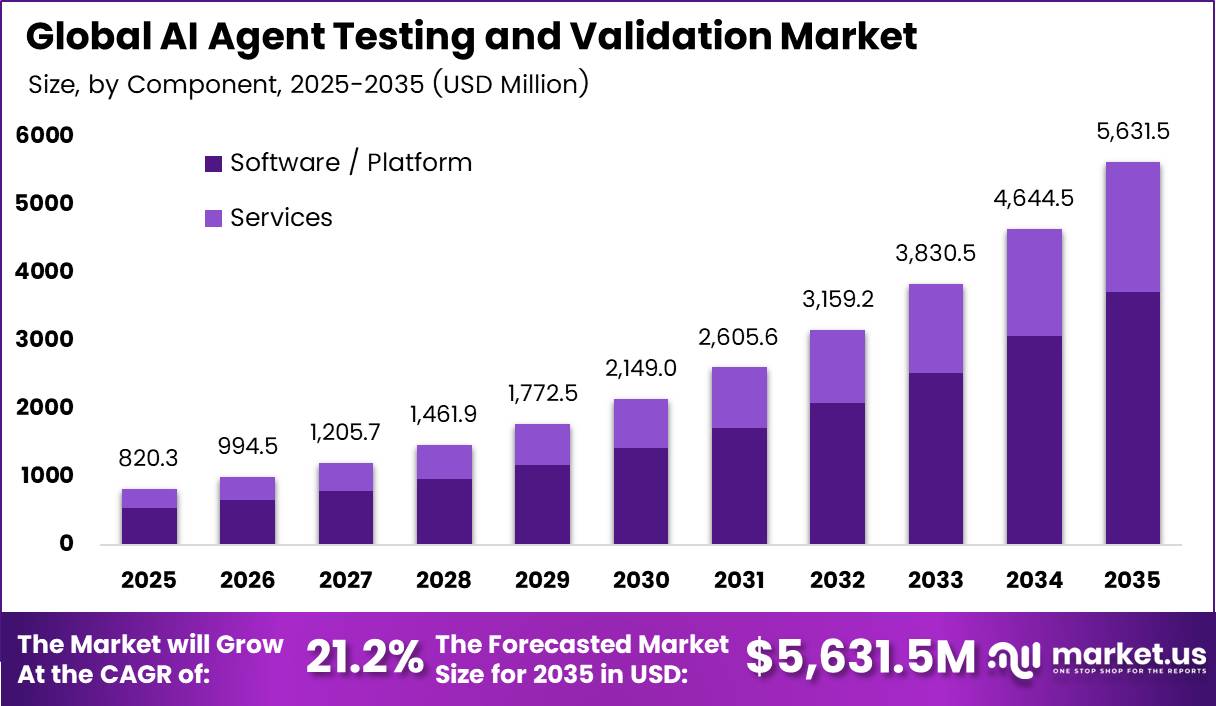
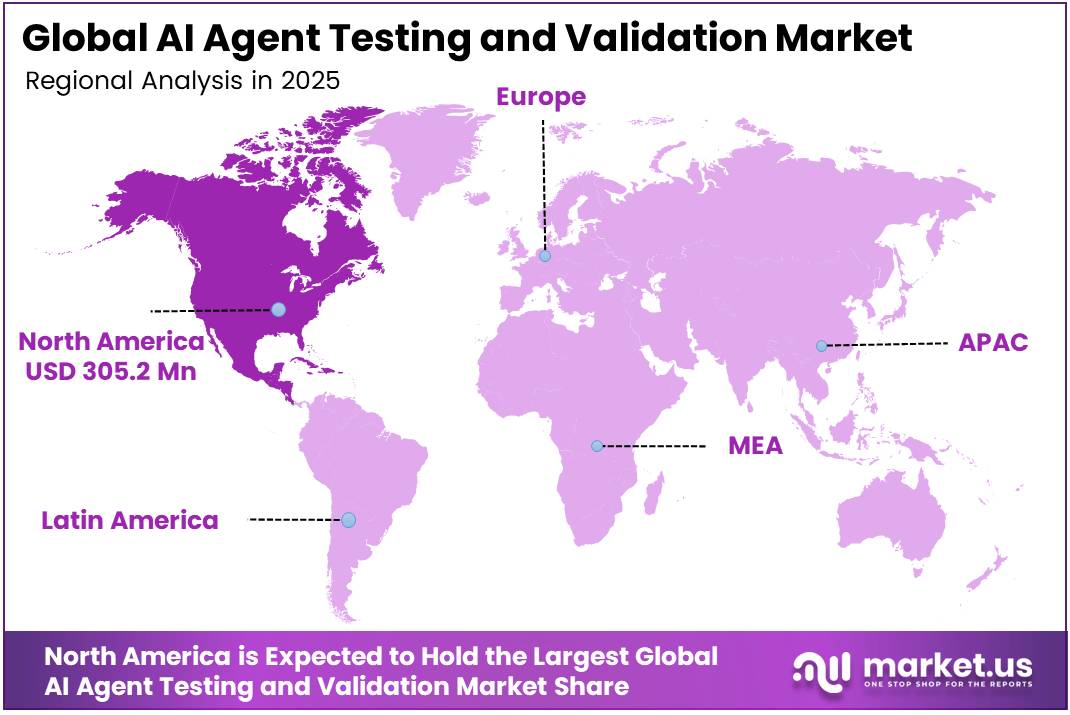
In 2025, the Global AI Agent Testing And Validation Market was valued at USD 820.3 million. The market is projected to grow at a CAGR of 21.2% during 2026–2035, reaching approximately USD 5,631.5 million by 2035. North America dominated the global market in 2025, accounting for more than 37.2% of the total market share and generating approximately USD 305.2 million in revenue.
According to the OECD, 20.2% of firms used AI in 2025, up from 14.2% in 2024. As businesses extend AI into customer service, software development, and operations, more workflows need checks before release. Agent testing examines decisions and tool use, not only text quality, so wider deployment points to a plausible, recurring need for evaluation. Adoption figures alone, however, cannot confirm the supplied revenue forecast.
The IEA reported that the United States accounted for 45% of global data centre electricity consumption in 2024, which signals substantial capacity for running models, storing traces and repeating evaluation workloads. The US Census Bureau estimated national retail e-commerce sales at USD 1,233.7 billion in 2025, creating a clear use case for checking shopping assistants, refund decisions and order-management agents before they act.
Key Takeaways
- The supplied market value totals USD 820.3 million in 2025, with a forecast of USD 5,631.5 million for 2035. The supplied CAGR stands at 21.2% for 2026-2035.
- Component: Software/Platform leads with a supplied share of 75.0%.
- Testing and Validation Type: Functional testing leads with a supplied share of 27.0%.
- Deployment Mode: Cloud leads with a supplied share of 70.0%.
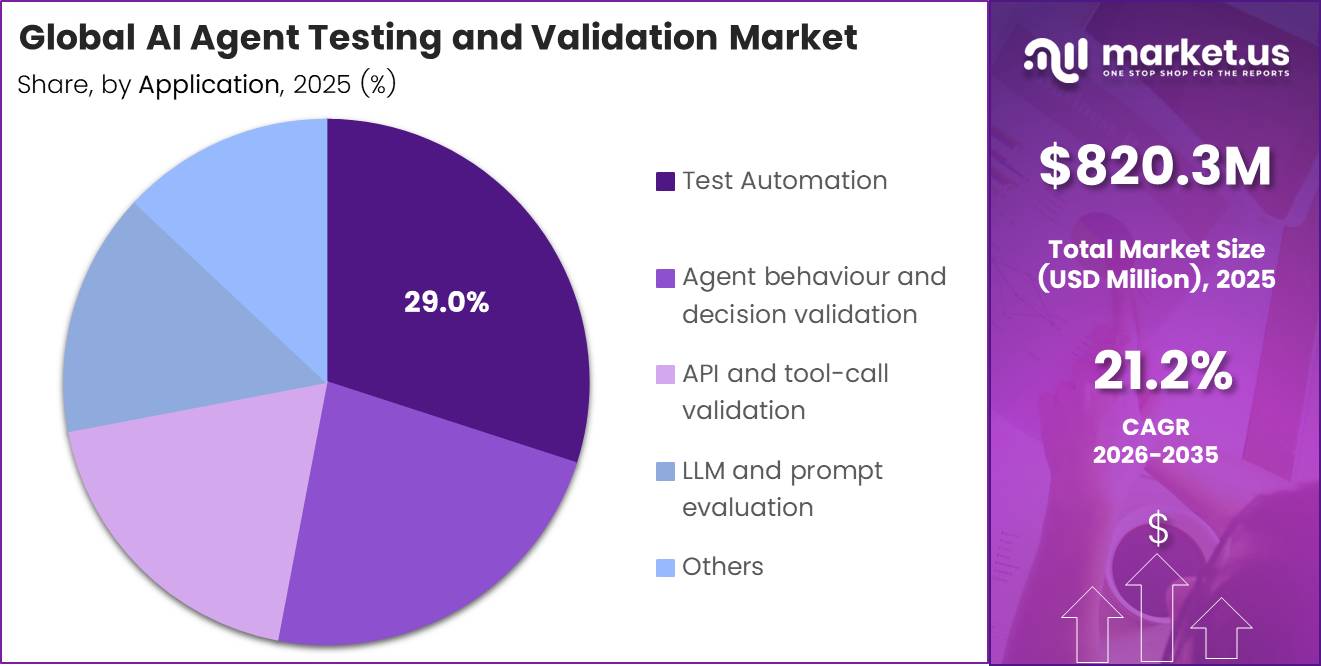
- Application: Test automation leads with a supplied share of 29.0%.
- Organisation Size: Large enterprises lead with a supplied share of 80.0%.
- End-Use Industry: IT and telecommunications leads with a supplied share of 30.0%.
- North America leads the supplied dataset with a 37.2% share and USD 305.2 million in revenue.
By Component
Software / Platform dominates with 75.0% due to reusable testing tools and centralised controls.
Your supplied shares place Software / Platform first. A common platform lets teams build test cases, compare agent outputs, track failures, and check changes before release. Buyers can reuse these tools across projects rather than fund separate manual reviews.
GitLab’s fiscal 2026 filing reports revenue of $955.2 million and growth of 26%, showing demand for shared software development platforms, not the size of this specific market. That wider buying pattern supports the case for platforms that combine agent testing with daily development work.
Services offer a strong growth opportunity because buyers still need help choosing test rules, connecting business systems, and judging unusual agent responses. In Eurostat’s 2025 survey, 70.89% of enterprises that considered AI but did not adopt it cited a lack of relevant expertise. This skills gap creates room for consulting, setup, staff training, and managed testing.
By Testing and Validation Type
Functional testing dominates with 27.0% due to essential checks on agent task completion.
Functional testing leads in your input because buyers first need proof that an agent completes the right task. Teams must check whether agents follow instructions, select suitable tools, handle missing inputs, and return useful results. These checks apply across customer service, software work, and internal support.
The Bank of England and FCA’s 2024 survey found that 55% of reported AI use cases involved some automated decision-making, while only 2% involved fully autonomous decisions. These figures cover financial services AI, not agent testing revenue, but they show why teams must test both task completion and human handovers.
By Deployment Mode
Cloud dominates with 70.0% due to flexible capacity and faster testing setup.
Cloud holds the leading position in your supplied data because teams can start testing without building a separate computing environment. They can add capacity during heavy test runs, share results across locations, and connect testing tools with online development services.
Eurostat reports that 52.74% of EU enterprises used paid cloud services in 2025, an increase of 7.42 percentage points from 2023. These figures describe broader cloud adoption rather than this market’s deployment shares. Still, they show that many buyers already have the cloud systems and purchasing processes that support online agent testing.
By Application
Test automation dominates with 29.0% due to repeated checks across frequent software changes.
Test automation ranks first in your market input because development teams must repeat checks whenever code, prompts, models, or tools change. Automated runs help teams compare results and spot failures before customers encounter them.
Microsoft’s 2025 annual report states that GitHub Copilot had more than 20 million users and that over 230,000 organisations used Copilot Studio. These adoption figures do not measure testing revenue, but they show a broad base of AI-assisted development and agent-building activity. That activity creates a clear commercial case for repeatable checks rather than manual review alone.
By Organisation Size
Large enterprises dominate with 80.0% due to broad deployments and complex approval needs.
Large enterprises lead under your supplied share assumptions because they run more systems, serve more users, and face wider business risks when agents fail. Their testing needs span security, legal review, service quality, and internal controls.
Eurostat reports that 55.03% of large EU enterprises used AI in 2025, compared with 17% of small enterprises and 30.36% of medium enterprises. These adoption rates support the explanation for stronger near-term demand among larger buyers, although they do not verify the market share.
By End-Use Industry
IT and telecommunications dominate with 30.0% due to intensive software development and digital operations.
IT and telecommunications lead in your input because these businesses build, connect, and operate the software that supports agent deployment. Frequent product updates and large support workloads create repeated demand for checks on accuracy, reliability, and system connections.
Eurostat reports that 62.52% of EU information and communication enterprises used AI in 2025, the highest share among the surveyed sectors. This broader industry measure supports the demand argument but does not directly establish agent testing revenue.
BFSI offers a strong growth case because agent errors can affect payments, customer treatment, fraud controls, and private financial information. In the Bank of England and FCA’s 2024 survey, 95% of responding insurers and 94% of responding international banks already used AI.
Key Market Segments
By Component
- Software / Platform
- Services
By Testing and Validation Type
- Functional testing
- Performance and reliability testing
- Agent evaluation and benchmarking
- Safety and security testing
- Others
By Deployment Mode
- Cloud
- On-premises
- Hybrid
By Application
- Test automation
- Agent behaviour and decision validation
- API and tool-call validation
- LLM and prompt evaluation
- Others
By Organisation Size
- Large enterprises
- Small and medium-sized enterprises
By End-Use Industry
- IT and telecommunications
- BFSI
- Healthcare and life sciences
- Retail and e-commerce
- Government and defence
- Manufacturing
- Other
Geopolitical Impact Analysis
Geopolitical risks reach this software market mainly through computing infrastructure, not physical product shipments. The IMF documented US steel and aluminium tariffs of 25% during January-April 2025. Those historical measures illustrate exposure for server racks, cooling equipment and data centre construction. They do not establish a tariff on downloadable testing software or a current duty for every hardware component.
UNCTAD estimated in April 2024 that diversions around Africa added about 12 days to Asia-Europe ship journeys. This historical disruption shows how route closures can delay containerised electrical and cooling equipment that supports evaluation capacity. It does not imply that every GPU shipment travels by sea or that software distribution faces the same delay. Cloud-based delivery avoids that direct transport burden.
The World Bank’s October 2026 commodity update reported a 25.7% increase in its energy price index during September, including a 15.3% rise in natural gas prices. These movements can raise electricity and backup-power costs for infrastructure providers. Repeated agent simulations consume computing resources, so sustained energy inflation can pressure provider margins and evaluation budgets. Contract terms determine any pass-through to customers.
The World Bank’s February 2025 Red Sea analysis found an average 8% decline in trade volumes across the leading ports it examined between November 2023 and October 2024, relative to pre-crisis levels. That regional evidence supports supply-chain risk, not a measured contraction in this software market. Buyers can compare available hosting locations and validate agents after model or infrastructure changes; the evidence does not support a precise market-wide price increase.
Regional Analysis
North America dominates the AI Agent Testing and Validation Market, holding a 37.2% share and generating USD 305.2 million in revenue. These figures follow the supplied base-year dataset rather than an independent regional sales audit. The United States and Canada form the regional coverage in this report.
Statistics Canada reported in October 2026 that 25.2% of businesses planned to use AI over the following year. Within that group, 39.3% planned to use large language models and 31.8% planned to use virtual agents or chatbots. These measures describe future intentions, not completed deployments or purchases of testing tools. Still, they indicate a pipeline of projects that may require evaluation before launch and monitoring after release.
Asia Pacific represents a growing region in the supplied input; the data do not establish a fastest-growing ranking. India’s Press Information Bureau reported an IndiaAI Mission budget of INR 10,371.92 crore and 38,000 onboarded GPUs in its November 2025 update. Greater access to compute can support experimentation and repeated evaluation.
Europe offers a demand base for agent evaluation, but the input provides no regional share or growth rate. Eurostat reported that 20.0% of EU enterprises with at least 10 employees used AI in 2025. This measure supports demand potential across Germany, France, Spain, Italy, and other EU markets, but it does not cover the UK on the same basis.
Key Regions and Countries
North America
- US
- Canada
Europe
- Germany
- France
- The UK
- Spain
- Italy
- Rest of Europe
Asia Pacific
- China
- Japan
- South Korea
- India
- Australia
- Rest of APAC
Latin America
- Brazil
- Mexico
- Rest of Latin America
Middle East and Africa
- GCC
- South Africa
- Rest of MEA
Market Dynamics
Drivers
| Driver | (~) % Impact on CAGR Forecast | Geographic Relevance | Impact Timeline |
|---|---|---|---|
| Production deployment of autonomous workflows | +1.4 pp | Global; North America-led | Short term (2 years or less) |
| Agent-specific security testing requirements | +0.8 pp | Global; enterprise deployments | Short term (2 years or less) |
| Voluntary governance and assurance adoption | +0.6 pp | North America, Europe, developed Asia | Short term (2 years or less) |
| Expansion of agent-tool connectivity | +0.5 pp | Global; enterprise software ecosystems | Short term (2 years or less) |
| Outcome-based agent billing verification | +0.4 pp | North America, Europe; customer operations | Medium term (2 to 4 years) |
Production deployment of autonomous workflows
Moving agents from demonstrations into operational workflows creates recurring demand to validate completed actions rather than merely score generated text. Anthropic’s December 2024 engineering guidance recommended extensive sandbox testing, while OpenAI’s March 2025 launch introduced production building blocks spanning web search, file search, and computer use.
According to OpenAI, these capabilities were accompanied by execution tracing. According to Anthropic’s June 2025 production account, an initial evaluation set contained about 20 representative queries, which shows that testing can begin before a large benchmark library exists.
In an illustrative analyst scenario informed by those deployment patterns, a 10% increase in paying production accounts combined with approximately 3% higher recurring validation revenue per account supports the assigned +1.4 percentage-point sensitivity. That figure applies only after allowing for partial adoption and substitution, and it is not a mechanical conversion of operational growth into market CAGR.
Restraints
| Restraint | (~) % Impact on CAGR Forecast | Geographic Relevance | Impact Timeline |
|---|---|---|---|
| Unmet sensitive-data processing prerequisites | −0.9 pp | EU, UK, US healthcare | Short term (2 years or less) |
| Uneconomic underlying agent deployments | −0.7 pp | Global; low-value transaction workflows | Short term (2 years or less) |
| Native-platform evaluation substitution | −0.5 pp | Global; platform-concentrated buyers | Short term (2 years or less) |
| Dedicated-agent project cancellation | −0.4 pp | Global; deterministic automation use cases | Short term (2 years or less) |
| Unverifiable deployment acceptance criteria | −0.3 pp | Global; open-ended knowledge workflows | Short term (2 years or less) |
Unmet sensitive-data processing prerequisites
Production traces may contain protected information that cannot simply be transferred into an external evaluation service. The European Data Protection Board’s December 2024 opinion states that AI-model anonymity requires case-specific assessment.
These requirements act as conditional processing gates rather than blanket bans on agent testing. The assigned -0.9 percentage-point sensitivity is an analyst stress case, not an institutional forecast. As an illustration, if approximately 5% of otherwise expected annual revenue remained unrecognized over a seven-year horizon from the supplied baseline, the annualized effect could be roughly this size. Neither the affected share nor the horizon comes from a source.
Challenges
| Challenge | (~) % CAGR Friction Drag | Geographic Relevance | Mitigation Horizon |
|---|---|---|---|
| Non-deterministic execution reproducibility | −0.8 pp | Global; multi-step agent deployments | Medium term (2 to 4 years) |
| Automated grader calibration | −0.6 pp | Global; open-ended output evaluation | Medium term (2 to 4 years) |
| Representative test environment fidelity | −0.5 pp | Global; browser and enterprise applications | Medium term (2 to 4 years) |
| Long-horizon state reconstruction | −0.4 pp | Global; persistent agent workflows | Medium term (2 to 4 years) |
| Expert edge-case adjudication | −0.3 pp | Global; specialist knowledge domains | Long term (4 years or more) |
Non-deterministic execution reproducibility
Identical inputs can generate different valid execution paths, which makes deterministic pass-or-fail scripts inadequate. Anthropic’s June 2025 engineering account explicitly describes this variability. NIST identifies reliable measurement as foundational to trustworthy AI.
OpenAI’s March 2025 release reported computer-use success rates of 38.1% on OSWorld and 58.1% on WebArena, illustrating substantial task-dependent performance rather than a universal reliability level. In an analyst test-design example, not an observed industry average, running 100 cases across 3 configurations with 5 repetitions requires 1,500 executions instead of 300 for a single pass.
That increases raw execution volume fivefold before diagnostic review. The resulting -0.8 percentage-point friction estimate reflects incomplete recovery of that additional delivery effort through pricing, rather than another deduction for blocked customer purchases.
Opportunities
| Opportunity | (~) % Potential CAGR Upside | Geographic Relevance | Execution Window |
|---|---|---|---|
| Embodied-agent validation subscriptions | +1.0 pp | East Asia, North America, Europe | Medium term (2 to 4 years) |
| Insurance-linked agent risk scoring | +0.7 pp | North America, UK, Europe | Long term (4 years or more) |
| Low-resource-language validation libraries | +0.5 pp | India, Southeast Asia, Africa | Medium term (2 to 4 years) |
| Specialist testing capability acquisitions | +0.4 pp | North America, Europe, India | Medium term (2 to 4 years) |
| Agent energy-efficiency certification | +0.3 pp | Europe, North America, developed Asia | Long term (4 years or more) |
Embodied-agent validation subscriptions
Physical agents create an adjacent testing category beyond software-only workflows. The International Federation of Robotics counted 542,000 industrial robots installed in 2024, but that installed-base flow should not be equated with AI-agent demand.
NVIDIA’s March 2025 engineering disclosure reported a pipeline that generated 780,000 synthetic trajectories, equivalent to 6,500 hours of human demonstration data, in 11 hours. The future opportunity is independent, cross-hardware validation subscriptions built around reusable physical-task scenarios, not the established sale of industrial robots or an assumption that synthetic training data proves safety.
An analyst scenario assumes reusable scenarios reduce delivery cost per validated task by 20%. At unchanged pricing and an initial delivery-cost ratio of 50% of revenue, gross margin would rise from 50% to 60%, before platform investment and physical verification costs.
These assumptions support a conditional +1.0 percentage-point upside allocation, not a source-reported forecast. Capturing it requires hardware partnerships, simulation-to-physical validation, and evidence that customers will buy an independent service rather than rely entirely on equipment suppliers.
Key Players Analysis
Tier 1 denotes broad enterprise scale, not verified leadership in agent-testing revenue. AWS reported 2025 segment sales of USD 128.7 billion, while Amazon recorded USD 131.819 billion in company-wide property and equipment purchases. Microsoft reported Azure revenue above USD 75 billion in FY2025.
Google Cloud generated USD 17.7 billion in fourth-quarter 2025 revenue. IBM reported USD 29.962 billion in 2025 software revenue and over USD 8.3 billion in company-wide research and development investment. This report groups both with the enterprise-scale providers.
Tier 2 covers specialist and adjacent challengers. Datadog generated USD 3.427 billion in 2025 revenue and spent USD 1.548 billion on research and development. LangChain announced USD 125 million in funding in October 2025 at a USD 1.25 billion valuation. Funding, valuation, and revenue measure different things.
Arize’s acquisition terms allocated approximately USD 815 million to cash, alongside replacement equity awards, illustrating consolidation around evaluation and observability. For Braintrust, Galileo, Fiddler, Patronus, Langfuse, Comet/Opik, Maxim, and HoneyHive, the reviewed evidence does not establish comparable segment revenues or research budgets.
Top Key Players in the Market
- LangChain, Inc. / LangSmith
- Amazon Web Services, Inc.
- Datadog, Inc.
- Arize AI, Inc.
- Braintrust Data, Inc.
- Galileo Technologies, Inc.
- Fiddler AI, Inc.
- Patronus AI, Inc.
- Langfuse GmbH
- Comet ML, Inc. / Opik
- Maxim AI, Inc.
- HoneyHive AI, Inc.
- Microsoft Corporation
- Google LLC / Google Cloud
- IBM Corporation
Recent Developments
- In February 2025, IBM completed its acquisition of HashiCorp at an enterprise value of USD 6.4 billion. The transaction added infrastructure automation and security capabilities for hybrid cloud and generative AI. This adjacent infrastructure deal does not represent a purchase of a dedicated agent-testing supplier.
- In December 2025, Alphabet announced an agreement to acquire Intersect for USD 4.75 billion in cash, plus assumed debt. The proposed transaction targeted data centre and energy infrastructure to support Google’s computing capacity. This upstream investment does not measure agent-testing market revenue.
- In March 2026, Google completed its acquisition of Wiz, following its announced USD 32 billion cash agreement. Wiz joined Google Cloud to strengthen cloud and AI security. The transaction concerns adjacent security capabilities, not a standalone agent-evaluation platform.
- In October 2026, Dynatrace completed its acquisition of Arize, following the announced USD 915 million cash-and-stock agreement. Arize adds AI model and agent evaluation alongside production observability, making this transaction directly relevant to agent testing and validation.
Report Scope
| Report Features | Description |
|---|---|
| Market Value (2025) | USD 820.3 million |
| Forecast Revenue (2035) | USD 5,631.5 million |
| CAGR (2026-2035) | 21.2% |
| Base Year for Estimation | 2025 |
| Historic Period | 2020-2024 |
| Forecast Period | 2026-2035 |
| Report Coverage | Revenue Forecast, Market Dynamics, Competitive Landscape, Recent Developments |
| Segments Covered | By Component (Software/Platform, Services); By Testing and Validation Type (Functional testing, Performance and reliability testing, Agent evaluation and benchmarking, Safety and security testing, Others); By Deployment Mode (Cloud, On-premises, Hybrid); By Application (Test automation, Agent behaviour and decision validation, API and tool-call validation, LLM and prompt evaluation, Others); By Organisation Size (Large enterprises, Small and medium-sized enterprises); By End-Use Industry (IT and telecommunications, BFSI, Healthcare and life sciences, Retail and e-commerce, Government and defence, Manufacturing, Other) |
| Regional Analysis | North America – US, Canada; Europe – Germany, France, The UK, Spain, Italy, Rest of Europe; Asia Pacific – China, Japan, South Korea, India, Australia, Singapore, Rest of APAC; Latin America – Brazil, Mexico, Rest of Latin America; Middle East & Africa – GCC, South Africa, Rest of MEA |
| Competitive Landscape | LangChain, Inc. / LangSmith, Amazon Web Services, Inc., Datadog, Inc., Arize AI, Inc., Braintrust Data, Inc., Galileo Technologies, Inc., Fiddler AI, Inc., Patronus AI, Inc., Langfuse GmbH, Comet ML, Inc. / Opik, Maxim AI, Inc., HoneyHive AI, Inc., Microsoft Corporation, Google LLC / Google Cloud, IBM Corporation |
| Customization Scope | We will provide customization for segments and region/country levels. Additionally, we can provide additional customization based on your requirements. |
| Purchase Options | We have three licenses to opt for: Single User License, Multi-User License (Up to 5 Users), Corporate Use License (Unlimited Users and Printable PDF) |