


Global Telesurgery Market By Component (System, Instrument & accessories and Services), By Application (General surgery, Urological surgery, Gynecological surgery, Neurosurgery and Cardiovascular surgery), By End-User (Hospitals, Outpatient facilities and Research and academic institutions), Region and Companies – Industry Segment Outlook, Market Assessment, Competition Scenario, Trends and Forecast 2026-2035
- Published date: Feb 2026
- Report ID: 178752
- Number of Pages: 217
- Format:
-
keyboard_arrow_up
Quick Navigation
Report Overview
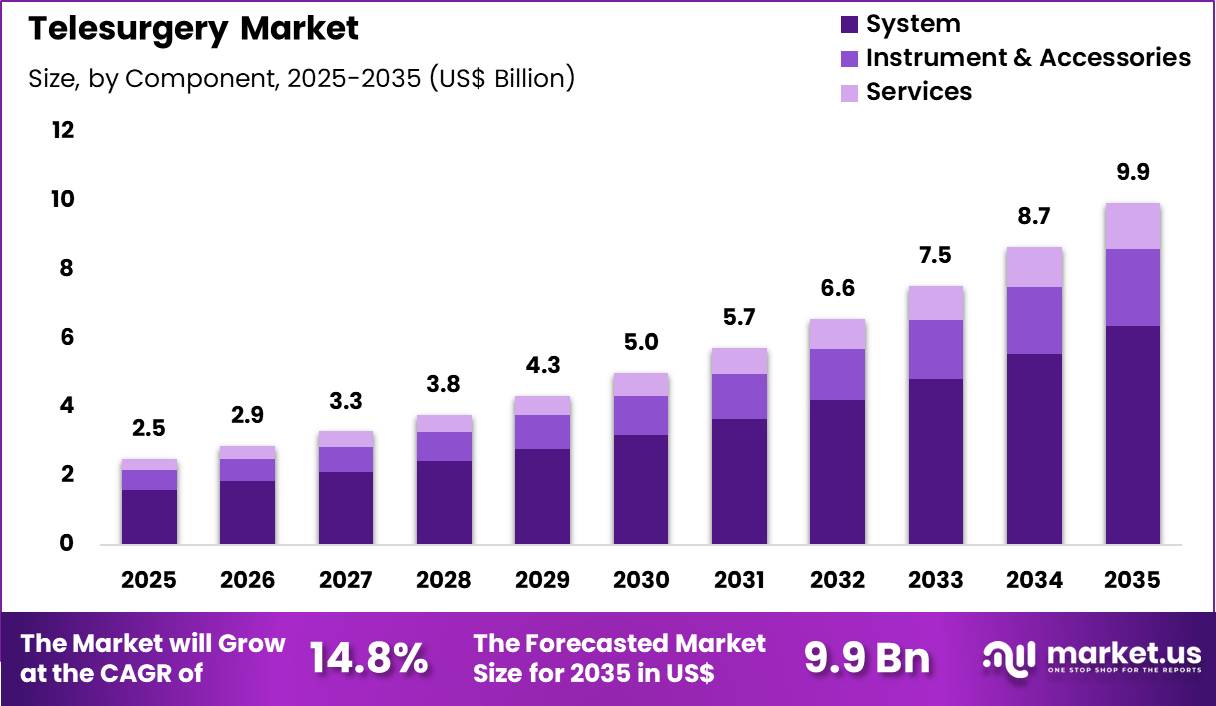
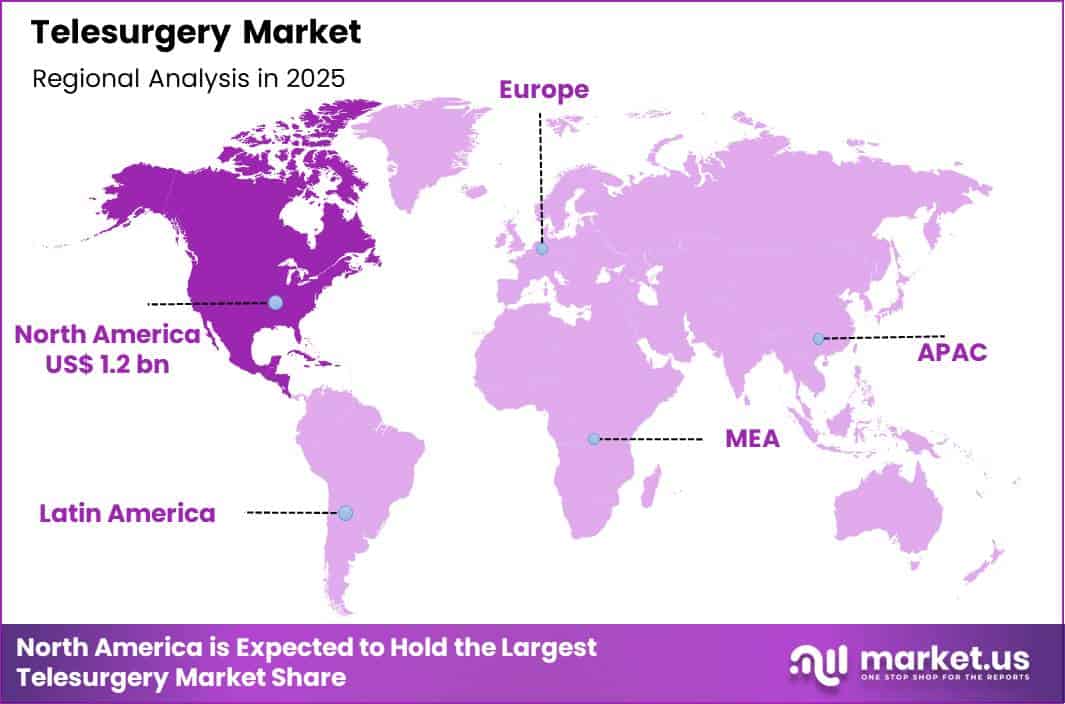
The Global Telesurgery Market size is expected to be worth around US$ 9.9 Billion by 2035 from US$ 2.5 Billion in 2025, growing at a CAGR of 14.8% during the forecast period 2026-2035. In 2025, North America led the market, achieving over 48.6% share with a revenue of US$ 1.2 Billion.
Increasing access to specialized surgical expertise amid global healthcare disparities drives the telesurgery market as providers leverage robotic systems and high-speed networks to perform remote operations with precision. Surgeons increasingly apply telesurgery in emergency trauma cases, where experts guide local teams to stabilize bleeding vessels or repair fractures in field hospitals or disaster zones.
These platforms support complex cardiac interventions, enabling remote valve repairs or arrhythmia ablations for patients in isolated facilities lacking cardiothoracic specialists. Neurosurgeons utilize telesurgery for tumor resections and aneurysm clippings, directing robotic arms to navigate delicate brain structures while minimizing travel risks for high-risk patients.
Orthopedic applications involve telesurgery for joint replacements and spinal fusions, where mentors oversee procedures in training hospitals to build local capabilities. In urology, telesurgery facilitates prostatectomies and kidney stone removals, reducing wait times and improving outcomes through expert input.
Manufacturers pursue opportunities to integrate artificial intelligence for predictive motion compensation, expanding applications in pediatric surgeries where minimal latency ensures safety during delicate tissue manipulation. Developers advance haptic feedback technologies that simulate tactile sensations, broadening utility in minimally invasive gastrointestinal procedures like endoluminal resections.
These innovations facilitate hybrid models combining telesurgery with augmented reality overlays, enhancing visualization in vascular reconstructions. Opportunities emerge in scalable platforms for military and space medicine, where remote guidance addresses injuries in extreme environments.
Companies invest in 5G-enabled systems that reduce latency below 1 millisecond, supporting real-time collaboration. Recent trends emphasize cybersecurity protocols and ethical frameworks for data privacy, positioning telesurgery as a transformative force in equitable healthcare delivery.
Key Takeaways
- In 2025, the market generated a revenue of US$ 2.5 Billion, with a CAGR of 14.8%, and is expected to reach US$ 9.9 Billion by the year 2035.
- The component segment is divided into system, instrument & accessories and services, with system taking the lead with a market share of 64.1%.
- Considering application, the market is divided into general surgery, urological surgery, gynecological surgery, neurosurgery and cardiovascular surgery. Among these, general surgery held a significant share of 37.5%.
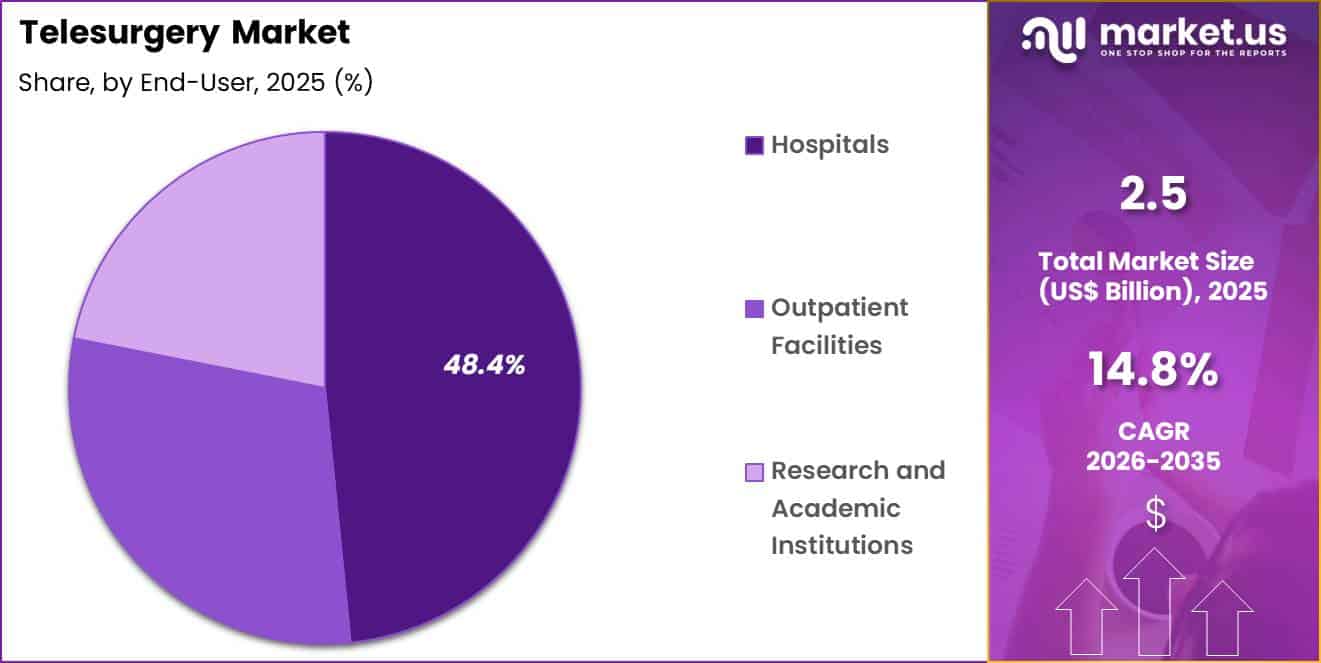
- Furthermore, concerning the end-user segment, the market is segregated into hospitals, outpatient facilities and research and academic institutions. The hospitals sector stands out as the dominant player, holding the largest revenue share of 48.4% in the market.
- North America led the market by securing a market share of 48.6%.
Component Analysis
Systems accounted for 64.1% of growth within component and led the telesurgery market due to their central role in enabling remote robotic control and real-time surgical visualization. Hospitals invest in integrated telesurgical platforms that combine robotic arms, surgeon consoles, and high-definition imaging systems.
These platforms support precise movements and low-latency communication, which enhances surgical accuracy across distances. High capital expenditure requirements concentrate revenue within full-system installations.
Growth strengthens as advancements in connectivity infrastructure improve reliability and reduce signal delays. Healthcare providers prioritize system upgrades to expand minimally invasive capabilities and remote collaboration.
Increasing interest in cross-border expert consultation further supports adoption. Manufacturers enhance ergonomics and software intelligence to improve surgical workflow. The segment is expected to remain dominant as complete telesurgical systems continue to form the foundation of remote operative care.
Application Analysis
General surgery generated 37.5% of growth within application and emerged as the leading segment due to its broad procedural scope and high case volume. Surgeons apply telesurgical systems in procedures such as cholecystectomy, hernia repair, and colorectal interventions.
These operations benefit from enhanced visualization and robotic precision, which improve outcomes. The diversity of general surgery cases supports consistent utilization of telesurgical platforms.
Growth accelerates as minimally invasive techniques expand across healthcare systems. Training programs incorporate robotic and remote-assisted techniques into general surgical curricula. Hospitals prioritize telesurgical integration for routine procedures before extending into highly specialized fields.
Increasing patient demand for advanced surgical options strengthens adoption. The segment is projected to remain dominant as general surgery continues to represent a large share of operative interventions suitable for remote assistance.
End-User Analysis
Hospitals accounted for 48.4% of growth within end-user and dominated the telesurgery market due to their concentration of surgical infrastructure and specialist expertise. Tertiary care centers invest in advanced robotic platforms to enhance service differentiation and clinical outcomes.
Hospitals manage complex cases that require comprehensive perioperative support, which strengthens reliance on integrated systems. Centralized procurement and capital budgeting facilitate high-value system acquisition.
Growth continues as hospitals expand digital health initiatives and high-speed network capabilities. Strategic partnerships with technology providers enhance training and system deployment. Teaching hospitals drive innovation through research and pilot programs.
Referral networks concentrate advanced surgical cases within hospital settings. The segment is expected to remain the primary growth driver as hospitals continue to anchor high-complexity surgical services and technological adoption.
Key Market Segments
By Component
- System
- Instrument & accessories
- Services
By Application
- General surgery
- Urological surgery
- Gynecological surgery
- Neurosurgery
- Cardiovascular surgery
By End-User
- Hospitals
- Outpatient facilities
- Research and academic institutions
Drivers
Increasing prevalence of chronic diseases is driving the market.
The escalating global burden of chronic diseases, such as cancer and cardiovascular conditions, has significantly boosted the demand for telesurgery systems to enable precise, minimally invasive procedures in underserved areas. Enhanced diagnostic capabilities have led to more cases requiring surgical intervention, expanding the application of telesurgery for complex treatments.
Healthcare providers are increasingly adopting telesurgery to address surgical backlogs and improve access to specialist care. The correlation between chronic disease rates and the need for remote surgical options underscores the market’s growth trajectory. Government health organizations are promoting telesurgery to mitigate disparities in surgical access for chronic patients.
Telesurgery platforms offer real-time collaboration, supporting better outcomes in disease management. National health statistics document the rising impact of these diseases, prompting greater investment in remote technologies.
Key manufacturers are refining systems to meet this clinical imperative. This driver fosters innovation in connectivity and robotic interfaces for chronic care. The global digital surgery devices market, including telesurgery components, was projected at $12.13 billion in 2024, driven by chronic disease prevalence.
Restraints
High cost of telesurgery systems is restraining the market.
The substantial pricing of telesurgery robotic systems and associated infrastructure limits their adoption in budget-constrained healthcare facilities. Manufacturing complexities for high-precision robotics and low-latency communication contribute to elevated production expenses.
Smaller hospitals often defer implementations, preferring traditional surgery due to financial limitations. Regulatory compliance for safety standards adds to the overall cost burden on suppliers. In public health systems, allocations favor essential equipment over premium telesurgery setups.
Providers must balance benefits against economic viability when selecting these systems for routine use. This restraint impacts scalability, particularly in developing economies with limited funding. Industry attempts to introduce mid-range models aim to alleviate pricing pressures partially.
Despite procedural advantages, the cost factor hinders universal implementation. High equipment costs affect 35% of hospitals in the minimally invasive surgical devices market, including telesurgery applications.
Opportunities
Expansion of telesurgery in emerging markets is creating growth opportunities.
The rapid development of healthcare infrastructure in Asia-Pacific and Latin America offers avenues for telesurgery systems to address surgeon shortages and improve access to specialized care. Governmental investments in telemedicine support the integration of telesurgery in regional hospitals.
Increasing chronic disease burdens in these regions amplify the potential for remote surgical interventions. Partnerships with local providers facilitate regulatory navigation and customized implementations. The large patient populations in populous nations magnify prospects for telesurgery adoption in high-demand areas.
Educational programs for medical staff promote standardized use of these systems in emerging economies. This opportunity enables global firms to diversify beyond established markets. Key corporations are establishing regional operations to optimize supply and reduce logistics costs. Overall, emerging expansions align with efforts to enhance surgical equity in developing areas.
Impact of Macroeconomic / Geopolitical Factors
Macroeconomic conditions shape the telesurgery market by influencing hospital investment capacity, digital infrastructure spending, and long term technology strategy. Sustained inflation increases costs for robotic platforms, high resolution imaging systems, and secure connectivity tools, which forces providers to prioritize core capital needs.
Higher interest rates make financing large scale remote surgery installations more expensive, slowing deployment in emerging programs. Geopolitical tensions disrupt the supply of precision electronics, sensors, and communication hardware that support real time surgical control.
Current US tariffs on imported robotic components and networking equipment elevate system acquisition costs and reduce short term purchasing flexibility. These pressures can delay cross border collaborations and limit adoption in cost constrained institutions.
At the same time, health systems pursue domestic technology partnerships and strengthen local technical support networks to manage risk. With growing demand for remote specialist access and advanced minimally invasive procedures, the market retains strong strategic momentum and long term growth confidence.
Latest Trends
Integration of 5G technology in robot-assisted telesurgery is a recent trend in the market.
In 2024, the adoption of 5G networks in telesurgery has advanced low-latency remote procedures, enabling surgeons to operate across vast distances with precision. These integrations utilize fiber-optic connections for seamless signal transmission in complex surgeries. Manufacturers have focused on compatibility with robotic platforms for real-time video and haptic feedback.
Clinical trials in 2024 demonstrated successful long-distance operations with minimal delays. The first 5G ultra-remote robot-assisted liver resection was performed in 2023, with median delay of 73 ms using the Toumai endoscopic system. This trend responds to demands for accessible expert care in remote locations.
Regulatory adaptations have supported 5G use in surgical applications with validation protocols. Industry collaborations refine network optimization for enhanced reliability. These developments aim to expand telesurgery beyond trials into routine practice. The evolution positions 5G as central to future remote surgical ecosystems.
Regional Analysis
North America is leading the Telesurgery Market
North America held a 48.6% share of the Telesurgery market in 2024, reflecting strong integration of robotic surgery with secure digital communication networks. Large hospital systems expanded hub and spoke surgical models, allowing expert surgeons to guide or assist procedures conducted in affiliated regional centers.
Growing procedure complexity in urology, gynecology, and cardiovascular care encouraged investment in advanced robotic consoles with remote connectivity features. Defense and academic institutions also supported innovation in remote operative capabilities to improve access in geographically dispersed areas.
Healthcare providers prioritized technologies that reduce patient transfer needs and shorten waiting times for specialist intervention. Interoperability between imaging, robotics, and network platforms strengthened procedural coordination.
A relevant supporting indicator comes from the American Hospital Association, which reported that over 6,100 hospitals operate in the United States in 2023, highlighting the extensive care network capable of adopting digitally connected surgical systems.
The Asia Pacific region is expected to experience the highest CAGR during the forecast period
The Telesurgery market in Asia Pacific is expected to expand steadily during the forecast period as countries modernize surgical infrastructure and expand digital healthcare frameworks. Governments promote technology driven healthcare delivery to improve access in rural and island regions.
Major urban hospitals collaborate with technology providers to deploy robotic platforms that enable remote guidance and mentoring. Expanding 5G and fiber broadband coverage strengthens real time data transmission required for precision control. Rising demand for high quality minimally invasive procedures increases institutional interest in digitally supported operating rooms.
Regional medical training centers incorporate remote surgical simulation into education programs. A verifiable signal of digital readiness appears in 2023 data from China’s Ministry of Industry and Information Technology, which reported continued nationwide expansion of 5G base stations, reinforcing the connectivity backbone that supports advanced remote surgical capabilities across Asia Pacific.
Key Regions and Countries
North America
- US
- Canada
Europe
- Germany
- France
- The UK
- Spain
- Italy
- Russia
- Netherland
- Rest of Europe
Asia Pacific
- China
- Japan
- South Korea
- India
- Australia
- New Zealand
- Singapore
- Thailand
- Vietnam
- Rest of APAC
Latin America
- Brazil
- Mexico
- Rest of Latin America
Middle East & Africa
- South Africa
- Saudi Arabia
- UAE
- Rest of MEA
Key Players Analysis
Leading participants in the telesurgery market scale growth by engineering ultra-reliable network architectures, proprietary motion control algorithms, and cybersecurity frameworks that enable safe remote intervention across geographically dispersed care settings. They accelerate adoption through outcome-driven clinical studies, surgeon credentialing programs, and simulation-based training platforms that reduce the learning curve and build institutional confidence.
Companies structure multi-year hospital partnerships that bundle hardware, software upgrades, and lifecycle maintenance into predictable service models aligned with capital budgeting cycles. They also collaborate with telecom providers to optimize bandwidth stability and latency performance, which strengthens procedural precision in cross-border applications.
CMR Surgical Ltd., headquartered in the United Kingdom, operates as an innovative medical robotics company that develops modular surgical robotic systems designed for flexibility and cost-efficient deployment in diverse operating environments.
The firm advances its market position through focused engineering investment, scalable manufacturing strategy, and disciplined commercial expansion into regions prioritizing digital surgery infrastructure.
Top Key Players
- RIVERFIELD Inc.
- Siemens Healthineers
- Sovato Health, Inc.
- SS Innovations International Inc.
- Intuitive Surgical
- Sina Robotics & Medical Innovators Co., Ltd
- MicroPort
- CMR Surgical Ltd.
- LIVSMED, INC.
- Asensus Surgical US, Inc.
- Medtronic PLC
- Virtual Incision
Recent Developments
- In October 2025, MicroPort MedBot announced that total global orders for its Toumai endoscopic surgical robot had reached 100 units, with nearly 80 systems installed to date. The achievement marks a notable commercialization milestone for a domestically developed Chinese robotic surgery platform and reflects growing international adoption.
- In June 2024, SS Innovations unveiled SSI Mantra 3, an upgraded version of its Mantra robotic surgery system. The platform incorporates five robotic arms and a 3D high-definition visualization headset designed to enhance surgical precision and control through improved optical clarity and instrument maneuverability.
Report Scope
Report Features Description Market Value (2025) US$ 2.5 Billion Forecast Revenue (2035) US$ 9.9 Billion CAGR (2026-2035) 14.8% Base Year for Estimation 2025 Historic Period 2020-2024 Forecast Period 2026-2035 Report Coverage Revenue Forecast, Market Dynamics, COVID-19 Impact, Competitive Landscape, Recent Developments Segments Covered By Component (System, Instrument & accessories and Services), By Application (General surgery, Urological surgery, Gynecological surgery, Neurosurgery and Cardiovascular surgery), By End-User (Hospitals, Outpatient facilities and Research and academic institutions) Regional Analysis North America – US, Canada; Europe – Germany, France, The UK, Spain, Italy, Russia, Netherlands, Rest of Europe; Asia Pacific – China, Japan, South Korea, India, Australia, New Zealand, Singapore, Thailand, Vietnam, Rest of APAC; Latin America – Brazil, Mexico, Rest of Latin America; Middle East & Africa – South Africa, Saudi Arabia, UAE, Rest of MEA Competitive Landscape RIVERFIELD Inc., Siemens Healthineers, Sovato Health, SS Innovations, Intuitive Surgical, Sina Robotics, MicroPort, CMR Surgical, LIVSMED, Asensus Surgical, Medtronic, Virtual Incision. Customization Scope Customization for segments, region/country-level will be provided. Moreover, additional customization can be done based on the requirements. Purchase Options We have three licenses to opt for: Single User License, Multi-User License (Up to 5 Users), Corporate Use License (Unlimited User and Printable PDF) 
-
-
- RIVERFIELD Inc.
- Siemens Healthineers
- Sovato Health, Inc.
- SS Innovations International Inc.
- Intuitive Surgical
- Sina Robotics & Medical Innovators Co., Ltd
- MicroPort
- CMR Surgical Ltd.
- LIVSMED, INC.
- Asensus Surgical US, Inc.
- Medtronic PLC
- Virtual Incision
Our Clients

- 178752
- Feb 2026






