Report Overview
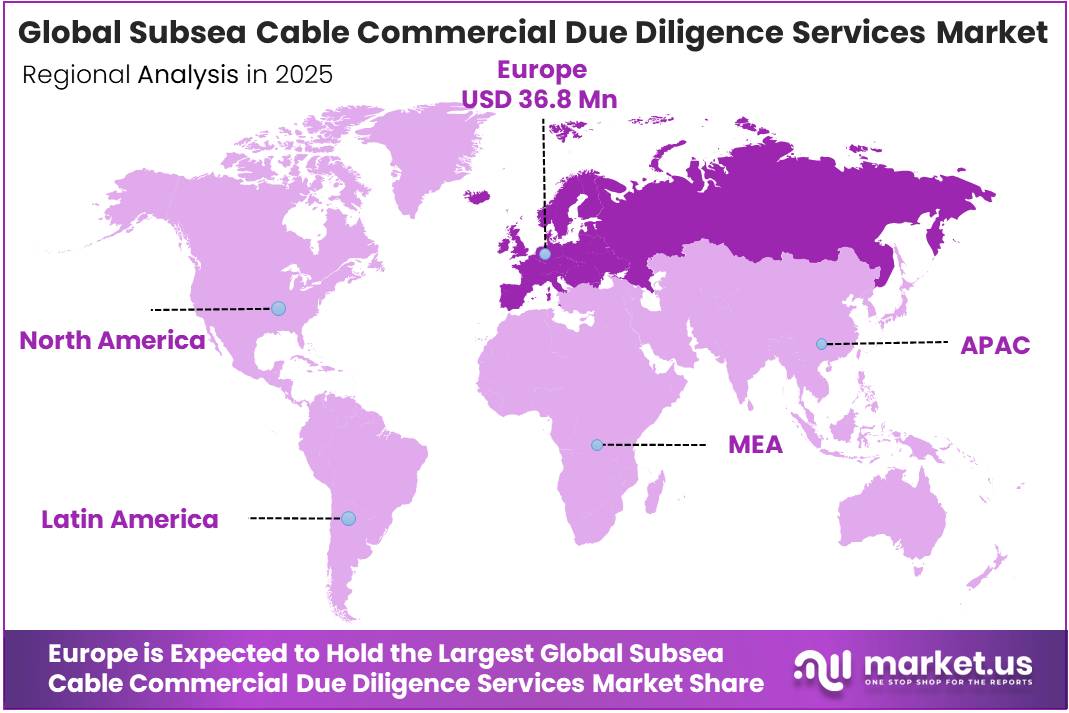
In 2025, the Global Subsea Cable Commercial Due Diligence Services Market was valued at USD 112.3 million. The market is projected to grow at a CAGR of 14.1% during 2026–2035, reaching approximately USD 420.0 million by 2035. Europe dominated the global market in 2025, accounting for more than 32.8% of the total market share and generating approximately USD 36.8 million in revenue.
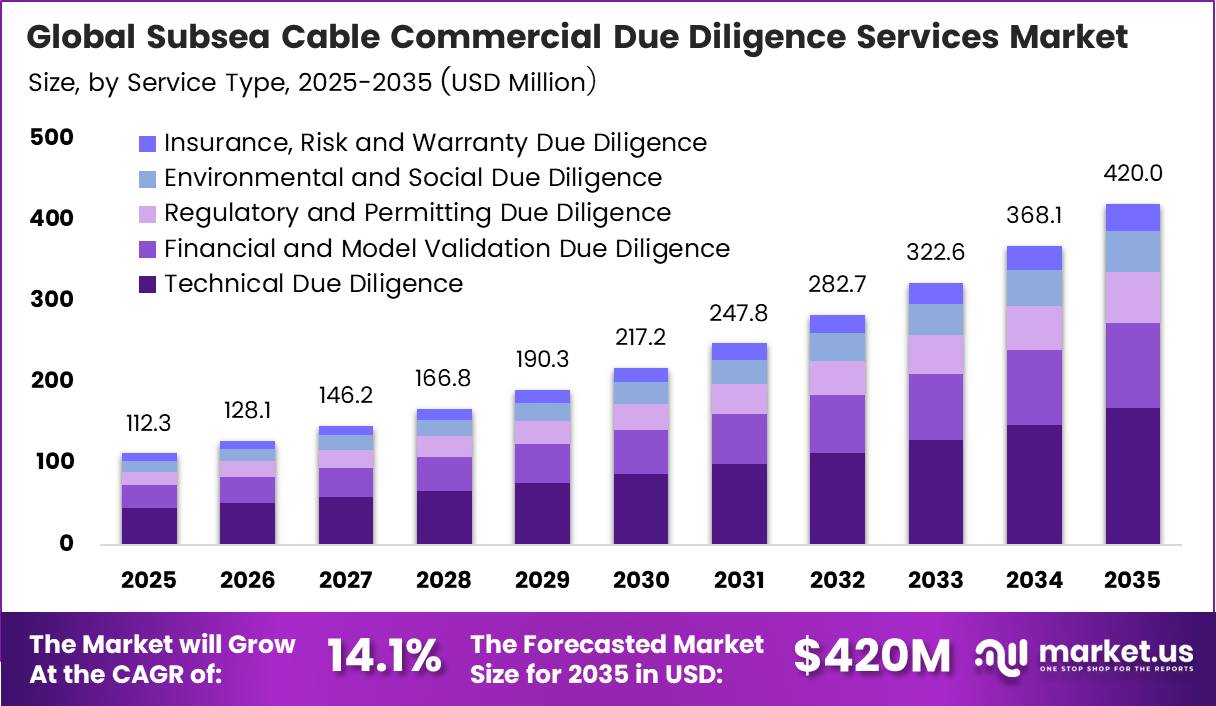
A large wave of cable building drives this growth. The IFC reported that investment in subsea cable infrastructure should exceed USD 13 billion from 2025 to 2027. That is about 2 times the level of 2022 to 2024. AI adds to the need. About half of the world’s data centers sit in North America and Western Europe, and they pull in much of global internet traffic.
Every new cable system needs lenders, equity investors, and owners to review build costs, capacity sales plans, and permits before committing money. Since 1995, the world has added almost 1 million miles of deep-sea cable, enough to circle the equator 40 times. Each new project creates fresh demand for technical, financial, and regulatory checks.
Europe has a deep base of infrastructure funds, project finance banks and cable makers. Prysmian is doubling production capacity at its submarine telecom center in Nordenham, Germany, and plans to hire up to 300 new staff. The new EXA Meridian system will link New Jersey with Brean in the UK over 6,552 km, with 24 fiber pairs and more than 500 Tbps of capacity.
Key Takeaways
- The Subsea Cable Commercial Due Diligence Services Market was worth USD 112.3 million in 2025 and should reach USD 420.0 million by 2035. At a CAGR of 14.1% from 2026 to 2035.
- By Service Type, Technical Due Diligence led with a 31.3% share.
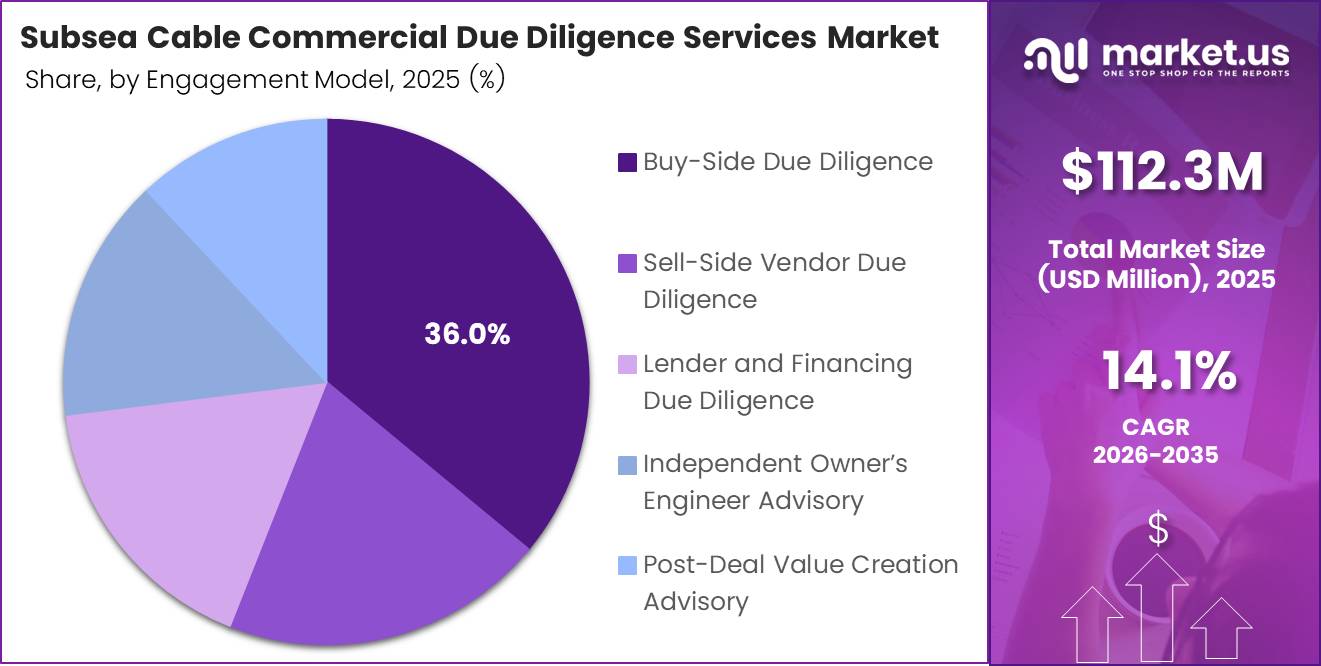
- By Engagement Model, Buy-Side Due Diligence led with a 36.0% share.
- By End User Type, Infrastructure Funds and Private Equity Firms led with a 27.6% share.
- Europe led the market with a 32.8% share, worth USD 36.8 million in 2025.
By Service Type
Technical Due Diligence dominates with 31.3% due to complex route and fault risk reviews.
Technical Due Diligence holds the top share because buyers must check the physical health of each cable before they commit money. The ITU counts over 500 operational systems stretching 1.4 million kilometres across the seabed. Each system has its own route, depth, and repair risks, so investors hire engineers to test design life, upgrade potential, and landing station condition.
Human activity causes most of the damage. The ITU reports that fishing and anchoring cause 86% of cable faults, and repairs can take weeks or months. Technical advisors model these fault patterns, review burial depth, and estimate repair costs. That makes their work the first step in almost every deal.
Regulatory and Permitting Due Diligence is growing fastest as governments tighten cable rules. New FCC landing license rules took effect on November 26, 2025. Licensees must now start service within 3 years of a grant and certify cybersecurity and physical security plans. The rules also ban equipment from the Covered List.
By Engagement Model
Buy-Side Due Diligence dominates with 36.0% due to acquirers verifying cable revenue and assets.
Buy-Side Due Diligence leads because the acquirer carries the most risk in a cable deal. The ITU reports that submarine cable investment grew from USD 0.8 billion in 2015 to USD 9.7 billion in 2025. That 12-fold rise has brought many new buyers into the market, and each one needs a full check of revenue, contracts, and asset life before closing.
Lender and Financing Due Diligence is the fastest-growing model as public lenders fund more projects. The World Bank approved a USD 35 million loan for Georgia to prepare a Black Sea cable, under a program worth up to USD 500 million. In March 2026, the European Commission opened Connecting Europe Facility calls worth €200 million. Of that, €180 million goes to backbone networks focused on 13 priority cable projects.
By End User Type
Infrastructure Funds and Private Equity Firms dominate with 27.6% due to steady long-term contracted cable revenue.
Infrastructure Funds and Private Equity Firms lead because subsea cables offer the long, stable cash flows these investors look for. The FCC grants cable landing licenses for 25 years from the in-service date, which gives owners a clear and lasting asset life. Funds buy stakes in cables and landing stations and order full commercial reviews before every purchase or exit.
Large asset bases also draw in fund capital. The FCC lists 90 licensed cable systems. As of December 2022, licensees reported more than 5.3 million Gbps of available capacity and 6.8 million Gbps planned for 2024. Funds need advisors to judge how much of this capacity will turn into sales.
Hyperscalers and Content Providers are growing fastest as they build their own cables for cloud and AI traffic. Meta plans Project Waterworth, a 50,000-kilometre system with 24 fiber pairs reaching five continents. Meta will lay parts of the route at depths of up to 7,000 metres to lower fault risk. The ITU also reports that cable bandwidth has grown 22% a year since 2021.
Key Market Segments
By Service Type
- Technical Due Diligence
- Financial and Model Validation Due Diligence
- Regulatory and Permitting Due Diligence
- Environmental and Social Due Diligence
- Insurance, Risk and Warranty Due Diligence
By Engagement Model
- Buy-Side Due Diligence
- Sell-Side Vendor Due Diligence
- Lender and Financing Due Diligence
- Independent Owner’s Engineer Advisory
- Post-Deal Value Creation Advisory
By End User Type
- Infrastructure Funds and Private Equity Firms
- Commercial and Investment Banks
- Telecom Operators
- Hyperscalers and Content Providers
- Cable-System Manufacturers
- Offshore Wind and Energy Developers
- Government Agencies and Sovereign Funds
Geopolitical Impact Analysis
Geopolitical tension now shapes the cost and timing of subsea cable projects. UNCTAD reported that tonnage through the Suez Canal was still 70% below 2023 levels by May 2025. Cable ships, repeaters and armored cable now move from factories in Europe and Asia to Indian Ocean and Gulf landing sites on much longer routes. Ships that once crossed the Red Sea in days now sail for weeks around the Cape of Good Hope.
These longer routes push up voyage costs. UNCTAD found that global seaborne trade reached 66,781 billion ton-miles in 2024, up 5.9%. That was the fastest growth since 2011. More ton-miles mean higher fuel use and higher charter costs for cable-laying and repair vessels. Due diligence advisors now test project budgets against these freight and vessel cost shocks.
Chokepoint risk also changes how teams plan cable routes. The Strait of Hormuz handles 11% of global trade and about one-third of seaborne oil trade. The June 2025 conflict between Iran and Israel raised fears of disruption there. Projects that land in the Gulf now need route diversity studies, war risk insurance checks, and backup repair plans.
UNCTAD also reported high and volatile freight rates and constant port disruption. Lenders now ask for stress tests on delivery dates and contingency budgets before they sign financing deals. This trend directly supports the fast growth of lender and financing due diligence.
Regional Analysis
Europe dominates the Subsea Cable Commercial Due Diligence Services Market, holding a 32.8% share and generating USD 36.8 million in revenue. Germany, France, the UK, Spain and Italy host most of the region’s cable makers, landing stations and advisors.
Prysmian and Fincantieri bought Xtera through an 80 to 20 joint venture, which gives Europe a full turnkey supplier. Prysmian is also looking at a new dedicated submarine telecom cable-laying vessel. In the UK, Global Marine bought a 128 metre cable ship in mid 2026 and ordered a 100 metre newbuild. Offshore wind adds another layer of demand.
North America is the fastest-growing region in the Subsea Cable Commercial Due Diligence Services Market. Hyperscalers based in the US drive most new routes. Google holds stakes in 33 subsea systems, and Meta holds stakes in 19. Hyperscalers account for 84% of trans-Atlantic bandwidth demand and 78% of trans-Pacific demand. A trans-oceanic system costs USD 250 million to USD 500 million and takes 2.5 to 3.5 years to build.
Asia Pacific holds a strong growth position. China leads the region, and other activity spans Japan, South Korea, India, Australia, and the rest of APAC. Over the past three years, Asia led cable investment with USD 2 billion in new systems. Announced cables worth over USD 3.7 billion could enter service in Asia from 2026 to 2029.
Key Regions and Countries
North America
- US
- Canada
Europe
- Germany
- France
- The UK
- Spain
- Italy
- Rest of Europe
Asia Pacific
- China
- Japan
- South Korea
- India
- Australia
- Rest of APAC
Latin America
- Brazil
- Mexico
- Rest of Latin America
Middle East and Africa
- GCC
- South Africa
- Rest of MEA
Market Dynamics
Drivers
| Driver | (~) % Impact on CAGR Forecast | Geographic Relevance | Impact Timeline |
|---|---|---|---|
| Hyperscaler-Led Private Cable Build-Out | +2.6% | Global, Trans-Atlantic, Trans-Pacific | Short term (2 years or less) |
| Cable Security Regulation and Risk Assessment Mandates | +1.9% | Europe, North America | Short term (2 years or less) |
| Public Co-Funding of Strategic Routes | +1.2% | Europe, Asia-Pacific | Medium term (2 to 4 years) |
| Infrastructure Fund Entry into Cable Assets | +1.1% | North America, Europe, Middle East | Medium term (2 to 4 years) |
| AI Workload Latency-Driven Route Diversification | +0.9% | Asia-Pacific, Middle East | Short term (2 years or less) |
| Landing License Scrutiny on Foreign Ownership | +0.7% | United States, Australia, India | Short term (2 years or less) |
Hyperscaler-Led Private Cable Build-Out
The root cause is a change in ownership: content and cloud operators have moved from buying capacity in telecom consortium cables to building and owning entire systems themselves. Meta finished its 45,000-kilometer 2Africa system across 33 countries in 2025, and its announced Project Waterworth would cover 50,000 kilometers.
AWS announced Fastnet, its first solo subsea project, which links Maryland and County Cork, with operation targeted for 2028, according to company announcements. Keppel’s annual report shows Bifrost adding more than 240 terabits per second of trans-Pacific capacity at a round-trip latency just under 165 milliseconds after it received its FCC landing license.
Restraints
| Restraint | (~) % Impact on CAGR Forecast | Geographic Relevance | Impact Timeline |
|---|---|---|---|
| Elevated Cost of Project Finance Debt | -1.1% | Global, Emerging Markets | Short term (2 years or less) |
| Geopolitical Route Bans and Permit Denials | -0.9% | South China Sea, Red Sea, Baltic | Short term (2 years or less) |
| In-House Diligence by Hyperscalers | -0.6% | North America, Europe | Medium term (2 to 4 years) |
| Supplier Exclusion Rules Cancelling Tenders | -0.5% | United States, Europe, Pacific Islands | Short term (2 years or less) |
| Sovereign Credit Stress in Landing States | -0.4% | Africa, South Asia, Latin America | Medium term (2 to 4 years) |
Elevated Cost of Project Finance Debt
The root cause is that policy rates remain well above the pre-2022 floor. Federal Reserve and ECB rate data show benchmark rates held in the 2% to 4.5% range through 2025, which pushed all-in project-finance coupons for non-hyperscaler cable sponsors into roughly the 7% to 10% band. The quantitative bottleneck sits in the financial model.
A 200-basis-point rise in debt cost can cut equity IRR on a 20– to 25-year IRU-backed system by an estimated 3 to 4 percentage points, as reflected in World Bank and IFC infrastructure lending benchmarks. That pushes marginal carrier-led and regional systems below their hurdle rates before diligence mandates are even issued.
The strategic impact is that financial close slips by 12 to 18 months for smaller consortia, lender-side technical and market advisory work is deferred, and fee pools shrink in exactly the emerging-market corridors where IMF debt-sustainability flags already limit sovereign guarantees.
Challenges
| Challenge | (~) % CAGR Friction Drag | Geographic Relevance | Mitigation Horizon |
|---|---|---|---|
| Repair Vessel Capacity Shortfall | -0.9% | Global, Europe, Asia-Pacific | Long term (4 years or more) |
| Scarce Specialist Advisory Talent | -0.7% | Global | Medium term (2 to 4 years) |
| Opaque Capacity Pricing Data | -0.5% | Global | Medium term (2 to 4 years) |
| Manufacturing and Lay Backlogs | -0.5% | Global | Medium term (2 to 4 years) |
| Fragmented Multi-Jurisdiction Permitting | -0.4% | Southeast Asia, Africa, Mediterranean | Long term (4 years or more) |
Repair Vessel Capacity Shortfall
The structural weakness is an ageing, thin global fleet of cable maintenance ships. The European Commission has acknowledged that it needs to fund modular repair equipment and is weighing a Multipurpose EU Cable Vessels Reserve fleet. The EU Submarine Cable Infrastructures Expert Group projects a 27% rise in cable faults by 2035 if maintenance resources keep shrinking.
The friction shows up in diligence models through longer mean-time-to-repair assumptions: an extra 10 to 20 days per fault raises outage-penalty and SLA-credit exposure. It also forces wider insurance and reserve buffers, according to ICPC industry incident reporting and operator annual reports. In practice, advisors now have to stress-test the repair-zone agreement on every route.
Opportunities
| Opportunity | (~) % Potential CAGR Upside | Geographic Relevance | Execution Window |
|---|---|---|---|
| Subsea Power Interconnector Diligence | +1.8% | Europe, Middle East, Asia-Pacific | Medium term (2 to 4 years) |
| Recurring Resilience Monitoring Subscriptions | +1.3% | Europe, North America | Medium term (2 to 4 years) |
| Secondary Market Asset Trading Advisory | +1.0% | Global | Long term (4 years or more) |
| Smart Sensing Cable Valuation Services | +0.7% | Europe, Pacific | Long term (4 years or more) |
| Small Island and Unserved Route Feasibility | +0.6% | Pacific Islands, Africa, Caribbean | Medium term (2 to 4 years) |
Subsea Power Interconnector Diligence
This counts as untapped rather than an active driver because most telecom-cable diligence providers have not yet turned their methods for route, permitting, and fault risk into services for HVDC power interconnectors and offshore-wind export cables. For now, that work stays with engineering firms that offer limited commercial demand modelling.
The Connecting Europe Facility is adding EUR 540 million for digital infrastructure in 2025 to 2027 and has awarded EUR 186 million to 25 cable projects, which sets a co-funding template that could later extend to energy links. On unit economics, reusing existing route-risk, vessel-availability, and landing-site datasets could lower the marginal cost per energy engagement by an estimated 25% to 35%.
Interconnector mandates also carry higher capital values, which could lift blended advisory margins by 4 to 6 percentage points, as reflected in ENTSO-E grid-development planning and Prysmian’s disclosures on long-term IMR frameworks.
Key Players Analysis
Tier 1 leaders include McKinsey & Company, The Boston Consulting Group, Bain & Company, and Roland Berger. These firms have global reach and serve infrastructure funds and hyperscalers on large cable deals. BCG grew revenue by 7% to USD 14.4 billion in 2025, up from USD 13.5 billion in 2024. That was its 22nd straight year of growth.
BCG has offices in more than 100 cities in over 50 countries and employs 33,500 staff. AI work brought in 25% of BCG’s 2025 revenue, which matches the AI-driven demand for subsea capacity. Roland Berger plans to double its revenue in Spain and Portugal within 5 years. That plan would add to its presence in European infrastructure advisory.
Tier 2 challengers include Analysys Mason, Cambridge Management Consulting, Tactis, Delta Partners, Hardiman Telecommunications, AP Telecom, Broadband Success Partners and David Ross Group. They win work through deep telecom and cable engineering skills. Analysys Mason posted 19% organic growth in the financial year ending February 2026.
Top Key Players in the Market
- David Ross Group Inc.
- AP Telecom LLC
- Cambridge Management Consulting Limited
- Tactis Strategy and Technology SAS
- Broadband Success Partners LLC
- Delta Partners FZ-LLC
- Hardiman Telecommunications Ltd
- Analysys Mason Limited
- McKinsey & Company, Inc.
- The Boston Consulting Group, Inc.
- Bain & Company, Inc.
- Roland Berger Holding GmbH
Recent Developments
- In December 2025, Prysmian agreed to buy Xtera Topco Limited, a UK and US turnkey submarine telecom specialist, at an enterprise value of USD 65 million through its 80% and 20% joint venture with Fincantieri.
- In September 2026, EXA Infrastructure selected Xtera to supply optical engineering and wet and dry plant for EXA Meridian, a 6,552 km trans-Atlantic cable with 24 fiber pairs and more than 500 Tbps of capacity.
- In October 2026, Analysys Mason acquired Modulai, a Swedish AI and machine learning consultancy, after posting 19% organic growth in its financial year to February 2026.
Report Scope
| Report Features | Description |
|---|---|
| Market Value (2025) | USD 112.3 Million |
| Forecast Revenue (2035) | USD 420.0 Million |
| CAGR (2026-2035) | 14.1% |
| Base Year for Estimation | 2025 |
| Historic Period | 2020-2024 |
| Forecast Period | 2026-2035 |
| Report Coverage | Revenue Forecast, Market Dynamics, Competitive Landscape, Recent Developments |
| Segments Covered | By Service Type (Technical Due Diligence, Financial and Model Validation Due Diligence, Regulatory and Permitting Due Diligence, Environmental and Social Due Diligence, Insurance, Risk and Warranty Due Diligence); By Engagement Model (Buy-Side Due Diligence, Sell-Side Vendor Due Diligence, Lender and Financing Due Diligence, Independent Owner’s Engineer Advisory, Post-Deal Value Creation Advisory); By End User Type (Infrastructure Funds and Private Equity Firms, Commercial and Investment Banks, Telecom Operators, Hyperscalers and Content Providers, Cable-System Manufacturers, Offshore Wind and Energy Developers, Government Agencies and Sovereign Funds) |
| Regional Analysis | North America – US, Canada; Europe – Germany, France, The UK, Spain, Italy, Rest of Europe; Asia Pacific – China, Japan, South Korea, India, Australia, Singapore, Rest of APAC; Latin America – Brazil, Mexico, Rest of Latin America; Middle East & Africa – GCC, South Africa, Rest of MEA |
| Competitive Landscape | David Ross Group Inc., AP Telecom LLC, Cambridge Management Consulting Limited, Tactis Strategy and Technology SAS, Broadband Success Partners LLC, Delta Partners FZ-LLC, Hardiman Telecommunications Ltd, Analysys Mason Limited, McKinsey & Company, Inc., The Boston Consulting Group, Inc., Bain & Company, Inc., Roland Berger Holding GmbH |
| Customization Scope | Customization for segments and region/country-level will be provided. Additional customization can be done based on requirements. |
| Purchase Options | We have three licenses to opt for: Single User License, Multi-User License (Up to 5 Users), Corporate Use License (Unlimited Users and Printable PDF) |