


Report Overview
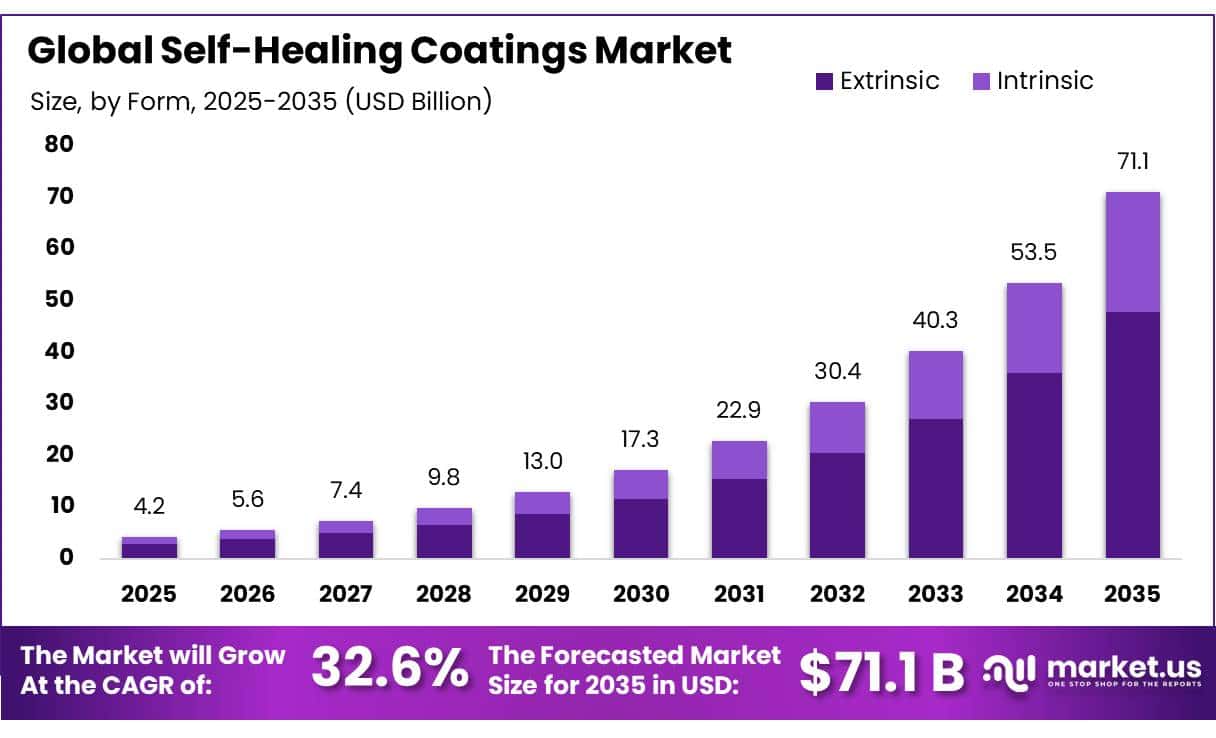
The Global Self-Healing Coatings Market size is expected to be worth around USD 71.1 Billion by 2035, from USD 4.2 Billion in 2025, growing at a CAGR of 32.6% during the forecast period from 2026 to 2035. In 2025, Asia Pacific held a dominant market position, capturing more than a 42.2% share, holding USD 1.7 Billion revenue.
Self-healing coatings are advanced protective coatings designed to repair minor scratches, cracks, and surface damage through heat, moisture, microcapsules, polymers, or reversible chemical bonding. Industrial demand is being shaped by automotive, aerospace, marine, construction, electronics, and energy assets where coating failure can raise downtime and lifecycle costs.
The strongest industrial driver is corrosion control: AMPP stated in 2025 that corrosion costs the global economy more than US$2.5 trillion annually, while proven corrosion-control practices can save up to 35% of these costs.
The industrial scenario is moving from laboratory-scale smart materials toward commercial protective films, corrosion-sensing systems and multifunctional nanocoatings. In April 2025, 3M’s Paint Protection Film Series 100 Gloss technical sheet highlighted self-healing technology for minor scratches or marks when heat is applied, a 10-year warranty, and use across personal and commercial fleet vehicles in the U.S. and Canada. 3M also reported full-year 2025 sales of US$24.9 billion, up 1.5%, with adjusted sales of US$24.3 billion, showing the scale of industrial platforms supporting advanced materials commercialization.
Driving factors include corrosion-cost reduction, lower repainting frequency, fleet uptime, sustainability rules, reduced material waste, and demand for longer-life vehicles, aircraft, bridges, ships and offshore structures. Government-backed research is also strengthening the technology pipeline. The EU-funded COAT4LIFE project ran from May 2021 to April 2025, received €570,400 in EU contribution, and focused on eco-friendly multifunctional coatings able to detect and prevent corrosion in aeronautics and offshore applications.
AMPP/NACE estimates global corrosion cost at US$2.5 trillion, equal to 3.4% of global GDP, while effective corrosion-control practices could save 15–35%, or US$375–875 billion. Self-healing coatings directly address this cost by extending substrate life and reducing maintenance cycles.
Regulatory and sustainability pressure is also strengthening the outlook. The European Commission links circular economy policy with durability, repairability, a nd resource efficiency, noting that up to 80% of product environmental impact is determined at the design stage and targeting a rise in the EU circular material-use rate from about 12% to 24% by 2030.
Key Takeaways
- Self-Healing Coatings Market size is expected to be worth around USD 71.1 Billion by 2035, from USD 4.2 Billion in 2025, growing at a CAGR of 32.6%.
- Extrinsic held a dominant market position, capturing more than a 67.4% share.
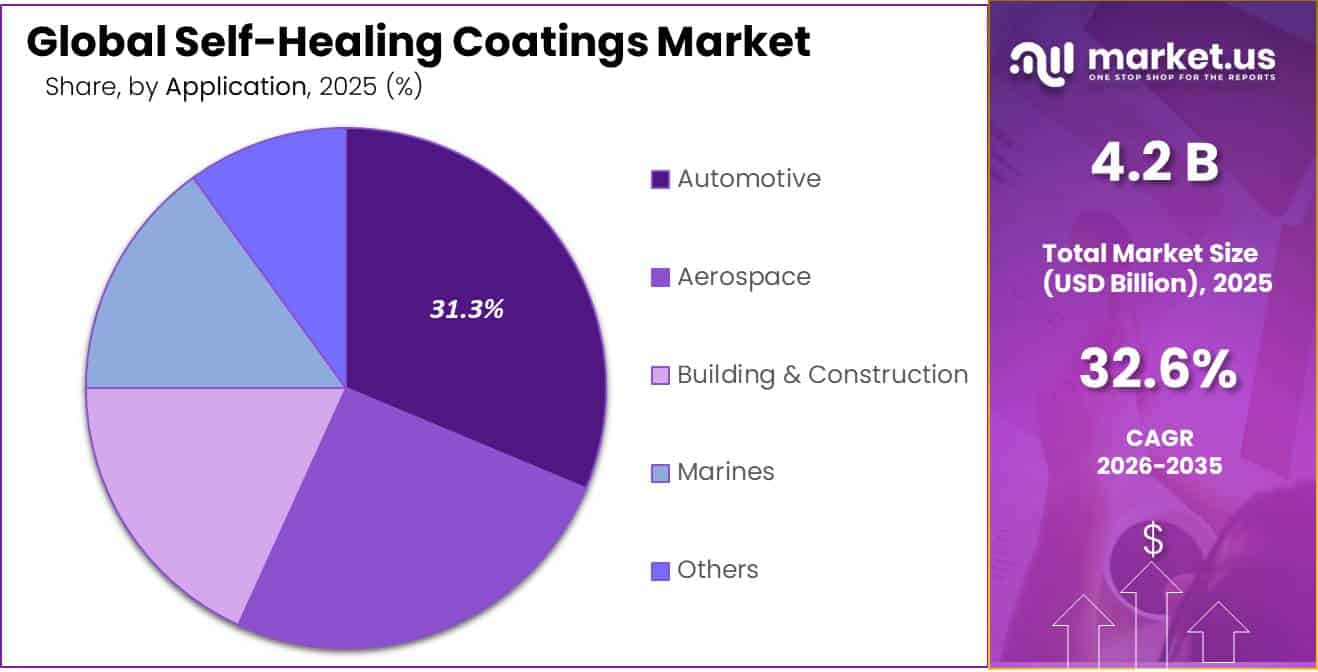
- Automotive held a dominant market position, capturing more than a 31.3% share.
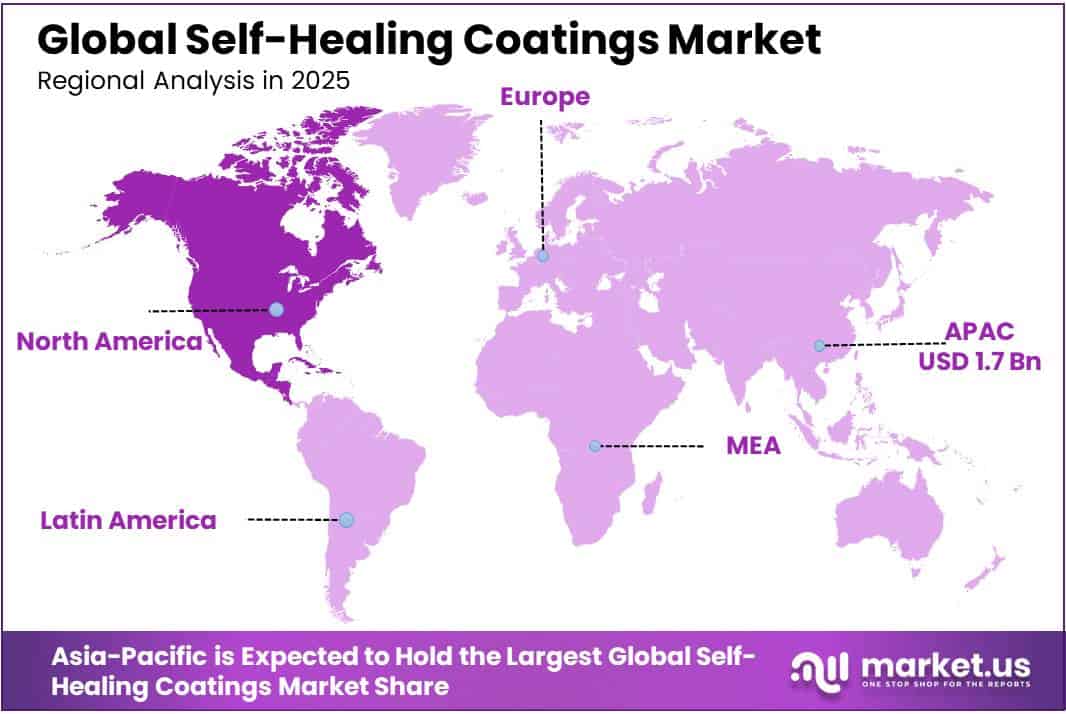
- Asia-Pacific has emerged as the leading region in the self-healing coatings market, holding a dominant share of 42.2% and reaching a value of around USD 1.7 billion.
By Form Analysis
Extrinsic self-healing coatings lead strongly with 67.4% driven by practical repair efficiency and wide industrial use
In 2025, Extrinsic held a dominant market position, capturing more than a 67.4% share. This strong lead is mainly because extrinsic self-healing systems are easier to design and implement across multiple industries such as construction, automotive, and marine coatings. These coatings use embedded capsules or vascular networks filled with healing agents, which makes them highly effective in repairing visible cracks and damage without complex chemical reactions.
By Application Analysis
Automotive leads with 31.3% as demand rises for scratch resistance and longer-lasting finishes
In 2025, Automotive held a dominant market position, capturing more than a 31.3% share. This growth is mainly driven by the increasing need for durable and low-maintenance vehicle coatings that can automatically repair minor scratches and surface damage. Car manufacturers are focusing more on improving vehicle appearance and reducing repair costs, which makes self-healing coatings a practical choice. These coatings are widely used on exterior surfaces to maintain gloss and protect against everyday wear like stone chips and light abrasions.
Key Market Segments
By Form
- Extrinsic
- Intrinsic
By Application
- Automotive
- Aerospace
- Building & Construction
- Marines
- Others
Emerging Trends
Shift toward eco-friendly and long-lasting coatings is shaping the latest market trend
One of the most noticeable trends in the self-healing coatings market is the strong shift toward environmentally friendly and long-lasting materials. Industries are no longer just looking for protection—they want coatings that reduce waste and support sustainability goals. Self-healing coatings are gaining attention because they extend the life of materials and reduce the need for repeated repainting or repairs. Studies show that these coatings can lower maintenance cycles by 40–60%, which directly reduces material consumption and environmental impact.
Governments and regulatory bodies, especially in regions like Europe and North America, are pushing strict environmental rules around emissions and waste. This is encouraging industries to adopt coatings that reduce the use of harmful chemicals like volatile organic compounds (VOCs). Self-healing coatings fit well into these policies because they minimize reapplication and improve durability over time.
Integration of smart materials and advanced technologies is accelerating innovation
Another important trend is the integration of smart materials and advanced technologies into self-healing coatings. Modern coatings are no longer passive layers—they are becoming active systems that can respond to damage, temperature, or environmental changes. Technologies like microcapsules and vascular networks are now widely used, allowing coatings to release healing agents automatically when cracks appear.
This trend is supported by ongoing research and innovation. For example, new self-healing polymer coatings can achieve up to 85% healing efficiency, showing significant improvement over older technologies. Governments and research institutions are also funding advanced material development to improve infrastructure durability and reduce long-term costs. In Asia, research institutions like IIT have already developed coatings that can repair cracks in minutes, showing how fast the technology is evolving.
Drivers
Rising infrastructure repair costs are pushing industries toward self-healing coatings
One of the biggest drivers for self-healing coatings is the rising cost of repairing and maintaining infrastructure across the world. Corrosion alone causes massive economic damage, with global losses exceeding $700 billion every year, which is more than 3% of global GDP. Governments and industries are under pressure to reduce this burden, especially in sectors like bridges, pipelines, and industrial equipment.
Field studies also show practical benefits—self-healing coatings can cut maintenance frequency by 40–60% over time, which directly saves labor, materials, and downtime. Governments are increasingly supporting such technologies because they help extend the life of public assets. For example, infrastructure policies in many countries now focus on durability and lifecycle cost savings rather than just initial construction cost.
Demand for cost-effective and durable materials is accelerating adoption
Another strong reason behind the growth of self-healing coatings is the need for long-lasting and cost-efficient materials across industries. Many sectors, including automotive, construction, and electronics, are looking for ways to reduce repair costs and improve product life. Studies show that businesses using these coatings have seen up to 40% reduction in maintenance and repair expenses, which is a big advantage in cost-sensitive industries
Governments are also supporting innovation in this space. For instance, the U.S. Department of Energy has invested $51.7 million in 2024 for advanced technologies, including self-healing coatings, to improve durability and reduce lifecycle costs in transportation systems. This kind of funding shows that public agencies see long-term value in reducing maintenance and improving sustainability.
Restraints
High production cost and complex technology are slowing adoption
One of the biggest challenges holding back the self-healing coatings market is the high cost of production and the complexity involved in manufacturing these materials. Compared to traditional coatings, self-healing systems are still expensive because they require advanced materials like microcapsules, polymers, and nanotechnology-based additives. In many cases, production costs are 3 to 5 times higher than conventional coatings, which makes it difficult for small and mid-sized industries to adopt them widely.
This becomes a serious concern in cost-sensitive sectors such as construction and basic manufacturing, where budgets are tightly controlled. Governments often push for durable infrastructure through initiatives and standards, but they also need to balance spending. For example, public infrastructure guidelines emphasize cost efficiency along with durability, meaning technologies must prove long-term savings before large-scale use.
Performance limitations and environmental constraints create hesitation
Another important restraining factor is the performance limitation of current self-healing coatings under real-world conditions. While the concept sounds promising, most coatings today do not fully restore their original strength after damage. Studies show that healing efficiency usually stays between 60% to 85% of the original performance, and it often decreases after repeated damage cycles
There are also environmental limitations. Many self-healing coatings work best only within a narrow temperature range, typically 15°C to 35°C, which restricts their use in extreme climates like very hot deserts or freezing regions. Governments and regulatory bodies are encouraging durable and climate-resistant materials for infrastructure, but these technical limits slow down approvals and adoption.
Opportunity
Growing demand from green infrastructure projects is creating new opportunities
One of the biggest growth opportunities for self-healing coatings is coming from the rapid expansion of green and sustainable infrastructure projects. Governments across the world are now focusing on long-lasting, low-maintenance construction materials to reduce environmental impact. For example, in 2024, India recorded 370 green-certified projects covering 8.5 million square meters, showing a clear shift toward sustainable building practices
These coatings help structures repair minor cracks on their own, which reduces material waste and maintenance activities. In infrastructure trials, they have shown up to 40–60% reduction in maintenance cycles, meaning fewer resources are needed over time. Governments promoting green building certifications and climate-resilient infrastructure are indirectly supporting this technology. As cities expand and older infrastructure ages, the need for durable coatings becomes more important.
Increasing industrial losses from corrosion is opening new demand areas
Another major opportunity comes from the growing financial impact of corrosion across industries. Global studies show that corrosion leads to losses of over $700 billion every year, which is more than 3% of the world’s GDP. Industries such as oil & gas, marine, and transportation are constantly looking for better ways to protect their assets and reduce these losses. This is where self-healing coatings are gaining attention, as they can automatically repair damage before corrosion spreads.
Governments and industrial bodies are now investing in advanced materials to improve asset life and reduce repair costs. Self-healing coatings can extend the lifespan of equipment and infrastructure while lowering downtime. Research also highlights that businesses using these coatings can reduce maintenance expenses by around 40%, which makes them attractive for large-scale industries
Regional Insights
Asia-Pacific dominates with 42.2% share valued at USD 1.7 Bn driven by strong industrial and infrastructure growth
Asia-Pacific has emerged as the leading region in the self-healing coatings market, holding a dominant share of 42.2% and reaching a value of around USD 1.7 billion. The region’s strong position is mainly supported by rapid industrialization, large-scale infrastructure projects, and increasing demand for durable coating solutions across countries like China, India, and Southeast Asia.
Governments across the region are heavily investing in transportation networks, smart cities, and energy infrastructure, which is directly increasing the demand for advanced coatings that can extend asset life and reduce maintenance costs. According to industry data, Asia-Pacific is also the fastest-growing region in this market, with a significantly higher growth rate compared to other regions.
Key Regions and Countries Insights
- North America
- US
- Canada
- Europe
- Germany
- France
- The UK
- Spain
- Italy
- Rest of Europe
- Asia Pacific
- China
- Japan
- South Korea
- India
- Australia
- Rest of APAC
- Latin America
- Brazil
- Mexico
- Rest of Latin America
- Middle East & Africa
- GCC
- South Africa
- Rest of MEA
Key Players Analysis
3M remains a strong player in advanced materials and coatings, including self-healing technologies used in automotive and industrial applications. In 2025, the company reported total revenue of around $24.9 billion, showing a 1.5% year-on-year growth. Its coatings segment benefits from strong R&D investments and innovation capabilities. With operating margins around 18.6%, the company continues to focus on high-performance materials, supporting demand for durable and smart coating solutions across global markets.
Akzo Nobel is a leading global coatings company with a strong presence in decorative and performance coatings. In 2025, the company generated revenue of approximately €10.16 billion, despite a 5% decline due to volume and currency impacts. The company maintained profitability with an EBITDA margin of 14.2%, supported by €98 million in cost savings initiatives. Its focus on sustainable coatings and innovation positions it well in the growing self-healing coatings market.
BASF SE is one of the largest chemical companies globally and a major player in advanced coatings. In 2025, BASF reported sales revenue of €59.7 billion, reflecting its strong global presence across chemicals, materials, and coatings. The company also recorded a net income of €1.6 billion, showing steady financial performance. BASF continues to invest in sustainable and high-performance materials, including innovations in self-healing coatings to support automotive, construction, and industrial sectors.
Top Key Players Outlook
- 3M
- Akzo Nobel N.V.
- Autonomic Materials, Inc.
- BASF SE
- Covestro AG
- FEYNLAB Inc
- GVD Corporation
- NEI Corporation
- Solvay
- spotLESS Materials Inc.
- Winn & Coales (Denso) Ltd.
- Revivify Coatings America
Recent Industry Developments
Covestro AG is actively contributing to the self-healing coatings space through its advanced polymer materials, especially polyurethane systems that are widely used in protective and smart coating applications. In 2025, the company reported total sales of €12.9 billion, reflecting an 8.7% decline from €14.1 billion in 2024, mainly due to pricing pressure and lower demand across regions.
3M Company has been steadily strengthening its position in the self-healing coatings space by focusing on high-performance materials and advanced surface technologies. In 2025, the company reported total sales of $24.9 billion, reflecting a 1.5% annual growth, while maintaining an operating margin of 18.6%, which shows strong profitability in its materials and coatings-related businesses.
Report Scope
| Report Features | Description |
|---|---|
| Market Value (2025) | USD 4.2 Bn |
| Forecast Revenue (2035) | USD 71.1 Bn |
| CAGR (2026-2035) | 32.6% |
| Base Year for Estimation | 2025 |
| Historic Period | 2020-2024 |
| Forecast Period | 2026-2035 |
| Report Coverage | Revenue Forecast, Market Dynamics, Competitive Landscape, Recent Developments |
| Segments Covered | By Form (Extrinsic, Intrinsic), By Application (Automotive, Aerospace, Building And Construction, Marines, Others) |
| Regional Analysis | North America – US, Canada; Europe – Germany, France, The UK, Spain, Italy, Rest of Europe; Asia Pacific – China, Japan, South Korea, India, Australia, Singapore, Rest of APAC; Latin America – Brazil, Mexico, Rest of Latin America; Middle East & Africa – GCC, South Africa, Rest of MEA |
| Competitive Landscape | 3M, Akzo Nobel N.V., Autonomic Materials, Inc., BASF SE, Covestro AG, FEYNLAB Inc, GVD Corporation, NEI Corporation, Solvay, spotLESS Materials Inc., Winn & Coales (Denso) Ltd., Revivify Coatings America |
| Customization Scope | Customization for segments, region/country-level will be provided. Moreover, additional customization can be done based on the requirements. |
| Purchase Options | We have three licenses to opt for: Single User License, Multi-User License (Up to 5 Users), Corporate Use License (Unlimited User and Printable PDF) |





































