


Global Seed Processing Machinery Market Size, Share, And Industry Analysis Report By Machinery Type (Cleaners, Pre Cleaners, Dryers, Graders, Polishers, Optical Sorters, Seed Packagers, Others), By Operation Mode (Automatic, Semi-Automatic, Manual), By Capacity (Less Than 1 Metric Ton per Hr, 1–10 Metric Tons per Hr, More Than 10 Metric Tons per Hr), By Crop Type (Cereals and Grains, Fruits and Vegetables, Oilseeds and Pulses, Others), By End-User (Commercial Seed Processing Plants, Grain Handling Facilities), By Region and Companies - Industry Segment Outlook, Market Assessment, Competition Scenario, Statistics, Trends and Forecast 2026-2035
- Published date: March 2026
- Report ID: 180705
- Number of Pages: 290 and 290
- Format:
-
keyboard_arrow_up
Quick Navigation
Report Overview
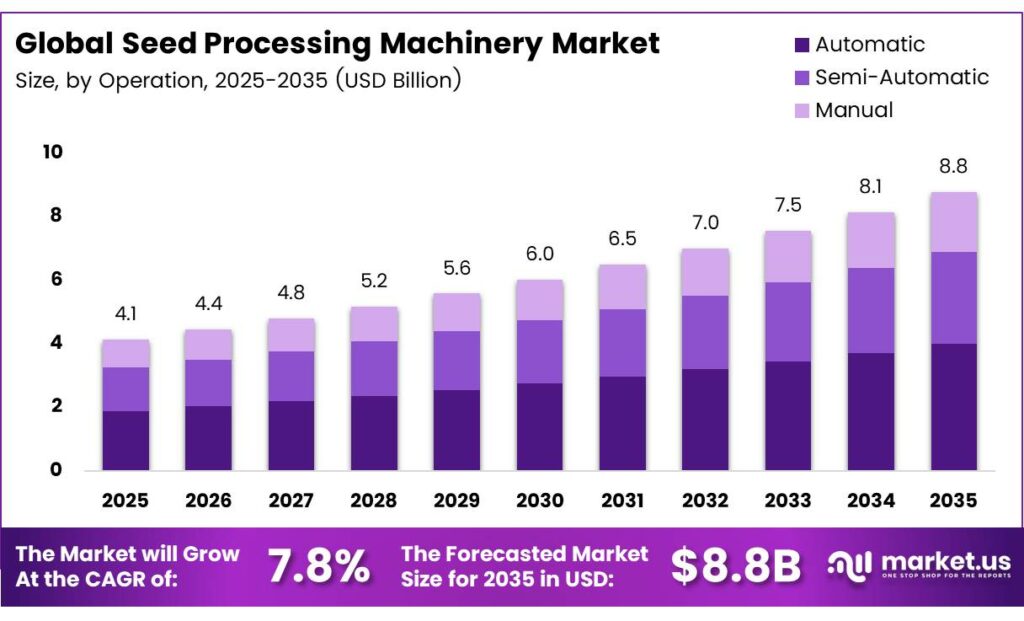
The Global Seed Processing Machinery Market size is expected to be worth around USD 8.8 billion by 2035 from USD 4.1 billion in 2025, growing at a CAGR of 7.8% during the forecast period 2026 to 2035.
The seed processing machinery market covers equipment used to clean, dry, grade, coat, treat, sort, and package seeds before commercial sale or planting. These machines handle a wide range of crops, from cereals and grains to oilseeds and vegetables. Farmers, seed companies, and research institutions all rely on this equipment to maintain seed quality and consistency.
Modern seed processing integrates multiple operations into a single production line. Equipment such as optical sorters, coaters, and destoners work together to deliver finished seeds that meet strict germination and purity standards. This integration reduces handling time and improves throughput across commercial seed processing plants globally.
- China’s exports of seed and grain cleaning and grading machinery reached USD 287.742 million and 45,532 items in 2024, making China the largest exporter in this trade category. This trade dominance reflects China’s strong manufacturing capacity and competitive pricing in the global seed equipment supply chain.
Government policies play a strong role in market growth. Many emerging economies now provide subsidies for post-harvest mechanization, encouraging seed producers to upgrade from manual handling to automated processing lines. These programs directly accelerate equipment adoption across South Asia, Sub-Saharan Africa, and Southeast Asia.
- India’s imports of seed and grain cleaning and grading machinery reached USD 90.459 million and 22,534 items in 2024, making India the largest importer globally. This import surge signals the rapid expansion of India’s commercial seed sector and growing demand for modern processing solutions across the country.
The rising demand for treated and certified seeds creates consistent pressure on equipment manufacturers to deliver precision coating and moisture control technologies. Hybrid seed varieties, in particular, require careful handling to protect germination rates. Consequently, seed companies invest heavily in modern processing infrastructure to meet regulatory and buyer requirements.
Key Takeaways
- The Global Seed Processing Machinery Market is valued at USD 4.1 billion in 2025 and is projected to reach USD 8.8 billion by 2035. at a CAGR of 7.8% during the forecast period 2026 to 2035.
- Cleaners hold the dominant position with a 25.7% market share in 2025.
- Automatic systems lead the segment with a 67.3% share.
- The 1–10 Metric Tons/Hour segment dominates with a 54.2% market share.
- Cereals and Grains account for the largest share at 48.6%.
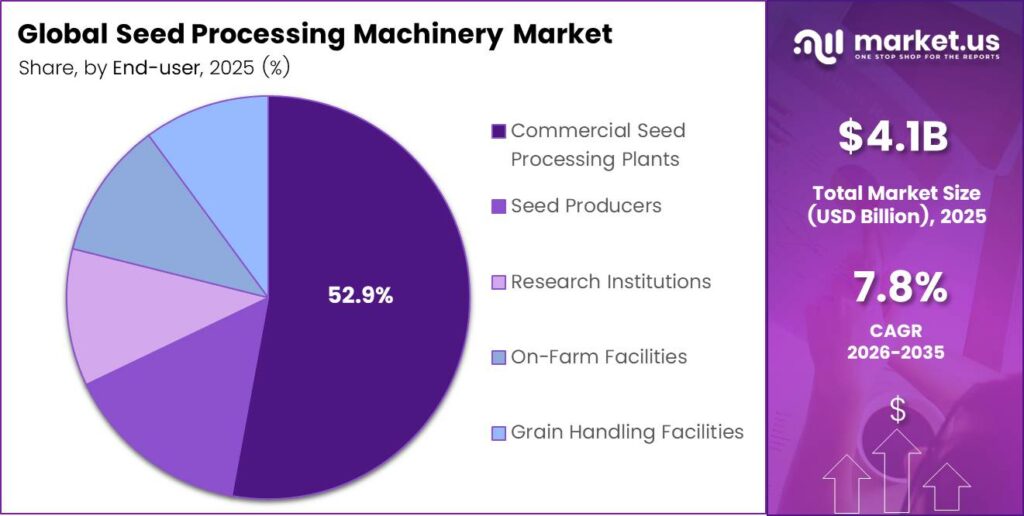
- Commercial Seed Processing Plants hold a 52.9% market share.
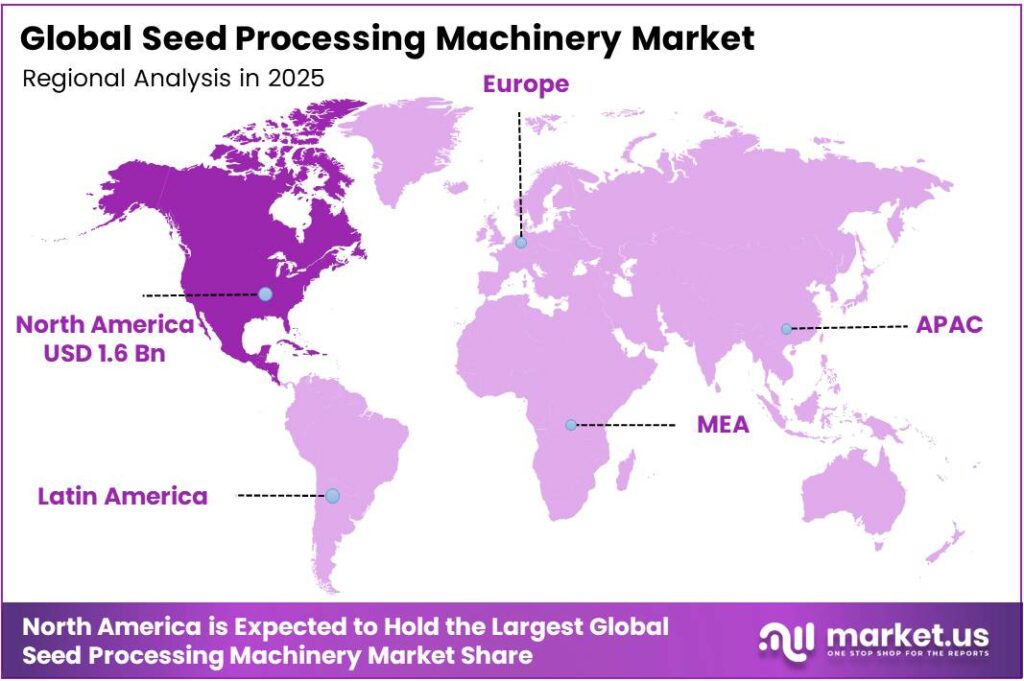
- North America is the dominant region, contributing 38.1% of the total market value, equivalent to USD 1.6 billion in 2025.
Machinery Type Analysis
Cleaners dominate with 25.7% due to their universal role in primary seed quality processing.
In 2025, Cleaners held a dominant market position in the By Machinery Type segment of the Seed Processing Machinery Market, with a 25.7% share. Cleaners perform the first critical step in seed processing by removing dust, chaff, and oversized particles. Their universal application across all crop types makes them the most widely deployed category in both small-scale and industrial processing lines.
Pre-cleaners support cleaning systems by handling raw field-harvested material before it enters the main processing line. These machines remove large debris and high-moisture material quickly. Moreover, pre-cleaners protect downstream equipment from damage, extending the operational lifespan of the entire processing system.
Dryers play a vital role in preserving seed viability by reducing moisture content to safe storage levels. Proper drying prevents mold, fungal growth, and germination loss during storage. Therefore, dryers remain essential investments for commercial seed producers handling high-value hybrid varieties in humid agricultural regions.
Polishers improve seed surface appearance and coating adhesion, supporting premium product presentation for commercial markets. Optical Sorters use advanced imaging to detect and reject defective seeds at high throughput speeds. Furthermore, Seed Packagers automate the final filling, weighing, and sealing operations, completing the processing line for commercial dispatch.
Operation Mode Analysis
Automatic systems dominate with 67.3% due to efficiency, speed, and labor cost advantages.
In 2025, Automatic systems held a dominant market position in the By Operation Mode segment of the Seed Processing Machinery Market, with a 67.3% share. Fully automatic lines require minimal human intervention and operate continuously at high throughput. Commercial seed processing plants prefer these systems because they reduce per-unit labor costs and deliver consistent quality output.
Semi-Automatic systems combine machine-driven processing with operator-managed adjustments at key steps. These systems suit mid-sized seed producers who need higher output than manual lines but cannot justify full automation capital costs. Additionally, semi-automatic equipment offers flexibility for processors handling multiple crop varieties in smaller seasonal batches.
Manual processing systems remain in use among small-scale on-farm operators and lower-income agricultural regions. These systems require significant labor input at every stage of the processing workflow. However, their low purchase cost and simple maintenance make them accessible entry points for seed producers beginning to formalize their post-harvest operations.
Capacity Analysis
1–10 Metric Tons/Hour capacity segment dominates with 54.2% as the preferred mid-range industrial standard.
In 2025, 1–10 Metric Tons/Hour held a dominant market position in the By Capacity segment of the Seed Processing Machinery Market, with a 54.2% share. This capacity range covers the needs of most commercial seed processing plants and cooperative facilities. Moreover, it balances throughput efficiency with manageable capital investment, making it the default choice for mid-scale operations globally.
Less than 1 Metric Ton/Hour capacity equipment serves on-farm processors, research institutions, and specialty seed producers handling limited volumes. These compact systems support identity preservation for organic and specialty seed varieties. Consequently, demand for sub-ton units grows as contract farming and niche crop markets expand across both developed and emerging economies.
More than 10 Metric Tons/Hour equipment serves large-scale commercial grain handling facilities and industrial seed producers managing high-volume output. These heavy-capacity systems require significant infrastructure investment. Therefore, their adoption concentrates among large multinational seed companies and government-backed grain handling facilities in major cereal-producing countries.
Crop Type Analysis
Cereals and Grains dominate with 48.6% as the largest global crop category requiring intensive seed processing.
In 2025, Cereals and Grains held a dominant market position in the By Crop Type segment of the Seed Processing Machinery Market, with a 48.6% share. Wheat, rice, corn, and barley collectively represent the highest processing volumes globally. The scale of cereal seed production drives consistent demand for high-capacity cleaners, graders, and dryers throughout major agricultural regions.
Fruits and Vegetables seed processing requires more delicate handling equipment due to smaller seed sizes and higher per-unit value. Processing lines for this category prioritize precision grading and low-damage optical sorting. Additionally, growing consumer demand for high-yield vegetable varieties accelerates equipment upgrades among horticultural seed companies worldwide.
Oilseeds and Pulses cover crops such as soybeans, sunflowers, canola, and lentils, each with specific density and size characteristics requiring specialized processing. Demand for oilseed processing equipment grows alongside expanding biofuel and edible oil industries. Furthermore, the Others sub-segment includes specialty and forage crops that require customized processing solutions for niche agricultural markets.
End-User Analysis
Commercial Seed Processing Plants dominate with 52.9% as the primary buyers of industrial-scale seed machinery.
In 2025, Commercial Seed Processing Plants held a dominant market position in the By End-User segment of the Seed Processing Machinery Market, with a 52.9% share. These facilities process certified seeds at an industrial scale for national and export markets. Their need for high-throughput, multi-crop processing lines makes them the largest individual buyers of advanced seed processing equipment globally.
Seed Producers invest in processing equipment to maintain quality control over their own seed stocks before sale or planting. Vertically integrated producers prefer owning processing capacity to reduce dependence on third-party plants. Moreover, producer-owned equipment supports faster turnaround and better traceability for premium or certified seed programs.
Research Institutions use smaller, precision processing systems for seed evaluation and variety development programs. These buyers prioritize accuracy over throughput and often require specialized handling for experimental seed batches. Additionally, On-Farm Facilities and Grain Handling Facilities represent growing buyer segments as farm-level mechanization expands across South Asia and Sub-Saharan Africa.
Key Market Segments
By Machinery Type
- Cleaners
- Pre Cleaners
- Dryers
- Graders
- Coaters and Treaters
- Separators and Destoners
- Polishers
- Optical Sorters
- Seed Packagers
- Others
By Operation Mode
- Automatic
- Semi-Automatic
- Manual
By Capacity
- Less Than 1 Metric Ton/Hour
- 1–10 Metric Tons/Hour
- More Than 10 Metric Tons/Hour
By Crop Type
- Cereals and Grains
- Fruits and Vegetables
- Oilseeds and Pulses
- Others
By End-User
- Commercial Seed Processing Plants
- Seed Producers
- Research Institutions
- On-Farm Facilities
- Grain Handling Facilities
Emerging Trends
Advanced Sensing and Automation Technologies Reshape Seed Processing Operations
Hyperspectral imaging and machine learning now power next-generation optical sorting systems across commercial seed processing lines. These technologies detect internal defects, moisture irregularities, and varietal contamination that conventional cameras miss entirely. United States exports of seed and grain cleaning machinery totaled USD 49.875 million and 2,482 items in 2024, reflecting strong demand for advanced American-engineered sorting equipment globally.
Fully automatic processing lines now integrate predictive analytics and SCADA platforms to monitor equipment performance in real time. These systems flag maintenance needs before failures occur, reducing costly downtime at commercial seed plants. IoT connectivity allows plant managers to track processing parameters remotely and generate data-driven quality reports for regulatory compliance and buyer transparency.
Chemical-free steam treatment technologies gain adoption as seed companies face tighter regulatory restrictions on conventional chemical seed treatments. These systems deliver effective pathogen control without chemical residue concerns. Additionally, containerized processing units allow seed producers to bring mobile, self-contained lines directly to farm sites, supporting identity preservation programs in contract farming arrangements.
Drivers
Automation, Treated Seed Demand, and Policy Support Accelerate Market Growth
Automation of optical sorting systems dramatically improves throughput efficiency while reducing dependence on manual inspection labor. Seed processing plants that adopt automated lines report faster processing cycles and lower per-unit operating costs. The European Union’s exports of seed and grain cleaning machinery reached USD 115.370 million and 9,792 items in 2024, confirming Europe’s leadership in supplying precision automation technology to global markets.
Rising demand for treated and value-added seeds pushes seed companies to invest in precision coating and treating equipment. Farmers increasingly prefer pre-treated seeds that offer protection against soil-borne pathogens from the moment of planting. Consequently, coating equipment manufacturers expand their product lines to handle a wider range of active ingredients and formulations across crop categories.
Government subsidy programs across emerging economies directly fund post-harvest mechanization upgrades. Countries including India, Brazil, and several Sub-Saharan African nations allocate agricultural modernization budgets toward seed processing infrastructure. Furthermore, sensor-based moisture control systems now improve germination rates for high-value hybrid seeds, providing measurable return on investment that justifies equipment adoption among commercial processors.
Restraints
High Capital Costs and Supply Chain Disruptions Slow Market Adoption
High upfront investment costs remain the primary barrier for small-scale seed processors seeking to upgrade their operations. A fully automated seed processing line can require capital outlays that small cooperatives and on-farm processors cannot finance through existing revenue. Moreover, access to affordable equipment financing remains limited in many developing markets where mechanization needs are greatest.
Supply chain volatility for precision components creates significant deployment delays for smart seed processing machinery. Sensors, programmable controllers, and optical components rely on global electronics supply chains that have proved vulnerable to disruption in recent years. Consequently, equipment manufacturers face longer lead times and higher component costs that they must pass on to buyers or absorb into tighter margins.
The combination of high costs and supply uncertainty particularly affects small and mid-sized seed producers in price-sensitive markets. These buyers often delay purchasing decisions or opt for lower-specification equipment that does not fully meet their processing needs. Therefore, manufacturers that develop cost-optimized or modular equipment configurations will hold a meaningful competitive advantage in these constrained market segments.
Growth Factors
Specialty Seeds, Asia-Pacific Expansion, and Flexible Financing Models Drive Future Growth
Containerized on-farm processing units open new growth avenues for seed machinery manufacturers serving contract farming networks. These mobile systems allow identity-preserved seed production directly at the farm level, reducing handling and transportation losses. Moreover, the Equipment-as-a-Service financing model enables capital-constrained buyers to access modern processing equipment through usage-based payments rather than outright purchase.
- Nigeria’s imports of seed and grain cleaning machinery reached USD 60.363 million in 2024, making Nigeria the second-largest importer globally in this category. This figure highlights the explosive growth of equipment demand across Sub-Saharan Africa, where post-harvest infrastructure investment accelerates rapidly. Additionally, India’s position as the world’s largest importer confirms Asia-Pacific’s role as the most dynamic growth region for seed processing machinery.
Rapid scaling of low-capacity processing lines under 1 metric ton per hour targets specialty and organic seed producers who require precision without industrial throughput. These smaller systems cost less and install faster, making them accessible to emerging market buyers. Furthermore, hybrid rice cultivation programs across Asia-Pacific countries generate sustained demand for dedicated processing capacity supported by national agricultural development funds.
Regional Analysis
North America Dominates the Seed Processing Machinery Market with a Market Share of 38.1%, Valued at USD 1.6 Billion
North America leads the global seed processing machinery market with a 38.1% share valued at USD 1.6 billion in 2025. The United States drives this dominance through its large-scale commercial seed industry, strong R&D investment, and widespread adoption of automated processing lines. Additionally, government programs supporting precision agriculture and food security reinforce continuous equipment upgrade cycles across the region.
Europe holds a strong position in the global market, supported by its advanced manufacturing base and high export capacity. According to WITS, the EU maintained a net trade surplus in seed and grain cleaning machinery in 2024. European manufacturers lead in precision grading, optical sorting, and coating technologies, supplying both domestic processors and export markets across Africa and Asia.
Asia Pacific represents the fastest-growing regional market, driven by hybrid rice programs, expanding commercial seed industries, and infrastructure investment. China dominates regional supply as the world’s largest exporter, while India leads global import volumes. Moreover, government-backed agricultural modernization schemes across Southeast Asia and South Asia accelerate equipment procurement and processing facility construction.
The Middle East and Africa region shows accelerating import growth, with seed and grain cleaning machinery in 2024. Food security programs and donor-funded agricultural development projects drive equipment procurement across Sub-Saharan Africa. Furthermore, India and China supply the majority of equipment entering this region due to competitive pricing and proximity.
Key Regions and Countries
North America
- US
- Canada
Europe
- Germany
- France
- The UK
- Spain
- Italy
- Rest of Europe
Asia Pacific
- China
- Japan
- South Korea
- India
- Australia
- Rest of APAC
Latin America
- Brazil
- Mexico
- Rest of Latin America
Middle East & Africa
- GCC
- South Africa
- Rest of MEA
Key Players Analysis
Bühler AG is a Swiss-headquartered global technology company and one of the most recognized names in grain, milling, and seed processing equipment. Bühler’s scale, global service network, and investment in sorting and processing innovation position it as a benchmark competitor across all seed processing categories.
Cimbria A/S, part of the Ag Growth International platform, is a Danish manufacturer specializing in seed and grain cleaning, handling, and storage systems. Cimbria’s product range covers the full post-harvest workflow from intake to outloading, with a strong presence in European and global export markets. The company’s integration within AGI’s commercial segment contributes to a diversified revenue base serving both farm-level and industrial-scale buyers across multiple geographies.
PETKUS Technologie GmbH is a German seed processing specialist with deep expertise in cleaning, grading, and treating equipment for cereal, vegetable, and specialty crop seeds. The company designs customized processing lines for commercial seed plants, research facilities, and on-farm applications. PETKUS holds a strong reputation in European and Eastern European markets and continues to expand its presence across the Asia-Pacific and African markets.
Satake Corporation is a Japanese manufacturer with a long history in rice and grain processing technology, including optical sorting, milling, and seed processing systems. The company operates globally, with solutions deployed across commercial seed plants and large grain handling operations. Satake’s investment in machine vision and optical sorting technology positions it competitively as demand for defect detection and quality automation grows across Asia and beyond.
Top Key Players in the Market
- Bühler AG
- Cimbria A/S
- PETKUS Technologie GmbH
- Satake Corporation
- Ag Growth International Inc.
- Lewis M. Carter Manufacturing, Inc.
- Alvan Blanch Development Company Limited
- Spectrum Industries
- Shijiazhuang Synmec International Trading Limited
- Agrosaw Private Limited
Recent Developments
- In 2025, Cimbria A/S designed and commissioned a complete 5 t/h (expandable to 9–10 t/h) seed processing line for Shambavi Agri Seeds in India, incorporating Delta 142.2 Precleaner, Delta 106 Super Fine Cleaner, GA 310 & GA 71 Gravity Separators, TS 180 Destoner, SCF 930 Super Cyclofan aspiration, EC8LS bucket elevators, and GT 400 belt conveyors; facility commissioned at Seed Park.
- In 2025, PETKUS Technologie GmbH entered a distribution partnership with Behst Machinery (Warman, SK, Canada), announced to supply comprehensive seed processing equipment and technologies across the Canadian market. Presented seed processing solutions focused on “What do you need for a perfect Seed?” at AGRITECHNICA 2025 and scheduled exhibitions including AgriTek/FarmTek Astana and VICTAM Asia.
Report Scope
Report Features Description Market Value (2025) USD 4.1 Billion Forecast Revenue (2035) USD 8.8 Billion CAGR (2026-2035) 7.8% Base Year for Estimation 2025 Historic Period 2020-2024 Forecast Period 2026-2035 Report Coverage Revenue Forecast, Market Dynamics, Competitive Landscape, Recent Developments Segments Covered By Machinery Type (Cleaners, Pre Cleaners, Dryers, Graders, Coaters and Treaters, Separators and Destoners, Polishers, Optical Sorters, Seed Packagers, Others), By Operation Mode (Automatic, Semi-Automatic, Manual), By Capacity (Less Than 1 Metric Ton/Hour, 1–10 Metric Tons/Hour, More Than 10 Metric Tons/Hour), By Crop Type (Cereals and Grains, Fruits and Vegetables, Oilseeds and Pulses, Others), By End-User (Commercial Seed Processing Plants, Seed Producers, Research Institutions, On-Farm Facilities, Grain Handling Facilities) Regional Analysis North America (US and Canada), Europe (Germany, France, The UK, Spain, Italy, and Rest of Europe), Asia Pacific (China, Japan, South Korea, India, Australia, and Rest of APAC), Latin America (Brazil, Mexico, and Rest of Latin America), Middle East & Africa (GCC, South Africa, and Rest of MEA) Competitive Landscape Bühler AG, Cimbria A/S, PETKUS Technologie GmbH, Satake Corporation, Ag Growth International Inc., Lewis M. Carter Manufacturing, Inc., Alvan Blanch Development Company Limited, Spectrum Industries, Shijiazhuang Synmec International Trading Limited, Agrosaw Private Limited Customization Scope Customization for segments, region/country-level will be provided. Moreover, additional customization can be done based on the requirements. Purchase Options We have three licenses to opt for: Single User License, Multi-User License (Up to 5 Users), Corporate Use License (Unlimited Users and Printable PDF)  Seed Processing Machinery MarketPublished date: March 2026add_shopping_cartBuy Now get_appDownload Sample
 -
-
- Bühler AG
- Cimbria A/S
- PETKUS Technologie GmbH
- Satake Corporation
- Ag Growth International Inc.
- Lewis M. Carter Manufacturing, Inc.
- Alvan Blanch Development Company Limited
- Spectrum Industries
- Shijiazhuang Synmec International Trading Limited
- Agrosaw Private Limited
Our Clients

- 180705
- March 2026






