


Global Recirculating Aquaculture System Market Size, Share, And Industry Analysis Report By Component (Biofiltration Units, Water Recirculation Systems, Oxygenation Systems, Monitoring and Control Systems, Equipment), By System Type (Indoor RAS, Outdoor RAS, Modular RAS, Containerized RAS, Freshwater RAS), By Scale of Operation (Small Scale Systems, Medium Scale Systems, Large Scale Systems), By Species (Finfish, Shellfish), By Application (Commercial Aquaculture, Fish Farming, Shellfish Farming, Mollusk Farming), By Region and Companies - Industry Segment Outlook, Market Assessment, Competition Scenario, Trends, and Forecast 2025-2034
- Published date: January 2026
- Report ID: 174575
- Number of Pages: 212
- Format:
-
keyboard_arrow_up
Quick Navigation
Report Overview
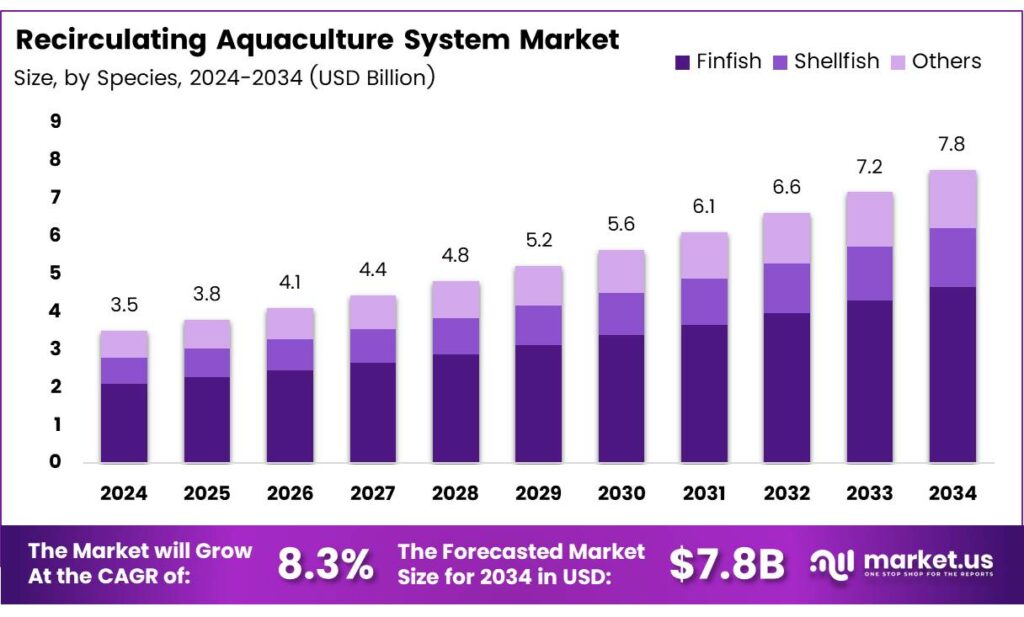
The Global Recirculating Aquaculture System Market size is expected to be worth around USD 7.8 billion by 2034, from USD 3.5 billion in 2024, growing at a CAGR of 8.3% during the forecast period from 2025 to 2034.
The Recirculating Aquaculture System Market represents controlled, land-based aquaculture using closed-loop water reuse technologies. Fundamentally, RAS enables year-round fish production independent of climate variability. Therefore, the market serves food security, urban aquaculture, and sustainable protein demand while supporting precision aquaculture, biofiltration systems, and water treatment solutions.
Recirculating Aquaculture Systems operate as near-closed circuits where culture water is continuously purified and reused. Consequently, solid waste, ammonium, and CO₂ are removed or biologically converted before oxygen-rich water returns to fish tanks. Although not fully closed, modern designs reuse 90% or more water, minimizing energy and freshwater dependence.
- In terms of scale, RAS infrastructure supports diverse production capacities. Systems range from large facilities producing over 1,000,000 pounds annually to mid-sized units near 500,000 pounds and small commercial setups around 50,000 pounds yearly. Therefore, RAS serves hatcheries, grow-out operations, ornamental fish producers, and fingerling supply chains.
Technically, sedimentation and biofiltration enable advanced waste management. Water from fish tanks passes through sedimentation units where polypropylene filter packs trap solids. Over time, biologically active silt enables up to 60% nitrate denitrification, converting nitrogen compounds into harmless gas, which reduces effluent discharge risks.
Water conservation further strengthens the value proposition. Because water is reused, RAS typically requires only 20% of the water volume demanded by open ponds. According to FAO and World Bank water resource studies, freshwater competition is intensifying globally, positioning RAS as a strategic solution for water-stressed regions and regulatory-driven sustainability programs.
Key Takeaways
- The Global Recirculating Aquaculture System Market is expected to reach USD 7.8 billion by 2034, up from USD 3.5 billion in 2024, growing at a CAGR of 8.3%.
- Biofiltration Units dominate the By Component segment with a 25.7% market share.
- Indoor RAS leads the By System Type segment with a 36.3% share.
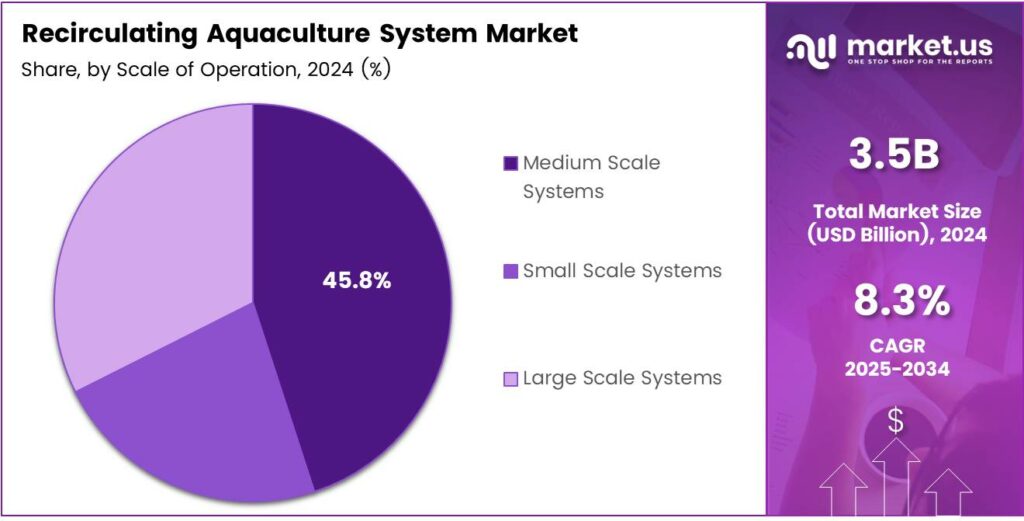
- Medium-scale systems hold the largest share in the Scale of Operation segment at 45.8%.
- Finfish dominates the By Species segment with a 66.2% market share.
- Commercial Aquaculture accounts for 71.6% of the market in the By Application segment.
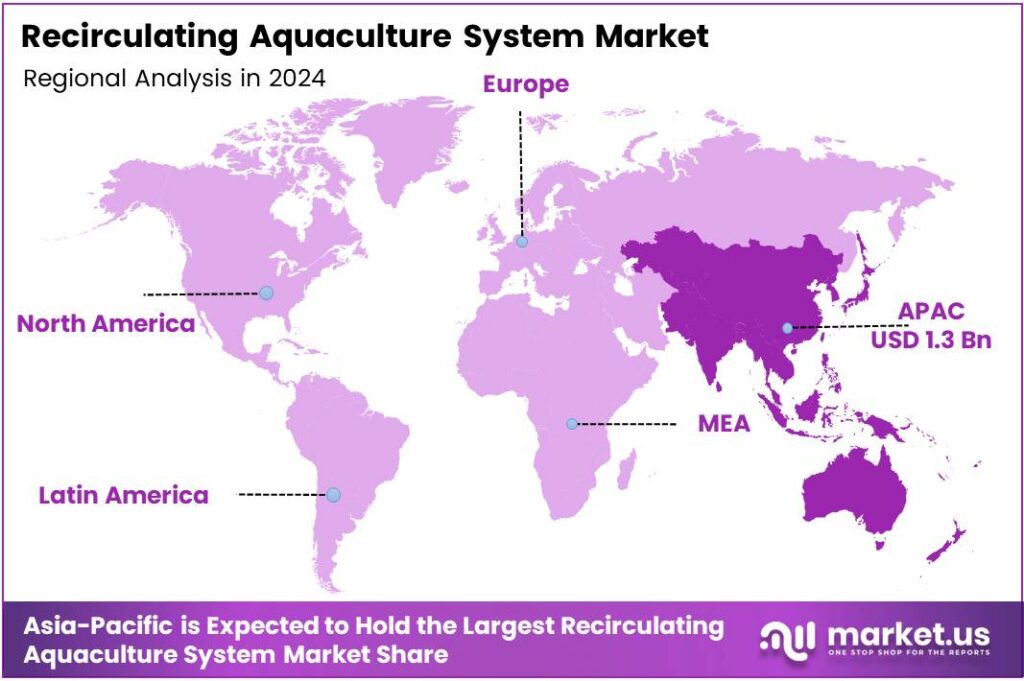
- Asia Pacific is the leading regional market with a 39.9% share, valued at USD 1.3 billion.
By Component Analysis
Biofiltration Units dominate with 25.7% due to their critical role in maintaining water quality and system stability.
In 2025, Biofiltration Units held a dominant market position in the By Component Analysis segment of the Recirculating Aquaculture System Market, with a 25.7% share. These units support efficient ammonia and nitrite removal, enabling healthier aquatic environments. Moreover, they reduce operational risks, reinforcing their adoption across commercial aquaculture and hatchery facilities.
Water Recirculation Systems advanced steadily as essential components ensuring continuous water movement. These systems optimize resource efficiency and lower water replacement frequency. As sustainability demands rise, operators prefer advanced recirculation solutions that maintain oxygen levels, stabilize temperature, and support long-term production goals across intensive aquaculture facilities.
Oxygenation Systems gained momentum as producers sought to boost fish survival and growth rates. These systems deliver consistent dissolved oxygen, crucial for improving feed conversion ratios. Additionally, expanding high-density fish farming drives demand for efficient oxygenation technologies that help maintain stable biological conditions within closed-loop operations.
Heating and Cooling Systems expanded due to their ability to regulate ideal temperature ranges for species-specific growth. Their role in stabilizing seasonal fluctuations supports predictable production cycles. As climate variability rises, RAS operators increasingly integrate precise thermal control systems for optimized biological performance.
By System Type Analysis
Indoor RAS dominates with 36.3% due to controlled environments and higher production efficiency.
In 2025, Indoor RAS held a dominant market position in the By System Type Analysis segment of the Recirculating Aquaculture System Market, with a 36.3% share. These systems offer full climate control, enabling predictable yields. Additionally, their biosecurity advantages support the production of high-value species with minimal disease risk.
Outdoor RAS continued expanding as producers utilized naturally available space and sunlight to reduce energy consumption. These systems are preferred for large-scale operations seeking cost-effective solutions. Furthermore, outdoor setups provide flexibility for species that thrive in semi-controlled environmental conditions.
Modular RAS gained traction due to its scalability and ease of installation. These systems enable gradual capacity increases, supporting both startups and commercial farms. Their plug-and-play design also helps reduce setup time, making them attractive for decentralized aquaculture projects.
Containerized RAS advanced as mobile farming solutions became popular. These compact units allow year-round production in urban and remote areas. Their mobility supports rapid deployment, helping producers test markets, launch pilot farms, or expand output without permanent infrastructure.
By Scale of Operation Analysis
Medium Scale Systems dominate with 45.8% due to balanced cost, production volume, and scalability.
In 2025, Medium Scale Systems held a dominant market position in the By Scale of Operation Analysis segment of the Recirculating Aquaculture System Market, with a 45.8% share. These systems balance capital investment with strong production output. Moreover, they attract commercial growers seeking reliable performance and manageable operating expenses.
Small-scale systems expanded steadily as they offered affordability and ease of management. These systems support hobbyists, research facilities, and small producers. Their minimal space requirements and low operational costs make them ideal for training centers and pilot-scale aquaculture operations.
Large-scale systems advanced as industrial farms focused on meeting rising seafood demand. These systems support mass production with automation, high-density stocking, and advanced water treatment. Their ability to produce year-round supplies positions them at the core of modern aquaculture expansion.
By Species Analysis
Finfish dominates with 66.2% due to strong commercial demand and high production efficiency.
In 2025, Finfish held a dominant market position in the By Species Analysis segment of the Recirculating Aquaculture System Market, with a 66.2% share. Finfish species such as salmon, trout, and tilapia are widely produced due to their market value and predictable growth. Their compatibility with RAS ensures stable yields with reduced environmental impact.
Shellfish adoption grew as producers explored controlled cultivation for shrimp and other species. These systems help maintain water quality and reduce disease exposure. As global seafood consumption expands, shellfish farming in RAS continues to gain attention for premium product output.
The Others category supported diversification with ornamental fish, experimental species, and niche markets. These species benefit from RAS precision, which ensures stable conditions for sensitive organisms. Their growing demand in specialty markets supports long-term segment expansion.
By Application Analysis
Commercial Aquaculture dominates with 71.6%, driven by rising production volumes and sustainable operations.
In 2025, Commercial Aquaculture held a dominant market position in the By Application Analysis segment of the Recirculating Aquaculture System Market, with a 71.6% share. Large farms rely on RAS to improve yield consistency, reduce water use, and meet growing seafood demand.
Fish Farming grew as producers increasingly turned to RAS for controlled grow-out environments. These systems help maintain biosecurity while improving feed utilization. Fish farming operators benefit from reduced disease risk and higher stocking densities.
Shellfish Farming advanced with farms adopting RAS to stabilize survival rates. Controlled water treatment supports delicate species and ensures predictable harvest cycles. As premium shellfish markets expand, producers invest in controlled rearing systems to meet quality standards.
Key Market Segments
By Component
- Biofiltration Units
- Water Recirculation Systems
- Oxygenation Systems
- Heating and Cooling Systems
- Monitoring and Control Systems
- Equipment
- Software
- Services
By System Type
- Indoor RAS
- Outdoor RAS
- Modular RAS
- Containerized RAS
- Freshwater RAS
- Saltwater RAS
- Hybrid RAS
- Integrated Systems
- Specialized Systems
By Scale of Operation
- Small-Scale Systems
- Medium Scale Systems
- Large Scale Systems
By Species
- Finfish
- Shellfish
- Others
By Application
- Commercial Aquaculture
- Fish Farming
- Shellfish Farming
- Mollusk Farming
- Others
Emerging Trends
Increasing Adoption of Smart Aquaculture Technologies Shapes Market Trends
Digital monitoring systems are becoming a major trend in RAS facilities. Farmers now use real-time sensors to track oxygen levels, water quality, temperature, and fish health. These tools reduce manual work and improve system efficiency, making smart RAS setups more popular.
- NOAA technical paper describing capture-and-reuse models notes that well-maintained RAS can reuse up to 99% of system water daily and use 90–99% less water than other aquaculture methods—this water efficiency is a key reason the “aquaculture + horticulture” link is gaining traction.
Circular economy models are gaining attention. Many RAS operators are exploring ways to reuse waste nutrients by growing plants through aquaponics. This dual-production model reduces waste and increases revenue potential, making it attractive for integrated farming companies.
Drivers
Rising Need for Water-Efficient Aquaculture Systems Drives Market Growth
Growing pressure on freshwater resources is pushing farmers to adopt systems that use less water. Recirculating Aquaculture Systems help reuse more than 90% of water, making them ideal for regions with scarcity. As water costs rise, farms see RAS as a more sustainable and long-term solution.
- RAS effluent explains that the discharge generated during clarifier backwash can be relatively small—possibly 0.2–0.5% of total recirculating flow when microscreen filters are used—meaning producers can design systems where most water stays in circulation and only a small fraction needs special handling.
Consumers are demanding safer and cleaner fish products. RAS supports controlled indoor production with minimal contamination risk. This improves fish quality, reduces disease outbreaks, and ensures a year-round supply, which encourages more producers to shift to RAS operations.
Restraints
High Installation and Operating Costs Limit Market Expansion
One of the biggest challenges limiting RAS adoption is its high initial investment. Farmers need to purchase tanks, filtration systems, sensors, and backup equipment, which raises setup costs. For small-scale operators, these expenses can be difficult to manage, slowing adoption.
- Energy consumption is another major restraint. RAS relies heavily on pumps, aeration units, and water treatment systems that require constant power. Ireland’s national aquaculture plan explicitly discusses freshwater RAS with 90–99% water reuse and outlines facilities with a capacity of around 4,000 tonnes per annum in planned development.
Technical expertise is also necessary to run RAS efficiently. Farmers must understand water chemistry, fish health, and system monitoring. Limited technical knowledge often results in operational mistakes, increasing mortality rates, and reducing profitability.
Growth Factors
Growing Demand for Sustainable and Localized Fish Production Creates New Opportunities
Urbanization is driving strong demand for fresh, locally produced seafood. RAS allows fish farming close to major cities, reducing transportation time and increasing shelf life. This presents major opportunities for companies targeting urban markets and premium seafood segments.
- Rising global interest in sustainable food production also opens new pathways for growth. Consumers prefer fish grown with responsible practices, low water use, and minimal environmental impact. A detailed RAS modelling study published in Aquacultural Engineering calculated a specific energy demand of 9.59 kWh/kg for a full grow-out, and reported 664 MWh needed for complete operation in the modelled system.
RAS aligns perfectly with these expectations, creating new business models for eco-friendly aquaculture. Expansion of high-value species farming is another opportunity. RAS enables the controlled production of species like salmon, trout, barramundi, and shrimp, which fetch higher prices. Farmers can achieve consistent quality and stable supply, strengthening revenue potential.
Regional Analysis
Asia Pacific Dominates the Recirculating Aquaculture System Market with a Market Share of 39.9%, Valued at USD 1.3 Billion
Asia Pacific leads the global Recirculating Aquaculture System (RAS) market, accounting for a dominant 39.9% share and reaching a value of USD 1.3 billion. This leadership is driven by strong seafood consumption, rapid aquaculture expansion, and growing pressure on freshwater resources. Governments across the region increasingly promote land-efficient and water-saving farming technologies. RAS adoption accelerates in both commercial fish farming and hatchery operations.
North America represents a mature and technology-driven RAS market, supported by advanced aquaculture practices and strong regulatory oversight. The region emphasizes sustainable seafood production, traceability, and biosecurity. High investment in automation and digital monitoring further supports steady RAS deployment. Adoption is particularly strong in indoor and high-density production systems.
Europe shows consistent growth in the RAS market due to strict environmental regulations and limited availability of coastal farming areas. Producers increasingly rely on closed-loop systems to meet sustainability and animal welfare standards. Innovation in energy-efficient system design also supports regional uptake. RAS is widely used for high-value species production.
The U.S. market demonstrates steady RAS adoption, supported by sustainability-focused policies and demand for locally produced seafood. Indoor RAS facilities help address zoning restrictions and environmental compliance. Strong research backing and commercial pilots continue to improve system efficiency. The market favours scalable and modular RAS solutions.
Key Regions and Countries
North America
- US
- Canada
Europe
- Germany
- France
- The UK
- Spain
- Italy
- Rest of Europe
Asia Pacific
- China
- Japan
- South Korea
- India
- Australia
- Rest of APAC
Latin America
- Brazil
- Mexico
- Rest of Latin America
Middle East & Africa
- GCC
- South Africa
- Rest of MEA
Key Players Analysis
In 2025, the global Recirculating Aquaculture System (RAS) market continues to expand as technology-focused companies strengthen system efficiency, sustainability, and biosecurity. Among key participants,
AKVA Group remains a central force due to its well-established engineering capabilities and broad aquaculture portfolio. The company’s focus on automation, modular RAS architecture, and long-term service partnerships supports its position as a preferred supplier for salmon hatcheries and land-based farms worldwide.
Aquacare Environment plays a significant role by delivering water treatment and biological filtration solutions that enhance system reliability and fish health. Its emphasis on energy-efficient recirculation technologies and customized system designs aligns well with the increasing shift toward low-impact aquaculture. The company’s specialized expertise allows it to serve both large commercial farms and emerging operators seeking scalable RAS models.
AquaMaof continues to gain market attention for its proprietary energy-saving RAS technology, which reduces operational costs and minimizes water consumption. Its turnkey approach, covering design to operational training, makes it particularly attractive for investors entering land-based aquaculture. The company’s involvement in high-capacity salmon and whitefish facilities strengthens its global presence and project pipeline.
Blue Planet Ecosystems stands out with its ecological farming model that integrates natural biological processes, positioning it within the sustainability-driven segment of the RAS industry. Its innovative closed-loop systems aim to reduce dependence on external feed inputs, appealing to markets prioritizing carbon efficiency and circular production principles. The company’s technology-forward strategy helps meet the growing demand for environmentally responsible aquaculture solutions.
Top Key Players in the Market
- AKVA Group
- Aquacare Environment
- AquaMaof
- Blue Planet Ecosystems
- Clewer Aquaculture
- Eyvi
- FRD Japan
- Hesy Aquaculture
- Nofitech
- PR Aqua
Recent Developments
- In 2025, AKVA Group supplied RAS technology for South Korea’s first land-based salmon farm, located at the Busan Smart Aquaculture Cluster, which is operated by Eco Aquafarm. The facility stocked its first salmon eggs in autumn 2024, with harvest expected in Q4 2026. AKVA provided system delivery, training, advisory services, and optimization.
- In 2025, AquaMaof appears limited based on available non-market sources. The company’s website highlights its MLD (Minimal Liquid Discharge) RAS technology for sustainable fish production, with strict biosecurity and efficient energy management.
Report Scope
Report Features Description Market Value (2024) USD 3.5 Billion Forecast Revenue (2034) USD 7.8 Billion CAGR (2025-2034) 8.3% Base Year for Estimation 2024 Historic Period 2020-2023 Forecast Period 2025-2034 Report Coverage Revenue Forecast, Market Dynamics, Competitive Landscape, Recent Developments Segments Covered By Component (Biofiltration Units, Water Recirculation Systems, Oxygenation Systems, Heating and Cooling Systems, Monitoring and Control Systems, Equipment, Software, Services), By System Type (Indoor RAS, Outdoor RAS, Modular RAS, Containerized RAS, Freshwater RAS, Saltwater RAS, Hybrid RAS, Integrated Systems, Specialized Systems), By Scale of Operation (Small Scale Systems, Medium Scale Systems, Large Scale Systems), By Species (Finfish, Shellfish, Others), By Application (Commercial Aquaculture, Fish Farming, Shellfish Farming, Mollusk Farming, Others) Regional Analysis North America (US and Canada), Europe (Germany, France, The UK, Spain, Italy, and Rest of Europe), Asia Pacific (China, Japan, South Korea, India, Australia, and Rest of APAC), Latin America (Brazil, Mexico, and Rest of Latin America), Middle East & Africa (GCC, South Africa, and Rest of MEA) Competitive Landscape AKVA Group, Aquacare Environment, AquaMaof, Blue Planet Ecosystems, Clewer Aquaculture, Eyvi, FRD Japan, Hesy Aquaculture, Nofitech, PR Aqua Customization Scope Customization for segments, region/country-level will be provided. Moreover, additional customization can be done based on the requirements. Purchase Options We have three licenses to opt for: Single User License, Multi-User License (Up to 5 Users), Corporate Use License (Unlimited Users and Printable PDF)  Recirculating Aquaculture System MarketPublished date: January 2026add_shopping_cartBuy Now get_appDownload Sample
 -
-
- AKVA Group
- Aquacare Environment
- AquaMaof
- Blue Planet Ecosystems
- Clewer Aquaculture
- Eyvi
- FRD Japan
- Hesy Aquaculture
- Nofitech
- PR Aqua
Our Clients

- 174575
- January 2026






