


Global Probiotics In Animal Feed Market Size, Share, And Industry Analysis Report By Product Type (Bacillus, Lactobacilli, Saccharomyces, Bifidobacterium, Enterococcus, Postbiotics, Streptococcus), By Form (Powder and Dry, Microencapsulated, Granules), By Function (Digestive Health and Gut Integrity, Immune Support and Modulation, Growth Promotion and Feed Efficiency, Pathogen Control and Competitive Exclusion, Stress Management), By Livestock (Poultry, Swine, Cattle, Aquaculture, Pet Food, Equine), By Distribution Channel (Feed Mills and Integrators, Veterinary Distributors, Direct Sales, Online E-Commerce), By Region and Companies - Industry Segment Outlook, Market Assessment, Competition Scenario, Statistics, Trends and Forecast 2025-2034
- Published date: February 2026
- Report ID: 178551
- Number of Pages: 234
- Format:
-
keyboard_arrow_up
Quick Navigation
Report Overview
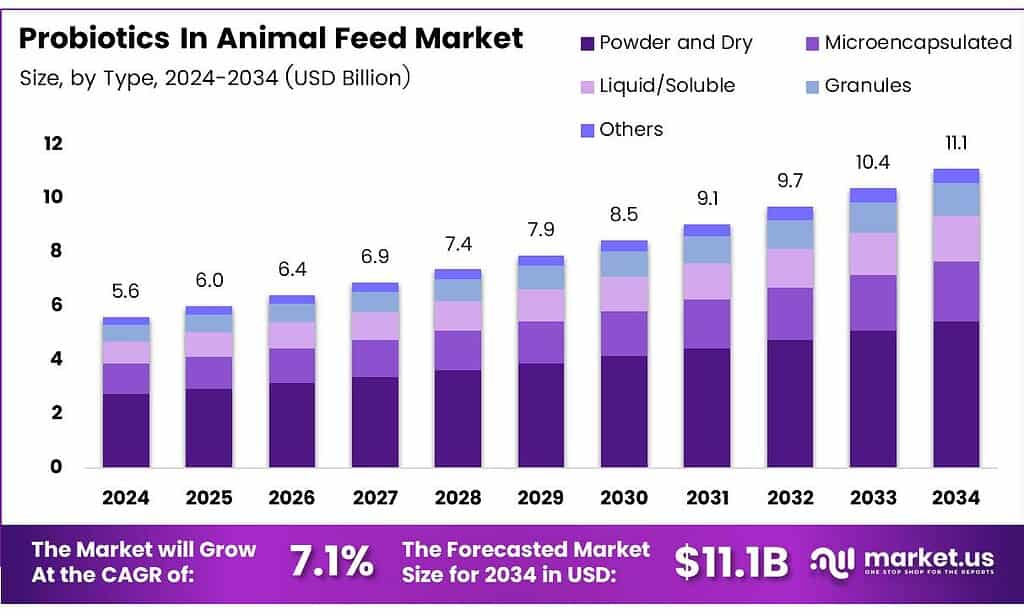
The Global Probiotics In Animal Feed Market size is expected to be worth around USD 11.1 billion by 2034 from USD 5.6 billion in 2024, growing at a CAGR of 7.1% during the forecast period 2025 to 2034.
Probiotics in animal feed refer to live beneficial microorganisms added to livestock and aquaculture diets. These microbial supplements improve gut health, strengthen immunity, and boost feed efficiency. Producers use them across poultry, swine, cattle, aquaculture, and pet food segments to support animal performance.
The market grows steadily as livestock farmers shift away from antibiotic growth promoters. Governments across Europe, Asia, and North America enforce stricter bans on in-feed antibiotics. This regulatory pressure drives feed producers and integrators to adopt probiotic-based alternatives that maintain animal productivity without residue risk.
- Evonik recorded external sales of €15,157 million in FY2024, with its Nutrition and Care segment generating €3,764 million, representing approximately 24.8% of total group revenue. This scale reflects the significant commercial weight that animal nutrition ingredients carry within diversified specialty chemical groups.
- Novonesis reported net sales of €3,833.5 million in FY2024, up from €2,402.2 million in FY2023. This growth highlights expanding market demand for biosolutions that include animal health microorganisms used directly in feed formulations worldwide.
Rising global meat consumption supports sustained demand for probiotics in animal nutrition. Growing middle-class populations in the Asia Pacific and Latin America increase protein intake. Consequently, livestock producers invest in gut-health solutions to maximize output while meeting food safety and quality standards set by importers and regulators.
Public and private investment in animal biotechnology accelerates innovation in this space. Research institutions and feed companies collaborate on strain-specific probiotic development. Moreover, government programs in the European Union and Southeast Asia fund antibiotic-alternative research, reinforcing the commercial pipeline for next-generation feed health solutions.
Key Takeaways
- The Global Probiotics in Animal Feed Market was valued at USD 5.6 billion in 2024 and is projected to reach USD 11.1 billion by 2034, at a CAGR of 7.1% during the forecast period 2025–2034.
- By Product Type, Bacillus holds the dominant position with a 27.9% market share in 2025.
- By Form, Powder and Dry leads the segment with a 39.7% share due to ease of blending and storage stability.
- By Function, Digestive Health and Gut Integrity dominate with a 36.8% share.
- By Livestock, Poultry holds the largest share at 41.5%, driven by high broiler and layer production volumes.
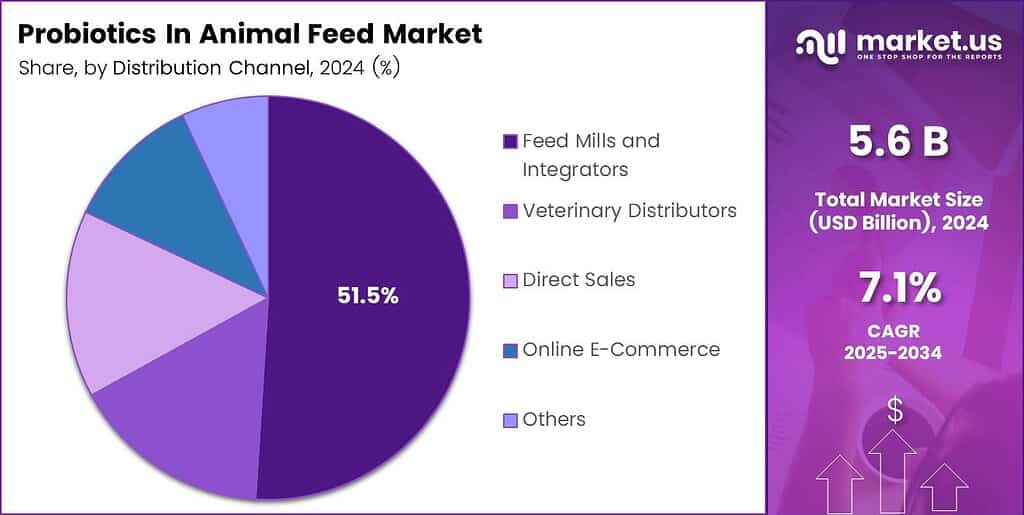
- By Distribution Channel, Feed Mills and Integrators account for 51.5% of the market.
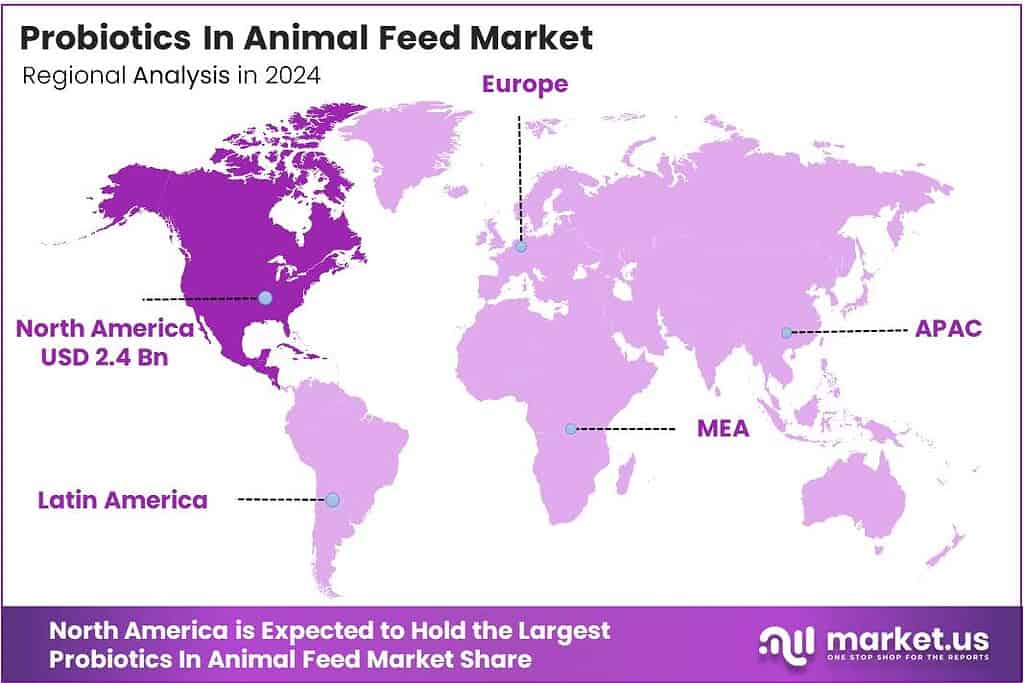
- North America leads regional demand with a 43.1% share, valued at USD 2.4 billion in 2025.
By Product Type Analysis
Bacillus dominates with 27.9% due to its heat stability and broad-spectrum efficacy in livestock diets.
In 2025, Bacillus held a dominant market position in the By Product Type segment of the Probiotics In Animal Feed Market, with a 27.9% share. Its spore-forming nature makes it highly resistant to feed pelleting temperatures. Consequently, feed producers prefer Bacillus strains for large-scale commercial inclusion.
Lactobacilli represent another significant category, widely used in poultry and swine diets to support gut colonization and pathogen suppression. These strains improve lactic acid production in the intestinal tract. Moreover, their established safety profile makes them a preferred choice among veterinary nutritionists globally.
Saccharomyces (Yeast-Based) probiotics deliver strong performance in ruminant and equine applications. Yeast supplementation improves fiber digestibility and rumen microbial balance in cattle. Additionally, their prebiotic properties complement probiotic activity, making them valuable components in synbiotic feed formulations.
Bifidobacterium, Enterococcus, Postbiotics, Streptococcus, and Others fill specialized niches across livestock and companion animal segments. These strains serve targeted functions such as immune priming, intestinal barrier support, and metabolite production. Their use grows in precision nutrition programs designed for specific production stages.
By Form Analysis
Powder and Dry dominates with 39.7% due to superior blending compatibility and extended shelf life.
In 2025, Powder and Dry held a dominant market position in the By Form segment of the Probiotics In Animal Feed Market, with a 39.7% share. Feed mills prefer this format because it integrates directly into premix and complete feed lines. Its long shelf life also reduces storage complexity for large-scale operations.
Microencapsulated probiotics offer enhanced viability by protecting live cultures from heat, moisture, and pH stress during processing. This format supports stable delivery of sensitive strains through pelleting and conditioning. Therefore, encapsulated products command premium pricing in high-performance livestock and aquaculture feed applications.
Liquid/Soluble, Granules, and Others serve specific application needs across different livestock species and production systems. Liquid formats work well for water-line delivery in poultry and swine operations. Granule forms suit on-farm top-dressing practices where flexibility and dosing precision are required.
By Function Analysis
Digestive Health and Gut Integrity dominate with 36.8% as the primary functional need across all livestock species.
In 2025, Digestive Health and Gut Integrity held a dominant market position in the By Function segment of the Probiotics in Animal Feed Market, with a 36.8% share. Maintaining a healthy intestinal lining reduces disease incidence and improves nutrient absorption. Feed producers prioritize this function as the baseline benefit of all probiotic inclusion programs.
Immune Support and Modulation represents the second major functional area, particularly valued in high-density poultry and swine production. Probiotic strains that stimulate innate immunity reduce reliance on therapeutic antibiotic use. Additionally, immune-enhancing solutions align with food safety certification requirements in premium export markets.
Growth Promotion and Feed Efficiency, Pathogen Control and Competitive Exclusion, Stress Management, and Others address production-specific challenges throughout the livestock cycle. Competitive exclusion products reduce Salmonella and Campylobacter colonization in broilers. Stress-mitigation strains support performance recovery during transport, weaning, and seasonal temperature changes.
By Livestock Analysis
Poultry dominates with 41.5%, driven by the high volume of broiler, layer, and breeder production worldwide.
In 2025, Poultry held a dominant market position in the By Livestock segment of the Probiotics in Animal Feed Market, with a 41.5% share. Broilers, Layers, Breeders, and Others within the poultry category consume the largest probiotic volumes globally. Producers use gut-health solutions to reduce medication costs and meet antibiotic-free certification standards.
Swine represents the second-largest livestock category, with Piglets, Growers, and Finishers each requiring tailored probiotic support. Post-weaning piglets face significant gut health challenges that probiotic supplementation addresses effectively. Therefore, swine feed producers increasingly incorporate multi-strain blends to improve performance across all growth phases.
Cattle applications cover Dairy Cattle and Beef Cattle, where probiotics improve rumen function and milk production efficiency. Aquaculture covers Salmon, Trout, Shrimp, Carp, and Others, a rapidly growing segment requiring disease-resistance solutions. Pet Food (Dogs and Cats), Equine, and Others round out the diversified livestock demand base, driving market expansion.
By Distribution Channel Analysis
Feed Mills and Integrators dominate with 51.5% as the primary bulk purchasing and blending channel globally.
In 2025, Feed Mills and Integrators held a dominant market position in the By Distribution Channel segment of the Probiotics in Animal Feed Market, with a 51.5% share. These facilities purchase probiotics in bulk and incorporate them directly into compound feed formulations. Their purchasing scale gives probiotic suppliers consistent, high-volume demand throughout the production calendar.
Veterinary Distributors serve as a key channel for farm-level probiotic products sold through animal health networks. These distributors reach smaller farms and specialty operations that purchase outside integrated supply chains. Moreover, veterinary guidance at the point of sale increases product credibility and adoption among cautious producers.
Direct Sales, Online E-Commerce, and Others serve niche and emerging distribution needs across the probiotic feed market. Direct sales channels allow suppliers to build long-term technical service relationships with large accounts. Online platforms expand reach to small-scale producers and pet food manufacturers seeking flexible procurement options.
Key Market Segments
By Product Type
- Bacillus
- Lactobacilli
- Saccharomyces (Yeast-Based)
- Bifidobacterium
- Enterococcus
- Postbiotics
- Streptococcus
- Others
By Form
- Powder and Dry
- Microencapsulated
- Liquid/Soluble
- Granules
- Others
By Function
- Digestive Health and Gut Integrity
- Immune Support and Modulation
- Growth Promotion and Feed Efficiency
- Pathogen Control and Competitive Exclusion
- Stress Management
- Others
By Livestock
- Poultry
- Broilers
- Layers
- Breeders
- Others
- Swine
- Piglets
- Growers
- Finishers
- Others
- Cattle
- Dairy Cattle
- Beef Cattle
- Aquaculture
- Salmon
- Trout, Shrimp
- Carp
- Others
- Pet Food
- Dogs
- Cats
- Equine
- Others
By Distribution Channel
- Feed Mills and Integrators
- Veterinary Distributors
- Direct Sales
- Online E-Commerce
- Others
Emerging Trends
Antibiotic-Free Production and Advanced Delivery Systems Reshape the Probiotics in Animal Feed Market
Livestock producers worldwide are accelerating the transition to antibiotic-free production systems across poultry and swine operations. Retailers and food brands enforce residue-free sourcing policies that push farmers toward proven microbial alternatives. The Nutrition and Care segment achieved an adjusted EBITDA margin of 16.0% in FY2024, up from 10.8% in FY2023, reflecting stronger profitability in animal nutrition inputs.
Microencapsulated and liquid probiotic delivery formats gain rapid adoption across commercial feed operations. Encapsulation technology protects live cultures from heat and moisture during pelleting, improving viable cell counts at the point of consumption. Moreover, liquid delivery through water lines offers precise dosing flexibility that dry premix formats cannot match for specific production stages.
Ruminant probiotic applications expand as producers focus on enhanced rumen function and methane emission reduction. Precision nutrition practices and AI-driven optimization tools now help nutritionists identify the most effective strain combinations for specific herds. DSM-Firmenich’s vitamin transformation program, designed to deliver approximately €200 million in adjusted EBITDA contribution, reflects the innovation investment that major players commit to advancing feed health science.
Drivers
Rising Protein Demand and Antibiotic Bans Drive Sustained Growth in Probiotics in Animal Feed
Global population growth and rising incomes in emerging markets increase worldwide demand for meat, dairy, and eggs. Livestock producers scale up operations to meet this protein surge, creating a consistent need for performance-enhancing feed additives. Probiotic supplementation helps producers maintain animal health and feed efficiency at higher stocking densities without additional drug inputs.
- Stringent regulatory bans on antibiotic growth promoters across the European Union, the United States, China, and Southeast Asia compel producers to find safe alternatives. Evonik’s Nutrition and Care segment reported an adjusted EBITDA of €601 million in FY2024, up from €389 million in FY2023, confirming that demand for animal nutrition solutions grows alongside tightening antibiotic regulations.
Rapid advancements in species-specific probiotic strain research accelerate product development cycles. Biotechnology companies identify more effective strains and develop encapsulation methods that improve heat tolerance. Additionally, growing consumer preference for residue-free and ethically produced animal products creates strong commercial incentives for probiotic adoption across all livestock sectors.
Restraints
High Development Costs and Regulatory Fragmentation Limit Faster Market Penetration
Developing effective probiotic strains for specific livestock species requires substantial investment in research, clinical trials, and regulatory submissions. Companies must demonstrate safety and efficacy across multiple markets that apply different approval standards. These high compliance costs create significant barriers for smaller suppliers seeking to enter or expand within the probiotics in animal feed market.
Lack of uniform international standards for probiotic classification and labeling creates market fragmentation. Regulatory bodies in the European Union, the United States, China, and Southeast Asia apply distinct rules for strain approval and dosage claims. Consequently, suppliers must navigate multiple approval pathways simultaneously, extending time to market and increasing total commercialization costs.
Product stability during feed processing poses a persistent technical challenge for live probiotic cultures. High-temperature pelleting and conditioning destroy viable cell counts in unprotected formulations. Therefore, manufacturers must invest in advanced encapsulation technologies that protect culture viability, adding to production costs and limiting price competitiveness in cost-sensitive markets.
Growth Factors
Aquaculture Expansion, Synbiotic Innovation, and Biotech Investment Accelerate Market Growth
Aquaculture production expands rapidly as wild fish stocks decline and global seafood demand rises. High-density shrimp, salmon, and carp farming requires targeted disease-resistance solutions to manage pathogen pressure. Novonesis Planetary Health Biosolutions’ net sales reached €2,165.4 million in FY2024, up from €1,872.1 million in FY2023, reflecting growing commercial demand for agricultural and animal health microorganisms.
- Rising public-private investment in biotechnology supports the development of next-generation antibiotic alternatives. Novonesis reported free cash flow before acquisitions of €660.9 million in FY2024, up from €281.8 million in FY2023. This financial capacity reflects the reinvestment potential that market leaders commit to advancing animal nutrition biosolution portfolios globally.
Development of customized multi-strain probiotics tailored to regional livestock needs opens new revenue streams. Suppliers formulate region-specific products that address local disease pressures, climate conditions, and production system requirements. Moreover, integration of probiotics with prebiotics and enzymes into advanced synbiotic formulations increases product value and effectiveness for feed manufacturers.
Regional Analysis
North America Dominates the Probiotics in Animal Feed Market with a Market Share of 43.1%, Valued at USD 2.4 Billion
North America leads the global probiotics in animal feed market, holding a 43.1% share valued at USD 2.4 billion in 2025. The United States drives this dominance through its large-scale integrated poultry and swine industries. Regulatory pressure from the FDA’s Veterinary Feed Directive accelerates probiotic adoption as producers seek compliant antibiotic-free solutions.
Europe represents a mature and highly regulated probiotics in animal feed market. The EU’s long-standing ban on antibiotic growth promoters, implemented in 2006, established the foundational demand for probiotic feed additives across the region. Germany, France, and the Netherlands lead adoption within large integrated livestock operations focused on premium export markets.
Asia Pacific shows the fastest growth trajectory among all regional markets for probiotics in animal feed. China, India, Vietnam, and Thailand drive demand through rapidly expanding poultry, swine, and aquaculture industries. Rising middle-class protein consumption and government programs promoting safer livestock production accelerate probiotic adoption across the region.
The Middle East and Africa market develops gradually, driven by poultry production expansion and food security initiatives. Gulf Cooperation Council countries invest in domestic livestock capacity to reduce import dependency. Additionally, South Africa serves as a hub for probiotic distribution into sub-Saharan markets as modern feed production infrastructure expands.
Key Regions and Countries
North America
- US
- Canada
Europe
- Germany
- France
- The UK
- Spain
- Italy
- Rest of Europe
Asia Pacific
- China
- Japan
- South Korea
- India
- Australia
- Rest of APAC
Latin America
- Brazil
- Mexico
- Rest of Latin America
Middle East & Africa
- GCC
- South Africa
- Rest of MEA
Key Players Analysis
Evonik Industries AG maintains a strong position in the probiotics in animal feed market through its Nutrition and Care segment, which delivers specialty amino acids, gut health solutions, and feed additives to livestock producers worldwide. The company invests consistently in research partnerships and production capacity to develop strain-specific solutions that support antibiotic-free production systems across poultry and swine globally.
ADM leverages its vast agricultural supply chain and ingredient manufacturing infrastructure to serve feed producers across all major livestock categories. The company integrates probiotic solutions into its broader animal nutrition portfolio, offering customers comprehensive feed health programs. ADM’s global distribution network gives it a strong commercial reach across North America, Europe, and emerging Asia Pacific markets.
DSM-Firmenich brings together complementary nutrition and biotechnology capabilities following its landmark merger, creating a diversified animal health and nutrition platform. The company pursues a targeted merger with adjusted EBITDA synergies already realized since the merger. DSM-Firmenich serves feed producers with science-backed probiotic and enzyme solutions designed for precision livestock nutrition programs.
Novonesis focuses on biosolutions that span agriculture, food, and animal health, positioning itself as a specialized microorganism supplier to the probiotics in the animal feed industry. The company’s Animal Health and Nutrition portfolio benefits from significant R and D investment and a growing commercial footprint in the Asia Pacific. Novonesis combines fermentation expertise with strain development capabilities to deliver consistent, high-viability probiotic products to global feed markets.
Top Key Players in the Market
- Evonik Industries AG
- ADM
- DSM-firmenich
- Novonesis
- International Flavors and Fragrances Inc.
- Alltech
- Kemin
- Orffa
- Lallemand Inc.
- Lesaffre
Recent Developments
- In 2025, Evonik announced an updated Ecobiol version with an optimized outgrowth profile. It germinates up to 46% faster than competitors, delivering more active probiotic cells in the upper small intestine for quicker gut health support, better feed efficiency, and nutrient absorption. Evonik debuted the poultry-focused Ecobiol probiotic in China as part of its efficiency and sustainability portfolio showcase.
- In 2025, DSM-Firmenich continues to offer established eubiotics/probiotics for animal feed, such as PoultryStar — a multi-species synbiotic (probiotic strains + prebiotic fructooligosaccharides) for broilers, layers, and breeders to promote beneficial gut microbiota. CYLACTIN — a live Enterococcus faecium probiotic to stabilize gut flora and reduce digestive disorders.
Report Scope
Report Features Description Market Value (2024) USD 5.6 Billion Forecast Revenue (2034) USD 11.1 Billion CAGR (2025-2034) 7.1% Base Year for Estimation 2024 Historic Period 2020-2023 Forecast Period 2025-2034 Report Coverage Revenue Forecast, Market Dynamics, Competitive Landscape, Recent Developments Segments Covered By Product Type (Bacillus, Lactobacilli, Saccharomyces (Yeast-Based), Bifidobacterium, Enterococcus, Postbiotics, Streptococcus, Others), By Form (Powder and Dry, Microencapsulated, Liquid/Soluble, Granules, Others), By Function (Digestive Health and Gut Integrity, Immune Support and Modulation, Growth Promotion and Feed Efficiency, Pathogen Control and Competitive Exclusion, Stress Management, Others), By Livestock (Poultry, Swine, Cattle, Aquaculture, Pet Food, Equine, Others), By Distribution Channel (Feed Mills and Integrators, Veterinary Distributors, Direct Sales, Online E-Commerce, Others) Regional Analysis North America (US and Canada), Europe (Germany, France, The UK, Spain, Italy, and Rest of Europe), Asia Pacific (China, Japan, South Korea, India, Australia, and Rest of APAC), Latin America (Brazil, Mexico, and Rest of Latin America), Middle East & Africa (GCC, South Africa, and Rest of MEA) Competitive Landscape Evonik Industries AG, ADM, DSM-Firmenich, Novonesis, International Flavors and Fragrances Inc., Alltech, Kemin, Orffa, Lallemand Inc., Lesaffre Customization Scope Customization for segments, region/country-level will be provided. Moreover, additional customization can be done based on the requirements. Purchase Options We have three licenses to opt for: Single User License, Multi-User License (Up to 5 Users), Corporate Use License (Unlimited Users and Printable PDF)  Probiotics In Animal Feed MarketPublished date: February 2026add_shopping_cartBuy Now get_appDownload Sample
 -
-
- Evonik Industries AG
- ADM
- DSM-firmenich
- Novonesis
- International Flavors and Fragrances Inc.
- Alltech
- Kemin
- Orffa
- Lallemand Inc.
- Lesaffre
Our Clients

- 178551
- February 2026






