Report Overview
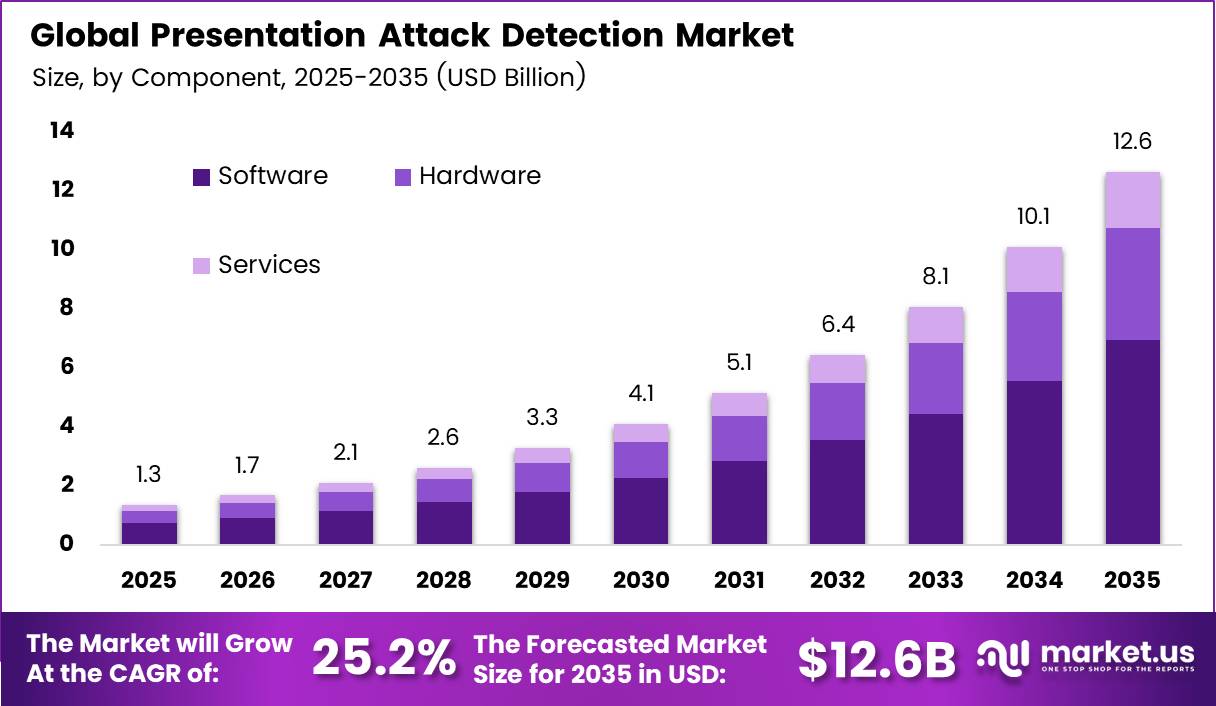
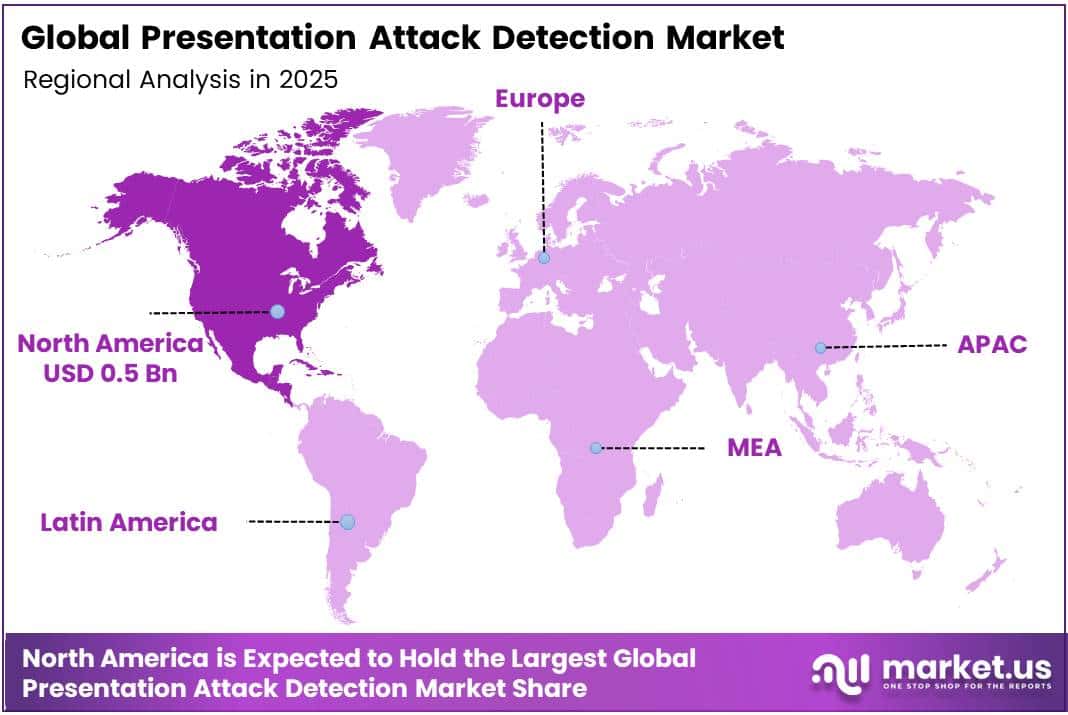
In 2025, the Global Presentation Attack Detection Market was valued at USD 1.3 billion. The market is projected to grow at a CAGR of 25.2% during 2026–2035, reaching approximately USD 12.6 billion by 2035. North America dominated the global market in 2025, accounting for more than 37.5% of the total market share and generating approximately USD 0.5 billion in revenue.
Digital identity checks are growing fast, and every check needs a way to stop fake faces, masks, and replayed videos. India’s UIDAI reported that people carried out more than 2,707 crore Aadhaar authentication transactions in FY2025. In March 2025 alone, people completed more than 15 crore face authentication transactions.
UIDAI also reported that face authentication doubled from 100 crore to 200 crore total transactions in less than 6 months, reaching that mark. Banks, government agencies, and payment firms now depend on face checks at this scale. That pushes them to buy liveness and spoof detection software, which keeps fraud out without slowing down real users.
The North America region’s high fraud losses drive this lead. According to the FBI Internet Crime Complaint Center, Americans reported record losses of USD 16.6 billion in 2024, up 33% from 2023. The FBI received 859,532 complaints, and 256,256 of them reported an actual loss. The average reported loss came to USD 19,372 per complaint. Fraud made up most of these losses.
Key Takeaways
- The Presentation Attack Detection Market was valued at USD 1.3 billion in 2025 and will reach USD 12.6 billion by 2035. at a CAGR of 25.2% from 2026 to 2035.
- By component, Software led the market with a 58.5% share.
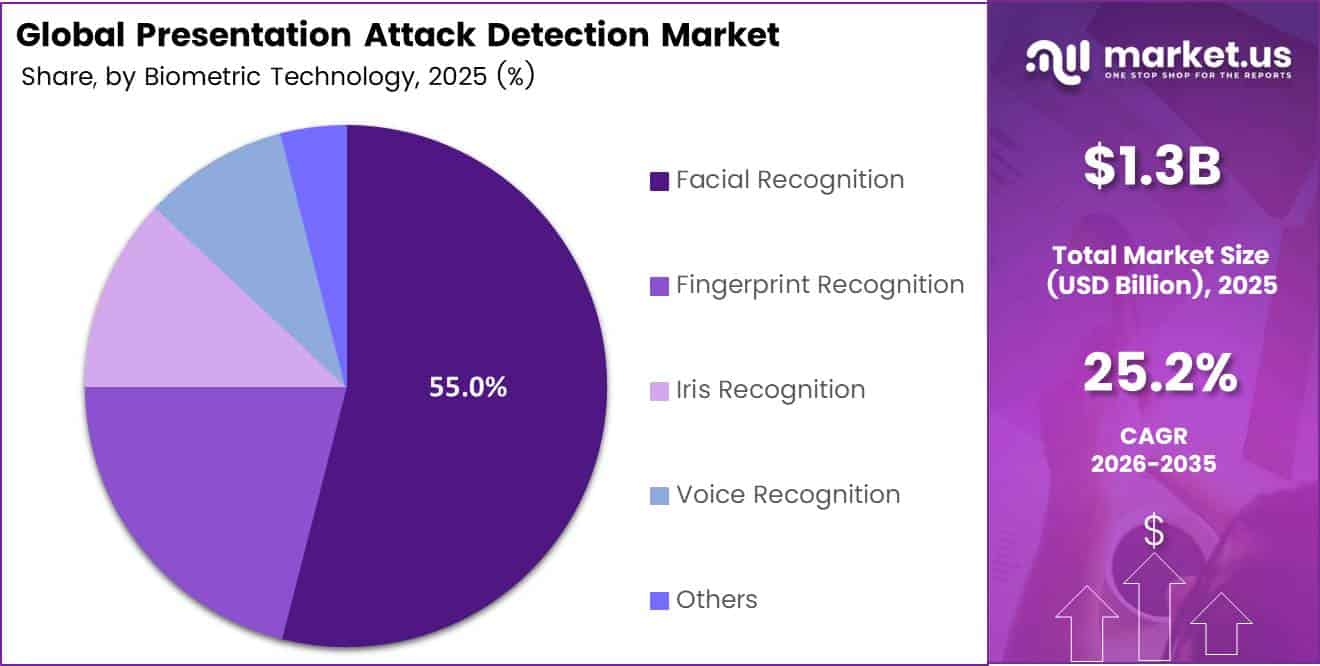
- By biometric technology, Facial Recognition led with a 55.0% share.
- By application, Identity Verification led with a 45.0% share.
- By end-use industry, Banking, Financial Services, and Insurance (BFSI) led with a 27.7% share.
- North America led the market in 2025 with a 37.5% share and USD 0.5 billion in revenue.
By Component
Software dominates with 58.5% due to easy upgrades on existing camera devices.
Software leads because banks, fintech firms, and public platforms can add liveness checks to cameras they already own. They don’t need to buy new equipment. The U.S. National Institute of Standards and Technology (NIST) tested 82 passive, software-only face PAD algorithms from 45 developers, which shows how many software suppliers now compete.
NIST tested these tools on about 20,000 attack attempts and 21,000 genuine images across 9 attack categories. Results varied widely, and no single algorithm caught every attack type. Because of this gap, buyers prefer software they can retrain and improve quickly, without changing their hardware.
Services is the fastest-growing sub-segment. NIST found that combining 4 top algorithms worked better than any one of them alone. Setups with several engines like this need expert integration, tuning, and testing. Most companies lack in-house biometric skills, so they hire service partners for certification support, threat monitoring, and false-alarm control.
By Biometric Technology
Facial Recognition dominates with 55.0% due to built-in front cameras on phones.
Facial recognition holds the top spot because almost every smartphone and laptop has a front camera, so users don’t need an extra sensor. India’s Unique Identification Authority (UIDAI) reached 200 crore Aadhaar face authentication transactions on 10 August 2025. That total doubled from 100 crore in January 2025 in under six months.
Monthly use keeps rising. UIDAI recorded 28.29 crore face authentications in November 2025, compared with 12.04 crore a year earlier. Each check needs liveness detection to block photo and video replay attacks, which makes face PAD a core part of very large public systems.
By Application
Identity Verification dominates with 45.0% due to mandatory digital KYC onboarding checks.
Identity verification leads because banks, telecom operators, and public agencies must confirm that a real, live person is behind every new account. UIDAI handled 231 crore Aadhaar authentication transactions in November 2025, about 8.5% more than in November 2024.
Payment security is the fastest-growing sub-segment. The FBI’s Internet Crime Complaint Center (IC3) reported $16.6 billion in losses in 2024, a 33% jump from 2023, across 859,532 complaints. Card, wallet, and real-time payments now use face and fingerprint approval more often. Because of this, payment providers are adding PAD to block spoofed biometrics before funds leave an account.
By End-Use Industry
Banking, Financial Services, and Insurance (BFSI) dominates with 27.7% due to heavy direct fraud losses.
BFSI ranks first because banks, insurers, and investment platforms lose the most money directly to fake identities. Victims of cryptocurrency investment fraud lost over $6.5 billion in 2024, and the average reported loss reached $19,372 per complaint, according to IC3.
Government is the fastest-growing sub-segment. In November 2025, nearly 60% of Digital Life Certificates created by Indian pensioners used face authentication. In the U.S., people over 60 lost nearly $5 billion to online crime in 2024. Both trends push public agencies to protect pension, welfare, and benefit portals with stronger spoof detection.
Key Market Segments
By Component
- Software
- Hardware
- Services
By Biometric Technology
- Facial Recognition
- Fingerprint Recognition
- Iris Recognition
- Voice Recognition
- Others
By Application
- Identity Verification
- Access Control
- Payment Security
- Others
By End-Use Industry
- Banking, Financial Services, and Insurance (BFSI)
- Government
- Healthcare
- Retail and E-commerce
- IT and Telecommunications
- Others
Geopolitical Impact Analysis
Trade tensions are raising the cost of the hardware behind presentation attack detection. These systems rely on cameras, depth sensors, chips, and kiosks, and Asia makes most of them. The WTO reports that the US simple average MFN tariff stood at 3.4% in 2025. The effective applied US tariff then rose to 10.6% by September 2026, roughly 3 times the MFN level.
Trade volume is slowing. The WTO cut its 2026 merchandise trade growth forecast to 0.5%, down from 1.8%, because tariff effects reach the market late. It raised its 2025 forecast to 2.4% after importers rushed to buy goods early. In the first quarter of 2025, world trade volume rose 5.3% year on year as North American buyers stocked up before the US tariffs announced on 2 April.
Shipping problems add delays and cost. UNCTAD found that Red Sea attacks pushed ships around the Cape of Good Hope, adding about 12 days to the trip from Shanghai to Rotterdam. Suez Canal transits fell 42% from their 2023 peak, and the longer routes cut effective global container capacity by about 9%. Sensor modules and kiosk parts headed to European integrators now arrive later.
Prices tell the same story. The WTO reported that the dollar value of world merchandise trade rose only 4% in the first quarter of 2025, while volume rose faster, which points to falling unit prices. These pressures favor software-led liveness detection, because vendors can ship it through the cloud with no tariffs or freight.
Regional Analysis
North America dominates the Presentation Attack Detection Market, holding a 37.5% share and generating USD 0.5 billion in revenue. The US drives most of this demand. FBI data show that investment fraud caused USD 6.57 billion in losses in 2024, making it the most costly cybercrime type. Business email compromise added USD 2.77 billion, and tech support fraud added about USD 1.46 billion.
Many of these schemes start with fake or stolen identities, so banks and platforms now add liveness checks at account opening. People aged 60 and over filed 147,000 complaints and lost USD 4.8 billion, the highest of any age group. Banks respond by adding face-based checks to protect older customers during high-value transfers.
Asia Pacific is the fastest-growing region in the Presentation Attack Detection Market. India drives much of this growth. UIDAI reported 231 crore Aadhaar authentication transactions in November 2025, up almost 8.5% year on year. Face authentication reached 28.29 crore transactions that month, compared with 12.04 crore a year earlier.
Europe holds a strong second place, driven by regulation. The European Commission requires member states to offer EU Digital Identity Wallets to every citizen, resident, and business by the end of 2026. More than 550 companies and public bodies across 26 member states, plus Norway, Iceland, and Ukraine, take part in wallet pilots.
Key Regions and Countries
North America
- US
- Canada
Europe
- Germany
- France
- The UK
- Spain
- Italy
- Rest of Europe
Asia Pacific
- China
- Japan
- South Korea
- India
- Australia
- Rest of APAC
Latin America
- Brazil
- Mexico
- Rest of Latin America
Middle East and Africa
- GCC
- South Africa
- Rest of MEA
Market Dynamics
Drivers
| Driver | (~) % Impact on CAGR Forecast | Geographic Relevance | Impact Timeline |
|---|---|---|---|
| Generative AI Deepfake and Injection Attack Surge | +3.1% | Global | Short term (2 years or less) |
| Remote Digital Onboarding and eKYC Mandates | +2.4% | Asia-Pacific, Europe, Middle East | Short term (2 years or less) |
| ISO/IEC 30107-3 and FIDO Certification Adoption | +1.6% | North America, Europe | Medium term (2 to 4 years) |
| Passwordless Biometric Authentication Rollout | +1.3% | Global | Short term (2 years or less) |
| Biometric Border and Travel Modernization | +0.9% | Europe, North America, Middle East | Medium term (2 to 4 years) |
Generative AI Deepfake and Injection Attack Surge
The root cause is that generative AI has become cheap and widely available. Face-swap and voice-clone tools now produce synthetic identities that can fool basic liveness checks for very little money per attempt. In early 2024, the Hong Kong Police Force reported a deepfake video-conference fraud that took about US$25 million from a multinational engineering firm.
Commercially, this is changing business models. PAD is shifting from one-time SDK licences to usage-priced SaaS APIs that charge per verification. Public filings from listed identity-verification vendors show subscription revenue rising above 70% of total revenue. Recurring model-retraining fees are also lowering customer acquisition cost payback periods for vendors that offer continuously updated deepfake classifiers.
Restraints
| Restraint | (~) % Impact on CAGR Forecast | Geographic Relevance | Impact Timeline |
|---|---|---|---|
| Biometric Privacy Litigation and Consent Laws | -1.4% | North America, Europe | Short term (2 years or less) |
| EU AI Act Biometric Use Prohibitions | -0.9% | Europe | Short term (2 years or less) |
| High Certification and Integration Costs | -0.7% | Emerging Markets | Medium term (2 to 4 years) |
| Legacy Low-End Sensor Installed Base | -0.5% | Asia-Pacific, Latin America, Africa | Medium term (2 to 4 years) |
| Constrained SME Security Budgets | -0.4% | Global | Short term (2 years or less) |
Biometric Privacy Litigation and Consent Laws
The root cause is a set of strict biometric statutes. The main one is the Illinois Biometric Information Privacy Act, which allows statutory damages of US$1,000 per negligent violation and US$5,000 per intentional or reckless violation. Similar consent rules have spread to Texas and Washington, and to wider state privacy codes tracked by the National Conference of State Legislatures.
The bottleneck is about numbers. Court records from settlements involving large platforms, including a US$650 million class settlement and a later US$1.4 billion settlement with the Texas Attorney General, have made general counsels wary of collecting any facial geometry. Many enterprises have paused or redesigned face-based PAD deployments in the affected states.
The strategic impact is delayed CapEx for retail, workforce, and access-control projects. Vendors are also absorbing 15% to 20% extra engineering cost for on-device template processing and consent-management features. This squeezes gross margin on enterprise contracts sold into high-litigation jurisdictions.
Challenges
| Challenge | (~) % CAGR Friction Drag | Geographic Relevance | Mitigation Horizon |
|---|---|---|---|
| Adversarial Model Arms Race | -1.2% | Global | Long term (4 years or more) |
| Demographic Bias in Detection | -0.7% | Global | Medium term (2 to 4 years) |
| Scarce Biometric Security Talent | -0.6% | North America, Europe, India | Medium term (2 to 4 years) |
| Usability Versus Security Friction | -0.4% | Global | Short term (2 years or less) |
| Fragmented Testing Standards | -0.3% | Asia-Pacific, Middle East | Medium term (2 to 4 years) |
Adversarial Model Arms Race
The structural weakness is that PAD classifiers trained on known attack types do not generalize well to new generative techniques. Academic benchmark results disclosed through IEEE biometrics conferences show error rates on unseen attack types several times higher than on in-distribution samples.
Vendors therefore have to retrain and recertify models every quarter instead of every year. ISO/IEC 30107-3 lab testing costs, as reported by accredited test laboratories, can run into tens of thousands of dollars per evaluation cycle. Investor disclosures from listed biometric firms point to R&D intensity of 20% to 30% of revenue.
Opportunities
| Opportunity | (~) % Potential CAGR Upside | Geographic Relevance | Execution Window |
|---|---|---|---|
| EU Digital Identity Wallet Liveness Layer | +1.9% | Europe | Medium term (2 to 4 years) |
| Voice and Call-Center Deepfake PAD | +1.4% | North America, Europe, Asia-Pacific | Short term (2 years or less) |
| Public Digital Infrastructure Face Authentication | +1.1% | India, Southeast Asia, Africa | Medium term (2 to 4 years) |
| Edge and Chipset-Embedded PAD Licensing | +0.8% | Global | Long term (4 years or more) |
| PAD Consolidation and M&A Roll-Ups | +0.5% | North America, Europe | Medium term (2 to 4 years) |
EU Digital Identity Wallet Liveness Layer
This is still untapped white space and not a current driver. Under the revised eIDAS Regulation adopted by the European Parliament and Council, each of the 27 member states must offer a European Digital Identity Wallet by the end of 2026. Large-scale pilots coordinated by the European Commission were still testing onboarding flows when the baseline was set.
New ways to make money include per-issuance and per-reverification fees embedded in wallet onboarding. Relying parties in banking, telecoms and public services could also be charged under wallet-acceptance mandates. Eurostat digital-adoption statistics suggest that a large share of the roughly 450 million EU population could eventually be onboarded. This represents a significant portion of unmet demand.
The unit economics also change. Certified PAD modules reused across national wallet schemes could raise gross margins by 8 to 12 percentage points. Cost per verification could fall by 30% to 40% as volumes grow, consistent with the cost curves seen in the national eID program disclosures of member-state digital agencies.
Key Players Analysis
Tier 1 leaders include Thales Group, IDEMIA, NEC Corporation, and Entrust. These firms combine global reach with large identity budgets. Thales reported Digital Identity and Security revenue of EUR 981.0 million in 2024, up 16.1% from the year before. Entrust bought Onfido in April 2024 to add AI-based liveness detection and deepfake detection, though it did not disclose the terms.
IDEMIA is reshaping itself through large sales of business units. IN Groupe completed its purchase of IDEMIA Smart Identity in July 2025, and the combined group now has turnover of more than EUR 1 billion and 4,000 employees. In April 2026, Amadeus agreed to buy IDEMIA Public Security for EUR 1.2 billion, with an earn-out that could lift the total to EUR 1.35 billion.
Tier 2 challengers lead in specific niches. Mitek Systems reported FY2025 revenue of USD 179.7 million, up 4%. Its Fraud and Identity Solutions segment earned USD 90 million, up 15%, and now makes up 50% of revenue. Mitek spent USD 35.3 million on R&D, about 20% of revenue. SaaS revenue grew 21% to USD 77 million.
Facephi grew FY2025 revenue by 24.6% to EUR 36.0 million, while normalized EBITDA rose to EUR 10.5 million. Its total contract value reached EUR 71.6 million, and it targets EUR 46.2 million in revenue for 2026. iProov, FaceTec, Jumio, Veriff, Daon, Innovatrics, Veridas, BioID, and Aware compete on liveness accuracy and certified spoof resistance.
Top Key Players in the Market
- iProov Limited
- FaceTec, Inc.
- IDEMIA
- Thales Group
- NEC Corporation
- Aware, Inc.
- BioID GmbH
- Daon, Inc.
- Innovatrics s.r.o.
- Facephi Biometría, S.A.
- Jumio Corporation
- Entrust (Onfido)
- Mitek Systems, Inc.
- Veridas
- Veriff
Recent Developments
- In July 2025, IN Groupe completed its purchase of IDEMIA Smart Identity, forming a secure identity group with more than EUR 1 billion in turnover and 4,000 employees.
- In April 2026, Amadeus agreed to buy IDEMIA Public Security for EUR 1.2 billion, with an earn-out that could raise the total to EUR 1.35 billion.
- In May 2026, Facephi reported FY2025 revenue of EUR 36.0 million, up 24.6%, and set a 2026 revenue target of EUR 46.2 million.
- In July 2026, Amadeus signed a EUR 1.2 billion syndicated bridge loan to fund the IDEMIA Public Security deal, which includes an earn-out of up to EUR 150 million.
- In August 2026, Mitek Systems reported fiscal third-quarter revenue of USD 54.0 million, up 18% year on year, and raised its full-year outlook.
Report Scope
| Report Features | Description |
|---|---|
| Market Value (2025) | USD 1.3 Billion |
| Forecast Revenue (2035) | USD 12.6 Billion |
| CAGR (2026-2035) | 25.2% |
| Base Year for Estimation | 2025 |
| Historic Period | 2020-2024 |
| Forecast Period | 2026-2035 |
| Report Coverage | Revenue Forecast, Market Dynamics, Competitive Landscape, Recent Developments |
| Segments Covered | By Component (Software, Hardware, Services); By Biometric Technology (Facial Recognition, Fingerprint Recognition, Iris Recognition, Voice Recognition, Others); By Application (Identity Verification, Access Control, Payment Security, Others); By End-Use Industry (Banking, Financial Services, and Insurance (BFSI), Government, Healthcare, Retail and E-commerce, IT and Telecommunications, Others) |
| Regional Analysis | North America – US, Canada; Europe – Germany, France, The UK, Spain, Italy, Rest of Europe; Asia Pacific – China, Japan, South Korea, India, Australia, Singapore, Rest of APAC; Latin America – Brazil, Mexico, Rest of Latin America; Middle East & Africa – GCC, South Africa, Rest of MEA |
| Competitive Landscape | iProov Limited, FaceTec, Inc., IDEMIA, Thales Group, NEC Corporation, Aware, Inc., BioID GmbH, Daon, Inc., Innovatrics s.r.o., Facephi Biometría, S.A., Jumio Corporation, Entrust (Onfido), Mitek Systems, Inc., Veridas, Veriff |
| Customization Scope | Customization for segments, region/country-level will be provided. Moreover, additional customization can be done based on the requirements. |
| Purchase Options | We have three licenses to opt for: Single User License, Multi-User License (Up to 5 Users), Corporate Use License (Unlimited Users and Printable PDF) |