Report Overview
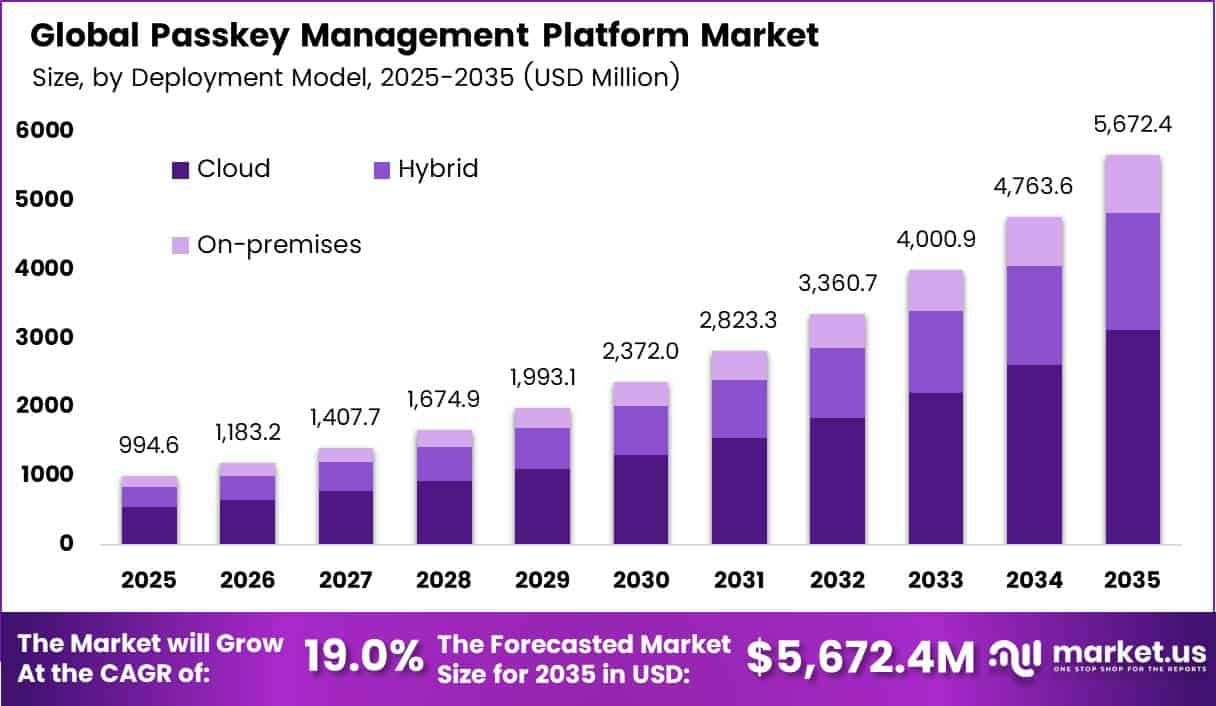
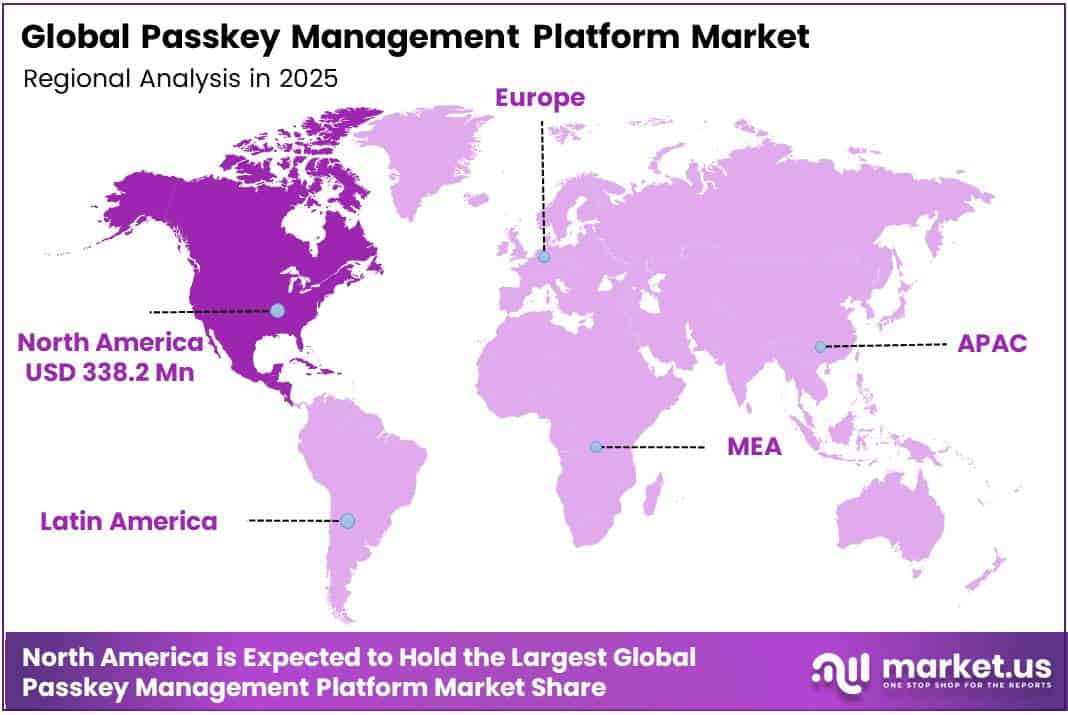
In 2025, the Global Passkey Management Platform Market was valued at USD 994.6 million. The market is projected to grow at a CAGR of 19.0% during 2026–2035, reaching approximately USD 5,672.4 million by 2035. North America dominated the global market in 2025, accounting for more than 34.0% of the total market share and generating approximately USD 338.2 million in revenue.
Fast consumer adoption drives this growth. The FIDO Alliance now estimates that 7 billion passkeys are in use worldwide, up from about 3 billion in October 2025. Its 2026 Passkey Index drew data from 15 major services, up from 9 the year before. These include JPMorgan Chase, PayPal, Shopify, Amazon and Microsoft.
The FIDO Alliance also reports a 93% sign-in success rate with passkeys. That is more than double the rate of older login methods. Banks, retailers and telecom firms now need platforms that can create, sync, audit and recover passkeys at large scale. This need turns consumer adoption into business spending on management software and services.
The North America region hosts the main identity vendors and the biggest early adopters. Okta, based in San Francisco, posted total revenue of USD 2.919 billion in fiscal 2026, up 12%. Its subscription backlog reached USD 4.827 billion, up 15%. Microsoft closed fiscal 2025 with USD 281.7 billion in revenue, up 15%. A FIDO Alliance survey also found that 48% of the world’s top 100 websites already support passkeys.
Key Takeaways
- The Passkey Management Platform Market reached USD 994.6 million in 2025 and will reach USD 5,672.4 million by 2035. at a CAGR of 19.0% from 2026 to 2035.
- By component, Software leads with a 71.2% share.
- By deployment model, Cloud leads with a 57.5% share.
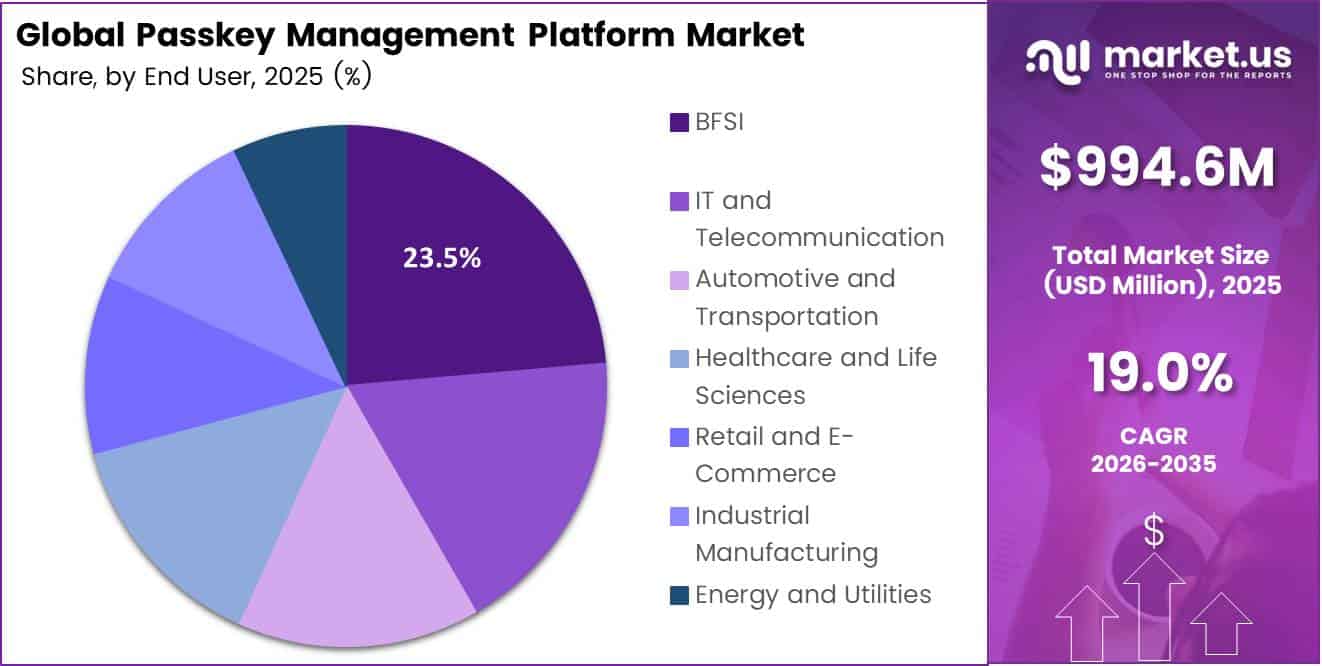
- By end user, BFSI leads with a 23.5% share.
- North America leads with a 34.0% share and USD 338.2 million in revenue.
By Component
Software dominates with 71.2% due to core passkey creation and sign-in engines.
Software leads because every passkey rollout starts with a platform that creates, stores, and checks passkeys. Buyers spend first on this core layer, as it links directly to their apps, browsers, and devices. The FIDO Alliance estimates that about 3 billion passkeys now protect consumer accounts, and each one needs software to issue and verify it.
Demand also comes from the open web. FIDO reports that 48% of the world’s top 100 websites already support passkeys, more than double the 2022 level. This scale pushes firms to license ready-made software rather than build tools in-house. Large sites also want fast updates, strong admin dashboards, and simple links to their identity tools.
Services is the fastest-growing component as firms move from pilots to full rollouts. The payoff is clear: FIDO’s Passkey Index shows up to 81% fewer login-related help desk incidents. Over 100 organizations have signed the Passkey Pledge, which creates fresh demand for setup and managed support.
By Deployment Model
Cloud dominates with 57.5% due to fast setup and low-cost scaling.
Cloud holds the largest share because buyers can launch passkey services in days without buying servers. Vendors handle updates, uptime, and new device support, which lightens the load on small IT teams. Eurostat data shows that 52.7% of EU enterprises paid for cloud computing services in 2025.
That figure rose by 7.4 percentage points compared with 2023, which shows a steady shift of business tools to the cloud. Passkey platforms ride this same wave, since they plug easily into cloud email, office suites, and customer apps.
Hybrid models grow fastest because many firms cannot move every system at once. The same Eurostat survey suggests that about 47.3% of EU enterprises did not pay for cloud services in 2025, so a large group still runs key apps on its own servers. Banks, hospitals, and public bodies also follow strict data rules that keep some identity records on-site.
By End User
BFSI dominates with 23.5% due to strict fraud and compliance pressure.
BFSI leads end-user demand because banks, insurers, and payment firms face constant phishing and account takeover attacks. Passkeys make stolen passwords useless, which protects both money and customer trust. FIDO’s Passkey Index notes that banking, along with healthcare, drove much of the passkey adoption seen in 2025.
The index also records a 93% sign-in success rate with passkeys, more than double the rate of other login methods. For banks, fewer failed logins mean fewer support calls and fewer lost customers. Insurers and lenders also use passkeys to meet stronger customer login rules.
Retail and E-Commerce is the fastest-growing user group as online shopping keeps rising. The U.S. Census Bureau reports retail e-commerce sales of $316.1 billion in the fourth quarter of 2025, or 16.6% of total retail sales. Login friction hurts these sellers directly: FIDO found that nearly half of consumers have dropped a purchase after forgetting a password.
Key Market Segments
By Component
- Software
- Services
By Deployment Model
- Cloud
- Hybrid
- On-premises
By End User
- BFSI
- IT and Telecommunication
- Automotive and Transportation
- Healthcare and Life Sciences
- Retail and E-Commerce
- Industrial Manufacturing
- Energy and Utilities
Geopolitical Impact Analysis
Passkey platforms run as software, but they rely on hardware. Security keys, phone secure chips and cloud servers all use chips. UNCTAD data shows that global trade passed USD 35 trillion for the first time in 2025, with growth of 7%. Goods trade grew about 6%. This shows that chip-heavy supply chains stayed active despite new tariffs.
Tariff risk still sits on key hardware. A US trade deal fixed a 19% tariff on Malaysian goods. Malaysia is a major chip packaging hub. Semiconductors also face a US national security review under the Trade Expansion Act. A new chip tariff would raise the cost of hardware keys and secure devices.
Demand from the AI boom tightens chip supply further. The World Semiconductor Trade Statistics group expects global chip sales near USD 1 trillion in 2026, up more than 26%. South Korea may pass USD 700 billion in yearly exports, led by chips. Hardware authenticator makers now compete with AI buyers for the same chip capacity.
UNCTAD expects slower trade in 2026 because of geopolitical fragmentation and rising trade costs. For platform vendors, this pushes buyers toward cloud-synced passkeys over hardware tokens. It also increases demand for local data hosting in the EU and Asia.
Regional Analysis
North America dominates the Passkey Management Platform Market, holding a 34.0% share and generating USD 338.2 million in revenue. Most of the region’s demand comes from the US. The country hosts the main identity platform owners, including Microsoft, Okta, Keeper Security, Bitwarden, HYPR, and GoTo. Okta’s fourth quarter of fiscal 2026 alone brought USD 761 million in revenue, up 11%.
Its subscription revenue reached USD 747 million. US banks, retailers and healthcare groups roll out passkeys early to cut phishing and account takeover losses. Keeper Security, based in Chicago, now protects more than 100,000 organizations, which shows strong demand from US mid-market firms. Canada adds steady demand through its banks and public sector buyers.
Asia Pacific is the fastest-growing region in the market. Japan and South Korea lead adoption. KDDI, LY Corporation, Mercari and NTT DOCOMO all appear in the FIDO Alliance 2026 Passkey Index. Fast mobile banking growth in India and China expands the base of users. The FIDO Alliance included respondents from China, South Korea, and Japan in its 2025 consumer survey, which reflects the region’s strong role.
Europe holds the second position. Germany, France, and the UK lead the region’s demand. Strict privacy and payment security rules push banks and public bodies toward phishing-resistant login methods. Yubico, based in Sweden, posted net sales of about SEK 2.2 billion over the last 12 months to Q4 2025. This reflects strong European demand for hardware passkeys.
Key Regions and Countries
North America
- US
- Canada
Europe
- Germany
- France
- The UK
- Spain
- Italy
- Rest of Europe
Asia Pacific
- China
- Japan
- South Korea
- India
- Australia
- Rest of APAC
Latin America
- Brazil
- Mexico
- Rest of Latin America
Middle East and Africa
- GCC
- South Africa
- Rest of MEA
Market Dynamics
Drivers
| Driver | (~) % Impact on CAGR Forecast | Geographic Relevance | Impact Timeline |
|---|---|---|---|
| Phishing-Resistant Authentication Mandates | +3.1% | North America, India, EU, GCC | Short term (2 years or less) |
| Help Desk & Login Cost Reduction | +2.4% | Global | Short term (2 years or less) |
| OS-Level Synced Passkey Ubiquity | +2.0% | Global | Short term (2 years or less) |
| Credential-Stuffing & ATO Fraud Escalation | +1.5% | North America, Europe, APAC | Medium term (2 to 4 years) |
| Zero Trust Workforce IAM Upgrades | +1.1% | North America, Western Europe | Medium term (2 to 4 years) |
Phishing-Resistant Authentication Mandates
The root cause is regulation turning passkeys from optional to a recognized compliance path. NIST published SP 800-63-4 in final form on July 31, 2025, after first adding syncable authenticators through interim guidance in April 2024. That revision formally covers synced passkeys, and under defined conditions, they can meet AAL2.
The effect is now measurable. FIDO Alliance Passkey Index data shows 93% of accounts are eligible for passkeys, 36% have one enrolled, and 26% of sign-ins already use them. According to the same FIDO Alliance index, roughly 3 billion passkeys protect consumer accounts. Per FIDO Alliance World Passkey Day research, 48% of the top 100 websites support passkeys, more than double the 2022 level.
Commercially, buyers are moving away from perpetual on-premises MFA licenses. They now pay for compliance-mapped, per-monthly-active-user SaaS orchestration. In an industry survey released alongside the FIDO Alliance index, 63% of organizations ranked passkeys as their top authentication investment priority.
Restraints
| Restraint | (~) % Impact on CAGR Forecast | Geographic Relevance | Impact Timeline |
|---|---|---|---|
| Free Platform-Native Passkey Bundling | -1.4% | Global | Short term (2 years or less) |
| Legacy Application Protocol Incompatibility | -1.0% | North America, Europe, Japan | Medium term (2 to 4 years) |
| Cross-Border Credential Sync Localization Rules | -0.8% | China, Russia, Select Middle East | Long term (4 years or more) |
| AAL3 Exclusion of Synced Credentials | -0.6% | US Federal, Defense, Global BFSI | Medium term (2 to 4 years) |
| Constrained SMB Security Budgets | -0.5% | Emerging Markets, Southern Europe | Short term (2 years or less) |
Free Platform-Native Passkey Bundling
The root cause is that the companies that control operating systems and browsers now ship passkey creation, storage, and sync at no direct cost. Google, Microsoft, and Amazon are among the providers whose deployments feed the FIDO Alliance Passkey Index. NIST SP 800-63-4 names keychain-style providers as valid syncable authenticators.
This creates a hard limit on what independent vendors can charge. Per the FIDO Alliance-linked survey, 86% of organizations say their infrastructure is already fully or mostly ready to support passkeys. That leaves standalone management platforms with smaller deals for the basic tier. On the purchasing side, a $2–$4 per-user annual add-on is hard to justify when the platform credential is free.
Strategically, this squeezes gross margins on commodity enrollment and authentication modules by an estimated 5–8 percentage points. It also pushes some relying parties to delay new orchestration spending until platform roadmaps settle. Vendors are responding by moving revenue toward analytics, recovery, and policy layers rather than credential storage itself.
Challenges
| Challenge | (~) % CAGR Friction Drag | Geographic Relevance | Mitigation Horizon |
|---|---|---|---|
| Account Recovery Fraud Exposure | -1.2% | Global | Medium term (2 to 4 years) |
| Cross-Ecosystem Credential Portability Gaps | -0.9% | Global | Short term (2 years or less) |
| FIDO2 Engineering Talent Shortage | -0.7% | India, North America, Europe | Medium term (2 to 4 years) |
| Low-End Device Fragmentation | -0.5% | South Asia, Africa, LATAM | Long term (4 years or more) |
| Persistent Password Fallback Dependence | -0.4% | Global | Medium term (2 to 4 years) |
Account Recovery Fraud Exposure
The friction is measurable. Per the FIDO Alliance Passkey Index, legacy sign-in methods succeed only 63% of the time, compared with 93% for passkeys. Every forced fallback brings back that weaker success rate and its fraud exposure. Only 26% of sign-ins currently use passkeys, which leaves the remaining 74% of authentication traffic exposed to downgrade attacks.
Navigating this requires long-term adjustments: identity-proofing re-binding at IAL2, device-bound backup credentials, and risk-scored recovery orchestration. Vendors are likely to shift an estimated 15–20% of R&D spending toward recovery assurance and to bundle liveness verification. This raises cost-to-serve per enrolled user even as authentication costs fall.
Opportunities
| Opportunity | (~) % Potential CAGR Upside | Geographic Relevance | Execution Window |
|---|---|---|---|
| Agentic AI Delegated Credential Management | +2.3% | North America, Europe, APAC | Medium term (2 to 4 years) |
| Passkey-Bound Payment Authentication Services | +1.8% | India, Southeast Asia, Brazil | Short term (2 years or less) |
| EUDI Wallet Integration Layers | +1.3% | European Union | Medium term (2 to 4 years) |
| MSP-Channel SMB Passkey Bundles | +1.0% | Global | Short term (2 years or less) |
| IoT & OT Machine Identity Extension | +0.7% | North America, Germany, Japan | Long term (4 years or more) |
Agentic AI Delegated Credential Management
This is still white space, not a current driver. WebAuthn and FIDO2 were designed around a human proving presence with a biometric or PIN at the moment of use, a requirement written into the NIST SP 800-63-4 conditions for syncable authenticators.
The economics favor whoever builds this layer first. A delegated-credential broker could charge per agent session or per transaction, not per human user. That could lift average revenue per account by an estimated 30–50% where one user runs several agents.
Policy-engine software margins in the 75–80% range, comparable to those reported in listed identity vendors’ SEC filings, would make this tier accretive. Reuse of the existing base of 3 billion consumer passkeys counted by the FIDO Alliance would keep acquisition costs near zero.
Platforms that ship scoped agent tokens tied to device-bound attestation could cut per-unit fraud-loss reserves by an estimated 20% for e-commerce relying parties. That is meaningful upside not yet reflected in the 19.0% baseline.
Key Players Analysis
Tier 1 market leaders include Microsoft Corporation and Okta, Inc. Microsoft posted fiscal 2025 revenue of USD 281.7 billion. Its Microsoft Cloud revenue reached USD 168.9 billion, up 23%. Operating income reached USD 128.5 billion. Microsoft builds passkeys into Windows, Entra ID and consumer accounts. This gives it the widest reach in the market.
Okta posted fiscal 2026 revenue of USD 2.919 billion and spent USD 639 million on research and development. That equals about 22% of revenue. Okta paid USD 54 million in cash for Axiom Security in September 2025. It booked USD 16 million in developed technology and USD 40 million in goodwill from the deal.
Tier 2 challengers hold strong niche positions. Keeper Security passed USD 240 million in annual recurring revenue and more than 100,000 business customers in October 2026. Yubico leads hardware passkeys with net sales of about SEK 2.2 billion over the last 12 months to Q4 2025. Thales and Entrust serve banks and governments with hardware security and identity services.
AgileBits, Dashlane, GoTo, Nord Security, Bitwarden and HYPR compete in consumer and mid-market password and passkey management. Dashlane recently expanded its SIEM integrations with browser data. HYPR focuses on phishing-resistant passwordless login with built-in identity checks. Most of these firms are private and do not publish audited segment revenue.
Top Key Players in the Market
- Microsoft Corporation
- Okta, Inc.
- AgileBits Inc.
- Dashlane, Inc.
- GoTo Group, Inc.
- Nord Security
- Bitwarden Inc.
- Keeper Security, Inc.
- HYPR Corp.
- Yubico AB
- Thales Group
- Entrust Corporation
Recent Developments
- In October 2026, Keeper Security announced that it protects more than 100,000 organizations worldwide and passed USD 240 million in annual recurring revenue. Keeper Security reported that its annual recurring revenue passed USD 225 million.
- In September 2025, Okta, Inc. completed its all-cash acquisition of Axiom Security for USD 54 million to expand its privileged access management features. Okta, Inc. reported fiscal 2025 revenue of USD 2.610 billion and research and development spending of USD 642 million, which funded its passwordless and identity security roadmap.
Report Scope
| Report Features | Description |
|---|---|
| Market Value (2025) | USD 994.6 Million |
| Forecast Revenue (2035) | USD 5,672.4 Million |
| CAGR (2026-2035) | 19.0% |
| Base Year for Estimation | 2025 |
| Historic Period | 2020-2024 |
| Forecast Period | 2026-2035 |
| Report Coverage | Revenue Forecast, Market Dynamics, Competitive Landscape, Recent Developments |
| Segments Covered | By Component (Software, Services); By Deployment Model (Cloud, Hybrid, On-premises); By End User (BFSI, IT and Telecommunication, Automotive and Transportation, Healthcare and Life Sciences, Retail and E-Commerce, Industrial Manufacturing, Energy and Utilities) |
| Regional Analysis | North America – US, Canada; Europe – Germany, France, The UK, Spain, Italy, Rest of Europe; Asia Pacific – China, Japan, South Korea, India, Australia, Singapore, Rest of APAC; Latin America – Brazil, Mexico, Rest of Latin America; Middle East & Africa – GCC, South Africa, Rest of MEA |
| Competitive Landscape | Microsoft Corporation, Okta, Inc., AgileBits Inc., Dashlane, Inc., GoTo Group, Inc., Nord Security, Bitwarden Inc., Keeper Security, Inc., HYPR Corp., Yubico AB, Thales Group, Entrust Corporation |
| Customization Scope | Customization for segments, region/country-level will be provided. Moreover, additional customization can be done based on the requirements. |
| Purchase Options | We have three licenses to opt for: Single User License, Multi-User License (Up to 5 Users), Corporate Use License (Unlimited Users and Printable PDF) |