Report Overview
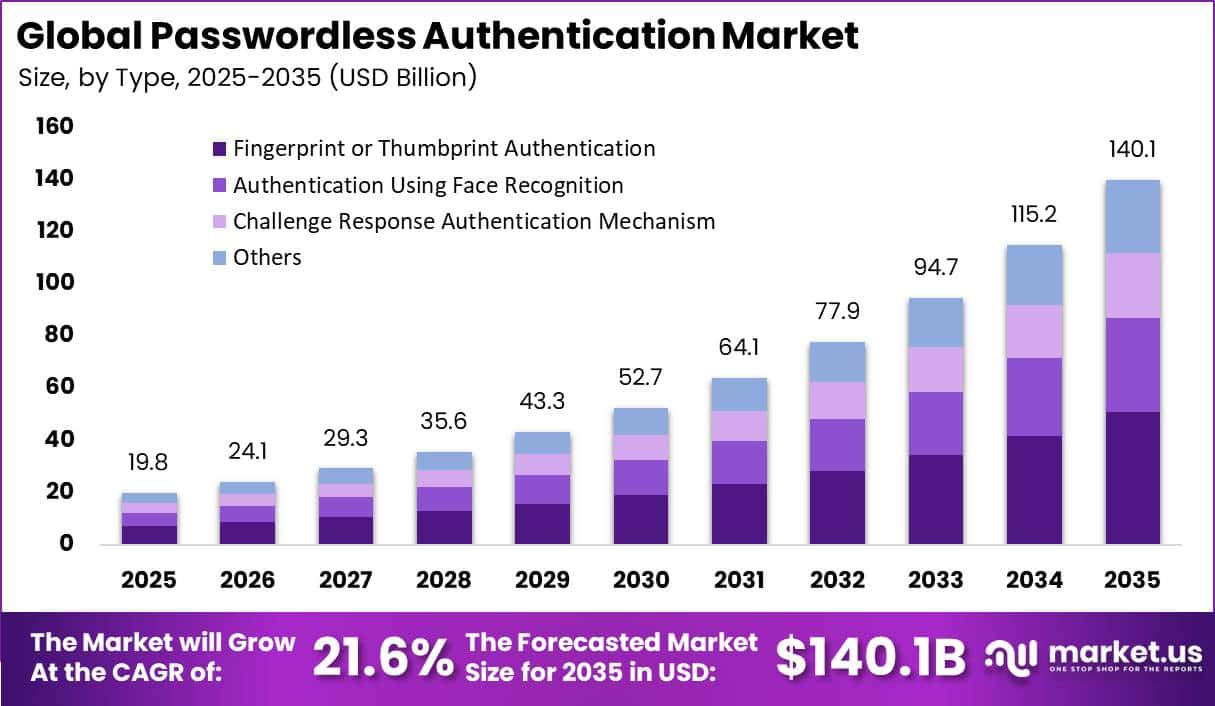
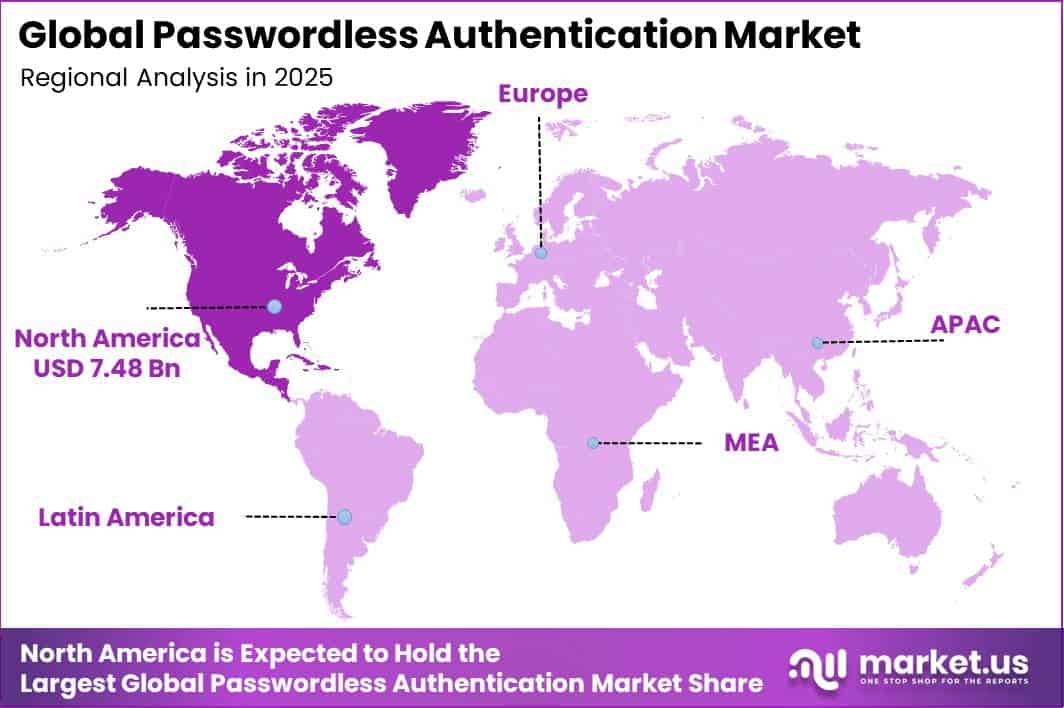
In 2025, the Global Passwordless Authentication Market was valued at USD 19.8 billion. The market is projected to grow at a CAGR of 21.6% during 2026–2035, reaching approximately USD 140.1 billion by 2035. North America dominated the global market in 2025, accounting for more than 37.8% of the total market share and generating approximately USD 7.4 billion in revenue.
Market growth is being supported by the rapid expansion of the global internet population and the increasing need for safer digital access. According to the ITU, nearly 6 billion people were using the internet in 2025, compared with 5.8 billion in 2024. The growing number of online users is creating more digital accounts and login points, increasing demand for authentication methods that reduce dependence on traditional passwords.
Rising cybercrime losses are also encouraging organizations to invest in stronger identity security. The FBI’s Internet Crime Complaint Center reported that U.S. cybercrime losses reached USD 16.6 billion in 2024, rising 33% from the previous year, before increasing to USD 20.9 billion in 2025, representing a further 26% annual increase.
Business email compromise generated losses of USD 2.7 billion in 2024 and USD 3.04 billion in 2025. These rising financial risks are pushing banks, healthcare organizations, enterprises, and government agencies toward biometrics, security keys, and device-based authentication, supporting continued market expansion.
Key Takeaway
- The Passwordless Authentication Market was valued at USD 19.8 billion in 2025 and is projected to reach USD 140.1 billion by 2035, growing at a CAGR of 21.6%.
- Fingerprint or Thumbprint Authentication led the Type segment with more than 36.3% share in 2025.
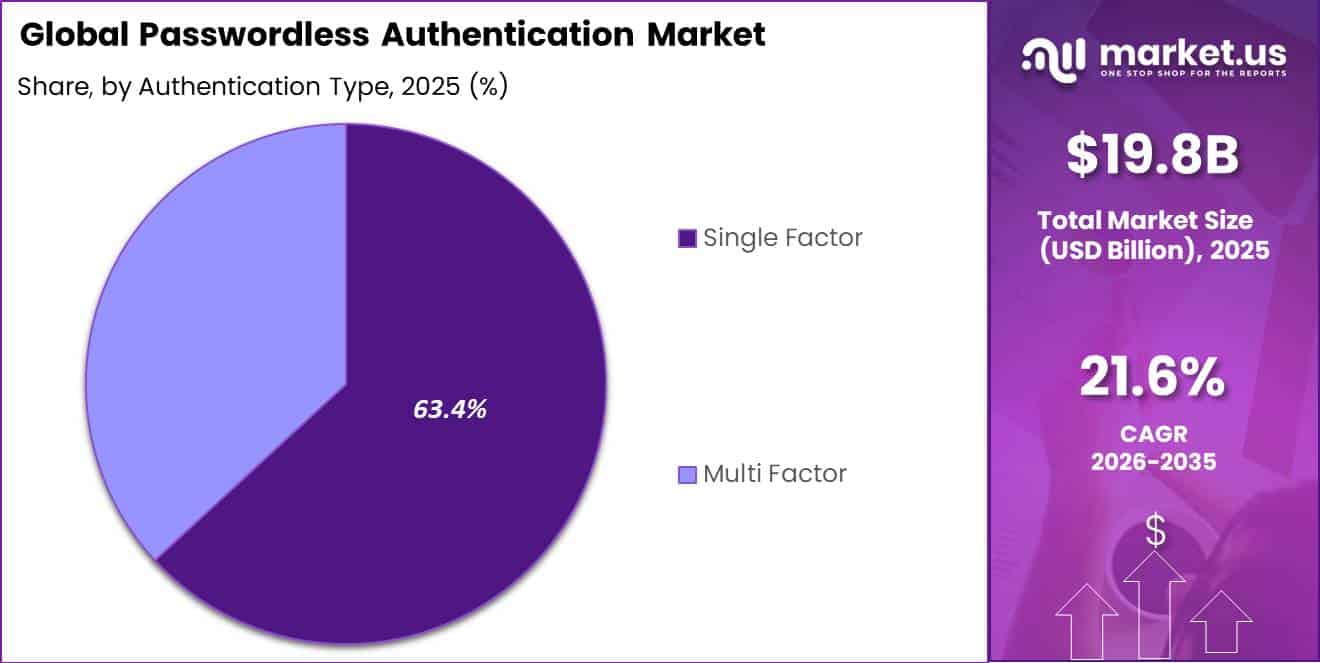
- Single Factor Authentication led the Authentication Type segment with more than 63.4% share in 2025.
- IT and Telecom led the Industry Vertical segment with more than 27.6% share in 2025.
- North America led the market in 2025 with more than 37.8% share, generating approximately USD 7.4 billion in revenue.
Market Statistics and Data Insights
- FIDO Alliance estimated that 5 billion passkeys were actively in use worldwide by May 2026. Its 2026 consumer research found that 90% of consumers were familiar with passkeys, 75% had enabled a passkey on at least one account, and 49% regularly used passkeys when they were available. These figures show that passwordless authentication has moved beyond early-stage adoption.
- The FBI received 1,008,597 internet-crime complaints in 2025, while reported U.S. cyber-enabled crime losses approached USD 21 billion. Around 453,000 cyber-enabled fraud complaints alone generated losses exceeding USD 17.7 billion. Cisco Talos separately found that identity-based attacks represented 60% of its incident-response cases in 2024, while valid accounts were used for initial access in nearly 70% of ransomware incidents it handled.
- GSMA reported 2.3 billion registered mobile-money accounts worldwide in 2025, including 593 million 30-day active accounts. More than USD 2 trillion flowed through mobile-money services during the year, while registered accounts increased by 268 million. The global 30-day activity rate also reached 25.7%. The scale of mobile financial activity increases the need for fast authentication without repeated passwords.
- FIDO Alliance reported in 2026 that 68% of organizations had deployed or were actively deploying passkeys for employee authentication. Around 82% said fully passwordless authentication was their ultimate workforce goal, although only 28% had fully achieved it. At the same time, 57% continued to rely on phishable authentication methods for primary employee sign-in.
- The World Economic Forum found that only 14% of organizations reported having the skilled workforce required to meet cybersecurity objectives, while 39% identified skills shortages as an important resilience barrier. The global cybersecurity talent shortfall was estimated at between 2.8 million and 4.8 million professionals, and the skills gap widened by 8% between 2024 and 2025.
- The FIDO Alliance Passkey Index found that an average of 93% of accounts at participating providers were eligible for passkeys in 2025. However, only 36% had an enrolled passkey, and just 26% of all sign-ins used one. Among organizations that were not fully passwordless, 24% said they were waiting for technologies and standards to mature, while 16% believed passwords combined with MFA were currently sufficient.
- Visa reports that biometric authentication produced approximately 50% lower fraud rates compared with SMS one-time passcodes in its global VisaNet analysis. Visa also states that 100% of major operating-system providers and about 90% of web browsers support FIDO authentication natively, while an estimated 4 billion consumer devices support FIDO authentication. Visa Payment Passkey is currently listed across 5 regional markets: North America, Asia-Pacific, Europe, CEMEA, and Latin America and the Caribbean.
- In June 2026, Microsoft increased Microsoft Entra’s dedicated FIDO2/passkey policy allocation to 20 KB. It also increased the maximum number of passkey profiles per tenant from 3 to 10, allowing enterprises to create more detailed authentication policies for different workforce groups and security requirements.
- In a Google web.dev case study updated in February 2026, pixiv recorded a passkey authentication success rate of 99%+, compared with roughly 70% for username-and-password authentication, representing about a 29-percentage-point improvement.
- Dashlane’s 2025 deployment recorded a 92% conversion rate when users were offered passkey authentication on the web, compared with 54% for automatic password sign-in opportunities, representing a 70% increase in conversion.
By Type
In 2025, Fingerprint or Thumbprint Authentication held a dominant market position, capturing more than a 36.3% share of the Passwordless Authentication Market. Its strong position is supported by the widespread availability of fingerprint sensors in smartphones and other connected devices.
According to GSMA data, global mobile connections reached 8.8 billion in 2025, while around 91% of these connections were linked to smartphones. This large installed base allows banks, telecom companies, and enterprises to introduce fingerprint-based login systems without requiring users to purchase additional security devices.
Government-backed biometric programs also demonstrate the scalability of fingerprint authentication. India’s Aadhaar enrollment system captures 10 fingerprints per person and supports a national identity database covering over a billion residents. Fingerprint authentication is also fast and convenient, as modern sensors can verify a user’s fingerprint in under one second.
By Authentication Type
In 2025, Single Factor Authentication held a dominant market position, capturing more than a 63.4% share of the Passwordless Authentication Market. Its leadership is supported by the need for fast and simple authentication across high-volume digital transactions. According to GSMA data, mobile money services processed 108 billion transactions worth around USD 1.6 trillion in 2024, while transaction volumes increased by 20% year-on-year.
The growth of digital commerce also supports single-factor authentication. UNCTAD reported that global business e-commerce sales reached approximately USD 28 trillion across 45 economies in 2024. Adding several verification steps to every transaction can increase checkout time and reduce user convenience.
Single-factor methods, including fingerprint verification and PIN-based access, are easier and generally less expensive to deploy for routine and lower-risk activities. With global mobile money accounts reaching 2.3 billion in 2025, demand for fast, scalable, and low-friction authentication continues to strengthen the segment’s market position.
By Industry Vertical
In 2025, IT and Telecom held a dominant market position, capturing more than a 27.6% share of the Passwordless Authentication Market. The segment leads because telecom operators and technology companies manage large volumes of user identities, network access points, and sensitive digital information.
CISA and the FBI reported that the Salt Typhoon cyber-espionage campaign affected at least 9 major U.S. telecom carriers, while compromised systems exposed metadata linked to over 1 million users. The incident highlighted the risks created by weak access controls and increased pressure on operators to strengthen authentication systems.
In December 2024, CISA, the NSA, and international partners issued guidance supporting stronger security practices across communications infrastructure. With annualized global telecom revenues estimated at nearly USD 1.7 trillion, the industry also has significant resources to invest in passwordless technologies, including biometrics, device-based authentication, and stronger access controls.
Key Market Segments
By Type
- Fingerprint or Thumbprint Authentication
- Authentication Using Face Recognition
- Challenge Response Authentication Mechanism
- Others
By Authentication Type
- Single Factor
- Multi Factor
By Industry Vertical
- IT and Telecom
- Aerospace and Defence
- BFSI
- Government and Law Enforcement
- Healthcare
- Retail
- Transportation and Logistics
- Others
Geopolitical Impact Analysis
Geopolitical risks are increasing the cost and delivery uncertainty of hardware used in the Passwordless Authentication Market, including biometric sensors, secure microcontrollers, security keys, smart cards, and identity-platform servers. In 2025, the U.S. Trade Representative increased the Section 301 tariff on selected Chinese semiconductors to 50%.
This can raise procurement costs for authentication-device manufacturers and U.S. enterprises that depend on Chinese-origin chips, diodes, transistors, and other electronic components. Higher tariffs are also encouraging vendors to adopt dual sourcing, regional assembly, and larger safety inventories, which can increase working-capital requirements and extend supplier qualification periods.
Shipping disruption is creating additional pressure on hardware supply chains. According to UNCTAD, rerouting Asia-Europe container traffic around the Cape of Good Hope adds about 12 sailing days to the Shanghai-Rotterdam route, increasing transit time by nearly 30% and reducing effective global container capacity by around 9%.
Suez Canal transits were also 42% below their 2023 peak, affecting the timely movement of fingerprint modules, secure-element chips, reader housings, and finished security keys from Asian production hubs.
Energy price volatility adds another layer of risk. The World Bank estimated that a major Middle East supply disruption could push Brent crude prices to USD 92 per barrel, around 15% above its 2025 baseline forecast. Higher fuel costs can increase airfreight, ocean freight, production, and last-mile delivery expenses.
Regional Analysis
North America held a dominant position in the global Passwordless Authentication Market in 2025, accounting for more than 37.8% of global revenue and generating approximately USD 7.4 billion. The region benefits from a strong enterprise IT sector, advanced cloud infrastructure, high cybersecurity spending, and early adoption of zero-trust security models across banking, healthcare, government, retail, and telecom.
In the United States, federal cybersecurity policies are also supporting market growth. CISA recommends the use of cloud-based passwordless authentication methods such as FIDO2/WebAuthn, PKI, PIV, and CAC credentials. Federal agencies are also moving toward phishing-resistant multifactor authentication for employees, contractors, and partners, supporting wider use of biometrics, passkeys, device-bound credentials, and hardware security keys.
Asia Pacific is expected to be the fastest-growing regional market, supported by mobile banking, digital commerce, cloud adoption, and government digital-ID programmes. The World Bank reported that 89% of adults in China had a financial account, while 82% used it for digital merchant payments.
Key Regions and Countries
- North America
- US
- Canada
- Europe
- Germany
- France
- The UK
- Spain
- Italy
- Rest of Europe
- Asia Pacific
- China
- Japan
- South Korea
- India
- Australia
- Rest of APAC
- Latin America
- Brazil
- Mexico
- Rest of Latin America
- Middle East & Africa
- GCC
- South Africa
- Rest of MEA
Market Dynamics
Drivers
| Driver | (~) % CAGR | Geographic Relevance | Impact Timeline |
|---|---|---|---|
| Passkey ecosystem scaling | +3.2% | Global | Short term (2 years or less) |
| Phishing-resistant public procurement | +2.4% | North America and Europe | Short term (2 years or less) |
| Cloud identity consolidation | +2.1% | Global | Medium term (2 to 4 years) |
| Mobile payment authentication | +1.8% | Asia Pacific and Africa | Medium term (2 to 4 years) |
| Workforce access modernization | +1.5% | North America and Europe | Short term (2 years or less) |
Passkey ecosystem scaling
Passkeys are shifting authentication from a stand-alone security purchase toward an embedded identity-service feature, allowing providers to bundle passwordless access within cloud subscriptions and reduce customer acquisition friction.
The FIDO Alliance reported that 74% of consumers were aware of passkeys in 2025, while 69% had enabled one on at least one account; it also found passkey support on 48% of the world’s top 100 websites.
By 2026, FIDO estimated 5 billion active passkeys, with 68% of organizations deploying, piloting, or rolling out passkeys for employee sign-in. This installed-device and standards base reduces enrolment cost, supports recurring identity-platform revenue, and plausibly contributes about 3.2 percentage points to the stated 21.6% baseline CAGR without implying that all demand converts immediately.
Restraints
| Restraint | (~) % CAGR | Geographic Relevance | Impact Timeline |
|---|---|---|---|
| Legacy-system replacement cost | -2.6% | Global | Medium term (2 to 4 years) |
| Biometric privacy restrictions | -1.9% | Europe and North America | Short term (2 years or less) |
| Hardware procurement inflation | -1.4% | Global | Short term (2 years or less) |
| Small-business budget limits | -1.3% | Emerging markets | Medium term (2 to 4 years) |
| Identity data residency rules | -1.1% | Europe, Middle East and Asia Pacific | Medium term (2 to 4 years) |
Legacy-system replacement cost
Legacy applications remain a major barrier to passwordless adoption because deployment often requires changes to directory services, VPNs, privileged-access systems, virtual desktops, recovery processes, and custom applications.
The World Economic Forum reported in 2025 that only 14% of organizations had the skilled talent needed to meet cybersecurity goals, while 39% identified skills shortages as a resilience barrier. CISA also recommends migrating toward cloud-based passwordless authentication through existing PKI, PIV, or CAC infrastructure, showing that implementation often depends on older systems.
The required integration, testing, and temporary parallel operation can raise costs and delay investment decisions, creating an estimated -2.6 percentage-point drag on near-term market growth.
Challenges
| Challenge | (~) % CAGR | Geographic Relevance | Mitigation Horizon |
|---|---|---|---|
| Account recovery assurance | -2.2% | Global | Medium term (2 to 4 years) |
| Cybersecurity skills scarcity | -1.8% | Global | Long term (4 years or more) |
| Cross-device credential portability | -1.6% | Global | Medium term (2 to 4 years) |
| Fragmented identity governance | -1.4% | Global | Medium term (2 to 4 years) |
| Synthetic identity attacks | -1.2% | North America and Europe | Short term (2 years or less) |
Account recovery assurance
Account recovery remains a major operational challenge because passwordless systems still need secure ways to restore access after a lost device, failed biometric match, or employee account issue. In 2026, the FIDO Alliance reported that 57% of organizations still used passwords for primary employee sign-in, while only 28% had achieved fully passwordless workforce authentication.
The FIDO Alliance’s 2025 Passkey Index also found that 93% of accounts were eligible for passkeys, but only 36% had an enrolled passkey, and just 26% of sign-ins used one. This gap shows that recovery, migration, identity proofing, fraud monitoring, and multi-device enrolment remain barriers to wider adoption, creating an estimated -2.2 percentage-point drag on maximum attainable CAGR.
Opportunities
| Opportunity | (~) % CAGR | Geographic Relevance | Execution Window |
|---|---|---|---|
| Consumer identity monetization | +2.8% | Global | Medium term (2 to 4 years) |
| Managed SME authentication | +2.2% | Global | Medium term (2 to 4 years) |
| Cross-border digital identity | +1.9% | Europe, Asia Pacific and Middle East | Long term (4 years or more) |
| Machine identity access | +1.7% | Global | Long term (4 years or more) |
| Post-quantum credential upgrades | +1.4% | North America, Europe and Japan | Long term (4 years or more) |
Consumer identity monetization
Consumer-facing identity remains a major untapped opportunity, as wider awareness has not yet led to universal passkey use across retail, travel, healthcare, subscriptions, and public services. In 2026, the FIDO Alliance found that 75% of consumers had enabled a passkey, but only 49% used passkeys regularly when available.
It also reported that 47% of consumers may abandon a purchase or sign-in when they forget a password, including 17% who are highly likely to do so. This usage gap creates room for transaction-based identity pricing, fraud-loss sharing, and premium recovery services.
FIDO data show that passkey deployments reduced password-reset tickets in 35% of organizations and phishing-related incidents in 32%. Strong execution in consumer identity could add about 2.8 percentage points above the baseline CAGR while improving margins through software-led delivery.
Key Players Analysis
The Passwordless Authentication Market is mainly led by Tier-1 identity and security providers, including Microsoft, Thales, Fujitsu, NEC, HID Global, and ASSA ABLOY. These companies benefit from strong enterprise software portfolios, biometric capabilities, digital identity platforms, physical-access solutions, and global distribution networks.
Microsoft remains a major software leader, reporting FY2025 revenue of USD 281.7 billion, Azure revenue of more than USD 75 billion, and R&D spending of USD 32.4 billion, equal to 12% of revenue. This investment supports products such as Microsoft Entra, Windows Hello, endpoint security, and cloud-based identity services.
Thales is also a major digital identity provider, generating EUR 2.3 billion in Digital Identity sales in 2025 and EUR 301 million in adjusted EBIT. The company invests about EUR 4.5 billion annually in R&D. Fujitsu reported FY2025 Service Solutions revenue of JPY 2.3 trillion, including JPY 1.7 trillion from Japan. NEC recorded FY2025 revenue of JPY 3.4 trillion and non-GAAP operating profit of JPY 311.3 billion.
ASSA ABLOY completed 23 acquisitions in 2025 with a combined purchase price of SEK 12.8 billion. Tier-2 players such as M2SYS, DERMALOG, and East Shore Technology mainly focus on biometric and public-sector projects. Safran is no longer a direct identity competitor after selling its Identity & Security business in a deal valued at EUR 2.4 billion. Exact vendor-level market shares are not publicly disclosed.
Top Key Players in the Market
- Fujitsu
- NEC Corporation
- HID Global Corporation
- M2SYS Technology
- Thales
- Safran
- DERMALOG Identification Systems GmbH
- East Shore Technology, LLC
- ASSA ABLOY
- Microsoft
Recent Developments
- In 2026, Microsoft expanded its passwordless authentication capabilities by making Microsoft Entra passkeys on Windows and passkey support for Microsoft Entra External ID generally available. Microsoft reported FY2025 R&D spending of USD 32.4 billion, equal to 12% of its USD 281.7 billion revenue, supporting continued investment in identity, cloud, security, and passwordless technologies.
- In 2025, Yubico expanded YubiEnterprise Delivery into 117 new locations, bringing its total coverage to 199 locations, including 175 countries and 24 territories. The company also expanded YubiKey as a Service across all European Union countries.
Report Scope
| Report Features | Description |
|---|---|
| Market Value (2025) | USD 19.8 Billion |
| Forecast Revenue (2035) | USD 140.1 Billion |
| CAGR (2026-2035) | 21.6% |
| Base Year for Estimation | 2025 |
| Historic Period | 2020-2024 |
| Forecast Period | 2026-2035 |
| Report Coverage | Revenue Forecast, Market Dynamics, Competitive Landscape, Recent Developments |
| Segments Covered | By Type (Fingerprint or Thumbprint Authentication, Authentication Using Face Recognition, Challenge Response Authentication Mechanism, Others); By Authentication Type (Single Factor, Multi Factor); By Industry Vertical (IT and Telecom, Aerospace and Defence, BFSI, Government and Law Enforcement, Healthcare, Retail, Transportation and Logistics, Others) |
| Regional Analysis | North America – US, Canada; Europe – Germany, France, The UK, Spain, Italy, Rest of Europe; Asia Pacific – China, Japan, South Korea, India, Australia, Singapore, Rest of APAC; Latin America – Brazil, Mexico, Rest of Latin America; Middle East & Africa – GCC, South Africa, Rest of MEA |
| Competitive Landscape | Fujitsu, NEC Corporation, HID Global Corporation, M2SYS Technology, Thales, Safran, DERMALOG Identification Systems GmbH, East Shore Technology LLC, ASSA ABLOY, Microsoft |
| Customization Scope | Customization for segments and region/country-level will be provided. Moreover, additional customization can be done based on the requirements. |
| Purchase Options | We have three licenses to opt for: Single User License, Multi-User License (Up to 5 Users), Corporate Use License (Unlimited Users and Printable PDF) |