


Report Overview
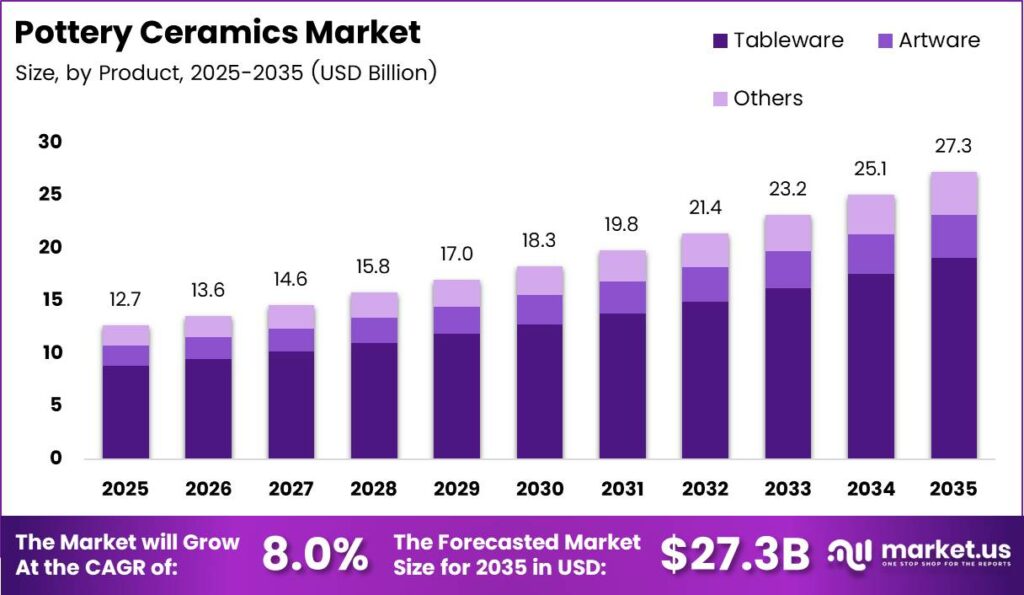
Global Pottery Ceramics Market size is expected to be worth around USD 27.3 Billion by 2035 from USD 12.7 Billion in 2025, growing at a CAGR of 8.0% during the forecast period 2026 to 2035.
The pottery ceramics market covers the manufacture and sale of fired clay products for household, hospitality, and decorative use. Product categories span functional tableware such as plates, bowls, and cups, alongside artware and decorative ceramics. Distribution runs through both offline retail channels and online platforms serving consumer and institutional buyers. This structure positions the market at the intersection of everyday household consumption and premium lifestyle purchasing.
Key Takeaways
- The global Pottery Ceramics Market is valued at USD 12.7 Billion in 2025 and is forecast to reach USD 27.3 Billion by 2035.
- The market grows at a CAGR of 8.0% during the forecast period 2026 to 2035.
- By Product, Tableware dominates with a 70.21% share in 2025.
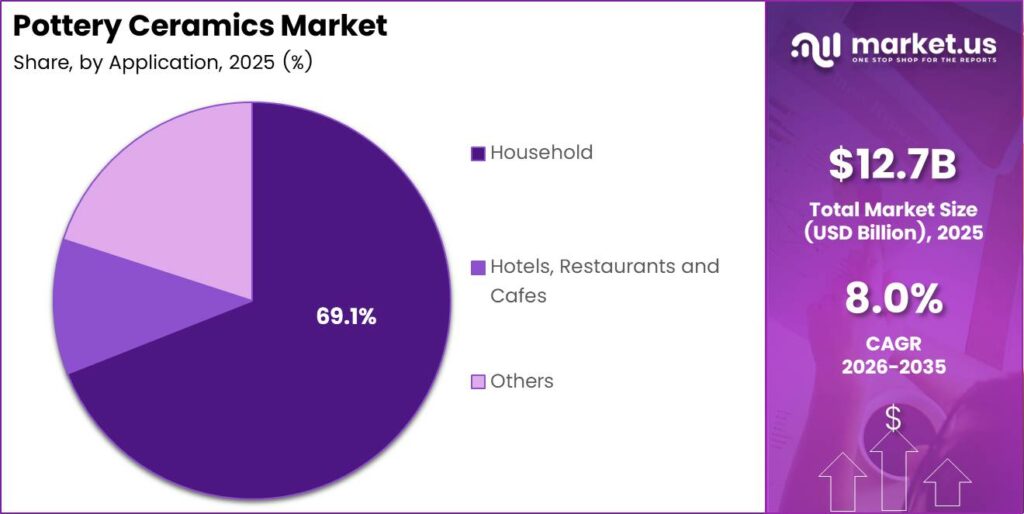
- By Application, Household holds the dominant share at 52.67% in 2025.
- By Distribution Channel, Online leads with a 66.23% share in 2025.
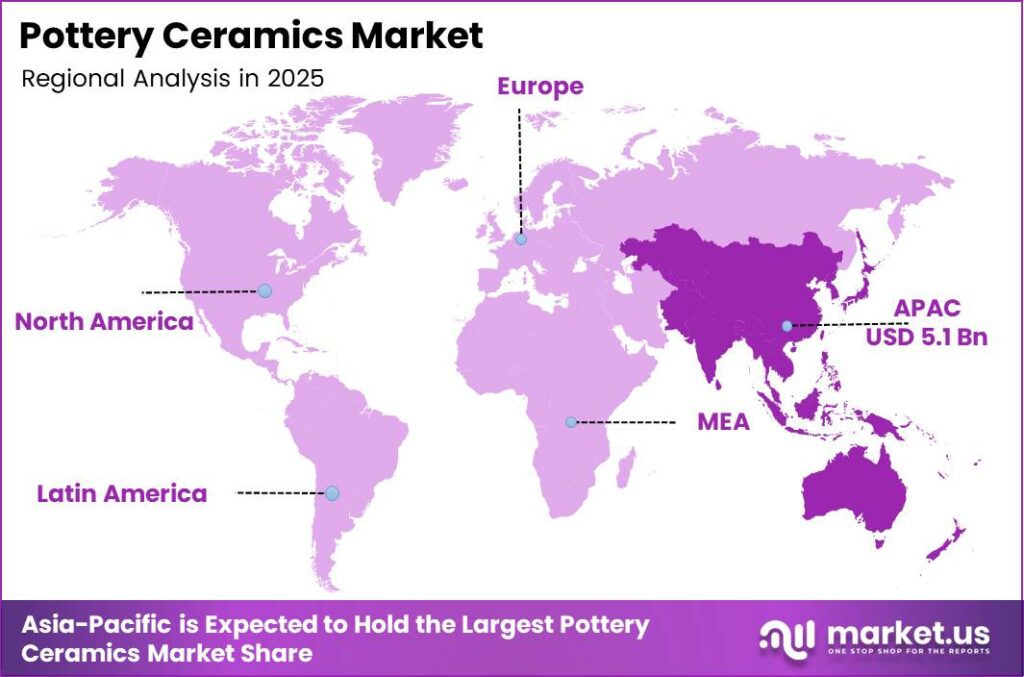
- Asia-Pacific dominates regional performance with a 40.34% market share, valued at USD 5.1 Billion in 2025.
- Europe is identified as the fastest-growing region during the forecast period.
The online retail channel acts as a structural growth multiplier for ceramic brands. According to Eurostat, 77% of EU internet users purchased goods or services online for personal use in 2024. This level of digital purchasing behavior creates a direct pipeline for ceramics brands that invest in e-commerce infrastructure. Vendors who optimize product listings, photography, and fulfillment will convert this digital traffic into measurable revenue share.
As per our research, PHO451 GREEN SERIES press technology installed at AkijBashir’s tableware division consumed 30% less energy than traditional pressing solutions. This efficiency gain directly compresses per-unit production cost at scale. Manufacturers that adopt energy-efficient pressing equipment gain a structural cost advantage over competitors still relying on conventional kiln and pressing infrastructure.
Product Analysis
Tableware dominates with 70.21% due to daily household and hospitality procurement cycles.
In 2025, Tableware held a dominant market position in the By Product segment of the Pottery Ceramics Market, with a 70.21% share. Hotels, restaurants, and cafes sustain recurring replacement demand for plates, bowls, and cups as inventory degrades through breakage and heavy use. As per our research, AkijBashir exported between 60% and 70% of its tableware production worldwide, demonstrating how export-oriented manufacturers can capture multi-market demand from a single production base.
Artware addresses the premium decorative and collectible segment within pottery ceramics. Buyers in North America, Europe, and East Asia purchase artware as gifting items, interior design elements, and cultural collectibles rather than functional replacements. In June 2026, RAK Ceramics signed a multi-year licensing agreement with Italian fashion house Roberto Cavalli to manufacture and distribute premium branded luxury ceramic tiles and sanitaryware, signaling how licensing partnerships expand artware’s addressable market beyond traditional retail.
Others within the product segment captures specialty and industrial ceramic items not classified under tableware or artware. This sub-segment serves niche application areas including studio supply, architectural ceramics, and custom institutional orders. Tableware and Artware hold the dominant combined share, with Others accounting for the remaining portion of the market.
Application Analysis
Household dominates with 52.67% due to universal daily use across income segments.
In 2025, Household held a dominant market position in the By Application segment of the Pottery Ceramics Market, with a 52.67% share. Ceramic tableware and decorative items form part of standard home furnishing across urbanizing markets in India, Southeast Asia, and Africa. Urban household formation in these regions drives first-purchase demand for functional ceramics, creating a structurally recurring volume base for mass-market producers.
Hotels, Restaurants and Cafes represent the most procurement-intensive application segment within pottery ceramics. Hospitality operators replenish tableware inventories continuously due to breakage, pattern refreshes, and service capacity expansion. UN Tourism identified 2024 as the year international tourism recovered from the pandemic, with international arrivals growing 4% in 2025, and this recovery restores the volume procurement cycles that ceramic tableware suppliers depend on from hospitality buyers.
Others within the Application segment includes institutional buyers such as corporate dining, healthcare facilities, and specialty retail environments. These buyers require consistent supply, standardized formats, and reliable lead times rather than premium design differentiation. Household and hospitality combined hold the dominant share, with Others accounting for the balance of the application mix.
Distribution Channel Analysis
Online dominates with 66.23% due to platform reach and lower-friction purchasing behavior.
In 2025, Online held a dominant market position in the By Distribution Channel segment of the Pottery Ceramics Market, with a 66.23% share. Digital platforms reduce geographic barriers for niche ceramic brands and enable direct-to-consumer sales without wholesale margin compression. Vendors who invest in platform optimization, high-resolution product imagery, and logistics partnerships capture disproportionate share within this structurally expanding channel.
Offline retail is identified as the fastest-growing distribution channel during the forecast period. Physical retail enables tactile product evaluation, which matters in premium ceramics purchasing where texture, weight, and glaze finish drive purchase decisions. Specialty retailers and home goods chains that expand their ceramic category footprint will benefit as consumer interest in artisanal homeware translates into in-store browsing and trial.
Key Market Segments
By Product
- Tableware
- Artware
- Others
By Application
- Household
- Hotels, Restaurants and Cafes
- Others
By Distribution Channel
- Online
- Offline
Regional Analysis
Asia-Pacific Dominates the Pottery Ceramics Market with a Market Share of 40.34%, Valued at USD 5.1 Billion
Asia-Pacific accounts for 40.34% of the global Pottery Ceramics Market, valued at USD 5.1 Billion in 2025. The region’s dominance reflects concentrated manufacturing capacity in China and established ceramics production clusters across South and Southeast Asia. Consumer markets in India, Japan, and South Korea sustain both mass-market tableware demand and a growing premium artware segment, reinforcing Asia-Pacific’s dual role as producer and buyer.
Europe is the fastest-growing region in the Pottery Ceramics Market during the forecast period. Premium homeware culture, strong artisanal ceramics traditions, and high consumer spending on home décor support above-average value growth across the region. In April 2026, RAK Ceramics introduced the KLUDI-REEF and RE-USE sustainable ceramic tile collections, winning two Red Dot Design Awards, reflecting how design-led innovation is raising the category’s commercial profile in European markets.
Key Regions and Countries
North America
- US
- Canada
Europe
- Germany
- France
- The UK
- Spain
- Italy
- Rest of Europe
Asia Pacific
- China
- Japan
- South Korea
- India
- Australia
- Rest of APAC
Latin America
- Brazil
- Mexico
- Rest of Latin America
Middle East and Africa
- GCC
- South Africa
- Rest of MEA
Market Dynamics
Market Opportunity Analysis - Underserved regions and niche segments offer entry points beyond the dominant tableware and online channel incumbents
The Offline distribution channel is identified as the fastest-growing channel, yet it holds the minority share against the 66.23% online dominant position. This gap signals that physical retail infrastructure remains underdeveloped relative to actual consumer demand for tactile ceramic evaluation. New entrants or category expansions that prioritize specialty brick-and-mortar placement in premium home goods environments capture buyers that online formats structurally cannot convert.
The Others sub-segment within Application serves institutional buyers including corporate dining, healthcare facilities, and specialty environments. This segment does not compete on design premiumization and instead rewards reliability, standardized formats, and supply consistency. Producers that build institutional sales programs with guaranteed lead times and replacement matching can build recurring contract revenue that insulates them from retail demand volatility.
Europe’s position as the fastest-growing region creates a disproportionate entry opportunity for mid-tier ceramics brands currently absent from European distribution. Asia-Pacific’s dominance at 40.34% share is anchored in China and established clusters, but secondary markets such as India and Australia within the region remain underpenetrated for premium artware and adaptive dining formats. Brands that enter these sub-markets early establish channel and brand equity before large regional incumbents accelerate their own expansion.
The Artware sub-segment addresses collectible, gifting, and interior design purchasing rather than functional replacement demand. This positions it outside the competitive pressure of hospitality replenishment cycles and material substitution risk that compresses tableware margins. By contrast, artware pricing power depends on brand narrative and design differentiation, giving smaller craft studios and licensed brand partnerships a viable path to margin that volume-led tableware producers cannot easily replicate.
Technology and Innovation Landscape - Advanced pressing systems and kiln efficiency technologies reshape production economics across the pottery ceramics supply chain
Data from KEDA shows DLT Technology’s 2.4-metre-wide tableware roller kiln carries a rated production capacity of 80,000 pieces per day, while its tunnel kilns achieve rated output of up to 200,000 pieces per day. These capacity figures demonstrate that modern kiln technology can sustain industrial-scale tableware output without proportional increases in floor space or headcount. Manufacturers investing in high-throughput kiln infrastructure position themselves to fulfill large hospitality and institutional orders at competitive unit economics.
SACMI’s 5 December 2025 announcement confirmed Saturnia commissioned its third PHO451 GREEN isostatic press at its Corchiano porcelain-tableware factory. SACMI reported that PHO GREEN pressing technology reduced energy consumption by more than 30% compared with traditional presses at Saturnia’s installation. This performance establishes a documented benchmark for energy cost reduction that procurement teams at competing manufacturers can use to build the capital justification for press upgrades.
As reported by KEDA, DLT Technology’s tableware roller kilns operate at an energy-consumption level of 950 kcal/kg.c, a specification that defines the thermal efficiency floor for high-output ceramic firing. DLT Technology’s isostatic pressing system produces ceramic bodies with moisture content as low as 3%, a technical characteristic KEDA linked to largely eliminating secondary drying. Removing the secondary drying stage reduces cycle time, floor space requirements, and energy cost simultaneously, creating a compounding production efficiency advantage.
SACMI’s 16 July 2026 report confirmed that AkijBashir’s PHO451 GREEN SERIES presses support plates, dishes, and bowls up to 38 cm in diameter and 110 mm in height, and round and oval articles up to 38 cm at Saturnia’s installation. This dimensional range covers the full standard tableware portfolio without requiring separate tooling investment for different article sizes. Manufacturers that standardize on this press platform consolidate their tooling inventory, reduce changeover time, and lower maintenance cost across their entire flatware range.
Drivers
Recovering global travel activity restores recurring procurement cycles for ceramic plates, bowls, cups, and serving ware as hotels and restaurants replenish inventories and refresh dining concepts. UN Tourism identifies 2024 as the year international tourism recovered, with international arrivals growing 4% in 2025. This recovery directly rebuilds the hospitality tableware replacement volumes that manufacturers depend on for predictable order flow and production utilization.
Urban household formation across India, Southeast Asia, and Africa generates first-purchase demand for functional ceramics at scale. Artisanal homeware premiumization in North America, Europe, and affluent Asian cities creates a parallel higher-value demand stream. Online specialty retail penetration accelerates product discovery for niche brands globally, while established gifting and collectible demand across East Asia, Europe, and North America provides a stable recurring revenue base for producers.
| Driver | (~) % Impact on CAGR Forecast | Geographic Relevance | Impact Timeline |
|---|---|---|---|
| Hospitality tableware replenishment | +0.55% | Global; tourism-intensive destinations | Short term (≤ 2 years) |
| Urban household formation | +0.35% | India; Southeast Asia; Africa | Medium term (2–4 years) |
| Artisanal homeware premiumization | +0.30% | North America; Europe; affluent Asian cities | Medium term (2–4 years) |
| Online specialty retail penetration | +0.25% | Global; digitally mature consumer markets | Short term (≤ 2 years) |
| Established gifting and collectible demand | +0.20% | East Asia; Europe; North America | Short term (≤ 2 years) |
Restraints
The European Union’s anti-dumping duty on Chinese ceramic tableware creates a direct landed-cost barrier that impairs price competitiveness rather than production efficiency. Implementing Regulation 2026/274, adopted on 5 February 2026 and effective on 7 February 2026, established a country-wide duty of 79% on covered imports. Importers face order cancellations, reduced assortment breadth, or supplier substitution as a direct consequence of this cost increase.
Food-contact non-compliance exclusions restrict market access for producers who cannot meet regulated lead, cadmium, and chemical migration thresholds in key markets. Working-capital credit constraints slow capacity investment among small producers and emerging-market clusters. Lower-priced material substitution from melamine, stainless steel, and plastic alternatives competes directly in price-sensitive household segments, while industrial permitting restrictions limit expansion at emission-sensitive manufacturing sites.
| Restraint | (~) % Impact on CAGR Forecast | Geographic Relevance | Impact Timeline |
|---|---|---|---|
| Chinese tableware import-duty barrier | -0.50% | European Union; Chinese export suppliers | Short term (≤ 2 years) |
| Food-contact noncompliance exclusions | -0.35% | Regulated food-contact markets | Short term (≤ 2 years) |
| Working-capital credit constraints | -0.30% | Small producers; emerging-market clusters | Short term (≤ 2 years) |
| Lower-priced material substitution | -0.25% | Global; price-sensitive household segments | Medium term (2–4 years) |
| Industrial permitting restrictions | -0.15% | Emission-sensitive manufacturing locations | Medium term (2–4 years) |
Challenges
Pottery production requires tightly controlled drying, firing, and cooling sequences, making saleable output sensitive to kiln loading, thermal profiles, and process consistency. The European Commission’s ceramic-manufacturing technical reference identifies drying and firing as the majority of energy consumption and highlights kiln controls, insulation, and heat recovery as core efficiency measures. Manufacturers that lack process instrumentation face margin pressure as fuel costs fluctuate.
Fragile goods logistics losses reduce net yield on finished ceramic shipments across long-distance distribution routes, creating an invisible cost that compounds with order volume. Skilled craft workforce succession challenges in European, Japanese, and artisanal production clusters risk quality degradation as experienced ceramicists retire. Clay and glaze consistency problems across multi-source mineral supply chains, combined with assortment forecasting errors in seasonal decorative collections, create further margin drag for producers operating without standardized input controls.
| Challenge | (~) % CAGR Friction Drag | Geographic Relevance | Mitigation Horizon |
|---|---|---|---|
| Kiln energy and yield variability | -0.40% | Global; fuel-dependent manufacturing clusters | Medium term (2–4 years) |
| Fragile goods logistics losses | -0.30% | Global; long-distance distribution routes | Short term (≤ 2 years) |
| Skilled craft workforce succession | -0.25% | European; Japanese; artisanal production clusters | Long term (≥ 4 years) |
| Clay and glaze consistency | -0.20% | Global; multi-source mineral supply chains | Medium term (2–4 years) |
| Assortment forecasting and obsolescence | -0.15% | Global; seasonal decorative collections | Short term (≤ 2 years) |
Opportunities
Configured-to-order ceramic personalization offers conditional margin upside where manufacturers combine standardized ceramic bodies with customer-selected decoration, inscriptions, or coordinated designs. An illustrative unit-economic model places the selling-price premium at 12%, with baseline production cost at 65% of the original selling price and incremental customization cost between 5% and 8% of that price. Gross margin moves to approximately 34.8% to 37.5% when decoration costs remain near the lower end and minimum batch disciplines are enforced.
Senior-friendly adaptive ceramic dining products address aging populations in Japan, Europe, and North America, where ergonomic and accessibility features command price premiums over standard tableware. Fragmented studio acquisition platforms offer consolidators a long-horizon opportunity to build regional ceramics portfolios across Europe, North America, and selected Asian clusters. Architectural ceramic art commissions in Gulf states and Asia-Pacific, alongside locally designed institutional collections in Africa, South Asia, and Latin America, extend the market’s addressable scope beyond consumer retail.
| Opportunity | (~) % Potential CAGR Upside | Geographic Relevance | Execution Window |
|---|---|---|---|
| Configured-to-order ceramic personalization | +0.45% | North America; Europe; affluent Asian cities | Medium term (2–4 years) |
| Senior-friendly adaptive ceramic dining | +0.30% | Japan; Europe; North America | Medium term (2–4 years) |
| Fragmented studio acquisition platforms | +0.25% | Europe; North America; selected Asian clusters | Long term (≥ 4 years) |
| Architectural ceramic art commissions | +0.20% | Gulf states; Asia-Pacific; North America | Medium term (2–4 years) |
| Locally designed institutional collections | +0.15% | Africa; South Asia; Latin America | Long term (≥ 4 years) |
Key Company Insights
American Art Clay Co., Inc. (AMACO) operates in the specialty ceramics supply segment, targeting studio potters, art educators, and ceramic hobbyists through its glaze and clay product lines. In April 2025, AMACO launched six new specialty colors under its Potters Choice Flux ceramic glaze line. This product expansion signals a deliberate strategy to capture demand from decorative and studio ceramics buyers before competing supply brands close the color range gap.
According to SACMI’s 16 July 2026 report, AkijBashir’s tableware division commissioned 4 new PHO451 GREEN SERIES isostatic presses, doubling its production capacity for porcelain flatware including plates, dishes, and bowls to exceed 125,000 pieces per day. The presses support plates up to 38 cm in diameter and 110 mm in height. In April 2026, Villeroy & Boch finalized the corporate integration of Ideal Standard, closing the 2025 financial year with revenue of €1,447 million, demonstrating how strategic consolidation can extend a ceramics brand’s total addressable market across adjacent product categories.
Key Players
- American Art Clay Co., Inc. (AMACO)
- Bhoomi Pottery
- Bluematchbox Potters Supplies Ltd
- CCGNZ Group Limited
- Clay-King
- Dick Blick Holdings Inc.
- Laguna Clay Company
- Sajo Ceramics
- Sheffield Pottery Inc.
- Sounding Stone
- Other Key Players
Recent Developments
- April 2025 – American Art Clay Co., Inc. (AMACO) launched six new specialty colors under its Potters Choice Flux (PCF) ceramic glaze product line, expanding the decorative options available to studio potters and art educators.
- March 2026 – The Denby Pottery Company Limited entered corporate administration following a rise in production energy costs, initiating a structured sale of its brand assets.
- August 2026 – Laguna Clay Company hosted its 2nd Annual Laguna Palooza event at its manufacturing plant in City of Industry, California, providing live commercial workshops and direct-to-consumer inventory discounts.
Report Scope
| Report Features | Description |
|---|---|
| Market Value (2025) | USD 12.7 Billion |
| Forecast Revenue (2035) | USD 27.3 Billion |
| CAGR (2026-2035) | 8.0% |
| Base Year for Estimation | 2025 |
| Historic Period | 2020-2024 |
| Forecast Period | 2026-2035 |
| Report Coverage | Revenue Forecast, Market Dynamics, Market Opportunity Analysis, Technology and Innovation Landscape, Competitive Landscape, Recent Developments |
| Segments Covered | By Product (Tableware, Artware, Others), By Application (Household, Hotels, Restaurants and Cafes, Others), By Distribution Channel (Online, Offline) |
| Regional Analysis | North America (US and Canada), Europe (Germany, France, The UK, Spain, Italy, and Rest of Europe), Asia Pacific (China, Japan, South Korea, India, Australia, and Rest of APAC), Latin America (Brazil, Mexico, and Rest of Latin America), Middle East and Africa (GCC, South Africa, and Rest of MEA) |
| Competitive Landscape | American Art Clay Co., Inc. (AMACO), Bhoomi Pottery, Bluematchbox Potters Supplies Ltd, CCGNZ Group Limited, Clay-King, Dick Blick Holdings Inc., Laguna Clay Company, Sajo Ceramics, Sheffield Pottery Inc., Sounding Stone, Other Key Players |
| Customization Scope | Customization for segments, region/country-level will be provided. Additional customization can be done based on requirements. |
| Purchase Options | We have three licenses to opt for: Single User License, Multi-User License (Up to 5 Users), Corporate Use License (Unlimited User and Printable PDF) |





































