


Report Overview
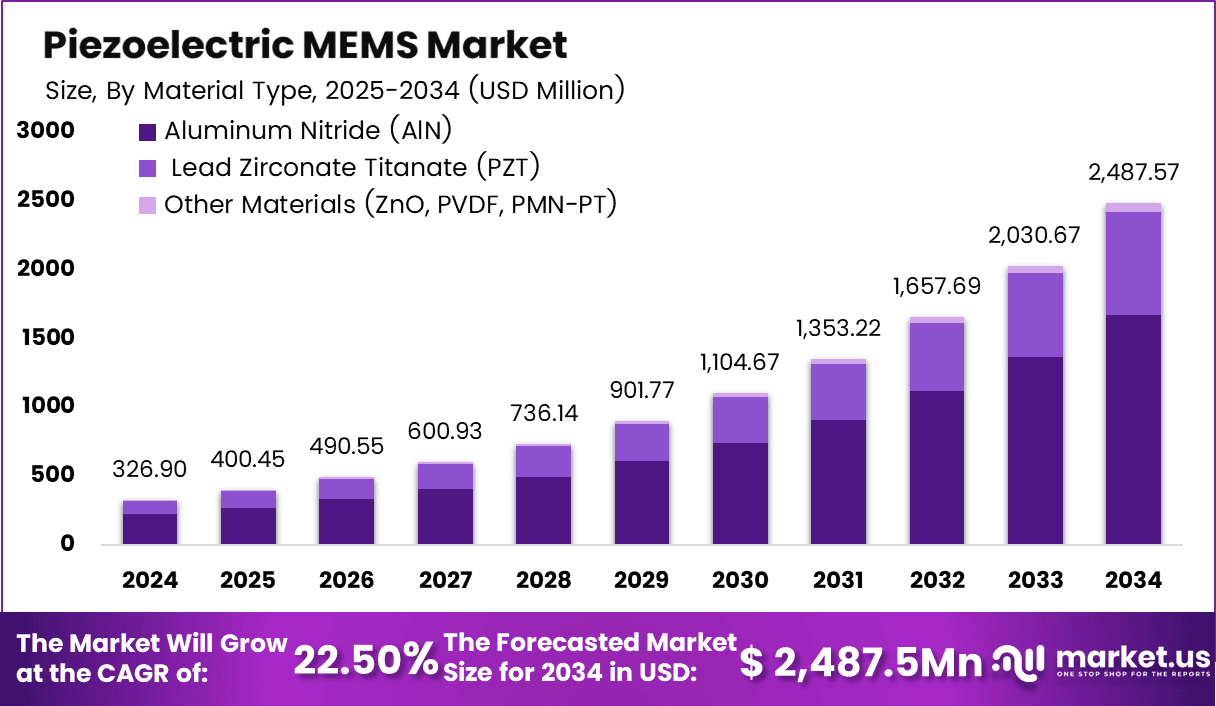
In 2024, the Global Piezoelectric MEMS Market was valued at USD 326.9 million. The market is projected to grow at a CAGR of 22.5% during 2025–2034, reaching approximately USD 2,487.5 million by 2034. North America dominated the global market in 2024, accounting for the total market share and generating approximately USD 122.5 million in revenue.
Connected-device adoption is strengthening demand for smaller and more power-efficient MEMS components. In 2024, 5G networks reached 51% of the global population, while 5.5 billion people were online, an increase of 227 million from the previous year.
Automotive electronics are creating another major growth area. Global motor-vehicle production reached about 92.5 million units in 2024, increasing demand for compact microphones and microphones used in safety systems, infotainment, cabin communication, vibration sensing, and driver-assistance applications.
The U.S. headquartered semiconductor firms recorded USD 318.2 billion in 2024 sales, highlighting the scale of the regional electronics ecosystem supporting MEMS design, testing, and adoption. Growth is supported by rising use of compact sensors and microphones in smartphones, wearables, connected home devices, industrial equipment, and vehicles.
Key Takeaways
- The Global Piezoelectric MEMS market is valued at USD 326.9 million in 2024 and is projected to reach USD 2,487.5 million by 2034, growing at a CAGR of 22.5%.
- Aluminum Nitride (AlN) leads the material segment with a 67.3% share, owing to its excellent thermal stability and compatibility with semiconductor fabrication.
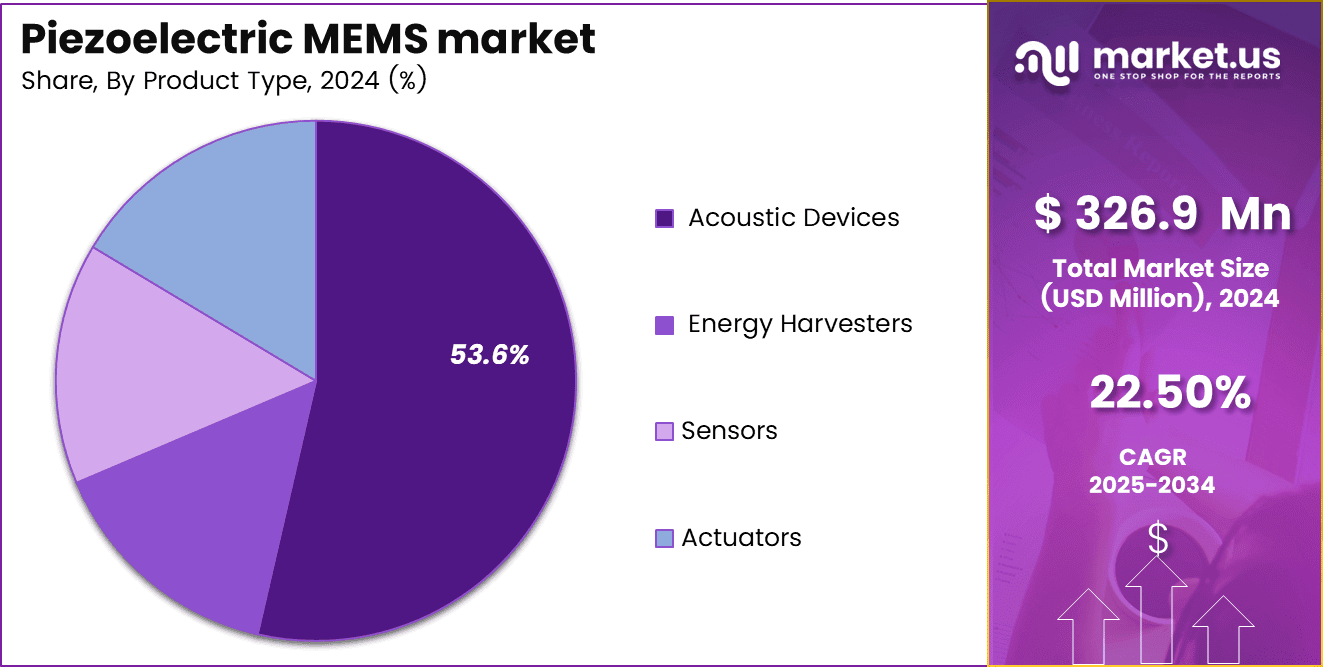
- Acoustic devices, particularly BAW filters, dominate the product category with a 53.6% share, driven by high adoption in smartphones and 5G communication systems.
- Consumer electronics account for 60.1% of the total end-use industry share, fueled by demand for compact sensors and microphones in smart devices.
- Asia Pacific remains the largest regional market with USD 122.5 million in 2024, led by China, Japan, and South Korea.
- China’s market alone is forecasted to reach USD 306.3 million by 2034, growing at an exceptional CAGR of 47.07%.
Role of Generative AI
The piezoelectric MEMS market is expected to witness strong growth over the next decade, primarily driven by the increasing integration of miniaturized sensors and actuators in consumer electronics and automotive systems. Analysts highlight that Aluminum Nitride (AlN) is likely to maintain dominance due to its superior material properties, offering reliability and scalability for high-frequency applications such as 5G communication and ultrasonic sensing.
Acoustic devices, especially BAW filters, are anticipated to continue leading the market as manufacturers focus on compact, high-performance solutions for smartphones, wearables, and IoT devices. The surge in demand from the consumer electronics sector, accounting for over 60% share, underlines the industry’s shift toward energy-efficient and multifunctional MEMS solutions.
By Material Type
Aluminum Nitride (AlN) dominates with 67.3% because CMOS-ready fabrication supports high-volume chip integration.
Aluminum Nitride (AlN) leads the material market because chip makers can deposit it on silicon wafers and combine it with standard chip processes. This fit helps producers make large volumes of compact microphones, filters, sensors, and actuators without adding complex process steps. AlN also avoids lead, which supports its use in consumer, industrial, and automotive electronics.
A U.S. National Institute of Standards and Technology study recorded an AlN film piezoelectric response of up to 6.5 pm/V in a CMOS-compatible process. This shows that AlN can deliver useful sensing and movement functions while fitting modern chip production. Its 67.3% share also matches the wider chip supply base: worldwide semiconductor sales reached USD 630.5 billion in 2024.
PZT supports ultrasonic tools, inkjet printheads, precision actuators, and medical transducers. As manufacturers add these higher-value devices, they choose PZT where AlN cannot provide enough output. The Semiconductor Industry Association expects global chip sales to reach USD 697.2 billion in 2025, creating more production capacity for both AlN and PZT MEMS devices.
By Product Type
Acoustic Devices dominate with 53.6% because smart devices require compact voice capture.
Acoustic devices lead the product market with a 53.6% share because phones, earbuds, smart speakers, laptops, and connected home products need small microphones that capture voice clearly. Piezoelectric MEMS microphones offer compact size, low power use, and strong resistance to dust and moisture. These benefits suit products that operate all day and need voice calls, noise reduction, voice commands, and sound monitoring.
The International Telecommunication Union counted 5.8 billion internet users in 2024, equal to 71% of the global population after its revised estimate. It also reported that 2.2 billion people remained offline, leaving room for more device use as connectivity expands. Sensors form the fastest-growing product type because factories, logistics sites, and smart buildings need real-time data on movement, pressure, vibration, and machine condition.
The International Federation of Robotics counted 4,281,585 industrial robots working in factories in 2023, a 10% increase from the prior year. Each new automated line needs more sensing points to guide equipment, prevent faults, and improve output. Piezoelectric MEMS sensors meet this need because they operate in small spaces and can detect physical changes quickly.
By End-Use Industry
Consumer Electronics dominates with 60.1% due to high smartphone volumes needing compact sensors.
Consumer electronics accounts for 60.1% of the piezoelectric MEMS market because makers place microphones, motion sensors, pressure sensors, and haptic parts in high-volume personal devices. Smartphones, wireless earbuds, watches, tablets, laptops, and gaming products create a broad and repeat-use demand base.
The World Health Organization estimates that 1.5 billion people live with some degree of hearing loss today, and it expects this number to reach nearly 2.5 billion by 2050. This need supports demand for hearing aids and personal audio products that use compact acoustic parts. Automotive represents the fastest-growing end-use industry because electric and connected vehicles add more electronic functions than basic vehicles.
The International Energy Agency reported global electric-car sales of more than 17 million units in 2024, growing by over 25% from 2023. The market added 3.5 million electric cars in one year alone. Carmakers use piezoelectric MEMS devices in cabin microphones, ultrasonic parking systems, vibration monitoring, battery systems, and safety functions.
Key Market Segments
By Material Type
- Aluminum Nitride (AlN)
- Lead Zirconate Titanate (PZT)
- Other Materials (ZnO, PVDF, PMN-PT)
By Product Type
- Acoustic Devices
- Sensors
- Inertial Sensors
- Pressure Sensors
- Ultrasonic Sensors
- Actuators
- Inkjet Printheads
- Micromirrors
- Precision Positioning and Valves
- Energy Harvesters
By End-Use Industry
- Consumer Electronics
- Automotive
- Healthcare and Life Sciences
- Industrial and IoT
- Aerospace and Defense
- Telecommunications
- Others
Regional Analysis
The Asia Pacific leads the global piezoelectric MEMS market, valued at around USD 122.5 million in 2024, supported by large-scale semiconductor production and rising demand for MEMS-based sensors in smartphones, wearables, and IoT applications. China, Japan, and South Korea are the major contributors, backed by strong manufacturing ecosystems and R&D advancements.
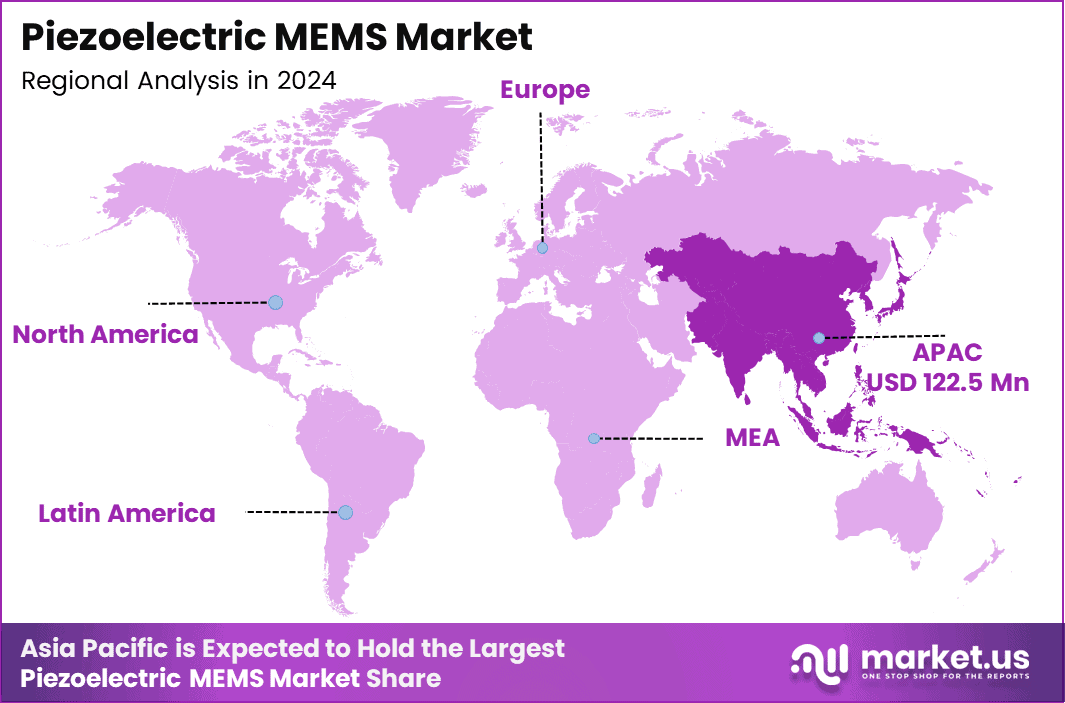
North America shows robust growth led by aerospace, healthcare, and defense sectors utilizing piezoelectric MEMS for high-precision sensing and imaging. Europe holds a solid position, emphasizing automotive innovation and industrial automation. Emerging regions such as the Middle East & Africa and Latin America are gradually expanding, with growing use of MEMS devices in telecommunications and energy infrastructure.
China Market Size
The China piezoelectric MEMS market is witnessing exceptional growth momentum, with its value expected to increase from around USD 47.1 million in 2024 to approximately USD 306.3 million by 2034, growing at an impressive CAGR of 47.07%. This rapid rise is driven by the country’s expanding semiconductor manufacturing capacity, strong government support for microelectronics, and the adoption of smart sensors in industrial and automotive applications.
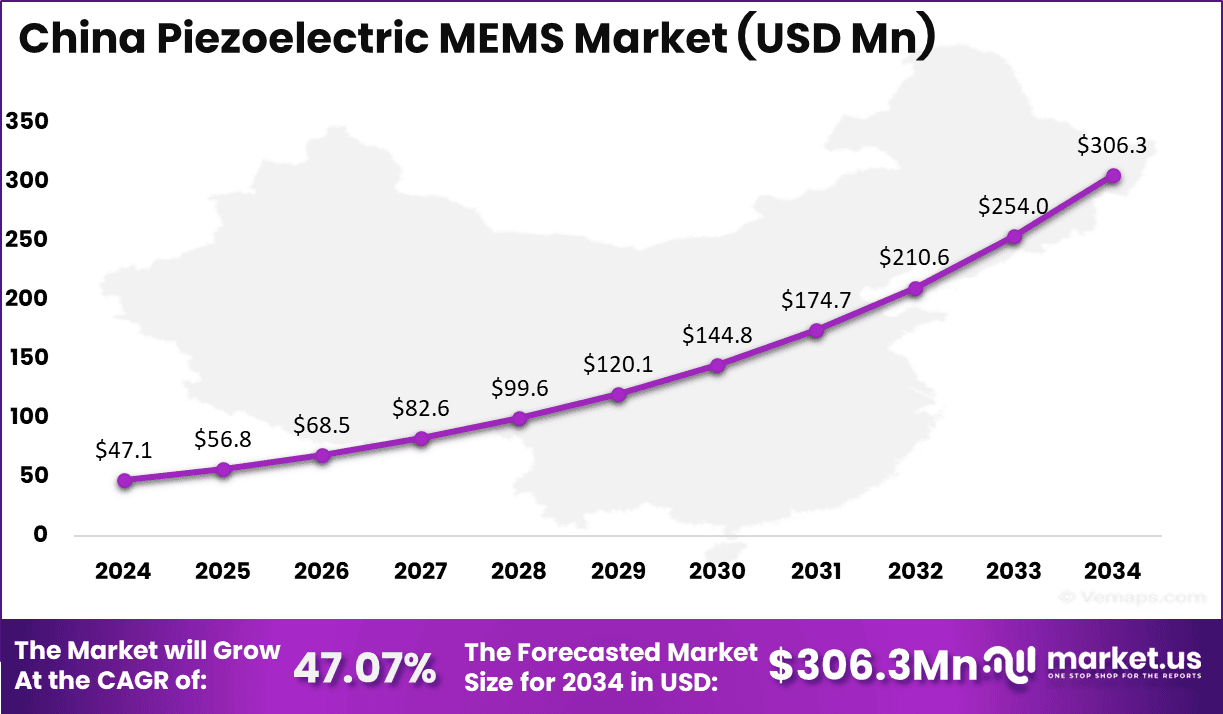
China’s large consumer electronics sector is also fueling demand for acoustic MEMS devices used in smartphones, wearables, and IoT systems. The integration of piezoelectric MEMS in robotics, medical diagnostics, and energy-harvesting applications further supports market expansion, positioning China as a dominant force in the global piezoelectric MEMS industry over the next decade.
Key Regions and Countries
- North America
- US
- Canada
- Europe
- Germany
- France
- The UK
- Spain
- Italy
- Rest of Europe
- Asia Pacific
- China
- Japan
- South Korea
- India
- Australia
- Singapore
- Rest of Asia Pacific
- Latin America
- Brazil
- Mexico
- Rest of Latin America
- Middle East & Africa
- South Africa
- Saudi Arabia
- UAE
- Rest of MEA
Market Dynamics
Drivers
| Driver | (~) % Impact on CAGR Forecast | Geographic Relevance | Impact Timeline |
|---|---|---|---|
| Vehicle Electrification Demand | +2.7% | Global | Medium term (2 to 4 years) |
| Voice Interface Adoption | +2.1% | North America, Asia Pacific, Europe | Short term (2 years or less) |
| Industrial Automation Expansion | +1.8% | Asia Pacific, Europe, North America | Medium term (2 to 4 years) |
| Connected Healthcare Devices | +1.4% | North America, Europe, Japan | Medium term (2 to 4 years) |
| Chip Design Investment | +1.2% | Global | Short term (2 years or less) |
Vehicle Electrification Demand
Vehicle electrification raises MEMS content per vehicle because electric platforms need more cabin sensing, acoustic control, battery monitoring, pressure measurement, and motion feedback than basic vehicle designs.
The International Energy Agency recorded more than 17 million electric-car sales in 2024, up by over 25% from the prior year, which expands the installed base for these functions. OICA recorded about 92.5 million motor vehicles produced worldwide in 2024, giving component suppliers a large production channel even before electric vehicles become the majority of output.
The Semiconductor Industry Association reported global semiconductor sales of USD 791.7 billion in 2025, a rise of 25.6%, which supports wider automotive electronic integration. MEMS suppliers can secure longer design-in cycles and higher unit content by selling qualified sensor modules rather than stand-alone dies.
Restraints
| Restraint | (~) % Impact on CAGR Forecast | Geographic Relevance | Impact Timeline |
|---|---|---|---|
| Advanced Tool Export Controls | -2.8% | China, United States, allied markets | Short term (2 years or less) |
| Automotive Qualification Costs | -1.7% | Global | Medium term (2 to 4 years) |
| Limited Foundry Access | -1.5% | Asia Pacific, North America, Europe | Short term (2 years or less) |
| Consumer Device Price Pressure | -1.2% | Global | Short term (2 years or less) |
| Medical Approval Delays | -1.0% | North America, Europe, Japan | Medium term (2 to 4 years) |
Advanced Tool Export Controls
Advanced tool export controls create an immediate restraint because MEMS production depends on deposition, etching, metrology, cleaning, and test equipment that often shares suppliers and process knowledge with the broader semiconductor chain. In December 2024, the U.S. Bureau of Industry and Security added controls covering 24 types of semiconductor manufacturing equipment and 3 software tools.
Challenges
| Challenge | (~) % CAGR Friction Drag | Geographic Relevance | Mitigation Horizon |
|---|---|---|---|
| Packaging Capacity Competition | -2.0% | Global | Medium term (2 to 4 years) |
| Material Purity Control | -1.6% | Asia Pacific, North America, Europe | Medium term (2 to 4 years) |
| Wafer Process Yield | -1.4% | Global | Medium term (2 to 4 years) |
| MEMS Engineering Skills | -1.1% | Europe, North America, Asia Pacific | Long term (4 years or more) |
| Device Test Complexity | -0.9% | Global | Medium term (2 to 4 years) |
Packaging Capacity Competition
Packaging capacity competition limits the market’s maximum growth rate because piezoelectric MEMS devices need specialized sealing, acoustic ports, wafer-level packaging, calibration, and final testing before customers can use them.
SEMI reported global semiconductor manufacturing equipment billings of USD 135.1 billion in 2025, up from USD 117.1 billion in 2024, showing strong demand for shared production tools. SEMI also recorded a 21% rise in assembly and packaging equipment sales and a 55% rise in test-equipment billings during 2025.
The Semiconductor Industry Association reported that global chip sales rose by 25.6% in the same year, increasing competition for packaging lines and test capacity. The U.S. Geological Survey also notes that China accounted for 99% of worldwide primary low-purity gallium production in 2024, which highlights wider material concentration across advanced electronics supply chains.
Opportunities
| Opportunity | (~) % Potential CAGR Upside | Geographic Relevance | Execution Window |
|---|---|---|---|
| Medical Ultrasonic Platforms | +3.0% | North America, Europe, Asia Pacific | Long term (4 years or more) |
| Edge AI Sensor Modules | +2.4% | Global | Medium term (2 to 4 years) |
| Energy Harvesting Nodes | +1.9% | Europe, North America, Asia Pacific | Long term (4 years or more) |
| Precision Industrial Actuators | +1.6% | Asia Pacific, Europe, North America | Medium term (2 to 4 years) |
| Defense Grade Navigation | +1.3% | North America, Europe, Asia Pacific | Long term (4 years or more) |
Medical Ultrasonic Platforms
Medical ultrasonic platforms offer untapped upside because most piezoelectric MEMS suppliers still focus on consumer microphones and general-purpose sensors rather than integrated diagnostic modules for point-of-care use. The World Health Organization projects that the population aged 60 years or older will rise from 1 billion in 2019 to 1.4 billion by 2030 and 2.1 billion by 2050, increasing the need for accessible monitoring and imaging tools.
A successful module strategy can improve gross margin by an estimated 5% to 10% versus selling a bare die, while reducing customer assembly steps and lowering system integration cost per unit. The opportunity remains future-facing because clinical validation, reimbursement pathways, and hospital purchasing cycles still limit broad volume adoption.
Key Players Analysis
Tier-1 leadership in piezoelectric MEMS includes STMicroelectronics, Bosch Sensortec/Robert Bosch, TDK/InvenSense, Murata Manufacturing, and Analog Devices. Estimated shares are 15–20% for STMicroelectronics, 12–16% for Bosch, 10–14% for TDK/InvenSense, 8–11% for Murata, and 6–9% for Analog Devices, giving a combined estimated share of around 51–70%.
STMicroelectronics generated USD 11.80 billion in FY2025 revenue, invested USD 1.713 billion in R&D, and spent USD 1.792 billion in net capital expenditure. Automotive contributed about 39% of its revenue, supporting strong MEMS adoption across vehicle sensing and electronic systems.
TDK’s Sensor Application Products segment recorded ¥224.6 billion in FY March 2026 sales, up 18.6% from ¥189.5 billion a year earlier. TDK invested 11.5% of FY March 2025 net sales in R&D. Murata reported FY2025 revenue of ¥1,830.9 billion, R&D spending of ¥149.3 billion, and capital expenditure of ¥180.5 billion, while its FY2026 capex plan increased to ¥247.8 billion.
Tier-2 players include Honeywell, Teledyne Technologies, Sensata, NXP, Texas Instruments, Qualcomm Technologies, Broadcom, Qorvo, Panasonic, Omron, SiTime, MEMSIC, and Knowles. Knowles sold its Consumer MEMS Microphone business in December 2024, while continuing operations generated USD 593.2 million in FY2025 revenue. Bosch invested €7.9 billion in R&D in 2025 and employed 82,100 R&D associates, highlighting the importance of technology scale, advanced packaging, and manufacturing capability.
Top Key Players
- STMicroelectronics
- Bosch Sensortec GmbH
- Analog Devices, Inc.
- Murata Manufacturing Co., Ltd.
- TDK Corporation
- Texas Instruments Incorporated
- Qualcomm Technologies, Inc.
- Broadcom Inc.
- NXP Semiconductors N.V.
- Honeywell International Inc.
- Panasonic Corporation
- Teledyne Technologies Incorporated
- Qorvo, Inc.
- Knowles Corporation
- Sensata Technologies, Inc.
- SiTime Corporation
- InvenSense, Inc. (a TDK Group Company)
- Robert Bosch GmbH
- Omron Corporation
- MEMSIC, Inc.
- Others
Recent Developments
- In August 2025, STMicroelectronics entered into a definitive agreement to acquire the MEMS sensors business of NXP Semiconductors for up to USD 950 million in cash, strengthening its position in MEMS sensing technologies across automotive, industrial, and consumer markets.
- In October 2024, TDK Corporation showcased its solution portfolio at electronica 2024, which included piezo-electric MEMS mirrors and ultrasonic lens-cleaner modules. The company explicitly referenced these piezo-MEMS solutions as key to its push in AI, electrified vehicles, and sensor applications.
Report Scope
| Report Features | Description |
|---|---|
| Market Value (2024) | USD 326.9 Million |
| Forecast Revenue (2034) | USD 2,487.5 Million |
| CAGR(2025-2034) | 22.5% |
| Base Year for Estimation | 2024 |
| Historic Period | 2020-2023 |
| Forecast Period | 2025-2034 |
| Report Coverage | Revenue forecast, AI impact on Market trends, Share Insights, Company ranking, competitive landscape, Recent Developments, Market Dynamics, nd Emerging Trends |
| Segments Covered | By Material Type (Aluminum Nitride (AlN), Lead Zirconate Titanate (PZT), Other Materials (ZnO, PVDF, PMNPT)), By Product Type (Sensors, [Inertial Sensors, Pressure Sensors, Ultrasonic Sensors], Actuators, [Inkjet Printheads, Micromirrors, Presision Positioning & Valves], Acoustic Devices, Energy Harvesters), By EndUse Industry (Consumer Electronics, Automotive, Healthcare & Life Sciences, Industrial & IoT, Aerospace & Defense, Telecommunications, Others) |
| Regional Analysis | North America – US, Canada; Europe – Germany, France, The UK, Spain, Italy, Russia, Netherlands, Rest of Europe; Asia Pacific – China, Japan, South Korea, India, New Zealand, Singapore, Thailand, Vietnam, Rest of Latin America; Latin America – Brazil, Mexico, Rest of Latin America; Middle East & Africa – South Africa, Saudi Arabia, UAE, Rest of MEA |
| Competitive Landscape | STMicroelectronics, Bosch Sensortec GmbH, Analog Devices, Inc., Murata Manufacturing Co., Ltd., TDK Corporation, Texas Instruments Incorporated, Qualcomm Technologies, Inc., Broadcom Inc., NXP Semiconductors N.V., Honeywell International Inc., Panasonic Corporation, Teledyne Technologies Incorporated, Qorvo, Inc., Knowles Corporation, Sensata Technologies, Inc., SiTime Corporation, InvenSense, Inc. (a TDK Group Company), Robert Bosch GmbH, Omron Corporation, MEMSIC, Inc., Others |
| Customization Scope | Customization for segments, region/country-level will be provided. Moreover, additional customization can be done based on the requirements. |
| Purchase Options | We have three licenses to choose from: Single User License, Multi-User License (Up to 5 Users), Corporate Use License (Unlimited Users, Printable PDF) |





































