


Global Pest Control Market Size, Share, And Industry Analysis Report By Pest Type (Insects, Termites, Rodents, Wildlife), By Control Method (Chemical, Biological, Mechanical), By Mode (Sprays, Powder, Pellets, Traps, Baits), By Application (Residential, Commercial, Industrial, Livestock), By Region and Companies - Industry Segment Outlook, Market Assessment, Competition Scenario, Trends, and Forecast 2025-2034
- Published date: February 2026
- Report ID: 178136
- Number of Pages: 376
- Format:
-
keyboard_arrow_up
Quick Navigation
Report Overview
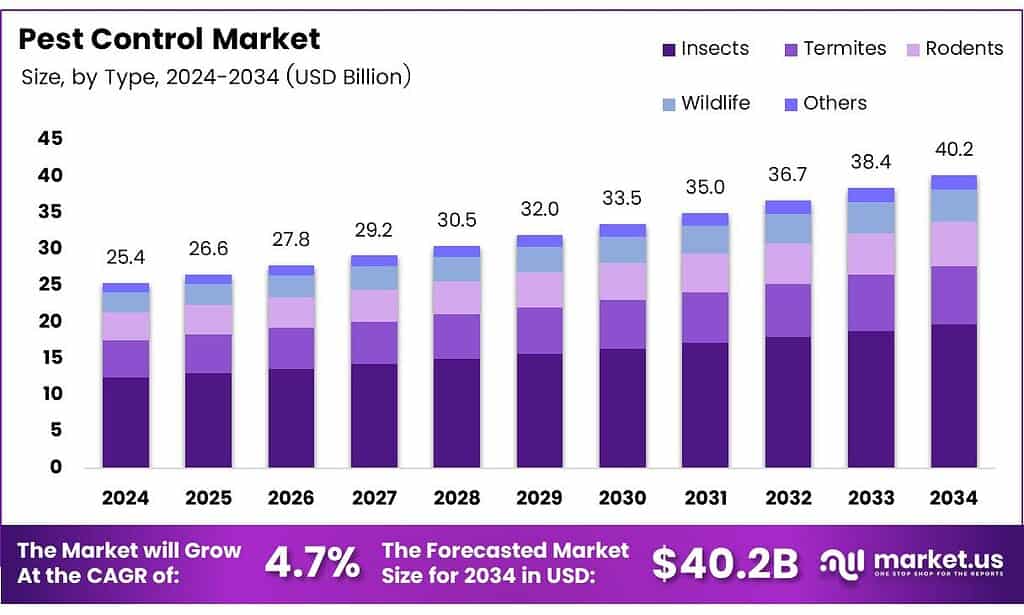
The Global Pest Control Market size is expected to be worth around USD 40.2 billion by 2034 from USD 25.4 billion in 2024, growing at a CAGR of 4.7% during the forecast period 2025 to 2034.
The pest control market covers a broad range of services and products designed to manage or eliminate harmful organisms. These include insects, rodents, termites, wildlife, and other pests that affect human health, food supplies, and property. The market serves residential, commercial, industrial, and agricultural end-users across the globe.
Pest management solutions span chemical, biological, and mechanical methods. Chemical treatments remain the most widely used approach, especially in urban and agricultural settings. Biological solutions, including microbial agents and plant extracts, are gaining momentum as awareness of environmental impact grows.
- The company generated revenue of $3.8 billion in FY2025, up 11.0% versus FY2024, reflecting organic revenue growth of 6.9% and acquisition-related revenues of 4.1%. This performance highlights the strong commercial demand and consolidation trends shaping the professional pest control services segment.
- Pest Control represented 79% of Group revenue and 79% of Group adjusted operating profit in FY2024, with an adjusted operating margin of 18.0%. This dominance signals that pest control remains the single most profitable and strategically central service line for large integrated facility management groups.
Governments worldwide are actively funding vector-borne disease surveillance programs and setting strict food safety regulations. These public health mandates compel businesses and households to invest in professional pest management. Moreover, regulatory frameworks now push the industry toward safer and more sustainable pest control alternatives.
Rapid urbanization and expanding commercial infrastructure continue to drive market demand. Hotels, food processing facilities, and healthcare institutions require consistent pest management to meet hygiene standards. Consequently, service providers are scaling their operations to accommodate these growing facility management needs.
Key Takeaways
- The Global Pest Control Market is valued at USD 25.4 billion in 2024 and is projected to reach USD 40.2 billion by 2034, at a CAGR of 4.7% during the forecast period 2025 to 2034.
- By Pest Type, Insects dominate with a 48.5% market share in 2025.
- By Control Method, Chemical methods hold the largest share at 58.6% in 2025.
- By Mode, Sprays lead the segment with a 48.2% share in 2025.
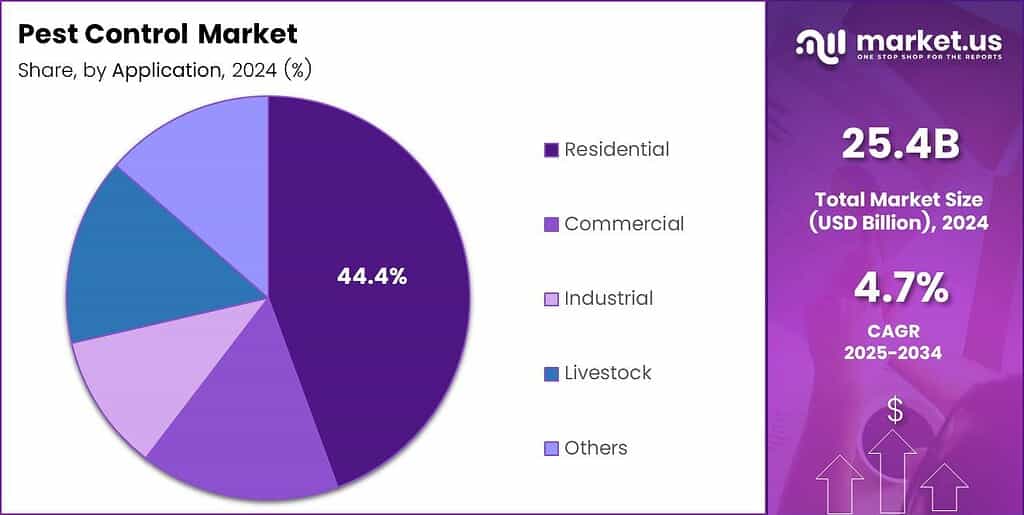
- By Application, Residential accounts for the highest share at 44.4% in 2025.
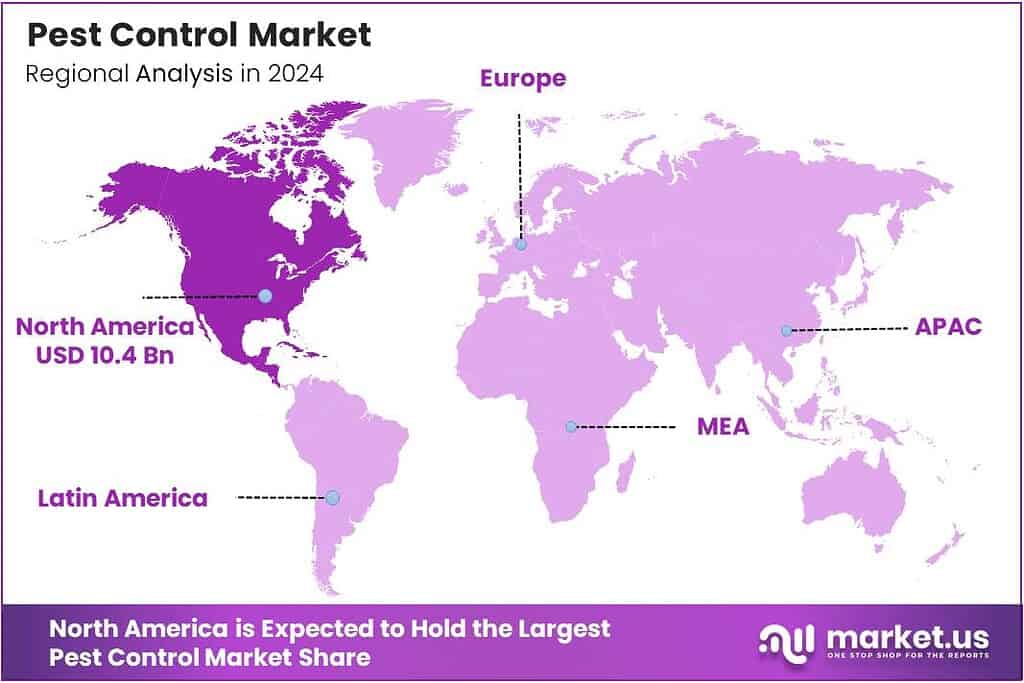
- North America dominates the global market with a 41.1% share, valued at USD 10.4 billion.
By Pest Type Analysis
Insects dominate with 48.5% due to widespread prevalence and direct impact on human health and food safety.
In 2025, Insects held a dominant market position in the By Pest Type segment of the Pest Control Market, with a 48.5% share. Insects represent the most commonly encountered pest category across all end-use settings. Their rapid reproduction cycles and adaptability to urban environments make consistent control programs essential for residential and commercial properties alike.
Termites represent one of the most economically damaging pest categories globally. They cause structural damage to wooden infrastructure, making professional termite management a priority for property owners. Consequently, this sub-segment drives significant demand for specialized treatment services, particularly in tropical and subtropical regions with high moisture levels.
Rodents pose serious public health and food safety risks across both urban and rural settings. Rats and mice contaminate food supplies and transmit diseases, prompting businesses in the food processing and hospitality sectors to invest heavily in rodent control. Therefore, this segment supports steady demand for trapping, baiting, and exclusion solutions.
Wildlife pest management addresses conflicts between humans and larger animals such as raccoons, birds, and squirrels. This sub-segment focuses primarily on humane removal and exclusion techniques. Additionally, Others covers pest categories like bed bugs and ticks that require specialized and often recurring treatment protocols.
By Control Method Analysis
Chemicals dominate with 58.6% due to proven efficacy and wide availability across pest control applications.
In 2025, Chemical methods held a dominant market position in the By Control Method segment of the Pest Control Market, with a 58.6% share. Chemical treatments deliver fast and measurable results, making them the preferred choice for high-infestation environments. The sub-segment includes Insecticides, Rodenticides, and Others tailored to specific pest types and application environments.
Biological control methods are growing rapidly as environmental concerns reshape industry preferences. This sub-segment includes Microbials, Plant Extracts, and Predatory Insects that target pests without harming non-target organisms. Moreover, regulatory pressure to reduce synthetic chemical use is accelerating the adoption of biological alternatives across agriculture and urban pest management.
Mechanical control methods provide chemical-free pest management solutions suitable for sensitive environments. This sub-segment covers Traps, UV radiation devices, Mesh screens, Ultrasonic vibrations, and Software and Services. Consequently, mechanical solutions appeal to schools, hospitals, and food production facilities that prioritize safety and regulatory compliance.
By Mode Analysis
Sprays dominate with 48.2% due to ease of application and effectiveness across diverse pest control scenarios.
In 2025, Sprays held a dominant market position in the By Mode segment of the Pest Control Market, with a 48.2% share. Spray-based formulations offer broad coverage and rapid results, making them the most widely used delivery method for both indoor and outdoor pest treatments. Their versatility across insect and rodent control applications reinforces their leading position.
Powder formulations serve environments where liquid sprays are impractical or hazardous. Dusts and powders penetrate wall cavities and hard-to-reach areas, providing residual protection over extended periods. Additionally, Pellets offer targeted delivery, especially in rodent baiting programs used in agriculture and food storage facilities.
Traps provide mechanical pest capture without chemical exposure, suiting sensitive and high-hygiene environments. Baits combine attractants with active ingredients to achieve targeted pest control with reduced environmental impact. Therefore, the growing preference for selective and low-toxicity delivery systems is pushing these modes toward broader commercial adoption.
By Application Analysis
Residential dominates with 44.4% due to rising homeowner awareness and increased urban pest infestation incidents.
In 2025, Residential held a dominant market position in the By Application segment of the Pest Control Market, with a 44.4% share. Growing urban housing density creates ideal conditions for pest infestation, particularly of insects and rodents. Homeowners increasingly rely on professional services for routine prevention and emergency treatment, sustaining strong demand across this segment.
Commercial applications span offices, retail spaces, restaurants, and hotels, all of which require ongoing pest management to comply with health regulations. The hospitality and food service sectors represent the most active buyers in this category. Moreover, businesses now prefer subscription-based service contracts that provide consistent protection year-round.
Industrial facilities, including warehouses, manufacturing plants, and logistics hubs, require large-scale pest management programs. Livestock applications address pest control in animal farming operations where insects and rodents threaten animal health and product quality. Additionally, Others encompasses institutional settings such as schools, hospitals, and government facilities with specialized hygiene requirements.
Key Market Segments
By Pest Type
- Insects
- Termites
- Rodents
- Wildlife
- Others
By Control Method
- Chemical
- Insecticides
- Rodenticides
- Others
- Biological
- Microbials
- Plant Extracts
- Predatory Insects
- Mechanical
- Traps
- UV radiation devices
- Mesh screens
- Ultrasonic vibrations
- Software & Services
By Mode
- Sprays
- Powder
- Pellets
- Traps
- Baits
By Application
- Residential
- Commercial
- Industrial
- Livestock
- Others
Emerging Trends
Digital Tools, Eco-Friendly Methods, and Smart Technologies Transform Pest Control Services
Pest control companies increasingly adopt digital scheduling and customer management platforms to streamline service delivery. These tools improve technician routing, automate appointment reminders, and generate real-time service reports. The European Union recorded pesticide sales of approximately 292,000 tonnes in 2023, the lowest since 2011, signaling a market-wide shift toward reduced chemical reliance and smarter application methods.
Heat treatment and non-toxic fumigation techniques are gaining acceptance as chemical-free alternatives for indoor pest elimination. These methods avoid pesticide residues and suit sensitive environments such as hotels and healthcare facilities. Additionally, the U.S. EPA granted Bayer AG a new registration for low-volatility dicamba herbicides, reflecting continued regulatory support for next-generation, lower-impact pest management chemistries.
Subscription-based preventive pest control contracts are replacing reactive one-time treatments across residential and commercial markets. Service providers use these recurring models to generate predictable revenue while keeping clients pest-free year-round. Furthermore, drone-assisted surveillance for large agricultural areas enables faster, more precise application over terrain that traditional ground equipment cannot efficiently reach.
Drivers
Urbanization, Public Health Mandates, and Commercial Growth Accelerate Pest Control Market Demand
Rapid urban housing expansion creates denser living conditions that increase the risk of pest infestation in residential buildings. Growing populations in metro areas push pest populations into closer contact with human habitation. Consequently, homeowners and property managers require more frequent and professional pest management services to maintain safe living environments.
- Rising vector-borne disease surveillance programs globally push governments and health agencies to invest in pest elimination. Mosquitoes, ticks, and other disease-carrying insects require active population management in endemic regions. Its Global Pest Elimination segment generated sales of $1,219.2 million in FY2025, up 7% year-over-year, reflecting how institutional demand for hygiene-driven pest control consistently supports market growth.
Stringent public health and food safety regulations compel businesses in food production, hospitality, and healthcare to maintain certified pest-free environments. Moreover, in 2025, Corteva Agriscience announced its Varpelgo next-generation insecticide for chewing pests as part of an expanding crop protection portfolio, illustrating how regulatory frameworks directly shape product innovation. Growth in commercial facilities and hospitality infrastructure further sustains demand for professional service contracts.
Restraints
Pest Resistance and Environmental Concerns Limit the Effectiveness of Chemical-Based Control Methods
Increasing resistance development among target pest species presents a growing challenge for chemical pest control solutions. Repeated exposure to the same active ingredients causes pest populations to evolve, reducing the efficacy of established treatment products. Therefore, service providers must continuously invest in new formulations and integrated methods to maintain control outcomes.
Environmental concerns over chemical-based pest control methods attract regulatory scrutiny and consumer pushback. Pesticide runoff affects soil health, water quality, and non-target species, including pollinators essential to agriculture. Consequently, municipalities and environmental agencies in Europe and North America are tightening restrictions on synthetic chemical use in urban and peri-urban areas.
These dual pressures force pest control companies to increase research and development spending on safer alternatives. Transitioning from established chemical protocols to biological or mechanical solutions requires significant training, equipment investment, and product reformulation. However, companies that fail to adapt risk losing contracts in regulated sectors such as food processing and public health-focused government programs.
Growth Factors
Integrated Management Models, Organic Solutions, and Smart Technologies Expand Market Opportunities
Expansion of integrated pest management service models offers pest control companies a pathway to higher-value, long-term client relationships. These models combine monitoring, biological treatments, and targeted chemical applications to reduce overall pesticide use. Moreover, government programs increasingly mandate IPM adoption in schools, public buildings, and agricultural operations, broadening the addressable market.
- Rising demand for organic and botanical pesticide solutions creates a strong commercial opportunity for bio-based product developers. In 2025, Corteva Agriscience announced Goltrevo bioinsecticide as its first Biologicals portfolio product targeting sap-feeding and chewing insects, including aphids and whiteflies. China exported insecticides worth $2.28 billion in 2024 at a volume of 562 million kg, highlighting massive global supply-chain capacity supporting demand growth for new formulations.
Smart monitoring systems for real-time pest detection transform how service providers manage accounts and respond to infestations. IoT-enabled sensors, connected traps, and data analytics platforms allow technicians to act before infestations escalate. Furthermore, untapped rural and semi-urban service markets in the Asia Pacific, Latin America, and Africa represent significant geographic expansion opportunities for both established operators and emerging regional players.
Regional Analysis
North America Dominates the Pest Control Market with a Market Share of 41.1%, Valued at USD 10.4 Billion
North America leads the global pest control market with a 41.1% share, valued at USD 10.4 billion. The United States drives this dominance through its large residential base, strict food safety regulations, and established professional service infrastructure. Representing the largest geographic revenue block within the Group, confirming the region’s outsized commercial importance.
Europe represents a mature market shaped by some of the world’s most stringent pesticide regulations and sustainability mandates. The EU’s drive to reduce chemical pesticide use is accelerating the adoption of biological and integrated pest management solutions across agricultural and urban sectors. Germany, France, Italy, and Spain anchor regional demand, with France and Germany among the top exporters of packaged insecticides globally in 2024.
Asia Pacific is the fastest-growing regional market, driven by rapid urbanization, tropical climate conditions, and rising awareness of vector-borne diseases. Additionally, Southeast Asian countries, including Indonesia and Thailand, show high inbound insecticide volumes, reflecting robust regional demand growth.
The Middle East and Africa market benefits from rising investment in infrastructure, hospitality, and public health programs across the Gulf Cooperation Council states and South Africa. Warm climates support year-round pest activity, sustaining constant demand for professional treatment services. However, market fragmentation and limited access to trained technicians constrain service penetration in several sub-Saharan African countries.
Key Regions and Countries
North America
- US
- Canada
Europe
- Germany
- France
- The UK
- Spain
- Italy
- Rest of Europe
Asia Pacific
- China
- Japan
- South Korea
- India
- Australia
- Rest of APAC
Latin America
- Brazil
- Mexico
- Rest of Latin America
Middle East & Africa
- GCC
- South Africa
- Rest of MEA
Key Players Analysis
Bayer AG maintains a strong position in the pest control market through its expansive crop protection and professional pest management portfolio. The company received U.S. EPA registration approval in 2025 for its Stryax low-volatility dicamba herbicide, reflecting continued regulatory progress for next-generation chemistries. Bayer emphasizes Integrated Pest Management on its crop protection platform, combining monitoring, biological inputs, and targeted chemical treatments.
Corteva Agriscience demonstrates strong momentum across both crop and non-crop pest control segments through active product development. The company announced two major innovations in 2025: Goltrevo bioinsecticide, targeting sap-feeding and chewing insects as the first product in its Biologicals portfolio, and Varpelgo, a next-generation insecticide for chewing pests. Commercial sales for both products are expected as early as 2027, pending regulatory approvals in target markets.
BASF SE operates as a key global supplier of pest control active ingredients and formulated products through its Agricultural Solutions division. The segment reported sales of €9,798 million in FY2024, with EBITDA before special items reaching €1,938 million, down from the prior year due to currency headwinds and pricing pressure. Nevertheless, BASF’s segment cash flow improved to €1,861 million in FY2024, confirming resilient operational cash generation despite softer market conditions.
Syngenta AG serves the global pest control market through a broad portfolio of crop-protection chemistries and pest-management solutions. The company reported Crop Protection sales of $13.2 billion in FY2024, reflecting a 13% reported decline due to channel inventory corrections and commodity pricing pressure. Notably, China recorded +7% growth, while North America fell by 24%, highlighting diverging regional demand dynamics within Syngenta’s global footprint.
Top Key Players in the Market
- Bayer AG
- Corteva Agriscience
- BASF SE
- Syngenta AG
- Rentokil Initial plc
- Anticimex
- Ecolab Inc.
- FMC Corporation
- De Sangosse
- Bell Laboratories
- PelGar International
- Fort Products Limited
Recent Developments
- In 2025, Bayer AG. The U.S. EPA granted a new registration for low-volatility dicamba herbicides. Bayer plans to launch it as Stryax dicamba herbicide (restricted use pesticide) to support weed control in relevant crops. Emphasized Integrated Pest Management (IPM) strategies on its crop protection hub, combining monitoring, biological/chemical insecticides, and pollinator protection to balance pest control with sustainability.
- In 2025, Corteva Agriscience announced two nature-inspired insect control solutions. Goltrevo bioinsecticide (microbial, broad-spectrum against sap-feeding and chewing insects, including aphids, whiteflies, and corn leafhopper) as the first in its Biologicals portfolio, and Varpelgo active (next-generation insecticide for chewing pests in various crops).
Report Scope
Report Features Description Market Value (2024) USD 25.4 Billion Forecast Revenue (2034) USD 40.2 Billion CAGR (2025-2034) 4.7% Base Year for Estimation 2024 Historic Period 2020-2023 Forecast Period 2025-2034 Report Coverage Revenue Forecast, Market Dynamics, Competitive Landscape, Recent Developments Segments Covered By Pest Type (Insects, Termites, Rodents, Wildlife, Others), By Control Method (Chemical, Biological, Mechanical), By Mode (Sprays, Powder, Pellets, Traps, Baits), By Application (Residential, Commercial, Industrial, Livestock, Others) Regional Analysis North America (US and Canada), Europe (Germany, France, The UK, Spain, Italy, and Rest of Europe), Asia Pacific (China, Japan, South Korea, India, Australia, and Rest of APAC), Latin America (Brazil, Mexico, and Rest of Latin America), Middle East & Africa (GCC, South Africa, and Rest of MEA) Competitive Landscape Bayer AG, Corteva Agriscience, BASF SE, Syngenta AG, Rentokil Initial plc, Anticimex, Ecolab Inc., FMC Corporation, De Sangosse, Bell Laboratories, PelGar International, Fort Products Limited Customization Scope Customization for segments, region/country-level will be provided. Moreover, additional customization can be done based on the requirements. Purchase Options We have three licenses to opt for: Single User License, Multi-User License (Up to 5 Users), Corporate Use License (Unlimited Users and Printable PDF) 
-
-
- Bayer AG
- Corteva Agriscience
- BASF SE
- Syngenta AG
- Rentokil Initial plc
- Anticimex
- Ecolab Inc.
- FMC Corporation
- De Sangosse
- Bell Laboratories
- PelGar International
- Fort Products Limited
Our Clients

- 178136
- February 2026






