Report Overview
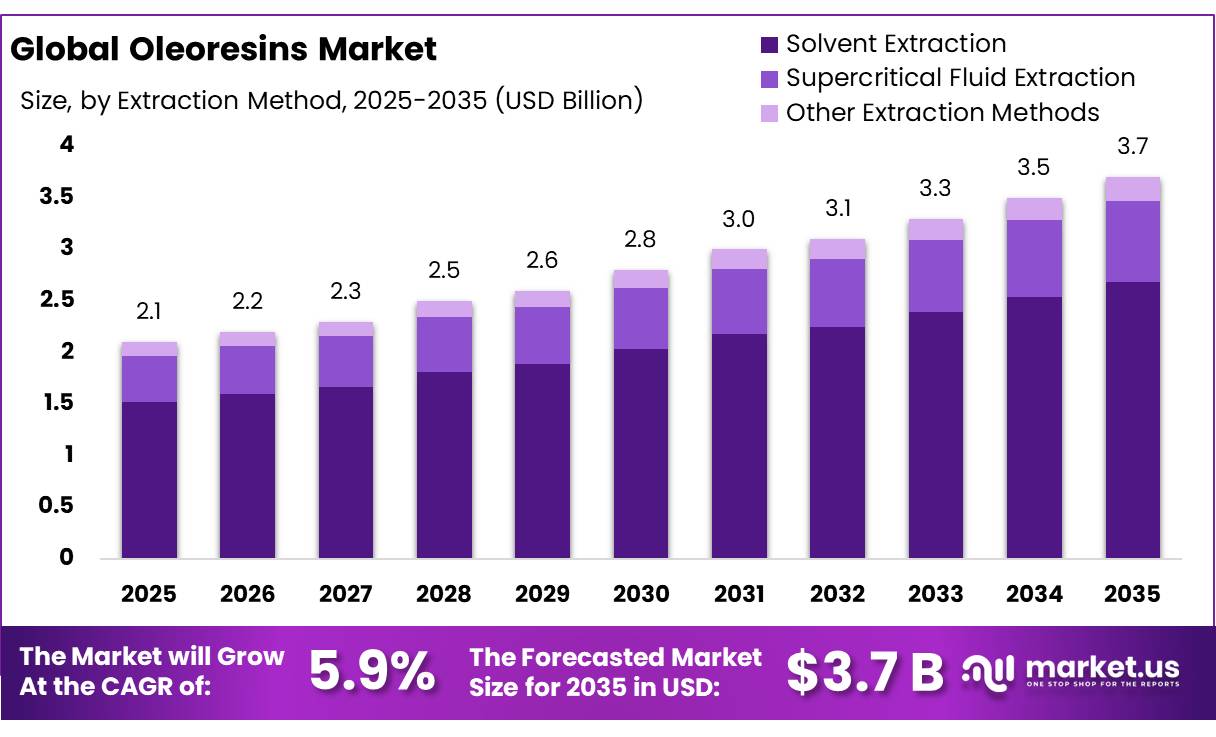
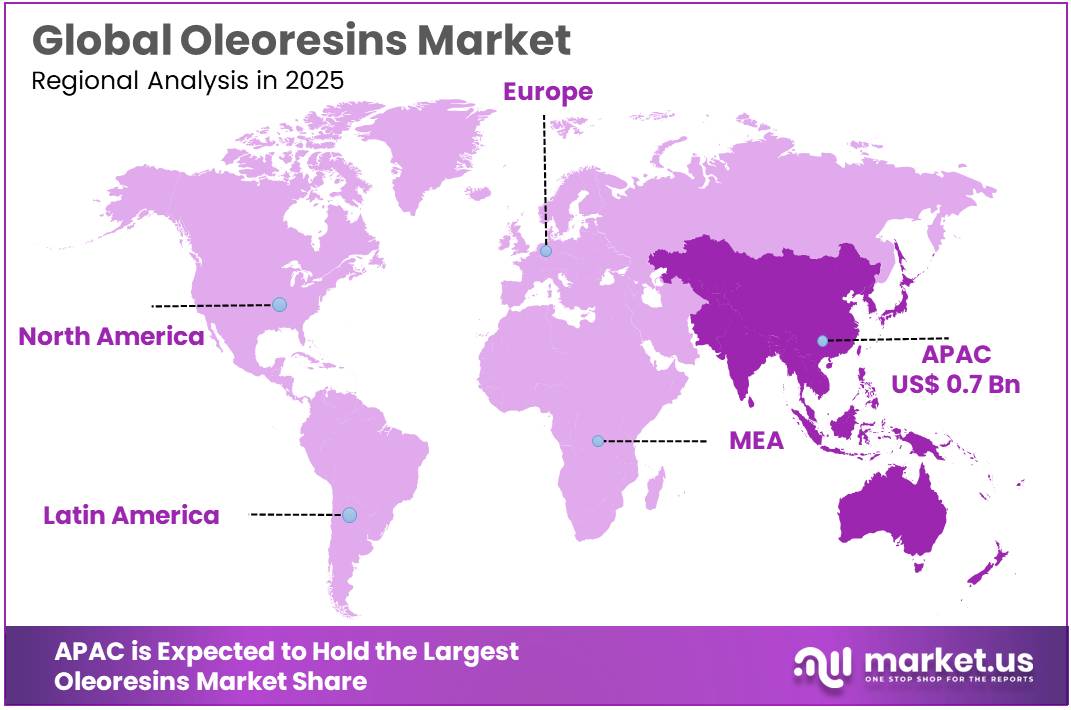
The Global Oleoresins Market size is expected to be worth around USD 3.7 Billion by 2035, from USD 2.1 Billion in 2025, growing at a CAGR of 5.9% during the forecast period from 2026 to 2035. In 2025, Asia Pacific held a dominant market position, capturing more than a 38.00% share, holding USD 0.7 Billion revenue.
Oleoresins are concentrated natural extracts obtained from spices, herbs, and other botanical materials using suitable extraction processes, primarily solvent extraction and supercritical carbon dioxide extraction. They contain the characteristic flavour, aroma, colour, and active components of the original plant material in a concentrated form. Common products include paprika oleoresin, black pepper oleoresin, turmeric oleoresin, capsicum oleoresin, ginger oleoresin, and cardamom oleoresin.
- According to the United Nations Industrial Development Organization (UNIDO), global manufacturing expanded by 2.9% in 2024, reflecting continued industrial investment and technological development. This broader manufacturing expansion creates opportunities for ingredient processors to improve extraction capacity, product standardisation, and supply-chain efficiency.
Demand is further supported by the growing preference for natural colours and flavouring ingredients in packaged foods, ready-to-eat meals, snacks, sauces, and convenience products. Paprika and turmeric oleoresins are particularly useful in applications requiring natural colouring, while black pepper, ginger, and capsicum oleoresins are valued for their flavour and pungency. The United States Food and Drug Administration (FDA) recognises paprika oleoresin under 21 CFR 73.340 and turmeric oleoresin under 21 CFR 73.615 for food-colouring applications, subject to applicable conditions. These regulatory listings support established industrial applications for natural spice extracts.
Another important driving factor is the increasing adoption of natural ingredients in food formulations. Food producers are focusing on clean-label products, ingredient transparency, and alternatives to synthetic colouring and flavouring agents.
The European Commission’s Regulation (EC) No. 1334/2008, adopted on 16 December 2008 and effective from 20 January 2009, establishes requirements for the safe use of flavourings in food products. Its Union list of approved flavouring substances was introduced on 1 October 2012. Such regulatory frameworks encourage manufacturers to strengthen ingredient traceability, product testing, and compliance procedures.
Key Takeaways
- Oleoresins Market size is expected to be worth around USD 3.7 Billion by 2035, from USD 2.1 Billion in 2025, growing at a CAGR of 5.9%.
- Paprika Oleoresin held a dominant market position, capturing more than a 24.00% share.
- Liquid held a dominant market position, capturing more than a 67.00% share of the Oleoresins Market.
- Solvent Extraction held a dominant market position, capturing more than a 72.00% share.
- Food and Beverages held a dominant market position, capturing more than a 58.00% share of the Oleoresins Market.
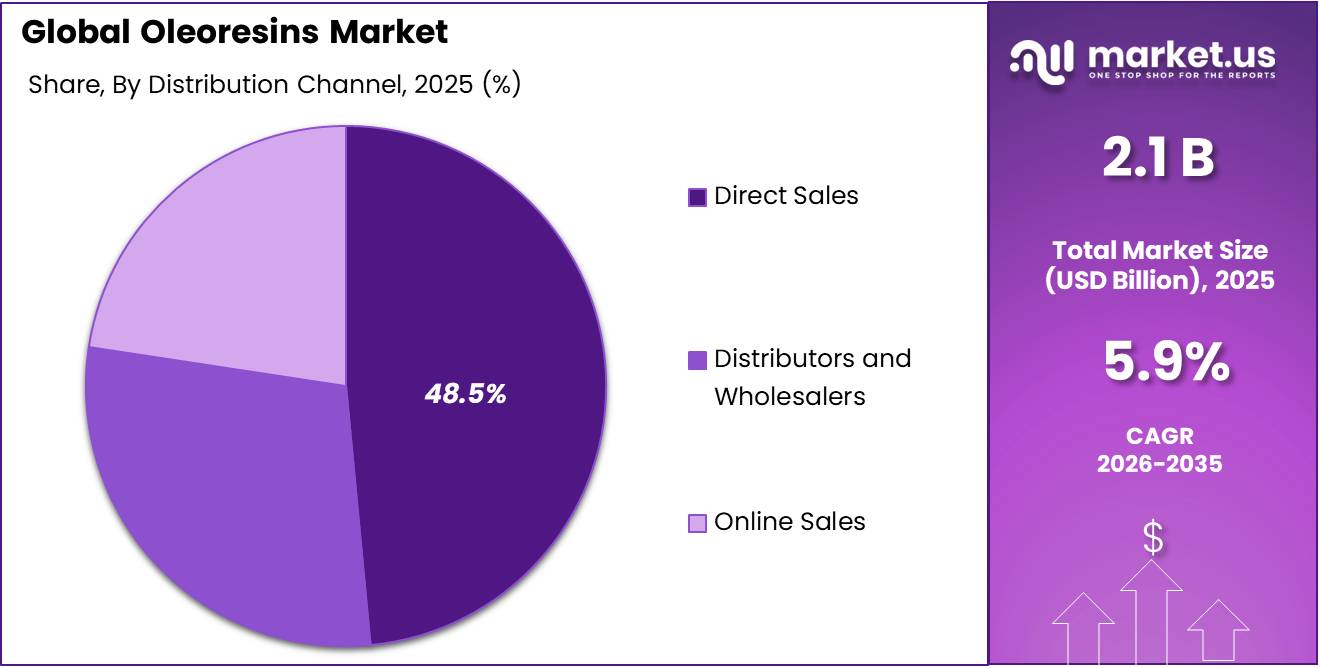
- Direct Sales held a dominant market position, capturing more than a 48.00% share.
- Asia-Pacific held a dominant position in the global Oleoresins Market in 2025, accounting for 38.00% of the market, valued at USD 0.7 billion.
By Product Type Analysis
Paprika Oleoresin – Dominates due to its strong demand for natural colouring and flavouring applications
In 2025, Paprika Oleoresin held a dominant market position, capturing more than a 24.00% share of the Oleoresins Market by product type. Its leading position is supported by its extensive use as a natural colouring ingredient in processed foods, snacks, sauces, seasonings, and meat products. Food manufacturers prefer paprika oleoresin because it provides consistent red and orange shades while delivering the characteristic flavour of paprika. Its concentrated composition also allows manufacturers to achieve the required colour intensity with smaller quantities.
Black Pepper Oleoresin represents an important product category in the Oleoresins Market because of its concentrated pungency, characteristic aroma, and versatility across food manufacturing applications. In 2025, demand was supported by its use in sauces, spice blends, marinades, soups, processed foods, and seasoning formulations. Its concentrated piperine content allows manufacturers to achieve consistent flavour intensity and simplify ingredient handling compared with conventional ground pepper.
According to World Bank World Integrated Trade Solution (WITS) data based on United Nations trade statistics, the United States imported approximately 50.99 million kg of dried whole pepper, valued at USD 377.93 million, in 2025. Vietnam accounted for approximately 37.23 million kg of these imports, highlighting the scale of the raw-material supply chain supporting pepper-based ingredient processing. Although these figures cover dried pepper rather than oleoresin specifically, they demonstrate the established industrial demand for pepper-derived ingredients.
By Form Analysis
Liquid Oleoresin – Dominates due to its easy blending, concentrated composition, and suitability for food processing
In 2025, Liquid held a dominant market position, capturing more than a 67.00% share of the Oleoresins Market by form. Its leading position is supported by its widespread use in sauces, seasonings, processed foods, meat products, and beverage formulations. Liquid oleoresins are preferred by food manufacturers because they can be easily blended into oil-based and liquid food preparations, allowing consistent flavour and colour distribution. Their concentrated composition also helps manufacturers maintain product uniformity while reducing the need to handle large quantities of raw spices.
Powder Oleoresin is an important segment of the Oleoresins Market, particularly among manufacturers producing dry seasoning mixes, instant foods, powdered soups, snacks, and packaged food products. In 2025, its industrial demand was supported by the convenience of handling, easier transportation, and suitability for dry blending applications. Powder formulations can be incorporated into products where liquid ingredients may create processing or moisture-related difficulties.
Manufacturers also use suitable carriers and encapsulation technologies to improve dispersibility, stability, and consistency during food processing. The segment benefits from demand for ready-to-use seasoning ingredients and customised powdered flavour formulations. Further improvements in spray drying and encapsulation technologies are expected to create opportunities for powder oleoresin applications across processed foods and industrial seasoning production.
By Extraction Method Analysis
Solvent Extraction – Dominates due to its established industrial use, processing efficiency, and cost-effectiveness
In 2025, Solvent Extraction held a dominant market position, capturing more than a 72.00% share of the Oleoresins Market by extraction method. Its leading position is supported by its widespread use in processing paprika, black pepper, turmeric, capsicum, and other spice-based raw materials. Food ingredient manufacturers prefer this method because it enables the extraction of concentrated flavour, aroma, colour, and active compounds from botanical materials.
It is also suitable for commercial-scale production, allowing processors to handle large volumes of raw spices with established industrial equipment. In 2025, its adoption remained important because manufacturers required consistent extract quality, reliable processing methods, and efficient production costs. Solvent extraction also supports the production of different oleoresin formulations for food, pharmaceutical, and personal care applications.
Government reference: The U.S. FDA lists carbon dioxide as a permitted food-related substance with a solvent and processing-aid function under 21 CFR 184.1240. This provides an official regulatory reference for the use of carbon dioxide in food processing and supports the relevance of carbon-dioxide-based extraction technologies.
By Application Analysis
Food and Beverages – Dominates due to strong demand for natural flavours, colours, and concentrated spice ingredients
In 2025, Food and Beverages held a dominant market position, capturing more than a 58.00% share of the Oleoresins Market by application. Its leading position is driven by the extensive use of oleoresins in processed foods, snacks, sauces, seasonings, meat products, instant meals, and ready-to-eat food preparations. Food manufacturers prefer oleoresins because they provide concentrated flavour, aroma, pungency, and natural colouring while supporting consistent product quality.
Paprika oleoresin and turmeric oleoresin are particularly important for natural colouring applications, whereas black pepper, ginger, and capsicum oleoresins are widely used to improve flavour profiles. The U.S. Food and Drug Administration (FDA) lists paprika oleoresin under 21 CFR 73.345 and turmeric oleoresin under 21 CFR 73.615 for food-colouring applications. Both ingredients were approved for food-colouring use in 1966, demonstrating their established regulatory acceptance.
Pharmaceuticals represent an important application segment in the Oleoresins Market, supported by the use of concentrated botanical extracts in medicinal formulations, topical preparations, and specialised healthcare products. In 2025, pharmaceutical manufacturers continued to utilise spice-derived ingredients such as turmeric, ginger, black pepper, and capsicum extracts for formulations requiring specific botanical compounds and functional properties.
By Distribution Channel Analysis
Direct Sales – Dominates through stronger manufacturer relationships and bulk procurement arrangements
In 2025, Direct Sales held a dominant market position, capturing more than a 48.00% share of the Oleoresins Market by distribution channel. Its leading position is supported by direct purchasing relationships between oleoresin manufacturers and large food processing, pharmaceutical, and ingredient manufacturing companies. This channel allows buyers to source products directly from producers, maintain consistent product specifications, and negotiate pricing for bulk requirements.
According to the U.S. Census Bureau’s 2024 Annual Integrated Economic Survey, manufacturers’ sales branches and offices recorded approximately USD 3.04 trillion in wholesale sales across industries. This demonstrates the significant role of manufacturer-operated sales networks in industrial distribution. Growing demand for customised ingredients, reliable supply arrangements, and long-term procurement contracts is expected to support the direct sales channel.
Distributors and Wholesalers play an important role in the Oleoresins Market by connecting manufacturers with small and medium-sized food processors, seasoning companies, pharmaceutical businesses, and regional ingredient buyers. This channel provides access to different oleoresin varieties without requiring customers to purchase directly from large manufacturers. Distributors also support product storage, bulk transportation, inventory management, and regional delivery requirements.
According to the United States Department of Agriculture (USDA), merchant wholesalers accounted for 55% of grocery wholesale sales in 2022, demonstrating their important role in the food distribution system. This established distribution network creates opportunities for oleoresin suppliers to reach a wider customer base, particularly manufacturers that require smaller or more frequent deliveries.
Key Market Segments
By Product Type
- Paprika Oleoresin
- Black Pepper Oleoresin
- Turmeric Oleoresin
- Ginger Oleoresin
- Capsicum Oleoresin
- Cardamom Oleoresin
- Clove Oleoresin
- Other Oleoresins
By Form
- Liquid
- Powder
By Extraction Method
- Solvent Extraction
- Supercritical Fluid Extraction
- Other Extraction Methods
By Application
- Food and Beverages
- Pharmaceuticals
- Cosmetics and Personal Care
- Animal Feed
- Nutraceuticals
- Other Applications
By Distribution Channel
- Direct Sales
- Distributors and Wholesalers
- Online Sales
Driver Analysis
Natural-Colour Reformulation
The active transition away from petroleum-based food dyes supports demand for colouring oleoresins where paprika or turmeric can meet the required hue, sensory profile and stability specifications. The FDA’s 2026 priorities explicitly support adoption of natural colour alternatives, while its July 2026 update distinguishes voluntary industry commitments to remove petroleum-based dyes in school products by the 2026 school year and more broadly by 2027 from legally binding product-specific actions.
Separately, the food-reformulation deadline following revocation of FD&C Red No. 3 authorization is 15 January 2027, compared with 18 January 2028 for ingested drugs; these dates must not be generalized into a statutory ban on all synthetic colours. Paprika oleoresin and turmeric oleoresin already have US food-colour listings under 21 CFR 73.345 and 73.615, respectively, subject to their applicable specifications and conditions of use.
An illustrative 100,000-tonne annual food portfolio reformulated at 0.03% oleoresin preparation requires 30 tonnes annually; that dosage is a scenario assumption rather than a recommended application rate. Suppliers capture value through colour-strength specifications, stability validation and customer-specific formulation approval, shifting competition from extract price alone toward cost per acceptable finished-food outcome. The +0.9 pp contribution assumes 30% of addressable market revenue grows 3 percentage points faster than the underlying-growth case, counting colour conversion within existing production rather than the new food output allocated to the next driver.
Drivers Impact Analysis
| Driver | (~) % Impact on CAGR Forecast | Geographic Relevance | Impact Timeline |
|---|---|---|---|
| Natural-colour reformulation | +0.9 pp | US core; EU, UK | Short term (≤ 2 years) |
| Processed-food capacity growth | +0.8 pp | India core; Southeast Asia | Medium term (2–4 years) |
| Standardized seasoning conversion | +0.6 pp | North America, EU, APAC | Short term (≤ 2 years) |
| Precision pungency formulation | +0.5 pp | US, Mexico, EU, India | Short term (≤ 2 years) |
| Application-ready extract adoption | +0.4 pp | North America, EU, Japan | Medium term (2–4 years) |
Restraint Analysis
Feedstock Cost Inflation
Extraction-grade spice inflation restrains real oleoresin demand when processors cannot pass higher costs through to food manufacturers without making customer formulations commercially unattractive. The Spices Board’s indicative report for the week ending 4 July 2026 quoted Guntur cold-storage chilli at ₹130–260/kg versus ₹98–133/kg a year earlier, Erode turmeric at ₹118–159/kg versus ₹91–139/kg, and Delhi ginger at ₹345–350/kg versus ₹258–260/kg. Arithmetic midpoints increased approximately 69%, 20% and 34%, respectively; however, these are broad market quotations—not matched extraction-grade purchase prices or annual average inflation rates.
The same report quoted Namakkal red chilli at ₹135–150/kg versus ₹160–180/kg, demonstrating that the inflation signal was not uniform across grades and locations. In a modeled extraction case, a 10% saleable yield requires 10 kg of feedstock per kilogram of oleoresin; raising raw-material cost from ₹100 to ₹130/kg increases the feedstock component from ₹1,000 to ₹1,300/kg of extract. With an assumed ₹1,800/kg selling price and ₹400/kg of other variable costs, unchanged pricing reduces contribution from ₹400 to ₹100/kg, or from 22.2% to 5.6% of sales; these figures are sensitivities, not observed industry margins.
Processors must therefore negotiate price-reset clauses, qualify alternative sourcing and align seasonal purchases with customer commitments, while avoiding inventory positions unsupported by executable orders. The −0.5 pp deduction assumes 25% of addressable revenue grows 2 percentage points more slowly because of affordability and purchasing constraints; nominal sales increases from input-price pass-through are excluded from this constant-price forecast.
Restraint Impact Analysis
| Restraint | (~) % Impact on CAGR Forecast | Geographic Relevance | Impact Timeline |
|---|---|---|---|
| Feedstock cost inflation | −0.5 pp | India core; global buyers | Short term (≤ 2 years) |
| Contaminant-related rejection | −0.4 pp | EU imports; Asian exporters | Short term (≤ 2 years) |
| Solvent compliance costs | −0.3 pp | EU, US; Asian processors | Medium term (2–4 years) |
| Application suitability limits | −0.3 pp | US, EU, UK, Japan | Medium term (2–4 years) |
| Competing ingredient economics | −0.2 pp | North America, EU, APAC | Long term (≥ 4 years) |
Opportunity Analysis
Poultry-Pigmentation Ingredients
EFSA’s assessment of saponified paprika extract describes preparations containing 25–90 g/kg of total carotenoids, with capsanthin exceeding 35% of total carotenoids, and concludes that the recommended maximum of 40 mg total carotenoids/kg complete feed is safe for chickens for fattening and laying hens; this is a product-specific scientific assessment, not universal authorization for every extract, species or jurisdiction.
Under an illustrative commercial program, 100,000 tonnes of eligible feed formulated at 20 mg carotenoids/kg requires 2 tonnes of carotenoids; a preparation containing 50 g/kg would supply this through 40 tonnes of annual product sales. These are planning assumptions within the cited assessment ranges, not feeding recommendations. The future opportunity is to qualify previously food-only suppliers and convert genuinely additional feed formulations or production volumes—not to portray the existing paprika-feed business as newly discovered.
Commercial entry requires validated stability, premix compatibility, species-specific evidence and destination authorization; EFSA’s revised feed-additive efficacy guidance applies to dossiers received from 1 December 2024, reinforcing the importance of an evidence-led development program. A staged route through established premix formulators can reduce channel-development expenditure, but customer qualification and supply assurances remain necessary.
The +0.30 pp upside corresponds to approximately 1.7 additional 2031 revenue-index points, counting incremental oleoresin-derived ingredient demand while excluding carrier inflation, existing baseline feed sales and orders merely transferred from competing oleoresin suppliers.
Opportunity Impact Analysis
| Opportunity | (~) % Potential CAGR Upside | Geographic Relevance | Execution Window |
|---|---|---|---|
| Poultry-pigmentation ingredients | +0.30 pp | EU, Brazil, Mexico, India | Medium term (2–4 years) |
| Premium extraction platforms | +0.25 pp | EU, US, Japan | Medium term (2–4 years) |
| Small-batch formulation hubs | +0.25 pp | EU, UK, US, India | Short term (≤ 2 years) |
| Side-stream extract recovery | +0.20 pp | India, China; EU buyers | Medium term (2–4 years) |
| Performance-linked supply contracts | +0.20 pp | US, EU, UK | Short term (≤ 2 years) |
Challenges Analysis
Batch Potency Standardization
Kalsec’s capsicum portfolio offers standardized or customized pungency, colour and heat, demonstrating that these are separately managed commercial specifications rather than interchangeable measures of quality. A 2025 ginger-extraction study also found that pressure, temperature and particle size influenced extraction yield or the resulting composition, reinforcing that finished-product potency depends on processing as well as feedstock.
In a simplified blending example, combining extracts with potency indices of 80 and 120 in equal proportions produces an index of 100; if the stronger lot falls to 110, its required share rises from 50% to approximately 66.7% to maintain the same target. That adjustment consumes higher-potency inventory faster and can alter the cost of a nominally unchanged grade. Separately, if incoming potency is an assumed 10% below expectation, approximately 11.1% more material is needed to deliver the same active content before considering other specification constraints.
Manufacturers need potency-based purchasing, calibrated analytical methods, retained reference samples and blending rules that preserve the broader sensory profile—not merely a single assay result. This differs from contaminant rejection: conforming material remains saleable, but inventory allocation, testing and blending become more demanding. The −0.30 pp friction estimate assumes 15% of addressable revenue grows 2 percentage points more slowly because standardization work, repeat testing and inventory imbalances absorb expansion capacity.
Challenges Impact Analysis
| Challenge | (~) % CAGR Friction Drag | Geographic Relevance | Mitigation Horizon |
|---|---|---|---|
| Batch potency standardization | −0.30 pp | India, China; US, EU buyers | Medium term (2–4 years) |
| Extraction scale-up reproducibility | −0.25 pp | India, China, EU, US | Medium term (2–4 years) |
| Shelf-life performance consistency | −0.25 pp | EU, US, Japan; tropical APAC | Long term (≥ 4 years) |
| Multi-tier traceability integration | −0.20 pp | India, China; EU import channels | Medium term (2–4 years) |
| Sensory transfer across matrices | −0.20 pp | US, EU, Mexico, India | Medium term (2–4 years) |
Geopolitical Impact Analysis
Geopolitical Impact of Ongoing Wars on the Oleoresins Market
The ongoing conflicts in the Middle East and the Russia-Ukraine region are creating indirect pressure on the global Oleoresins Market through higher transportation costs, energy price fluctuations, and disruptions to international agricultural supply chains. Oleoresin manufacturers depend on a steady supply of spices such as paprika, black pepper, turmeric, and capsicum.
Shipping delays and higher freight insurance costs can increase raw-material procurement expenses and affect the timely delivery of finished extracts to international food and pharmaceutical manufacturers. According to UNCTAD, global merchandise trade growth is projected to slow from 4.7% in 2025 to 1.5%–2.5% in 2026 amid geopolitical uncertainty. The Food and Agriculture Organization (FAO) also reported that disruptions around the Strait of Hormuz threaten fertilizer availability and agricultural production, potentially increasing food commodity costs.
These developments may raise cultivation, extraction, packaging, and distribution expenses. Manufacturers may respond by diversifying spice suppliers, increasing inventory levels, and strengthening regional sourcing networks. Although oleoresins are not directly linked to military demand, prolonged conflicts could affect production margins and international trade.
Regional Insights
Dominating Region: Asia-Pacific – 38.00% Share | USD 0.7 Billion
Asia-Pacific held a dominant position in the global Oleoresins Market in 2025, accounting for 38.00% of the market, valued at USD 0.7 billion. The region’s leadership is supported by its established spice-processing industry, availability of botanical raw materials, and growing demand from food and beverage manufacturers. China, Indonesia, Vietnam, and other Southeast Asian countries contribute to regional spice cultivation, processing, and ingredient manufacturing.
The region benefits from the use of paprika, black pepper, turmeric, and ginger extracts in sauces, seasonings, processed foods, and packaged products. According to Vietnam’s National Statistics Office, manufacturing activity increased by 9.97% in 2025, reflecting stronger industrial production and supporting opportunities for food ingredient suppliers.
Processed food and beverage manufacturing is an important growth area for oleoresin suppliers across Asia-Pacific. Rising production of packaged foods, ready-to-eat meals, sauces, snacks, and convenience products is increasing the requirement for concentrated natural flavours and colours. Vietnam recorded a 110.5 manufacturing index for food products during the first 11 months of 2025, compared with the 2021 base of 100. Its beverage manufacturing index reached 104.6 during the same period.
Key Regions and Countries Insights
- North America
- US
- Canada
- Europe
- Germany
- France
- The UK
- Spain
- Italy
- Rest of Europe
- Asia Pacific
- China
- Japan
- South Korea
- India
- Australia
- Rest of APAC
- Latin America
- Brazil
- Mexico
- Rest of Latin America
- Middle East & Africa
- GCC
- South Africa
- Rest of MEA
Key Players Analysis
Synthite Industries is a major producer of spice oleoresins, essential oils, and botanical extracts. Established in 1972, the company offers more than 500 products and serves customers across 90+ countries. Its product portfolio includes paprika, turmeric, black pepper, and cardamom oleoresins. According to CRISIL, the company reported consolidated revenue of INR 3,074 crore in FY2025, compared with INR 2,513 crore in FY2024. Its focus on extraction technology, product quality, and international supply supports its competitive position.
Kalsec Inc. is a natural ingredient manufacturer specialising in spice extracts, natural colours, antioxidants, and flavour solutions. Founded in 1958, the company operates through international research, manufacturing, and distribution facilities. In 2025, it opened an applications laboratory in Jakarta, Indonesia, to strengthen customer support and product development. In 2026, it opened a new Spice Processing Center in Kalamazoo, Michigan, to improve processing efficiency, quality control, and production capabilities. These investments support its position in natural spice extracts and food ingredient applications.
Plant Lipids is an established manufacturer of oleoresins, essential oils, natural colours, and specialised food ingredients. With more than 45 years of experience, the company serves customers across 85+ countries, supported by 14 manufacturing hubs and 4 research and development centres. Its product portfolio includes black pepper, chilli, turmeric, and other spice extracts. The company also operates continuous and batch extraction facilities, supporting customised production and consistent product quality. Its international manufacturing and sourcing network strengthens its position in the global oleoresins industry.
Top Key Players Outlook
- Synthite Industries Pvt. Ltd.
- Kalsec Inc.
- Plant Lipids Pvt. Ltd.
- MANE Kancor Ingredients Pvt. Ltd.
- Chenguang Biotech Group Co., Ltd.
- AVT Natural Products Ltd.
- Akay Natural Ingredients Pvt. Ltd.
- Universal Oleoresins Pvt. Ltd.
- Givaudan SA
- PT Indesso Aroma
- Ozone Naturals Pvt. Ltd.
- Paprika Oleo’s India Ltd.
- Vidya Herbs Pvt. Ltd.
- Jean Gazignaire S.A.S.
- Ungerer & Company
Recent Developments
- In August 2026, Chenguang Biotech Group Co., Ltd half-year report disclosed that cumulative utilisation of raised funds had reached RMB 606.18 million, representing 97.92% of the available funds.
- July 2026, AVT Natural Products Limited also confirmed that manufacturing of oleoresins, spice extracts, and value-added teas accounted for 97.62% of standalone turnover, with spice oleoresins contributing 23.61%. The company reported total income of INR 695.47 crore and profit after tax of INR 53.86 crore in FY2025-26.
Report Scope
| Report Features | Description |
|---|---|
| Market Value (2025) | USD 2.1 Bn |
| Forecast Revenue (2035) | USD 3.7 Bn |
| CAGR (2026-2035) | 5.9% |
| Base Year for Estimation | 2025 |
| Historic Period | 2020-2024 |
| Forecast Period | 2026-2035 |
| Report Coverage | Revenue Forecast, Market Dynamics, Competitive Landscape, Recent Developments |
| Segments Covered | By Product Type (Paprika Oleoresin, Black Pepper Oleoresin, Turmeric Oleoresin, Ginger Oleoresin, Capsicum Oleoresin, Cardamom Oleoresin, Clove Oleoresin, Other Oleoresins), By Form (Liquid, Powder), By Extraction Method (Solvent Extraction, Supercritical Fluid Extraction, Other Extraction Methods), By Application (Food and Beverages, Pharmaceuticals, Cosmetics and Personal Care, Animal Feed, Nutraceuticals, Other Applications), By Distribution Channel (Direct Sales, Distributors and Wholesalers, Online Sales) |
| Regional Analysis | North America – US, Canada; Europe – Germany, France, The UK, Spain, Italy, Rest of Europe; Asia Pacific – China, Japan, South Korea, India, Australia, Singapore, Rest of APAC; Latin America – Brazil, Mexico, Rest of Latin America; Middle East & Africa – GCC, South Africa, Rest of MEA |
| Competitive Landscape | Synthite Industries Pvt. Ltd., Kalsec Inc., Plant Lipids Pvt. Ltd., MANE Kancor Ingredients Pvt. Ltd., Chenguang Biotech Group Co., Ltd., AVT Natural Products Ltd., Akay Natural Ingredients Pvt. Ltd., Universal Oleoresins Pvt. Ltd., Givaudan SA, PT Indesso Aroma, Ozone Naturals Pvt. Ltd., Paprika Oleo’s India Ltd., Vidya Herbs Pvt. Ltd., Jean Gazignaire S.A.S., Ungerer & Company |
| Customization Scope | Customization for segments, region/country-level will be provided. Moreover, additional customization can be done based on the requirements. |
| Purchase Options | We have three licenses to opt for: Single User License, Multi-User License (Up to 5 Users), Corporate Use License (Unlimited User and Printable PDF) |