Report Overview
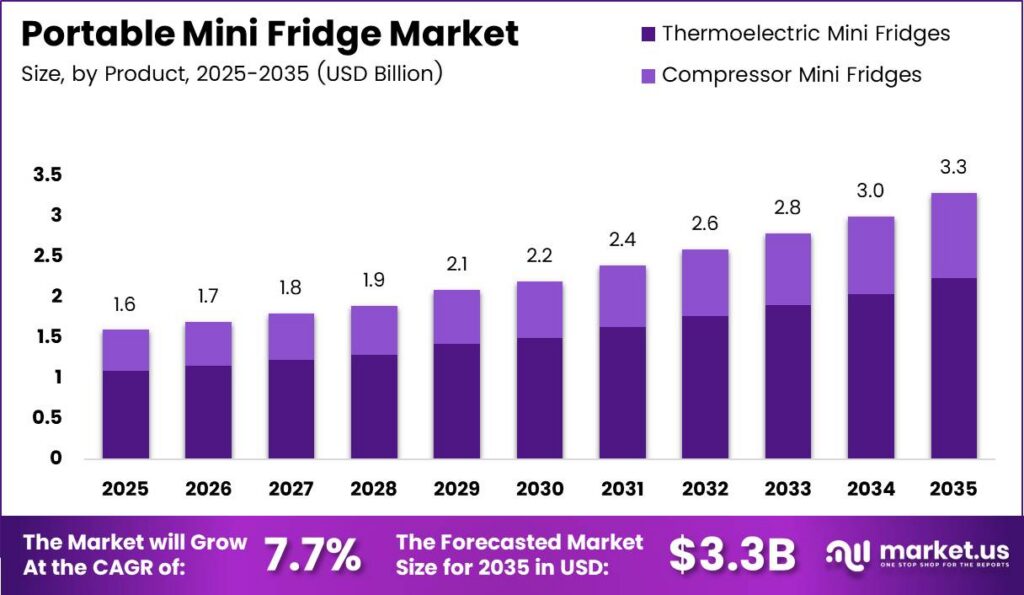
Global Portable Mini Fridge Market size is expected to be worth around USD 3.3 Billion by 2035 from USD 1.6 Billion in 2025, growing at a CAGR of 7.7% during the forecast period 2026 to 2035. A portable mini fridge is a compact, lightweight cooling appliance that operates on alternating current mains or direct current vehicle power to preserve beverages, food, pharmaceuticals, and personal care items during transit or in small rooms.
Commercial hospitality, automotive touring, healthcare logistics, and urban housing form the core revenue pillars of this market. According to WTTC, global travel and tourism contributed a record USD 11.6 trillion to global GDP in 2025, representing 9.8% of the global economy, while domestic visitor spending reached USD 5.63 trillion. Consequently, rising domestic road travel and hotel occupancy directly expand institutional procurement of cabin and vehicle cooling units. Suppliers must target hospitality and automotive accessory distributors to capture volume.
Key Takeaways
- The global Portable Mini Fridge Market was valued at USD 1.6 Billion in 2025.
- The market is projected to reach USD 3.3 Billion by 2035.
- The industry will expand at a CAGR of 7.7% during the forecast period from 2026 to 2035.
- Thermoelectric Mini Fridges led the Product segment in 2025 with a 67.23% market share and represent the fastest growing product category.
- The Below 10 L segment dominated the Capacity category in 2025 with a 61.34% share, while the Above 10 L segment is the fastest growing capacity tier.
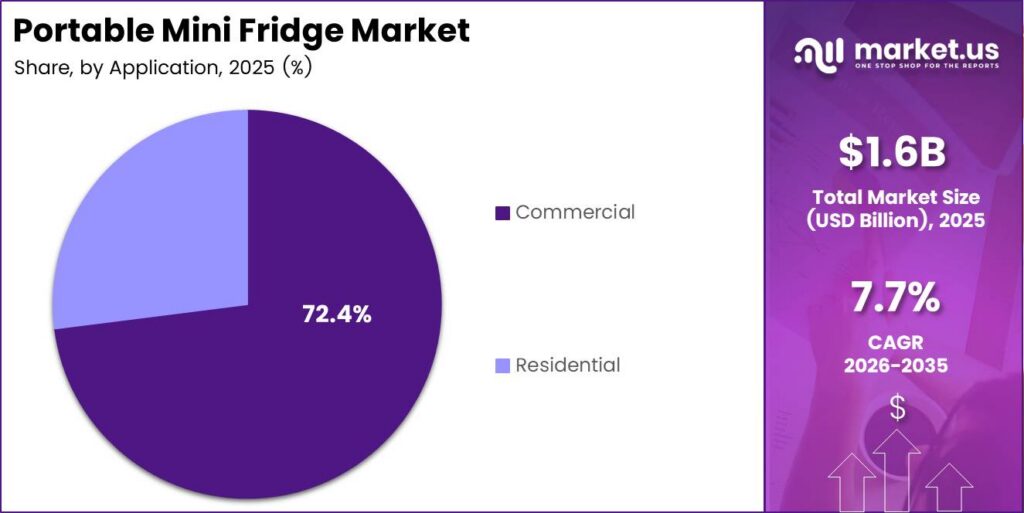
- The Commercial segment held the largest share of 72.45% in the Application category in 2025 and is the fastest growing application segment.
- The Offline channel captured a dominant 84.56% share in the Distribution Channel category in 2025, whereas the Online channel is the fastest growing route to market.
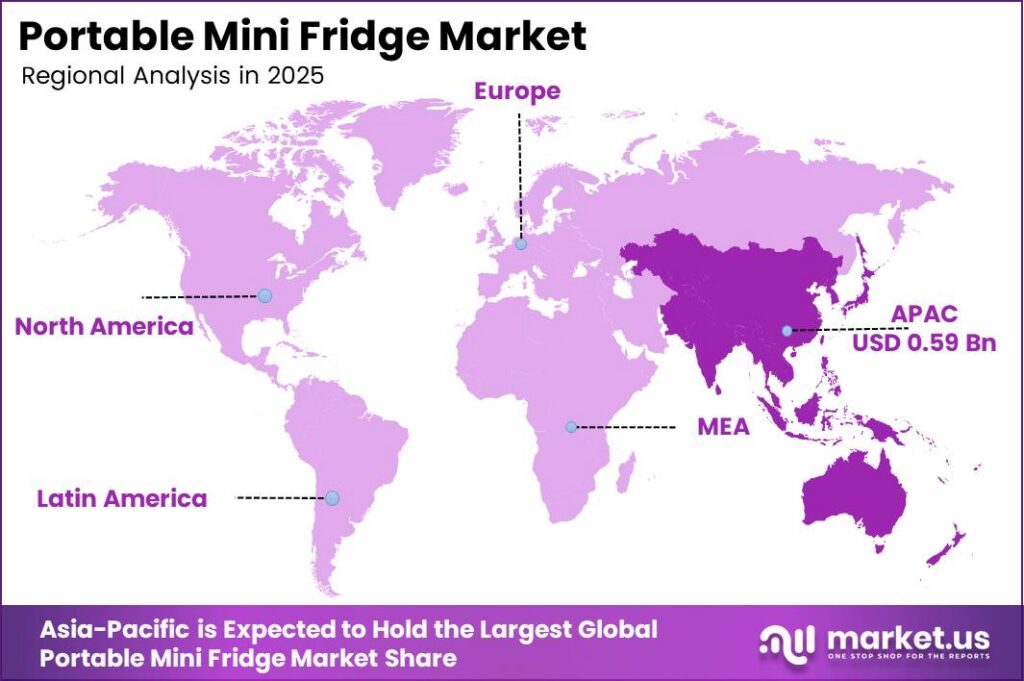
- Asia-Pacific dominated the global regional landscape in 2025 with a 37.54% market share valued at USD 0.59 Billion, while Middle East & Africa is the fastest growing region.
National energy efficiency mandates and climate policies now govern product engineering across major appliance manufacturing hubs. As reported by IEA, global energy efficiency progress improved by 1.8% in 2025 compared to 1.0% in 2024, while building space cooling energy demand has grown by over 4% annually since 2000 . Therefore, stricter power consumption limits force appliance makers to upgrade insulation panels and low-wattage variable compressors. Manufacturers that certify low energy draw gain priority shelf placement with retail buyers.
Major appliance manufacturers are restructuring regional production footprints through cross-border capital alliances to lower unit assembly costs. In April 2026, two leading global appliance groups formed a 15-year strategic partnership in North America involving a 65% equity acquisition in a Juarez, Mexico refrigeration plant and a 55% to 45% South Carolina manufacturing joint venture . This alliance commits SEK 1.1 billion in capital expenditure over 3 years to generate SEK 0.6 billion in annual cost efficiencies . Consequently, localized North American assembly shields suppliers from import tariffs.
Asia-Pacific dominates the global industry with a 37.54% market share in 2025, supported by dense appliance supply chains and expanding regional travel. Data from UNWTO shows that international tourist arrivals reached 1.52 billion overnight visitors globally in 2025, reflecting a 4% annual increase of nearly 60 million additional visitors . This tourism expansion across Asian urban centers fuels hotel room minibar installations and recreational vehicle accessory sales. Investors should prioritize Asian manufacturing hubs to serve both domestic and export channels.
Producers are also deploying capital into emerging industrial zones to serve adjacent high-growth territories. In September 2026, a major global appliance manufacturer announced the November 2026 opening of Phase 2 at its 200,000-square-meter Egypt Ecological Park in 10th of Ramadan City, backed by USD 135 million in total investment . This facility adds over 500,000 units of annual refrigerator and freezer production capacity for regional distribution . This signals that duty-free regional manufacturing hubs will capture price-sensitive commercial contracts across developing markets.
Product Analysis
Thermoelectric Mini Fridges dominates with 67.23% share in 2025 due to low cost and compact versatility.
In 2025, Thermoelectric Mini Fridges held a 67.23% share in the Product segment of the Portable Mini Fridge Market and represent the fastest growing product category. Cosmetics Europe found that European cosmetics and personal care retail sales reached EUR 110 billion in 2025, with skincare generating EUR 32.3 billion or 29.4% of retail value . Active biological compounds like vitamin C and retinol oxidize rapidly at room temperature, requiring solid-state Peltier cooling modules to maintain stable 10°C to 15°C storage without vibration. Consequently, appliance brands are partnering with beauty retailers to cross-sell countertop units.
Compressor Mini Fridges deliver deep sub-zero freezing and rapid thermal pull-down for heavy-duty automotive overlanding, marine fleets, and commercial transport. Based on OICA data, global motor vehicle sales rose 4.7% from 95.3 million units in 2024 to 99.8 million units in 2025, while global vehicle production climbed 3.9% to 96.4 million units . Expanding sport-utility and light commercial vehicle fleets require direct-current hermetic vapor-compression systems that maintain -18°C freezing despite high cabin heat and road incline angles. Therefore, compressor fridge makers must secure original equipment automotive accessory contracts to lock in recurring volume.
Product engineering across both cooling technologies now centers on thermal insulation upgrades and regulatory compliance. US DOE indicates that federal energy conservation standards under rule 88 FR 12452 impact 49 residential refrigeration manufacturers and require USD 1,323.6 million in industry conversion spending, equal to 3.8% of product revenue . In October 2024, Dometic Group AB launched its CFX5 Series across 7 portable compressor models from 25L to 94L, utilizing Vacuum Insulated Panels and VMSO 3.5 compressors to reach -7°F (-21.6°C) . This signals that vacuum insulation lowers evaporator workload and defends premium pricing.
Capacity Analysis
Below 10 L dominates with 61.34% share in 2025 due to personal desktop and bedroom convenience.
In 2025, Below 10 L held a 61.34% share in the Capacity segment of the Portable Mini Fridge Market. Figures from IEA show that high-efficiency refrigerators save up to 40% in total lifecycle costs, while mature standards and labelling programs have lowered average domestic cold appliance energy consumption by 22% to 64%, cutting new unit energy draw by 2.3% annually . Smaller internal cabinet volumes below 10 liters minimize polyurethane foam surface heat gain and allow low-wattage power supplies to meet strict household plug-load budgets. This means suppliers can market sub-10L units as low-bill secondary appliances for dormitories and home offices.
The Above 10 L segment represents the fastest growing capacity tier in the market, serving multi-day recreational touring and field medical transport. According to WHO, off-grid healthcare clinics receiving 3 hours or fewer of daily electricity cannot operate standard electric refrigerators requiring 4 to 24 hours of power and need portable solar or battery cold chain units holding +2°C to +8°C . In June 2024, Dometic Group AB launched its CFX2 electric cooler series in 28L, 37L, 45L, and 57L capacities holding 36 to 84 cans at USD 599.99 to USD 899.99 . Larger insulated chambers provide the thermal mass needed to protect biological vials and family provisions during multi-day power outages. Consequently, manufacturers are scaling 28L to 60L production to capture higher average selling prices.
High-capacity dual-zone architectures allow users to run simultaneous refrigeration and deep-freezing compartments inside a single portable chassis. As reported by Engel Australia Pty Ltd., the company released its Bluetooth-enabled ELITE Series 12V fridge-freezers in June 2024, featuring the 45-liter MT45J-ELITE at AUD 1,599 and the 60-liter MT60J-ELITE at AUD 2,199, alongside the 75-liter Twin Door Combi MT-V80C at AUD 2,259 and 40-liter MB40V top-loader . Partitioned evaporator coils in cabinets above 40 liters regulate separate temperature zones without requiring two separate vehicle power outlets. Therefore, product portfolios that add smartphone telemetry and dual-zone dividers will capture high-margin overland buyers.
Application Analysis
Commercial dominates with 72.45% share in 2025 due to hospitality and retail beverage deployment.
In 2025, Commercial held a 72.45% share in the Application segment of the Portable Mini Fridge Market and stands as the fastest growing application category. Data from NRA shows that United States restaurant and foodservice industry sales reached USD 1.5 trillion in 2025 . In January 2025, the US DOE published Final Rule 90 FR 7464, setting stricter maximum daily kilowatt-hour consumption limits for commercial refrigerators and chef bases with compliance starting January 22, 2029 . Commercial foodservice counters, hotel rooms, and promotional beverage displays require continuous-duty sealed cooling systems that maintain food-safe temperatures under frequent door openings. Consequently, commercial buyers are accelerating fleet replacement cycles to meet upcoming energy rules.
Residential buyers purchase portable mini fridges for bedroom beverage storage, nursery milk preservation, and home entertainment spaces. OECD found that real household disposable income per capita across member nations grew by 2.1% in 2024 and 0.8% in 2025, with fourth-quarter 2025 income rising 0.7% against 0.2% real GDP per capita growth. Higher discretionary household purchasing power reduces price sensitivity for non-essential secondary cooling appliances that eliminate trips to the primary kitchen refrigerator. This means consumer appliance brands can expand margins by introducing low-noise residential models with decorative finishes.
Digital ordering across European hospitality and food delivery networks is also reshaping commercial compact refrigeration placement. Based on Eurostat data, 99.05% of European Union accommodation and foodservice enterprises conducting electronic sales received orders via websites or mobile apps, within an overall enterprise e-sales turnover share of 19.49% across 1.53 million businesses . Rapid online meal and cold-beverage dispatch requires decentralized portable staging coolers positioned directly at kitchen packing stations and delivery vehicles to prevent thermal spoilage. Therefore, B2B equipment distributors should bundle portable staging fridges for ghost kitchens and hotel room-service operators.
Distribution Channel Analysis
Offline dominates with 84.56% share in 2025 due to physical inspection and dealer installation.
In 2025, Offline held an 84.56% share in the Distribution Channel segment of the Portable Mini Fridge Market. US Census Bureau indicates that retail sales at physical United States electronics and appliance stores reached USD 64,939 million during the first 9 months of 2025, including USD 7,728 million in September 2025 within USD 733.3 billion of total monthly retail sales . In September 2024, ARB invested AUD 25.0 million (USD 16.7 million) to lift its stake in Off Road Warehouse from 30% to 50%, funding a USD 30 million purchase of 42 retail stores from 4 Wheel Parts to build a 53-store U.S. network . Buyers of heavy vehicle fridge-freezers require physical dimension checks, battery wiring kits, and slide-mount installation at brick-and-mortar showrooms. Consequently, manufacturers are acquiring specialty retail chains to control showroom shelf space.
The Online channel is the fastest growing distribution segment, propelled by direct-to-consumer appliance storefronts and marketplace fulfillment. Figures from US Census Bureau show that total United States retail e-commerce sales increased 5.4% to reach USD 1,233.7 billion in 2025 from USD 1,192.6 billion in 2024, with fourth-quarter 2025 online sales hitting USD 316.1 billion or 16.1% to 16.3% of total retail . Lightweight thermoelectric mini fridges fit standard parcel shipping dimensions and require zero professional installation, allowing digital shoppers to compare wattages and buy directly from factories. Therefore, brands must invest in drop-tested corrugated packaging and marketplace search visibility to capture online volume.
High consumer internet penetration across European markets reinforces digital discovery and cross-border parcel ordering for compact cooling appliances. According to Eurostat, 95% of European Union individuals aged 16 to 74 used the internet in 2025, and 78% of those internet users purchased goods or services online for private use . Broad consumer comfort with digital transactions lowers customer acquisition costs for specialty appliance brands lacking physical retail distribution across fragmented European countries. This signals that manufacturers can launch direct web stores with localized warranty support to bypass traditional wholesale markups.
Key Market Segments
By Product
- Thermoelectric Mini Fridges
- Compressor Mini Fridges
By Capacity
- Below 10 L
- Above 10 L
By Application
- Commercial
- Residential
By Distribution Channel
- Offline
- Online
Regional Analysis
Asia-Pacific Dominates the Portable Mini Fridge Market with a Market Share of 37.54% in 2025, Valued at USD 0.59 Billion
Asia-Pacific led the global Portable Mini Fridge Market in 2025 with a 37.54% share valued at USD 0.59 Billion. As reported by WTTC, Asia-Pacific recorded the fastest regional travel and tourism GDP expansion in 2025, rising 8.1% year-on-year to reach USD 3.29 trillion, led by China at USD 1,904.5 billion, Japan at USD 324.3 billion, and India at USD 268.7 billion . Booming regional hospitality construction and domestic leisure travel directly increase bulk procurement of compact room refrigerators and portable vehicle coolers. Consequently, global appliance leaders concentrate their primary compressor and thermoelectric assembly lines across China, Thailand, and India.
Middle East & Africa is the fastest growing region in the global market, driven by desert tourism, hospitality mega-projects, and extreme ambient temperatures. Data from UNWTO shows that Middle East international tourist arrivals rose 3% in 2025 to reach nearly 100 million visitors, standing 39% above 2019 levels while regional tourism receipts climbed 76% above pre-pandemic benchmarks . Desert safari fleets, luxury glamping resorts, and coastal hotels require rugged portable compressor refrigeration to keep beverages and perishables cold in high heat. This means suppliers with tropical-rated condensers can secure high-margin commercial contracts across Gulf states.
Expanding motor vehicle ownership across Asian and Middle Eastern transport corridors further accelerates aftermarket attachment of mobile 12-volt cooling units. OICA found that motor vehicle sales across Asia, Oceania, and the Middle East increased by 7.1% year-on-year in 2025 to reach 55.02 million units, representing over 55% of global vehicle demand . Commercial truck drivers, family road-trippers, and ride-hailing operators in these congested corridors rely on in-cabin mini fridges for daily hydration and food storage. Therefore, bundling direct-current mini fridges with regional automotive dealerships creates a high-volume distribution channel.
Key Regions and Countries
North America
- US
- Canada
Europe
- Germany
- France
- The UK
- Spain
- Italy
- Rest of Europe
Asia Pacific
- China
- Japan
- South Korea
- India
- Australia
- Rest of APAC
Latin America
- Brazil
- Mexico
- Rest of Latin America
Middle East and Africa
- GCC
- South Africa
- Rest of MEA
Market Dynamics
Rising global temperatures and electrical grid strain are reshaping technical demand across the portable refrigeration sector. Based on IEA data, each 1°C increase in daily maximum temperature in India adds over 7 GW of peak electricity demand compared to 4 GW in 2019, while Southeast Asia cooling equipment stock will expand ninefold from 30 million units in 2020 to 275 million units by 2040 as Indonesian household ownership rises from 14% in 2023 to 85% by 2050 . Consequently, buyers increasingly demand solar-compatible, battery-backed portable fridges that maintain cooling during peak grid brownouts.
Drivers
Rising recreational-vehicle shipments push portable fridge demand through dealer accessory bundles and aftermarket replacements. The RV Industry Association reported 333,733 vehicle shipments in 2024 and 342,220 in 2025, reflecting 2.5% annual growth alongside a 13.9% first-quarter 2025 jump. A 5% to 10% attachment rate across annual shipments generates 17,000 to 34,000 potential accessory units before replacements. Within the 7.7% baseline CAGR, recreational touring contributes +0.55 percentage points out of +1.70 total driver points, while restraints subtract -1.15 and challenges subtract -0.90. Future opportunities add +1.20 percentage points for an 8.9% upper scenario, directing sellers toward pre-season dealer inventory.
| Driver | (~) % Impact on CAGR Forecast | Geographic Relevance | Impact Timeline |
|---|---|---|---|
| Recreational-vehicle and touring demand | +0.55% | North America; Europe; Australia | Short term (≤ 2 years) |
| Compact compressor product availability | +0.40% | Global | Short term (≤ 2 years) |
| Cross-compatible vehicle and mains power | +0.30% | Global automotive accessory markets | Short term (≤ 2 years) |
| Online specialty-retail distribution | +0.25% | North America; Europe; Asia-Pacific | Short term (≤ 2 years) |
| Personal beverage and cosmetic cooling | +0.20% | Urban consumer markets | Medium term (2–4 years) |
Restraints
Existing passive ice chests satisfy occasional leisure buyers and directly eliminate powered appliance purchases during short outings. Manufacturer guidelines position thermoelectric units for day trips and compressor models for extended travel, establishing trip duration as a clear substitution boundary. Across 6 annual outings over 3 years, a buyer spreads hardware acquisition costs over just 18 uses, whereas 12 annual outings cut the per-trip hardware cost in half. This substitution creates a -0.35 percentage-point drag on the baseline CAGR. Therefore, suppliers must avoid margin-eroding price cuts and instead market ice-free storage space to frequent travelers.
| Restraint | (~) % Impact on CAGR Forecast | Geographic Relevance | Impact Timeline |
|---|---|---|---|
| Passive-cooler substitution for occasional use | −0.35% | Global leisure markets | Short term (≤ 2 years) |
| Upfront affordability constraints | −0.30% | Price-sensitive emerging markets | Short term (≤ 2 years) |
| Unavailable destination electricity | −0.20% | Remote campsites; underserved rural destinations | Medium term (2–4 years) |
| Institutional food-storage exclusions | −0.15% | Rule-restricted accommodation and workplaces | Short term (≤ 2 years) |
| Unqualified vaccine-storage exclusion | −0.15% | Global immunization procurement | Long term (≥ 4 years) |
Challenges
Thermoelectric coolers rely on ambient temperature differentials, creating performance gaps in hot regions that elevate customer return rates. Standard thermoelectric modules cool up to 20°C below ambient levels, meaning a 35°C environment yields an internal temperature near 15°C and leaves a 10°C gap above a 5°C food-safety target. This thermal limitation imposes a -0.30 percentage-point friction drag on market expansion. Consequently, engineering teams must target a 10% to 15% reduction in hot-weather power draw and cut warranty-and-return expenses by 1 to 2 percentage points of revenue through clearer climate labeling.
| Challenge | (~) % CAGR Friction Drag | Geographic Relevance | Mitigation Horizon |
|---|---|---|---|
| Hot-ambient thermal performance gaps | −0.30% | South Asia; Southeast Asia; Middle East; hot-season markets | Medium term (2–4 years) |
| Transport vibration reliability management | −0.20% | Global vehicle-use markets | Medium term (2–4 years) |
| Bulky parcel damage exposure | −0.15% | Cross-border and parcel-delivery channels | Short term (≤ 2 years) |
| Fragmented appliance classification requirements | −0.15% | European Union; multi-jurisdiction exporters | Medium term (2–4 years) |
| Seasonal inventory forecast error | −0.10% | Seasonal outdoor-recreation markets | Short term (≤ 2 years) |
Opportunities
Managed workplace refrigeration fleets for construction and field-service crews offer a +0.35 percentage-point CAGR upside beyond standard retail hardware sales. Dual-voltage compressor units running on 12/24 V vehicle sockets and 220 to 240 V mains power support fleet deployment across 180 to 220 days per year. Recovering equipment costs over 30 to 36 months spreads capital across 450 to 660 active workdays. Early service operators can lower customer-acquisition costs by 15% to 20% and expand gross margins by 3 to 5 percentage points through multi-unit maintenance contracts with industrial employers.
| Opportunity | (~) % Potential CAGR Upside | Geographic Relevance | Execution Window |
|---|---|---|---|
| Managed workplace refrigeration fleets | +0.35% | Industrial sites; construction corridors; field-service hubs | Medium term (2–4 years) |
| Validated specialty-food sampling kits | +0.30% | Urban food-service and specialty retail networks | Medium term (2–4 years) |
| Certified refurbishment and resale | +0.25% | Established appliance recovery markets | Medium term (2–4 years) |
| Modular furniture integration partnerships | +0.20% | Co-living; serviced apartments; flexible offices | Long term (≥ 4 years) |
| Accessible independent-living product design | +0.10% | Aging-population markets | Long term (≥ 4 years) |
Key Company Insights
Midea Group
Midea Group operates as a leading global manufacturer of compact refrigeration, thermoelectric coolers, and residential home appliances across more than 200 countries. Midea Group Annual Report indicates that total operating revenue rose 12.1% to RMB 458.5 billion in 2025, with Smart Home revenue reaching RMB 326.1 billion (71.1% share), overseas sales climbing 15.9% to RMB 195.9 billion, and R&D spending hitting RMB 17.8 billion across 23,000 researchers . This massive scale allows Midea to supply cost-competitive mini fridges to global retail chains.
Midea Group continues to expand its localized refrigeration manufacturing footprint across Latin America to capture regional retail growth. According to Midea Official News, the company committed an additional RMB 258 million investment in June 2025 to expand manufacturing and logistics in Minas Gerais, Brazil, following the December 2024 launch of its USD 99 million (over RMB 700 million), 70,000-square-meter Pouso Alegre plant with a 1.3 million-unit annual capacity . Consequently, local Brazilian assembly shortens delivery lead times for South American distributors.
ARB
ARB manufactures heavy-duty 12-volt portable compressor fridge-freezers engineered for off-road four-wheel-drive vehicles and harsh outback touring conditions. While ARB focuses on rugged automotive accessories, global refrigeration scale is benchmarked by Haier Smart Home Annual Report figures showing 2025 revenue of RMB 302.35 billion (up 5.71%), including RMB 84.76 billion in refrigeration revenue (up 1.4%) and a 47.7% offline retail share in China across 18 consecutive years of global volume leadership . Therefore, specialty off-road fridge brands must differentiate through weatherproof cabinets and vehicle mounting systems rather than competing on mass-market price.
Competitive pressure in commercial and mobile cold storage has intensified as major appliance groups acquire specialized refrigeration assets. As reported by Haier Smart Home Corporate Filings, the group completed its USD 775 million acquisition of Carrier Commercial Refrigeration in October 2024 to expand commercial cooling capabilities, followed by the December 2024 acquisition of South African appliance leader Kwikot . This signals that ARB and specialty mobile cooler makers must defend their aftermarket dealer networks against multinational refrigeration conglomerates entering commercial and regional channels.
Key Players
- Midea Group
- ARB
- Danby
- DOMETIC GROUP AB (PUBL)
- Living Direct, Inc.
- Engel Australia Pty Ltd.
- Haier Inc.
- Whirlpool Corporation
- Godrej Group
- Electrolux AB
- Other Key Players
Recent Developments
2026
- November 2026: Electrolux AB signed an industrial investment agreement with the Ministry of Enterprises and Made in Italy committing over EUR 100 million across its Italian plants to sustain annual production capacity of 3.2 million appliance units as reported by Il Sole 24 Ore .
- September 2026: Midea Group invested RMB 8.5 billion in research and development during the first half of 2026 after spending over RMB 70.0 billion from 2021 to 2025 and deployed over 20,000 internal AI agents alongside the MevoX smart home system for 150 million users to raise factory efficiency by 30% and scheduling speed by 50% according to HKEX Filings .
- June 2026: Whirlpool Corporation reached a definitive agreement to divest its remaining 25% equity stake in Beko Europe B.V. to Arcelik for cash and a 2.9% Arcelik equity stake following a February 2026 USD 30 million private placement of 434,782 common shares at USD 69 per share with Whirlpool China according to US SEC Form 10-Q .
- April 2026: Whirlpool Corporation announced a USD 60 million capital investment to convert its Perrysburg, Ohio facility as its 11th U.S. plant and 6th Ohio site with advanced automation creating 100 to 150 new jobs over 2 years according to Whirlpool Corporation Official Press Release .
2025
- November 2025: Whirlpool Corporation announced a USD 300 million investment across its Clyde and Marion, Ohio appliance plants creating 400 to 600 jobs and sold 14.3 million shares representing an 11% stake in Whirlpool of India for USD 166 million to reduce its ownership from 51% to 40% according to Whirlpool SEC Filings .
- November 2025: Midea Group completed the merger of Italian cooling specialist Clivet with newly acquired Arbonia Climate to form MBT Climate and added 18 new overseas factories by year-end 2025 to reach 63 overseas manufacturing bases according to Midea Group Official Release .
- September 2025: Haier Group inaugurated a 324,000-square-meter cooling appliance industrial park in Chonburi, Thailand backed by a THB 10 billion (USD 270 million) investment starting at 3 million units annually in 2025 and scaling to 3.5 million units in 2026 and 6 million units by 2027 with 3,000 jobs as reported by Bangkok Post .
2024
- September 2024: Godrej Enterprises Group inaugurated a 100,000-square-foot automated manufacturing line at Shirwal, Maharashtra with a capital expenditure of INR 100 crore within a 7-year INR 1,500 crore manufacturing investment program while targeting INR 10,000 crore in appliance revenue by FY2026 according to Godrej Enterprises Official Press Release .
Geopolitical Impact Analysis
Tariff realignments and maritime chokepoint disruptions directly inflate the landed cost of cross-border portable refrigeration shipments. Data from WTO shows that global merchandise trade value rose 7% to USD 26.26 trillion in 2025 as trade volume grew 4.6% compared to 2.7% in 2024, while economists revised 2026 merchandise trade volume growth to 3.9% from a March baseline of 1.9% amid Middle East conflict and tariff pressures . Simultaneously, UNCTAD found that global seaborne trade reached 12,720 million tons in 2024 (up 2.2% in volume and 5.9% in ton-miles), while Red Sea rerouting around the Cape of Good Hope drove a 17% surge in container ton-miles and pushed the Shanghai Containerized Freight Index up 149% to an average of 2,496 points before slowing containerized volume growth from over 6% in 2024 to 1.4% in 2025 . These ocean freight surcharges directly raise import costs for Asian-made Peltier thermoelectric modules, hermetic micro-compressors, and polyurethane insulation cabinets shipped to European and North American distributors.
Maritime cargo losses and macroeconomic inflation further tighten working capital for appliance importers and retail buyers. Based on World Shipping Council data, across 250 million containers shipped annually carrying over USD 7 trillion in cargo, containers lost at sea jumped from 221 units in 2023 to 576 units in 2024 (with 33% recovered) and rose again in 2025 due to severe weather along Cape of Good Hope routes . In addition, IMF indicates that global real GDP growth will decelerate from 3.5% in 2024 and 2025 to 3.0% in 2026 before reaching 3.4% in 2027, while headline inflation climbs from 4.1% in 2025 to 4.7% in 2026 due to conflict-driven energy spikes . Higher energy prices increase raw material costs for copper evaporator tubing, aluminum heat sinks, and acrylonitrile butadiene styrene plastic liners. Consequently, portable fridge manufacturers are nearshoring final assembly to Mexico, Egypt, and Eastern Europe while holding 30 to 45 days of buffer component inventory.
Report Scope
| Report Features | Description |
|---|---|
| Market Value (2025) | USD 1.6 Billion |
| Forecast Revenue (2035) | USD 3.3 Billion |
| CAGR (2026-2035) | 7.7% |
| Base Year for Estimation | 2025 |
| Historic Period | 2021-2025 |
| Forecast Period | 2026-2035 |
| Report Coverage | Revenue Forecast, Market Dynamics, Market Opportunity Analysis, Technology and Innovation Landscape, Competitive Landscape, Recent Developments |
| Segments Covered | By Product (Thermoelectric Mini Fridges, Compressor Mini Fridges), By Capacity (Below 10 L, Above 10 L), By Application (Commercial, Residential), By Distribution Channel (Offline, Online) |
| Regional Analysis | North America (US and Canada), Europe (Germany, France, The UK, Spain, Italy, and Rest of Europe), Asia Pacific (China, Japan, South Korea, India, Australia, and Rest of APAC), Latin America (Brazil, Mexico, and Rest of Latin America), Middle East and Africa (GCC, South Africa, and Rest of MEA) |
| Competitive Landscape | Midea Group, ARB, Danby, DOMETIC GROUP AB (PUBL), Living Direct, Inc., Engel Australia Pty Ltd., Haier Inc., Whirlpool Corporation, Godrej Group, Electrolux AB, Other Key Players |
| Customization Scope | Customization for segments, region / country-level will be provided. Additional customization can be done based on requirements. |
| Purchase Options | We have three licenses to opt for: Single User License | Multi-User License (Up to 5 Users) | Corporate Use License (Unlimited User and Printable PDF) |