


Off Highway Vehicle Engine Market Report Overview
Global Off Highway Vehicle Engine Market size is expected to be worth around USD 87.6 Billion by 2035 from USD 47.5 Billion in 2026, growing at a CAGR of 6.3% during the forecast period 2026 to 2035. Off highway engines supply mechanical power for construction machines, tractors, mining haul trucks, generators, and industrial equipment. The market rewards suppliers that balance fuel efficiency, torque, compliance, and service access.
Construction, mining, agriculture, and oil and gas fleets set the market structure because each sector needs durable power under variable loads. According to UNIDO, global manufacturing output rose 2.8% in 2023. Factory output lifts demand for materials handling, site development, and industrial equipment, so engine suppliers with standardized platforms can convert wider equipment production into recurring original equipment and service revenue.
Key Takeaways
- The Off Highway Vehicle Engine market is valued at USD 47.5 Billion in 2026 and is projected to reach USD 87.6 Billion by 2035, growing at a CAGR of 6.3%.
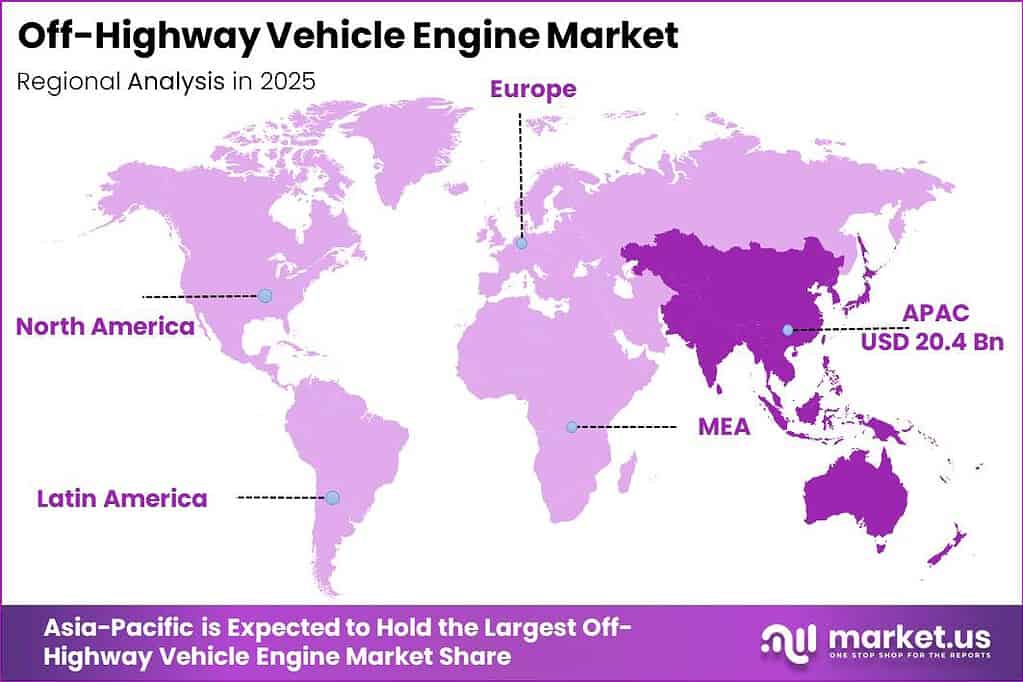
- Asia Pacific leads with a 42.87% market share in 2026, valued at USD 20.4 Billion.
- Under 50 Hp engines dominate the Component segment with a 46.78% share in 2026.
- Diesel leads the Fuel Type segment with a 67.43% share in 2026.
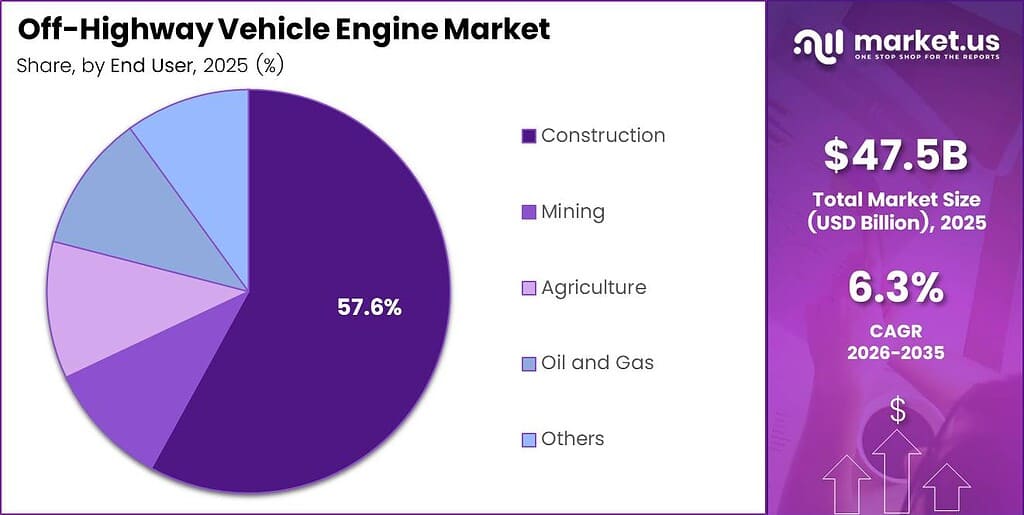
- Construction is the largest end-user segment, holding a 57.67% share in 2026.
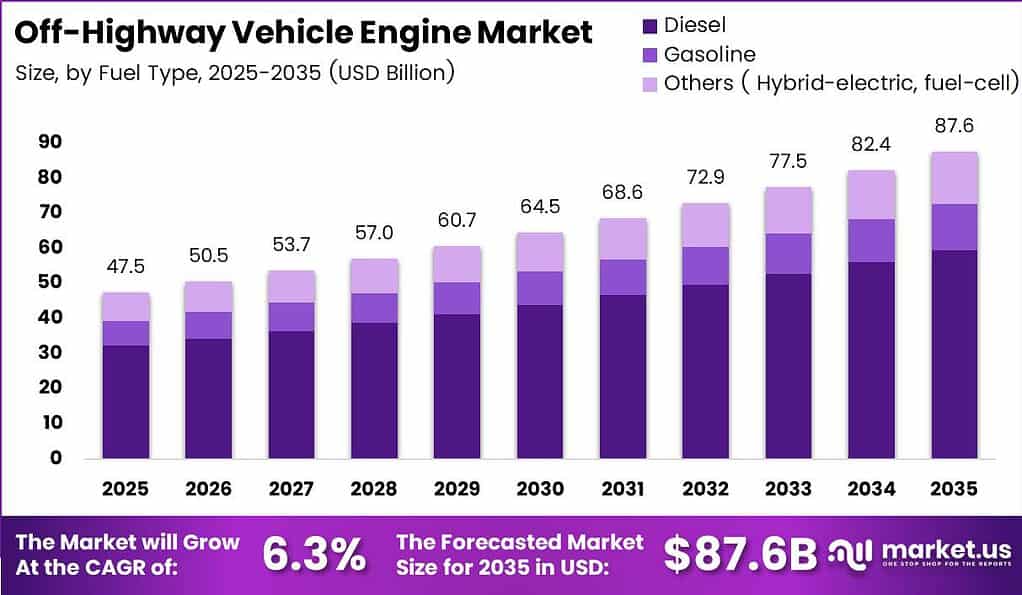
Public and private infrastructure spending affects engine orders through equipment fleet utilization and replacement decisions. As reported by the World Bank, global private investment in infrastructure projects increased 10% in 2023. Contractors need excavators, loaders, compactors, and generators when project pipelines expand. This means engine producers should prioritize high uptime designs, emissions compliance, and dealer parts coverage for infrastructure-led procurement cycles.
Caterpillar’s July 2026 allocation of up to USD 5 million for Texas workforce training sits within a five year USD 100 million initiative. According to Caterpillar, the program targets advanced manufacturing and technician roles. Skilled labor supports assembly quality and field service capacity, which reduces delivery and maintenance risk for engine buyers. This signals that workforce investment can protect supplier execution as machine technology becomes more complex.
Asia Pacific dominates the Off Highway Vehicle Engine Market with a market share of 42.87% in 2026, valued at USD 20.4 Billion. Figures from UNIDO show manufacturing in Asia and Oceania rose 4.9% year over year during the final quarter of 2023. Regional equipment production, infrastructure activity, and farm mechanization increase engine fitment volumes. This means suppliers need localized manufacturing, calibration, and dealer support to defend share.
Volvo Construction Equipment announced a USD 261 million global investment in crawler excavator production in June 2025. Data from Volvo Group shows the program strengthens excavator capability across production locations. Crawler excavators use high duty cycle engines with sustained torque and thermal control needs. Therefore, suppliers that secure platform positions on new excavator lines can gain longer production runs and parts revenue.
Component Analysis
Under 50 Hp dominates with 46.78% share in 2026 due to compact equipment fleet replacement.
In 2026, Under 50 Hp held a 46.78% share in the Component segment of the Off Highway Vehicle Engine Market. DEUTZ indicates that its D 2.9 L4 off highway engine delivers 49 hp. Compact loaders, mini excavators, and small tractors need low mass engines that fit tight chassis spaces. This means manufacturers can protect volume through common compact-engine designs and efficient dealer service programs.
Engines above 50 and below 100 Hp serve utility tractors, telehandlers, and mid size construction equipment where buyers seek flexible output. Based on DEUTZ data, TAFE will manufacture up to 30,000 licensed DEUTZ engines spanning 50 to 100 hp. This power band balances hydraulic demand with fuel use. Therefore, localized production can lower lead times and improve pricing for regional equipment builders.
Engines above 100 Hp support machines that need high drawbar pull, hydraulic flow, and sustained work cycles. Deere & Company found that the JD5 engine will offer an anticipated range of 125 to 268 hp. Excavators, large tractors, and material handlers require this output to move heavier loads without frequent downshifts. This creates premium opportunities for suppliers with durable cooling, turbocharging, and emissions systems.
Fuel Type Analysis
Diesel dominates with 67.43% share in 2026 due to high torque duty cycles.
In 2026, Diesel held a 67.43% share in the Fuel Type segment of the Off Highway Vehicle Engine Market. Yanmar Holdings indicates that its industrial diesel range spans 11 to 100 hp. Diesel engines deliver high low speed torque and long operating endurance for loaders, tractors, and generators. This means fleet buyers will continue to value fuel access, repair familiarity, and productive uptime.
Gasoline engines remain relevant where small equipment buyers value lower purchase costs and simple packaging. According to Yanmar Holdings, its industrial portfolio includes a gasoline engine rated at 2.5 hp. Light tools and compact applications need quick response rather than high torque at extended duty cycles. Therefore, suppliers can retain niche demand through cost controlled products and broad distributor availability.
Hybrid electric and fuel cell systems serve applications that need lower local emissions, quieter operation, or energy recovery. As reported by the IEA, global electric truck sales exceeded 400,000 units in 2025 and doubled from the prior year. Battery systems can support stop start work patterns and auxiliary loads. This signals that engine suppliers should invest in hybrid controls and alternative power partnerships.
End User Industry Analysis
Construction dominates with 57.67% share in 2026 due to equipment intensive project delivery.
In 2026, Construction held a 57.67% share in the End User Industry segment of the Off Highway Vehicle Engine Market. Construction fleets require excavators, loaders, compactors, and generators that operate through long shifts and variable site conditions. Engine suppliers benefit when contractors replace equipment to reduce downtime and meet project schedules. This means durable, serviceable engines remain central to tender competitiveness and rental fleet economics.
Mining equipment buyers prioritize engines that maintain torque, cooling, and reliability under steep gradients and dusty conditions. Komatsu reached a USD 440 million equipment agreement with Barrick for the Reko Diq project over the first five years in June 2025. According to Komatsu, the agreement supports a major mining equipment placement. This means mining projects can create concentrated demand for high horsepower engines and long term parts support.
Agriculture depends on engines that power tractors, harvest equipment, irrigation pumps, and material movement across seasonal workloads. FAO found that around 10% of crop farmers use tractors or mechanical power in production and processing. Low mechanization leaves substantial room for equipment adoption where financing and service networks improve. Therefore, suppliers can target affordable engines, localized parts, and practical maintenance packages for farm buyers.
Off Highway Vehicle Engine Market Segments
By Component
- Under 50 Hp
- >50 and 100 Hp
- >100 Hp
By Fuel Type
- Diesel
- Gasoline
- Others
- Hybrid-electric
- Fuel-cell
By End User Industry
- Construction
- Mining
- Agriculture
- Oil and Gas
- Others
Regional Analysis
Asia Pacific Dominates the Off Highway Vehicle Engine Market with a Market Share of 42.87% in 2026, Valued at USD 20.4 Billion
Asia Pacific held a 42.87% share of the Off Highway Vehicle Engine Market in 2026 and reached USD 20.4 Billion. Asia Pacific equipment makers supply construction, agricultural, and industrial fleets at scale. Regional production networks lower component sourcing time and support local calibration needs. This means engine producers with local plants, supplier bases, and field service networks can capture both original equipment and replacement demand.
Latin America offers expansion potential through infrastructure, mining, and agricultural equipment demand. The World Bank projected Latin America and Caribbean GDP growth of 2.1% in 2026. Economic activity affects contractor investment, farm income, and mineral project spending. Consequently, engine suppliers should use flexible financing, regional parts warehouses, and fuel tolerant configurations to convert uneven investment conditions into recurring fleet business.
Middle East and Africa markets combine mining, construction, agriculture, and power generation needs across difficult operating conditions. World Bank data shows Sub Saharan Africa growth was projected at 3.8% in 2025, compared with 3.5% in 2024. Infrastructure and extractive activity require dependable engines in remote locations. This means suppliers that improve filtration, cooling, and dealer technician coverage can reduce operating risk for buyers.
Key Regions and Countries
North America
- US
- Canada
Europe
- Germany
- France
- The UK
- Spain
- Italy
- Rest of Europe
Asia Pacific
- China
- Japan
- South Korea
- India
- Australia
- Rest of APAC
Latin America
- Brazil
- Mexico
- Rest of Latin America
Middle East and Africa
- GCC
- South Africa
- Rest of MEA
Off Highway Vehicle Engine Market Dynamics
Emissions policy changes the engine design, sourcing, and investment agenda for off highway equipment makers. The IEA indicates that a policy target requires 100% of in state off road vehicle and equipment sales to be zero emission by 2035. Buyers will evaluate diesel platforms against electric and hybrid alternatives sooner. This means engine suppliers need transition portfolios that protect current fleet support while funding low emission systems.
Technology and Autonomy Analysis
Caterpillar accelerated construction automation in January 2026 by introducing intelligent machine capabilities for excavators, loaders, and other site equipment. According to Caterpillar, autonomous Cat 777 trucks at Luck Stone moved more than 2 million tons during their first operating year. Autonomous work cycles depend on stable engine output, thermal control, telemetry, and fault detection. This means powertrain suppliers can gain value through integrated controls and predictive service tools.
Caterpillar’s autonomy program makes engine uptime more valuable because operators cannot compensate for unplanned failures in an automated work cycle. Machine owners need sensors, electronic controls, and service schedules that detect fuel, cooling, and exhaust faults early. Therefore, engine manufacturers should integrate telematics data with dealer diagnostics and parts planning. Suppliers that reduce stops can support contractor productivity and build recurring aftermarket revenue.
Product Innovation Analysis
Deere & Company introduced the JD5 and JD8 industrial engine platforms at CONEXPO CON AGG in March 2026. Deere stated that the JD5 will deliver an anticipated power range of 125 to 268 horsepower, while the lead JD8 application is planned for 2029. Equipment OEMs need flexible engine architectures across several machine sizes. This means modular platforms can reduce integration work and shorten product development cycles.
Industrial engine buyers increasingly evaluate installation size, cooling requirements, fuel use, and emissions hardware alongside power output. Deere’s JD5 range covers equipment that needs more than compact-engine performance but less than large mining-engine capacity. Therefore, suppliers can improve margins by using shared components across several ratings. OEMs benefit when one platform supports excavators, tractors, handlers, and industrial machines with fewer redesigns.
Manufacturing Capacity Analysis
Volvo Construction Equipment announced a USD 261 million global investment in crawler excavator production in June 2025. Volvo Group stated that the program covers three production sites, with output plans beginning during the first half of 2026. Crawler excavators require durable engines that maintain torque through digging, lifting, and travel cycles. This means new production capacity creates direct engine-fitment opportunities for powertrain suppliers.
Regional production expansion changes how manufacturers should manage engine supply, inventory, and technical support. Local assembly reduces freight exposure and lets OEMs align engine calibration with regional emissions standards and fuel conditions. Consequently, engine suppliers should place component inventory near excavator plants and strengthen supplier relationships in each production region. Faster delivery and localized support improve supplier selection prospects when equipment makers expand capacity.
Electric and Hybrid Equipment Analysis
Volvo Construction Equipment selected Eskilstuna, Sweden for a SEK 700 million crawler-excavator plant in December 2025. Volvo Group stated that the mixed production line can build up to 3,500 electric and internal-combustion machines each year. The facility will serve medium and large excavators, where operators still need extended duty range. This means diesel engines retain a role while electrified systems gain selected applications.
Mixed electric and combustion production shows that off-highway buyers will adopt powertrains according to work cycle, charging access, operating hours, and total ownership cost. Long shifts, remote sites, and heavy hydraulic loads still favor combustion engines for many excavators. Therefore, engine suppliers need parallel strategies for efficient diesel, hybrid systems, and electric drivetrain integration. Investors should favor firms that can support both present fleets and future equipment designs.
Mining Automation Analysis
Caterpillar demonstrated fully autonomous operation of a Cat 777 off-highway truck at Luck Stone in November 2024. Caterpillar expanded autonomous hauling into the 100-ton class, equivalent to about 90 tonnes. Mining and quarry operations need predictable haul cycles, controlled fuel use, and high equipment availability. This means high-horsepower engine suppliers must pair mechanical durability with data connectivity and remote monitoring capability.
Autonomous mining trucks shift the buying decision from engine purchase price toward lifetime productivity and planned maintenance performance. Fleet owners need engines that sustain output in dust, grades, heat, and continuous loading cycles without unscheduled stops. Therefore, suppliers that offer condition monitoring, remote calibration, and local parts stock can improve their position on automated fleets. Higher truck utilization also expands the value of service contracts and replacement components.
Agricultural Equipment Innovation Analysis
Deere & Company launched six redesigned 8R and 8RX tractor models in February 2026 with higher horsepower options and autonomy-ready architecture. Deere positioned the models around ground-up redesigns and improved precision agriculture capability. Large farms need stable engine power for deep tillage, planting, hauling, and hydraulic implements. This means engine suppliers can benefit from rising demand for higher-output agricultural machinery.
Autonomy-ready farm equipment raises the importance of consistent engine response, electronic controls, and system communication. Precision tools work best when the engine, transmission, hydraulic system, and guidance platform coordinate during variable field conditions. Therefore, powertrain providers should design engines for data sharing, remote updates, and efficient operation under changing loads. Suppliers that support precision agriculture can secure longer relationships with tractor OEMs and dealer service networks.
Dealer and Aftermarket Analysis
Volvo Construction Equipment recognized a dealer investment in April 2026 that created a 52,000-square-foot headquarters in Colorado. Volvo Group stated that the facility includes 17 service bays and a dedicated training area. Engine buyers depend on nearby diagnostics, replacement parts, and trained technicians when machines stop unexpectedly. This means dealer infrastructure directly supports engine availability, warranty execution, and fleet retention.
Aftermarket capacity influences engine purchasing because contractors and rental fleets assess downtime risk before choosing a machine platform. A larger service footprint can shorten repair queues and improve access to injectors, filters, sensors, turbochargers, and aftertreatment components. Therefore, engine manufacturers should expand dealer training and digital diagnostics with equipment partners. Investors should view service coverage as a source of recurring revenue and a barrier to competitor replacement sales.
Emissions and Powertrain Integration Analysis
Deere & Company introduced 9RX tractor models in February 2024 with an 18-liter JD18 engine rated up to 830 horsepower. Deere stated that the engine meets Final Tier 4 and Stage V emissions requirements. High-output tractors need strong torque while operating large implements under sustained loads. This means compliance hardware must integrate with cooling, fuel injection, and engine controls without reducing field productivity.
Final Tier 4 and Stage V compliance raises engineering and service requirements across large agricultural and construction equipment. OEMs must package exhaust aftertreatment, sensors, and thermal systems inside space-constrained machine designs. Therefore, suppliers that simplify installation and improve diagnostic access can reduce machine development time and warranty risk. Buyers gain more dependable compliance when engines include proven controls, service support, and durable emissions components.
Drivers
Infrastructure equipment replacement supports engine purchases because contractors and rental fleets renew aging excavators, loaders, telehandlers, compactors, and generators. Construction demand was expected to rise about 2.77% in 2025 and about 3.7% in 2026 after United States equipment shipments fell around 17%. This means replacement cycles favor engines with efficient fuel systems, diagnostics, turbochargers, and compatible aftertreatment.
Replacement led procurement shifts purchases from discretionary capacity additions toward machines that improve uptime and meet tender requirements. The driver could add an estimated 1.4% to the baseline CAGR of 6.3%. OEMs need common engine architectures to control production costs, while rental fleets need standardized service parts. Therefore, suppliers that combine compliance with repair speed can defend margins during fleet renewal.
| Driver | (~) % Impact on CAGR Forecast | Geographic Relevance | Impact Timeline |
|---|---|---|---|
| Infrastructure equipment replacement | +1.4% | North America, Europe, India, Middle East | Short term (≤ 2 years) |
| Agricultural mechanization demand | +1.2% | India, Southeast Asia, Latin America, Africa | Medium term (2–4 years) |
| Emissions-compliant engine replacement | +1.0% | Europe, China, India, North America | Short term (≤ 2 years) |
| Mining and quarry fleet renewal | +0.8% | Australia, Latin America, Africa, Middle East | Medium term (2–4 years) |
| Higher-power compact equipment | +0.6% | North America, Europe, Japan, South Korea | Medium term (2–4 years) |
| Rental fleet utilization recovery | +0.5% | North America, Europe, Gulf Cooperation Council | Short term (≤ 2 years) |
Restraints
High borrowing costs restrict equipment purchases because contractors, rental firms, and farmers often use dealer finance, leasing, or fleet credit. A 100 basis point financing rate increase can alter total ownership costs for multi year machine purchases. Buyers can delay replacement and keep older assets operating longer. This means engine manufacturers face lower build schedules, weaker dealer replenishment, and pressure to offer lower cost derivatives.
High financing costs could deduct an estimated 1.3% from the baseline CAGR of 6.3%. Contractors respond to uncertain utilization by extending equipment life, while dealers reduce stock commitments. Engine suppliers can offset some volume risk through maintenance contracts and selective inventory support. However, these responses can reduce near term margins if suppliers absorb financing or service costs.
| Restraint | (~) % Impact on CAGR Forecast | Geographic Relevance | Impact Timeline |
|---|---|---|---|
| High borrowing-cost equipment deferral | -1.3% | North America, Europe, Latin America | Short term (≤ 2 years) |
| Construction activity financing constraints | -1.0% | China, Europe, North America | Short term (≤ 2 years) |
| Diesel price and fuel-access volatility | -0.8% | Africa, Latin America, South Asia, Middle East | Short term (≤ 2 years) |
| Low-emission zone procurement exclusions | -0.7% | Western Europe, major Chinese cities, North America | Medium term (2–4 years) |
| Dealer inventory correction | -0.6% | North America, Europe, China | Short term (≤ 2 years) |
| Small-farm affordability ceiling | -0.5% | India, Africa, Southeast Asia, Latin America | Medium term (2–4 years) |
Challenges
Aftertreatment integration creates engineering pressure because off highway engines must meet emissions, packaging, thermal management, visibility, and service requirements across varied machine layouts. United States Tier 4 rules reduced particulate matter and nitrogen oxides by about 90% versus the prior tier. China CN Stage IV requires diesel particulate filtration above 37 kW. This means suppliers must fund calibration and validation across several regional standards.
Aftertreatment complexity could create an estimated 1.1% drag on attainable market growth. OEMs must protect cooling performance and machine space while dealers must diagnose urea systems, filters, and sensors. Field failures raise warranty costs and harm fleet productivity. Therefore, manufacturers need modular aftertreatment packages, technician training, and regional parts availability to limit ownership risk.
| Challenge | (~) % CAGR Friction Drag | Geographic Relevance | Mitigation Horizon |
|---|---|---|---|
| Aftertreatment integration complexity | -1.1% | Europe, China, India, North America | Medium term (2–4 years) |
| Electronic component supply exposure | -0.8% | Global | Short term (≤ 2 years) |
| Skilled service technician gap | -0.7% | North America, Europe, India, Australia | Medium term (2–4 years) |
| Fuel-quality reliability risk | -0.6% | Africa, Latin America, South Asia, Middle East | Medium term (2–4 years) |
| Platform calibration fragmentation | -0.5% | Global | Long term (≥ 4 years) |
| Extreme-duty thermal durability | -0.4% | Mining regions, deserts, tropical markets | Long term (≥ 4 years) |
Opportunities
Hybrid retrofit platforms can pair smaller combustion engines with battery buffering, electrified auxiliaries, regenerative functions, and digital energy controls. Suitable stop start and variable load duties can cut fuel use by about 10% to 25%. Hybrid systems can also allow engine downsizing of about 15% to 30%. This means suppliers can sell controls, electronics, monitoring, and maintenance alongside the powertrain.
Hybrid retrofit programs could add about 1.5% to CAGR above the 6.3% baseline and lift gross margins by an estimated 3% to 6% percentage points. OEM partnerships, safety checks, technician training, and residual value support determine whether projects scale. Therefore, early movers can build service revenue and fleet data advantages before hybrid offerings become standard procurement requirements.
| Opportunity | (~) % Potential CAGR Upside | Geographic Relevance | Execution Window |
|---|---|---|---|
| Hybrid powertrain retrofit platforms | +1.5% | Europe, North America, Japan, South Korea | Medium term (2–4 years) |
| Remanufactured engine service ecosystems | +1.2% | North America, Europe, India, Latin America | Short term (≤ 2 years) |
| Connected uptime monetization | +1.0% | North America, Europe, China, Australia | Medium term (2–4 years) |
| Alternative-fuel industrial engines | +0.9% | Europe, North America, Middle East, China | Long term (≥ 4 years) |
| Localized emerging-market powertrains | +0.8% | India, Africa, Southeast Asia, Latin America | Medium term (2–4 years) |
| Modular power-as-a-service fleets | +0.7% | Mining, ports, construction rental markets | Long term (≥ 4 years) |
Key Company Insights
AGCO Corporation
AGCO Corporation supplies agricultural equipment and power systems through dealer networks serving farm customers across major producing regions. AGCO reported full year 2025 net sales of USD 10.1 Billion. According to AGCO Corporation, the figure reflected a 13.5% decrease from 2024. The sales base still gives AGCO purchasing scale and installed fleet access, which supports engine related service and equipment decisions.
AGCO reported its first quarter 2026 results in May 2026, with net sales of USD 2.3 Billion, up 14.3% year over year. As reported by AGCO Corporation, reported earnings per share reached USD 0.76. Farm equipment recovery can improve supplier order visibility when dealer inventories normalize. This means engine partners should align production and parts planning with regional farm cycle changes.
Caterpillar Inc.
Caterpillar Inc. serves construction, mining, and energy customers through equipment, engines, parts, and dealer support across global markets. Caterpillar reported 2025 sales and revenues of USD 67.6 Billion. Data from Caterpillar shows the scale of its exposure to high utilization equipment fleets. This means Caterpillar can influence engine technology adoption through platform volume, dealer coverage, and service contract reach.
Caterpillar acquired Skycatch in July 2026 to extend mining spatial data capture, processing, and analysis capabilities. Caterpillar reported that autonomous Cat 777 trucks at Luck Stone had moved more than 2 million tons within the first operating year. Digital mine tools can increase machine uptime and optimize haul cycles. Therefore, engine suppliers can benefit when autonomy raises fleet utilization and maintenance data quality.
Key Players
- AGCO Corporation
- Caterpillar Inc.
- Cummins Inc.
- Deere & Company
- Deutz AG
- Komatsu Ltd.
- Mahindra Powerol
- Scania AB
- Volvo Penta
- Yanmar Holdings Co., Ltd.
- Weichai Power Co., Ltd.
- Kubota Corporation
- Other Key Players
Recent Developments
2026
- August 2026: Volvo Construction Equipment investment expanded United States production with USD 40 million, taking cumulative investment above USD 1.4 Billion and tripling annual output capacity. Volvo Group
- August 2026: Yanmar investment began construction of a Brazilian manufacturing hub supported by BRL 280 million. Yanmar Holdings
- July 2026: DEUTZ AG acquisition agreement covered 100% of FFG Flensburger Fahrzeugbau Gesellschaft for EUR 1.6 Billion. DEUTZ AG
- March 2026: Caterpillar innovation reported autonomous Cat 777 trucks moved more than 2 million tons at Luck Stone. Caterpillar Inc.
- February 2026: Yanmar Compact Equipment investment allocated EUR 6.5 million for its Saint Dizier European manufacturing hub. Yanmar Holdings
2025
- November 2025: Scania product deployment placed 2 electric tippers at LKAB for 70 ton loads at 1,250 metres underground. Scania AB
2024
- May 2024: Caterpillar investment committed USD 90 million in Texas and expected to create 25 jobs from 2026. Caterpillar Inc.
- February 2024: Deere & Company product launch introduced 9RX tractor models with an option reaching 830 horsepower. Deere & Company
Geopolitical Impact Analysis
Trade policy shifts and supply route disruption influence engine component costs and delivery schedules. UNCTAD found that global trade in goods and services exceeded USD 35 Trillion in 2025. The WTO projected world merchandise trade growth of 2.4% for 2025. Engine manufacturers depend on international flows of turbochargers, fuel injectors, electronic controls, castings, and aftertreatment substrates. This means higher trade volumes can support availability, but tariff changes can alter sourcing economics quickly. Manufacturers need dual sourcing for electronics and emissions components. Distributors need safety stock near major equipment markets. Buyers need delivery clauses that address freight delays and changing import costs.
Maritime reliability affects engine deliveries because many suppliers move finished engines and precision components through container networks. The World Shipping Council reported 576 containers lost at sea in 2024 amid Red Sea route disruption. UNCTAD indicates that global goods trade reached about USD 13.7 Trillion during the first half of 2026, up 12.5% from the same period in 2025. Higher freight activity raises exposure to port congestion, route diversions, and inventory gaps. This means manufacturers should regionalize assemblies and stock filters, sensors, injectors, and aftertreatment parts. Equipment dealers should forecast critical spares earlier. Fleet owners should value suppliers with dependable local service inventory.
Report Scope
| Report Features | Description |
|---|---|
| Market Value (2026) | USD 47.5 Billion |
| Forecast Revenue (2035) | USD 87.6 Billion |
| CAGR (2026-2035) | 6.3% |
| Base Year for Estimation | 2026 |
| Historic Period | 2021-2025 |
| Forecast Period | 2026-2035 |
| Report Coverage | Revenue Forecast, Market Dynamics, Market Opportunity Analysis, Technology and Innovation Landscape, Competitive Landscape, Recent Developments |
| Segments Covered | Component: Under 50 Hp, >50 and 100 Hp, >100 Hp. Fuel Type: Diesel, Gasoline, Others including Hybrid-electric and fuel-cell. End User Industry: Construction, Mining, Agriculture, Oil and Gas, Others. |
| Regional Analysis | North America (US and Canada), Europe (Germany, France, The UK, Spain, Italy, and Rest of Europe), Asia Pacific (China, Japan, South Korea, India, Australia, and Rest of APAC), Latin America (Brazil, Mexico, and Rest of Latin America), Middle East and Africa (GCC, South Africa, and Rest of MEA) |
| Competitive Landscape | AGCO Corporation, Caterpillar Inc., Cummins Inc., Deere & Company, Deutz AG, Komatsu Ltd., Mahindra Powerol, Scania AB, Volvo Penta, Yanmar Holdings Co., Ltd., Weichai Power Co., Ltd., Kubota Corporation, Other Key Players |
| Customization Scope | Customization for segments, region / country-level will be provided. Additional customization can be done based on requirements. |
| Purchase Options | We have three licenses to opt for: Single User License | Multi-User License (Up to 5 Users) | Corporate Use License (Unlimited User and Printable PDF) |





































