


Report Overview
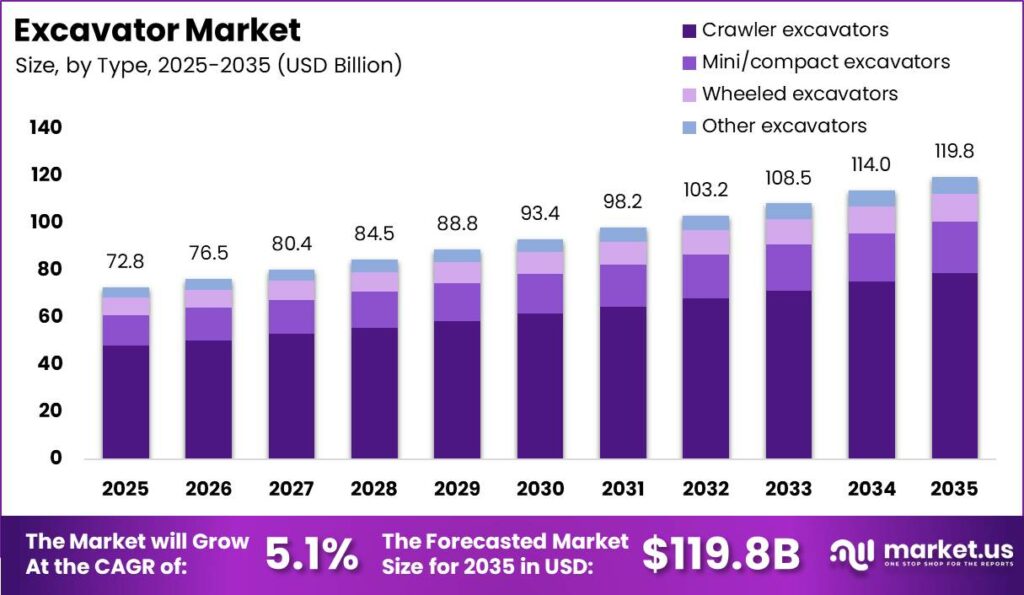
Global Excavator Market size is expected to be worth around USD 119.8 Billion by 2035 from USD 72.8 Billion in 2025, growing at a CAGR of 5.1% during the forecast period 2026 to 2035. This expansion converts multi-year civil works pipelines into steady machine replacement cycles. Fleet buyers gain clearer multi-year CapEx visibility when growth stays near this mid-single-digit path. OEMs that lock framework supply deals early capture volume before price competition intensifies.
Therefore, the excavator market covers tracked and wheeled earthmoving machines sold into construction, mining, utilities, and related site work. Product lines span mini units under 10 tons through large mining shovels above 45 tons. Power trains still center on diesel, while electric and hybrid options enter regulated urban zones. This structure rewards suppliers who pair iron with attachments, telematics, and uptime services.
Key Takeaways
- The market reaches USD 72.8 Billion in 2025 and USD 119.8 Billion by 2035 at a 5.1% CAGR.
- Crawler Excavators lead By Type with a 66.00% share.
- Internal Combustion Engine leads By Power Source with a 94.00% share.
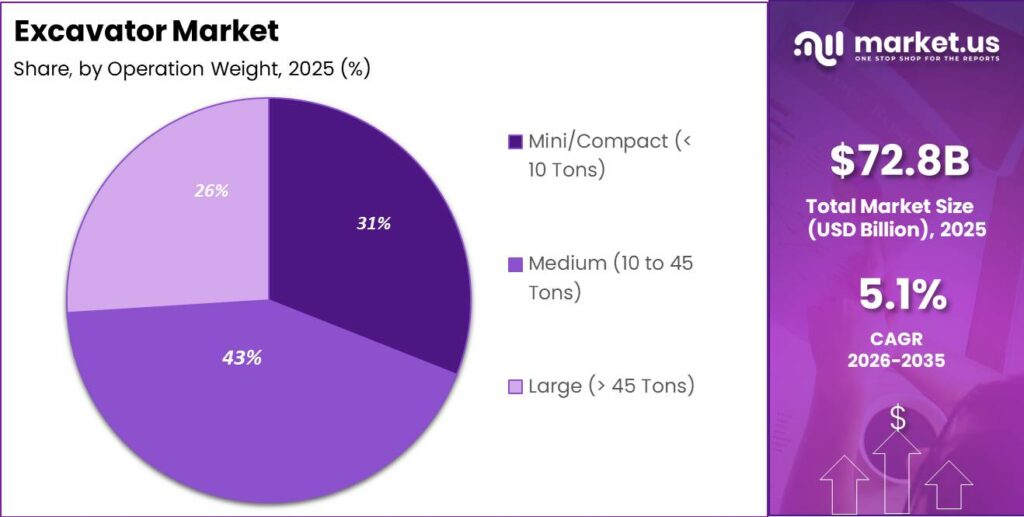
- Medium (10 To 45 Tons) leads By Operation Weight with a 43.00% share.
- Construction leads By End-Use Industry with a 61.00% share.
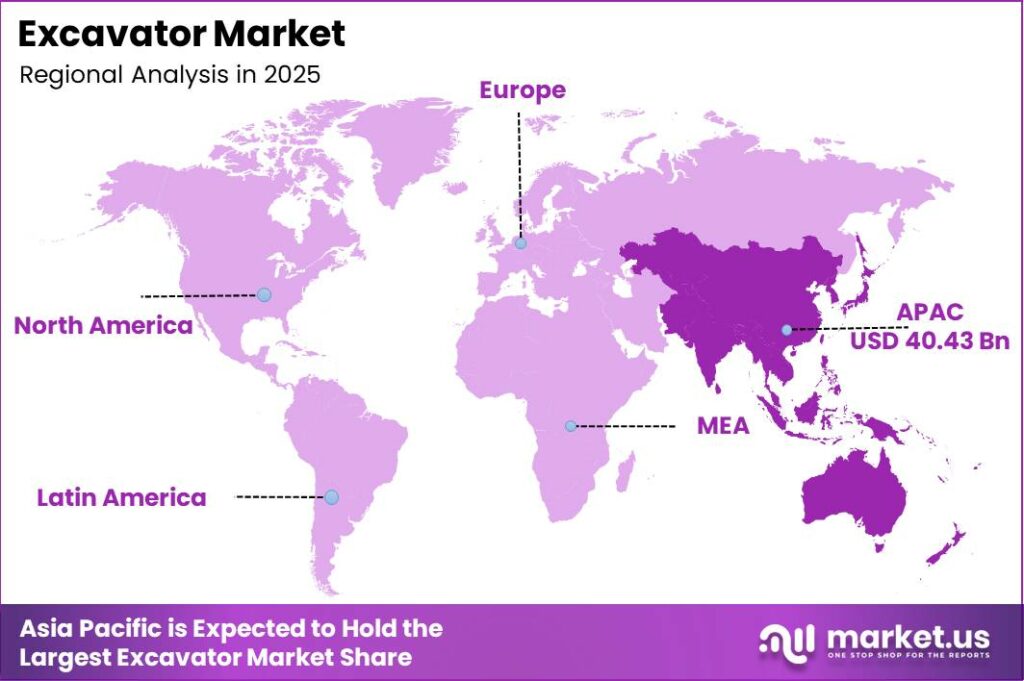
- Asia Pacific leads regionally with a 55.54% share, valued at USD 40.43 Billion.
Government capital programs keep public works on multi-year schedules, so contractors treat excavators as contracted project inputs rather than optional fleet adds. Emission rules in Europe and North America also force diesel fleet retooling toward compliant hydraulics and cleaner power trains. In March 2025, Volvo Construction Equipment expanded commercial rollout of its EC230 Electric excavator across additional European markets. This move links zero-emission zone rules directly to compact machine demand on city sites.
As a result, end-use growth in energy infrastructure feeds higher machine hours on pipeline, pad, and access-road work. According to the U.S. Energy Information Administration, U.S. crude oil production averaged a record 13.2 million barrels per day in 2024. That output supports excavation-heavy energy projects and lifts demand for durable mid and large units. Suppliers tied to energy contractors gain steadier utilization than pure residential builders.
Caterpillar estimates its next generation excavator portfolio helps reduce approximately 2.2 million metric tons of CO₂ emissions annually through lower fuel use. This efficiency gain cuts operating cost for large fleets while meeting stricter nonroad rules. Buyers who standardize on fuel-efficient platforms lock lower lifetime cost before rivals match the specification. This creates a procurement edge for dealers who can prove fuel and carbon savings on live jobs.
Type Analysis
Crawler Excavators dominate with 66.00% due to superior traction on rough terrain.
In 2025, Crawler Excavators held a dominant market position in the By Type segment of Excavator Market, with a 66.00% share. Volvo Construction Equipment states the EC550E crawler excavator delivers up to 35% higher productivity than its predecessor in heavy excavation. Higher output per hour shortens cycle times on mass earthworks and quarry faces. Fleets that standardize on high-traction crawlers protect bid margins when soil conditions turn unstable.
Mini and compact excavators serve tight urban digs, utility trenches, and indoor retrofit work where full-size crawlers cannot enter. China customs data show excavator exports reached USD 3.112 billion from January to April 2025, up 21.75% year on year. Strong export flow signals deep factory capacity feeding both compact and standard lines. Dealers who stock compact units near city depots win short-notice rental and retail orders.
Wheeled excavators move quickly between paved urban sites without lowboy trucks, cutting mobilization cost for municipalities and road crews. India exported over 10,000 excavators to nearly 100 countries in 2024, with export value above USD 600 million. That trade depth shows global appetite for versatile wheeled and crawler formats from cost-competitive plants. Other excavators hold the remaining share collectively and cover specialty demolition and material-handling variants.
Power Source Analysis
Internal Combustion Engine dominates with 94.00% due to long runtime and refueling speed.
In 2025, Internal Combustion Engine held a dominant market position in the By Power Source segment of Excavator Market, with a 94.00% share. U.S. EPA Tier 4 nonroad rules and EU Stage V particle-number limits of 1×10¹² per kWh still shape diesel platform design. Compliant diesel keeps remote mines and long-shift highway jobs running without grid access. OEMs that master aftertreatment reliability defend the largest installed base.
Electric excavators target zero-emission urban zones, indoor work, and low-noise municipal contracts where diesel faces bans. In June 2025, Komatsu commercialized the PC210LCE-11 battery-electric excavator in Europe after customer field trials. Early commercial units give rental fleets a compliant tool for city tenders. Suppliers who secure battery supply and charger partners capture premium urban rentals first.
Hybrid systems recover swing energy and cut fuel burn on repetitive dig and dump cycles without full battery dependence. IEA monitoring links clean construction equipment growth to urban emission rules that already push electric niche lines above 20% annual expansion in leading markets. Hybrids bridge sites that lack high-power charging yet face fuel-cost pressure. Fleet managers trial hybrids as a lower-risk step before full electrification.
Operation Weight Analysis
Medium (10 To 45 Tons) dominates with 43.00% due to balanced power and transportability.
In 2025, Medium (10 To 45 Tons) held a dominant market position in the By Operation Weight segment of Excavator Market, with a 43.00% share. The U.S. Bureau of Labor Statistics counts about 539,500 construction equipment operator jobs, with median pay of USD 58,320 in May 2024. Medium machines match the bulk of general contractor crews and common operator skill sets. OEMs that optimize this class win the highest unit velocity through dealer networks.
Mini and compact units under 10 tons serve residential foundations, landscaping, and utility drops where street access limits mass. BLS projects about 46,200 openings for construction equipment operators each year from 2024 to 2034. Steady operator demand supports high utilization of compact fleets on short urban jobs. Rental houses that densify sub-10-ton inventories capture small contractor spend without long finance cycles.
Large excavators above 45 tons anchor quarry faces and high-volume bulk loading where bucket size drives shift output. Caterpillar’s Cat 6030 hydraulic mining shovel features a 30-tonne bucket payload and 1,230 kW engine output for large-scale mining excavation. That class of iron justifies multi-year mine fleet CapEx when ore grades and strip ratios stay favorable. Mining buyers lock large units early to avoid production bottlenecks at the face.
End-Use Industry Analysis
Construction dominates with 61.00% due to continuous public and private site work.
In 2025, Construction held a dominant market position in the By End-Use Industry segment of Excavator Market, with a 61.00% share. World Bank work on infrastructure investment shows public capital still funds the majority of fixed works in many emerging economies. Roads, rail, and urban redevelopment keep medium crawlers on long hire. OEMs aligned with civil contractors secure the widest repeat order base.
Mining fleets buy heavy hydraulic excavators when copper, iron ore, and bulk commodities justify new pit capacity. USGS data show U.S. mine copper production near 1.1 million tons in 2024, valued around USD 10 billion. Stable metal output supports replacement of high-hour loading tools at the face. Suppliers with mining-duty undercarriage and large buckets defend high average selling prices.
Oil and gas site work needs durable diggers for pads, gathering lines, and access roads in remote corridors. Caterpillar’s Cat 395 Front Shovel supports bucket capacities from 5.6 m³ to 6.5 m³ and operates at 96.3 tonnes for high-production quarry and mining applications. That capacity profile also fits energy earthworks that move large cut volumes per shift. Forestry, agriculture, utilities, and other industries hold the remaining share collectively through narrower duty cycles.
Key Market Segments
By Type
- Mini/Compact Excavators
- Crawler Excavators
- Wheeled Excavators
- Other Excavators
By Power Source
- Internal Combustion Engine
- Electric
- Hybrid
By Operation Weight
- Mini/Compact (less than 10 Tons)
- Medium (10 To 45 Tons)
- Large (greater than 45 Tons)
By End-Use Industry
- Construction
- Mining
- Forestry And Agriculture
- Utilities
- Oil And Gas
- Other Industries
Regional Analysis
Asia Pacific Dominates the Excavator Market with a Market Share of 55.54%, Valued at USD 40.43 Billion
Asia Pacific leads because dense public works pipelines in China, India, and nearby economies convert budget releases into high unit shipments. National statistical construction output and World Bank capital formation trends keep crawler and medium-class demand elevated across the region. Local OEM depth also shortens delivery times versus long import cycles. Global suppliers without Asia assembly risk share loss on price-sensitive tenders.
Europe is a fast-moving arena for electric and intelligent machines as city emission zones tighten equipment choice. In December 2025, Hitachi Construction Machinery established LANDCROS Development Center Europe GmbH in Germany to speed battery-powered and autonomous excavator research. That investment signals lasting European pull for low-emission platforms. OEMs with EU engineering hubs will clear compliance tenders faster than import-only rivals.
North America draws fleet replacement from infrastructure disbursements and mining and energy site work, while Latin America and Middle East and Africa add project-led spikes. Buyers in these regions still favor diesel medium crawlers where fuel logistics beat grid access. Dealers who bundle finance and parts coverage win when interest costs stretch purchase cycles. Regional mix therefore favors flexible production that can swing between compact urban and large resource units.
Key Regions and Countries
North America
- US
- Canada
Europe
- Germany
- France
- The UK
- Spain
- Italy
- Rest of Europe
Asia Pacific
- China
- Japan
- South Korea
- India
- Australia
- Rest of APAC
Latin America
- Brazil
- Mexico
- Rest of Latin America
Middle East and Africa
- GCC
- South Africa
- Rest of MEA
Market Dynamics
Market Opportunity Analysis - Electric platforms, wheeled formats, and secondary regions still leave clear entry room
Electric power source units remain far behind the Internal Combustion Engine majority, so urban zero-emission zones stay open for specialists. Rental fleets need quiet machines for indoor and city-night work that diesel cannot serve. New entrants that pair batteries with charger networks can win municipal tenders before full-line OEMs flood the niche. This creates a focused beachhead rather than a broad share war.
Wheeled excavators sit well below crawler leadership and still fit paved municipal and road-maintenance routes. Contractors value road travel without trailers, which cuts mobilization cost on multi-site urban programs. Challengers that design wheeled packages with quick-attach tools can take share from crawler-only dealers. Regional governments become natural launch accounts for this format.
By contrast, Latin America and Middle East and Africa trail Asia Pacific shipment scale yet run large mining and civil corridors. Project-led buying leaves gaps where local dealer density and finance products are thin. Investors who fund dealer roll-ups and parts hubs capture utilization that pure importers miss. Early service coverage becomes the moat once projects award multi-year fleets.
Mini and compact weight classes also stay underexploited relative to medium-tonnage volume in dense cities. Small contractors and short infrastructure jobs prefer rental over ownership when finance costs stay high. Platforms built for high rental turns and interchangeable attachments fit that buyer better than mining-duty iron. This signals room for pure-play compact specialists beside global full-liners.
Technology and Innovation Landscape - Guidance software, cleaner hydraulics, and smart attachments rewrite fleet economics
Three-dimensional machine control and GNSS-guided excavation cut staking labor and raise first-pass accuracy on complex grades. Trimble states machine control systems eliminate continuous surveying and staking while improving excavation accuracy, productivity, and equipment utilization. Contractors finish earthworks with fewer rework hours and leaner survey crews. OEMs that factory-fit guidance sell higher average transaction values and stickier software renewals.
As reported by Caterpillar, the next generation hydraulic excavator platform reduces CO₂ emissions by up to 30% versus the previous 320D series through fuel and hydraulic gains. Lower fuel burn directly improves total cost of ownership on long highway and quarry shifts. Buyers under carbon reporting rules gain a measurable compliance tool without waiting for full electrification. This reflects a near-term path to greener fleets inside diesel-dominant yards.
Trimble’s excavator productivity study found machine-guided excavation significantly improved productivity compared with conventional methods. Connected platforms also host AI-enabled predictive maintenance that flags hydraulic and undercarriage wear before failures stop the job. Dealers monetize uptime contracts instead of only emergency parts calls. Fleets that adopt predictive alerts protect project schedules and residual values.
Hybrid hydraulic systems and interchangeable smart attachments extend one carrier across digging, breaking, and handling tasks. Attachment flexibility raises hours per chassis for rental houses chasing multi-application contractors. Hybrid recovery of swing energy trims fuel on repetitive cycles where full battery packs remain impractical. Manufacturers who certify broad attachment ecosystems lock customers into their coupler and control stack.
Drivers
Public infrastructure and urbanization spend is the strongest force lifting baseline growth, adding roughly +2.4% to the 5.1% path. Asia Pacific and North America convert multi-year public works into mandated machine hours rather than optional contractor CapEx. India mechanization programs and U.S. nonresidential structure outlays keep medium and crawler orders on contract schedules. OEMs that hold framework deals with public contractors gain multi-year revenue visibility and richer parts attach rates.
Mining fleet modernization, emission-compliant retooling, telematics monetization, and compact urban demand add further upside across Australia, Latin America, Africa, the EU, and East Asia. Each driver shortens replacement cycles or raises utilization on machines already in the field. Sellers who package uptime guarantees with hydraulics and connected services defend margin when unit prices compress. Investors should weight OEMs with public-works exposure and digital fleet tools over pure spot sellers.
| Driver | (~) % Impact on CAGR Forecast | Geographic Relevance | Impact Timeline |
|---|---|---|---|
| Public infrastructure & urbanization spend | +2.4% | Asia Pacific, North America | Short term (2 years or less) |
| Mining & mineral extraction expansion | +1.3% | Australia, Latin America, Africa | Medium term (2 to 4 years) |
| Fleet replacement & emission-compliant retooling | +1.0% | EU, North America | Short term (2 years or less) |
| Telematics-enabled fleet monetization | +0.8% | Global | Medium term (2 to 4 years) |
| Compact & wheeled excavator urban demand | +0.7% | Europe, East Asia | Short term (2 years or less) |
Restraints
High interest rates on equipment finance remain the sharpest drag, removing an estimated -1.8% from baseline growth. Roughly half of construction equipment buys rely on debt, and loans dominate well over 50% of the finance channel. Elevated policy rates through 2024 and 2025 lifted costs on 48-to-72-month loans for small and mid-sized contractors. Many buyers deferred compact and mid-tonnage orders, freezing current-period new-unit sales.
Consequently, OEMs face margin pressure on captive finance arms and must fund rate buy-downs that erode net price. Elevated compliant-machine stickers, tariff pass-through, softer residential starts, and used-equipment gluts add further brakes in the EU, North America, China, and Southeast Asia. Dealers delay yard CapEx when showroom turns slow. Participants who expand rental and short-term hire options keep machines working while purchase cycles stretch.
| Restraint | (~) % Impact on CAGR Forecast | Geographic Relevance | Impact Timeline |
|---|---|---|---|
| High interest rates on equipment finance | -1.8% | Global, emerging markets acute | Short term (2 years or less) |
| Elevated upfront cost of compliant machines | -1.1% | EU, North America | Short term (2 years or less) |
| Tariff & trade barrier cost pass-through | -0.9% | North America, China | Medium term (2 to 4 years) |
| Residential construction slowdown | -0.7% | North America, Europe | Short term (2 years or less) |
| Used-equipment glut suppressing new sales | -0.5% | China, Southeast Asia | Medium term (2 to 4 years) |
Challenges
The shortage of certified heavy-equipment operators is the heaviest structural friction, cutting an estimated -1.2% from maximum growth. Construction needed nearly 454,000 additional workers in 2025, while excavation operator roles showed a shortfall above 22,000 against roughly 467,000 employed operators in U.S. labor data. Retirements outpace training pipelines, so fleets sit idle even when project demand exists. Extended timelines cap how fast contractors absorb new iron.
This friction opens a revenue path in operator-assist automation, semi-autonomous grade control, and dealer training academies. Battery and power-electronics limits, weak jobsite charging, rare-earth and hydraulic sourcing risk, and cybersecurity loads add global drag. OEMs that productize simpler controls lower the skill barrier and protect aftermarket hours. Investors should favor platforms that sell assist software and training with every base machine.
| Challenge | (~) % CAGR Friction Drag | Geographic Relevance | Mitigation Horizon |
|---|---|---|---|
| Skilled operator talent deficit | -1.2% | North America, Europe, Gulf | Long term (4 years or more) |
| Battery & power-electronics supply drag | -0.9% | Global | Medium term (2 to 4 years) |
| Charging & jobsite grid infrastructure gap | -0.7% | EU, North America | Long term (4 years or more) |
| Rare-earth & hydraulic component sourcing | -0.6% | Global, China-dependent | Medium term (2 to 4 years) |
| Data interoperability & cybersecurity load | -0.4% | Global | Medium term (2 to 4 years) |
Opportunities
Battery-electric excavators are the largest untapped upside, estimated near +2.0% above baseline in the EU, North America, and Japan. Commercial use still sits at rental and pilot scale, with 20-ton-class battery models entering Japanese and European rental channels from late 2023 and broadening through 2025. Electric construction equipment in restricted urban zones tracks growth above 20% annually from IEA clean-technology monitoring. Higher stickers offset through lower energy and maintenance cost, expanding gross margin versus diesel.
This means early movers can lock premium urban rental fleets before electric platforms commoditize under tighter EU nonroad rules. Equipment-as-a-service, autonomous upsell in mining regions, aftermarket retrofit data platforms, and emerging-market dealer consolidation add further upside. Each path shifts revenue from one-time iron sales toward recurring utilization fees. Companies that build charger ecosystems and remote-operation stacks will set the next profit pool.
| Opportunity | (~) % Potential CAGR Upside | Geographic Relevance | Execution Window |
|---|---|---|---|
| Battery-electric excavator white space | +2.0% | EU, North America, Japan | Medium term (2 to 4 years) |
| Equipment-as-a-service & rental monetization | +1.4% | Global, urban markets | Medium term (2 to 4 years) |
| Autonomous & remote-operation upsell | +1.1% | Australia, North America mining | Long term (4 years or more) |
| Aftermarket parts & retrofit data platforms | +0.9% | Global | Medium term (2 to 4 years) |
| Emerging-market dealer roll-up & M&A | +0.7% | Africa, Southeast Asia, LatAm | Long term (4 years or more) |
Key Company Insights
Caterpillar Inc. anchors large construction and mining fleets with deep dealer coverage and next-generation hydraulics. Caterpillar reports the Cat 336 delivers up to 10% higher production efficiency and up to 15% lower maintenance costs than the prior generation. In April 2025, Caterpillar introduced the Cat 395 Front Shovel for quarrying and mining with higher durability and output. That mix defends share where uptime and bucket productivity decide awards.
Komatsu Ltd. competes through intelligent machine control and surface-mining scale that few rivals match. Komatsu’s PC8000-11 surface mining excavator offers operating weight up to 773 tonnes, 3,000 kW engine power, and a 42 m³ bucket for high-production mines. This heavy iron locks multi-year pit fleets and high parts intensity. Komatsu’s control software edge also raises switching costs once grade automation is embedded on site.
Key Players
- Caterpillar Inc.
- Komatsu Ltd.
- Hitachi Construction Machinery Co., Ltd.
- Volvo Construction Equipment
- Sany Heavy Industry Co., Ltd.
- Xcmg Construction Machinery Co., Ltd.
- Liebherr Group
- Deere & Company
- Hd Hyundai Infracore Co., Ltd. (Develon)
- J.C. Bamford Excavators Ltd. (Jcb)
- Kobelco Construction Machinery Co., Ltd.
- Hd Hyundai Construction Equipment Co., Ltd.
- Cnh Industrial N.V. (Case Construction Equipment)
- Guangxi Liugong Machinery Co., Ltd.
- Zoomlion Heavy Industry Science & Technology Co., Ltd.
Recent Developments
- January 2025: Komatsu launched the PC220LCi-12 intelligent Machine Control hydraulic excavator with next-generation 3D machine guidance and semi-automatic excavation capabilities.
- April 2025: HD Hyundai Construction Equipment unveiled next-generation HX and HW excavator models at Bauma 2025, incorporating AI-assisted features and advanced safety technologies.
- May 2025: Hitachi Construction Machinery introduced its LANDCROS brand strategy to strengthen development of advanced construction equipment, including next-generation excavators.
- September 2025: HD Hyundai Construction Equipment officially launched its Next Generation crawler and wheeled excavator lineup with improved fuel efficiency and intelligent machine technologies.
Geopolitical Impact Analysis
UNCTAD reports that average U.S. tariff rates rose from about 2.8% before 2025 to over 20% by early September 2025. Steel and aluminum duties moved to 50% in mid-2025, lifting costs for booms, sticks, undercarriage steel, and fabricated frames. Excavator plants that import plate, castings, or finished derivatives face higher bill-of-material cost and longer landed lead times. OEMs with local fabrication capacity protect quote stability when duties swing.
Consequently, WTO trade outlook material and related policy notes highlight stacked industrial tariffs that ripple into nonroad machinery supply chains. Shipping and component rerouting add weeks when hydraulic valves, semiconductors, and rare-earth motors shift away from single-country sources. Dealers must reprice machines and spare parts faster or absorb margin hits on fixed bid fleets. Regional dual-sourcing of steel fabrications and hydraulics becomes a core risk hedge for investors.
Report Scope
| Report Features | Description |
|---|---|
| Market Value (2025) | USD 72.8 Billion |
| Forecast Revenue (2035) | USD 119.8 Billion |
| CAGR (2026-2035) | 5.1% |
| Base Year for Estimation | 2025 |
| Historic Period | 2020-2024 |
| Forecast Period | 2026-2035 |
| Report Coverage | Revenue Forecast, Market Dynamics, Market Opportunity Analysis, Technology and Innovation Landscape, Competitive Landscape, Recent Developments |
| Segments Covered | By Type (Mini/Compact Excavators, Crawler Excavators, Wheeled Excavators, Other Excavators), By Power Source (Internal Combustion Engine, Electric, Hybrid), By Operation Weight (Mini/Compact (less than 10 Tons), Medium (10 To 45 Tons), Large (greater than 45 Tons)), By End-Use Industry (Construction, Mining, Forestry And Agriculture, Utilities, Oil And Gas, Other Industries) |
| Regional Analysis | North America (US and Canada), Europe (Germany, France, The UK, Spain, Italy, and Rest of Europe), Asia Pacific (China, Japan, South Korea, India, Australia, and Rest of APAC), Latin America (Brazil, Mexico, and Rest of Latin America), Middle East and Africa (GCC, South Africa, and Rest of MEA) |
| Competitive Landscape | Caterpillar Inc., Komatsu Ltd., Hitachi Construction Machinery Co., Ltd., Volvo Construction Equipment, Sany Heavy Industry Co., Ltd., Xcmg Construction Machinery Co., Ltd., Liebherr Group, Deere & Company, Hd Hyundai Infracore Co., Ltd. (Develon), J.C. Bamford Excavators Ltd. (Jcb), Kobelco Construction Machinery Co., Ltd., Hd Hyundai Construction Equipment Co., Ltd., Cnh Industrial N.V. (Case Construction Equipment), Guangxi Liugong Machinery Co., Ltd., Zoomlion Heavy Industry Science & Technology Co., Ltd. |
| Customization Scope | Customization for segments, region / country-level will be provided. Additional customization can be done based on requirements. |
| Purchase Options | We have three licenses to opt for: Single User License | Multi-User License (Up to 5 Users) | Corporate Use License (Unlimited User and Printable PDF) |





































