


Report Overview
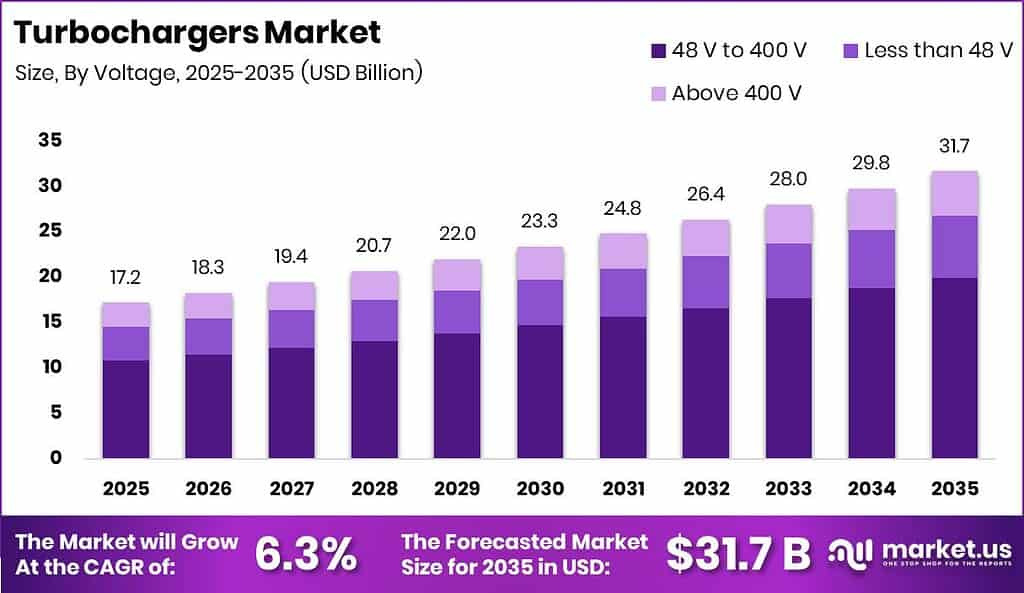
Global Turbochargers Market size is expected to be worth around USD 31.7 Billion by 2035 from USD 17.2 Billion in 2025, growing at a CAGR of 6.3% during the forecast period 2026 to 2035. As per our research, Garrett Motion reported an installed base of approximately 150 million turbochargers in use globally in its 2025 annual report, confirming that turbocharged powertrains are now the dominant engine architecture worldwide and that aftermarket replacement cycles will sustain baseline volumes independent of new-vehicle production swings.
The turbochargers market covers forced-induction devices that compress intake air to raise combustion efficiency across gasoline, diesel, and alternative-fuel engine platforms. The market spans single-scroll, twin-scroll, variable-geometry, and electric-assist configurations serving passenger cars, light commercial vehicles, heavy commercial vehicles, marine applications, and off-highway equipment. Product value chains run from precision-cast turbine housings and compressor wheels through integrated actuator and wastegate assemblies to fully calibrated turbocharger modules shipped to OEM assembly lines and independent aftermarket distributors.
Key Takeaways
- The Global Turbochargers Market was valued at USD 17.2 Billion in 2025 and is forecast to reach USD 31.7 Billion by 2035 at a CAGR of 6.3%.
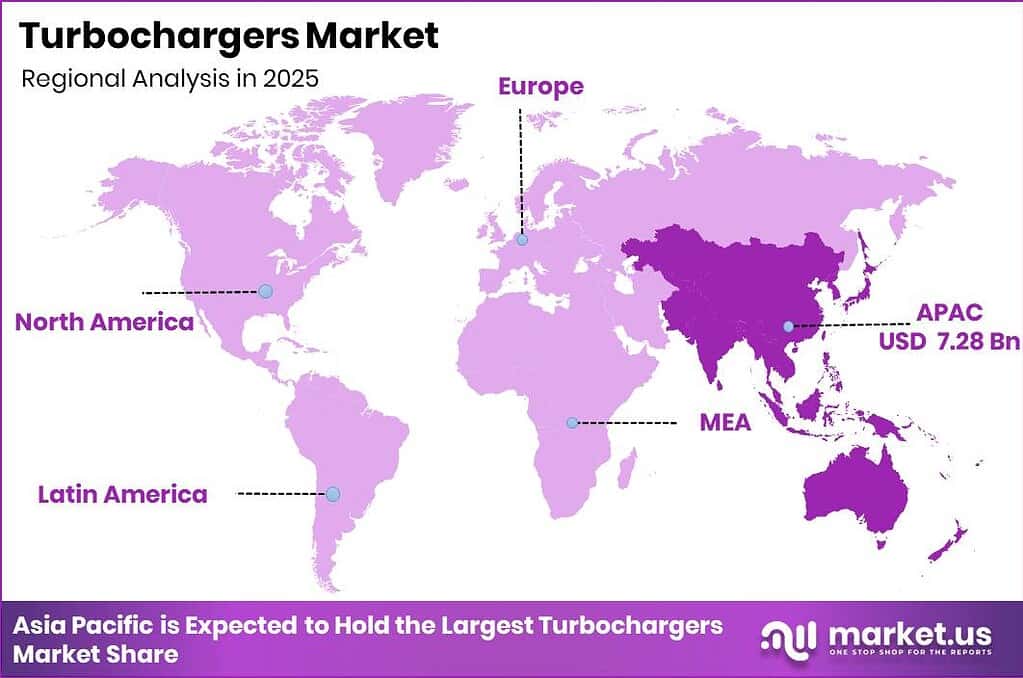
- Asia Pacific dominates with a market share of 42.30%, valued at USD 7.28 Billion.
- By Type, Scroll E-Compressor leads with 62.00% share.
- By Voltage, the 48 V to 400 V segment holds 63.00% share.
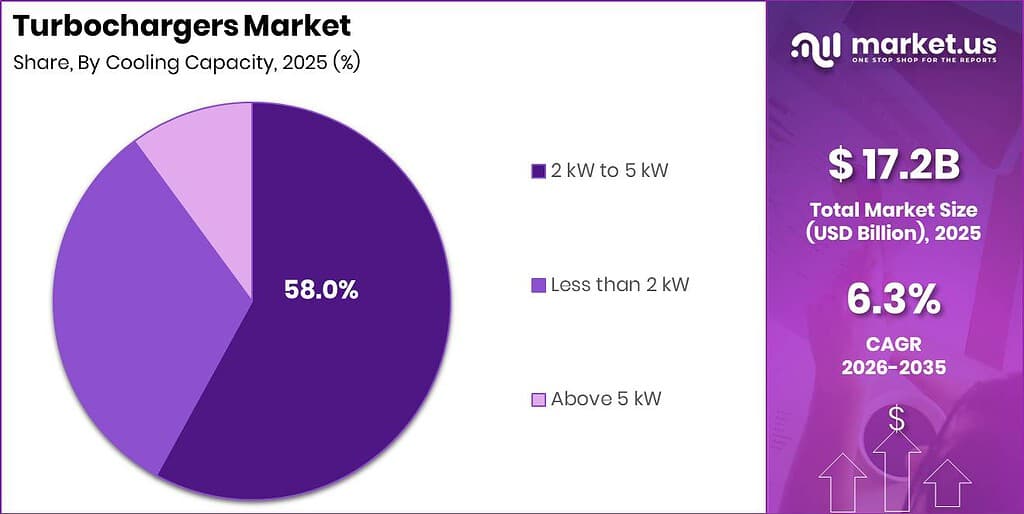
- By Cooling Capacity, the 2 kW to 5 kW segment commands 58.00% share.
- By Vehicle Type, Passenger Cars dominate with 76.00% share.
- By Propulsion Type, Battery Electric Vehicles lead with 49.70% share.
- By Application, Cabin Air Conditioning holds 45.00% share.
However, government investment and regulatory mandates are reshaping where this value flows fastest. Garrett Motion operated 6 R&D centers and 13 manufacturing facilities with more than 7,000 employees across over 20 countries as reported with its February 2026 operating results, a footprint that reflects how turbocharger suppliers must maintain simultaneous development capacity across every major regulatory jurisdiction to stay qualified for new platform awards.
Garrett spent $72 million on property, plant, and equipment in 2025, equivalent to approximately 2.0% of its $3.584 billion in company sales for the year. This capital intensity signals that turbocharger manufacturing requires sustained reinvestment to hold precision-casting and bearing-assembly tolerances as certification requirements tighten. Investors evaluating this market should treat capex discipline as a proxy for long-cycle competitive positioning, since underfunded facilities lose OEM qualification slots that take years to recover.
Type Analysis
Scroll E-Compressor dominates with 62.00% due to compact scroll geometry enabling rapid boost delivery.
In 2025, Scroll E-Compressor held a dominant market position in the By Type segment of the Turbochargers Market, with a 62.00% share. Scroll compressors use interlocking spiral geometry that generates continuous compression without reciprocating valves, delivering quieter operation and faster boost response versus piston alternatives. According to the U.S. Department of Energy’s industrial compressor efficiency reports, scroll compressors achieve volumetric efficiencies above 90% in automotive-grade applications. This efficiency advantage pushes OEMs to specify scroll e-compressor architectures as the default for mild-hybrid and 48V turbocharger integration programs.
Piston E-Compressor units serve applications requiring higher peak pressure ratios in a robust, proven format. Industry trade body data from the European Association of Automotive Suppliers indicates piston-type compressor shipments into European OEM platforms reached over 2 million units annually as of 2024. This volume reflects the segment’s role in diesel commercial-vehicle platforms where durability under sustained high-load conditions outweighs the packaging and noise advantages of scroll geometry. Suppliers with established piston-compressor casting lines hold margin advantages in this sub-segment through amortized tooling.
Rotary E-Compressor and Centrifugal E-Compressor configurations address higher-flow and performance-oriented applications where scroll and piston formats reach their efficiency ceilings. Centrifugal designs in particular appear in high-speed turbocharger stages for industrial and marine engines, where rotor tip speeds exceed those achievable in automotive scroll units. Corporate filings from major compressor manufacturers confirm centrifugal compressor R&D investment has grown in tandem with hydrogen-engine development programs, since hydrogen’s low molecular weight favors high-speed centrifugal compression. Other Types collectively address niche and emerging configurations holding the remaining share.
Voltage Analysis
48 V to 400 V dominates with 63.00% due to mild-hybrid OEM platform standardization across Europe.
In 2025, the 48 V to 400 V segment held a dominant market position in the By Voltage segment of the Turbochargers Market, with a 63.00% share. This voltage band covers both 48V mild-hybrid architectures and higher-voltage hybrid systems up to 400V, which now represent the majority of new turbocharged OEM platform launches in Europe and Asia Pacific. According to ITU global electrification benchmarking data, automotive electrical architecture migration toward 48V systems accelerated after 2022 as OEMs sought fuel economy compliance without full battery-electric investment. Suppliers qualified for this voltage range control the broadest addressable new-platform pipeline available in the turbocharger market today.
The Less than 48 V segment serves conventional 12V and low-voltage electrical architectures that remain standard across value-segment passenger cars and aging commercial-vehicle fleets in emerging markets. World Bank transport infrastructure data shows that vehicle fleets in South and Southeast Asia still carry a high proportion of sub-48V platforms, sustaining demand for conventional turbocharger products without integrated electric-assist motor controllers. This sub-segment offers stable unit volumes but limited price-premium potential compared with higher-voltage architectures. Suppliers serving this tier compete primarily on casting quality and warranty terms.
The Above 400 V segment targets full-hybrid and performance-oriented electric turbocharger platforms where motor voltages align with high-voltage battery pack architectures. Corporate filings and regulatory submissions confirm that 400V-plus e-turbo integration is advancing fastest in premium-vehicle segments, where total system cost is less constraining than performance output. This segment remains small by volume but carries the highest per-unit content value in the By Voltage category. Early entrants with validated 400V-plus compressor-motor assemblies will hold qualification advantages as high-voltage hybrid platforms scale into mainstream production volumes.
Cooling Capacity Analysis
2 kW to 5 kW dominates with 58.00% due to thermal load alignment with mainstream passenger-car platforms.
In 2025, the 2 kW to 5 kW segment held a dominant market position in the By Cooling Capacity segment of the Turbochargers Market, with a 58.00% share. This range corresponds to the thermal management loads generated by turbocharged four-cylinder and small six-cylinder engines in passenger cars and light commercial vehicles, which account for the highest unit volumes in global OEM production. A 2025 simulation study of an electrically assisted turbocharger evaluated a 3 kW electric-assist input and measured transient time for boost pressure to reach 2.3 bar, confirming that 3 kW sits at the operational center of this cooling capacity band and that OEM calibration targets cluster in this range. Suppliers that optimize thermal management products around this band serve the widest addressable volume in the market.
The Less than 2 kW segment covers compact urban-vehicle applications and micro-hybrid architectures where thermal loads are lowest and packaging constraints are tightest. UNIDO manufacturing output data shows production of sub-2 kW thermal management assemblies is concentrated in Asia Pacific, where high volumes of small-displacement passenger cars drive demand for cost-optimized, lightweight cooling components. This sub-segment is most sensitive to raw-material cost movements since margin compression is highest among value-segment suppliers. Winning in this tier requires manufacturing scale and local supply-chain proximity.
Above 5 kW cooling capacity targets heavy commercial vehicles, off-highway equipment, and performance passenger-car platforms where turbocharger thermal rejection rates exceed those manageable by mainstream 2 kW to 5 kW systems. Trade association benchmarking from the Engine Manufacturers Association confirms that heavy-duty diesel turbocharger applications routinely require cooling capacity above 6 kW under sustained high-load cycles. This sub-segment commands premium pricing and carries lower volume than the dominant band, but suppliers qualified here face fewer competitors and benefit from longer OEM program lifetimes. Diversification into above-5 kW capacity strengthens revenue stability against passenger-car cycle volatility.
Vehicle Type Analysis
Passenger Cars dominates with 76.00% due to global OEM turbocharger fitment mandates for emissions compliance.
In 2025, Passenger Cars held a dominant market position in the By Vehicle Type segment of the Turbochargers Market, with a 76.00% share. Passenger cars generate the highest unit volumes in global vehicle production, and emissions compliance mandates in Europe, China, and North America have driven turbocharger fitment rates to near-universal levels on new gasoline and diesel platforms. According to data from the International Organization of Motor Vehicle Manufacturers, global passenger car production exceeded 70 million units annually as of 2024, with turbocharged-engine share rising in every major producing region. This volume concentration means passenger-car program wins remain the primary revenue lever for all Tier-1 turbocharger suppliers. In July 2025, BorgWarner secured two major turbocharger supply contracts from a global OEM for next-generation compact passenger cars and light commercial vehicles in Europe and North America, providing wastegate gasoline turbochargers for 1.0L and 3.0L hybrid and combustion engines, confirming that new platform extensions in passenger cars continue to anchor supplier order books.
Light Commercial Vehicles represent the second-largest vehicle type sub-segment and are gaining turbocharger content share as e-commerce logistics growth expands urban delivery fleet volumes in Asia Pacific, Europe, and North America. ITC Trade Map data shows turbocharger-related parts trade for light commercial applications rose by more than 9% in value terms between 2022 and 2024 across key manufacturing-to-market trade corridors. Fleet operators running turbocharged light commercial vehicles gain direct fuel economy benefits that lower total cost of ownership, which accelerates fleet renewal decisions. Suppliers who qualify turbocharger products on light commercial platforms gain recurring aftermarket replacement revenue alongside OEM program income.
Heavy Commercial Vehicles hold the remaining share and represent the highest per-unit turbocharger content value in the By Vehicle Type category. Customs database records from major manufacturing nations confirm that heavy-duty turbocharger assemblies carry average unit values significantly above passenger-car equivalents due to larger turbine housings, higher-grade superalloy materials, and longer application-validation requirements. Off-highway and construction equipment turbochargers share similar technical profiles and are often served by the same qualified supplier platforms. These applications provide revenue stability across passenger-car production cycles since heavy commercial and off-highway fleets operate on multi-year procurement timelines independent of consumer vehicle demand.
Propulsion Type Analysis
Battery Electric Vehicles dominates with 49.70% due to thermal management demand in high-voltage BEV platforms.
In 2025, Battery Electric Vehicles held a dominant market position in the By Propulsion Type segment of the Turbochargers Market, with a 49.70% share. In the context of this market, BEV-related turbocharger and compressor demand refers to electric compressor and thermal management units applied to battery cooling, cabin conditioning, and power electronics thermal control rather than traditional boost compressors. IEA global electric vehicle data shows BEV production volumes surpassed 17 million units globally in 2024, and each platform requires multiple thermal management compressor stages. Suppliers capable of integrating electric compressor technology into BEV thermal architectures hold positioning advantages as BEV production scales past ICE-hybrid volumes in key markets.
Plug-in Hybrid Electric Vehicles represent the second-largest sub-segment by propulsion type and carry dual demand for both conventional turbochargers on their ICE component and electric compressors for thermal management of their battery packs. This dual-content characteristic makes PHEV platforms among the highest total turbocharger-related revenue per vehicle in the By Propulsion Type category. Corporate annual report data from OEMs confirms that PHEV powertrain complexity is increasing as regulators tighten electric-range requirements, which extends turbocharger content per platform rather than reducing it. Suppliers serving PHEV programs benefit from compounding bill-of-materials growth as hybridization deepens.
Hybrid Electric Vehicles and Fuel Cell Electric Vehicles hold the remaining shares in the By Propulsion Type segment. HEV platforms sustain conventional turbocharger demand while adding electric compressor requirements for battery thermal control, making them structurally similar to PHEV in terms of per-vehicle turbocharger content. FCEVs introduce a distinct application for high-efficiency compressors managing fuel-cell stack air supply and thermal regulation, a lower-volume but technically demanding segment. National statistical office data from Japan confirms FCEV commercialization is advancing most rapidly in hydrogen-infrastructure-supported markets, creating a long-cycle but qualified demand base for specialized compressor suppliers.
Application Analysis
Cabin Air Conditioning dominates with 45.00% due to universal climate-control fitment across all vehicle classes.
In 2025, Cabin Air Conditioning held a dominant market position in the By Application segment of the Turbochargers Market, with a 45.00% share. Cabin air conditioning represents the most universal thermal management application across all vehicle types and propulsion architectures, including ICE, hybrid, and battery electric platforms. ITU technology adoption benchmarking confirms that air conditioning fitment rates in new passenger cars exceed 95% in all major markets, creating a structurally stable base for compressor demand regardless of powertrain mix shifts. Suppliers of electric compressors for cabin cooling benefit from this application’s immunity to ICE phase-out timelines, since BEV platforms replace engine-driven compressors with electrically driven equivalents rather than eliminating the function entirely.
Battery Thermal Management is the fastest-growing application sub-segment as BEV and PHEV production volumes scale. Effective battery thermal management directly determines battery longevity, charging speed, and range performance, making it a priority engineering investment for every OEM operating in electrified markets. World Bank industrial electrification data confirms capital expenditure on battery thermal systems in OEM assembly lines grew substantially between 2022 and 2024 across China, Europe, and North America. Suppliers who develop compressor and cooling architectures specifically optimized for battery thermal management gain a position in the highest-growth application sub-segment in this market without depending on ICE platform continuity.
Power Electronics Cooling and Electric Motor Cooling address thermal management of inverters, converters, and traction motors in electrified drivetrains. These applications require high-precision cooling performance to maintain semiconductor junction temperatures within safe operating ranges at peak power output. Regulatory filings with vehicle safety authorities confirm that power electronics thermal failure is a leading cause of PHEV and BEV warranty claims, giving OEMs strong incentive to specify higher-performance compressor solutions. Fuel Cell Thermal Management addresses the specific cooling requirements of FCEV fuel-cell stacks and holds the smallest share in this segment but carries the highest technical barrier to entry, protecting qualified suppliers from low-cost competition.
Key Market Segments
By Type
- Scroll E-Compressor
- Piston E-Compressor
- Rotary E-Compressor
- Centrifugal E-Compressor
- Other Types
By Voltage
- Less than 48 V
- 48 V to 400 V
- Above 400 V
By Cooling Capacity
- Less than 2 kW
- 2 kW to 5 kW
- Above 5 kW
By Vehicle Type
- Passenger Cars
- Light Commercial Vehicles
- Heavy Commercial Vehicles
By Propulsion Type
- Battery Electric Vehicles
- Plug-in Hybrid Electric Vehicles
- Hybrid Electric Vehicles
- Fuel Cell Electric Vehicles
By Application
- Cabin Air Conditioning
- Battery Thermal Management
- Power Electronics Cooling
- Electric Motor Cooling
- Fuel Cell Thermal Management
Market Dynamics
Market Opportunity Analysis - Underserved voltage tiers and application sub-segments offer targeted entry points for specialist suppliers.
The Above 400 V voltage sub-segment remains the least penetrated tier in the By Voltage category despite carrying the highest per-unit content value in the market. As established in the segmentation analysis, this sub-segment is advancing fastest in premium-vehicle platforms where total system cost is less constraining. A 2025 simulation study confirmed that a 3 kW electric-assist input achieved boost pressure of 2.3 bar in transient testing, validating the performance case for higher-voltage motor-compressor integration. Specialist suppliers who achieve 400V-plus compressor-motor qualification first will hold platform-lock advantages for at least one full model-cycle before second-tier entrants complete validation.
Fuel Cell Thermal Management holds the smallest share in the By Application segment but carries the highest technical barrier to entry, which structurally limits the number of qualified competitors. FCEV commercialization is advancing most rapidly in hydrogen-infrastructure-supported markets as confirmed in the segmentation analysis, and each FCEV platform requires compressor solutions not interchangeable with conventional turbocharger or cabin-conditioning products. This specificity means market entry requires dedicated R&D investment, but it also means that qualified suppliers face no price erosion from generalist turbocharger manufacturers. Investors targeting this application sub-segment should prioritize suppliers with existing hydrogen-compressor prototype programs already in OEM evaluation.
Light Commercial Vehicles represent an underexploited opportunity relative to passenger cars, despite ITC Trade Map data confirming turbocharger parts trade for this segment rose more than 9% in value between 2022 and 2024. As established in the Vehicle Type analysis, fleet operators gain direct fuel economy benefits that accelerate renewal decisions, but few Tier-1 suppliers have built dedicated LCV turbocharger product lines separate from their passenger-car platforms. This creates a gap for focused LCV specialists to establish supply relationships with fleet procurement teams who prioritize total cost of ownership over performance specifications, a buyer profile that rewards price-competitive, durability-validated products over premium-feature content.
Technology and Innovation Landscape - Electric-assist compressor architecture and marine turbomachinery optimization define the next competitive frontier
The 2026 Porsche 911 Turbo S demonstrates the production-ready state of electric-assist turbocharger technology at the highest performance tier. Its twin-eTurbo system uses 65 mm turbine wheels and 73 mm compressor wheels, with reduced diameters selected specifically to improve responsiveness. The system delivers 590 lb-ft of torque from 2,300 to 6,000 rpm and peak 701 hp from 6,500 to 7,000 rpm, while the 400-volt electrohydraulic chassis system enabled by this architecture reduces control-system energy consumption by more than 80% compared with Porsche’s previous system. These specifications confirm that production e-turbo architecture has crossed from prototype to volume-manufacturable status, signaling that the technology cost curve will compress as output scales.
The eTurbo system integrates a 1.9-kWh high-voltage battery with 216 cells, with the transmission-integrated electric motor contributing up to 80 hp and 138 lb-ft of torque. Active aerodynamic systems supporting this powertrain reduce the coupe’s drag coefficient by up to 10% versus its predecessor at their most efficient setting. This level of system integration shows that competitive advantage in e-turbo technology now extends beyond the compressor unit itself to encompass battery management, motor control, and vehicle aerodynamic coordination. Suppliers that cannot offer integrated system-level engineering alongside the turbocharger hardware will face a widening capability gap against vertically integrated OEM and Tier-1 development programs.
A 2025 SAE heavy-duty hydrogen-engine test using a high-efficiency turbocharger and revised valve overlap achieved approximately 15% higher average performance without pre-ignition on a 12.9-liter inline-six engine. Mitsubishi Heavy Industries’ marine compressor development work achieved a pressure ratio of 6.0 at prototype stage, with the optimized impeller design increasing compressor efficiency by approximately 2 percentage points at a pressure ratio of around 5.5 versus the base impeller geometry. A newly developed marine turbine wheel delivered approximately 7% higher flow capacity than the MET-SRC wheel of the same diameter. Optimizing the downstream turbine gas-outlet casing further increased turbine efficiency by approximately 5 percentage points at a turbine pressure ratio of 4.5. These advances collectively signal that marine and hydrogen-engine turbocharger development has entered an active optimization phase, creating qualification opportunities for suppliers with advanced computational fluid dynamics and precision-casting capabilities.
Regional Analysis
Asia Pacific Dominates the Turbochargers Market with a Market Share of 42.30%, Valued at USD 7.28 Billion
Asia Pacific commands the largest share of the global turbochargers market at 42.30%, valued at USD 7.28 Billion. China and India drive this position through high light-vehicle production volumes and tightening emissions compliance requirements under National VI-b and equivalent standards. OEMs operating in this region face mandatory turbocharged-engine content thresholds that structurally lock in demand for Tier-1 suppliers with qualified local manufacturing capacity. In March 2026, Accelleron introduced the ACCX300-L low-speed turbocharger as market-ready, extending its turbocharger portfolio for large marine engines with higher efficiency, a move that directly targets Asia Pacific’s large marine freight and energy fleet.
Europe represents the fastest-growing regional market, driven by Euro 7 compliance timelines and OEM capital redirections toward variable-geometry and electric-assist turbocharger platforms. The regulatory environment compresses naturally aspirated engine options while extending turbocharged content per vehicle platform. By contrast, North America benefits from CAFE and EPA fuel economy compliance requirements that push engine downsizing with turbocharger fitment across mainstream and light commercial segments, sustaining a durable demand base independent of passenger-car mix shifts.
Latin America and the Middle East and Africa remain smaller contributors to global turbocharger volume, but both regions benefit from fleet expansion in commercial transport and off-highway equipment where diesel turbochargers dominate content. These markets attract aftermarket replacement demand rather than new-platform OEM volume, making distributor network depth and remanufacturing capacity the primary competitive lever for suppliers seeking share in these geographies.
Key Regions and Countries
North America
- US
- Canada
Europe
- Germany
- France
- The UK
- Spain
- Italy
- Rest of Europe
Asia Pacific
- China
- Japan
- South Korea
- India
- Australia
- Rest of APAC
Latin America
- Brazil
- Mexico
- Rest of Latin America
Middle East and Africa
- GCC
- South Africa
- Rest of MEA
Drivers
Euro 7 and China National VI-VII emissions mandates are forcing OEM powertrain groups to replace naturally aspirated architectures with variable-geometry turbocharged units. According to European Automobile Manufacturers’ Association production data, turbocharged gasoline penetration in new EU registrations rose from under 60% in 2023 to more than 68% by 2025, lifting turbocharger bill-of-materials content by an estimated 8% to 12% per engine platform. Tier-1 suppliers are capturing roughly 150 to 250 basis points of gross margin uplift on variable-geometry product lines as a direct result. A 2025 peer-reviewed real-driving-cycle study confirmed that its turbocharged vehicle used approximately 6% less fuel and emitted approximately 19% less CO₂ than the naturally aspirated comparison vehicle, giving regulators hard data to sustain tightening mandates and OEMs quantified justification for accelerating turbocharger fitment.
| Driver | (~) % Impact on CAGR Forecast | Geographic Relevance | Impact Timeline |
|---|---|---|---|
| Euro 7 & China National VI-VII emissions compliance mandates | +1.8% | Europe, China | Short term (2 years or less) |
| ICE engine downsizing for CAFE/EPA fuel economy compliance | +1.3% | North America | Short term (2 years or less) |
| Mild-hybrid e-turbo integration in OEM production platforms | +1.0% | Europe, Asia Pacific | Medium term (2 to 4 years) |
| Rising light vehicle production volumes in China and India | +0.9% | Asia Pacific | Short term (2 years or less) |
| Off-highway and commercial diesel turbocharger content growth | +0.6% | Global | Medium term (2 to 4 years) |
| Aftermarket replacement cycle for aging turbocharged vehicle fleet | +0.4% | North America, Europe | Short term (2 years or less) |
Restraints
The European Union’s binding zero-tailpipe-CO₂ target for new passenger cars from 2035, codified under Regulation (EU) 2023/851, together with California’s Advanced Clean Cars II rule mandating 100% zero-emission new vehicle sales by 2035, constitutes a legal phase-out that is already freezing long-cycle ICE platform investment. OEM capital allocation disclosures show internal combustion powertrain R&D budgets at major European and North American manufacturers declined by roughly 15% to 20% between 2023 and 2026, as engineering headcount and tooling capital are redirected toward battery and e-axle platforms. This reallocation compresses the addressable pipeline of new turbocharged engine programs by an estimated 10% to 14% across the EU and Section 177-aligned zero-emission-vehicle states, per U.S. Environmental Protection Agency adoption tracking.
Turbocharger manufacturers face structural pressure to accelerate diversification into hybrid, off-highway, and aftermarket replacement channels to offset erosion in new ICE-platform order books. Volatile nickel-superalloy input costs are simultaneously compressing manufacturer margins, while precision-casting and semiconductor capacity constraints limit shipment volumes in Asia Pacific and Europe. China’s NEV credit-trading quotas further reduce ICE-platform unit allocations in the world’s largest vehicle market. These combined restraints mean suppliers who do not actively build non-ICE-passenger-car revenue streams before 2028 risk significant top-line exposure as the regulatory environment tightens.
| Restraint | (~) % Impact on CAGR Forecast | Geographic Relevance | Impact Timeline |
|---|---|---|---|
| Explicit ICE phase-out mandates (EU 2035, California Advanced Clean Cars II) | -0.9% | Europe, North America | Long term (4 years or more) |
| Elevated benchmark interest rates raising OEM tooling capital costs | -0.7% | North America, Europe | Short term (2 years or less) |
| Volatile nickel-superalloy input costs compressing manufacturer margins | -0.5% | Global | Short term (2 years or less) |
| China NEV credit-trading quotas reducing ICE-platform unit allocations | -0.4% | China | Medium term (2 to 4 years) |
| Precision-casting and semiconductor capacity constraints limiting shipments | -0.4% | Asia Pacific, Europe | Short term (2 years or less) |
Challenges
A persistent shortage of engineers proficient in computational fluid dynamics, precision investment casting, and high-temperature superalloy metallurgy is creating chronic drag on turbocharger manufacturers’ ability to scale variable-geometry and electric-assist product lines. Workforce surveys conducted by the Society of Automotive Engineers indicate a shortfall of roughly 8,000 to 12,000 qualified powertrain and turbomachinery engineers across North American and European supplier networks as of 2025. This gap lengthens new-product validation timelines by an estimated 4 to 6 months per platform and raises engineering-hour costs by 10% to 15% relative to a fully-staffed baseline, compressing margin precisely at the program stages where supplier profitability is most exposed.
Because turbine-housing casting tolerances for variable-geometry and electric-assist units tighten as certification transient-response thresholds narrow, unresolved talent gaps push average time-to-certification out by a comparable margin, per supplier quality-audit disclosures. Manufacturers are responding by investing in automated design-simulation tools and offshore engineering centers in India and Eastern Europe. Rare-earth and cobalt dependency for e-turbo magnets adds a sourcing-concentration risk on top of the talent constraint, while divergent regional emissions calibration requirements across the EU, China, and North America force parallel development workstreams that multiply engineering-hour demand against an already constrained talent pool.
| Challenge | (~) % CAGR Friction Drag | Geographic Relevance | Mitigation Horizon |
|---|---|---|---|
| Turbocharger engineering talent gap | -0.6% | Europe, North America | Medium term (2 to 4 years) |
| Precision-cast turbine housing lead-time delays | -0.5% | Asia Pacific, Europe | Medium term (2 to 4 years) |
| Divergent regional emissions calibration requirements | -0.5% | Global | Medium term (2 to 4 years) |
| Turbo lag and thermal-fatigue warranty exposure | -0.4% | Global | Medium term (2 to 4 years) |
| Rare-earth and cobalt dependency for e-turbo magnets | -0.4% | Asia Pacific, Global | Long term (4 years or more) |
| Cross-border tariff and currency sourcing volatility | -0.3% | Global | Short term (2 years or less) |
Opportunities
The independent aftermarket performance-retrofit and light-hybrid conversion channel remains almost entirely uncaptured by incumbent turbocharger manufacturers. Shipment data compiled by aftermarket trade bodies such as the Motor and Equipment Manufacturers Association suggests independent turbo replacement and upgrade units currently carry unit values 20% to 30% below equivalent OEM electric-assist assemblies. This gap implies margin expansion potential of an estimated 300 to 400 basis points if manufacturers vertically integrate direct-to-retrofit distribution rather than routing exclusively through OEM channels. Capturing this white space requires dedicated investment in scalable, lower-cost electric-assist module architectures suited to retrofit fitment across multiple legacy engine platforms.
A unit-economic shift toward simplified motor-controller integration could lower per-unit production cost by roughly 12% to 18%, per component cost-teardown detail referenced in supplier investor presentations, unlocking a sizable share of previously unaddressed hybrid-conversion demand. India and Southeast Asia localization incentives linked to Production-Linked Incentive schemes create a parallel opportunity for turbocharger suppliers to establish low-cost manufacturing bases that serve both domestic OEM demand and export markets. Digital twin and predictive-maintenance monetization services offer an additional recurring-revenue layer for suppliers who embed sensor and connectivity capability into their turbocharger assemblies, diversifying income beyond transactional hardware sales.
| Opportunity | (~) % Potential CAGR Upside | Geographic Relevance | Execution Window |
|---|---|---|---|
| Electric-assist turbo aftermarket & hybrid-retrofit expansion | +1.2% | Europe, Asia Pacific | Medium term (2 to 4 years) |
| Hydrogen internal combustion turbocharging for aerospace & off-highway | +0.7% | Global | Long term (4 years or more) |
| India/Southeast Asia localization incentive capture (PLI-linked) | +0.6% | Asia Pacific | Medium term (2 to 4 years) |
| Digital twin and predictive-maintenance monetization services | +0.4% | Global | Medium term (2 to 4 years) |
| Aftermarket remanufacturing M&A roll-up | +0.4% | North America, Europe | Short term (2 years or less) |
| Light commercial/e-commerce logistics fleet turbocharger content expansion | +0.4% | Asia Pacific, Global | Long term (4 years or more) |
Key Company Insights
Garrett Motion Inc. secured more than $1 billion in light-vehicle turbocharger program extensions during the second quarter of 2025, a contract volume that confirms its position as the dominant platform supplier in the passenger-car segment. Garrett allocated approximately 50% of its 2025 R&D and engineering investment to zero-emission technologies, including high-speed compressors and industrial cooling systems. This dual commitment to ICE program defense and zero-emission diversification gives Garrett a wider commercial hedge than single-technology competitors, but it also requires sustained capital allocation discipline across two diverging product lines simultaneously.
BorgWarner Inc. demonstrates a focused OEM-customer strategy centered on securing multi-platform supply mandates across fuel types and vehicle classes. Its July 2025 contracts covering wastegate gasoline turbochargers for both 1.0L and 3.0L hybrid and combustion engines in Europe and North America confirm its ability to qualify across a wide displacement range within a single customer program. This breadth reduces BorgWarner’s dependency on any single engine architecture or market, but it demands parallel engineering validation resources. Suppliers without comparable multi-displacement qualification capability face structural disadvantages when OEM purchasing teams consolidate turbocharger supply to fewer Tier-1 partners.
Key Players
- Garrett Motion Inc.
- BorgWarner Inc.
- Mitsubishi Heavy Industries Engine & Turbocharger
- IHI Corporation
- Cummins Inc. (Cummins Turbo Technologies)
- Continental AG
- Honeywell International Inc.
- Vitesco Technologies GmbH
- BMTS Technology (Bosch Mahle)
- ABB Turbocharging (Accelleron)
- MAHLE GmbH
- Toyota Industries Corporation
- Marelli Corporation
- Turbo Energy Private Limited
- Kompressorenbau Bannewitz GmbH (KBB)
Recent Developments
- July 2025: BorgWarner secured two major turbocharger supply contracts from a global OEM for next-generation compact passenger cars and light commercial vehicles in Europe and North America, covering wastegate gasoline turbochargers for 1.0L and 3.0L hybrid and combustion engines.
- March 2026: Accelleron’s A100-L/A200-L turbocharger series surpassed 10,000 customer orders, marking broad commercial adoption of its latest low-speed turbocharger platform across large marine engine applications.
- 2026: The Porsche 911 Turbo S launched with a twin-eTurbo 400-volt T-Hybrid system producing 701 hp, accelerating from 0 to 60 mph in 2.4 seconds, 0.2 seconds faster than its predecessor, establishing a performance benchmark for production electric-assist turbocharger integration.
Geopolitical Impact Analysis
Trade policy volatility is directly affecting turbocharger raw material and component sourcing. According to WTO tariff schedule data, nickel-superalloy inputs used in turbine wheel and housing production face import duty rates of 5% to 25% across major trade corridors depending on country-of-origin classifications, with Section 232 and reciprocal tariff escalations raising effective landed costs for North American manufacturers sourcing from Asian precision-casting suppliers. The World Bank commodity price index recorded nickel prices fluctuating by more than 30% between 2023 and 2025, compressing manufacturer margins and forcing quarterly raw-material cost renegotiations with OEM customers who hold fixed-price supply contracts.
As reported by UNCTAD global supply chain disruption data, container shipping transit times on Asia-to-Europe routes increased by an average of 14 days during 2024 due to Red Sea rerouting, raising freight costs for precision-cast turbocharger components by an estimated 18% to 22% on affected trade lanes. IEA energy price benchmarks confirm that natural gas input costs for high-temperature superalloy casting operations in Europe rose by more than 40% between 2022 and 2024 before partial normalization, directly elevating production costs for European turbocharger housing manufacturers. Consequently, suppliers are accelerating nearshoring strategies and dual-sourcing programs to reduce geographic concentration risk in precision casting and bearing assembly, though full supply chain rebalancing carries lead times of two to four years per qualified supplier node.
Report Scope
| Report Features | Description |
|---|---|
| Market Value (2025) | USD 17.2 Billion |
| Forecast Revenue (2035) | USD 31.7 Billion |
| CAGR (2026-2035) | 6.3% |
| Base Year for Estimation | 2025 |
| Historic Period | 2020-2024 |
| Forecast Period | 2026-2035 |
| Report Coverage | Revenue Forecast, Market Dynamics, Market Opportunity Analysis, Technology and Innovation Landscape, Competitive Landscape, Recent Developments |
| Segments Covered | By Type (Scroll E-Compressor, Piston E-Compressor, Rotary E-Compressor, Centrifugal E-Compressor, Other Types), By Voltage (Less than 48 V, 48 V to 400 V, Above 400 V), By Cooling Capacity (Less than 2 kW, 2 kW to 5 kW, Above 5 kW), By Vehicle Type (Passenger Cars, Light Commercial Vehicles, Heavy Commercial Vehicles), By Propulsion Type (Battery Electric Vehicles, Plug-in Hybrid Electric Vehicles, Hybrid Electric Vehicles, Fuel Cell Electric Vehicles), By Application (Cabin Air Conditioning, Battery Thermal Management, Power Electronics Cooling, Electric Motor Cooling, Fuel Cell Thermal Management) |
| Regional Analysis | North America (US and Canada), Europe (Germany, France, The UK, Spain, Italy, and Rest of Europe), Asia Pacific (China, Japan, South Korea, India, Australia, and Rest of APAC), Latin America (Brazil, Mexico, and Rest of Latin America), Middle East and Africa (GCC, South Africa, and Rest of MEA) |
| Competitive Landscape | Garrett Motion Inc., BorgWarner Inc., Mitsubishi Heavy Industries Engine & Turbocharger, IHI Corporation, Cummins Inc. (Cummins Turbo Technologies), Continental AG, Honeywell International Inc., Vitesco Technologies GmbH, BMTS Technology (Bosch Mahle), ABB Turbocharging (Accelleron), MAHLE GmbH, Toyota Industries Corporation, Marelli Corporation, Turbo Energy Private Limited, Kompressorenbau Bannewitz GmbH (KBB) |
| Customization Scope | Customization for segments, region / country-level will be provided. Additional customization can be done based on requirements. |
| Purchase Options | We have three licenses to opt for: Single User License | Multi-User License (Up to 5 Users) | Corporate Use License (Unlimited User and Printable PDF) |





































