


Report Overview
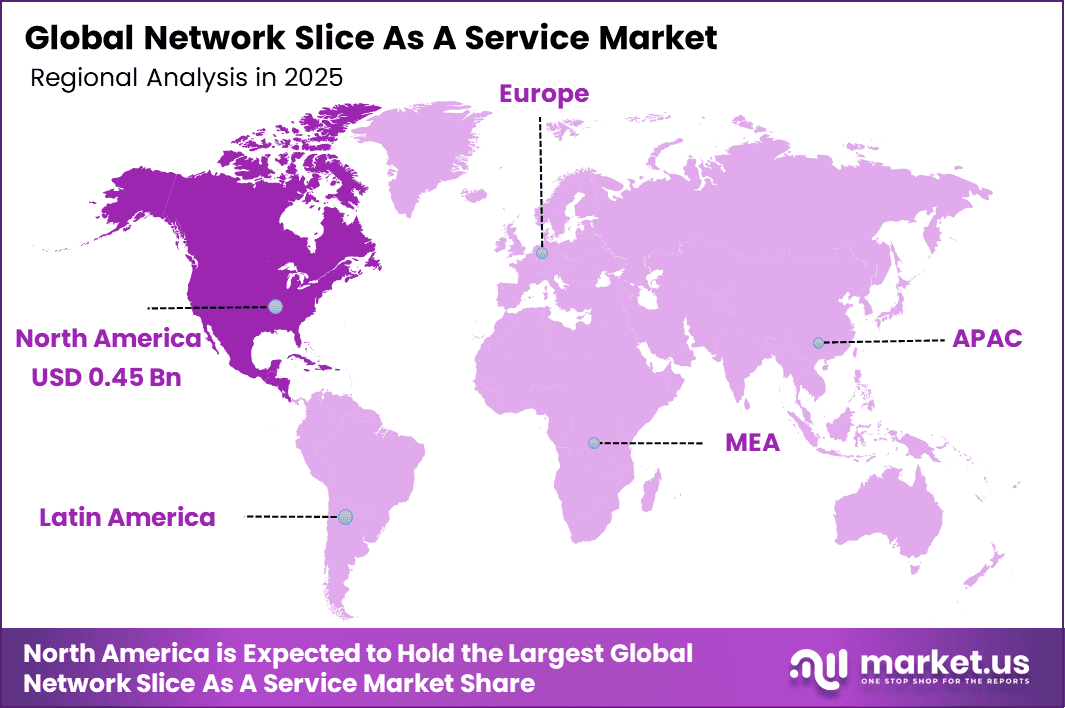
The Global Network Slice As A Service Market generated USD 1.21 billion in 2025 and is predicted to register growth from USD 1.51 billion in 2026 to about USD 11.36 billion by 2035, recording a CAGR of 25.1% throughout the forecast span. In 2025, North America held a dominant market position, capturing more than a 37.3% share, holding USD 0.45 billion in revenue.
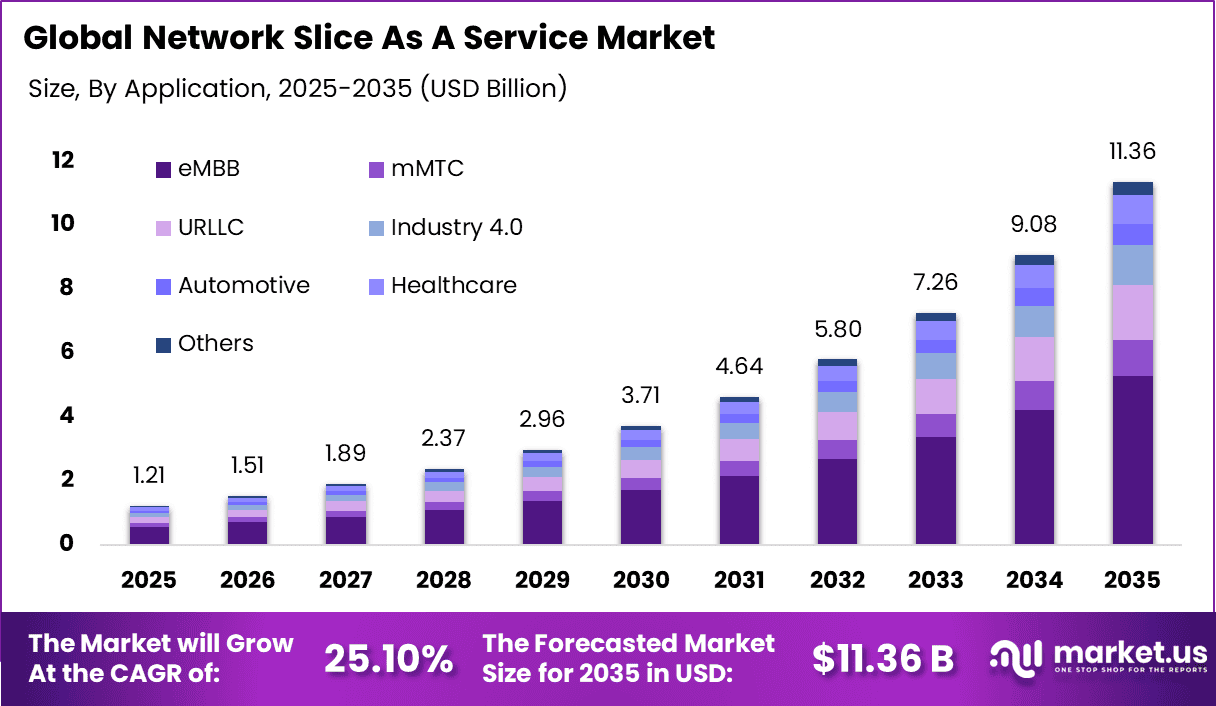
Network Slice as a Service market refers to a managed connectivity model in which telecom operators provide virtual network slices on shared 5G infrastructure for specific enterprise or institutional needs. The market is gaining importance as businesses look for more tailored network performance for industrial automation, smart mobility, critical communication, and other advanced digital operations without investing in fully private network infrastructure.
Many enterprises now run digital operations that cannot depend on standard shared mobile networks alone, especially when performance consistency is important. Another important factor is the wider progress of 5G standalone deployments, which allows operators to offer more flexible and differentiated network services to business users across multiple sectors.
Demand for Network Slice as a Service is increasing among manufacturers, transport operators, utilities, smart city projects, media users, and public sector organizations that need more predictable and isolated connectivity. These buyers want a practical option that offers better control than standard mobile service but lower complexity than building a dedicated private network.
Top Market Takeaways
- Slice management and orchestration commands 47.6% market share, delivering automated provisioning, real-time monitoring, and policy-driven lifecycle management across multi-domain 5G networks.
- Enhanced Mobile Broadband (eMBB) applications capture 46.5%, enabling high-throughput connectivity for AR/VR streaming, ultra-HD video, and massive IoT deployments with guaranteed QoS.
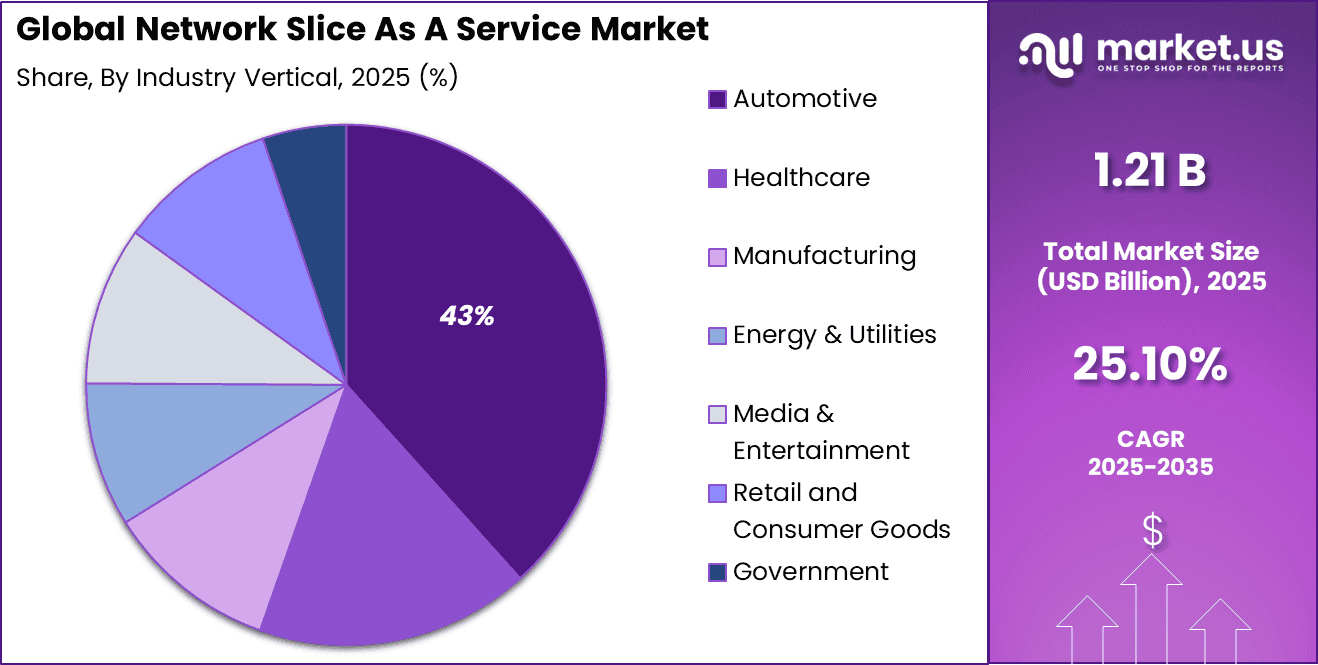
- Automotive vertical holds 42.8%, powering V2X communications, ADAS sensor fusion, and software-defined vehicle architectures through dedicated low-latency slices.
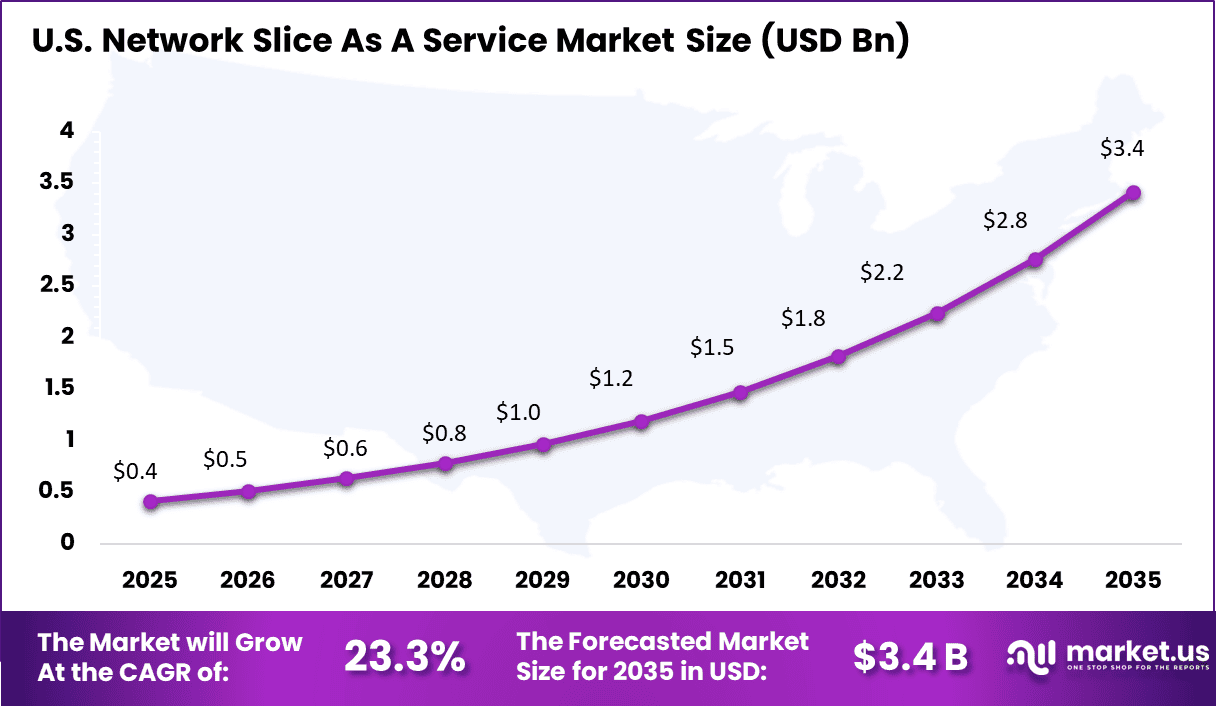
- North America drives 37.3% global value, with the U.S. market at USD 0.42 billion and 23.3% CAGR, fueled by AT&T, Verizon 5G slicing pilots, and OEM partnerships.
By Component Analysis
Slice management and orchestration accounted for 47.6% of the Network Slice As A Service Market. This segment leads because it enables operators to create, manage, and allocate network slices based on specific service requirements. It allows dynamic control over network resources, ensuring performance, isolation, and efficient utilization across different use cases.
The segment is also supported by the need for automated network operations. As networks become more complex, orchestration platforms help streamline provisioning, monitoring, and lifecycle management of slices, which strengthens their importance in service delivery environments.
By Application Analysis
Enhanced mobile broadband eMBB represented 46.5% of the market. This segment dominates because it supports high-speed data services required for streaming, gaming, and large-scale content consumption. Network slicing helps allocate dedicated bandwidth to maintain consistent performance for these data-intensive applications.
The segment is driven by rising demand for faster and more reliable mobile connectivity. As users expect seamless digital experiences, eMBB continues to benefit from network slicing capabilities that improve speed, capacity, and overall service quality.
By Industry Vertical Analysis
Automotive accounted for 43% of the market. This segment leads because connected vehicles require reliable and low-latency communication for navigation, safety systems, and real-time data exchange. Network slicing enables dedicated connectivity for automotive applications, improving performance and reliability.
The segment is supported by the growth of connected and autonomous vehicle technologies. Automotive companies rely on advanced network capabilities to support vehicle communication and data processing, which drives adoption of network slice as a service solutions in this industry.
Key Market Segments
By Service Type
- Slice Management and Orchestration
- Slice Security
- Slice Monitoring
- Others
By Application
- Enhanced Mobile Broadband (eMBB)
- Massive Machine Type Communications (mMTC)
- Ultra-Reliable Low-Latency Communications (URLLC)
- Industry 4.0
- Automotive
- Healthcare
- Others
By Industry Vertical
- Healthcare
- Manufacturing
- Automotive
- Energy & Utilities
- Media & Entertainment
- Government
- Others
Regional Analysis
North America accounted for 37.3% of the Network Slice as a Service Market, reflecting strong adoption of advanced 5G capabilities across telecom operators and enterprise networks. Service providers across the region increasingly deploy network slicing to create dedicated virtual networks tailored to specific use cases such as industrial automation, smart cities, and connected devices.
The growing demand for low latency, high reliability, and customized network performance continues to drive adoption of network slice as a service solutions across North America.
The U.S. generated about USD 0.42 billion within the regional market and is projected to expand at a CAGR of 23.3%. Telecom operators and enterprises across the country continue to invest in 5G infrastructure to support specialized connectivity for different applications.
Network slicing allows efficient resource allocation and improved service quality for sectors such as healthcare, manufacturing, and autonomous systems. As digital transformation accelerates and demand for flexible network services increases, adoption of network slice as a service continues to grow rapidly across the US market.
Key Regions and Countries
- North America
- US
- Canada
- Europe
- Germany
- France
- The UK
- Spain
- Italy
- Russia
- Netherlands
- Rest of Europe
- Asia Pacific
- China
- Japan
- South Korea
- India
- Australia
- Singapore
- Thailand
- Vietnam
- Rest of APAC
- Latin America
- Brazil
- Mexico
- Rest of Latin America
- Middle East & Africa
- South Africa
- Saudi Arabia
- UAE
- Rest of MEA
Drivers Impact Analysis
| Key Driver | Impact on CAGR Forecast (~%) | Geographic Relevance | Impact Timeline | Strategic Effect |
|---|---|---|---|---|
| Rapid expansion of 5G networks and infrastructure | +4.6% | North America, Asia Pacific, Europe | Short to Mid Term (2025–2031) | Enables customized network services |
| Increasing demand for low-latency and high-reliability applications | +4.2% | Global | Mid Term (2026–2032) | Supports critical enterprise use cases |
| Growth of IoT and connected device ecosystems | +3.9% | Asia Pacific, North America | Mid to Long Term (2026–2035) | Expands network segmentation needs |
| Rising adoption of cloud native and virtualized networks | +3.6% | Global | Mid Term (2026–2032) | Improves network flexibility |
| Telecom operators focus on monetizing network capabilities | +3.3% | North America, Asia Pacific | Mid to Long Term (2026–2035) | Creates new revenue streams |
Restraints Impact Analysis
| Key Restraint | Impact on CAGR Forecast (~%) | Geographic Relevance | Impact Timeline | Strategic Effect |
|---|---|---|---|---|
| Complexity in deploying and managing network slices | -2.9% | Global | Mid Term (2026–2032) | Increases operational challenges |
| High infrastructure and deployment costs | -2.6% | Global | Mid Term (2026–2032) | Limits adoption among smaller operators |
| Interoperability issues across multi-vendor networks | -2.3% | North America, Europe | Mid Term (2026–2032) | Slows integration |
| Limited standardization across network slicing frameworks | -2.1% | Global | Mid to Long Term (2026–2035) | Creates implementation challenges |
| Skill gaps in advanced telecom network management | -1.9% | Global | Mid Term (2026–2032) | Delays deployment |
Investor Type Impact Analysis
| Investor Type | Growth Sensitivity | Risk Exposure | Geographic Focus | Investment Outlook |
|---|---|---|---|---|
| Venture Capital Firms | Very High | High | US, Europe, Asia Pacific | Strong telecom innovation potential |
| Private Equity Firms | High | Medium | North America, Asia Pacific | Expansion in telecom infrastructure |
| Strategic Technology Investors | Very High | Medium | US, China, Japan | Strengthens 5G ecosystem |
| Corporate Venture Arms | High | Medium | Global | Supports telecom partnerships |
| Government and Infrastructure Funds | Medium | Low to Medium | Asia Pacific, Europe | Supports digital connectivity initiatives |
Technology Enablement Analysis
| Technology Enabler | Impact on CAGR Forecast (~%) | Geographic Relevance | Impact Timeline | Implementation Significance |
|---|---|---|---|---|
| Network slicing technology within 5G architecture | +4.8% | Global | Short to Mid Term (2025–2031) | Enables customized network segments |
| Software-defined networking and network function virtualization | +4.4% | Global | Mid Term (2026–2032) | Improves network flexibility |
| Edge computing integration with telecom networks | +4.0% | North America, Asia Pacific, Europe | Mid to Long Term (2026–2035) | Reduces latency for applications |
| AI-driven network orchestration and automation | +3.6% | Global | Mid to Long Term (2026–2035) | Enhances network efficiency |
| Cloud native telecom infrastructure platforms | +3.3% | Global | Mid Term (2026–2032) | Supports scalable deployment |
Key Challenges
- Managing and orchestrating multiple network slices is a major challenge because each slice may need different latency, bandwidth, security, and service quality requirements at the same time.
- Integration with older telecom systems can be difficult because many existing networks and support platforms are not fully ready for slice-based service delivery.
- Meeting strict service level requirements is another challenge because operators must continuously monitor performance and keep each slice stable for different enterprise use cases.
- Security and isolation remain important concerns because service providers must ensure that one slice does not affect the performance, privacy, or reliability of another slice.
- Commercial deployment is still difficult because pricing models, cross-network coordination, and large-scale automation are not yet simple for many operators and enterprise customers.
Emerging Trends
A key trend in the Network Slice As A Service market is the growing use of customized virtual network segments designed for specific applications and user needs. Organizations are increasingly leveraging network slicing to create dedicated environments for services such as enterprise connectivity, industrial automation, and real-time communication.
These slices allow better control over performance, latency, and reliability without affecting other network operations. This trend reflects a shift toward more flexible and service-oriented network models where resources are allocated based on application requirements.
Growth Factors
The expansion of advanced connectivity use cases is supporting the growth of Network Slice As A Service solutions. Businesses require reliable and tailored network performance to support applications that depend on stable and responsive connections. Network slicing helps meet these needs by providing isolated and optimized network segments for different operations.
At the same time, the growing adoption of connected devices and digital services encourages the use of solutions that can manage network traffic efficiently while maintaining consistent service quality across diverse use environments.
Competitive Analysis
The competitive landscape of the Network Slice as a Service market includes major telecom network equipment providers and cloud networking companies. Nokia, Ericsson, Huawei, Cisco Systems, Samsung Electronics, ZTE Corporation, Fujitsu, NEC Corporation, Juniper Networks, Ciena Corporation, and VMware hold strong positions because they offer core network, transport, and orchestration solutions that support network slicing across 5G environments.
These companies compete by improving network flexibility, service quality, and efficient resource allocation for telecom operators and enterprise users. Other players such as Mavenir Systems, Amdocs, Comarch, Altran Technologies, Digital Route, Infosys, and HPE add competition through software integration, service orchestration, analytics, and managed network solutions.
The market is shaped by demand for customized connectivity, low-latency services, and better support for industry-specific use cases such as smart manufacturing, healthcare, and connected mobility. Overall, competition remains strong as vendors work to deliver scalable and reliable slicing services.
Top Key Players in the Market
- Nokia
- Ericsson
- Huawei
- Cisco Systems
- Samsung Electronics
- ZTE Corporation
- Fujitsu
- NEC Corporation
- Juniper Networks
- Mavenir Systems
- Ciena Corporation
- VMware
- Amdocs
- Comarch
- Altran Technologies
- Digital Route
- Infosys
- HPE
- Others
Future Outlook
The future outlook for the Network Slice as a Service Market looks strong as telecom operators and enterprises seek more flexible and application-specific connectivity over 5G networks. Current industry guidance shows that network slicing allows multiple virtual networks to run on shared infrastructure, each tailored for different performance, security, and service needs, which makes it useful for industries such as manufacturing, transport, media, and enterprise connectivity. As 5G standalone networks expand and operators look for new service revenue, demand for slice-based managed services is expected to grow steadily in the coming years.
Recent Developments
- In January 2026, Huawei iMaster NCE-FabricAutomation orchestrated 5K+ enterprise slices daily across China Mobile 5G SA cores with 100μs e2e latency guarantees. Solution activated 1M+ IoT slices for smart cities automatically.
- In February,2026, Nokia’s multi-access edge slicing solution launched with e& UAE, enabling on-demand slices across 5G/FWA/fixed networks serving gaming/enterprise consumers with integrated orchestration and 99.99% SLA enforcement. Orchestration Center automated 10K+ slice instances daily across MENA deployments.
Report Scope
| Report Features | Description |
|---|---|
| Market Value (2025) | USD 1.21 Billion |
| Forecast Revenue (2035) | USD 11.36 Billion |
| CAGR(2025-2035) | 25.1% |
| Base Year for Estimation | 2024 |
| Historic Period | 2020-2024 |
| Forecast Period | 2025-2035 |
| Report Coverage | Revenue forecast, AI impact on Market trends, Share Insights, Company ranking, competitive landscape, Recent Developments, Market Dynamics and Emerging Trends |
| Segments Covered | By Service Type (Slice Management and Orchestration, Slice Security, Slice Monitoring, Others), By Application (Enhanced Mobile Broadband (eMBB), Massive Machine Type Communications (mMTC), Ultra-Reliable Low-Latency Communications (URLLC), Others), By Industry Vertical (Healthcare, Manufacturing, Government, Others) |
| Regional Analysis | North America – US, Canada; Europe – Germany, France, The UK, Spain, Italy, Russia, Netherlands, Rest of Europe; Asia Pacific – China, Japan, South Korea, India, New Zealand, Singapore, Thailand, Vietnam, Rest of Latin America; Latin America – Brazil, Mexico, Rest of Latin America; Middle East & Africa – South Africa, Saudi Arabia, UAE, Rest of MEA |
| Competitive Landscape | Nokia, Ericsson, Huawei, Cisco Systems, Samsung Electronics, ZTE Corporation, Fujitsu, NEC Corporation, Juniper Networks, Mavenir Systems, Ciena Corporation, VMware, Amdocs, Comarch, Altran Technologies, Digital Route, Infosys, HPE, Others |
| Customization Scope | Customization for segments, region/country-level will be provided. Moreover, additional customization can be done based on the requirements. |
| Purchase Options | We have three licenses to opt for: Single User License, Multi-User License (Up to 5 Users), Corporate Use License (Unlimited Users and Printable PDF) |





























