


Report Overview
In 2025, the Global AR and VR Training Market was valued at USD 25.3 billion and is expected to reach USD 126.4 billion by 2035, growing at a CAGR of 17.5% during 2026–2035. North America led the market with over 45% share, generating around USD 11.39 billion in revenue in 2025.
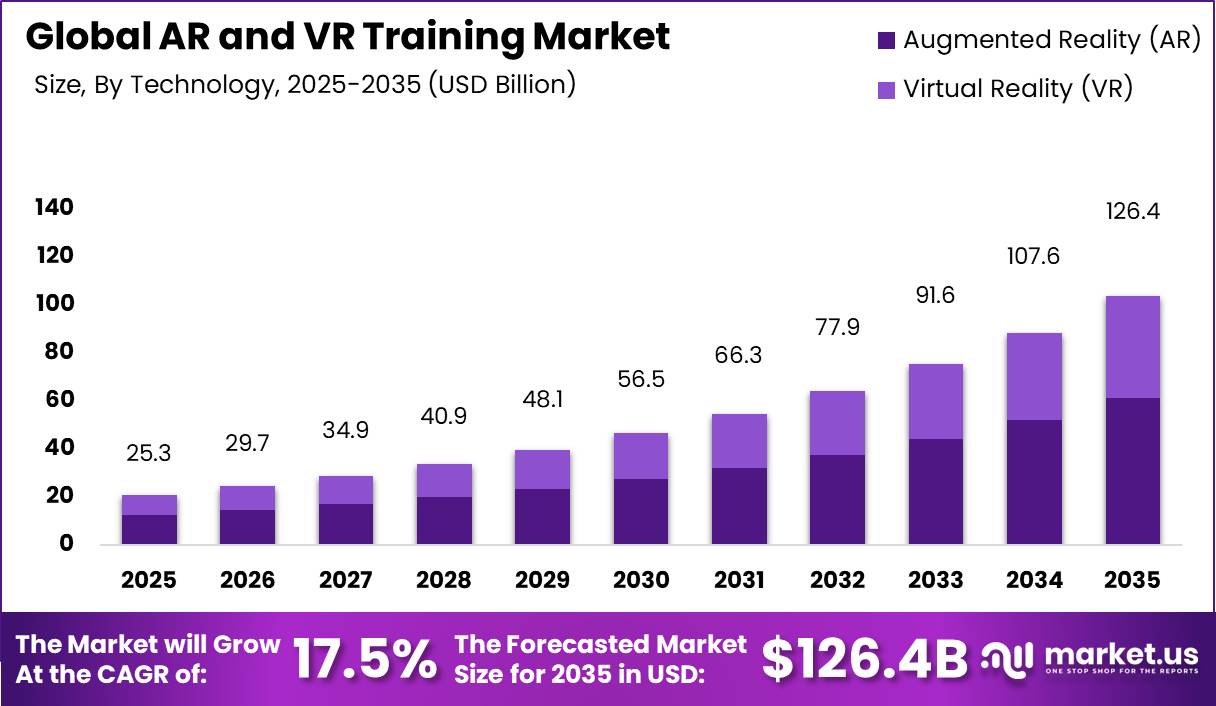
Market growth is mainly driven by the rapid transformation of the global workforce. According to the World Economic Forum’s Future of Jobs Report 2025, 22% of jobs will be affected by 2030, with 170 million new jobs created and 92 million displaced, resulting in a strong need for new skills. Around 59% of workers will require reskilling by 2030.
The WEF’s Reskilling Revolution aims to benefit more than 856 million people by 2030. As traditional classroom training is difficult to scale, organizations are increasingly adopting AR and VR training. The World Bank’s analysis of 31 studies found that VR-based learning delivers better technical, practical, and interpersonal skill outcomes than conventional training, with learners achieving higher post-training scores.
The World Bank also manages nearly USD 7 billion in workforce and skills projects across more than 50 developing countries, highlighting growing public investment in advanced training methods. The U.S. Department of Defense requested a USD 849.8 billion FY2025 budget, including USD 147.5 billion for readiness and training modernization. In addition, the U.S. Army’s IVAS program, valued at up to USD 21.9 billion, demonstrates large-scale adoption of AR-based training, supporting continued market growth.
Key Takeaway
- The Global AR and VR Training Market was valued at USD 25.3 billion in 2025 and is projected to reach USD 126.4 billion by 2035.
- The market is expected to expand at a CAGR of 17.5% during the forecast period from 2026 to 2035.
- By Technology, Augmented Reality (AR) dominated the market with a 48.3% share in 2025.
- By Component, Hardware accounted for the largest market share at 55.0% in 2025.
- By Training Type, Safety & Compliance Training emerged as the leading segment, holding a 38.0% share in 2025.
- By End-Use Industry, Defense & Military led the market with a 28.0% share in 2025.
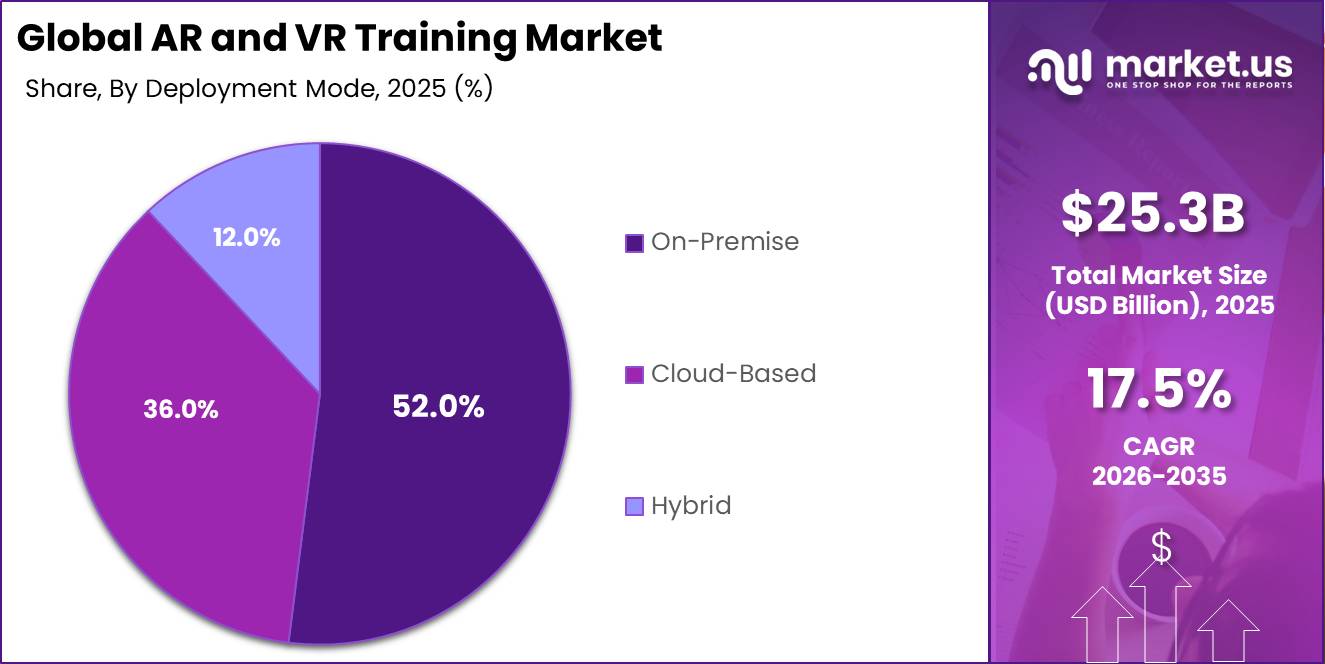
- By Deployment Mode, On-Premise dominated the market, accounting for 52.0% of total revenue in 2025.
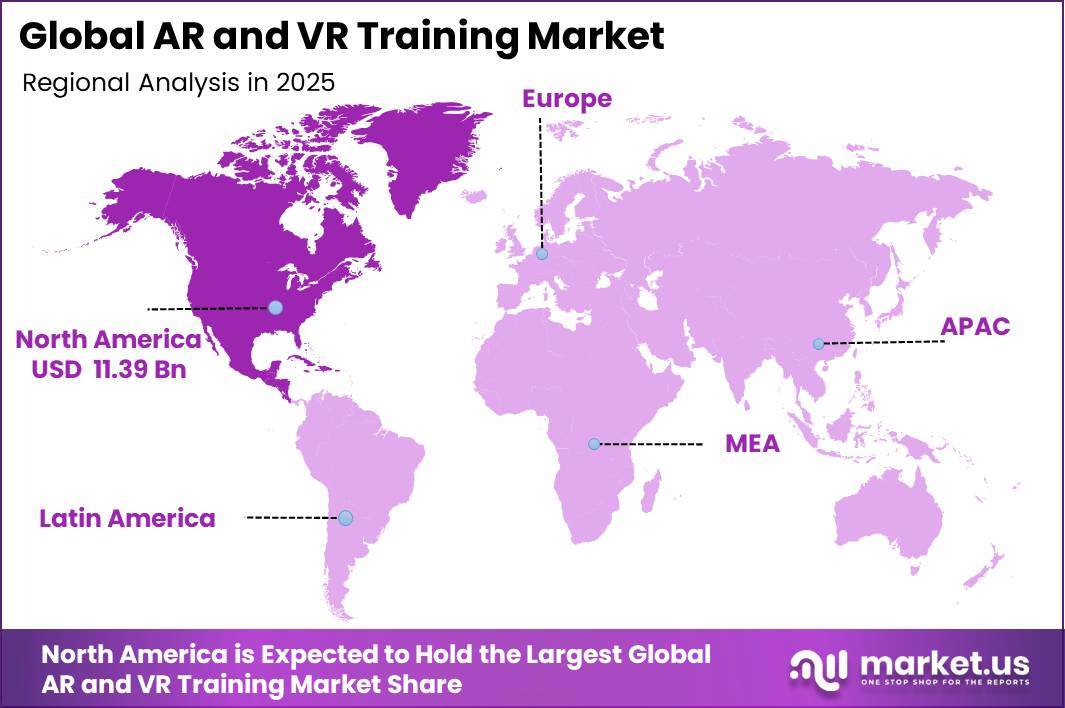
- North America held the largest regional share of over 45.0%, generating approximately USD 11.39 billion in revenue in 2025.
By Technology
With a 48.3% market share, Augmented Reality (AR) is the leading technology segment in the global AR and VR Training Market. AR enhances real-world environments by overlaying digital instructions, hazard alerts, and interactive guidance onto equipment and workplaces, allowing employees to learn while performing actual tasks.
Virtual Reality (VR) is the fastest-growing technology segment because it enables realistic simulation of hazardous, complex, or expensive scenarios without exposing trainees to real-world risks. VR is increasingly used for emergency response, industrial safety, medical procedures, defense exercises, and technical skill development.
Research shows that VR-based training can improve safety awareness by around 30% compared with traditional methods in Industry 4.0 environments. As organizations seek better learning outcomes, lower training costs, and improved employee readiness, investment in VR-based training continues to rise.
By Component
Hardware accounted for 55.0% of the market in 2025, making it the largest component segment. Every AR/VR training program depends on physical devices such as head-mounted displays, smart glasses, sensors, controllers, cameras, and networking equipment.
Large enterprise deployments require significant upfront investments in hardware, while ongoing maintenance and periodic device upgrades further contribute to spending. As organizations expand immersive training across multiple facilities and locations, hardware remains the largest revenue-generating component.
By Training Type
Safety and compliance training held the largest share at 38.0%, driven by increasing workplace safety regulations and the need to reduce operational risks. AR and VR allow employees to practice emergency evacuations, equipment handling, PPE usage, and hazardous procedures in realistic but risk-free environments.
Immersive simulations improve safety awareness, reduce training-related risks, and help organizations lower workplace accidents and compliance costs. These benefits continue to drive strong adoption across construction, manufacturing, mining, oil & gas, and healthcare.
By End-Use Industry
Defense and military represented 28.0% of the global market in 2025. Armed forces continue to invest heavily in AR and VR technologies to improve combat readiness, mission planning, equipment maintenance, and operational training.
With global military expenditure reaching approximately USD 2.718 trillion in 2024, defense organizations have substantial budgets for advanced simulation technologies. Immersive training reduces the cost of live exercises while improving operational preparedness, making defense the largest end-use segment.
By Deployment Mode
On-premise deployment accounted for 52.0% of the market, as many organizations prefer to keep sensitive training data within their own IT infrastructure. Industries such as defense, healthcare, manufacturing, and government often require strict control over employee performance data, simulation records, and security information.
Cloud-based deployment is the fastest-growing segment because it enables organizations to deliver AR and VR training across multiple locations without investing in extensive local infrastructure. The global cloud services market was valued at around USD 700 billion in 2024, reflecting rapid enterprise cloud adoption.
Cloud platforms simplify content updates, remote access, centralized management, and integration with learning management systems. As businesses continue expanding hybrid work models and multi-site operations, cloud deployment is expected to witness the strongest growth throughout the forecast period.
Key Market Segments
By Technology
- Augmented Reality (AR)
- Virtual Reality (VR)
By Component
- Hardware
- Head-Mounted Displays (HMDs)
- Smart Glasses
- Haptic Gloves
- Hand-Tracking Modules
- Motion Trackers
- Software
- Training Simulation Platforms
- Software Development Kits (SDKS)
- Cloud-Based Content Management
- 3D Modeling Tools
- Services
- Content Creation & Development Services
- System Integration & Deployment Services
- Maintenance & Support Services
- Consulting Services
By Training Type
- Safety & Compliance Training
- Technical & Skills Training
- Soft Skills & Leadership Training
- Others
By End-Use Industry
- Defense & Military
- Healthcare & Medical
- Aerospace & Aviation
- Automotive & Manufacturing
- Others
By Deployment Mode
- On-Premise
- Cloud-Based
- Hybrid
Geopolitical Impact Analysis
In 2025, geopolitical tensions are significantly increasing costs and disrupting supply chains across the Global AR and VR Training Market, particularly for head-mounted displays, optical modules, and high-performance GPUs sourced from East Asia. Combined U.S. tariff exposure on many China-origin electronics averages around 33%, including MFN duties of about 3.4%, Section 301 tariffs of 7.5%–25%, and additional reciprocal and IEEPA-related levies.
These tariffs have raised the cost of displays, sensors, and PCB assemblies, prompting manufacturers to shift production to countries such as Vietnam and Mexico to reduce the impact of 10%–40% tariff bands on electronics. At the same time, export controls on advanced semiconductors have reduced the availability of high-end GPUs, increasing the cost of processors required for enterprise-grade VR training systems.
Logistics disruptions are also affecting deployment timelines and overall project costs. According to UNCTAD, disruptions in the Red Sea and Suez Canal have reduced container ship transits by 67% and lowered effective shipping capacity on some routes by 15%–20%. Rerouting vessels around the Cape of Good Hope has added 10–15 days to Asia–Europe transit times, increasing freight costs for AR/VR devices, optical glass, and lithium-ion batteries.
In addition, the International Energy Agency reported that European natural gas prices remained around 50% above pre-crisis levels in 2024, contributing to 5%–10% higher contract prices for advanced AR/VR hardware. Although global maritime trade is projected to grow by around 2% annually through 2029, vendors continue to hold larger inventories and diversify suppliers, leading to longer cash-conversion cycles, extended delivery times, and more frequent price revisions for enterprise customers.
Regional Analysis
North America dominated the global AR and VR Training Market in 2025, accounting for approximately 45.0% of total revenue, equivalent to around USD 11.39 billion. The region’s leadership is supported by its advanced digital infrastructure, strong presence of major AR/VR technology providers, and early adoption of immersive training across industries such as defense, manufacturing, healthcare, education, and corporate learning.
High enterprise investment in digital workforce training, widespread 5G deployment, and continuous innovation across the U.S. and Canada continue to strengthen the region’s market position. Asia Pacific is the fastest-growing regional market, supported by rapid industrialization, expanding digital transformation, and increasing investment in workforce development.
Growing smartphone penetration, improving access to affordable AR/VR hardware, government-led digital skills initiatives, and rising corporate spending on e-learning are accelerating market growth. As a result, Asia Pacific is expected to register the highest CAGR during the forecast period, gradually narrowing the gap with North America.
Key Regions and Countries
North America
- US
- Canada
Europe
- Germany
- France
- The UK
- Spain
- Italy
- Rest of Europe
Asia Pacific
- China
- Japan
- South Korea
- India
- Australia
- Rest of APAC
Latin America
- Brazil
- Mexico
- Rest of Latin America
Middle East & Africa
- GCC
- South Africa
- Rest of MEA
Market Dynamics
Drivers
| Driver | (~) % CAGR | Geographic Relevance | Impact Timeline |
|---|---|---|---|
| Enterprise Workforce Upskilling & Safety Compliance Mandates | +4.2% | North America, Western Europe, Australia | Short term (≤ 2 years) |
| Hardware Cost Deflation & Mainstream Headset Accessibility | +3.1% | Global, led by North America & Asia Pacific | Short term (≤ 2 years) |
| Government-Backed Digital Education & Defence Training Programmes | +2.8% | USA, China, India, EU Member States | Medium term (2–4 years) |
| PwC-Validated Training ROI Evidence Accelerating L&D Budget Reallocation | +2.3% | North America, UK, Germany, Japan | Short term (≤ 2 years) |
| AI-Augmented Simulation Realism Elevating Training Efficacy | +2.0% | Global | Medium term (2–4 years) |
| Healthcare Sector Clinical & Surgical Simulation Adoption | +1.6% | North America, EU, Asia Pacific | Short term (≤ 2 years) |
Enterprise Workforce Upskilling & Safety Compliance Mandates
Structural labour market pressures amplified by post-pandemic skills gaps, accelerating automation displacement, and tightening occupational health and safety legislation across OSHA-regulated industries in the USA, EU Directive 89/391/EEC jurisdictions, and Australian WHS frameworks have catalysed a fundamental reallocation of corporate learning & development (L&D) budgets toward immersive simulation.
Over 71% of enterprises surveyed in 2024–2025 reported active AR/VR deployment for employee training, up from under 40% in 2022, driven by documented productivity outcomes: PwC research quantified a 4× reduction in training cycle time and a 23% improvement in post-training employee performance versus classroom equivalents.
The economic break-even calculus is particularly compelling at scale at 3,000 learners; VR-delivered training is 52% cheaper than instructor-led alternatives, with programme ROI typically captured within 12–18 months of deployment.
This is accelerating a structural shift in procurement from one-time hardware purchases to subscription-based SaaS content platforms, compressing per-seat licensing costs toward $15–$40 per learner per annum for standardised compliance modules while expanding total addressable spend per enterprise.
The enterprise XR training sub-segment was valued at approximately $4.59 billion in 2025, commanding over 52% of total extended-reality training market share, and is the primary current revenue engine pulling the broader AR/VR training market’s baseline growth trajectory upward.
Restraints
| Restraint | (~) % on CAGR | Geographic Relevance | Impact Timeline |
|---|---|---|---|
| High Upfront Content Development & Custom Module Costs Freezing SME Adoption | -3.4% | Global, disproportionate in emerging markets & SME-dominated economies | Short term (≤ 2 years) |
| Biometric Data Privacy Regulation & GDPR/State-Level Compliance Burden | -2.1% | EU, USA (Illinois BIPA, Texas CUBI, California CPRA), India DPDPA | Short term (≤ 2 years) |
| Elevated Interest Rates Compressing Enterprise CapEx Allocation for Hardware Fleets | -1.8% | North America, UK, EU | Short term (≤ 2 years) |
| Lack of Interoperability Standards Across VR Platforms & LMS Ecosystems | -1.5% | Global | Medium term (2–4 years) |
| Cybersickness & Adverse Physiological Response Limiting Mandatory Deployment Programmes | -1.1% | Global | Medium term (2–4 years) |
High Upfront Content Development & Custom Module Costs Freezing SME Adoption
The single largest active brake on market velocity is the prohibitive cost structure of bespoke immersive training content development, which structurally excludes the global SME segment representing over 90% of all enterprises by count from initial procurement.
Developing a custom, high-fidelity VR training module from brief to deployment typically requires $50,000–$300,000 per learning experience depending on interactivity complexity, 3D asset density, and multi-platform optimisation, with production timelines of 3–6 months for non-templated industrial simulations. This cost floor is approximately 8–15× the per-module outlay of equivalent e-learning content, deterring organisations with annual L&D budgets below $500,000 from committing to immersive programmes.
The constraint operates as a hard procurement stop, not merely a friction factor, because the minimum viable deployment (typically 5–20 headsets per site plus platform licensing at $3,000–$8,000 per annum) creates a fixed overhead that cannot be amortised below a learner population threshold that most SMEs cannot reach organically.
In economies where SMEs contribute 40–70% of GDP, notably India, Southeast Asia, and Southern Europe, this restraint directly suppresses total addressable market realisation by an estimated 30–40% relative to the addressable headcount.
Challenges
| Challenge | (~) % CAGR | Geographic Relevance | Mitigation Horizon |
|---|---|---|---|
| XR Developer Talent Scarcity | -2.6% | Global, most acute in South Asia, Southeast Asia, Eastern Europe | Long term (≥ 4 years) |
| Cross-Platform LMS Integration Friction | -1.9% | Global | Medium term (2–4 years) |
| Rapid Hardware Obsolescence Cycles | -1.7% | Global, amplified in price-sensitive APAC markets | Medium term (2–4 years) |
| Organisational Change Management Resistance | -1.4% | Global, particularly manufacturing & public sector verticals | Short term (≤ 2 years) |
| Network Latency & Edge Infrastructure Gaps | -1.2% | Emerging markets, rural/semi-urban industrial clusters | Long term (≥ 4 years) |
XR Developer Talent Scarcity
The structural deficit in qualified XR developers and engineers fluent in Unity, Unreal Engine, WebXR, and spatial audio pipeline tools alongside domain-specific instructional design competencies represents the most durable ceiling constraint on the AR/VR training market’s maximum growth potential.
The US Bureau of Labor Statistics projects software developer roles (including XR specialists) to grow at 15% annually through 2034, yet XR-specific curriculum penetration in accredited computer science programmes globally remains below 8% of undergraduate cohorts as of 2025, creating a structural mismatch between demand and supply that worsens as enterprise adoption scales.
Industry estimates place the current global XR developer shortfall at approximately 150,000–200,000 qualified practitioners, with median US XR developer compensation now at $113,000 annually a 22–35% premium over generalist software developer benchmarks, driving labour cost inflation that directly compresses independent software vendor (ISV) and boutique content studio margins by an estimated 8–12 percentage points.
This talent scarcity creates compounding downstream friction: longer production lead times (averaging 4–8 months for bespoke enterprise modules versus theoretical 6–10 week rapid-authoring targets), quality inconsistency in deliverables from under-resourced studios, and overconcentration of development capacity in a small number of Tier-1 markets.
Opportunities
| Opportunity | (~) % CAGR | Geographic Relevance | Execution Window |
|---|---|---|---|
| Generative AI-Powered Adaptive Content Authoring Platforms | +3.8% | Global | Medium term (2–4 years) |
| Untapped Defence & Para-Military Simulation TAM in APAC & Middle East | +2.9% | India, Saudi Arabia, UAE, South Korea, Australia | Medium term (2–4 years) |
| Emerging Economy Vocational & Government Skills-Training Mandates | +2.4% | India, Southeast Asia, Sub-Saharan Africa, Latin America | Long term (≥ 4 years) |
| White-Label SaaS Content Marketplace & Revenue-Share Licensing Models | +2.0% | North America, EU, Australia | Short term (≤ 2 years) |
| Mixed Reality Remote Expert-Assist & On-the-Job Performance Support | +1.7% | Global, led by manufacturing, utilities, energy sectors | Medium term (2–4 years) |
Generative AI-Powered Adaptive Content Authoring Platforms
This opportunity remains almost entirely untapped because the current market monetisation architecture is built around bespoke studio-produced modules and seat-licence distribution, neither of which benefits meaningfully from generative AI capabilities that only reached sufficient reliability and spatial-context fluency in 2024–2025.
The white space is a new product category: AI-native authoring platforms that enable a subject-matter expert with zero 3D modelling or Unity skills to assemble a fully navigable, branching VR training scenario from a natural-language brief, an existing SOPs document, or a video upload collapsing content production costs from $50,000–$300,000 per module to an estimated $3,000–$12,000 range and compressing timelines from 3–6 months to 2–4 weeks.
This unit-economic shift directly unlocks the $15–$25 billion addressable SME training TAM that the current cost structure has placed out of reach, while simultaneously enabling large enterprises to scale content libraries from single-digit to hundreds of modules per year at manageable incremental cost.
The margin architecture of AI authoring platforms, estimated gross margins of 65–78% versus 28–42% for traditional content studios, structurally favours platform-first players over project-services incumbents. Capitalising on this opportunity requires deliberate strategic action: integration of foundational models (text-to-3D, scene generation, adaptive dialogue branching) into purpose-built XR pipelines.
Key Players Analysis
Tier-1 companies in the global AR and VR Training Market include Meta (Reality Labs), Microsoft (HoloLens and Dynamics 365 Guides/Remote Assist), and EON Reality. Together, these companies are estimated to account for approximately 45–55% of global enterprise and education AR/VR training spending across hardware, software, and content.
Their leadership is supported by large financial resources, advanced XR platforms, extensive partner ecosystems, and strong adoption across manufacturing, healthcare, aerospace, defense, and education. Meta remains one of the market’s largest investors in immersive technologies. In 2025, Reality Labs generated approximately USD 2.1–2.2 billion in revenue while reporting an operating loss of around USD 19.1–19.2 billion, reflecting Meta’s long-term investment strategy to expand the AR/VR ecosystem.
By 2026, Reality Labs employed around 15,000 people, supporting the development of enterprise headsets, collaboration tools, and training applications. Microsoft continues to strengthen its position by integrating HoloLens, Dynamics 365 Guides, and Remote Assist into its cloud and enterprise software portfolio, enabling mixed reality training for manufacturing, field services, and industrial operations.
EON Reality focuses on education and workforce development, offering USD 1 million to USD 16 million grant-supported K-12 deployment programs, with funding designed to support approximately 10 schools per initiative and improve workforce readiness through immersive learning.
Top Key Players in the Market
- Microsoft Corporation
- Meta Platforms Inc. (Oculus)
- HTC Corporation (VIVE)
- PTC Inc.
- Unity Technologies
- Strivr Labs, Inc.
- EON Reality Inc.
- Magic Leap, Inc.
- Talespin Reality Labs
- Mursion Inc.
- PIXO VR (PIXO Platform)
- Varjo Technologies
- Virti Ltd.
- Loft Dynamics AG
- zSpace Inc.
Recent Developments
- In June 2026, Meta Platforms and Lenovo expanded their enterprise mixed reality partnership, under which Lenovo began reselling Meta Quest devices and bundled services to global corporate customers, targeting deployments of “tens of thousands” of headsets across training and collaboration use cases and aligning with Lenovo’s commercial PC customer base of over 100 million units shipped annually in recent years.
- In July 2026, Fairfield announced that the AR and VR in training market is projected to grow from USD 18.6 billion in 2026 to USD 83.8 billion by 2033 at a 24.0% CAGR, implying incremental annual training-focused AR/VR revenues of approximately USD 65.2 billion over seven years for vendors such as Microsoft, Meta, HTC VIVE, PTC, Unity, Strivr, EON Reality, Varjo and others.
Report Scope
| Report Features | Description |
|---|---|
| Market Value (2025) | USD 25.3 Billion |
| Forecast Revenue (2035) | USD 126.4 Billion |
| CAGR (2026-2035) | 17.5% |
| Base Year for Estimation | 2025 |
| Historic Period | 2020-2024 |
| Forecast Period | 2026-2035 |
| Report Coverage | Revenue Forecast, Market Dynamics, Competitive Landscape, Recent Developments |
| Segments Covered | By Technology (Augmented Reality (AR), Virtual Reality (VR)), By Component (Hardware, Software, Services), By Training Type (Safety & Compliance Training, Technical & Skills Training, Soft Skills & Leadership Training, Others), By End-Use Industry (Defense & Military, Healthcare & Medical, Aerospace & Aviation, Automotive & Manufacturing, Others), By Deployment Mode (On-Premise, Cloud-Based, Hybrid) |
| Regional Analysis | North America – US, Canada; Europe – Germany, France, The UK, Spain, Italy, Rest of Europe; Asia Pacific – China, Japan, South Korea, India, Australia, Singapore, Rest of APAC; Latin America – Brazil, Mexico, Rest of Latin America; Middle East & Africa – GCC, South Africa, Rest of MEA |
| Competitive Landscape | Microsoft Corporation, Meta Platforms Inc. (Oculus), HTC Corporation (VIVE), PTC Inc., Unity Technologies, Strivr Labs, Inc., EON Reality Inc., Magic Leap, Inc., Talespin Reality Labs, Mursion Inc., PIXO VR (PIXO Platform), Varjo Technologies, Virti Ltd., Loft Dynamics AG, zSpace Inc. |
| Customization Scope | Customization for segments and region/country-level will be provided. Moreover, additional customization can be done based on the requirements. |
| Purchase Options | We have three licenses to opt for: Single User License, Multi-User License (Up to 5 Users), Corporate Use License (Unlimited Users and Printable PDF) |





























