


Report Overview
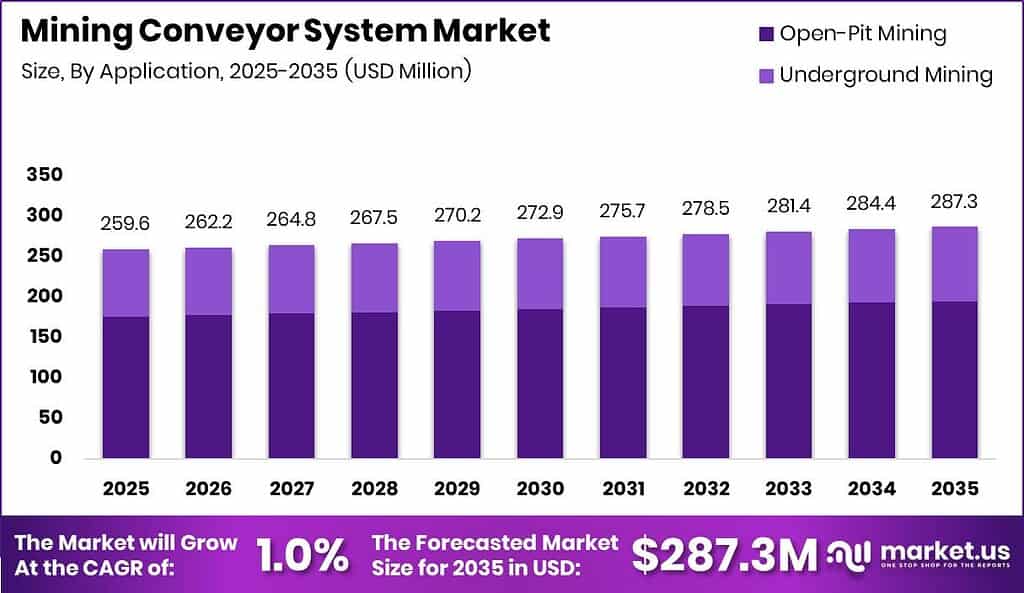
Global Mining Conveyor System Market size is expected to be worth around USD 287.3 Million by 2035 from USD 259.6 Million in 2025, growing at a CAGR of 1.0% during the forecast period 2026 to 2035. This modest pace reflects a mature equipment base where growth now comes from upgrades rather than new installations. Buyers are prioritizing efficiency retrofits over ground-up network expansion.
Mining conveyor systems move bulk ore, coal, and waste rock across pit, plant, and port locations without truck haulage. The market spans belt, cable, bucket, and specialty conveyor types serving both open-pit and underground operations. Equipment is grouped by drive mechanism, service function, and installation environment. This structure lets operators match conveyor type to ore characteristics and site topography. Therefore, purchasing decisions hinge on total cost of ownership rather than headline unit price alone.
Key Takeaways
- The Mining Conveyor System Market is valued at USD 259.6 Million in 2025 and is projected to reach USD 287.3 Million by 2035.
- The market is set to grow at a CAGR of 1.0% between 2026 and 2035.
- Belt Conveyors lead the By Conveyor Type segment with a 57.00% share.
- Overland Conveyors lead the By Service Type segment with a 26.00% share.
- Open-Pit Mining leads the By Application segment with a 68.00% share.
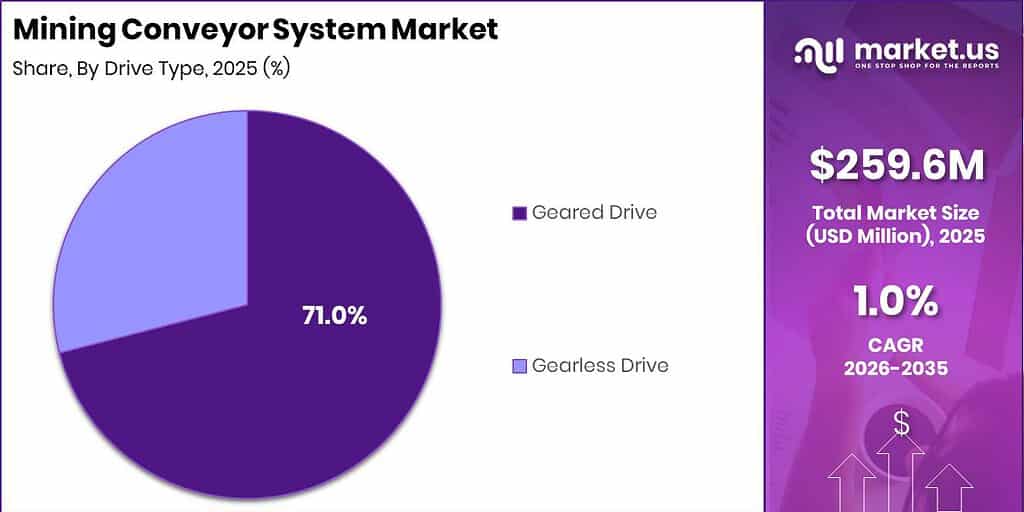
- Geared Drive leads the By Drive Type segment with a 71.00% share.
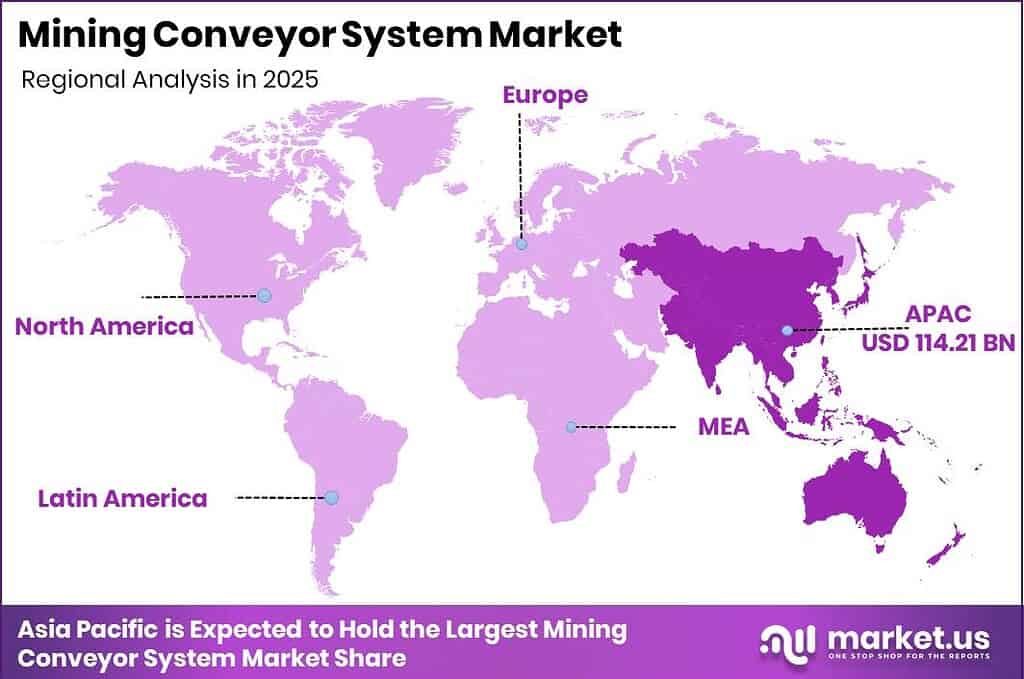
- Asia Pacific dominates the regional landscape with a 44.00% share, valued at USD 114.21 Million.
Mine operators face pressure to cut per-tonne energy costs as ore grades decline and haul distances lengthen. As per our research, a lignite mine study found that raising average conveyor load by 35%, from 2,000 Mg/h to approximately 2,700 Mg/h, cut unit energy consumption by 26%, a drop of 90 Wh/Mg/km. This means load optimization delivers measurable savings without new capital spending. Operators chasing lower operating costs now treat load balancing as a standard efficiency lever.
This finding extends further. As per our research, optimizing load distribution across mining conveyor networks can reduce energy consumption by up to 30% without major infrastructure investment. Consequently, mine planners are prioritizing software-driven load balancing over hardware replacement cycles. This reflects a broader shift where end-use demand from coal, iron ore, and industrial mineral producers is pushing conveyor makers to bundle efficiency software with mechanical equipment sales.
Conveyor Type Analysis
Belt Conveyors dominates with 57.0% due to versatile handling across diverse ore types.
In 2025, Belt Conveyors held a dominant market position in the By Conveyor Type segment of Mining Conveyor System Market, with a 57.0% share. Data from UNIDO show global rubber and textile conveyor belting output exceeded several million linear meters annually across heavy industry users. This scale reflects belt conveyors’ role as the default choice for high-volume ore transport. Mines favor belts because installation and maintenance networks are already established worldwide.
Cable and steel cord conveyors serve routes needing long unsupported spans and higher tensile strength. According to ITC Trade Map, steel cord and wire rope exports tied to industrial handling equipment have remained a steady trade category across major mining exporting nations. This structural role suits deep-pit and mountainous terrain projects. However, higher installation cost keeps this type limited to specialized long-distance corridors rather than standard site layouts.
Bucket and side wall conveyors handle steep incline transport where standard belts would spill material. Based on World Bank industry data, extractive sector capital equipment spending has remained concentrated in a small number of resource-rich economies. This buyer concentration limits volume for niche conveyor types. Consequently, manufacturers of bucket and side wall systems depend on repeat orders from a narrow customer base rather than broad market penetration.
Remaining conveyor types, including specialty and hybrid designs grouped under Others, collectively hold the balance of segment share. These systems serve custom site conditions not addressed by mainstream belt, cable, or bucket configurations.
Service Type Analysis
Overland Conveyors dominates with 26.0% due to long distance bulk ore transfer.
In 2025, Overland Conveyors held a dominant market position in the By Service Type segment of Mining Conveyor System Market, with a 26.0% share. According to national statistical offices tracking freight substitution, overland systems increasingly replace truck fleets on routes exceeding several kilometers. This substitution lowers diesel dependency for operators. Mines investing in overland corridors reduce long-run haulage cost even though upfront civil works remain expensive.
In-pit conveyors move material directly from the extraction face before it reaches surface stockpiles. Data from customs databases tracking heavy machinery shipments show steady cross-border movement of modular in-pit conveyor components. This structural role shortens the material path inside active pits. As a result, operators using in-pit systems cut intermediate loading steps and reduce fleet-related emissions per tonne moved.
In-plant conveyors handle processed material between crushing, screening, and stockpile stages within a fixed plant footprint. Pipe conveyors, by contrast, enclose material for dust and spill control on environmentally sensitive routes. As reported by regulatory filings on dust emission compliance, enclosed conveyor adoption has risen at sites facing tighter air quality permitting. This signals growing preference for enclosed transfer where community proximity is a factor.
Stackers, reclaimers, and feed conveyors together manage stockpile building and reclaiming functions and collectively account for the remaining segment share, each serving a distinct handoff point in the material flow chain.
Application Analysis
Open-Pit Mining dominates with 68.0% due to higher bulk volume extraction rates.
In 2025, Open-Pit Mining held a dominant market position in the By Application segment of Mining Conveyor System Market, with a 68.0% share. Figures from FAO adjacent industrial land-use tracking show open-pit operations typically process substantially higher daily tonnage than confined underground sites. This volume advantage favors continuous conveyor transport over cyclical truck haulage. Therefore, open-pit operators gain the fastest payback period on conveyor infrastructure investment.
Underground mining applications require compact, ventilation-compatible conveyor designs suited to confined tunnel geometry. Based on IAEA adjacent underground infrastructure safety reporting, confined-space equipment must meet stricter fire and ventilation clearance standards than surface systems. This structural constraint raises per-unit engineering cost underground. Consequently, underground conveyor buyers prioritize compact, fire-resistant belting even at a premium over standard surface-grade materials.
Drive Type Analysis
Geared Drive dominates with 71.0% due to reliable torque control at scale.
In 2025, Geared Drive held a dominant market position in the By Drive Type segment of Mining Conveyor System Market, with a 71.0% share. According to IEA industrial motor efficiency benchmarks, geared drive systems remain the standard choice for high-torque, variable-load mining applications. This reliability keeps replacement cycles predictable for maintenance teams. Mines standardize on geared drives because spare parts and technician familiarity are already widespread across most regions.
Gearless drive systems eliminate mechanical gearboxes in favor of direct-drive motor configurations. Figures from ITU adjacent industrial automation tracking show direct-drive electrical control systems gaining ground in energy-sensitive automated plants. This shift reduces mechanical wear points in the drivetrain. However, higher upfront electrical control cost keeps gearless adoption concentrated in newer, automation-focused mine builds rather than legacy retrofits.
Key Market Segments
By Conveyor Type
- Belt Conveyors
- Cable/Steel Cord Conveyors
- Bucket and Side Wall Conveyors
- Others
By Service Type
- In-Pit Conveyors
- In-Plant Conveyors
- Overland Conveyors
- Pipe Conveyors
- Stackers
- Reclaimers
- Feed Conveyors
By Application
- Open-Pit Mining
- Underground Mining
By Drive Type
- Geared Drive
- Gearless Drive
Regional Analysis
Asia Pacific Dominates the Mining Conveyor System Market with a Market Share of 44.00%, Valued at USD 114.21 Million
Asia Pacific leads the global market, holding a 44.00% share valued at USD 114.21 Million in 2025. Large coal and iron ore operations across China, India, and Australia drive continuous demand for high-capacity overland and in-pit conveyor networks. This concentration reflects the region’s dense cluster of active open-pit sites. In December 2025, BEUMER Group inaugurated a new manufacturing facility at Reliance MET City, India, expanding regional production capacity for mining conveyor equipment.
North America is emerging as a fast-growing region as operators replace aging diesel haul fleets with electric drive conveyor infrastructure. Grid-tied electrification programs across US and Canadian mine sites are pushing operators toward geared and gearless drive upgrades. This transition creates recurring retrofit demand beyond initial equipment sales. Therefore, suppliers with strong regional service networks stand to capture a growing share of upgrade-driven revenue in the coming forecast years.
Latin America contributes meaningfully to global demand through iron ore expansion projects. In April 2025, BEUMER Group, through its subsidiary FAM, secured two contracts from Gerdau to engineer and supply bulk material handling systems for iron ore operations in Brazil. This deal strengthens regional conveyor project pipelines. Europe, the Middle East, and Africa round out demand through smaller but steady modernization and safety compliance driven equipment orders.
Key Regions and Countries
North America
- US
- Canada
Europe
- Germany
- France
- The UK
- Spain
- Italy
- Rest of Europe
Asia Pacific
- China
- Japan
- South Korea
- India
- Australia
- Rest of APAC
Latin America
- Brazil
- Mexico
- Rest of Latin America
Middle East and Africa
- GCC
- South Africa
- Rest of MEA
Market Dynamics
Market Opportunity Analysis - Underserved segments and regions offer clear entry points for new equipment suppliers.
Gearless Drive systems remain underexploited despite covering only a fraction of the drive type segment. This structural gap exists because most legacy sites still run geared configurations. This creates room for suppliers offering retrofit-friendly gearless upgrades to enter accounts without waiting for full site rebuilds. New entrants targeting automation-focused mine expansions can compete on energy efficiency rather than matching incumbent geared-drive pricing.
Underground Mining applications remain a smaller share of total demand relative to open-pit operations. This gap reflects the higher engineering cost of confined-space conveyor design. However, deep-deposit mining expansion across Asia-Pacific and Africa signals rising underground activity. Suppliers who develop compact, fire-resistant conveyor lines now stand to secure early positioning before underground demand catches up with open-pit volume.
Middle East and Africa remain a smaller regional contributor compared with the dominant Asia Pacific market. This reflects a less mature installed base of automated conveyor infrastructure. Instead of competing head-on in saturated Asia Pacific accounts, new entrants can use these regions to build reference projects. This approach lets challengers establish a track record before expanding into higher-volume, higher-competition territories.
Technology and Innovation Landscape - AI-driven monitoring and defect detection are reshaping conveyor reliability.
Coal-conveyor monitoring systems built on the GSSA-YOLOM model achieved 89.9% mAP@50 for detecting rollers, foreign objects, and metal rods on moving belts. This means operators can catch hazards before they cause unplanned stoppages. Manufacturers integrating this kind of detection into standard conveyor packages gain a reliability edge over vendors still selling monitoring as a separate add-on.
The same monitoring system reached 90.8% detection precision and 85.5% recall in its full configuration. This balance between accuracy and coverage reduces both false alarms and missed defects. Consequently, maintenance teams can trust automated alerts enough to shift technician time toward planned repairs instead of constant manual inspection rounds.
Belt-edge segmentation technology within this system reached a mean intersection-over-union score of 98.9%, supporting precise conveyor-deviation measurement. This level of accuracy allows automatic correction before belt misalignment causes spillage or tearing. Vendors offering this capability as a standard feature can justify premium pricing over competitors selling basic mechanical tracking systems alone.
A separate laser-scanning and deep-learning inspection system achieved 96.6% mAP for conveyor-belt micro-damage detection, a 5.9 percentage point improvement over the baseline YOLOv7 model. This means early-stage belt damage can be caught before it forces a full belt replacement. Operators adopting this technology extend belt service life and cut unplanned replacement costs across their conveyor fleets.
Drivers
Mine operators are shifting capital away from reactive belt replacement toward condition-based asset management. Unplanned conveyor downtime has historically consumed 8% to 12% of processing-plant availability. Sensor retrofits covering vibration, temperature, and belt-tear detection are now closing that gap by 4 to 6 percentage points of uptime. This means predictive maintenance directly protects plant throughput rather than simply preventing breakdowns.
Sensor-equipped systems cut mean-time-to-repair by roughly 30% and reduce unplanned maintenance labor spend per linear meter of belt by 15% to 20%. Consequently, equipment makers are shifting from one-time hardware sales toward recurring data and service contracts. This move compresses hardware margins by 3 to 5 percentage points while expanding service margins by a comparable or greater amount for early adopters.
| Driver | (~) % Impact on CAGR Forecast | Geographic Relevance | Impact Timeline |
|---|---|---|---|
| Sensor-Based Predictive Maintenance and Automation Retrofits | +0.35% | Global (APAC, North America) | Short term (2 years or less) |
| Underground and Deep-Deposit Mining Expansion | +0.30% | Asia-Pacific, Africa | Medium term (2 to 4 years) |
| Critical Mineral and Energy Transition Demand Surge | +0.25% | Global | Short term (2 years or less) |
| Grid-Tied Electric Drive Adoption Replacing Diesel Haulage | +0.15% | North America, Europe | Medium term (2 to 4 years) |
| Labor Safety Regulation-Driven Automation Mandates | +0.10% | Australia, North America | Short term (2 years or less) |
Restraints
Long overland conveyor corridors carry disproportionately high upfront civil, structural, and electrical integration costs compared with adding truck fleets. Long-term infrastructure debt for extractive-sector borrowers in emerging markets has pushed weighted average cost of capital above 9% in several resource-rich jurisdictions. This means smaller operators often delay conveyor sanctioning until haul distances clearly justify the investment, typically beyond 3 to 5 kilometers.
This financing pressure delays equipment orders across the supply chain. OEM order backlogs are extending by 6 to 9 months as mid-tier operators postpone conveyor sanctioning decisions. As a result, suppliers are turning to vendor-financing and deferred-payment structures to preserve order volume. This shift signals a structural change in how equipment makers manage revenue timing during periods of tighter mine-project financing.
| Restraint | (~) % Impact on CAGR Forecast | Geographic Relevance | Impact Timeline |
|---|---|---|---|
| High Upfront Capital Expenditure and Capital Rationing | -0.35% | Global (acute in emerging markets) | Short term (2 years or less) |
| Elevated Interest Rates Curtailing Mine Project Financing | -0.30% | Global | Short term (2 years or less) |
| Safety Certification Bans on Non-Compliant Conveyor Systems | -0.20% | Asia-Pacific (China, India) | Short term (2 years or less) |
| Steel and Rubber Input Cost Volatility Squeezing OEM Margins | -0.15% | Global | Short term (2 years or less) |
| Import Tariffs on Foreign Conveyor Components | -0.05% | North America | Short term (2 years or less) |
Challenges
An aging heavy-equipment maintenance workforce and thin vocational pipeline are straining conveyor operations. Mining-equipment mechanic vacancy rates have stayed above 15% across major mining jurisdictions. Average time-to-fill for a certified conveyor-systems technician now exceeds 4 months, up from roughly 2 months in 2022. This gap directly raises reactive-versus-planned maintenance ratios by 10% to 14% at affected sites.
This shortage creates a real opportunity for technology-driven maintenance models. Operators are investing in remote diagnostics and augmented-reality-guided maintenance protocols alongside apprenticeship co-funding arrangements. Training capital expenditure per site is rising by 2% to 3% of annual maintenance budgets. However, this spending gradually reduces dependency on scarce in-house technical headcount, opening a new service revenue stream for equipment vendors over time.
| Challenge | (~) % CAGR Friction Drag | Geographic Relevance | Mitigation Horizon |
|---|---|---|---|
| Skilled Maintenance Technician Shortage | -0.25% | Global (acute Australia, North America) | Medium term (2 to 4 years) |
| Belt Wear in Abrasive Ore Environments | -0.20% | Global | Medium term (2 to 4 years) |
| Legacy Fleet Retrofit Complexity | -0.15% | North America, Europe | Long term (4 years or more) |
| Fragmented Environmental Permitting Timelines | -0.10% | Asia-Pacific, Africa | Medium term (2 to 4 years) |
| Cybersecurity Risk in Networked Controls | -0.10% | Global | Long term (4 years or more) |
Opportunities
Today’s sensor retrofits only feed isolated maintenance dashboards, leaving full digital-twin orchestration as untapped white space. No mine site has deployed real-time, network-wide conveyor simulation and self-optimization at scale. Early pilot data suggests throughput gains of 8% to 12% per network once orchestration replaces point-solution sensors. This means the operator that moves first captures a meaningful efficiency advantage over competitors still running isolated systems.
Full orchestration also cuts energy cost per ton-kilometer moved by an estimated 20% through dynamic speed and load matching. Capturing this opportunity requires new monetization models, specifically software-licensing and data-orchestration fees layered atop hardware sales. This could expand blended OEM margins by 4 to 6 percentage points. However, realization depends on interoperability standards that remain under active development industry-wide.
| Opportunity | (~) % Potential CAGR Upside | Geographic Relevance | Execution Window |
|---|---|---|---|
| Autonomous AI-Driven Digital Twin Network Orchestration | +0.35% | Global | Long term (4 years or more) |
| Conveyor-as-a-Service Outcome-Based Leasing Models | +0.30% | North America, Europe | Medium term (2 to 4 years) |
| Retrofit and Modular Upgrade M&A Roll-Up | +0.25% | North America, Europe | Medium term (2 to 4 years) |
| Adjacent Vertical Expansion into Ports and Bulk Terminals | +0.15% | Asia-Pacific, Middle East | Long term (4 years or more) |
| Hydrogen Fuel-Cell and Battery Drive Conversion for Remote Sites | +0.10% | Europe, Australia | Long term (4 years or more) |
Key Company Insights
FLSmidth A/S holds a structural advantage through its broad mining equipment portfolio spanning conveyor systems, crushing, and processing infrastructure. This integrated offering lets the company bundle conveyor sales with wider plant contracts. An improved idler-inspection model built for real-time monitoring processes images at 285 frames per second, supporting the kind of always-on diagnostics that integrated suppliers like FLSmidth increasingly position around their equipment lines.
Continental AG strengthened its mining position in May 2025 when its ContiTech division expanded manufacturing in Ponta Grossa, Brazil, and launched its Total Conveyance platform integrating belts, monitoring systems, and maintenance services. This bundled approach creates a recurring service relationship beyond the initial belt sale. However, competitors offering standalone monitoring software could still undercut Continental on price for operators unwilling to commit to a full platform contract.
Key Players
- FLSmidth A/S
- Continental AG
- Metso Corporation
- ABB Ltd.
- BEUMER Group GmbH & Co. KG
- TAKRAF GmbH
- Siemens AG
- Fenner Dunlop (Michelin Group)
- Sandvik AB
- thyssenkrupp AG
- Innomotics (Siemens spin-off)
- Phoenix Conveyor Belt Systems (Continental)
- Hebei Joyroll Conveyor Machinery Co., Ltd.
- Shandong Land Bridge Rubber Co., Ltd.
Recent Developments
- September 2025: Metso received an order to modernize railcar dumper systems for a major Pilbara mining operation in Western Australia, upgrading bulk material handling infrastructure that integrates with high capacity mine conveyor networks to improve reliability and safety.
- December 2025: BEUMER Group inaugurated a new manufacturing facility at Reliance MET City, India, to increase production capacity for bulk material handling equipment, including conveyor systems serving mining and minerals processing industries.
Geopolitical Impact Analysis
Trade tensions are reshaping steel and rubber input costs central to conveyor belt manufacturing. According to WTO trade monitoring, tariff actions on steel-linked products have added measurable cost pressure across several exporting economies in 2025 and 2026. As reported by the World Shipping Council, container freight rates on key Asia to North America routes have shown double-digit percentage swings this year. This means conveyor OEMs face volatile input and shipping costs simultaneously.
Energy volatility compounds this pressure on conveyor manufacturing regions. Data from IEA show industrial electricity price swings of over 10% in several manufacturing hubs tied to regional supply disruptions. As per UNCTAD shipping data, transit delays on major bulk trade corridors have added several extra days to average delivery times. Consequently, conveyor makers are diversifying component sourcing to reduce exposure to any single tariff or shipping route.
Report Scope
| Report Features | Description |
|---|---|
| Market Value (2025) | USD 259.6 Million |
| Forecast Revenue (2035) | USD 287.3 Million |
| CAGR (2026-2035) | 1.0% |
| Base Year for Estimation | 2025 |
| Historic Period | 2020-2024 |
| Forecast Period | 2026-2035 |
| Report Coverage | Revenue Forecast, Market Dynamics, Market Opportunity Analysis, Technology and Innovation Landscape, Competitive Landscape, Recent Developments |
| Segments Covered | By Conveyor Type (Belt Conveyors, Cable/Steel Cord Conveyors, Bucket and Side Wall Conveyors, Others), By Service Type (In-Pit Conveyors, In-Plant Conveyors, Overland Conveyors, Pipe Conveyors, Stackers, Reclaimers, Feed Conveyors), By Application (Open-Pit Mining, Underground Mining), By Drive Type (Geared Drive, Gearless Drive) |
| Regional Analysis | North America (US and Canada), Europe (Germany, France, The UK, Spain, Italy, and Rest of Europe), Asia Pacific (China, Japan, South Korea, India, Australia, and Rest of APAC), Latin America (Brazil, Mexico, and Rest of Latin America), Middle East and Africa (GCC, South Africa, and Rest of MEA) |
| Competitive Landscape | FLSmidth A/S, Continental AG, Metso Corporation, ABB Ltd., BEUMER Group GmbH & Co. KG, TAKRAF GmbH, Siemens AG, Fenner Dunlop (Michelin Group), Sandvik AB, thyssenkrupp AG, Innomotics, Phoenix Conveyor Belt Systems, Hebei Joyroll Conveyor Machinery Co., Ltd., Shandong Land Bridge Rubber Co., Ltd. |
| Customization Scope | Customization for segments, region / country-level will be provided. Additional customization can be done based on requirements. |
| Purchase Options | We have three licenses to opt for: Single User License | Multi-User License (Up to 5 Users) | Corporate Use License (Unlimited User and Printable PDF) |





































