


Report Overview
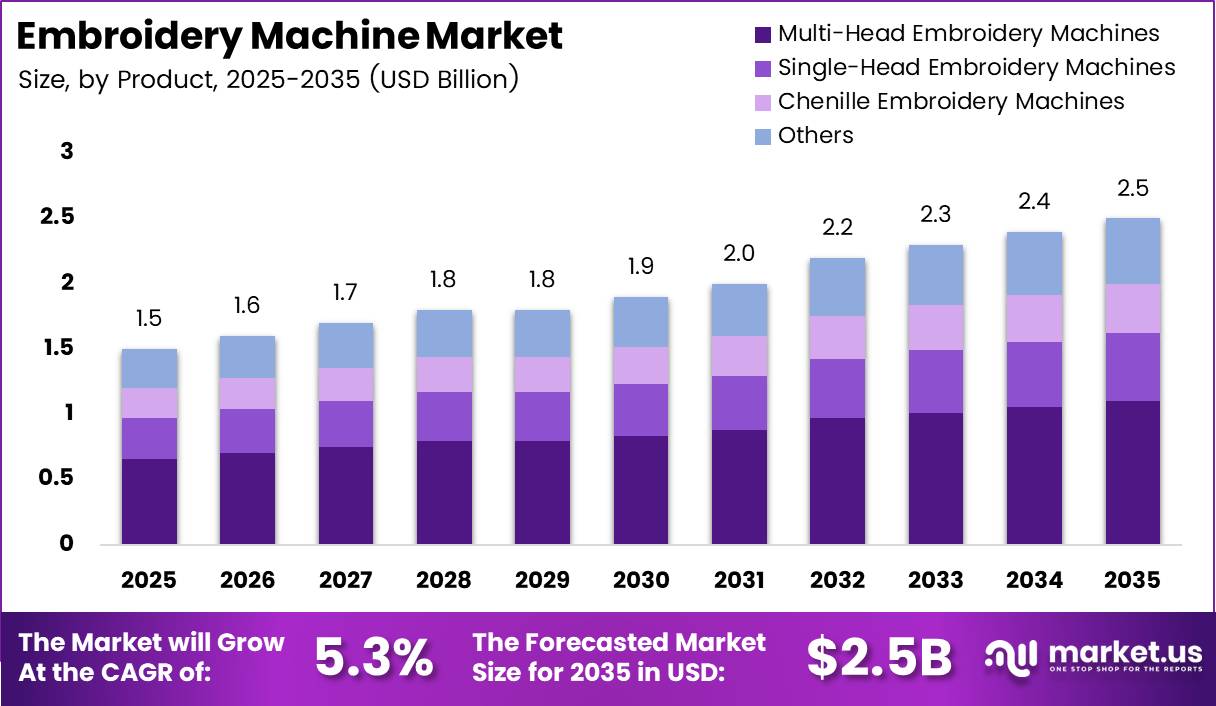
Global Embroidery Machine Market size is expected to be worth around USD 2.5 Billion by 2035 from USD 1.5 Billion in 2025, growing at a CAGR of 5.3% during the forecast period 2026 to 2035.
The embroidery machine market spans industrial, commercial, and home-use segments. Manufacturers produce single-head and multi-head systems for garment decoration, corporate branding, and home textile applications. Demand originates from fashion brands, promotional merchandise producers, and individual crafters seeking precision stitching at scale.
Fully computerized machines now form the backbone of commercial embroidery production. These systems reduce operator dependency and cut per-unit production time. Brands investing in automated embroidery lines gain a measurable cost advantage over competitors still running semi-automatic or manual setups.
Apparel and garments represent the largest end-use segment in this market. Fashion labels, sportswear brands, and uniform suppliers rely on high-throughput embroidery systems to meet order volumes. The shift toward personalized products has pushed commercial buyers to upgrade their machine fleets more frequently than before.
In March 2025, Brother Industries, Ltd. launched the PR1X commercial embroidery machine with a 300 × 200 mm embroidery area, targeting startup embroidery businesses and customized apparel producers. This launch signals that top manufacturers see strong commercial demand at the entry-to-mid tier, where growth in small business formation is creating new buyer pools.
According to embroideryhoopstore.com, Tajima TMEZ-SC and comparable commercial-grade models operate at a maximum of 1,200 stitches per minute, even with longer stitches up to 4mm. This benchmark illustrates the performance ceiling that commercial buyers evaluate when selecting machines. Higher SPM directly reduces per-piece production cost, making speed a primary procurement criterion.
According to thesai.org, an AI-assisted embroidery pattern design system using a computer-based linear classifier achieves classification accuracy of more than 95% across different embroidery pattern types. This level of accuracy means manufacturers can automate design selection without manual operator intervention, reducing lead times and error rates in custom order fulfillment.
Key Takeaways
- The Global Embroidery Machine Market was valued at USD 1.5 Billion in 2025 and is forecast to reach USD 2.5 Billion by 2035.
- The market grows at a CAGR of 5.3% during the forecast period 2026 to 2035.
- By Product, Multi-Head Embroidery Machines lead with a 39.6% share in 2025.
- By Technology, Fully Automatic/Computerized Machines dominate with a 59.2% share in 2025.
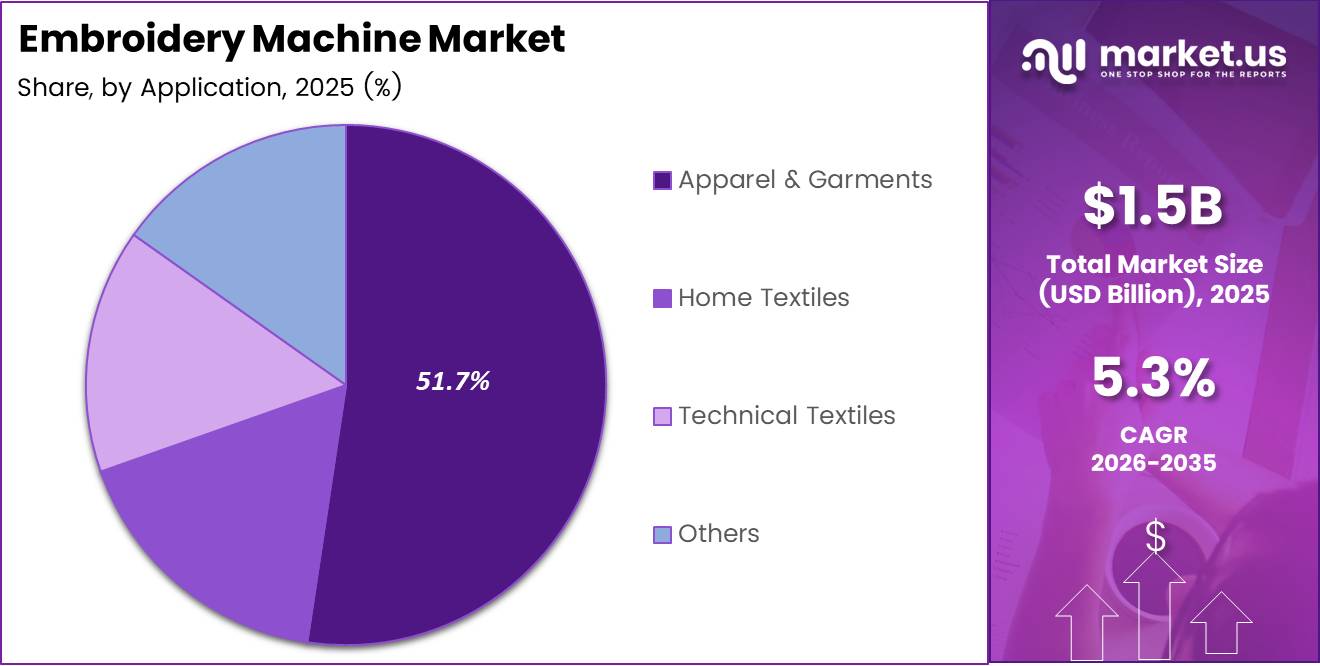
- By Application, Apparel & Garments holds the largest share at 51.7% in 2025.
- By End-User, Industrial Use leads with a 45.1% share in 2025.
- By Distribution Channel, Offline channels account for 69.3% of market share in 2025.
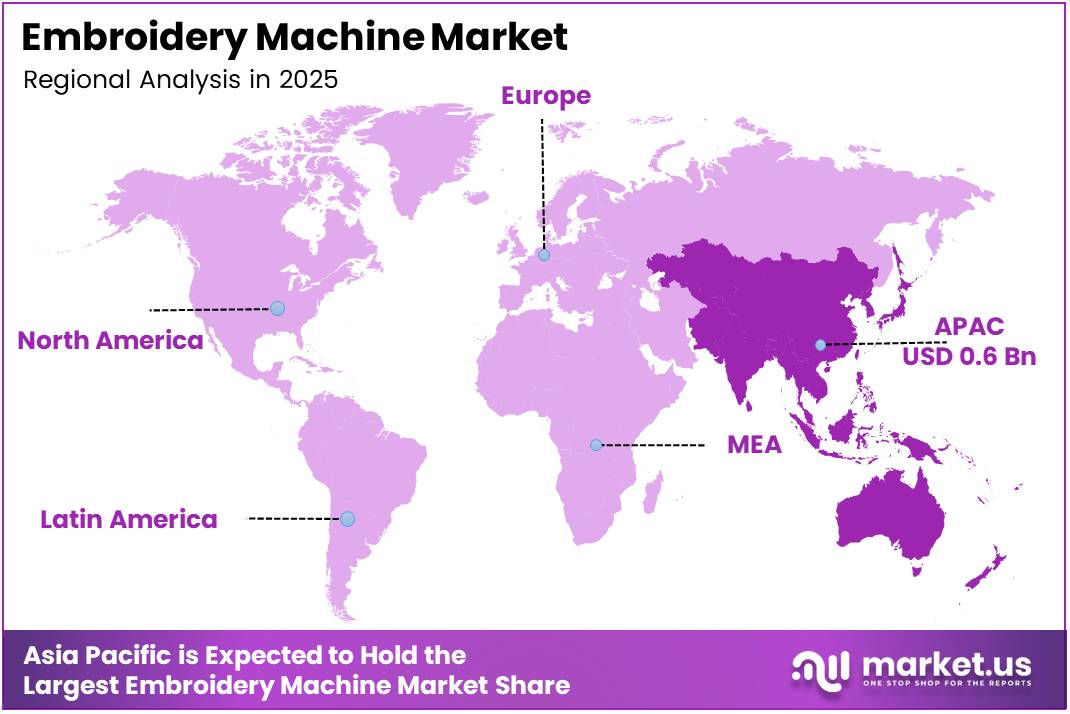
- Asia Pacific dominates the regional landscape with a 42.80% share, valued at USD 0.6 Billion in 2025.
Product Analysis
Multi-Head Embroidery Machines dominate with 39.6% due to high-volume commercial production demand.
In 2025, Multi-Head Embroidery Machines held a dominant market position in the By Product segment of the Embroidery Machine Market, with a 39.6% share. Industrial buyers and commercial embroidery shops prefer multi-head systems because they stitch identical designs across multiple garments simultaneously. This parallel output capability directly reduces per-piece labor cost and delivery time for large uniform and promotional orders.
Single-Head Embroidery Machines serve small businesses, boutique studios, and creative entrepreneurs requiring flexible, lower-volume production. These machines allow operators to run varied designs without complex changeover procedures. Their lower acquisition cost makes them the preferred entry point for home-based businesses and startup embroidery operations entering the customized apparel segment.
Chenille Embroidery Machines address a specialized segment within the textile decoration industry. These machines produce raised, looped stitch textures used in letterman jackets, varsity patches, and premium fashion accessories. Buyers in the sports apparel and luxury casual wear segments drive demand for chenille-capable systems, which command higher unit prices than standard flat embroidery equipment.
Others in the product category include specialty and hybrid machines combining embroidery with quilting or sequin-application functions. This sub-segment serves niche decorative textile producers and high-end fashion houses requiring unique surface textures. Growing interest in multi-function machines is expanding this category beyond its traditionally narrow base.
Technology Analysis
Fully Automatic/Computerized Machines dominate with 59.2% due to production efficiency and design precision advantages.
In 2025, Fully Automatic/Computerized Machines held a dominant market position in the By Technology segment of the Embroidery Machine Market, with a 59.2% share. These systems accept digital design files and execute complex stitch patterns without continuous operator input. According to barudanamerica.com, Barudan K Series multi-head machines achieve a maximum speed of 1,100 stitches per minute on flat goods and 1,000 stitches per minute on caps, demonstrating the throughput advantage that drives commercial buyers toward computerized platforms.
Manual Embroidery Machines retain relevance in artisanal and heritage textile production. Craftspeople, independent embroiderers, and cultural textile producers use manual systems for work requiring tactile control and traditional technique. However, this sub-segment faces steady displacement as digital literacy among home users improves and entry-level computerized machines become more affordable.
Semi-Automatic Machines occupy a transition tier between manual and fully automated systems. Small commercial shops and growing home businesses use these machines to access programmable stitch patterns while keeping initial investment lower than fully computerized alternatives. As production volumes increase, most semi-automatic users eventually migrate toward computerized platforms, making this segment a feeder category for the dominant tier.
Application Analysis
Apparel & Garments dominates with 51.7% due to high-volume uniform and fashion decoration demand.
In 2025, Apparel & Garments held a dominant market position in the By Application segment of the Embroidery Machine Market, with a 51.7% share. Fashion brands, sportswear manufacturers, and corporate uniform suppliers generate consistent machine procurement demand. The expansion of on-demand apparel customization services has added a new buyer group beyond traditional large-scale garment producers.
Home Textiles represent the second largest application area, covering decorative cushions, bed linens, table covers, and curtain embellishments. Interior design trends toward personalized home décor support steady volume in this segment. Manufacturers serving home textile producers supply mid-range multi-needle machines capable of handling varied fabric weights and design complexities.
Technical Textiles form an emerging application segment with strong structural tailwinds. Automotive interior manufacturers, medical textile producers, and industrial safety equipment makers use precision embroidery for functional surface decoration and structural reinforcement. This application demands machines with high positional accuracy and compatibility with synthetic and performance fabrics.
Others in the application segment include promotional merchandise, footwear decoration, and specialty accessories. Corporate gifting programs and branded merchandise campaigns generate demand for fast-turnaround embroidery services. In April 2025, Janome Corporation released the Memory Craft 100E compact embroidery machine, directly targeting the home and creative embroidery segment that serves small-scale promotional applications.
End-User Analysis
Industrial Use dominates with 45.1% due to large-scale production requirements across textile manufacturing.
In 2025, Industrial Use held a dominant market position in the By End-User segment of the Embroidery Machine Market, with a 45.1% share. Large textile manufacturers and garment exporters operate multi-head machine banks running continuous production shifts. The cost economics of industrial embroidery reward scale, making large buyers resistant to switching platforms once production workflows are established.
Home/Personal Use buyers represent the fastest-evolving end-user group. Compact digital machines with built-in design libraries and intuitive touchscreen controls have lowered the technical barrier for individual crafters and home-based entrepreneurs. This sub-segment benefits from e-commerce platforms enabling direct-to-consumer machine sales without traditional dealer networks.
Commercial/Small Business Use covers independent embroidery shops, print-and-stitch operators, and boutique decoration studios. These buyers require machines that balance throughput with design flexibility. Single-head and entry-level multi-head computerized machines serve this segment effectively, with total cost of ownership being the primary procurement consideration.
Others in the end-user classification include educational institutions, textile research labs, and vocational training centers. These buyers prioritize machine versatility and ease of instruction rather than throughput speed. Their procurement volumes are modest but consistent, forming a stable niche within the broader distribution network.
Distribution Channel Analysis
Offline channels dominate with 69.3% due to buyer preference for machine demonstration before purchase.
In 2025, Offline distribution held a dominant market position in the By Distribution Channel segment of the Embroidery Machine Market, with a 69.3% share. Industrial and commercial buyers prefer in-person demonstrations, technical consultations, and on-site service agreements available through authorized dealer networks. The complexity of evaluating machine performance across stitch types and fabric weights makes physical retail the preferred purchase channel for high-value equipment.
Online distribution is gaining ground among home users and small business buyers purchasing entry-level and mid-range machines. E-commerce platforms reduce geographic limitations on machine availability and enable competitive price comparison. Manufacturers are expanding direct-to-consumer online channels to capture first-time buyers and replacement purchasers who no longer require dealer support.
Key Market Segments
By Product
- Multi-Head Embroidery Machines
- Single-Head Embroidery Machines
- Chenille Embroidery Machines
- Others
By Technology
- Fully Automatic/Computerized Machines
- Manual Embroidery Machines
- Semi-Automatic Machines
By Application
- Apparel & Garments
- Home Textiles
- Technical Textiles
- Others
By End-User
- Industrial Use
- Home/Personal Use
- Commercial/Small Business Use
- Others
By Distribution Channel
- Offline
- Online
Drivers
Automation Adoption and Customization Demand Are Accelerating Commercial Embroidery Machine Procurement
Fashion brands and corporate merchandise buyers are placing larger orders for personalized embroidered products. This shift forces commercial embroidery operators to replace slow manual setups with high-speed computerized machines. The business case is straightforward: faster turnaround on custom orders directly translates to higher revenue per shift without adding headcount.
Automated embroidery systems reduce dependence on skilled manual operators, which addresses a persistent labor challenge in textile manufacturing. Factories running fully computerized machines can train new staff faster and maintain consistent stitch quality across production runs. According to thesai.org, an AI-assisted embroidery pattern design system improves user satisfaction by 20%. This figure confirms that automation benefits extend beyond throughput to measurable quality outcomes that buyers and end consumers notice.
In June 2025, Janome Corporation launched the Memory Craft 1000 and Memory Craft 100E entry-level embroidery machine series with an automatic thread cutter and enhanced built-in embroidery designs. This product release demonstrates that manufacturers are expanding automation features into lower price tiers, which broadens the addressable market by bringing computerized capability to small business and home-based buyers who previously could not afford it.
Restraints
High Equipment Costs and Skilled Operator Shortages Limit Adoption Among Smaller Embroidery Producers
Advanced multi-needle embroidery machines carry significant upfront capital requirements. Small embroidery businesses and startup operators often cannot secure financing for commercial-grade equipment without an established revenue track record. This cost barrier concentrates machine ownership among larger industrial players and slows market penetration at the small business tier.
According to barudanamerica.com, the Barudan K Series BEKY-S1506CII supports embroidery areas up to 450 x 520 mm with 15 needles per head. This technical complexity illustrates the skill gap operators face. Running high-specification machines at full capacity requires trained technicians who can manage thread tension, needle alignment, and design file calibration simultaneously. This skill is scarce and commands premium wages.
Maintenance costs compound the initial investment challenge. Multi-head machines require regular calibration, part replacement, and software updates to maintain performance. For small business operators, unplanned downtime caused by mechanical failure can eliminate weeks of profit margin. Until manufacturers develop more self-diagnosing and low-maintenance machine architectures, this restraint will continue to deter adoption below the industrial tier.
Growth Factors
AI Integration and E-Commerce Expansion Are Creating New Revenue Streams for Embroidery Machine Manufacturers
Artificial intelligence is entering embroidery machine systems at the design and stitch-optimization layer. Machines that automatically adjust stitch density, thread tension, and pattern alignment based on fabric type reduce operator intervention and defect rates. This capability is converting embroidery from a labor-intensive craft into a scalable manufacturing process that attracts investment from fashion technology companies.
According to embroideryhoopstore.com, the Tajima SAI compact model supports a maximum speed of 800 stitches per minute with an embroidery area of 200 x 300 mm. This specification profile targets the growing home crafting and small business segment, where buyers need capable machines at compact form factors. The existence of purpose-built compact models signals that manufacturers have identified home-based embroidery as a structurally distinct and commercially significant buyer category.
In July 2025, Janome America, Inc. unveiled the Memory Craft embroidery machine lineup including the Memory Craft 9850LE, Memory Craft 1000, and Memory Craft 100E models, specifically positioned for affordable professional embroidery solutions. This multi-model release strategy shows manufacturers pursuing tiered market capture, from entry-level home users to serious semi-professional operators, which broadens the commercial footprint without requiring separate distribution infrastructure.
Emerging Trends
Cloud Connectivity, Multi-Function Capability, and Sustainable Materials Are Reshaping Embroidery Machine Design Standards
Embroidery machine manufacturers are integrating wireless connectivity and cloud-based design software into new product lines. Operators can now upload design files remotely, monitor machine status in real time, and update firmware without physical access to the machine. This connectivity shift reduces downtime and enables multi-location embroidery businesses to standardize design libraries across all production sites.
Multi-function machines combining sewing, quilting, and embroidery capabilities are gaining commercial traction. Buyers who previously needed separate machines for each function now purchase unified platforms. According to maggieframes.com, Tajima sequin devices operate at speeds up to 1,000 stitches per minute while supporting various sequin sizes and shapes. This demonstrates that specialty attachment capabilities are being built into mainstream commercial machines rather than treated as add-on peripherals.
Sustainable embroidery threads and eco-friendly decoration processes are becoming purchase criteria for fashion brands with environmental commitments. Suppliers developing biodegradable thread options and low-waste embroidery processes position themselves for preference among apparel brands that face ESG reporting pressure from retail partners and institutional investors. This materials trend creates a new product differentiation axis beyond speed and needle count.
Regional Analysis
Asia Pacific Dominates the Embroidery Machine Market with a Market Share of 42.80%, Valued at USD 0.6 Billion
Asia Pacific holds a 42.80% share of the global embroidery machine market, valued at USD 0.6 Billion in 2025. China, Japan, South Korea, and India anchor this dominance through concentrated garment manufacturing, machine production, and domestic textile demand. The region hosts the world’s largest embroidery machine manufacturers alongside its largest commercial embroidery operators, creating a self-reinforcing supply and demand structure.
North America Embroidery Machine Market Trends
North America represents a mature but actively upgrading market. Corporate branding programs, promotional merchandise producers, and sports apparel decorators sustain consistent machine replacement demand. The United States in particular drives commercial embroidery machine imports, with buyers prioritizing high-speed multi-head systems capable of handling large uniform and merchandise orders efficiently.
Europe Embroidery Machine Market Trends
Europe maintains a strong presence in premium embroidery machine manufacturing, particularly in Germany and Switzerland. European buyers prioritize precision engineering, long service life, and compatibility with technical textile applications. Regulatory focus on sustainable manufacturing has accelerated interest in eco-compatible embroidery processes and thread materials among fashion and automotive textile producers across the region.
Latin America Embroidery Machine Market Trends
Latin America presents a developing market with concentrated activity in Brazil and Mexico. Local garment producers and growing promotional merchandise sectors drive machine procurement. Import dependency on Asian and European manufacturers limits price competitiveness for end buyers, but expanding e-commerce platforms are improving machine access for small commercial and home-based operators in the region.
Middle East & Africa Embroidery Machine Market Trends
The Middle East and Africa market centers on traditional textile decoration, fashion embroidery, and growing uniform supply sectors in GCC countries. Saudi Arabia and the UAE support commercial embroidery businesses serving hospitality, corporate, and fashion clients. Infrastructure investment in technical and vocational textile training programs across South Africa and GCC states is gradually developing a skilled operator base to support market expansion.
Key Regions and Countries
North America
- US
- Canada
Europe
- Germany
- France
- The UK
- Spain
- Italy
- Rest of Europe
Asia Pacific
- China
- Japan
- South Korea
- India
- Australia
- Rest of APAC
Latin America
- Brazil
- Mexico
- Rest of Latin America
Middle East & Africa
- GCC
- South Africa
- Rest of MEA
Key Company Insights
Brother Industries, Ltd. has built a commanding position across both consumer and commercial embroidery segments through deliberate product tiering. The March 2025 PR1X launch targets startup commercial buyers, while the August 2025 PR1060W with matrix copy functionality serves established production environments. This dual-track release strategy captures buyers at entry and scale stages, reducing the likelihood of losing customers to competitors as their businesses grow.
Bernina International AG positions itself at the premium end of the embroidery and sewing machine market, targeting professional users and serious enthusiasts who prioritize Swiss engineering and long machine service life. This positioning creates strong customer retention among buyers who make purchase decisions based on quality and durability rather than price. The risk is exposure to downward pricing pressure if mid-tier manufacturers close the performance gap.
Janome Sewing Machine Co., Ltd. is executing an aggressive product expansion strategy across multiple price points simultaneously. The April, June, and July 2025 Memory Craft releases targeted home users, creative embroiderers, and affordable professional segments in a compressed launch window. This breadth signals confidence in underlying demand across tiers, while also creating potential brand complexity if buyers struggle to differentiate between closely positioned models.
Tajima Industries Ltd. holds a dominant position in commercial and industrial embroidery machine supply, with its TMEZ-SC models operating at up to 1,200 stitches per minute and sequin-capable devices running at 1,000 SPM. These performance benchmarks establish Tajima as the reference standard for commercial buyers evaluating throughput. The company’s technical depth in high-speed multi-head systems creates a durable competitive advantage that smaller manufacturers cannot replicate without equivalent R&D investment.
Key Players
- Brother Industries Ltd.
- Bernina International AG
- Janome Sewing Machine Co. Ltd.
- Tajima Industries Ltd.
- ZSK Stickmaschinen GmbH
- Ricoma International Corp.
- Melco International
- PFAFF Industriesysteme und Maschinen GmbH
- Singer Sewing Company
- SWF (SunStar Co. Ltd.)
- Barudan Co. Ltd.
Recent Developments
- June 2025 – Brother Industries, Ltd. introduced the SKiTCH PP1 embroidery machine featuring smartphone-based embroidery operation through the Artspira application platform, enabling operators to control machine functions directly from a mobile device.
- August 2025 – Brother Industries, Ltd. launched the PR1060W professional embroidery machine with matrix copy functionality, designed for commercial embroidery production environments requiring high-throughput multi-position stitching.
- August 2025 – SVP Worldwide announced the global launch of new PFAFF sewing and embroidery-compatible machines including the creative expression 750, quilt expression 725, and expression 715 series, expanding the PFAFF product range across multiple embroidery and sewing application tiers.
- April 2026 – Brother Industries, Ltd. commercially expanded the PR1060W flagship 10-needle embroidery machine with upgraded positioning technology and enhanced production automation features, strengthening its position in high-volume commercial embroidery production.
Report Scope
| Report Features | Description |
|---|---|
| Market Value (2025) | USD 1.5 Billion |
| Forecast Revenue (2035) | USD 2.5 Billion |
| CAGR (2026-2035) | 5.3% |
| Base Year for Estimation | 2025 |
| Historic Period | 2020-2024 |
| Forecast Period | 2026-2035 |
| Report Coverage | Revenue Forecast, Market Dynamics, Competitive Landscape, Recent Developments |
| Segments Covered | By Product (Multi-Head Embroidery Machines, Single-Head Embroidery Machines, Chenille Embroidery Machines, Others), By Technology (Fully Automatic/Computerized Machines, Manual Embroidery Machines, Semi-Automatic Machines), By Application (Apparel & Garments, Home Textiles, Technical Textiles, Others), By End-User (Industrial Use, Home/Personal Use, Commercial/Small Business Use, Others), By Distribution Channel (Offline, Online) |
| Regional Analysis | North America (US and Canada), Europe (Germany, France, The UK, Spain, Italy, and Rest of Europe), Asia Pacific (China, Japan, South Korea, India, Australia, and Rest of APAC), Latin America (Brazil, Mexico, and Rest of Latin America), Middle East & Africa (GCC, South Africa, and Rest of MEA) |
| Competitive Landscape | Brother Industries Ltd., Bernina International AG, Janome Sewing Machine Co. Ltd., Tajima Industries Ltd., ZSK Stickmaschinen GmbH, Ricoma International Corp., Melco International, PFAFF Industriesysteme und Maschinen GmbH, Singer Sewing Company, SWF (SunStar Co. Ltd.), Barudan Co. Ltd. |
| Customization Scope | Customization for segments, region/country-level will be provided. Moreover, additional customization can be done based on the requirements. |
| Purchase Options | We have three licenses to opt for: Single User License, Multi-User License (Up to 5 Users), Corporate Use License (Unlimited User and Printable PDF) |





































