


Report Overview
Global Waterjet Cutting Machine Market size is expected to be worth around USD 2,208.7 Million by 2035 from USD 1,393.9 Million in 2025, growing at a CAGR of 4.7% during the forecast period 2026 to 2035. This trajectory signals a market moving from niche industrial use toward mainstream precision manufacturing.
Waterjet cutting machines use high-pressure streams of water, or water mixed with abrasive particles, to cut through a wide variety of materials. The technology eliminates heat-affected zones, which makes it suitable for aerospace alloys, composites, ceramics, and glass. This non-thermal cutting advantage drives adoption where material integrity is non-negotiable.
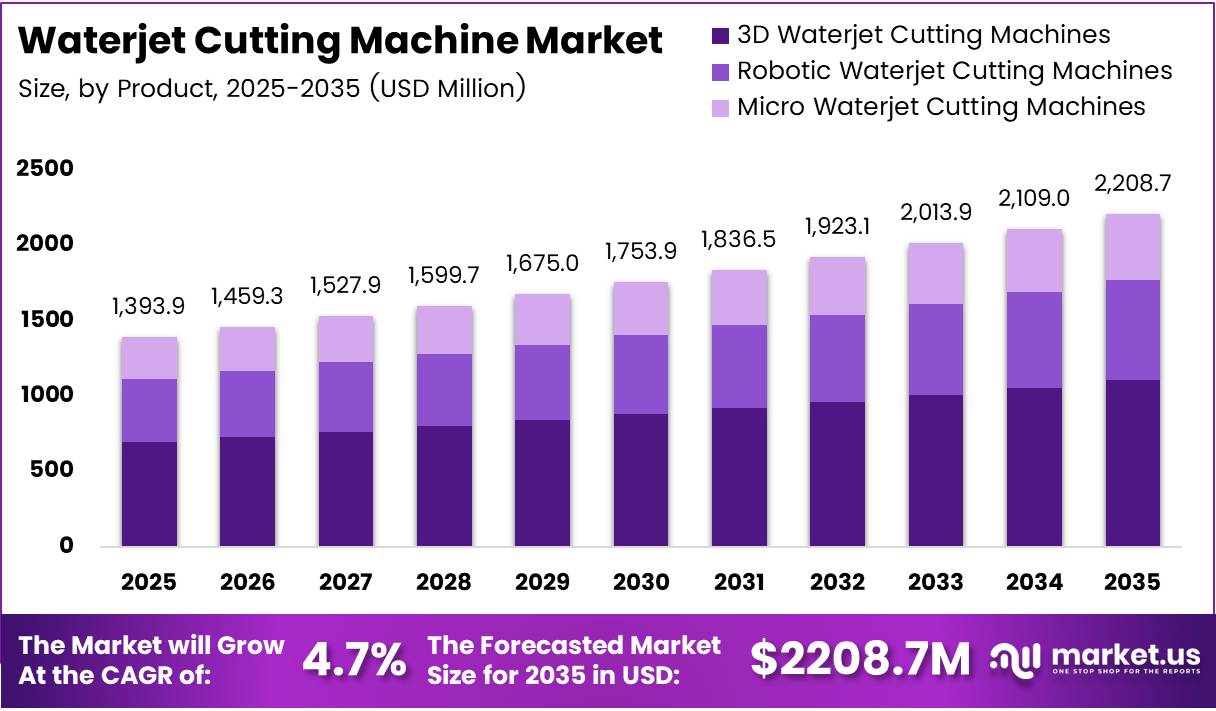
The market divides into two core cutting types: abrasive and pure waterjet systems. Abrasive systems hold a dominant 76.3% share, reflecting the industrial preference for cutting hard materials such as metals and stone. Product types range from 3D and robotic systems to micro waterjet machines, each targeting distinct production environments and tolerances.
End-use industries span automotive, aerospace and defense, electronics, metal fabrication, and mining. Automotive applications lead with a 32.7% share, anchoring the market in high-volume, precision-dependent manufacturing. This concentration creates both stability and vulnerability, as any slowdown in automotive production directly affects waterjet equipment demand.
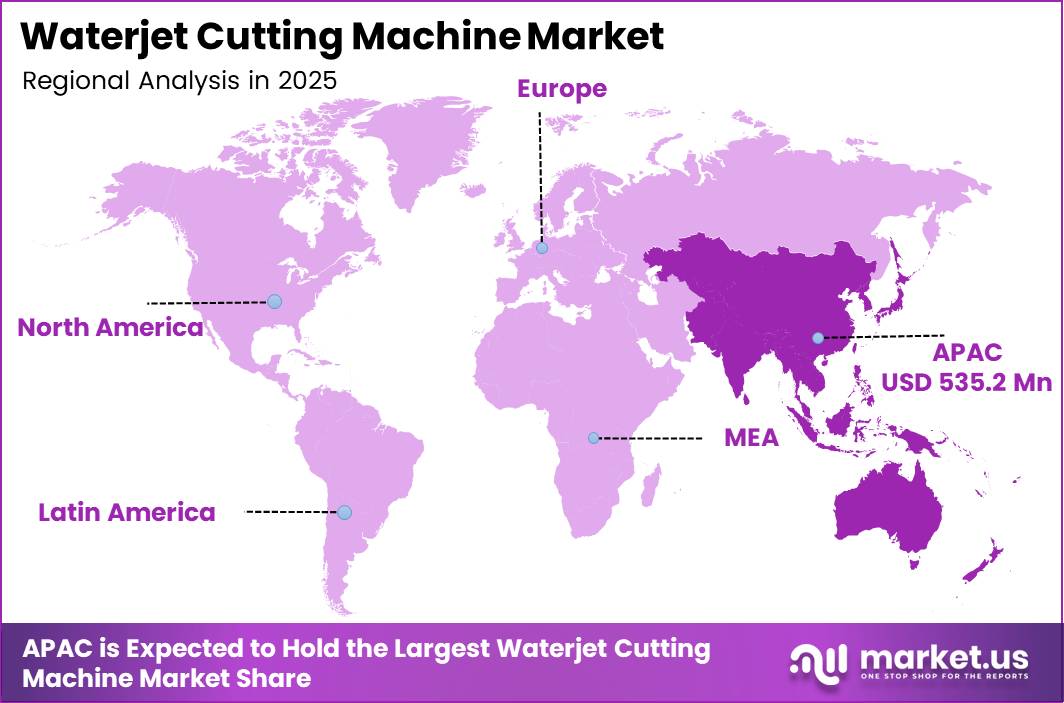
Asia Pacific holds the largest regional share at 38.40%, valued at USD 535.2 Million. China, Japan, South Korea, and India collectively drive this position through expanding factory capacity and investment in advanced manufacturing infrastructure. This regional concentration means suppliers without a strong Asia Pacific channel face a structural disadvantage.
Industrial automation is accelerating adoption of multi-axis and CNC-controlled waterjet systems. Manufacturers integrating Industry 4.0 capabilities into cutting equipment are capturing buyers who prioritize data connectivity alongside cutting performance. This shift rewards technology-forward vendors and puts pressure on suppliers offering legacy systems without software integration.
According to a 2026 report, a metal fabrication shop in Australia estimated annual savings of approximately USD 57,000 by switching to waterjet cutting, based on 10 hours saved per week at a USD 110 per hour shop rate. This quantified ROI case strengthens the commercial argument for waterjet adoption in mid-size fabrication operations seeking measurable cost reduction.
Key Takeaways
- The global Waterjet Cutting Machine Market was valued at USD 1,393.9 Million in 2025 and is forecast to reach USD 2,208.7 Million by 2035.
- The market grows at a CAGR of 4.7% during the forecast period 2026 to 2035.
- By Type, Abrasive Waterjet Cutting Machines dominate with a 76.3% share.
- By Product, 3D Waterjet Cutting Machines lead with a 43.8% share.
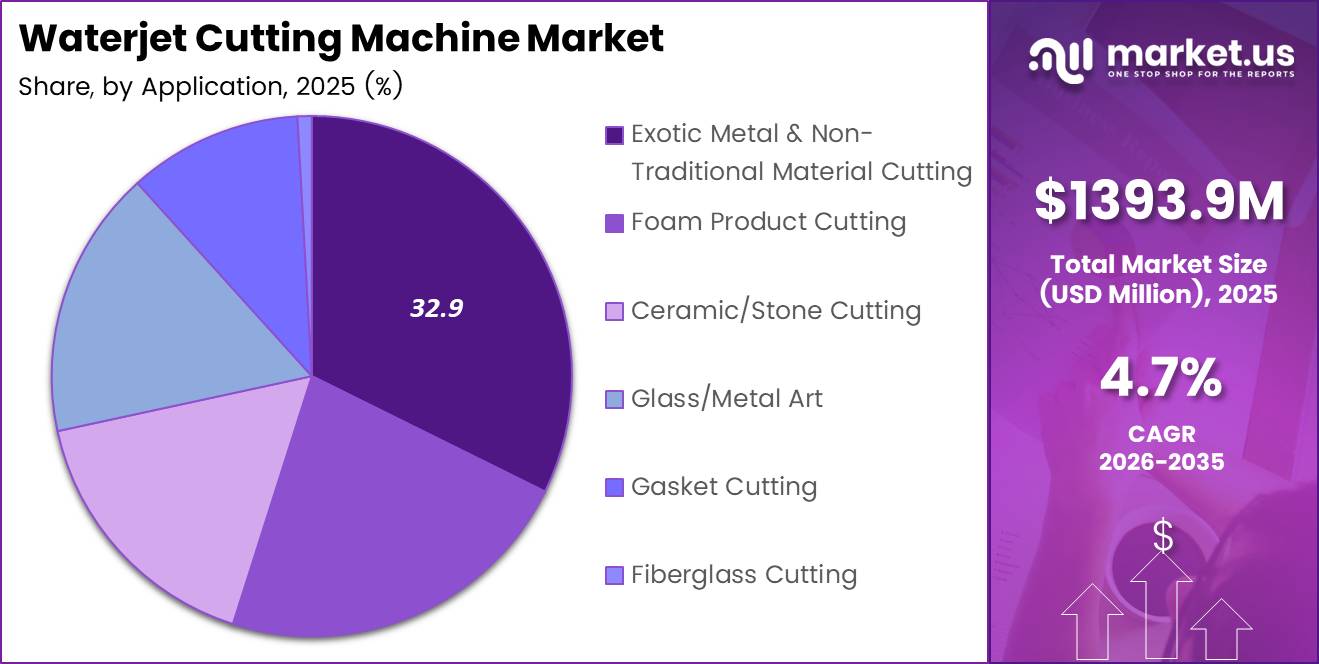
- By Application, Exotic Metal and Non-Traditional Material Cutting holds the largest share at 32.9%.
- By End-Use, Automotive is the leading segment with a 32.7% share.
- Asia Pacific is the dominant region with a 38.40% share, valued at USD 535.2 Million.
Type Analysis
Abrasive Waterjet Cutting dominates with 76.3% due to superior performance on hard industrial materials.
In 2025, Abrasive Waterjet Cutting held a dominant market position in the By Type segment of the Waterjet Cutting Machine Market, with a 76.3% share. Abrasive systems mix garnet or other particles into the water stream, enabling cuts through metals, ceramics, and composites. This capability makes them the default choice for aerospace, automotive, and metal fabrication buyers who cannot accept thermal distortion or secondary finishing costs.
Pure Waterjet Cutting serves applications where abrasive contamination would damage the workpiece or compromise cleanliness standards. Foam, rubber, food products, and certain textiles rely on pure waterjet streams for clean, precise cuts without particle residue. This segment remains smaller by volume but commands premium pricing in specialized processing environments where purity of cut is a non-negotiable production requirement.
Product Analysis
3D Waterjet Cutting Machines dominate with 43.8% due to multi-axis precision across complex geometries.
In 2025, 3D Waterjet Cutting Machines held a dominant market position in the By Product segment of the Waterjet Cutting Machine Market, with a 43.8% share. These machines use multi-axis heads to cut three-dimensional profiles in a single pass, reducing setup time and rework. Aerospace and automotive buyers prefer 3D systems for structural components where dimensional accuracy directly affects assembly fit and safety certification.
Robotic Waterjet Cutting Machines pair waterjet heads with industrial robot arms, enabling flexible cutting paths on curved or irregular surfaces. Automotive body panel trimming and aerospace composite shaping represent the primary use cases. As of June 2025, KMT Waterjet Systems updated CE certification for its Pro SL V 55k high-pressure pump, supporting deployment of robotic and advanced waterjet systems across European industrial markets and broadening the addressable buyer base.
Micro Waterjet Cutting Machines target precision applications in electronics, medical devices, and micro-component manufacturing where cutting widths of fractions of a millimeter are required. These systems operate at lower abrasive volumes and higher positional accuracy than standard industrial machines. Their adoption in electronics aligns with the broader end-use data showing electronics as a distinct and growing segment within the market.
Application Analysis
Exotic Metal and Non-Traditional Material Cutting dominates with 32.9% due to heat-free processing requirements in aerospace and defense.
In 2025, Exotic Metal and Non-Traditional Material Cutting held a dominant market position in the By Application segment of the Waterjet Cutting Machine Market, with a 32.9% share. Titanium, Inconel, carbon fiber composites, and other advanced materials require cutting methods that preserve metallurgical properties. Waterjet technology meets this requirement directly, making it the preferred process for aerospace and defense fabricators who face strict material certification standards.
Foam Product Cutting uses waterjet systems to achieve clean, repeatable profiles in automotive seating, packaging, and acoustic insulation production. Foam compresses under mechanical cutting, creating dimensional inaccuracies. Waterjet streams eliminate contact force, preserving foam geometry and reducing scrap rates. This application benefits suppliers serving the automotive interior supply chain where dimensional consistency affects final vehicle assembly quality.
Ceramic and Stone Cutting requires abrasive waterjet technology to achieve the surface quality and edge definition demanded by architectural and construction buyers. Traditional diamond saw cutting introduces micro-cracks and edge chipping that increase finishing costs. Waterjet systems cut ceramic and stone without thermal stress, reducing rework and accelerating project timelines for tile, countertop, and facade fabricators.
Glass and Metal Art applications use waterjet cutting to produce custom decorative profiles, architectural glass panels, and artistic metalwork. These are lower-volume but high-margin applications where design complexity justifies premium machine investment. Job shops serving interior designers and architects represent the primary buyer profile in this application segment.
Gasket Cutting relies on waterjet technology to process sealing materials including rubber, cork, PTFE, and composite laminates to precise dimensional tolerances. Industrial maintenance and OEM seal manufacturing both drive demand. The ability to cut intricate gasket profiles without tooling changeover reduces lead times and supports low-volume custom gasket production in industrial aftermarket supply chains.
Fiberglass Cutting presents a health and safety challenge for conventional cutting methods, as mechanical processes generate hazardous airborne particles. Waterjet cutting eliminates dry dust generation while delivering clean edge profiles on fiberglass panels, marine components, and wind turbine blade sections. Regulatory pressure on workplace air quality standards is shifting fabricators in these sectors toward waterjet as the compliant alternative.
End-Use Analysis
Automotive dominates with 32.7% due to high-volume precision cutting of body and interior components.
In 2025, Automotive held a dominant market position in the By End-Use segment of the Waterjet Cutting Machine Market, with a 32.7% share. Automotive manufacturers use waterjet systems for cutting interior panels, rubber seals, carpet, headliners, and structural composites. The high production volumes in this sector make equipment utilization rates favorable, and the shift toward lightweight composite materials in electric vehicles is extending waterjet adoption further into body and chassis production.
Electronics manufacturing uses waterjet cutting for circuit board trimming, precision component shaping, and cutting of heat-sensitive substrates where laser or mechanical processes would cause thermal damage or delamination. The miniaturization trend in consumer electronics and semiconductor packaging is expanding the role of micro waterjet systems within this end-use segment.
Aerospace and Defense represent a technically demanding end-use where material certifications, traceability requirements, and dimensional tolerances are strict. Waterjet systems process titanium, aluminum alloys, and advanced composites used in airframes, engine nacelles, and defense structures. Procurement cycles in this sector are long, but contract values are high, making aerospace and defense a priority vertical for waterjet equipment suppliers building recurring revenue through service and consumables contracts.
Mining applies waterjet technology primarily in rock cutting, tunnel boring assistance, and surface preparation tasks where conventional mechanical methods create excessive vibration or thermal loading. Adoption in mining remains more selective than in precision manufacturing, but the sector’s interest in remote-controlled and automated cutting equipment aligns with the broader Industry 4.0 integration trend driving the overall market.
Metal Fabrication is a broad end-use segment covering structural steel, sheet metal, and custom fabricated components for construction, industrial machinery, and consumer goods. Job shops and contract fabricators in this segment are primary buyers of mid-range waterjet systems. The decision to invest is heavily influenced by payback period data, making documented ROI evidence a critical sales tool for equipment vendors targeting this buyer group.
Key Market Segments
By Type
- Abrasive Waterjet Cutting
- Pure Waterjet Cutting
By Product
- 3D Waterjet Cutting Machines
- Robotic Waterjet Cutting Machines
- Micro Waterjet Cutting Machines
By Application
- Exotic Metal & Non-Traditional Material Cutting
- Foam Product Cutting
- Ceramic/Stone Cutting
- Glass/Metal Art
- Gasket Cutting
- Fiberglass Cutting
By End-Use
- Automotive
- Electronics
- Aerospace & Defense
- Mining
- Metal Fabrication
- Others
Drivers
Waterjet eliminates heat zones, cutting material waste by up to 30%
Data from a 2026 industry assessment shows modern waterjet systems reduce material waste by up to 30% compared to traditional cutting methods. This reduction directly lowers raw material costs per unit produced. For manufacturers processing expensive aerospace alloys or exotic composites, a 30% waste reduction translates into measurable cost savings that accelerate payback on equipment investment.
The ability to process diverse materials without generating heat-affected zones is a structural advantage that no competing thermal process can replicate. Laser and plasma cutting introduce heat that alters the metallurgical properties of titanium, Inconel, and high-strength steel. Waterjet technology preserves material integrity, which eliminates secondary inspection and rework costs in aerospace and defense fabrication environments where certification standards are strict.
In 2025, Flow International Corporation showcased its HyperJet HV 100,000-psi waterjet technology, designed to deliver faster cutting speeds and higher productivity for advanced manufacturing applications. This development signals that performance benchmarks in the market are shifting upward. Buyers evaluating new equipment now face a higher baseline for cutting speed, creating upgrade pressure across installed base users and drawing new entrants into the market.
Restraints
New waterjet systems cost $60,000 to $400,000, excluding multi-year maintenance
According to data from Slabwise, new waterjet cutting machines in 2026 cost between USD 60,000 and USD 400,000 or more, depending on table size, pump horsepower, cutting heads, and automation level. Used systems range from USD 25,000 to USD 150,000. This capital requirement places waterjet technology beyond the budget threshold of many small fabrication operations, directly limiting the addressable buyer pool.
Slabwise data further shows operating costs range from USD 30 to USD 80 per hour in abrasive, water, and wear parts as of 2026. These ongoing costs accumulate rapidly in high-volume production environments. Buyers who underestimate consumable and wear-part expenses during procurement often face budget overruns within the first year of operation, reducing confidence in waterjet as a cost-effective alternative to conventional cutting.
As reported by Slabwise, annual maintenance costs for waterjet cutting machines range from USD 10,000 to USD 30,000, with intensifier pump rebuilds costing USD 8,000 to USD 20,000 every 2,000 to 4,000 operating hours. These maintenance cycles create unplanned downtime and capital demands that smaller enterprises cannot absorb reliably. This cost structure pushes smaller buyers toward service bureaus rather than equipment ownership, capping direct equipment sales in the small-enterprise segment.
Growth Factors
Waterjet payback period reaches 1.5 to 2 years versus 4 to 6 years for conventional systems
Based on a 2026 European brand comparison, the estimated payback period for high-efficiency waterjet cutters is 1.5 to 2 years, compared to 4 to 6 years for conventional stone cutting systems. This compressed ROI timeline changes the investment calculus for mid-size fabricators. A payback horizon under 2 years removes a primary objection in capital equipment sales cycles and expands the addressable buyer pool to include operations with tighter capital planning windows.
A 2026 buyer guide from Fedjet Cutting indicates the initial purchase price of a waterjet machine typically represents only 20 to 30% of total cost over a 10-year operating period. This framing shifts buyer evaluation from upfront price to lifetime cost. Vendors who compete on total cost of ownership rather than sticker price will build stronger long-term customer relationships and differentiate against lower-cost competitors who underinvest in consumable and service infrastructure.
In September 2025, OMAX Corporation introduced the ProtoMAX Prime compact waterjet cutting machine with enhanced bevel-cutting capabilities, targeting job shops, prototyping facilities, and small-scale manufacturing operations. This product move expands waterjet access to buyers who previously could not justify the investment in full-size industrial systems. Compact systems at lower entry prices create a new growth channel in the market’s lower tier, building a pipeline of future upgrade customers.
Emerging Trends
PEP Technology automation delivers 36% fewer cutting inches and 28% material savings
PEP Technology found that Ramage Sheetmetals achieved 36% fewer inches of cutting and 28% material savings using its automated waterjet optimization software, as documented in an August 2025 case study. These figures demonstrate that software optimization, not just hardware upgrades, is now a primary lever for productivity improvement in waterjet operations. Vendors offering integrated software solutions alongside hardware will capture buyers focused on operational efficiency rather than cutting speed alone.
High-end waterjet systems achieve maximum traverse speeds of up to 1,400 inches per minute with a repeatability of 0.001 inches, as documented by PB Metal Fab. This performance level positions waterjet technology directly against laser cutting in high-speed sheet metal processing. As repeatability standards tighten in automotive and electronics supply chains, suppliers who can demonstrate sub-millimeter consistency at production speeds will command premium pricing and preferred vendor status.
The integration of Industry 4.0 technologies for real-time machine monitoring and analytics is shifting waterjet systems from standalone equipment to networked production assets. CNC-controlled multi-axis systems now generate operational data that feeds into factory management platforms. Early movers who embed connectivity and analytics into their product lines will build switching costs through data ecosystem lock-in, making it structurally harder for buyers to migrate to competing equipment brands.
Regional Analysis
Asia Pacific Dominates the Waterjet Cutting Machine Market with a Market Share of 38.40%, Valued at USD 535.2 Million
Asia Pacific holds the largest share of the global Waterjet Cutting Machine Market at 38.40%, valued at USD 535.2 Million. China, Japan, South Korea, and India drive this position through dense manufacturing infrastructure and active investment in precision fabrication capacity. The region’s concentration of automotive, electronics, and aerospace supply chains creates structural demand for advanced cutting technology across multiple end-use sectors simultaneously.
North America represents a mature market where replacement cycles and technology upgrades drive equipment spending rather than greenfield capacity additions. The United States hosts a large installed base of waterjet systems in aerospace, defense, and metal fabrication. Buyers in this region prioritize software integration, automation compatibility, and service network depth when selecting cutting equipment, rewarding vendors with strong domestic support infrastructure.
Europe combines established industrial manufacturing with tightening workplace safety and environmental regulations that favor waterjet over alternative cutting methods generating hazardous emissions or thermal waste. Germany, France, and the United Kingdom are the primary demand centers. Regulatory compliance requirements in the European Union are creating additional justification for waterjet adoption in sectors including fiberglass processing and stone fabrication where dust and fume control is a legal obligation.
Latin America presents an earlier-stage adoption profile where industrial capacity expansion in Brazil and Mexico is creating first-time buyers of waterjet equipment. Local fabricators in these markets are moving from manual and low-technology cutting processes toward CNC-controlled systems as export competition raises quality standards. This transition creates volume opportunity for entry-level and mid-range waterjet systems rather than premium high-pressure platforms.
Middle East and Africa show selective adoption concentrated in construction material processing, oil and gas component fabrication, and defense-related manufacturing. The GCC countries represent the primary demand center within this region, supported by active investment in industrial diversification programs. Adoption rates remain below global averages, but infrastructure development pipelines in Saudi Arabia and the UAE are generating consistent demand for precision stone and metal cutting applications.
Key Regions and Countries
North America
- US
- Canada
Europe
- Germany
- France
- The UK
- Spain
- Italy
- Rest of Europe
Asia Pacific
- China
- Japan
- South Korea
- India
- Australia
- Rest of APAC
Latin America
- Brazil
- Mexico
- Rest of Latin America
Middle East and Africa
- GCC
- South Africa
- Rest of MEA
Key Company Insights
Dardi International Corporation positions itself as a volume-oriented waterjet equipment manufacturer serving mid-range industrial buyers across Asia and emerging markets. This approach builds broad distribution reach but exposes Dardi to margin pressure as lower-cost regional competitors enter the same price tier. Their competitive strength depends on maintaining cost efficiency while raising software and automation capabilities to meet shifting buyer expectations.
ESAB brings a multi-process cutting portfolio that includes waterjet alongside plasma and laser technologies. This breadth allows ESAB to serve buyers seeking consolidated equipment sourcing from a single vendor. However, waterjet is not ESAB’s core revenue driver, which means investment in waterjet-specific innovation may lag behind dedicated waterjet manufacturers who compete on cutting performance and application depth as their primary differentiator.
Flow International Corporation holds a strong technical reputation anchored by its HyperJet HV 100,000-psi ultra-high-pressure technology. This pressure milestone sets a performance benchmark that competitors have not yet matched publicly. Flow’s investment in ultra-high-pressure systems targets the advanced manufacturing segment where cutting speed and productivity are more important than upfront equipment cost, giving Flow a defensible position at the premium end of the market.
Hypertherm, Inc., operating the OMAX brand, combines hardware innovation with proprietary software through its IntelliMAX and IntelliVISOR platforms. The September 2025 MAXIEM X Series launch and the June 2025 partnership with BLM GROUP signal an active strategy to expand market reach through both product development and channel integration. This dual approach creates compounding competitive advantage by tying buyers into a connected hardware and software ecosystem that raises the cost of switching to alternative suppliers.
Key Players
- Dardi International Corporation
- ESAB
- Flow International Corporation
- Hypertherm, Inc.
- Jet Edge, Inc.
- Koike Aronson, Inc.
- OMAX Corporation
- Resato International
- WARDJet
- KMT
Recent Developments
- September 2025 – Hypertherm Associates (OMAX) launched the new OMAX MAXIEM X Series JetMachining Centers, featuring upgraded IntelliMAX software, IntelliVISOR mobile monitoring, enhanced abrasive management systems, and improved automation capabilities for precision waterjet cutting applications.
- July 2025 – Hypertherm Associates (OMAX) unveiled its next-generation OMAX industrial waterjet cutting system at Marmomac 2025, incorporating advanced 5-axis cutting control, low-pressure piercing technology, and optimized software for stone, metal, and composite material processing.
- June 2025 – Hypertherm Associates (OMAX) formed a strategic partnership with BLM GROUP to expand the market reach of OMAX waterjet cutting systems and integrate complementary cutting and fabrication technologies for industrial customers.
Report Scope
| Report Features | Description |
|---|---|
| Market Value (2025) | USD 1,393.9 Million |
| Forecast Revenue (2035) | USD 2,208.7 Million |
| CAGR (2026-2035) | 4.7% |
| Base Year for Estimation | 2025 |
| Historic Period | 2020-2024 |
| Forecast Period | 2026-2035 |
| Report Coverage | Revenue Forecast, Market Dynamics, Competitive Landscape, Recent Developments |
| Segments Covered | By Type (Abrasive Waterjet Cutting, Pure Waterjet Cutting), By Product (3D Waterjet Cutting Machines, Robotic Waterjet Cutting Machines, Micro Waterjet Cutting Machines), By Application (Exotic Metal & Non-Traditional Material Cutting, Foam Product Cutting, Ceramic/Stone Cutting, Glass/Metal Art, Gasket Cutting, Fiberglass Cutting), By End-Use (Automotive, Electronics, Aerospace & Defense, Mining, Metal Fabrication, Others) |
| Regional Analysis | North America (US and Canada), Europe (Germany, France, The UK, Spain, Italy, and Rest of Europe), Asia Pacific (China, Japan, South Korea, India, Australia, and Rest of APAC), Latin America (Brazil, Mexico, and Rest of Latin America), Middle East and Africa (GCC, South Africa, and Rest of MEA) |
| Competitive Landscape | Dardi International Corporation, ESAB, Flow International Corporation, Hypertherm, Inc., Jet Edge, Inc., Koike Aronson, Inc., OMAX Corporation, Resato International, WARDJet, KMT |
| Customization Scope | Customization for segments, region/country-level will be provided. Additional customization can be done based on requirements. |
| Purchase Options | We have three licenses to opt for: Single User License, Multi-User License (Up to 5 Users), Corporate Use License (Unlimited User and Printable PDF) |





































